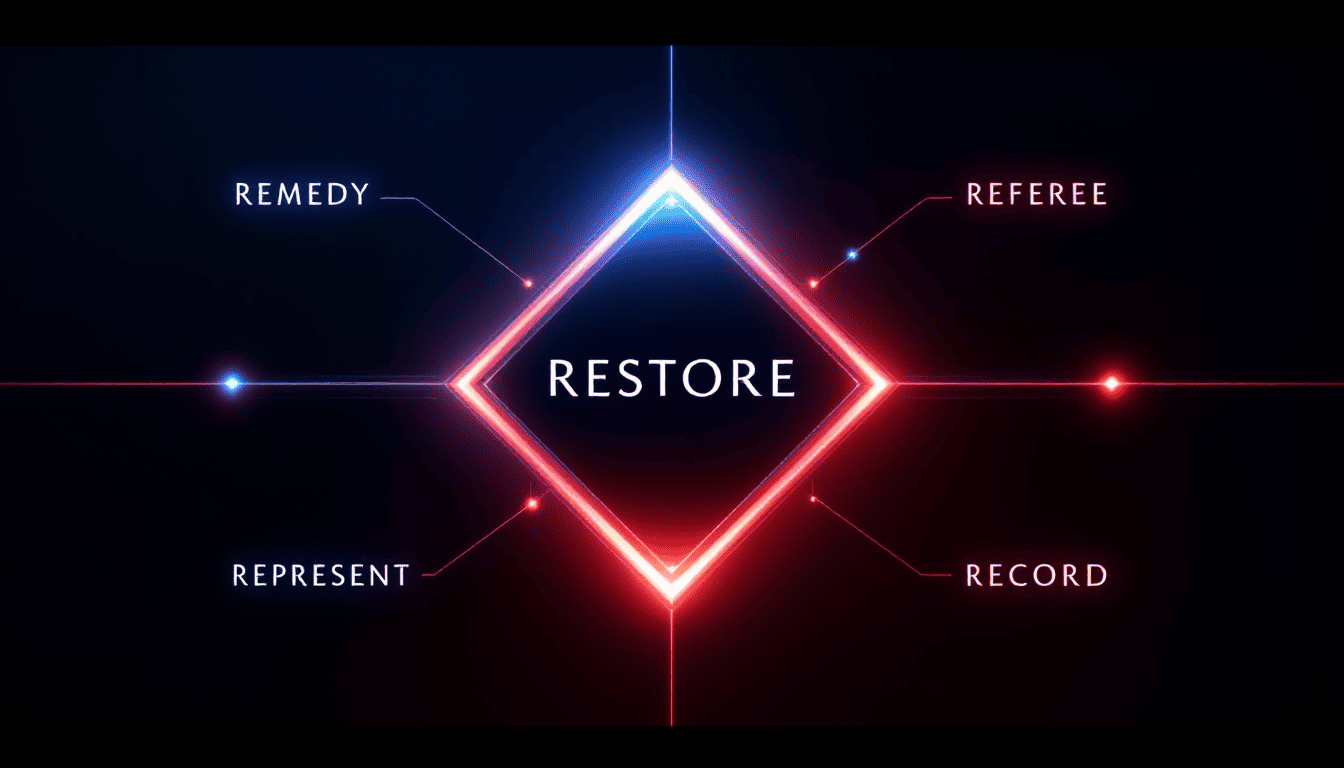
5R Restoration Doctrine: Remedy, Referee, Represent, Record
Government must be strictly firewalled to four categories of activity and prohibited from any other interference. Its purposes, in service of protecting the good and punishing the evil, are to remediate conflict; referee markets, represent its people; and record events. Nothing more. At all. Ever.


The Bible is extremely clear what government is, and what its role and function are. Governments are established by God as bounded delegation of his authority on Earth to limit sin; to protect the good, and punish the wicked. Those in authority are described as “the servant[s] of God” (Rom. 13:4) and “ministers of God” (Rom. 13:6, hence why we call them "ministers"). Such derived and limited authority is to be exercised for the good of all people (Rom. 13:4).
Governments act as God’s agents of justice who “bear the sword” (Rom. 13:4), carrying out earthly justice against the wicked (Romans 13:5). Humans are called to steward the rest of God’s creation, and political leaders are to wisely direct and oversee the proper use of earthly resources. God created government to establish ordered and peaceful social space where not only is judgment carried out, but good is recognised and encouraged (see 1 Pet. 2:14).
Put more simply, the biblical role of government is to maintain order, enact justice, protect the innocent, and provide stability by restraining evil.
Nothing more.
Specifically it is not to assume the role of the church. Socialism is secular Christianity.
Government is not there as a real estate developer for the poor; an overbearing network of technocratic "super-regulators" managing everyday behaviour; a financial sink "from the cradle to the grave"; an eschatological saviour for Millenarian pseudo-religion; a provider of enforced social outcomes; a central econometric planning authority for the economy; an ordained priesthood for the sacrament of marriage; nor as an apparatus for terrorising and deceiving those who fund it.
5R Doctrine In A Sentence
The 5R model of government can be summarised in different ways:
The United Kingdom can be restored by deliberately restricting the government to its four essential functions: remediating conflict by providing justice; refereeing healthy free markets; representing its people and culture internationally; and officially recording key events.
Judicially:
The state exists solely to maintain a moral and civil order in which free people may act. Its jurisdiction is limited to four functions: Remedy, Referee, Represent, and Record. Any action outside these functions is ultra vires and illegitimate.
Technologically:
The 5R Doctrine is an attempt to restate the English state in pre-administrative terms, adapted for an AI-driven future.
Doctrinally:
The 5R Restoration Doctrine belongs to the English constitutional tradition that predates the administrative welfare state, emphasising remedy, rule-of-law, and civil society over planning, management, and ideological governance.
Philosophically:
The 5R Restoration Doctrine stands in the Burke–Dicey tradition of English constitutionalism, informed by Hayek’s critique of technocracy, correcting Locke’s openness to legislative expansion, rejecting Hobbesian total sovereignty, and departing from Nozick’s atomistic minimalism.
5R Cheatsheet: What Fits Where
The rule is simple: if it doesn't fit in one of the four boxes, it is out of the state's jurisdiction entirely. It must be filled by someone or something else.
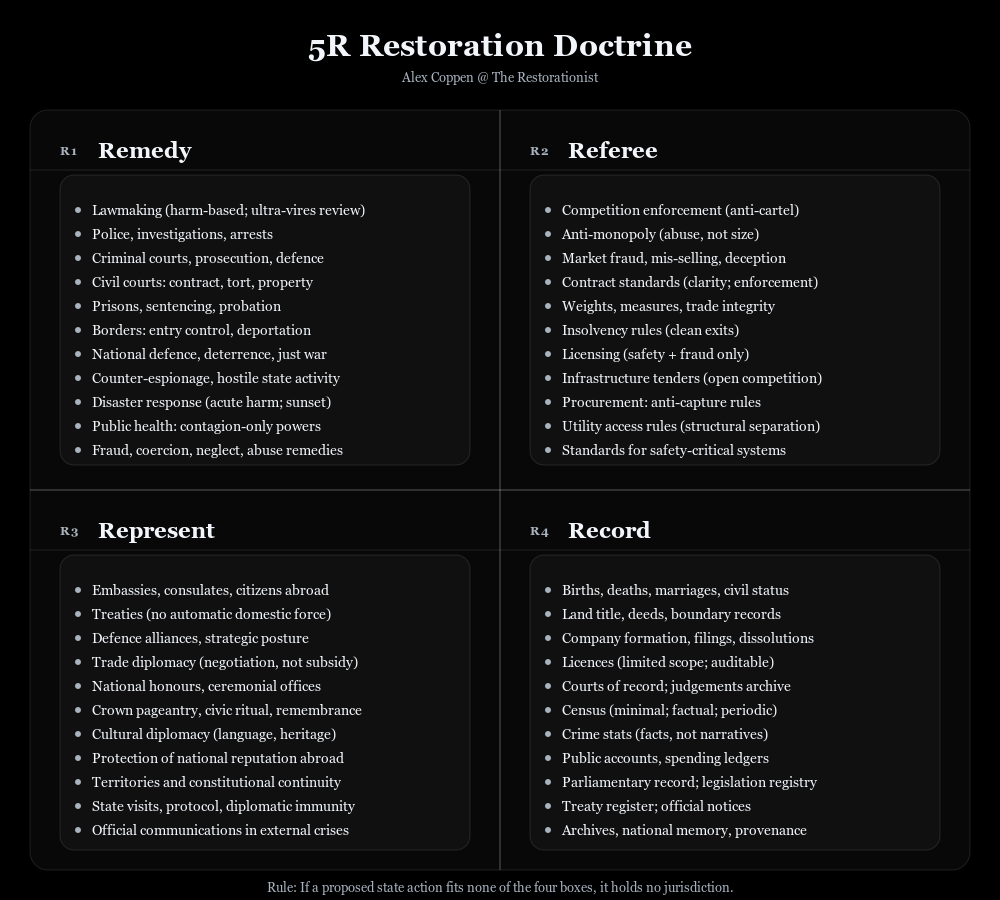
If it is not there, it doesn't exist as a function of the state. The state is prohibited from establishing or maintaining any organisation or policy in that area.
A Constitutional Ontology of the British State
Before the welfare state, before the quangos, before the endless regulators and commissars and expert panels, the English understood something we have forgotten. They understood what a state is.
Not what it promises. Not what it delivers. What it is.
The medieval English state had a remedial function—justice, punishment, protection of the realm. It had a recording function—courts of record, charters, titles to land. It had a representational function—the Crown as a person among nations, carrying honour and continuity. And it had a light refereeing function in trade—weights, measures, punishment of fraud. There was no concept whatsoever of the Crown existing to improve outcomes, manage society, or optimise the lives of subjects. The very idea would have struck a medieval jurist as absurd, possibly heretical.
The great constitutional documents bear this out. Magna Carta in 1215, the Petition of Right in 1628, the Bill of Rights in 1689—these were not "rights documents" in the modern sense of granting entitlements. They were jurisdictional restraints. They answered the question: where may the Crown not tread? They defined coercion as illegitimate unless it met specific conditions. They demanded remedies be administered according to law. This is negative power—the state forbidden from acting—not positive provision, the state obliged to deliver.
Edmund Burke understood this instinctively.
Burke distrusted rationalist redesign. He believed institutions should evolve organically, because tradition embodies wisdom accumulated across generations. Above all, he insisted civil society—churches, guilds, mutual associations, the thick fabric of human connection—should do most of the social lifting. The state was a guardian of boundaries, not an engineer of souls. Burke never systematised this into constitutional architecture, but the instinct was sound and deep.
A century later, A.V. Dicey gave that instinct sharper teeth.
Dicey hated administrative courts. He despised regulatory discretion. He saw expert rule as the enemy of the rule of law itself. For Dicey, the law must be general and knowable, not a shifting mass of bureaucratic interpretation. Parliament may legislate; courts may judge; but no hybrid creature may do both while being accountable for neither.
The 5R Restoration Doctrine stands in this lineage. It does for Burke what Dicey did for common law: it formalises instinct into architecture. It answers the question modern politics refuses to ask—what may the state legitimately be?—and provides an answer precise enough to enforce.
Ultra Vires: If It's Not Permitted, It's Forbidden
The answer is fourfold. The state exists solely to maintain a moral and civil order in which free people may act. Its jurisdiction is limited to four functions: Remedy, Referee, Represent, and Record. Any action outside these functions is ultra vires—beyond its powers—and therefore illegitimate.
Not merely unwise. Not merely inefficient. Constitutionally void.
Legitimacy concerns why a state may exist at all. Jurisdiction concerns what actions fall within its lawful authority. A government may enjoy democratic legitimacy while exercising powers beyond its proper jurisdiction.
Modern governance routinely collapses this distinction. Electoral mandate becomes a licence for unlimited action. Popular consent becomes justification for administrative expansion.
The 5R Doctrine rejects this collapse. It accepts political legitimacy as necessary but insists jurisdiction remains bounded regardless of mandate. No vote can authorise a function outside Remedy, Referee, Represent, or Record.
Legitimacy chooses governors. Jurisdiction limits government.
Notice immediately what kind of claim this is. It is not a policy programme promising benefits. It is not an ideology describing the good life. It is a constitutional ontology—a theory of what the state fundamentally is, as opposed to what it might choose to do on any given Tuesday. Most political programmes fail because they argue about policy while leaving the underlying state machinery untouched. The 5R doctrine attacks the machinery itself.
Notice also the framing: narrow but absolute.
This is not a call for a weak state. Weak states cannot defend borders, cannot punish criminals, cannot enforce contracts, cannot maintain the cultural confidence required to survive in a hostile world. The 5R state is not weak. It is ferociously strong within its jurisdiction—and completely absent outside it. A state which does few things but does them with full authority. The distinction matters profoundly.
Under the 5R framework, the state acts only where harm cannot be remedied, rules cannot be enforced, representation cannot be maintained, or records cannot be kept by smaller institutions.
Families, churches, guilds, charities, and markets hold primacy by default. The state intervenes only when coercive authority proves necessary.
Centralisation signals failure, not progress.
Subsidiarity prevents administrative growth while preserving social cohesion. It recognises human institutions pre-date the state and outperform it in most social functions.
Remedy: The Sword
The sword function: ancient and irreplaceable. Remedy is the state's monopoly on legitimate coercion for the purpose of correcting injustice, deterring wrongdoing, defending the realm, and restoring violated rights. This encompasses criminal justice from police through courts to prisons.
It encompasses civil justice—contracts, torts, property disputes, the entire machinery by which private wrongs are made right. It encompasses border enforcement and immigration control, national defence and just war, counter-espionage and internal security. When disaster strikes—flood, fire, plague—Remedy permits the state to act, because disaster constitutes acute harm requiring immediate response.
But Remedy has hard edges.
It excludes social engineering. It excludes behavioural nudging. It excludes moral re-education, preventative micromanagement, and the entire apparatus of risk-avoidance legislation divorced from actual harm.
The critical question is whether the state may act before harm occurs. The answer must be precise: yes, but only where there is probable, concrete, and proximate harm. No speculative prevention. No statistical projections treated as guilt. No ideological precaution dressed up as safety. That path leads directly to technocracy.
Harm involves demonstrable injury, violated rights, or proximate danger. Risk involves projection, modelling, or probability.
The administrative state governs by risk. The 5R Doctrine governs by harm.
Preventative action falls under Remedy only where threat is concrete, immediate, and identifiable. Abstract futures, speculative models, or behavioural correlations do not establish jurisdiction.
This distinction alone dissolves much of modern regulatory excess.
A harder line still must be drawn around welfare. Under the 5R doctrine, poverty is not a crime. Misfortune is not an injustice requiring state remedy. Remedy applies only where an identifiable actor has violated a right. A man who loses his job has suffered misfortune; he has not been wronged in any way the state may remedy.
This position will be attacked relentlessly. It must be held, because the alternative is a state with unlimited jurisdiction over every human unhappiness—which is precisely the state we have now and wish to replace.
Referee: The Umpire
The second function, Referee, is where the doctrine lives or dies, because it is here the sports metaphor becomes constitutional principle. Referee means the state ensures fair play in competitive systems without becoming a player itself.
A referee keeps the game moving and intensely competitive. A referee punishes fouls. A referee prevents dominant players from poisoning the match through coercion or collusion. But a referee does not score goals. A referee does not handicap successful teams. A referee does not redesign the sport between matches. Too many referees and the game is gone.
What Referee is not deserves emphasis. It is not managing outcomes. It is not guaranteeing equality. It is not planning markets or stabilising prices. It is not ensuring "fairness" as some moral abstraction untethered from rules. It means enforcing rules of engagement—nothing more, nothing less. This encompasses contract enforcement, anti-fraud law, anti-cartel and anti-monopoly action, market transparency requirements (truth, not disclosure overload), weights and measures, standards of trade, and insolvency courts providing clean exits rather than bailouts.
The explicit exclusions are equally important: industrial policy, subsidies, bailouts, ESG mandates, price controls, credential inflation, and licensing beyond what safety and fraud prevention genuinely require.
The golden rule of refereeing provides the test: if the state's action makes the game less competitive, it is disallowed.
One question demands a clear answer: who defines monopoly? The doctrine's position is monopoly means market dominance plus coercive abuse—not size alone. A company may grow enormous through excellence; that is success, not villainy. Monopoly becomes a problem only when dominance is weaponised to exclude competitors through means other than superior products and prices. Punishing bigness as such punishes success, which is the opposite of refereeing.
Infrastructure presents the clearest application of the Referee principle. Civil servants are not construction workers. They are umpires. The state defines safety and performance standards, tenders contracts competitively, enforces those contracts rigorously, and punishes fraud and collusion where it finds them. The state does not build. It does not operate. It does not manage. It referees.
Represent: The Standard
The third function, Represent, is where the 5R doctrine quietly departs from libertarianism—and must, because a stateless culture dies. Representation is the state acting as a person among nations, carrying identity, memory, honour, and continuity across generations. This encompasses diplomacy and treaties, defence alliances, embassies and consulates, protection of citizens abroad. It encompasses cultural institutions: archives, museums, national ceremonies, the pageantry and tradition by which a people remember who they are.
Libertarianism often treats representation as optional window-dressing, a vestige of monarchy best quietly forgotten. The 5R doctrine takes the opposite view.
Representation is the soul function of the polity. Without it, a nation is merely an administrative zone—a place where taxes happen to be collected by one bureaucracy rather than another. The United Kingdom may assert its historical culture without apology. It may maintain symbols, honours, and continuity. It may project soft power and define itself to the world. Representation is descriptive of who we are, not ideological propaganda about who we ought to become.
The doctrine rejects cultural neutrality outright. A state claiming neutrality becomes a vessel for whatever ideology shouts loudest. Neutrality is not possible; it is merely disguised partisanship, usually in favour of the newest fashion. Far better to be honest about what the nation is and represents.
On international bodies, the position is clear: participation is permitted, sovereignty is never delegated, and no treaty acquires automatic domestic force. We attend; we negotiate; we do not subordinate. International agreements bind the Crown in its dealings with other nations; they do not automatically become domestic law binding upon subjects without parliamentary assent.
The state may negotiate treaties, alliances, and international arrangements under Represent. No agreement acquires domestic force without parliamentary assent within existing jurisdiction.
- International bodies may advise. They may not legislate, regulate, or compel.
- Sovereignty remains indivisible. External norms do not override domestic jurisdiction.
This preserves cooperation without subordination.
Record: The Register
The fourth function is Record—underestimated, easily overlooked, and absolutely crucial. Record is the state as authoritative witness of reality. Not manager. Not interpreter. Witness.
This is the memory function of civilisation itself: births, deaths, marriages; property and title registries; company formation and dissolution; courts of record; census (limited and factual); crime statistics; parliamentary proceedings; treaties and enacted law.
The exclusions matter as much as the inclusions. Record bodies may not engage in narrative framing or political spin. They may not produce "impact assessments" serving ideological purposes. They may not conduct behavioural analytics or predictive governance. They may not interpret data beyond bare presentation of facts. They publish; they do not advocate.
This is quietly radical. A state controlling records controls truth. Consider how statistics are routinely massaged to support predetermined conclusions, how definitions are adjusted until crimes appear to fall or economies appear to grow, how "independent" statistical bodies somehow always find what ministers hoped they would find.
The 5R doctrine prevents statistical laundering, metric gaming, and policy-based evidence-making by restricting Record bodies to witnessing and preserving facts. Interpretation is for Parliament, for courts, for citizens themselves. The state's job is to record what happened, not to tell us what it means.
The Closed-Loop Jurisdiction Test
The four Rs create a closed system. This is the architectural innovation the doctrine contributes to English constitutionalism. If a function does not fit within Remedy, Referee, Represent, or Record, it is not the government's jurisdiction. Period.
No function may be expanded by reinterpretation, emergency, international agreement, or delegated authority.
It might be the jurisdiction of families, churches, guilds, mutual societies, businesses, or charities. It might be nobody's jurisdiction—a matter of individual choice free from any collective authority. But it is not the state's jurisdiction, and any attempt to exercise power over it is constitutionally illegitimate.
Every proposed act of government must therefore satisfy a jurisdiction test.
- Which single R does this action fall under? No hybrids are permitted; an action claiming to serve multiple Rs is inherently suspicious, because category-blurring is how jurisdiction creeps.
- What specific harm or failure exists absent state action? If no concrete harm can be identified, the action fails.
- What coercive power is being exercised? The state acts through coercion; if there is no coercion, there is no state action, merely advice anyone may ignore.
- Why cannot this be done by markets, churches, guilds, or charity? If non-state actors could perform the function, the state has no business performing it. And finally:
- What is the sunset condition? When does this power expire? Permanent powers are permanent temptations.
Failure on any point renders the action unconstitutional.
Courts serve as guardians of jurisdiction under 5R. Any law, regulation, or administrative act may be challenged on jurisdictional grounds.
A simple test applies:
- Which R authorises this action?
- Which harm, rule, representation, or record requires it?
Failure voids the act.
Judicial review under 5R focuses on scope, not intent. Good intentions carry no weight. Necessity must be proven within constitutional bounds.
Emergency & Hybrid Abuse
Emergency powers require special treatment because they are the main vector through which state expansion occurs. Every crisis becomes an excuse for new powers; every new power outlives the crisis that justified it. The 5R doctrine addresses this directly.
Emergency powers exist solely under Remedy and only for acute harm. Each declaration requires:
- defined scope
- geographic limitation
- fixed expiry
Renewal demands fresh evidence and parliamentary assent. No emergency may create standing bodies, permanent authorities, or enduring regulations.
- Once harm passes, state power retracts. Normal jurisdiction resumes.
- Emergency governance represents a temporary exception, not a parallel system.
Emergency powers are permitted only under Remedy, because emergencies by definition involve acute harm. They must be tied to identifiable harm, geographically bounded scope, and fixed expiry date. Renewal requires fresh parliamentary assent and published evidence demonstrating continued necessity.
No emergency power may create a permanent institution.
This single provision would have prevented the vast majority of COVID-era excesses. Lockdowns would have required evidence. Vaccine mandates would have faced jurisdictional challenge. The creeping normalisation of emergency measures would have been structurally impossible, because the doctrine forbids emergency powers from outliving emergencies.
Similarly, the anti-delegation principle prevents the diffusion of state power into unaccountable bodies. No R may be delegated to quangos, international organisations, technocratic panels, or NGOs wielding coercive authority. Advice is permitted; authority is not. Experts may inform Parliament's decisions; they may not make decisions themselves. This is not anti-expertise; it is anti-technocracy, which is something quite different.
Finally, institutional separation ensures each R remains distinct:
- Remediation bodies may not regulate markets.
- Referee bodies may not provide services.
- Representation bodies may not legislate.
- Recording bodies may not interpret data.
The modern state's capture by regulatory agencies results precisely from allowing these categories to blur until the same body makes rules, enforces rules, judges rule-breakers, and records outcomes—a concentration of functions the doctrine renders impossible.
The Illegitimacy Of Soviet Quangoes
All of this leads to the quango question, because quangos are not merely inefficient or unaccountable. They are constitutionally illegitimate.
A "quango"—quasi-autonomous non-governmental organisation—is an entity exercising state power without sovereign accountability, jurisdictional clarity, or democratic legitimacy. It is neither a ministry answerable to Parliament, nor a court bound by law, nor a private body subject to market discipline.
It is a commissariat: authority without ownership, power without responsibility. Britain now has hundreds of these creatures, employing tens of thousands of people, spending billions of pounds, exercising coercive authority over every aspect of national life—and almost nobody can name them, explain what they do, or identify who is responsible when they fail.
Quangos arise because they avoid electoral scrutiny, diffuse responsibility, and reward bureaucratic growth. Expertise substitutes for accountability. Independence shields power from correction.
The problem lies not with individuals but with structure. Quangos exercise power without constitutional home. They do not remedy harm, referee conduct, represent the nation, or record fact. They manage outcomes, steer behaviour, and interpret morality. Such functions fall outside state jurisdiction. Reform cannot cure this defect. Abolition follows as constitutional necessity.
Under the 5R doctrine, quangos are unconstitutional by definition. Not because they are inefficient, though they are. Not because they are unaccountable, though they are. But because they exercise power without belonging to any legitimate function of the state. 5R removes incentive by removing jurisdiction. Where authority lacks constitutional footing, institutional growth halts.
The constitutional test they fail is simple: every exercise of state power must be assignable to exactly one R. Quangos cannot meet this test.
They typically combine functions across Rs, exercising coercion without Remedy legitimacy, interpreting data without Record authority, regulating outcomes rather than refereeing conduct. They exist to perform a fifth function the doctrine does not recognise: manage society toward preferred outcomes.
There is no Managerial R. There is no Optimisation R. There is no Steering R. The quango state is therefore ultra vires by definition—beyond the powers any legitimate state possesses.
The claim that quangos are "independent" and "expert-led" makes the constitutional problem worse, not better. Independence severs accountability. Expertise replaces jurisdiction. "Apolitical" authority becomes moralised technocracy, all the more dangerous for believing itself above politics.
Only a sovereign may legitimately coerce; only a court may legitimately judge; only a register may legitimately record. Quangos do all three while being none of them.
- Consider Ofcom, which claims to referee broadcasting and telecommunications but actually performs content governance, narrative shaping, and moral regulation of speech. Referees punish fouls; they do not punish opinions. Under the 5R doctrine, Ofcom has no constitutional existence. Speech disputes return to courts under Remedy, where they belong.
- Consider the Environment Agency, which claims to referee but engages in outcome planning, behavioural control, and long-term environmental management based on projected futures. Under 5R, actual pollution harms are prosecuted under Remedy and basic safety standards are maintained under Referee; everything else returns to civil society, insurers, and landowners.
- Consider the Equality and Human Rights Commission, which claims Remedy but performs ideological arbitration without justiciable harm, creating new moral duties without legislation. Under 5R, it does not exist. Rights disputes return to courts under common law.
The verdict is not reform. It is abolition or eviction—absorption into a single R-bounded ministry, or removal from state authority entirely. There is no "better governed" quango, because the quango form itself is the problem.
Transforming The Incumbent Violations
Where does this leave the functions most people assume are core government responsibilities?
The current ideological mess is informative:
| Area | Current Status |
|---|---|
| Healthcare | State-run monopoly |
| Education | Centralised ideological system |
| Welfare | Universal entitlement system |
| Housing | Planner-driven rationing |
| Energy | Subsidised + regulated cartel |
| Industry | Industrial policy |
| Media | Narrative-shaping |
| Data | Politicised statistics |
| Regulation | Over-lawyering |
| Culture | Managed pluralism |
The Welfare State
Welfare is not a state function under the 5R doctrine. Before Beveridge, before the postwar settlement, risk was pooled voluntarily. Friendly societies covered sickness. Guild welfare handled unemployment. Church networks provided for widows and orphans. Mutual aid societies proliferated across every trade and town. The state's welfare apparatus did not fill a vacuum; it destroyed an ecology. The 5R doctrine assumes that ecology can regenerate once the state vacates. This is not cruel libertarian atomism. It is thick civil society—communitarian without being collectivist, social without being socialist.
School
Education is not a state function in its current form. The state may record qualifications and referee against fraud or abuse. It may not control curricula, run schools, or operate a centralised ideological monopoly over the formation of children. Delivery belongs to families, churches, guilds, and markets. The future model is personalised AI-assisted learning for every child—adaptive, individual, freed from the industrial classroom—combined with physical hubs for sport, arts, and social formation. Those hubs should return to churches and guilds, which provided them for centuries before the state intervened and which can provide them again with renewed confidence and purpose.
Health
Healthcare is not a state function except under Remedy. Contagion is demonstrable harm to others; the state may act to contain it. Negligence and malpractice are wrongs requiring remedy; courts may adjudicate them. But lifestyle is personal choice, and the state has no jurisdiction over it. No permanent health surveillance. No behavioural mandates. No lifestyle governance dressed up as public health. Health is personal; disease is public. The distinction must be rigidly maintained.
Market Gameplay
Industrial policy is not a state function. Picking winners, steering capital, subsidising favoured sectors—all of this poisons the competitive game the Referee exists to protect. The state's role in the economy is to ensure fair play, not to play.
The State After 5R
Afterwards, the UK's rearrangement is far more focused:
| Area | 5R Outcome |
|---|---|
| Justice | Strengthened, faster, clearer |
| Defence | Focused, restrained, serious |
| Markets | Competitive, anti-cartel |
| Infrastructure | Private delivery, strict refereeing |
| Welfare | Civil society & mutual aid |
| Education | Personalised, decentralised |
| Health | Mixed system, contagion-only state role |
| Culture | Explicitly British |
| Data | Factual record only |
| Regulation | Minimal, enforceable |
5R Political Ancestry And Pedigree
The 5R Restoration Doctrine has ancestors worth claiming. It belongs to the English constitutional tradition predating the administrative welfare state—the tradition of jurisdictional restraint, negative liberty, organic civil society, and scepticism toward rationalising ambition.
5R is not utilitarian. It is moral realism, natural law compatible, and compatible with Christian and classical thought. It offers a real alternative to socialism and neoliberal technocracy.
- It is Burkean in its respect for tradition and its insistence on church and guild.
- It is Diceyan in its hostility to administrative discretion.
- It shares Hayek's diagnosis of knowledge failure and technocratic hubris but goes further than Hayek ever dared, proposing to dismantle the regulatory machinery rather than merely soften it.
Where does it stand relative to the canonical thinkers?
- John Locke provided the moral framework—life, liberty, property—but left loopholes through which the administrative state later marched. The 5R doctrine is post-Lockean: it closes those loopholes by specifying not merely why government exists but what government may ever do.
- Thomas Hobbes diagnosed the disorder that justifies state power but prescribed unlimited sovereignty as the cure. The 5R doctrine is anti-Hobbesian: it accepts the diagnosis while rejecting the cure, offering order at strictly bounded cost rather than order at any cost.
- Nozick proposed a minimal night-watchman state but stripped away the cultural and representational thickness a nation requires to survive. The 5R doctrine departs from Nozickian minimalism: it is civilisational where Nozick is merely individualistic, retaining the soul function Nozick discards.
The closest single ancestor may be the pre-Beveridge mutualism of friendly societies and guild welfare—not because the doctrine is nostalgic, but because that ecology demonstrated something modern Britain has forgotten.
Society can provide for itself. Families can raise children. Churches can form souls. Guilds can train workers. Mutual associations can pool risk. Business can build. Charity can relieve suffering.
The state's job is not to do these things, or to manage these things, or to optimise these things. The state's job is to remedy wrongs, referee fair play, represent the nation, and record what happens.
Nothing more. Nothing less. Nothing else.
A Refreshed Doctrine For A New Century
Restoration of the United Kingdom can be initiated by deliberately restricting the government to its four essential functions:
- Remedy: providing justice, defending borders, punishing wrongdoing, responding to genuine emergencies.
- Referee: keeping markets competitive, punishing fraud and collusion, enforcing contracts, ensuring fair play without becoming a player.
- Represent: carrying British identity, memory, and honour in the world.
- Record: witnessing and preserving the facts of national life.
The state becomes smaller but sharper. It does less but does it properly. It stops pretending to optimise society and returns to its ancient, serious, irreplaceable work.
Civil society—families, churches, guilds, mutual societies, businesses, charities—resumes responsibility for everything the state has wrongly claimed. The thick social fabric, shredded by a century of administrative expansion, begins to regenerate.
It is not a slogan. It is not a policy. It is a constitutional settlement for a nation ready to remember what its state is supposed to be.