A Self-Correcting Society Can't Function While Blind
Nobody is lying. The hospital administrator deleting patients at £33 a head is following protocol. The algorithm profiling a million claimants is doing what the system rewards. They are measuring the wrong things with increasing precision. The SEND override expired on Wednesday. The trick ran out.


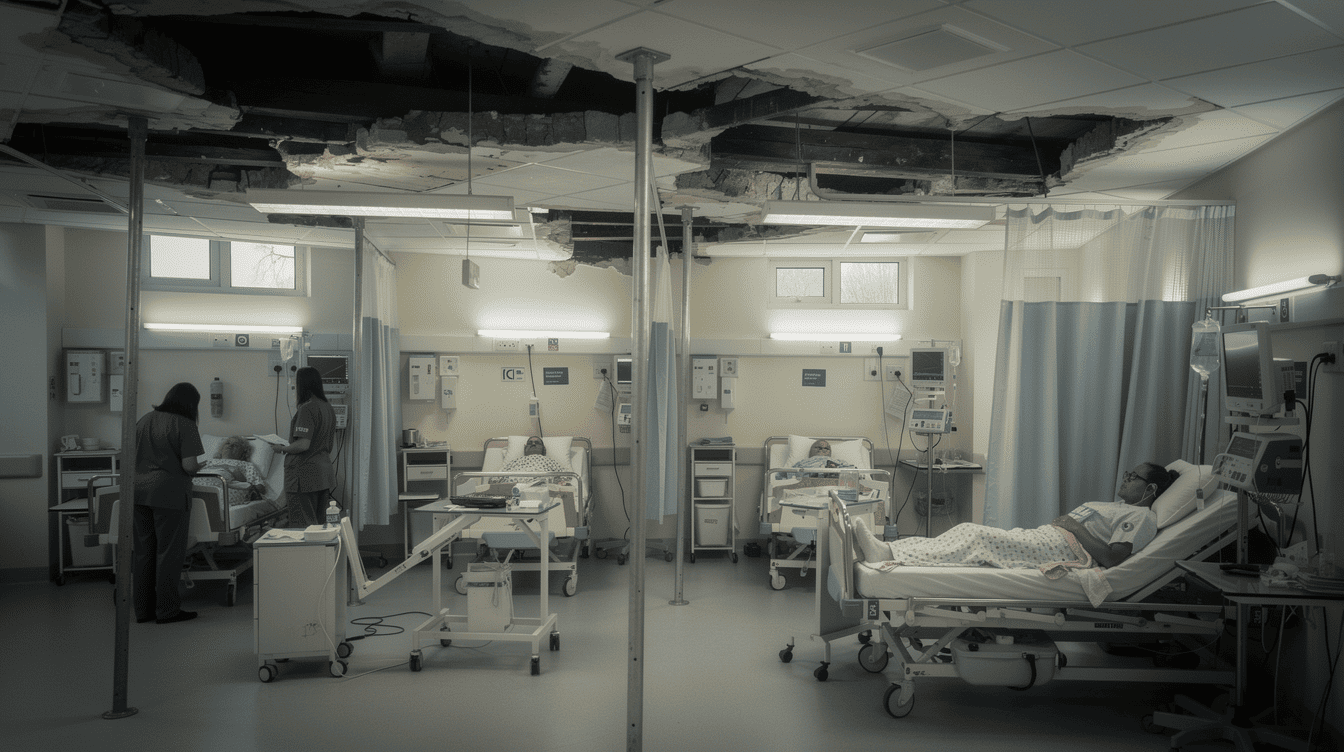
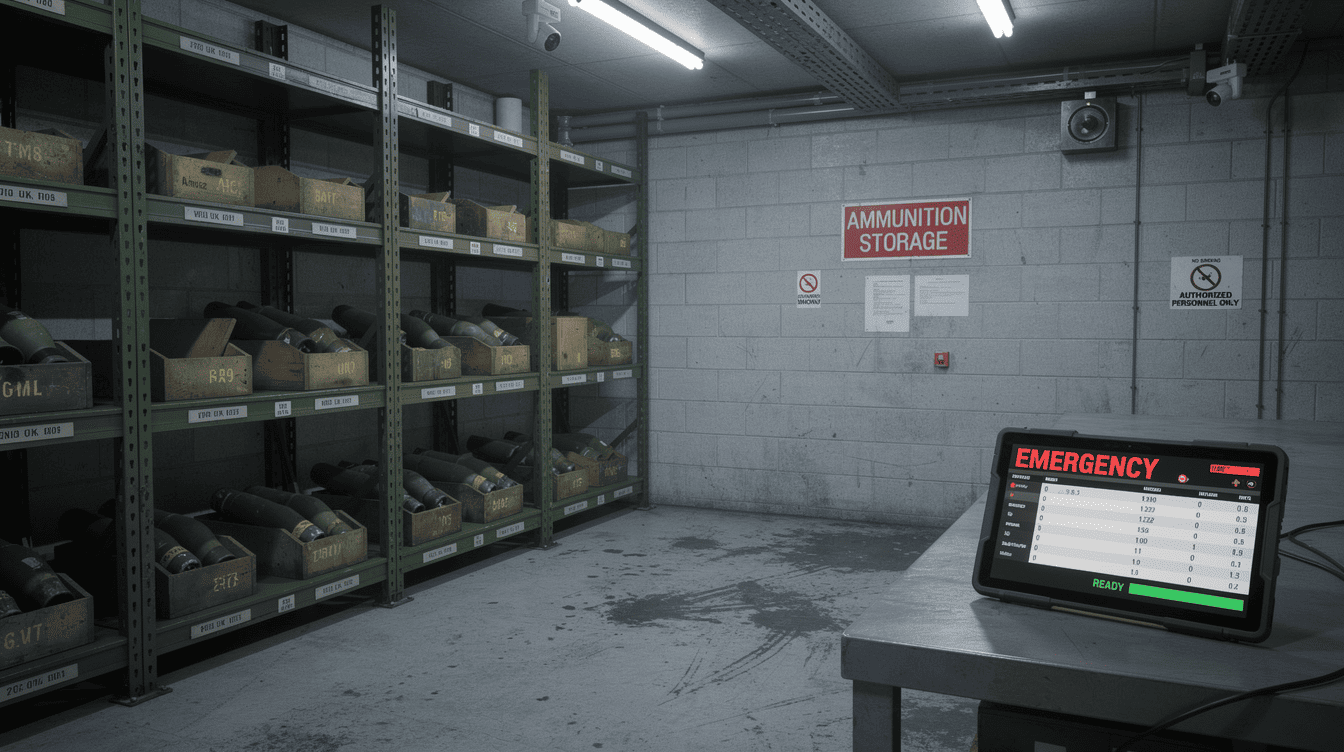
Something connects a hospital propped up with steel, a courtroom booked half a decade after the crime, and an army that would run out of shells before the second week of a war.
It is not politics. The failures documented in this series span every government of the last thirty years. It is not austerity. Some of these institutions were starved of money. Others — the NHS, the welfare system — were funded on a scale previous generations would have found extraordinary, and failed anyway. The MoD cannot account for £1.5 billion it spent on nuclear warheads. The NHS maintenance backlog is £15.9 billion. The DWP built a machine-learning profiling system covering a million claimants a year. Money was present. Sight was not.
It is not incompetence in the ordinary sense. The people inside these systems are largely doing what the systems ask; just following orders. The administrator deleting patients from a waiting list at thirty-three pounds a head is following protocol. The algorithm selecting a claimant for investigation is performing as designed. The Treasury official writing to seventeen regulators demanding they regulate less is implementing policy. The procurement officer signing a sole-source contract with Palantir is complying with a framework his own department created.
Dominic Cummings has endlessly made this point: the pathological system is working as intended. A civil servant wrote in the Telegraph:
Having a go at a “corporate job” ticks a box that helps grease the pole of a mandarin’s Whitehall ascent. These are not freak cases: they are, to quote Cummings, “the system working as intended”.
The connection is architectural. The purpose of a system is what it does.
Every institution this series has examined underwent the same transformation. A system rooted in local knowledge, human judgment, and direct accountability was dismantled and replaced by centralised machinery promising efficiency, consistency, and scale. And in every case (councils, water, hospitals, courts, defence, welfare, policing) the machinery ended up measuring something adjacent to the thing it was supposed to be watching. The measurement became the output. The reality it was supposed to represent drifted quietly out of view. One could call this the metadata over the substance.
The NHS does not know how many people need treatment. It knows how many names are on a list. The MoD does not know whether Britain can sustain a fight. It knows how many procurement contracts are in the pipeline. The CQC does not know whether your care home is safe. It knows which box was last ticked. The justice system does not know whether the public is protected. It knows the backlog is 76,957 and rising.
Different institutions. Different failures. Same architecture.
The system still acts. It no longer perceives.
Multiple errors principles are at work which have come to define the total failure of technocracy:
- Reification: treating abstractions (lists, scores, ratings, “cases”) as if they are the underlying reality.
- Goodhart's law: When a measure becomes a target, it ceases to be a good measure.
- Pathology: The purpose of a system is what it does—not what it claims or was designed to do.
- Campbell’s Law: the more a metric is used for decision-making, the more it will be corrupted.
- McNamara Fallacy: valuing what can be measured while ignoring what cannot—then concluding the immeasurable does not matter.
- The Streetlight Effect: searching for answers only where it is easiest to look.
- Parkinson’s Law: work expands to fill the time available—and institutions expand to justify their existence.
- Parkinson’s Law of Triviality: systems focus on what is easy to discuss rather than what matters.
- The Peter Principle: organisations promote individuals to their level of incompetence.
- Hanlon’s Razor: Never attribute to malice what can be explained by systemic failure.
- Chesterton’s Fence: removing legacy systems without understanding their function destroys hidden safeguards.
- The Cobra Effect: incentives designed to solve a problem end up worsening it.
- The Principal–Agent Problem: those making decisions do not bear the consequences of those decisions.
- Moral Hazard: actors take greater risks when they are insulated from the cost of failure.
- Information Asymmetry: those with power lack ground truth; those with ground truth lack power.
- Normal Accidents: in complex systems, failure is inevitable and often catastrophic.
- Unintended Consequences: interventions in complex systems produce unpredictable and often adverse results.
- Conway’s Law: systems mirror the structure of the organisations that build them.
- Ashby’s Law of Requisite Variety: a system must be as complex as the environment it controls—or it will fail.
- The Iron Law of Bureaucracy: those who control the system prioritise maintaining the system over its purpose.
- Goal Displacement: means become ends; process replaces purpose.
- Automation Bias: humans defer to automated outputs even when they are wrong.
The system shifts from achieving outcomes to optimising its own processes; metrics intended as proxies for reality become detached and begin to diverge from the thing they represent; the mechanism for detecting and correcting errors is severed or delayed beyond usefulness.
Decision-makers become too far removed from ground truth to interpret data meaningfully; actors are rewarded for compliance with the system rather than success in reality; the cost of failure is borne by the public, while decision-makers face no direct consequences. Those closest to reality cannot influence decisions; those making decisions cannot perceive reality; the aggregation of information at the centre destroys the local context required to understand it; success is defined as following the correct procedure, not achieving the correct result; delays in the system (courts, planning, procurement) render correct action irrelevant by the time it occurs.
This is the same stupefying brain rot infecting all the academic domains of university life; talking about things in meta-commentary rather than being competent and qualified at doing them. "Medical studies" talks about medicine without doing any actual medicine; "cultural studies" talks about culture without learning any history. It is the fruit of stuffing universities with junk sociology degrees for a an easy path to a cosy job in the Civil Service for five decades.
Richard Dawkins put it bluntly when examining the Sokal Hoax and Sokal Squared Hoax. He described the sociology disease as:
the stupefyingly boring, pretentious & deliberately unclear literature of postmodern metabullshit.
The purpose of a system is what it does. Technocracy optimises for appearance over substance, and as a platform for the ineffective to substitute activity for achievement; it optimises for the incompetent to appear competent.
What England Built and What England Lost
This publication argued, before this series began, that England's greatest contribution to civilisation was not the common law, or Parliament, or the Industrial Revolution. It was something prior to all three: the political feedback loop. The mechanism by which a society detects its own errors and corrects them without tearing itself apart.
It was never a single institution. It was a web. Parish constables who knew their streets and answered to the people walking them. Lay magistrates who brought local knowledge to local justice, unpaid, unglamorous, and effective precisely because they were embedded in the community rather than appointed from above. Coroners who investigated death without waiting for permission. Local auditors who could read a balance sheet and know when someone was lying. Beat officers who understood their patch at the resolution of individual houses and individual grudges. Juries : ordinary people, drawn from the community, judging their neighbours. A free press with statutory access to public information and the combative instinct to use it.
Not efficient. Not uniform. Not scalable. Not designed.
Tested. Over centuries. By use.
These institutions shared a common feature the administrative state never understood and therefore never replicated. They were sensing systems. Their purpose was not to govern. It was to see. To detect the discrepancy between what an institution claimed to be doing and what it was actually doing; to notice when the accounts did not balance, when the building was unsafe, when the officer was violent, when the care was cruel. Their authority came not from credentials or frameworks but from proximity.
They worked because the people operating them lived with the consequences of failure. The parish constable who ignored a crime lived on the same street as the victim. The local auditor who missed the fraud worked in the same town as the debtor. The magistrate who got the sentence wrong saw the defendant's family at church.
The administrative state looked at these systems and saw inefficiency, inconsistency, and amateurism. It was not entirely wrong. The old systems were inconsistent. They were sometimes corrupt. They were certainly not modern.
But they could see.
The replacements cannot.
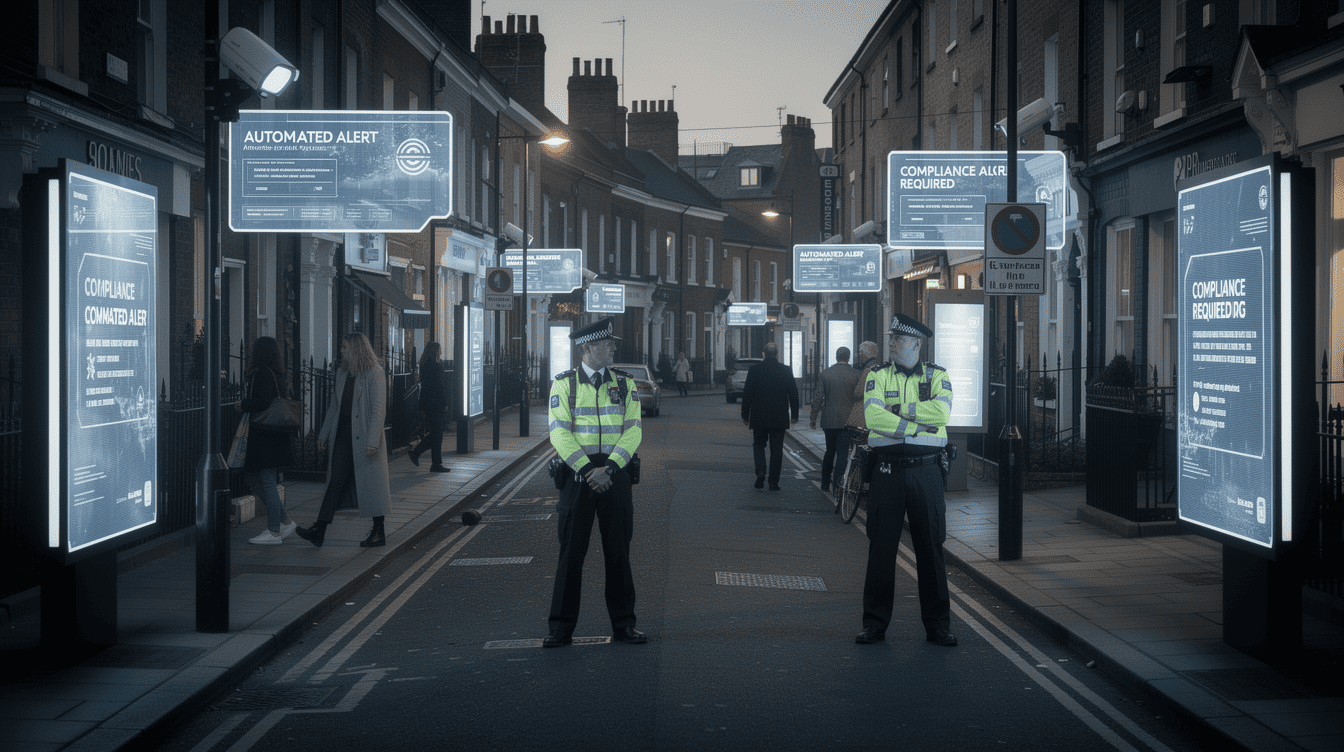
National regulators staffed by professionals rotating between sectors — health one year, water the next, finance the year after — with no roots in any community and no long-term stake in any outcome. Digital frameworks ingesting data from thousands of providers and producing ratings nobody on the ground trusts. Performance dashboards reporting upward through layers of management to ministers and permanent secretaries who have no independent means of verifying whether any of it corresponds to reality. Compliance regimes measuring process adherence rather than outcomes. Algorithms substituting pattern recognition for the irreducible complexity of individual human circumstances.
Professional. National. Uniform.
Blind.
The Border, Grid, Tax Office, and Lecture Hall
If the pattern stopped at the fourteen institutions examined over the past three weeks, it would be serious enough. It does not stop. It runs through every domain the centralised state has reached, including several this series has not had space to examine in full. They deserve naming now, because the pattern is the point.
The border is not controlled. It is administered. Asylum cases take years to process. Hotels accommodate tens of thousands of people at a cost running into the billions annually. This is not a policy failure in the conventional sense. It is the system performing its actual function: managing presence, because it cannot control entry. The gate was replaced by a queue. The queue has no end.
HMRC processes millions of tax returns automatically. It is extraordinarily efficient at collecting revenue from people whose tax affairs are simple: employees, pensioners, small traders. Complex avoidance is a different matter. It requires the kind of case-by-case forensic expertise the department has been shedding for years. The system catches the nurse who overclaims mileage. The offshore structure designed by a team of specialists to be legally uncatchable walks past untouched. Investigation was replaced by statistical risk-scoring. The risk scores catch the easy cases. The hard cases are hard precisely because they do not look like the easy ones.
Universities expanded around international student fee income with an enthusiasm indistinguishable from dependency. When visa restrictions began to cut that income, the model had no reverse gear. There was no contingency because the funding structure was built to contemplate only growth. Institutions founded to advance learning optimised for revenue instead. The revenue is now contracting. The debts, the buildings, the staff, and the obligations are not. Some institutions will close. The communities around them, economically dependent on the university's presence, will feel the impact long after the vice-chancellor has moved on.
The energy grid has planning permission. It does not have connection capacity. Wind farms approved. Solar arrays permitted. Battery storage facilities signed off. Data centres authorised. All waiting, some of them for a decade or more, for physical connection to a grid that cannot absorb what has already been approved, let alone what is coming. Britain's energy future exists in documents, applications, and ministerial announcements. On the ground, the queue for connection stretches into the mid-2030s and beyond. Permission is not delivery. Announcement is not construction. The map is not the territory.
Housing tells the same story from another angle. The planning system does not exist to enable building. It exists to process applications. These are different activities producing different results. One puts roofs over heads. The other produces paperwork. The system is performing its actual function — processing — with considerable efficiency. The paperwork does not keep anyone warm.
The economy itself is the pattern writ large. Record public expenditure. Collapsing productivity. The state spending more in real terms than at almost any point in its history and delivering measurably less than it did a generation ago. Because the spending does not fund outcomes. It funds the machinery of administration. And the machinery of administration produces nothing except more administration, more measurement, more reporting, more frameworks, more dashboards — and less of everything the spending was supposed to buy.
Nobody Is Lying
This requires saying with precision, because it is the most dangerous finding of the entire series.
Nobody is lying.
The hospital trust reporting a shorter waiting list is not lying. The list is shorter. Patients were removed. Not treated — removed. Through validation exercises, administrative reclassification, and an e-Referral System that automatically deletes referrals after 180 days with no human decision required. The dashboard does not record the difference between a patient treated and a patient deleted. It was not designed to. It reports a number. The number went down. By the metrics the system uses to evaluate itself, performance improved.
The DWP is not lying when it says its fraud-detection system works. The system does detect patterns consistent with fraud. It also exhibits documented bias across age, nationality, and health status, and the department went to court to prevent disclosure of its own data proving this. But within the logic of the system, it is functioning. It identifies targets. It generates referrals. Officials who follow the algorithm need no justification. Those who override it must explain themselves in writing. The architecture makes compliance the path of least resistance and judgment the path of maximum risk.
The Ministry of Defence is not lying when it reports procurement progress. Contracts exist. Programmes are underway. Money is being spent: vast quantities of it, much of it to single suppliers without competitive tender. The NAO found £1.5 billion in nuclear weapons spending it could not verify at all. But the reports are filed. The frameworks are followed. The dashboards are green.
Nobody is lying. They are doing something worse.
They are measuring the wrong things with increasing precision. Reporting the measurements upward through chains of management to people who have no independent way to verify whether any of it reflects the world as it actually is. A system that measures itself through metrics will optimise for the metrics. A system that reports through dashboards will optimise the dashboard. A system that has replaced human judgment with process compliance will optimise the process.
Reality does not optimise. Concrete degrades on its own schedule. Ammunition runs out regardless of the procurement pipeline. Court cases do not resolve themselves because somebody relabelled the backlog as a pipeline. Patients are not cured by being deleted from a list. Buildings do not become safe because a rating was updated. Children with cerebral palsy and autism do not stop needing specialist provision because the accounting override was extended to 2028.
The physical world does not read the framework. It does not care about the dashboard. It collects what is owed, on its own terms, in its own time.
For a while the gap between the measurement and the reality can be managed. Failures deferred. Reclassified. Refinanced. Suppressed. The override extended. The super-injunction holding. The regulator ordered to step back. The backlog renamed. The target redefined so the target is met.
Then a ceiling comes down. An army discovers it cannot fight past the first week. A court lists a trial date five years after the crime. A council discovers the accounting trick bought time but not solvency. A child discovers the provision promised by statute does not exist in the town where she lives.
The physical world reasserts itself.
It always does.
The Instinct Built This
The instinct now — already visible, already being acted upon — is to build more machinery. Commission another review. Appoint another Soviet tsar. Establish another regulator to oversee the regulators. Produce another framework. Launch another digital platform. Publish another set of recommendations to be implemented by the same apparatus, staffed by the same people, following the same incentives, that produced the failure being investigated.
The instinct is understandable. Machinery is what the governing class knows how to commission. Whitehall can produce a framework in weeks, establish a quango in months, deploy a dashboard by the end of the financial year. These are the tools available. When your only instrument is process, every failure looks like a process problem.
It is not a process problem. It is an architecture problem. The centralised bureaucratic oversight model — quangos, frameworks, national regulators, algorithmic systems, compliance regimes — does not work. Not because of underfunding. Not because of bad management, though both are endemic. It does not work because it is structurally incapable of seeing. It severs the connection between the people who observe reality and the people who act upon it. It replaces proximity with abstraction, judgment with compliance, accountability to the community bearing the consequences with reporting to a centre that receives dashboards and mistakes them for sight.
The centre cannot see. The centre has never been able to see. No amount of data will make it see, because the problem is not insufficient information. It is the absence of the judgment required to interpret information, and the absence of the accountability required to act on the interpretation honestly. A dashboard can tell you the waiting list has shortened. It cannot tell you the patients were deleted. Only a person — in the hospital, on the ward, close enough to see and independent enough to speak — can tell you that. And the system has spent thirty years eliminating that person from every institution in Britain, because that person is inefficient, inconsistent, and resistant to management.
What replaces the machinery will not come from Whitehall. It never could have.
It will come from the restoration of what Whitehall displaced. Local competence. Institutions embedded in communities. People who know their patch and can see when the ceiling is cracking, when the books do not balance, when the algorithm is wrong about the specific person standing in front of them. Judgment, which cannot be automated. Proximity, which cannot be scaled. Accountability to the people who live with the consequences, which no framework can simulate and no regulator rotating through on a three-year secondment can replicate.
England built the common law from argument and precedent, case by case, over centuries, before the administrative state existed. It built accountability not because a central planner designed it but because communities demanded answerability from the powerful, repeatedly, persistently, across generations, until the powerful conceded. The feedback loop was not invented. It was grown. It required time. It required friction. It required the stubborn, bloody-minded, irreducibly local insistence on seeing what is actually there rather than accepting what the centre says is there.
That insistence is what has been lost. It is the only thing worth recovering.
The failures are visible now. Not everywhere. Not completely.
But enough.
Enough to see the pattern. Enough to know it is structural. Enough to know the machinery will not repair itself, because the machinery is the disease presenting as the cure.
There is no way around what has happened.
Only through it.
What comes next?
Us.
Restorationist; Socialist; Conservative; Fascist; Communist. It doesn't matter.
It has to end with us.
Next, we're going to talk about how.