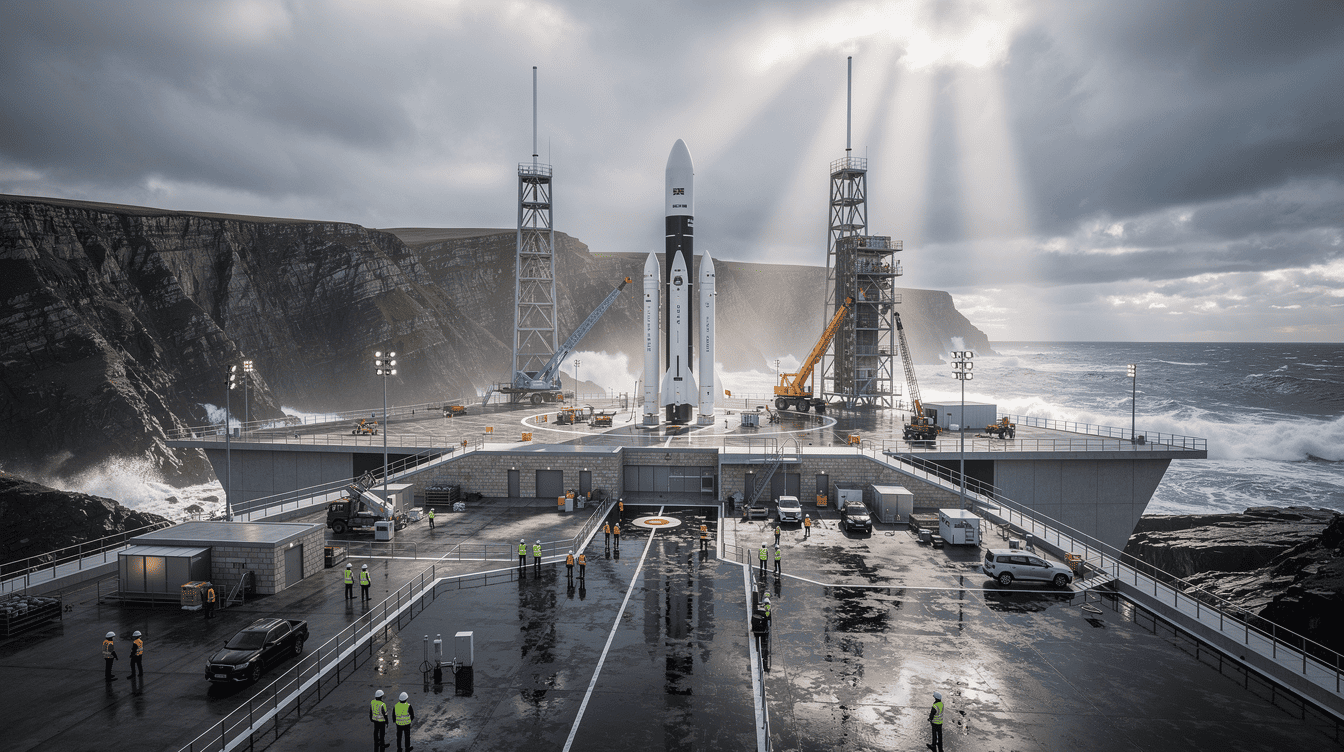
After The 2nd Wave: Rebuilding A Warfighting State
Britain plans defence from the wrong end. It asks what it can afford, not what must survive. After Wave Two, 100 platforms leaves 29. The formula is simple. The numbers are devastating. And every war Britain has ever fought began with a force designed for the previous one.

The first duty of a state is to secure its people, its territory, and its continuity. Everything else (healthcare, education, commerce, law) exists only because external security makes it possible. A country unable to defend its airspace, coastline, ports, infrastructure, and population is not being governed. It is being managed on the assumption nothing will go wrong.
The armed forces remain among the least ideological and most disciplined institutions in national life. They are generally non-political, internally accountable, and structured around outcomes. The task of government is not to manage the military. It is to fund it, equip it, and get out of its way. Money must flow directly to fighting power.
The Ministry of Defence originated in a 1923 attempt to support the armed forces. Over time it has become a rival ecosystem, absorbing resources through procurement bureaucracy, consultancy, and administrative overhead before a single pound reaches a frontline unit. The department should support the military, not substitute for it. Politicians set objectives and constraints. The military defines the minimum force required to meet them.
The 1940 Test
Defence cannot be planned around the United States or the European Union. This is not anti-Americanism or Euroscepticism. It is the only honest planning assumption for a country whose survival is at stake.
In a serious threat scenario: one involving peer conflict, alliance fracture, political upheaval, or any of the cascading failures modern geopolitics routinely produces, both the US and the EU are susceptible to paralysis, distraction, internal crisis, or outright collapse of political will. The notion of folding British forces into a European army is not a strategy. It is a cop-out: a mechanism by which politicians avoid the cost and responsibility of sovereign defence by outsourcing it to a committee of twenty-seven nations unable to agree on a fisheries quota.
In 1940, France fell in six weeks. The United States was not yet in the war. The Soviet Union was on track with Germany. The British Empire stood functionally alone against the most powerful military machine in European history. Every assumption about allied support, continental strategy, and collective security had collapsed. Britain survived because it still possessed — barely — the independent capacity to fight. Our navy was the largest in the world.
This is the 1940 test, and every element of British defence must pass it: can this force function when Britain stands alone, without allies, in extremity?
- If it depends on American missile maintenance, it fails the test.
- If it depends on European political consensus, it fails the test.
- If it depends on supply chains running through countries whose commitment cannot be guaranteed under fire, it fails the test.
The purpose of alliances is to make the 1940 scenario unlikely; the purpose of sovereign defence is to survive it when alliances fail. A country planning its military around the assumption allies will always be there is not planning. It is hoping.
Always Fighting the Previous War
In 1940, the army was configured for the trenches of 1918: static, positional, attritional. It was hit by mobile combined-arms warfare and driven from the continent in weeks. In Singapore, 85,000 troops were defeated by 35,000 because the defences were oriented against a seaborne assault; the enemy came overland. During the Battle of Britain, 750 fighters held against 2,500 Luftwaffe aircraft — a victory won on a margin so thin it should have permanently cured the habit of planning to "appropriate" levels. At Suez, Britain deployed military capability into a strategic reality it had not bothered to understand. In the Falklands, improvisation and courage won a war most of the world thought unwinnable, but the losses were a serious proportion of what had been sent.
The pattern never changes. The generals prepare for the war they know. The enemy brings a different one.
Today the same mistake is being repeated. Britain maintains a force structured around conventional expeditionary deployment: small, professional, lightly stocked, optimised for coalition operations abroad. The probable next conflict does not look like Afghanistan or Iraq. It looks like sustained missile and drone saturation of England, infrastructure sabotage, undersea cable attack, cyber disruption, and economic coercion — delivered remotely, at speed, against a country with almost no layered homeland defence.
Stop assuming the current model is correct. It has been wrong before every war Britain has ever fought.
Geography Is Strategy
Britain is an island. Every serious defence question begins and ends with this fact.
England learned early its security depends on the water around it. The Channel and surrounding seas are the first wall of the realm. Any hostile power wishing to impose its will on the British Isles must first solve a maritime and air problem before it can begin to think about a land problem. No hostile force reaches these shores at scale unless it first wins, at least temporarily, at sea and in the air.
The Nazis' Operation Sea Lion required the entire Luftwaffe, thousands of converted barges, and naval cover the Kriegsmarine could not provide. It was cancelled because Germany failed to achieve air superiority.
The Normandy landings required total control of the sea and sky, roughly 7,000 vessels, over 11,000 aircraft, and two million troops over time; against a continental coastline and a defender already stretched across multiple fronts.
Invert the problem: an attacker attempting the same against a defended island, an intact navy, a non-distracted air force, and a population of seventy million faces military arithmetic so punishing most have failed at step one.
Air power can punish. Missiles can devastate. But armies, fuel, armour, and occupation still move at scale by sea. There is no brute-force alternative to controlling the air and the water. An unprotected mass crossing does not arrive as an army, but as wreckage.
British strategy reduces to a single principle: deny the chain.
An enemy must:
- First win the air;
- Then protect movement across the sea;
- Then land a force surviving immediate counterattack;
- Then open ports;
- Then sustain fuel, armour, ammunition, and reinforcements;
- All against a nuclear-armed state at existential risk.
Britain should exist to break this chain at every link.
But the moat works both ways. If an enemy cannot easily cross it, an enemy can also use it to starve, throttle, and isolate. The U-boat campaigns of 1917 and 1940–43 came closer to defeating Britain than any land army ever did; so much so Churchill transported the Empire's entire gold supply to Montreal for safety. Today, Britain imports 44 per cent of all the energy it consumes, 35 per cent of its food, and has lost sovereign primary steelmaking capacity entirely. A sea-denial campaign (submarines, mines, drone swarms, and long-range anti-ship missiles targeting commercial shipping) would not need to be total. It would need only to collapse confidence in shipping insurance and choke the flow of fuel, food, and raw materials to an island unable to replace them domestically.
Defence is therefore not only about intercepting missiles and sinking landing craft. It is about ensuring the country can still eat, stay warm, manufacture ammunition, repair ships, and keep the lights on when the sea lanes are contested.
Compounding Attrition: Reversing the Planning
Defence planning starts from the wrong end. The conventional method asks: "What can we afford?" It begins with the budget, works forward to an inventory, and declares the result adequate. This is how Britain has planned for every war it has ever fought. It is why Britain has entered every war under-equipped and why our military planning is so laughable it is mocked in comedy shows.
The correct method works in the opposite direction. Start at Wave Two — after the opening strikes have landed, after the first air engagements, after ships have been hit, after sustained combat has ground the force down — and ask: what does Britain need to still hold in its hand? Not what it started with. What remains.
This is the floor: the minimum force still capable of defending England and projecting enough offensive power to change the outcome.
Then work backwards through compounding attrition. Three things eat your force before it fights at full strength, and they compound in sequence:
Maintenance: 30 per cent unavailable
On any given day, roughly 30 per cent of any military force is in refit, deep servicing, upgrade, or crew rotation. This is not mismanagement. It is the structural reality of complex machines.
Wave One: 40 per cent lost
The opening strikes — missiles hitting bases, air combat, drone saturation, mine strikes — destroy or damage 40 per cent of what was available. This is not a worst case. It is a realistic planning assumption for peer conflict.
Wave Two: 30 per cent further attrition
Sustained combat, continued engagements, mechanical failure under stress, crew exhaustion, ammunition depletion, and logistics disruption erode another 30 per cent of whatever survived the first wave.
Here is what happens to 100 platforms:
- 100 in the inventory.
- 70 available after maintenance.
- 42 survive Wave One.
- 29 still fighting at Wave Two.
Twenty-nine from a hundred. Less than a third.
Inventory × 0.29 = Floor
The formula is simple:
- Inventory × 0.70 × 0.60 × 0.70 = What you can fight with.
- Turn it round: Floor ÷ 0.29 = What you must own.
That single calculation drives every number henceforth.
What Britain Needs After Wave Two
Britain needs the following forces still fighting, still offensively dangerous, after absorbing maintenance losses, a first wave of strikes, and sustained combat attrition. These are the floors. Each inventory figure is derived from dividing the floor by 0.29.
Air
- Floor: 500 combat aircraft after Wave Two.
- Required inventory: 1,700 combat-air equivalents.
Not all crewed fast jets. The number must include carrier-capable strike aircraft, loyal-wingman drones, autonomous strike and ISR platforms, and attritable systems providing depth without multiplying pilot demand. Behind the combat layer: AEW, tankers, transports, maritime patrol, ISR, and electronic warfare in enough depth to keep the combat fleet usable through sustained operations.
Britain currently has roughly 250 combat aircraft. The gap is a factor of seven.
Sea
- Floor: 45 escorts and 25 attack submarines after Wave Two.
- Required inventory: 155 destroyers and frigates. 86 subs.
This is the point at which home waters, North Atlantic work, convoy and escort duty, carrier support, undersea cable protection, and battle-damage absorption coexist without the fleet hollowing itself every time a handful of ships enter refit or take hits. The Royal Navy currently has 14.
However...
This is also where Britain becomes the most dangerous undersea warfare state outside the United States. Not just boats, but the entire undersea system: attack submarines, seabed warfare, autonomous underwater vehicles, undersea sensing, cable and infrastructure defence, and North Atlantic mastery. The submarine force should be built around sovereign quantum navigation (systems resilient to GPS denial and electromagnetic disruption) giving British boats a targeting and positioning advantage no adversary can jam. An island power with nuclear submarine expertise, global geography, and a Five Eyes intelligence position is uniquely placed to dominate this domain. Submarines are silent, lethal, and terrifyingly difficult to counter.
The current plan is "up to 12."
Three nuclear-powered carriers
Britain has fourteen Overseas Territories. Crises will not occur sequentially. With only two carriers, one in maintenance leaves a single unit carrying impossible weight. With three: one east, one south or west, one home. The carrier is a sovereign forward operating base: jets, drones, marines, electronic warfare, missile defence, command-and-control, and logistics in one platform able to appear where Britain has no friendly land base and no time to negotiate one. Each carrier should be built as a multi-domain hub: the most advanced carrier-integrated autonomous warfare capability in the world.
A much larger auxiliary and replenishment fleet. Total fleet: 250 or more hulls across all classes.
Land
- Floor: 225,000 troops deployable after Wave Two.
- Required inventory: 776,000 regulars and trained reserves combined.
The regular component should sit at 300,000 to 350,000. The remaining 400,000 to 450,000 must be genuinely trained reserves: equipped, exercised, and mobilisable within weeks.
A two-year military service option, rewarded with a fully funded university degree or trade qualification, would rebuild the national reserve culture Britain lost when it abandoned conscription and never replaced it with anything. The reserve model should move closer to Swiss or Israeli practice.
The current regular Army is 73,000. Trained reserves stand at roughly 29,000. Combined: 102,000. The requirement is nearly eight times larger.
Domestic Air and Missile Defence
A thick, layered national shield: fixed and mobile coverage around cities, bases, ports, nuclear sites, and critical infrastructure. Deep magazines, reloads, directed-energy weapons, and dense counter-drone capability. The metric is not whether the first barrage is stopped. It is whether the system still functions after the fifth.
Munitions and Industry
Measured in time, not pounds. Britain's ammunition ran out after eight days in a NATO war game. Russia burns through 250,000 artillery rounds a month. The opening 96 hours of the Iran campaign consumed over 5,000 munitions. Every service branch should have statutory minimum stockpile days, plus domestic production capacity to replace expenditure under sustained conflict. Not just the weapon, but the reload, the spare, and the factory.
Sovereign Production Behind the Moat
Britain imports 44 per cent of its energy. North Sea oil and gas production has fallen 68 per cent from its 1999 peak. Gas production hit a record low in 2025. The country imports 68 per cent of its gas. Since 2013, two major refineries have closed, leaving four operational. Food self-sufficiency stands at 65 per cent overall, 53 per cent for fresh vegetables, 15 per cent for fresh fruit. The closure of Port Talbot's blast furnaces left Britain without sovereign primary steelmaking for the first time in over a century.
A country this dependent on imports is not defended by a navy. It is held hostage by the sea lanes the navy is supposed to protect. The 1940 test applies here too: if Britain stands alone, can it feed, fuel, and arm itself?
Sovereign production minimums must be enacted alongside force-level minimums:
Nuclear baseload
Nuclear is the only large-scale source immune to both weather variability and maritime interdiction. Sovereign energy production must cover critical national consumption without seaborne imports for a sustained period.
Vertical underground farming
A statutory floor of 80 per cent domestic self-sufficiency for indigenous-type food, rising toward 90. Farmland protected by law. Strategic grain and protein reserves covering six months of import disruption. Plants don't need sun; they can be produced hydroponically underground and new vertical techniques increase agricultural density.
Steel
Sovereign primary steelmaking capacity urgently restored. A country unable to pour its own steel cannot build warships, manufacture armour, or produce ammunition casings.
Fuel and munitions reserves
Strategic fuel reserves expanded well beyond the current IEA obligation. Munitions stockpile minimums paired with domestic production capacity for continuous wartime replacement.
Shipbuilding and repair
An island nation whose navy is the first line of defence must build, repair, and replace warships from sovereign yards. All ships produced domestically must have dual civil-military use to prevent another Dunkirk.
Not the Biggest: The Most Dangerous
Britain will never match continental powers unit for unit. It does not need to. It needs to be so costly to attack no rational enemy would try, and so strategically indispensable no serious ally would do without it.
In nature, the most dangerous species are not the largest. They are the most venomous. Britain's strategic identity should follow the same principle: choose a few domains, overmatch completely, and become the country every coalition planner says we need the British for this.
Undersea warfare
25 attack submarines after Wave Two, backed by seabed warfare, autonomous underwater vehicles, and sovereign quantum navigation making British boats unjammable and unpredictable. The most dangerous undersea power outside the United States.
The hybrid carrier
A multi-domain sovereign base: Advance fighters, loyal-wingman drones, autonomous strike aircraft, electronic warfare, long-range missiles, marines, command-and-control — nuclear-powered, with unlimited range. Larger powers spread their effort. Britain can concentrate.
Counter-drone and directed-energy defence
Cheap drones against expensive interceptors is a losing trade. If Britain builds the best low-cost anti-drone kill chain — lasers, electronic warfare, sensors, automation — it fills a niche every Western military desperately needs.
Sovereign strategic technology
Britain never won by mass alone. It won by compressing more energy, more information, more lethality into less. Radar. The jet engine. Bletchley Park. The SAS. The next version is nuclear propulsion, autonomous warfare, GPS-denied navigation, and the industrial energy base beneath them. A smaller nation wins by packing more power into less.
A great military is not only a tool of war. It is a visible expression of national competence and will. The Harrier was ingenuity made visible. The B-2 is a declaration of American technological supremacy. Britain needs its own equivalents: visible sovereign capabilities telling the world this country still builds machines with real bite.
The Overseas Estate
Britain's strategic geography extends far beyond the home islands. The Falklands, Ascension, Gibraltar, Cyprus, the Chagos Archipelago, the Antarctic territories, Turks and Caicos, Pitcairn — these are fixed nodes in a global operating network. Staging posts, surveillance positions, logistics hubs, and sovereignty anchors spanning every ocean.
They should be treated as a system. Each offers something: mid-Atlantic positioning, Indian Ocean access, Mediterranean presence, Caribbean and Pacific reach, polar logistics. Connected by satellite, defended by submarines, supported by carrier deployments, and maintained as sovereign infrastructure, they become a power-projection network most nations cannot replicate.
The Falklands taught the essential lesson: speed, distance, and deployability. The task force departed within three days and travelled over 8,000 miles. A state unable to project force at range cannot defend global commitments.
Intelligence should be understood as the nervous system running through all of this: re-integrated with warfighting priorities, fused into undersea warfare, autonomous targeting, seabed operations, electronic warfare, and strategic warning. Intelligence is not a separate department. It is the connective tissue making submarines deadlier, carriers smarter, and air defence faster. There is a strong case for removing Military Intelligence Section Five and Military Intelligence Section Six from the civilian chain and placing them back under their original military control.
Service as a National Compact
A force of 776,000 does not materialise from a recruitment website. It requires a national compact: an arrangement where service is honoured, rewarded, and socially embedded.
- Military pay, housing, and family support should be raised sharply enough to make service an attractive and respected profession.
- Two years of military service should earn a fully funded university degree or equivalent trade qualification.
- Veterans should carry status, not stigma.
This is not militarism. It is the opposite of the current model, where a tiny professional force shoulders the entire burden while the rest of the population has no connection to defence and no stake in its readiness.
Defence Minimums in Law
Minimum force levels should be enacted by Parliament as statutory floors: derived by the military services from operational reality, changeable only by primary legislation.
The minimums should cover:
- fleet numbers
- aircraft numbers
- submarine strength
- ammunition stockpiles
- air-defence coverage
- shipbuilding capacity
- reserve manpower
- domestic munitions production
- trained pilot numbers
- food and energy self-sufficiency ratios, and
- sovereign steelmaking capacity.
Every major asset class should carry three published metrics:
- How many are available now
- How fast damage can be repaired, and
- How fast replacements can be built.
The military services — not the MoD civil service — should certify readiness. If a service chief believes the minimum is not being met, formal notification to Parliament is required. If a statutory floor is breached for more than six months, the responsible minister makes a statement to the House.
The current system allows capability to erode quietly, redefined by administrators, concealed by reclassification, and discovered only when a crisis arrives and the cupboard is bare.
The Last Line: A Sovereign Nuclear Deterrent
Britain is a nuclear weapons state. This is not a historical curiosity. It is the final guarantee of national survival.
But the deterrent is not sovereign. The Trident II D5 missiles are American-designed, American-built, and American-maintained; returned to the United States for scheduled maintenance by Lockheed Martin. The warhead is widely assessed as based on the American W76. Key components including aeroshells are purchased from the US. The guidance system is designed and manufactured by the Charles Stark Draper Laboratory in Massachusetts. Targeting software interfaces with US systems. The Atomic Weapons Establishment at Aldermaston is part-managed by Lockheed Martin.
The government's answer is "operational independence" — Britain retains sole authority over the launch decision, with no American lock-out or veto. This is true in the narrow, immediate sense. But operational independence is not strategic independence. If the United States withdrew maintenance, component supply, or design collaboration — as political leverage, as a consequence of alliance breakdown, or simply through a future administration's indifference — the deterrent would degrade. Not in days. In years. But it would degrade.
This fails the 1940 test.
The entire point of a national deterrent is to provide a guarantee no alliance relationship can revoke. A deterrent dependent on another power's continued goodwill is not a guarantee. It is a permission.
Repatriate the nuclear supply chain
Britain must develop sovereign capacity to design, build, maintain, and guide its own delivery system (missile, warhead, and guidance) without dependency on any foreign state for critical components or maintenance access. The AWE's work on the replacement warhead is a step, but only if it leads to genuine design sovereignty rather than another variant built from American blueprints with American-supplied parts.
Parliament must authorise nuclear use in law
Britain's current policy is deliberate ambiguity. This was designed for the Cold War. In a world where multiple nuclear states are modernising arsenals and the credibility of extended guarantees is openly questioned, ambiguity erodes deterrence.
Parliament should enact legislation specifying the exact conditions under which the executive (a Prime Minister or, in the event of decapitation, a surviving submarine commander) is authorised and required to launch a nuclear strike. Not guidelines. Not convention. Not a letter in a safe. Statute.
The legislation should define when nuclear weapons may be used: if Britain's existence as a sovereign state is threatened by weapons of mass destruction or by aggression the conventional forces cannot repel. It should define when they must be used: if a first strike has destroyed the chain of command and the submarine commander has confirmed, through defined protocols, the destruction of national authority. No international law override. No legal fog. No ambiguity about whether a second strike is lawful. No post-hoc prosecution of a commander who followed the law Parliament wrote.
This is not recklessness. It is the opposite. A deterrent no one believes will be used is not a deterrent. A second strike muddied by legal uncertainty is not a deterrent. The entire architecture of nuclear deterrence exists to ensure these weapons are never needed. But that architecture holds only if every potential adversary understands, with zero ambiguity, the consequences of testing it. The law should be published. The doctrine should be plain. And every hostile capital should be able to read it in English.
Resume testing
Britain has not conducted a nuclear test since 1991. It is a signatory to the Comprehensive Nuclear-Test-Ban Treaty, though the CTBT has never entered into force: the United States, China, and several other required states have not ratified it. Russia withdrew its ratification in 2023. The treaty contains a standard sovereign withdrawal clause.
Britain should withdraw from the CTBT and conduct a limited programme of underground nuclear tests at a sovereign site. Not because testing is desired. Because a deterrent whose weapons have not been tested in over three decades, while potential adversaries modernise, while physics packages age, while simulation replaces empirical verification, is a deterrent whose credibility quietly degrades.
A test programme accomplishes three things:
- Empirical confirmation the weapons work.
- A signal to every adversary Britain is willing and able to maintain, modernise, and if necessary use thermonuclear force.
- And restoration of sovereign competence in nuclear weapons science: competence slowly atrophying as institutional knowledge retires and is replaced by computational modelling alone.
No serious person wants to use nuclear weapons. But a nation unwilling to demonstrate its capability is a nation hoping credibility will outlast complacency. It will not.
The Money: Real Rearmament Vs The NHS
A restoration programme of this scale requires a temporary rearmament rate of 7-10% of GDP for a defined rebuilding period — perhaps fifteen to twenty years — followed by sustained spending of 5-6% once the force is rebuilt and the industrial base re-established. No serious country spends 2.3% on one of its three core functions.
This is less than the NHS budget. It is less than the cumulative cost of the quango state. Defence, like justice, is a core function of the state. Two to three per cent of GDP on a core function is a misconfiguration: treating survival as a discretionary item.
Britain should not ask what it can afford. It should ask what failure would cost.
- A country unable to defend its airspace pays in infrastructure.
- Unable to control its seas, it pays in trade.
- Unable to protect its people, it pays in lives.
- Unable to deter coercion, it pays in sovereignty.
The sum is not a line item. It is the end of self-governance.
How It Fails Again, and How Failure Is Caught
The most likely failure modes are familiar.
- The Treasury reasserts control and treats statutory minimums as aspirational.
- Procurement reverts to decades-long programmes delivering late and under-spec.
- The MoD administrative layer re-expands to absorb new funding before it reaches fighting units.
- Politicians redefine "defence" to include climate resilience, diversity initiatives, and international aid: diluting the budget without reducing the headline number.
- Industrial capacity is promised but never built.
- Reserve forces are announced but never trained or equipped.
And the cycle of quiet decay resumes, concealed by reclassification and discovered only in crisis.
The correction is transparency enforced by law. Every statutory minimum carries a published readiness metric: updated quarterly, reported to Parliament, available to the public. How many ships are at sea. How many aircraft can fly. How many days of ammunition are held. How many reserves have been exercised.
The military services certify readiness. Not the MoD civil service. Not consultants. Not committees.
Britain does not need the largest military on earth. It needs something more specific and more honest: a state understanding its geography, funding its armed forces before its bureaucracy, keeping hard minimums in law, and making itself so costly to attack no rational enemy would attempt it. And so self-sufficient no blockade, no alliance failure, and no political betrayal can starve it into submission.
An island nation survives by sea power, air defence, reserves, reach, and readiness. The task is not to rebuild a museum piece. It is to restore a warfighting state — one able to absorb shock, remain dangerous, project force at distance, and sustain itself through the worst.
Britain does not fail when it makes bad decisions. It fails when it loses the ability to know what is real, to act on it, and to attempt what is necessary.