Our Broken Bomb: The Hidden Crisis Inside AWE Aldermaston
Britain's nuclear deterrent depends on factories falling apart. Facilities meant to replace them are a decade late and billions over budget. Our defence relies on one submarine not failing, and we can't manufacture weapons. The Ministry of Defence doesn't want you to know how bad things have become.

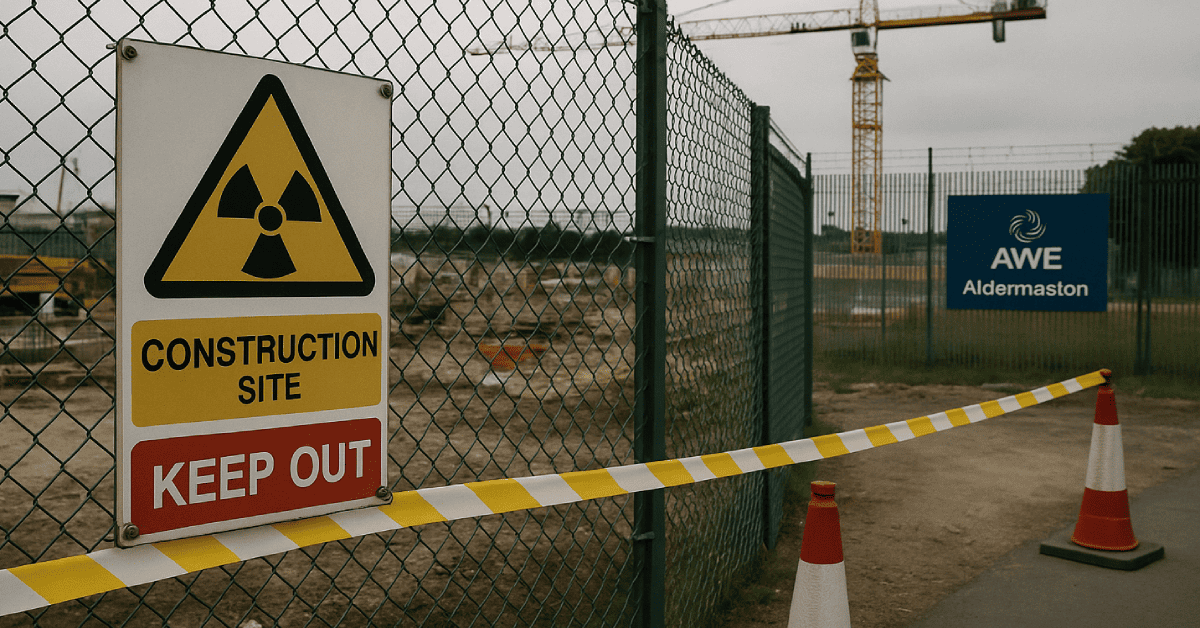
The fluorescent lights in Building A45 at AWE Aldermaston have been flickering for over seventy years. Built in the 1950s when rationing was still fresh in British memory, this enriched uranium facility was supposed to have been replaced by 2016. Instead, in 2012, corrosion ate through its steel frame. Workers discovered the damage during routine inspection. The building, declared "incapable of meeting future capability and regulatory requirements," limped along. By 2014, Project Pegasus—the £634 million facility meant to replace it—had been suspended. When finally restarted in 2021, the Ministry of Defence admitted the manufacturing capability wouldn't arrive until 2030.
Meanwhile, warheads require uranium components.
This is not an isolated failure. Across AWE's sites at Aldermaston and Burghfield, the infrastructure maintaining Britain's nuclear deterrent is collapsing under the weight of decades of delays, cost overruns, and management failures so systematic they suggest something more troubling than mere incompetence.
The UK's ability to manufacture and refurbish nuclear weapons—the plutonium cores, the uranium components, the final assembly—depends on facilities reaching end-of-life whilst their replacements remain years from completion and billions beyond budget.
Parliament's Public Accounts Committee put it bluntly: the Ministry of Defence "cannot explain why its leadership has not learned from these experiences." The National Audit Office was more circumspect but equally damning. What neither can say openly, constrained by national security exemptions, is whether Britain can still credibly claim to possess an independent nuclear deterrent when the factories producing it are, quite literally, falling to pieces.
The Gravel Gerties' Last Stand
Since the 1950s, AWE Burghfield has assembled and disassembled Britain's nuclear warheads inside structures known as Gravel Gerties—reinforced concrete bunkers designed to collapse inward in the event of an accidental detonation. They are, in conception and execution, products of early Cold War engineering: functional, robust, and utterly obsolete.
The Office for Nuclear Regulation, Britain's independent nuclear safety quango, has certified these facilities for continued operation only on a temporary basis, subject to repeated safety reviews. By 2008, they were already on borrowed time. In 2018, regulators ruled use would be permitted only until 2026, and only if immediate risk-reduction measures were implemented. The Gerties are operating on life support.
Project MENSA was meant to replace them. A single main processing facility incorporating modern environmental controls, enhanced safety features, and the capacity to handle both current W76 mod-1 design Holbrook warheads and the future Astraea design. Original budget: £734 million. Expected completion: 2017.
Current budget: £2.2 billion. Expected completion: classified for national security reasons, but certainly not before 2024.
The National Audit Office investigation revealed construction began when the design was perhaps 10-20% complete. This is not a minor procedural oversight. Starting construction without finalised designs is rather like laying a ship's keel before deciding whether it should be a frigate or a destroyer. Changes made during construction—walls repositioned, systems redesigned, entire sections rebuilt—consumed £400 million alone. Nearly half the total cost increase stemmed from this single decision.
The commercial arrangements compounded the damage. The initial contract lacked mechanisms to manage delays. The Ministry of Defence assumed excessive risk whilst contractors faced insufficient penalties for overruns. Oversight proved inadequate. Subcontractors operated without effective supervision. When costs spiralled, the project was "reset" in 2016—paused, restructured, re-budgeted. It remains, as of this writing, unfinished.
Meanwhile, the Gravel Gerties soldier on, their continued operation certified in short increments by regulators increasingly alarmed at the gap between closure date and replacement availability.
The Plutonium Problem
If MENSA represents delay, Project Aurora represents a deeper malaise. Plutonium pits—the spherical cores about the size of a bowling ball—are the heart of every thermonuclear weapon. They initiate the fission reaction that triggers fusion in the weapon's secondary stage. Without pit production capability, Britain cannot manufacture new warheads or maintain its existing stockpile.
Aurora, meant to replace the A90 plutonium facility built in the 1990s, appeared on the government's Major Projects Portfolio in 2023 with an estimated cost between £2 billion and £2.5 billion. The facility had been quietly in development since at least 2019, though details emerged only when the Infrastructure and Projects Authority required its inclusion in public reporting. No announcement. No parliamentary debate. Simply an acknowledgement that, yes, Britain needs new plutonium production capability, and no, the old facility can't meet requirements for the Astraea warhead.
By 2024, Aurora—along with Pegasus—had been absorbed into the Future Materials Campus, a consolidation of multiple failed or delayed projects into a single programme whose total cost remains undisclosed. The FMC procurement process began in December 2024. Production won't commence until well into the 2030s, if the pattern holds.
This matters because the UK's next-generation warhead is being developed in coordination with the United States' W93 programme. The American warhead will be housed in the Mk7 aeroshell; Britain's Astraea will share this same reentry vehicle, creating a tight linkage between the two programmes. Some sources suggest the connection goes deeper—that design work on the W93 and Astraea may be closer to a joint project than either government publicly acknowledges.
But the Americans, for all their own struggles with plutonium pit production, are at least working towards 80 pits per year by the 2030s across two sites. Britain's capability? Unknown. The last detailed public information dates from before Aurora's consolidation into the FMC. What is known: the current A90 facility was built in the 1990s, was refurbished at a cost of £272 million as part of the Nuclear Warhead Capability Sustainment Programme, and cannot produce pits at the scale required for Astraea production.
If the United States falters on the W93—if Congress, sceptical of the programme's necessity, withdraws funding—Britain's warhead programme faces severe consequences. The tight coupling between the two designs, the shared Mk7 aeroshell, the compressed timeline driven partly by British lobbying: all these create dependencies. An "independent" deterrent built on American timelines, American components, American willingness to maintain cooperation.
A Pattern Decades Old
Those experiences stretch back to 1987, when the refurbishment of what was then the Atomic Weapons Research Establishment suffered from construction beginning before designs were finalised, insufficient oversight of contractors, and commercial arrangements placing excessive risk on the government. That project overran. Costs ballooned.
In 1994, during the transition from Polaris to Trident, similar failures occurred. Construction started prematurely. Costs escalated. Oversight proved inadequate.
In 2002, facilities at Devonport required the Ministry of Defence to abandon its hands-off approach as costs spiralled beyond control.
And now, forty years later: Pegasus, MENSA, Aurora, the core production facilities at Rolls-Royce Raynesway. Different sites, different contractors, identical failures. Construction beginning before designs are mature. Contracts lacking mechanisms to manage delays. Insufficient oversight. Excessive risk assumed by the taxpayer.
The absurd Submarine Delivery Agency, responsible for the submarine programme, was short 250 staff in March 2020. Experienced project managers prove difficult to recruit and retain. Contract employees fill strategic positions, creating business continuity risks. The Office for Nuclear Regulation has maintained enhanced regulatory attention on AWE sites since approximately 2013 due to "safety and compliance concerns, and the continued undertaking of operations in ageing facilities due to delays to the delivery of modern standard replacement facilities."
The regulator expected AWE to return to normal oversight in 2021 after new facilities came online. Those facilities remain incomplete.
The Deterrent That Doesn't Deter
In June 2016, HMS Vengeance test-fired a Trident II D5 missile off the coast of Florida. The missile veered off course. Its self-destruct mechanism activated. The test occurred weeks before Parliament voted on a £40 billion upgrade to the Trident programme. The Ministry of Defence and Downing Street did not disclose the failure until January 2017, after the vote had passed. Reports suggest the United States requested the cover-up.
In January 2024, HMS Vanguard—fresh from a seven-year refit at Devonport Dockyard originally scheduled for three years and £300 million but ultimately costing over £500 million—test-fired another Trident missile. Defence Secretary Grant Shapps and First Sea Lord Admiral Sir Ben Key were aboard for the demonstration. The missile cleared the launch tube. The first-stage boosters did not ignite. The missile fell back into the Atlantic, landing, as one source described it, "right next to them."
Two consecutive failures.
The Ministry of Defence insists these anomalies were "event specific" and have "no implications for the reliability of the wider Trident missile systems and stockpiles." Yet when the United States tests Trident missiles from its Ohio-class submarines, they succeed. Since 1989, there have been 191 successful US sea-launch tests.
The UK has conducted approximately twelve tests total. Two of the last two failed.
The failure rate tells a story. Whether it's maintenance procedures, crew training, or the condition of the launch systems on ageing Vanguard-class submarines, something differs between British and American operations. The missiles themselves come from a shared pool maintained by the United States at Kings Bay, Georgia. Britain pays £12 million annually towards the facility's upkeep but owns no individual missiles—merely rights to draw from the common stock.
The warheads are British, designed and manufactured at AWE. They are believed to be based heavily on the American W76 design, with blueprints provided under the 1958 Mutual Defence Agreement. The gas reservoirs are likely produced in the United States, certainly filled with tritium there. The body shell housing the warhead is purchased from the United States. The guidance system is designed and manufactured by Charles Stark Draper Laboratories in Massachusetts.
Britain's "independent" nuclear deterrent depends on American missiles, American components, American cooperation, and American willingness to maintain the arrangements. When those missiles fail to launch from British submarines at a rate eight times higher than American vessels, questions arise about whether the system remains credible not merely to potential adversaries but to allies whose extended deterrence commitments underpin European security.
Russia possesses over 4,000 nuclear warheads. China is expanding its arsenal towards 600, with projections suggesting it will exceed 1,000 by 2035. Against these forces, Britain's maximum deployment of 40 warheads on eight missiles aboard a single submarine at sea must present a credible threat. Credibility requires not merely possession but demonstrated capability.
Missiles that plop into the sea do not demonstrate capability. Factories running decades behind schedule do not inspire confidence. Facilities operating on temporary regulatory approval, their replacements perpetually delayed, suggest a programme consuming resources without delivering results.
The Opacity Problem
The Ministry of Defence classifies most information about AWE's capabilities and programmes under national security exemptions. The National Audit Office and Public Accounts Committee can access restricted information but must carefully limit what appears in public reports.
The Infrastructure and Projects Authority quango reviews major programmes and assigns delivery confidence ratings—red, amber-red, amber, amber-green, green. AWE programmes have received red and amber-red ratings, indicating "successful delivery of the project appears to be unachievable" or "significant issues already exist requiring management attention."
We know this from fragmentary releases: parliamentary questions, Freedom of Information Act requests, occasional admissions in updates to Parliament that the Ministry of Defence publishes each December. The 2022 update, for instance, was delayed until March 2023 with no explanation provided despite parliamentary inquiry. The report confirmed the Astraea programme had entered its "concept phase"—the first formal stage in the acquisition process—but disclosed neither costs nor timeline beyond "the 2030s."
Information emerges indirectly. A US congressional hearing where Admiral Charles A. Richard mentions the UK's warhead replacement programme. Budget documents from the US Department of Energy referencing British participation in the W93 development. National Audit Office reports on infrastructure projects that mention, in passing, delays to Pegasus or cost overruns on MENSA.
This opacity serves a purpose. Commercial negotiations with contractors benefit from confidentiality. Adversaries need not know Britain's precise stockpile composition or warhead specifications. But opacity also shields failure. Without public scrutiny, projects drift years off schedule. Budgets double or triple without consequence. Lessons from previous decades' failures go unlearned because the institutional memory dispersed, the contract staff moved on, and the permanent officials face no mechanism for accountability.
The Defence Committee could hold closed hearings, as it did during the 1980s when Britain last designed a new warhead. It could summon the senior responsible owners of major projects. It could visit Aldermaston and Burghfield, speak directly with scientists and engineers about the state of facilities and the realistic prospects for delivery. It chooses not to.
Parliament voted in 2016 to proceed with four Dreadnought-class submarines to replace the Vanguard fleet, committing £31 billion to construction and potentially £205 billion across the programme's lifetime. It did so without demanding answers about whether the warheads those submarines would carry could actually be manufactured. The vote occurred weeks after a Trident missile test failure the government concealed.
MPs enthusiastically endorsed spending £3 billion annually—six per cent of the defence budget—on a deterrent whose factories are crumbling and whose missiles cannot reliably launch.
What Is To Be Done?
The temptation, having catalogued failure, is to advocate abandonment. Britain cannot afford Trident's replacement. The threats we face—terrorism, cyber-attacks, pandemics—cannot be deterred with nuclear weapons. South Africa dismantled its arsenal. Ukraine, Kazakhstan, and Belarus surrendered theirs after the Soviet collapse. Perhaps Britain should follow?
This argument has some merit but misconceives the challenge. Dismantling nuclear weapons is not cost-free. Decommissioning AWE's facilities when they become redundant, including nuclear waste disposal, was estimated at £3.4 billion in 2005. Prices have not decreased. The plutonium stockpile—some 3.2 tonnes of weapons-grade material plus over 100 tonnes of reactor-grade plutonium from the civil programme—requires secure storage regardless of whether warheads remain assembled. The submarines still require decommissioning. The sites still require regulatory oversight.
Nor does disarmament eliminate Britain's security requirements. The UK's nuclear umbrella, whilst primarily defensive, contributes to NATO's extended deterrence. American nuclear forces may suffice, but relying entirely on Washington in an era of American unpredictability creates its own risks. France maintains an independent deterrent; Britain's participation in the Western nuclear guarantee carries diplomatic and strategic weight beyond the mere existence of weapons.
The issue, then, is not whether Britain should possess nuclear weapons but whether the current programme is remotely fit for purpose. If the answer is no—if the infrastructure cannot be delivered, if costs have spiralled beyond reasonable bounds, if the coupling to American programmes undermines any pretence of independence—then the question becomes what alternative exists.
A smaller deterrent, perhaps. Fewer submarines, fewer missiles, acceptance that Britain's role is contributory rather than independent. This would reduce costs but requires political courage few possess. Admitting that the "independent" deterrent is neither independent nor, given recent test failures, reliably deterrent invites uncomfortable questions about the premises underlying British defence policy since 1952.
A different approach to procurement: binding contracts with real penalties for delay, mature designs before construction begins, sufficient ministry staff to provide effective oversight, commercial arrangements distributing risk appropriately between taxpayer and contractor. The NAO and PAC have recommended precisely these reforms for years. They go unimplemented because the nuclear sector operates under different rules, where national security exemptions shield programmes from normal scrutiny and where the small number of firms capable of the work limits competitive pressure.
Or, perhaps most radically, honesty. An acknowledgement that Britain's nuclear weapons programme, as currently structured, cannot deliver what it promises within remotely reasonable cost or time parameters. That the factories are falling apart, the replacements are years late and billions over budget, and the missiles sometimes fail to fire. That continued investment in a system demonstrably not working represents resources diverted from capabilities Britain actually needs.
The Bomb We Cannot Build
The Astraea warhead will be Britain's first designed without live nuclear testing, relying instead on simulation, modelling, and hydrodynamic experiments at the joint Anglo-French EPURE facility in Valduc, France. AWE's Orion laser will generate conditions simulating detonation at temperatures exceeding 10 million degrees Celsius. The Valiant supercomputer will model weapons physics at unprecedented scale.
These technologies are genuine achievements, representing billions in investment and decades of scientific development. But they depend on infrastructure that does not yet exist:
- EPURE became fully operational only in recent years, itself subject to delays.
- The Future Materials Campus housing plutonium and uranium production remains in procurement.
- MENSA sits unfinished.
- Pegasus was suspended, restarted, and absorbed into the FMC with timelines stretching into the 2030s.
By the time Britain possesses the facilities to manufacture Astraea warheads at scale, the Holbrook stockpile will have aged further. Plutonium pits degrade over time; tritium reservoirs require periodic replacement. The submarines meant to carry these warheads—the Dreadnought class—will be entering service in the 2030s, their service lives designed to extend into the 2060s or beyond. They will patrol the seas carrying warheads assembled in facilities currently operating on temporary regulatory approval, awaiting replacement buildings perpetually under construction.
This is not a deterrent. It is a very expensive fiction.
At some point—perhaps when the Gravel Gerties finally close and MENSA remains incomplete, perhaps when the next Trident test fails and the excuses wear thin, perhaps when the bill for the Future Materials Campus arrives and Parliament asks why Britain is spending billions to remain a decade behind schedule—the fiction will become unsustainable.
Until then, the lights in Building A45 will continue to flicker. The engineers will submit their safety cases. The Office for Nuclear Regulation will certify operations for another year, then another. The ministers will assure Parliament that Britain's nuclear deterrent remains safe, secure, and effective. The missiles will occasionally fall into the sea. The costs will climb. The delays will compound.
And deep in the Berkshire countryside, in bunkers designed when Churchill still walked the earth, Britain will continue assembling nuclear weapons in buildings regulators have deemed unfit for purpose, awaiting replacements that may arrive in time for the next generation to manage—or the one after that.
Our broken bomb. Too important to abandon. Too broken to fix. Too expensive to ignore. Too secret to scrutinise. A deterrent that deters nothing so much as honest assessment of its own dysfunction.