China's Lawyer In No. 10
Surrendering Diego Garcia to a Chinese satellite. Collapsed prosecutions of Chinese spies. Approving a Chinese spy embassy. And now an intelligence-sharing agreement with Beijing. This man is exceptionally stupid, or security needs to investigate. If there is an option C, please let us know.
You've probably never heard of Michel Pablo. It was the pen name of Michalis Raptis ("Abdelkrim," "Molitor," "Speros"), a Greek Trotskyite communist militant radical who was given a state funeral in 1996 by the country's socialist leader, Andreas Papandreou. He was imprisoned for smuggling money and weapons to the Algerian National Liberation Front (FLN), a communist-ist paramilitary junta who ruled their country as a one-party vanguard state.
The young secretary of the Haldane Society of Socialist Lawyers, Keir Starmer, knew all about him. Their publication, Socialist Lawyer, was a haven for the British Communist Party. Before he was a Fabian socialist, young Starmer was also involved with the Miliband family's Socialist Society, and edited Socialist Alternatives, a small Marxist magazine/group affiliated with the International Revolutionary Marxist Tendency (IRMT), and who loved Raptis. Its tiny fringe audience were renowned as "pabloists."
Pabloism is a bizarre and quasi-fringe form of communist... something. Marxists don't like it much, apparently. Its a "tendency" or "strategic orientation" within Trotskyism associated with deep entryism into mass parties; seeing Stalinism as "anti-revolutionary," and support for anti-colonial guerrilla movements.
None of this is remotely controversial. The Telegraph's biography of him states it openly. It also sounds, frankly, like the Judean People's Front (aka the People' Front of Judea), and/or mental illness within student politics.
They also note the mother of his children, a Blair campaign volunteer, was far more militant activist than he was – despite him campaigning for abolition of the monarchy, and opposing the Great Satan's imperialism in Iraq by ensuring intelligence agencies couldn't impose travel orders on its terrorist enemies. It must have been a terrible shock to learn his mentor, who was electrified by Trotsky, could have been behind this kind of imperialism.
“I had a sense that to fix problems you had to pull levers only politicians could do,” he said. “I wanted to be part of making social justice.”
Wherever one reads about Starmer's life and sympathies, one cannot help but think he must be starstruck – in awe – last week, as he visited heroic China, home of socialism with Chinese characteristics. Socialism is scientifically inevitable according to the stages of history and late capitalism, after all, isn't it? The transition from American decadence to technocratic Chinese dominance?
Surely this can have nothing to do with him purging the party, censoring thoughtcrime, central planning, shutting down elections, and blocking rivals from standing as candidates.
Starmer is governing Britain as if it were a law firm compliance department, not a sovereign power in a hostile world.
I. The Matter of the Embassy
On 20 January 2026, Housing Secretary Steve Reed signed an approval permitting the People's Republic of China to construct its largest European embassy at Royal Mint Court, London.
- The decision overruled objections from Tower Hamlets Council, which had rejected the application in December 2022 citing security risks.
- It overruled concerns raised by MI5's Director-General and GCHQ's Director, who wrote jointly to ministers warning national security risks from the proposed facility could not be "wholly eliminated."
- It overruled Members of Parliament from both parties who had spoken against the project.
- It overruled American lawmakers who expressed "deep concern" about the proximity of the complex to communications infrastructure serving the City of London.
- It overruled the repeated protests of Tibetan, Uyghur, Hong Kong and Taiwanese diaspora communities, who warned the embassy would serve as a platform for surveillance and intimidation on British soil.
Eight days after the approval was issued, Keir Starmer boarded a flight to Beijing.
The sequencing was not coincidental. Bloomberg reported what diplomatic sources had indicated for months: President Xi Jinping made the embassy approval a precondition for receiving the Prime Minister. The precondition was satisfied. The invitation was extended. The Prime Minister flew to China for photographs in the Great Hall of the People.
The government's defence was typically procedural. Planning conditions had been met. Security mitigations were attached. The decision could withstand judicial review. What the government did not offer — what it has never offered — is a strategic justification for permitting an adversarial power to construct what amounts to an intelligence operations hub within metres of Britain's financial infrastructure.
The question was not answered because it was not asked. In the world Keir Starmer inhabits, some questions need not be asked provided the paperwork is in order.
Ambassador Liu Xiaoming made a small joke when Beijing purchased the site in 2018: the initials (Royal Mint Court) now stood for "Right Monument of China." The symbolism was deliberate. The humiliation is being returned, with interest, and the man responsible for approving it did so in exchange for a state visit.
II. The Matter of the Spies
Christopher Cash was a parliamentary researcher. Christopher Berry was an academic. Both were arrested in 2023 and charged in April 2024 under the Official Secrets Act 1911 with passing information to a suspected Chinese intelligence handler between December 2021 and February 2023. The allegations were grave. The evidence was sufficient for arrest, charge, and the commencement of proceedings. A trial date was set for autumn 2025.
In September 2025, weeks before the trial was due to begin, the Crown Prosecution Service discontinued the case.
The explanation provided by Director of Public Prosecutions Stephen Parkinson was extraordinary. In a letter to Parliament — a rare public intervention for a figure who typically operates in careful silence — Parkinson stated the prosecution had sought evidence from the government confirming China posed a threat to national security at the time of the alleged offences. The government, he wrote, had been asked repeatedly over many months. The government had declined to provide the necessary statement.
His exact words:
Efforts to obtain that evidence were made over many months, but notwithstanding the fact that further witness statements were provided, none of these stated that at the time of the offence China represented a threat to national security, and by late August 2025 it was realised that this evidence would not be forthcoming.
The prosecution collapsed for want of a sentence the government refused to write.
Consider the implications. British security services identified suspected Chinese intelligence operations targeting Parliament itself. Evidence was gathered. Suspects were charged. Legal proceedings advanced toward trial. And then the government of Keir Starmer declined to state under oath what MI5's Director-General says publicly every year, what Parliament's Intelligence and Security Committee declared in 2023, what every former head of British intelligence has confirmed on the record — that China conducts hostile espionage against the United Kingdom.
MI5 Director-General Ken McCallum, in a rare public appearance following the collapse, was asked whether Chinese state actors present a national security threat. "The answer is of course yes they do, every day," he replied. He described being "frustrated" when prosecutions of national security threats fail to proceed "for whatever reason."
Sir Richard Dearlove, former chief of MI6, called the outcome "completely absurd" and said the case should be reopened immediately. Lord Sedwill, National Security Adviser from 2017 to 2020, said the official explanation was "very hard to understand." Lord MacDonald, former Director of Public Prosecutions, observed if China was prepared to recruit British citizens including a parliamentary researcher as spies against British interests, a jury could easily have concluded this fact alone made China a threat.
The Parliamentary inquiry which followed found the handling of the case "shambolic." It identified systemic failures, misaligned expectations between prosecutors and government, and questionable decision-making at multiple levels. What it did not find was a coordinated conspiracy. The comfortable word is incompetence. The uncomfortable observation is direction: every failure, every omission, every shambolic process failure tilted the same way. A big mess where nobody was to blame – again.
Speaker Lindsay Hoyle spoke for many when he addressed the House:
At this moment, I feel we haven't had the protection. I do want to put on record — I'm angry and disappointed. My job is to protect Parliament. I feel we aren't getting that protection.
The Prime Minister's explanation blamed the previous Conservative government for not designating China a "threat" during the period of the alleged offences.
This explanation invited the obvious question of why his own government could not provide such a designation retroactively for the purposes of prosecution.
It invited the further question of why, if the previous government's policy was inadequate, his government has not changed it.
It invited the still further question of why, among all the statements his officials refused to make, the one they refused most firmly was the one that would have permitted suspected Chinese spies to face British justice.
The Prime Minister did not answer these questions. He has not answered them since.
III. The Matter of the Island
Diego Garcia is a coral atoll in the central Indian Ocean, approximately seven thousand miles from London and unknown to most British citizens. To the military planners of every major power, it represents one of the most strategically valuable pieces of territory on Earth.
The joint UK-US base on Diego Garcia supports nuclear deterrence logistics. It enables power projection across the Indo-Pacific. It provides submarine tracking and satellite communications facilities. When American bombers struck targets in Afghanistan following the September 11 attacks, many launched from Diego Garcia's runways. When coalition forces required staging capacity for operations in Iraq, Diego Garcia provided it. The base underpins Western containment doctrine against Chinese naval expansion into the Indian Ocean — expansion which has accelerated markedly over the past decade.
On 22 May 2025, Keir Starmer signed a treaty surrendering British sovereignty over the Chagos Archipelago, including Diego Garcia, to Mauritius.
The government's defence emphasised what was preserved. The base itself remains under British operational control for at least ninety-nine years under a leaseback arrangement. The treaty contains provisions for extension. Military operations can continue as before. The strategic asset is protected.
This defence misunderstands what sovereignty means.
Sovereignty determines not merely who operates a facility today but who controls the terms on which it operates tomorrow. Sovereignty determines telecommunications access, port services, contractor selection, customs protocols, legal jurisdiction, and the framework for renegotiation when circumstances change. A tenant cannot renegotiate with a landlord from a position of equality. A tenant who has surrendered his freehold has surrendered his leverage permanently.
Mauritius is not a hostile state. It is, however, a state with substantial and growing economic ties to the People's Republic of China. The China-Mauritius Free Trade Agreement — Beijing's first with any African nation — entered force in January 2021 and establishes Mauritius as a gateway for Chinese investment into the African continent. The agreement promotes the development of Renminbi clearing facilities in Mauritius. Chinese loans have funded major Mauritian infrastructure projects, including a $260 million terminal at the nation's main international airport. Mauritius was among the first African nations to recognise the People's Republic in 1972 and has maintained close diplomatic ties since.
None of this means Mauritius takes instructions from Beijing. It means Mauritius operates within a sphere of Chinese economic influence which will only deepen over the coming decades. When the ninety-nine-year lease approaches expiration, or when Mauritius seeks to renegotiate terms mid-treaty, or when questions arise about access, oversight, or the activities permitted on the surrounding islands, Britain will negotiate as a tenant whose lease is running down, not as a sovereign power defending permanent interests.
President Trump's reaction was immediate and unambiguous. He called the agreement "an act of great stupidity" and intervened publicly to express American displeasure. Senator Marco Rubio warned the handover would "provide an opportunity for communist China to gain valuable intelligence on our naval support facility." The UN Committee on the Elimination of Racial Discrimination expressed "deep concern" at treaty terms which explicitly prevent displaced Chagossians from returning to their ancestral island of Diego Garcia.
The government's response to American criticism was revealing. Officials noted the previous administration had supported the negotiations and pointed out that Trump himself planned to visit China. What they did not do — what they could not do — was explain why surrendering sovereignty over a permanent strategic asset in exchange for compliance with an advisory opinion from an international court served British national interests.
The International Court of Justice opinion was advisory. It carried no enforcement mechanism. Britain could have declined to act on it indefinitely, as major powers routinely decline to act on international rulings which conflict with their interests. The government chose compliance over capability, procedure over power, the appearance of good global citizenship over the preservation of strategic advantage.
The choice was Keir Starmer's. The consequences will outlast him by generations.
IV. The Matter of the Visit
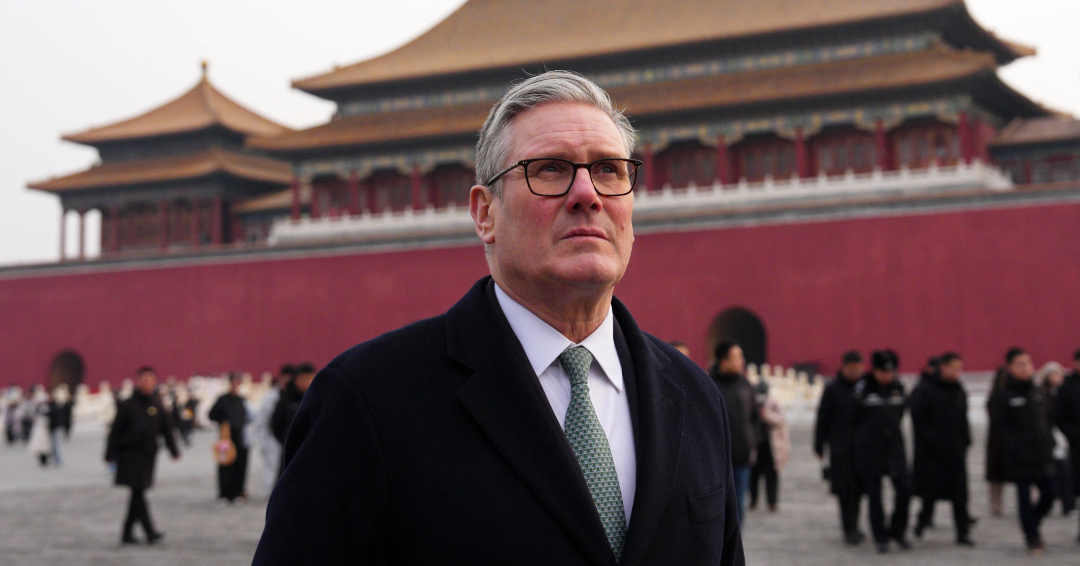
Keir Starmer arrived in Beijing on 28 January 2026 accompanied by nearly sixty British business executives — the largest such delegation in a decade. He met President Xi Jinping in the Great Hall of the People, toured the Forbidden City, addressed the UK-China Business Council, and announced his desire for a "sophisticated relationship" with the world's second-largest economy.
The visit was the first by a British Prime Minister since Theresa May travelled to China in 2018. The intervening years had seen relations deteriorate sharply: the imposition of a national security law crushing Hong Kong's autonomy, the detention of British citizens on political charges, the sanctioning of British parliamentarians, credible allegations of Chinese espionage operations on British soil, and Beijing's refusal to condemn Russia's invasion of Ukraine.
Against this backdrop, the achievements of the visit were, ahem, modest.
- China agreed to reduce whisky tariffs from ten percent to five percent — a concession worth, by government estimates, hundreds of millions over time.
- British tourists gained visa-free access to China for stays under thirty days.
- Beijing lifted sanctions it had imposed on British MPs in 2021 for criticising human rights abuses in Xinjiang — sanctions which should never have been imposed and whose lifting represented the return of stolen property rather than a genuine concession.
- AstraZeneca announced fifteen billion dollars in Chinese investment to 2030. The announcement was made during the visit. The investment had been planned regardless.
What Britain did not obtain is easier to enumerate.
Jimmy Lai, a 78-year-old British citizen and founder of Hong Kong's pro-democracy Apple Daily newspaper, has spent five years in detention — including more than 1,800 days in solitary confinement — on charges of "colluding with foreign forces" for the crime of publishing articles critical of Beijing. He was convicted in December 2025 and faces the possibility of life imprisonment. His son, speaking in London, described his treatment as "torture" and called on the government to make his release a precondition for closer relations with China.
The Prime Minister raised the case with Xi Jinping. Downing Street declined to confirm whether he actually requested Lai's release or merely "raised" the situation — a distinction diplomats understand and the public should notice. The government's position calling for Lai's immediate release "has not changed." Jimmy Lai remains in prison.
The Uyghur genocide continues. International tribunals have documented forced sterilisation, mass detention, and cultural erasure amounting to crimes against humanity. British supply chains remain entangled with forced labour in Xinjiang. No concrete measures addressing this were announced.
Chinese espionage against British institutions continues. MI5 reports disrupting Chinese state-backed threats on a weekly basis. No framework for addressing this systematically emerged from the visit.
Beijing's material support for Russia's war in Ukraine — including the purchase of sanctioned Russian oil and the supply of dual-use technology sustaining Moscow's military production — went unremarked in any joint statement.
The Prime Minister returned to London speaking of "warm" meetings and a "level of engagement" that exceeded expectations. Critics observed the warmth flowed in one direction. The engagement consisted of Britain offering diplomatic normalisation while China offered visa stamps and whisky tariffs.
Donald Trump, asked about the visit while attending a film premiere in Washington, offered his assessment: "Well, it's very dangerous for them to do that."
The President was not engaging in hyperbole. He was describing reality.
V. The Matter of Character
The episodes enumerated above might be explained by misfortune, misjudgment, or the ordinary failures of complex government. Taken individually, each admits of innocent interpretation. The embassy approval followed planning procedure. The prosecution collapsed due to systemic failures. The Chagos treaty reflected international legal pressure. The Beijing visit pursued legitimate commercial interests.
Taken together, the pattern admits of fewer innocent interpretations. Every decision tilted the same direction. Every judgment favoured the same party. Every failure produced the same beneficiary.
The question is not whether Keir Starmer is corrupt. No evidence to date suggests personal financial benefit or hidden inducement. The question is not whether he is ideologically sympathetic to Chinese communism. The question is not whether he has been captured by Chinese influence operations in the manner sometimes alleged of European politicians. British security services would presumably know and would act – we hope.
The question is whether Keir Starmer possesses the capacity to think strategically — to weigh permanent national interests against procedural compliance, to distinguish between adversaries and partners, to understand some decisions cannot be justified by process because their consequences transcend process.
His biography suggests he does not. According to the man himself, he does not dream.
In 2007, before entering public life, Starmer worked pro bono alongside Richard Hermer — former Searchlight magazine supporter and communist agitator, now his Attorney General — on a case called Al-Skeini v Secretary of State for Defence. The case successfully argued the European Convention on Human Rights applied to British forces operating in Iraq. The legal victory was followed by years of criminal investigations into hundreds of British soldiers, many based on allegations later proven false or fabricated by the solicitor Phil Shiner, who was subsequently struck off and convicted of fraud.
The Iraq Historic Allegations Team, established to process claims generated by this litigation, cost taxpayers approximately sixty million pounds over its lifetime. It secured not a single prosecution before being disbanded in 2017. Soldiers who had already been cleared found themselves reinvestigated. Families endured years of uncertainty. One soldier, Sergeant Richie Catterall, was pursued for thirteen years over a shooting in which a judge ultimately ruled he acted in self-defence.
Starmer's role in Al-Skeini was limited — representing intervening human rights organisations on points of law rather than the Iraqi claimants directly. The point is not he bears personal responsibility for every subsequent abuse. The point is he chose, without payment, to advance arguments whose predictable consequence was subjecting British servicemen to years of legal jeopardy. The legal questions interested him. The institutional consequences did not enter his calculation.
The same intellectual architecture governs his approach to China.
When the question arose whether to approve a Chinese mega-embassy against security advice, a legal mind asks: Were planning procedures followed? Can the decision withstand judicial review? Are conditions attached? A strategic mind asks: Does this serve our national interest? What capability are we permitting an adversary to construct? What message does this send about our willingness to resist pressure?
When the question arose whether to provide evidence for an espionage prosecution, a legal mind asks: What was the formal designation of China at the time of the alleged offence? What evidentiary threshold must be met? Can the statement survive cross-examination? A strategic mind asks: Should we permit hostile intelligence operations against Parliament to proceed unpunished? What deterrent effect does this failure create?
When the question arose whether to surrender sovereignty over strategic territory, a legal mind asks: What did the International Court of Justice advise? What obligations arise under international law? Can the treaty withstand legal challenge? A strategic mind asks: What permanent advantage are we relinquishing? How will this be perceived by allies and adversaries? What leverage are we surrendering forever?
Keir Starmer's mind is a legal mind. He cannot think strategically because nothing in his formation taught him to do so. He governs Britain the way he governed the Crown Prosecution Service — by following frameworks, satisfying thresholds, and achieving outcomes that can withstand review. The outcomes may be catastrophic for the national interest. They remain procedurally defensible, and that is all that matters.
VI. The Matter of the Nation
Britain at present faces an international environment more dangerous than any since 1945. Great power competition has returned. Russia wages aggressive war in Europe. China prepares for potential conflict over Taiwan. America under its current administration questions alliance commitments that were once axiomatic. The Middle East burns. Global supply chains that once seemed permanent reveal their fragility.
In this environment, other nations are adapting. Japan is rewriting its pacifist constitution to permit military expansion. Australia is acquiring nuclear-powered submarines. Poland is doubling its army. Germany is rearming for the first time since 1945. South Korea is reconsidering its nuclear posture. These nations have concluded capability matters more than compliance — power must be built before rules can be enforced.
Britain is moving in the opposite direction.
Britain under Keir Starmer approves hostile embassies against security advice, collapses espionage prosecutions to avoid diplomatic inconvenience, surrenders strategic territory in compliance with advisory court opinions, and dispatches its Prime Minister to Beijing bearing gifts and asking nothing serious in return.
This is not foreign policy. It is administrative processing applied to questions of national survival.
The pattern is not ambiguous. The direction is not unclear. Every judgment tilts one way.
The verdict belongs to the British people, who did not consent to become Beijing's compliance partner. Who did not vote for a Prime Minister who operates as China's barrister in Downing Street. Who did not agree to surrender permanent strategic advantages for temporary diplomatic atmospherics.
If the governing class cannot recover the capacity for strategic thought — if procedure has so thoroughly colonised their minds that power politics becomes literally incomprehensible to them — then the governing class must be replaced.
That is not a threat. It is a description of democratic accountability. It is what elections are for.