Desolemnising The Marriage Covenant For Scrap
Marriage was once a sacrament covenant witnessed and recorded by the state. Over two centuries, the British government quietly transformed itself from clerk to officiant, then to demolition contractor — and the human wreckage is measured in the "modernisation" of millions of fatherless children.
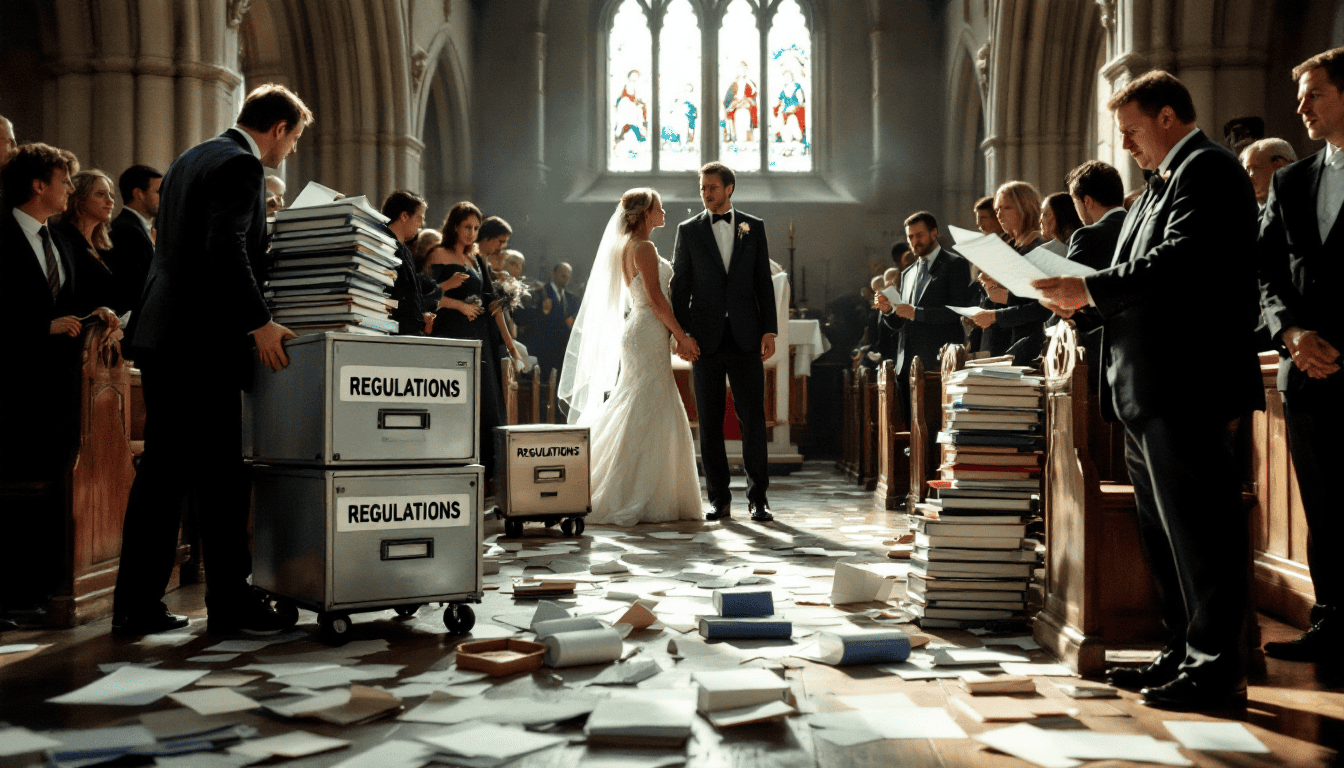
There is a moment in the life of every institution when the people running the filing cabinet decide they ought to be running the show. For English marriage, this happened with surgical precision across two years in the middle of the nineteenth century, and almost nobody at the time understood what had been lost.
Before 1836, the British state's relationship to marriage was essentially clerical. It had opinions about who could marry, under what conditions, and with what consequences for property and inheritance. But the act itself, the binding of two lives before God and community, belonged to the Church. The state's role was to record, to witness, and to enforce the legal consequences downstream. Think of a land registry: it does not build the house, does not design the rooms, does not choose who lives there. It notes the title. It stamps the deed.
The Marriage Act of 1836, operative from 1837, changed the architecture entirely. For the first time, couples could marry in a civil ceremony presided over by a state official — a superintendent registrar — with no clergyman present, no liturgy spoken, no transcendent authority invoked. The General Register Office, established in tandem, created a national bureaucratic infrastructure for vital events. The state was no longer merely recording what the Church solemnised. It was solemnising marriages itself, in its own buildings, under its own authority, in its own name.
One year later, in 1857, Parliament passed the Matrimonial Causes Act, which transferred jurisdiction over divorce from the ecclesiastical courts to a new civil tribunal. By 1858, the state could both create and dissolve the marital bond without reference to any authority beyond its own statutes. England had, in the space of two decades, undergone what can only be described as a constitutional re-platforming of marriage — from sacrament administered by priests and recorded by clerks, to civil status created and destroyed by government officials sitting behind government desks.
The land registry had begun building the houses.
Licence and the Banns
Before the state ever dreamt of officiating marriages, it perfected something subtler and more revealing: the art of requiring permission to hold one.
Medieval England inherited from the Church a system of marriage formation built on mutual consent. In principle, two people could bind themselves for life by simply declaring present intent — no priest, no witnesses, no paperwork. The theological logic was elegant: marriage was a sacrament between the couple and God, and no intermediary was strictly necessary. The practical consequences were catastrophic. Secret marriages produced inheritance chaos, bigamy flourished unchecked, coerced unions left no paper trail, and the ecclesiastical courts drowned in disputes over who had promised what to whom in a barn at midnight.
The Church's solution, formalised at the Fourth Lateran Council in 1215, was the reading of banns — public announcements made in the parish church on three consecutive Sundays before a wedding. The purpose was not romantic. It was forensic. Banns functioned as a community safeguard: if the groom was already married, if the bride was underage, if the couple shared prohibited degrees of kinship, someone in the congregation was expected to say so. Marriage was dragged from the private shadows into the public square, not to celebrate it but to police it.
But banns were slow, public, and inconvenient — particularly for anyone with money, status, or a reason to avoid three weeks of parish scrutiny. So a parallel mechanism emerged: the marriage licence. For a fee, and upon sworn oath before an ecclesiastical authority confirming no legal impediment existed, a couple could bypass the banns entirely. A financial bond backed the oath. If you lied, you paid. The licence was not a romantic concession. It was an administrative shortcut for the propertied classes — gentry, merchants, widows remarrying, mobile populations who could not easily satisfy the residency requirements of a parish reading.
The two tracks coexisted for centuries, serving different social strata but producing the same legal outcome. Banns were ordinary. Licences implied means. Both were ecclesiastical instruments, administered through the Church of England's courts even after the Reformation transferred supreme headship to the Crown. The English state governed marriage through the Church — a classic piece of institutional delegation, characteristically English in its preference for indirect control.
Lord Hardwicke's interesting Clandestine Marriages Act of 1753 transformed this arrangement from custom into statute. Designed to eliminate the epidemic of hidden marriages — ceremonies performed in lawless jurisdictions like the Fleet Prison, where unscrupulous clergymen married anyone who turned up with a fee — the Act made banns or a licence a statutory requirement for validity. Not a procedural nicety. A condition of existence. A marriage performed without them was not irregular. It was void. Parental consent became mandatory for minors. Formal ceremony and parish recording were required. England moved, in a single statute, from consent-based marriage to procedurally regulated marriage, and the licence — once a convenient ecclesiastical shortcut — became a component in a state-enforced system of marital validity.
The deeper logic was never sentimental. Marriage in eighteenth-century England determined legitimacy, land succession, title inheritance, and dynastic alliance. You cannot run a stable property society on ambiguous unions and midnight promises. Hardwicke's Act was not about love, or even about religion. It was about orderly transmission of wealth. The licence existed because the state needed to know who was married to whom — not to bless the union, but to protect the ledger.
This distinction matters enormously for everything which followed. The licence-and-banns system, even at its most bureaucratic, preserved a crucial boundary: the state set the conditions under which a valid marriage could be formed, but the formation itself remained an ecclesiastical act. The priest performed the rite. The parish kept the register. The state defined the rules and enforced the consequences. It was regulation, not officiation — the difference between a building inspector who certifies a structure and the architect who designs it.
When the Marriage Act of 1836 created civil marriage, it did not merely add a new venue. It erased the boundary entirely. The state ceased to be the inspector and became the architect. And in doing so, it inherited an authority it had never been designed to wield — the power to define, through its own ceremonies and its own officials, what a marriage actually is.
A Revolution Disguised as Administration
What makes the mid-Victorian shift so consequential is not its drama but its quietness. No mobs gathered outside Parliament. No bishops were defrocked. The Church of England retained its central role in most marriages for decades afterwards, and the cultural weight of the wedding ceremony — the white dress, the hymns, the vows spoken before a congregation — persisted long into the twentieth century. The state had inserted itself as an alternative authority, not a replacement. For the moment.
But something fundamental had changed in the underlying logic. Before 1837, marriage derived its authority from a source the state acknowledged but did not control: the sacramental tradition of the Church, rooted in centuries of canon law and theological reasoning about the nature of the conjugal bond. After 1837, a parallel track existed in which marriage derived its authority from the state alone. The vows spoken in a register office carried the same legal force as those spoken at an altar, but they carried nothing else. No theology. No congregation. No covenant language. Just two signatures, a witness, and a civil servant.
This is worth dwelling on, because the implications took a century and a half to fully unfold. When a society maintains two sources of marital authority — one sacred, one secular — the secular one will eventually dominate, for the simple reason that it asks less of its participants. A church wedding demands faith, community, preparation, and submission to a moral framework. A civil ceremony demands a fee and two forms of identification. In a culture moving steadily away from organised religion, the path of least resistance leads inevitably through the register office door.
By the eve of the First World War, Anglican marriage remained culturally dominant, but the architecture for its displacement was already in place. The state had become an alternative source of marital authority, and it had built itself a court system capable of dissolving what it created. The only remaining question was how quickly the culture would catch up with the legal machinery.
The Wrecking Ball Dressed in Compassion
If the 1836–1858 settlement gave the state the power to officiate and dissolve marriages, the century and a half which followed saw it exercise those powers with accelerating enthusiasm — always in the language of fairness, always with the vocabulary of compassion, and always with consequences nobody in the chamber bothered to measure until it was far too late.
The parliamentary record reads like the minutes of a demolition committee which never once discussed structural engineering. In 1839, the Custody of Infants Act had permitted mothers to petition for custody of children under seven — who were considered property of the father — providing the first statutory crack in the idea of marriage as a single indivisible legal unit. In 1870, the Married Women's Property Act declared money and property earned by a woman during marriage to be her own — another defensible reform, another brick loosened.
Then the pace quickened. The 1878 Matrimonial Causes Act allowed women who were victims of marital violence to obtain separation orders. In 1882, women gained absolute control over their own money and property. By 1909, a Royal Commission on Marriage and Divorce was sitting — the state now treating its own marriage laws as a subject requiring formal governmental inquiry, barely seventy years after it had first presumed to officiate the ceremony.
Each reform addressed a supposed injustice. Each was narrowly defensible. And each established a pattern so consistent it acquired the force of inevitability: every generation's Parliament loosening the bolts a little further, every debate conducted on the assumption the existing settlement was too restrictive, never once pausing to ask whether the cumulative effect might prove more destructive than any individual adjustment.
In 1923, the Matrimonial Causes Act made adultery by either spouse sufficient ground for divorce, removing a double standard. In 1925, grounds for separation broadened again. In 1926, Parliament introduced formal adoption procedures and allowed children to be legitimated by the subsequent marriage of their parents — the state now actively reclassifying family structures after the fact.
In 1929, the minimum age of marriage rose to sixteen. In 1937, divorce grounds expanded beyond adultery to include desertion, cruelty, sodomy, incest, and incurable insanity. By the late 1950s, the Wolfenden Committee was reviewing laws on homosexual activity and prostitution, and the state's interest in the sexual and relational behaviour of its citizens had swelled from record-keeping into something closer to comprehensive regulatory ambition.
Then came the rupture. The Divorce Reform Act of 1969, passed under Harold Wilson's socialist government and operative from 1 January 1971, replaced the centuries-old requirement to prove a matrimonial offence — adultery, cruelty, desertion — with a new and radically different principle: irretrievable breakdown aka irreconcilable differences. A couple could now divorce after two years of separation with consent, or five years without. The guilty-and-innocent framework, which had structured English divorce law since the ecclesiastical courts, was dismantled and replaced with what amounted to a managed cooling-off period.
Parliamentary researchers have explicitly connected the 1971 reforms to the sustained elevation in divorce rates familiar to every subsequent generation. A society which had treated marriage as a presumptively permanent status — exitable only upon proof of grave breach — had quietly redefined it as a durable but reversible arrangement.
The vows remained the same. The words "till death us do part" were still spoken in churches across the country. But the legal system behind those words now treated them as aspirational rather than operative. A promise of lifelong fidelity backed by a statute book which required only patience and paperwork to escape.
What followed was not reform but proliferation. In 1976, the Domestic Violence and Matrimonial Proceedings Act created new protective orders. In 1987, the Family Law Reform Act removed all remaining legal distinctions between children born to married and unmarried parents — a measure designed to protect children, but one which simultaneously eliminated a powerful structural incentive for marriage itself.
In 1994, the age of consent for sodomy dropped from twenty-one to eighteen, and later to sixteen via a perverse ECHR ruling which was aggressively rejected by the Upper House as unconstitutional.
In 2004, Blair's Civil Partnership Act created an entirely new state-administered relationship status, duplicating much of marriage's legal infrastructure under a different name for same-sex couples. In 2013, the Marriage (Same Sex Couples) Act distorted civil marriage to include same-sex couples in England and Wales, with the first ceremonies taking place in March 2014.
By 2019, civil partnerships had – absurdly – been extended to opposite-sex couples as well, meaning the state now administered two near-overlapping relationship statuses with subtly different legal architectures.
The final act came in 2022. The Divorce, Dissolution and Separation Act 2020, operative from 6 April 2022, completed the transformation by introducing genuine no-fault divorce. Neither party need allege wrongdoing. One spouse can end the marriage even if the other wants it to continue. The process is largely administrative, much of it conducted online. One partner files a statement of breakdown. A minimum period elapses. The marriage ends. No reason need be given. No defence can be mounted.
Marriage in England and Wales became, in strict legal terms, unilaterally terminable — a status you enter by ceremony and exit by form submission.
And the state is not finished.
In October 2025, the Ministry of Justice launched what it described as the most "significant overhaul" of marriage law since the nineteenth century (really) — a consultation on moving from a venue-based to an officiant-based model of marriage. Under the proposed reforms, legal marriages would take place on beaches, in forests, at heritage sites, wherever an authorised officiant happens to stand upright. The government's own press release framed this not in terms of solemnity or covenant but in the language of economic stimulus: £535 million injected into the economy and 12,000 new jobs.
This apparently addresses the "discrimination" and "inequality" towards "humanist" non-religion-religion, which really is absurd as it sounds. According to Humanists UK:
A humanist wedding is a non-religious ceremony that is completely personal to the couple and conducted by a humanist celebrant. It differs from a civil wedding in that it is entirely hand-crafted and reflective of the humanist beliefs and values of the couple, conducted by a celebrant who shares their beliefs and values.
Yes, the non-religious "humanists" want a religious Christian institution ceremony which is versioned on their "beliefs and values." One wonders when the inevitable regulator quango will appear.
Read the consultation documents and you will search in vain for a single reference to permanence, to covenant, to the welfare of children, or to the centuries of institutional weight the ceremony once carried. The language is relentlessly commercial: flexibility, choice, the wedding industry, untapped opportunities. Marriage, in the eyes of the twenty-first-century British state, is a consumer experience to be optimised for customer satisfaction and GDP contribution. The vows are set dressing. The venue is a revenue opportunity. The officiant is a licensed service provider. And the entire edifice can be dissolved, at either party's initiative, with less procedural friction than cancelling a mobile phone contract.
Consider what this means for the words spoken at the altar — or the beach, or the forest clearing, or wherever the authorised officiant happens to be standing with a clipboard and a lanyard. A promise of lifelong fidelity and partnership, carrying profound emotional and spiritual weight, spoken before witnesses who understand it to mean something permanent — and behind it, a legal system which permits either party to walk away for any reason, or no reason, after filling in a digital form.
The ceremony says "forever." The statute book says "until one of you decides otherwise, and here is the web portal." The dissonance is not subtle. It is architectural. And it has been constructed, brick by careful brick, over nearly two centuries, by a Parliament which has never once asked the only question worth asking: what is counterfeit marriage actually for?
The Contraceptive Earthquake
To understand how Britain arrived at a world in which nine out of ten marrying couples have already lived together — and in which cohabitation, aka common law marriage without the ceremony cost, is not merely common but essentially compulsory as a cultural expectation — you must look at a single decade which most social commentary skips over entirely.
Between roughly 1968 and 1982, British society underwent a series of structural shocks so profound they permanently altered the sequencing of adult life.
The most consequential was pharmaceutical. The contraceptive pill arrived in Britain in 1961, initially available only to married women. The Family Planning Act of 1967 (whose nomenclature is descended from Soviet central planning) began broadening access. By the early 1970s, reliable contraception was widely available on the NHS, and for the first time in human history, sex, partnership, and childbearing decoupled from one another as a practical matter.
The significance of this cannot be overstated. For centuries, pregnancy had functioned as a sensible marriage enforcement mechanism. Young couples who conceived were expected — socially compelled, often economically forced — to marry quickly. The "shotgun wedding" was not a joke; it was a demographic institution. Remove the threat of unplanned pregnancy, and you remove the single most powerful mechanism pushing young people into early marriage. What follows is not irrational at all. It is the predictable behavioural response of a population decoupled from a biological constraint which had shaped mating patterns since the Neolithic.
Simultaneously, the Divorce Reform Act of 1969 made the dissolution of marriage visible and ordinary. Children growing up in the 1970s watched neighbours, friends' parents, and sometimes their own families separate. Divorce lost its stigma with startling speed. And a generation exposed to widespread marital failure developed something economists would recognise immediately: commitment caution. If marriage might fail — if you had watched it fail, repeatedly, in the households around you — then testing compatibility before making vows was not cowardice. It was rational risk management.
In short, the rapid uptick in divorce fueled the risk management feedback loop which produced cohabitation, like a chain reaction.
Layer onto this the expansion of female higher education and workforce participation through the 1970s and 1980s. Marriage had always been partly an economic institution — an institution through which women accessed financial security and men accessed domestic labour. When women perceived they could support themselves, the economic logic of early marriage weakened drastically. Marriage stopped being the gateway to adulthood to be replaced, and became, instead, something you did once adult-childhood was already well established studying the humanities at university for an email job.
The institutional world adapted in parallel. By the 1980s, landlords routinely rented to unmarried couples. Mortgage lenders accepted joint applications regardless of marital status. The benefits system stopped assuming marriage as the default household structure. When every institution surrounding a social norm relaxes its enforcement, behaviour shifts rapidly. Statisticians call this a norm cascade — a process in which change accelerates once the pushback threshold drops below a critical point.
By 1994, ONS data shows 59.6 per cent of couples lived together before marriage. By 2017, the figure was 88 per cent. By 2022, it exceeded ninety per cent. Cohabitation had completed its journey from fringe behaviour to universal expectation in roughly thirty years.
And the ideology followed the behaviour: what began as a structural response to delayed marriage and reduced pregnancy risk was retrospectively rationalised as wisdom. "You should live together first" became a nonsensical piece of folk advice so ubiquitous it was rarely questioned — despite the evidence, as we shall see, being considerably less flattering than its advocates assume.
A Mortgage Is Not a Marriage
One of the most persistent and dangerous myths in modern British life is the belief, held by a startling number of cohabiting couples, long-term cohabitation confers the same legal protections and social/moral status as marriage. It does not. It has never done so. And the British government is explicit on the point: "common law marriage" does not exist in England and Wales, regardless of how long a couple has lived together or how many children they share.
This is not a technicality. It is a chasm.
A married spouse has automatic rights to a share of marital assets, pension sharing, spousal maintenance, inheritance tax exemptions, and next-of-kin authority in medical emergencies. A cohabiting "partner" has none of these by default. In the event of separation, a cohabiting lover who raised children, who contributed to a mortgage in their boyfriend's name, who built a shared life over decades, may find themselves legally invisible. The family courts have limited tools to help them. The law treats them, in most respects, as strangers.
The French have a name for this: concubinage. Being a concubine.
The irony is suffocating. A generation which delayed marriage in the name of caution — which insisted on "testing" compatibility, on "making sure," on treating commitment as something to be earned through years of cohabitation — often ends up in a legal position far more precarious than the one it was trying to avoid. The mortgage-is-more-binding-than-marriage crowd have it exactly backwards. A mortgage is a joint liability on a depreciating asset, resolvable by sale or refinance. Marriage is a legal status triggering an entire architecture of protections, obligations, and default rules built up over centuries.
Comparing the two is like comparing a gym membership to citizenship.
Parliamentary committees have flagged this perception gap repeatedly. Researchers and government bodies warn about the "common law marriage myth" and the exposure it creates for cohabiting families. And yet the myth persists, sustained by a culture which has absorbed the aesthetics of "partnership" — the shared home, the joint account, the children with hyphenated surnames — while rejecting the legal institution designed to protect it.
The Vow as Architectural Ornament
Do wedding vows carry any legal weight?
The answer is both simple and devastating. Marriage vows are not, and have never been, legally enforceable promises. You cannot sue your spouse for failing to love, honour, or cherish you. English law has never treated the words spoken at a wedding as a contract in the commercial sense. Instead, it treats marriage as a status — a legal condition the state recognises, like citizenship or adoption, with consequences attached to its existence rather than to the specific promises made at its creation.
The vows are the ritual gateway into the status. Not the enforceable content.
This has been true for centuries. So the question is not "did vows used to have legal force which has now vanished?" They did not. The question is more interesting, and more troubling: what made the vows feel binding?
The answer is friction.
Before the late twentieth century, marriage was intentionally expensive to exit. Divorce required proof of a matrimonial offence — adultery, cruelty, buggery, desertion — often established through humiliating court proceedings. It carried severe social stigma, economic danger, and reputational damage. The vow mattered not because a court would enforce the promise, but because breaking the promise cost enormously. Economists would call this a high-friction institution. High friction produces high commitment — not through moral purity, but through structural incentive.
Every reform since 1969 has reduced that friction. Breakdown replaced fault. Separation periods shortened. No-fault divorce eliminated the need for allegations entirely. The legal exit cost of marriage has been driven so close to zero the institution now depends almost entirely on personal conviction and social expectation for its durability — the very forces which have been weakening for decades.
The vows are still spoken. The words are unchanged. But the architecture behind them — the legal difficulty, the social consequences, the economic entanglement which once made "till death us do part" feel like a structural fact rather than a romantic aspiration — has been systematically degraded. What remains is a ceremony of extraordinary emotional power resting on a legal foundation of extraordinary fragility. An ornamental arch, still beautiful, stripped of the load it was built to carry.
The Evidence Nobody Wants to Discuss
There is a statistic in modern family research so uncomfortable it is almost never discussed honestly in public: across every society where divorce is liberalised, women initiate approximately two-thirds of divorces which break up relationships and families. This finding, drawn from longitudinal research including the widely cited How Couples Meet and Stay Together dataset, is robust, replicated, and studiously avoided by commentators who find its implications inconvenient.
It gets more uncomfortable. Data from ONS and Scandinavian registries consistently show female same-sex marriages dissolving at significantly higher rates than ordinary marriages or male same-sex marriages — in some datasets, roughly 1.5 to 2 times more often. Early Danish registry analyses established this pattern; later Nordic studies confirmed it; English and Welsh data point in the same direction.
The uncomfortable statistical truth is women divorce each other even more than they divorce men, or men divorce other men.
This correlates with highly increased domestic violence within same-sex pairing, and the other uncomfortable truth female-female domestic violence is staggeringly higher than any other category.
None of this is fringe research. It is mainstream demography, published in peer-reviewed journals, replicated across multiple Western countries. The question is not whether the data is real. It is what the data means.
Several mechanisms deserve serious attention. Modern marriage is built overwhelmingly around expectations of emotional reciprocity, communicative depth, and relational fairness — expectations research consistently shows women hold more intensely than men on average. When both partners in a female same-sex marriage hold these expectations at high intensity, the tolerance band narrows. Psychologists have documented this as a pattern: high emotional attunement can paradoxically produce higher conflict volatility. Relationships run hotter precisely because both parties are more emotionally invested.
Men, research suggests, are on average slightly more likely to tolerate lower relationship quality if the household is otherwise stable. Men remarry at higher rates than women after divorce. The partner market economics partly explain this — older men typically face a larger pool of potential partners — but the behavioural pattern is consistent: men appear more willing to re-enter the institution women are more willing to leave.
One piece of research is devastating.
Winning the lottery doubles the likelihood of divorce in female winners. In male winners, it predicts marriage and larger families.
When exit costs are low and expectations are high, the partner with higher relational standards is more likely to leave. If one designs an institution around emotional fulfilment and then removes every barrier to departure, one should not be surprised when the spouse who demands the most from the institution is also the spouse most likely to conclude it has failed.
This is simple institutional mechanics. And it has consequences measured not in academic papers but in millions of children growing up without a dad.
When "Due Diligence" Becomes Institutional Drift
Multiple studies have identified what researchers call the "cohabitation effect" — a correlation between premarital cohabitation and higher divorce risk. UK research has found this association, though it weakens across cohorts as cohabitation becomes more universal. Critics correctly note much of the correlation reflects selection: the sort of people who cohabited in the 1970s were demographically different from those who did so in the 2010s. Once you control for age at marriage, education, income, and religiosity, the raw effect diminishes.
But a residual mechanism persists in the literature, and it is deeply unflattering to the "test-drive" ideology. Researchers describe it as "sliding versus deciding" — the tendency for couples to drift into cohabitation for practical reasons (shared rent, convenience, a lease ending) and then drift onward into marriage through accumulated inertia rather than deliberate choice. Shared furniture, merged social circles, a joint tenancy, perhaps a pet — these create switching costs which make separation progressively harder, even when the relationship is mediocre. Marriage becomes the path of least resistance rather than the product of genuine discernment.
The irony is exquisite. A generation which rejected early marriage as impulsive — which insisted on years of evaluation before undertaking vows — often arrives at the altar through exactly the kind of unexamined momentum it claimed to be guarding against. The cohabitation was supposed to be the test. Instead, it frequently becomes the trap.
ONS data tells the other half of the story. Born in 1930, 51 per cent of men and 74 per cent of women were married by 25. Born in 1993, just 3.6 per cent of men and 7.5 per cent of women had married by 25. Median ages at first marriage have reached 32.7 for men and 31.2 for women — the highest on record. A decade-long gap now stretches between the typical onset of adult relationships and formal commitment. Cohabitation does not fill this gap with careful evaluation. It fills it with domesticity. And domesticity, as anyone who has shared a bathroom for five years can attest, is not the same thing as covenant.
The Quiet Counter-Evidence
If the trajectory described so far seems relentlessly bleak, there is a counter-current worth examining — not because it offers easy comfort, but because it reveals something important about which institutional features actually produce durable pair bonds.
Consider arranged marriages. Not forced marriages — the coercive practice rightly condemned and criminalised — but the structured introduction systems still prevalent in many South Asian, Middle Eastern, and East Asian communities, in which families vet potential partners, assess compatibility across economic, educational, religious, and temperamental dimensions, and present curated options to the marrying parties. These systems consistently produce lower dissolution rates than self-selection marriage markets.
The instinctive Western response is to attribute this to "stigma" and social pressure — to assume the marriages persist because the participants cannot leave. And in some cases, this is true. But it is not a sufficient explanation, because the same systems also feature strong extended-family support networks, shared economic infrastructure, clearer role expectations, and — crucially — selection processes which prioritise long-term compatibility over short-term emotional intensity.
The question arises: if marriage is deemed successful based on it being an "emotional" venture based on a "relationship," then why are arranged "loveless" marriages more successful?
In the language of institutional design, arranged marriage systems combine three features the modern Western model has systematically weakened:
- Rigorous selection (family vetting replaces individual romantic judgement).
- Thick support architecture (the extended family mediates conflict and provides material assistance), and
- High exit friction (social and economic costs of dissolution remain substantial).
Each of these independently predicts marital longevity. Together, they produce durable institutions almost regardless of the subjective romantic experience of the participants.
This is not an argument for importing arranged marriage into British culture. It is an observation about what makes institutions last — and a devastating implied criticism of a society which has simultaneously weakened selection (cohabitation as drift), dismantled support networks (nuclear family isolation), and reduced exit friction to near zero (no-fault divorce). Britain has, in effect, engineered the conditions for maximum marital fragility and then expressed surprise at the results.
There is another counter-current, closer to home. Divorce risk in Britain is now heavily stratified by education. University-educated couples who marry after thirty show very low dissolution rates — in some cohorts, lower than couples who married in the 1960s. Marriage among the educated and affluent appears to be quietly re-stabilising, even as it fractures elsewhere. Some statisticians describe this as a "marriage gap": the institution is becoming robust among those with the resources to sustain it, and fragile among those without.
This should alarm anyone who cares about social cohesion far more than any argument about tradition or theology. If stable marriage is becoming a privilege of the educated and wealthy — if the institution which most powerfully predicts child welfare is increasingly available only to those who least need its protections — then the state's century-long project of desolemnising marriage has produced not liberation but a new and vicious form of stratification.
The Philosophers Who Wanted the Family Dead
No honest account of marriage's desolemnisation can ignore the intellectual tradition which regarded the family not as a foundation to be strengthened but as an obstacle to be demolished. The men who supplied the theoretical ammunition did not hide their intentions. They published them.
Karl Marx was explicit. In the Communist Manifesto of 1848, he and Engels wrote with characteristic bluntness:
Abolition of the family! Even the most radical flare up at this infamous proposal of the Communists.
They did not flinch from the charge.
On what foundation is the present family, the bourgeois family, based? On capital, on private gain.
The bourgeois family, they declared, would "vanish as a matter of course" with the vanishing of capital. Bourgeois marriage was "in reality a system of wives in common" — the communists merely proposed to replace the "hypocritically concealed" version with an "openly legalised" one.
When accused of wanting to end the exploitation of children by their parents, Marx answered with four words: "To this crime we plead guilty." (Section II, "Proletarians and Communists".)
Engels was, if anything, more systematic. In The Origin of the Family, Private Property and the State (1884), he argued monogamous marriage had entered history not as a reconciliation of man and woman but as "the subjugation of the one sex by the other" — the first class oppression coinciding with the domination of the female sex by the male. Marriage existed to enforce patrilineal inheritance and concentrate property. Its abolition was therefore not incidental to the communist programme but structurally necessary: eliminate private property, educate children communally, and the two pillars of traditional marriage — the economic dependence of wife on husband and of children on parents — would collapse. An early Engels draft for the Manifesto, which was also titled "A Communist Confession of Faith," fully stated it with brutal clarity: communist society:
does away with private property and educates children on a communal basis, and in this way removes the two bases of traditional marriage.
This was not marginal pamphleteering. It was the foundational intellectual architecture of the most consequential political movement of the nineteenth and twentieth centuries. And its practical application came with startling speed.
Lenin followed in this disastrous tradition:
So long as woman is burdened with housework, her position remains a slave's.
In 1919, György Lukács — newly appointed Deputy Commissar for Culture in the short-lived Bolshevik regime of Béla Kun in Hungary — set about translating theory into policy. His target was not the economy. It was the classroom. Lukács reasoned with cold strategic logic: if Christian sexual ethics could be undermined among children, then both the family and the Church would suffer a crippling blow simultaneously. Stable societies built on family life and strong child protections do not, as a rule, produce revolutionaries. The task, therefore, was to destroy the conditions of stability.
He launched a radical "sex education" programme in Hungarian schools he labelled "cultural terror." Graphic literature was distributed to children. Lectures promoted promiscuity and instructed youth in sexual intercourse. Students were encouraged to deride and reject Christian moral teaching, monogamy, and the authority of both parents and clergy. The explicit goal was the annihilation of what Lukács called "the old values" — and the strategic instrument was the deliberate sexualisation of children as a wedge between generations. Sever the child from the parent's moral world, and you sever the transmission belt of an entire civilisation.
It would be crude to draw a straight line from Marx's study in the British Museum to a 2020s British register office and claim the entire desolemnisation of marriage was a Marxist plot. History does not work so neatly, and most of the MPs who voted for successive divorce reforms had probably never read a page of Lukács in their lives. But ideas do not need to be consciously adopted to be operationally effective. They need only to become ambient — absorbed into the assumptions of policymakers, educators, and cultural gatekeepers who have forgotten where the assumptions came from.
And the core Marxist propositions about the family — the family as a site of "oppression" rather than nurture; marriage as a mechanism of economic control rather than covenantal commitment; the education of children as properly a communal rather than a parental function; the treatment of inherited moral frameworks as obstacles to progress rather than the wisdom of accumulated experience — have become so thoroughly embedded in the institutional culture of the modern university West they no longer need to announce themselves as Marxist. They arrive dressed as compassion, or reform, or simply the way things are now.
Marx wanted the family abolished because it was the last institution the state could not fully control. Lukács understood the mechanism: go through the children. The British state has never formally adopted either programme. It has merely, across two centuries of incremental reform, achieved much of the same result — not by revolutionary decree, but by the patient, well-intentioned, democratically mandated erosion of every structural feature which once made the family difficult to dissolve and therefore worth building.
The State as Arsonist and Fire Brigade
Step back far enough and a pattern emerges from two centuries of British marriage reform which is as darkly comic as it is consequential.
The state inserted itself as an alternative marital authority in 1837, creating a secular path into a historically sacred institution. It assumed jurisdiction over dissolution in 1858, taking from the Church the power to adjudicate the ending of marriages. It progressively loosened the grounds for divorce through the twentieth century — equalising, broadening, and eventually eliminating the requirement to prove fault. It created an entirely new relationship status in 2005 with civil partnerships, duplicating much of marriage's legal infrastructure under a different name. It extended marriage to same-sex couples in 2014 and civil partnerships to opposite-sex couples in 2019, such that the state now administers two near-overlapping statuses with subtly different legal consequences. And in 2022, it completed the transformation by making divorce available on demand, without allegation, without defence, largely online.
At every stage, the reforms were presented as progressive, compassionate, and necessary. And at every stage, the cumulative effect was to strip marriage of the very features — permanence, difficulty, solemnity, consequence — which had made it function as a durable institution for the raising of children and the structuring of adult life.
The state is now simultaneously the body which officiates marriages, the body which dissolves them with minimal friction, the body which administers alternative statuses competing with them, and the body which funds the social consequences when they fail — single-parent support, child welfare services, housing assistance, family courts. It is the arsonist and the fire brigade. It lights the match with one hand and reaches for the hose with the other, and at no point does anyone in the machinery pause to notice the absurdity.
Meanwhile, the people at the centre of this — the couples standing in register offices or churches, the children born into households of uncertain permanence, the men and women navigating a legal system designed to make commitment easy to enter and easier to leave — bear the full human cost of an institutional architecture constructed by people who never have to live inside it.
The Covenant or the Clipboard
Marriage is not a government service. It is not a tax status. It is not an administrative convenience or a lifestyle accessory or a cultural ritual stripped of content and offered as an optional extra alongside civil partnerships, cohabitation agreements, and whatever new hybrid the next Parliament invents.
Marriage is — or was, before a century and a half of state interference reduced it to a form with a fee — the foundational institution of human civilisation. Every enduring society in recorded history has built itself around some version of the permanent pair bond, formalised publicly, embedded in religious or communal obligation, and structured to prioritise the welfare of children over the convenience of adults. This is not sentimentality. It is anthropological bedrock. Societies which fail to transmit stable family structures to the next generation do not last. They produce atomised populations, dependent on the state for functions once performed by kin, progressively incapable of the sustained cooperative effort on which every complex civilisation depends.
The data is not ambiguous. Children raised in stable two-parent homes outperform, on virtually every measurable dimension, children raised in fragmented households. This is not a finding from one ideological tradition. It is replicated across decades of research, in multiple countries, using multiple methodologies. Family stability is one of the strongest predictors of child welfare known to social science. And family stability is precisely what British marriage policy has spent two centuries systematically undermining.
We have arrived, through incremental reform and institutional drift, at a settlement in which marriage vows are ceremonially grand and legally weightless; in which cohabitation is the universal pathway into a commitment almost nobody treats as permanent; in which one partner can dissolve the union without the other's consent, without alleging wrongdoing, by completing a digital form; in which the state simultaneously officiates, dissolves, and funds the wreckage of an institution it has hollowed out from the inside.
This is not modernity. It is institutional vandalism performed in slow motion over seven generations, each Parliament congratulating itself on its compassion while the rubble piled higher around the children nobody consulted.
The question is not whether we can return to 1837. We cannot. The question is whether Britain is prepared to admit what has been done — to look honestly at the evidence, to acknowledge the relationship between institutional friction and family durability, to stop pretending the progressive dismantling of every mechanism which once made marriage difficult, consequential, and therefore meaningful was an unqualified good.
The covenant has been reduced to a clipboard. The vows have been drained of structural weight and filled with sentiment. The state has made itself the author, editor, and shredder of a document it should never have been allowed to write.
And in every town in England, in every housing estate and every suburb and every village, the children of this experiment are growing up in the wreckage — not because their parents were wicked, but because their country built an institution designed to fail and called it freedom.