Eight Days.
Britain has no missile defence. Its nuclear warhead factory is seven years late. A special forces death squad was covered up for a decade. Its soldiers come home to mould. And in a NATO war game, the ammunition ran out on day eight. The Navy only has 15 ships. But we have 29 quangos.
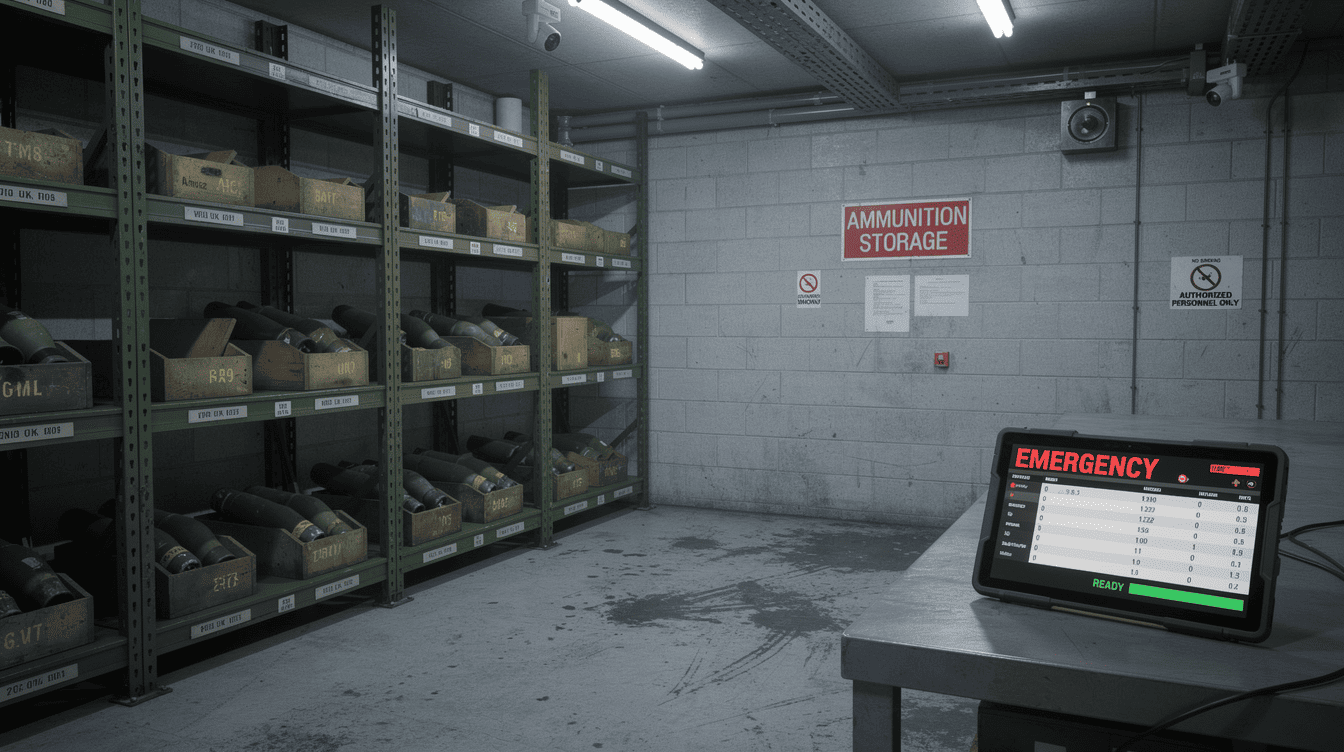
In 2021, British forces joined a NATO war game alongside their American and French counterparts. The British Army ran out of critical ammunition after eight days. The exercise was designed to last ten.
The figure comes not from a classified document or a leak. It comes from General Ben Hodges, former commanding general of United States forces in Europe, who cited it publicly. The quality of British forces, he said, was superb. The quantity was:
wholly inadequate for all the things I expect His Majesty's government requires of the military.
Replenishment timelines run to years. Industrial capacity to surge production does not exist. The domestic munitions base was sized for peacetime efficiency, not wartime consumption. Britain's 2025 Strategic Defence Review acknowledged the problem and earmarked £1.5 billion for six new munitions factories – but not for us; for Ukraine. The factories have not been built yet. The phrase the government used was "hollowing out." The implication was inadvertent: the hollowing out had already happened.
The British Army stands at approximately 72,000 trained personnel, its smallest since the Napoleonic era, and is currently recruiting five replacements for every eight who leave. It fields 288 Challenger 2 tanks on paper. In 2023, only 157 were assessed as available for operations within a 30-day period. Many of the rest are in storage, being cannibalised for spare parts. Only 148 are being upgraded to the Challenger 3 standard, with initial operating capability expected in 2027. The Army retired its AS90 self-propelled artillery in 2025, with no replacement in service.
The Royal Air Force has 107 Typhoon combat aircraft and approximately 47 F-35Bs delivered against a long-term commitment of 138. The Commons Library described the fleet as providing "a boutique high capability" that lacks numerical depth and an adequate attrition reserve. The F-35s have achieved roughly a third of their planned mission targets due to availability problems. The RAF is currently without airborne early warning aircraft: the Sentry was retired in 2021 and its replacement, the Boeing E-7 Wedgetail, has been delayed repeatedly. The Defence Select Committee described the gap as presenting "a serious threat" to UK operations. The MoD stopped publishing full RAF pilot numbers because the shortage was too embarrassing to report.
The Royal Navy has 13 major surface combatants, 6 Type 45 destroyers and 7 Type 23 frigates, plus two aircraft carriers. Maintenance and refit cycles mean only 6 to 8 of those destroyers and frigates are typically available. Each carrier requires a frigate escort the fleet can barely provide. The submarine fleet, 4 Vanguard-class for nuclear deterrence and 6 fleet submarines, is separately constrained by maintenance backlogs and crewing pressures.
Against Russia's current output of 250,000 artillery rounds per month, and NATO's own finding that its stockpiles fall short of the minimum 30-day requirement, these are not abstract concerns. In the first ten months of the Russia-Ukraine conflict, Russian and Ukrainian forces together lost over 2,000 tanks. The UK has fewer than 160 ready to fight.
A Sky with No Shield
In April 2025, Air Commodore Blythe Crawford, then head of the RAF Air and Space Warfare Centre, told the Royal United Services Institute simulations of Russia's initial missile strikes against Ukraine showed the UK could not defend itself against a comparable attack. A former general told the BBC the same year Britain does not have enough ground-based air defences to protect key military bases, let alone its towns and cities.
The reality of this has now come to settle its accounts: we cannot defend a single base in Cyprus and we cannot defend a single base in Diego Garcia from long-range missiles which may be capable of hitting London. The bureaucrats resorted to metrics – again.
Housing Secretary Steve Reed told the BBC there was "no specific assessment that the Iranians are targeting the UK - or even could if they wanted to", after the Israel Defense Forces (IDF) said on Saturday that Tehran had weapons that could reach up to 4,000km (2,485 miles).
The Royal Institute for International Security Affairs stated in 2025 UK ground-based air defence systems are "not currently equipped to be able to defeat many kinds of air threat." The Army's Sky Sabre medium-range system, designed as an expeditionary asset for forces in the field rather than a national shield, is the primary ground-based capability. Most of the Stormer short-range air defence vehicles were donated to Ukraine (Ed: !!!! what the hell is wrong with these people?). The programme to replace them was issued in May 2025, with a contract assessment phase running to December 2028.
Britain has no ballistic missile defence capability of its own. It relies on NATO's SM-3 batteries in Poland and Romania. It has no high-altitude interceptors. It has no equivalent to Iron Dome, THAAD, or the Patriot systems operated by close allies. Against the hypersonic and cruise missile threats Ukraine has faced since 2022, the UK mainland is, in the assessment of its own military experts, largely defenceless.
A £1 billion investment was announced in the 2025 Strategic Defence Review. No detail was provided. The Defence Investment Plan, which would have provided it, was still not published as of March 2026.
A Deterrent the State Cannot Maintain
Britain's independent nuclear deterrent, four Vanguard submarines carrying Trident missiles, represents the hardest possible limit of national defence. The capability a state maintains so that its ultimate destruction is too costly for any adversary to contemplate.
The infrastructure for maintaining that deterrent is failing.
Project MENSA, the facility at AWE Burghfield designed to consolidate warhead assembly and disassembly, was expected to be complete in 2017. It has been delayed more than seven years. Its original budget of £800 million has more than doubled to approximately £2.16 billion. The MoD declines to publish planned in-service dates on grounds of national security.
Project Pegasus, an enriched uranium facility at AWE Aldermaston, was paused in 2018 after an "overly complex technical solution" produced severe cost overruns. It restarted in 2021. The manufacturing element is now targeted for 2030.
The Office for Nuclear Regulation has given both AWE sites enhanced regulatory attention since 2013, citing "safety and compliance concerns, and the continued undertaking of operations in ageing facilities due to delays to the delivery of modern standard" replacements.
Why do we have a "regulator" for the government's own department, at all? Why?
In November 2025, AWE announced 400 to 500 redundancies. The same month, the National Audit Office qualified its opinion on the MoD's accounts because £1.5 billion in AWE legacy project costs had remained unchanged on the balance sheet for years, with no supporting evidence the assets existed in usable form.
The department responsible for maintaining Britain's nuclear deterrent cannot tell the nation's auditor what £1.5 billion of nuclear weapons spending was for.
The Soldiers the State Put on Trial
In May 2025, BBC Panorama broadcast testimony from more than 30 former members of British Special Forces describing the routine unlawful killing of detainees in Afghanistan and Iraq over more than a decade. Unarmed men. Handcuffed prisoners. At least one child. Squadrons keeping kill counts, competing against each other. Operation Northmoor, the Royal Military Police investigation launched in 2014 into more than 600 alleged offences, was closed in 2019 without a single prosecution, despite the proven permanent deletion of evidence. Its lead investigator later described it as "flawed and ineffective," conducted to give the appearance of investigation while suppressing the truth.
A judge-led public inquiry is currently under way. Senior officers testified concerns were raised with the Director of Special Forces as early as 2011. The response was an internal review the whistleblower described as "a little fake exercise." The killings continued for at least two more years.
Operation Northmoor is the military's version of the Single Assessment Framework swallowing 500 inspection reports. The institution whose accounts cannot be verified, whose deterrent cannot be serviced on schedule, whose ammunition lasts eight days, maintained for over a decade an internal culture in which unlawful killing was covered up at the highest levels and the machinery created to investigate it performed the appearance of oversight rather than its substance.
The form of accountability without its function.
Dozens Of Bodies and No Shield
The military doesn't need help from politicians to run its affairs. The Ministry of Defence has been usurping the armed forces with expensive, useless quangos for decades. Defence Equipment and Support, a 12,000-person organisation. The Defence Infrastructure Organisation. The Defence Nuclear Organisation. The absurd Submarine Delivery Agency. Strategic Command. The Defence Academy. The Defence and Security Accelerator. UK Defence Innovation. jHub Defence Innovation. The Defence Science and Technology Laboratory. The Military Aviation Authority. The Defence Safety Authority. The National Cyber Force. The National Cyber Security Centre. The National Space Operations Centre. The Service Prosecuting Authority. The Service Complaints Ombudsman. The Single Source Regulations Office, created to regulate the sole-supplier contracts that make up nearly half of all MoD spending because competition has largely ceased to exist. The Armed Forces' Pay Review Body. The Central Advisory Committee on Compensation. The Defence Nuclear Safety Expert Committee. The Scientific Advisory Committee on the Medical Implications of Less-Lethal Weapons. An Advisory Group on Military and Emergency Response Medicine. An LGBT Veterans Independent Review. A Nuclear Research Advisory Council.The censorious Defence and Security Media Advisory Committee. A UK National Authority for Counter-Eavesdropping.
Twenty-nine bodies and counting – at least. Hundreds of frameworks. Thousands of civil servants, programme managers, and compliance officers.
The ratio is not a quirk of timing. It is the logical endpoint of a model in which oversight expands to fill the space vacated by the capability it was created to support. Every body on that list exists because something went wrong. The Military Aviation Authority after air accidents. The Defence Safety Authority after safety failures. The Service Complaints Ombudsman after complaints went unaddressed. The Single Source Regulations Office after procurement abuse. Each body is a scar from a previous wound, given a budget and a chief executive and a communications function.
None of them fires a shell.
The Homes They Come Back To
The soldiers, sailors, and pilots who remain come home to accommodation assessed as a factor driving people to leave. Just a quarter of armed forces personnel expressed satisfaction with the quality of maintenance and repair of service family homes in the 2024 survey. Damp and mould cases rose from 3,780 in 2022 to 5,225 in 2023, a 40% increase in a single year. The Defence Committee described the conditions it found as "shocking." The Strategic Defence Review 2025 criticised "shoddy accommodation" as undermining morale and retention.
Until 2022, it was considered acceptable to allocate housing to families where damp and mould were already known to exist. The 36,000 service family homes were sold to a private company in 1996 and leased back at a cost that prevented investment in maintenance for nearly three decades. The government has now bought them back. It estimates total planned spending of £7 billion this Parliament.
The redundancies, the mould, the delayed deterrent, the empty sky, the missing audit: all connected. An institution optimised for process generates paperwork and frameworks and bodies with statutory remits. It does not generate maintenance schedules that work, or ammunition stocks the enemy cannot outlast, or an air defence system the country can rely on.
You can model a procurement pipeline. You can stand up an accelerator. You can publish a strategy.
When the ammunition runs out, none of those documents fire.
Tomorrow: the justice system has not collapsed suddenly. It has been filling up for years — cases stacking behind cases, remand prisoners behind remand prisoners, a probation service that cannot assess risk behind a prison estate that cannot hold people safely. The courts are now booked to 2030. The government's response is to abolish jury trial for offences carrying up to three years. Not as principle. As arithmetic.
- What was promised: a defence establishment fit for a leading NATO power
- What exists: eight days of ammunition, an undefended sky, and a nuclear warhead factory seven years behind schedule
- What happens when they meet: we find out.