For England To Live, Sir Humphrey Has To Die
Every five years, the British public marches to polling stations believing they are choosing who runs the country. They are choosing who holds the title. Britain's permanent bureaucracy has written itself laws making it unfireable, unreformable, and untouchable by any democratic process.


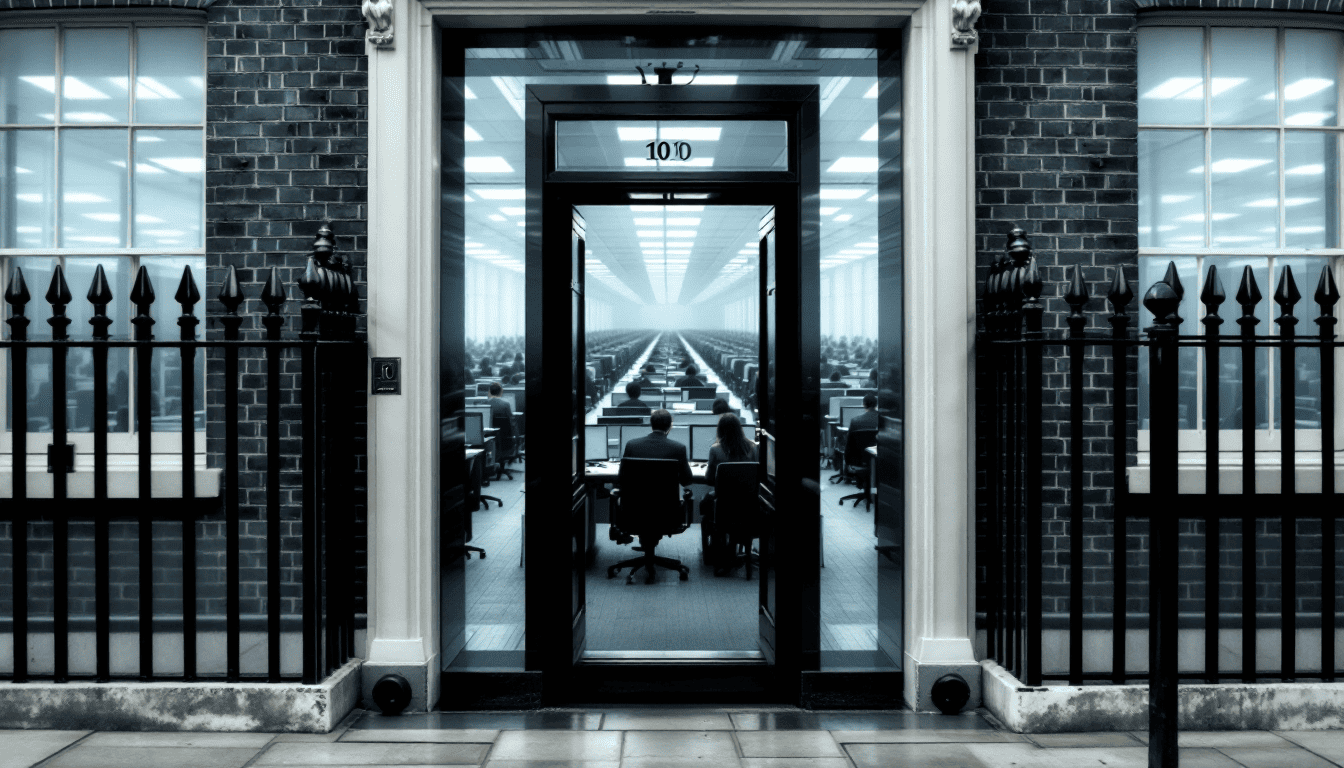
On the morning after every general election, the cameras gather outside a black door in Westminster to witness what the nation believes is a transfer of power. The new Prime Minister waves, steps inside, and takes possession of the most famous office in Britain. Red boxes appear. Permanent Secretaries arrive with briefing folders. The machinery of state hums into apparent motion.
Within weeks—sometimes days—the new occupant discovers the terrible secret their predecessors never shared publicly and the press has never properly examined. The office is a stage set where they are "housetrained." The levers of power are props. The instructions issued from behind the famous door travel into a bureaucratic labyrinth designed, with exquisite care over decades, to ensure they never emerge as action.
[The Civil Service phrase for making a new Minister see things their way is ‘house-training’. When a Minister is so house-trained that he automatically sees everything from the Civil Service point of view, this is known in Westminster as the Minister having ‘gone native’ – Ed.] – Yes Minister Diaries: A Satirical Look at British Politics
The Prime Minister commands Parliament.
Parliament no longer commands anything.
What the British public watches on election night is not the transfer of power. It is the rotation of figureheads. The permanent government—four hundred thousand officials whose jobs are protected by statutes they quietly drafted, administered by commissions they control, and defended by courts they have taught to see ministerial authority as suspect—watches each new arrival with the patience of an institution which knows it will outlast them all.
These people are not anonymous. They hide behind the shield of the perceived "unfairness" of receiving blame for ministerial decisions, despite being the authors of them. The size of the civil service has grown over 300% despite the rest of the population struggling with an unprecedented inflation crisis. At least 300 of them are paid more than the Prime Minister.
Nicholas Macpherson and Gus O'Donnell.are two of the worst, but there are plenty of others.
- Brexit sabotage: Olly Robbins, Michael Ellam
- Boriswave immigration: Philip Rutnam
- Covid lockdowns: Chris Wormald, Simon Ridley
- Two-tier justice: Matthew Rycroft, Simon Ridley, Antonio Romeo
This is not incompetence. This is not the inevitable friction of large organisations. This has been a calculated, documented constitutional soft coup, executed in slow motion over one hundred and seventy years, now so complete the usurpers can barely be bothered to hide it.
Failure: Where Do We Even Begin?
The "Rolls-Royce" of administration which is supposedly the "envy of the world" is, when looked at closely, a staggering catalogue of failure. Failure so deep and persistent it has killed a lot of people.
- Post Office Horizon scandal: Around 1,000 wrongful convictions, about 10,000 compensation claims, and at least 13 suicides.
- Infected blood, Orgreave, and repeated inquiries: Multiple investigations failed to reach root causes until sustained campaigning forced public inquiries.
- Iraq War decision-making (Chilcot): No one ensured ministers received proper legal advice and decisions were not properly recorded.
- Independent Committee on Standards in Public Life: Reluctance to listen to concerns, failure to identify emerging issues, and failure to learn from past mistakes.
- Civil Service pension crisis: 90,000 retirees faced hardship due to payment delays.
- Universal Credit “policy reset”: disaster, everywhere.
- £40bn worth of state IT failures: 50 years of incompetence.
- Windrush scandal: wrongful detention, deportation, and denial of rights (like work, for thousands of Commonwealth citizens.
- Hillsborough cover-ups: 600 people compensated for institutional obstruction of justice.
- Grenfell Tower: 72 people dead.
- Endless whistleblowing about the MoD: abuse, criminality, and chaos.
- Redacting documents with AI: huh?
- Edinburgh Tram: cost overruns, schedule delays, and benefits falling short
- And this goes on, and on, and on, and on.
It just keeps going, and the D-notices keep on ensuring these things don't appear too prominently in view of the British public. If they do, the men in black vans turn up with special equipment for the national interest.
We could also look at MI5's election-rigging, chemical warfare experiments, soviet spies, colonial document shredding, foreign coups, forced expulsions, internment torture, it just goes on forever.
And that doesn't come close to the 40-page dossier given to ministers detailing horrific sexual abuse by public figures which went "missing."
How They Built the Fortress
The genius of the administrative takeover lies in its apparent reasonableness. No single reform created the present nightmare. Each step was modest, justified, and presented as good governance. Together, they constitute the most successful seizure of power in British history—achieved without a single shot, a single election, or a single moment the public could identify as the point of no return. Because the authors were English themselves.
It began with the infamous Northcote-Trevelyan reforms of 1854. Competitive examinations. Appointment by merit. Political neutrality. Permanence of office. Each principle defensible. The explicit purpose was preventing corruption and professionalising administration. Like all British failures, it failed from hubristic presumption: the implicit assumption civil servants would remain servants—advising and implementing, never commanding. That assumption was never written into law. It did not need to be. Everyone understood.
Victorian reformers feared three things: a) political patronage; b) American-style spoils; c) state collapse every election. They concluded a state which can be purged can be captured, so they made capture impossible — by anyone, including the electorate. Parliament decided democracy should control ends; bureaucracy should control means; and the two must never be allowed to merge.
From that point, the civil service was designed to be unfireable by politicians. Not accidentally.
Deliberately.
The unwritten understanding was quietly rewritten. The BBC documented it with multiple comedies.
Permanence of office, intended to prevent politically-motivated sackings, hardened into permanent tenure. Officials could not be removed for poor performance, for obstruction, for failure to implement policy, or for any reason short of criminal misconduct—and sometimes not even then. A job for life became a constitutional right.
Political neutrality, intended to ensure impartial advice, hardened into operational independence. Entire sectors of government were removed from ministerial direction: immigration enforcement, prosecution, public health, statistics, regulation. Each removal was justified by expertise. Each removal meant one more area where elected ministers could be blamed for outcomes they were forbidden to control.
Merit-based appointment, intended to prevent patronage, hardened into a closed guild. Ministers cannot appoint people who share their objectives. They inherit whatever the permanent establishment has selected. A new government arrives to find its own bureaucracy staffed entirely by people chosen by the previous regime's bureaucracy, selected for their compatibility with bureaucratic culture, and promoted for their skill at managing ministers rather than serving them.
Britain quietly evolved into this structure:
- The people elect lawmakers.
- The lawmakers appoint ministers.
- The ministers govern nothing directly.
- The administrators run everything permanently.
Britain did not create an unelected bureaucracy by accident. It created one to stop tyranny. The problem is tyranny has learned to wear a lanyard. Northcote–Trevelyan solved patronage corruption, but it has produced a new one: institutional capture without accountability. The civil service is a fourth branch of government with no recall mechanism. A permanent ruling class is incompatible with democratic legitimacy; a democracy cannot survive if the state has a never-ending elite who can thwart elected power without consequence, but neither can it if each election allows a purge.
By the late twentieth century, the fortress was largely complete. But the administrative class wanted more than practical immunity. They wanted legal immunity. They wanted their conquest written into statute, beyond reach of any future government which might attempt to reassert democratic control.
In 2010, they got it. Courtesy of Jack Straw and Willy Bach.
The Act Which Abolished Ministerial Authority
The Constitutional Reform and Governance Act 2010 deserves to be studied by anyone who wishes to understand how democracies die without anyone noticing. It placed the civil service on a statutory footing for the first time in British history. It sounds technical. It was revolutionary.
Before 2010, civil servants existed under the royal prerogative. Their position was customary, traditional, capable of being altered by determined ministers. After 2010, their position was legal, entrenched, and protected by courts whose entire training teaches them to side with process against politics.
Section 1 defines civil servants as serving "the Crown"—not ministers, not the government, not the electorate. The Crown is a legal fiction, a corporate entity existing independently of elections, manifesto commitments, or democratic mandates of any kind. Civil servants were formally converted from government employees into servants of an abstraction no voter can influence.
Section 2 created the Civil Service Commission quango—an "independent" body which polices appointments, hears complaints against ministers who pressure officials, and enforces the bureaucratic monopoly on hiring. It does not answer to ministers. It does not answer to Parliament. It answers to the statute the civil service effectively wrote for itself.
Section 5 makes the Civil Service Code legally enforceable. The Code requires officials to act with "integrity, honesty, objectivity, and impartiality." These words sound uncontroversial. In practice, "impartiality" means officials can refuse ministerial instructions by claiming implementation would compromise their neutrality. Obstruction became a legally protected activity.
Sections 10-14 require appointments "on merit on the basis of fair and open competition." Ministers cannot appoint people who will actually implement their policies. They must accept whomever the existing bureaucracy certifies as qualified—certification controlled by the bureaucracy itself.
The administrative class took its customary privileges, converted them into legal rights, created an enforcement body it controls, and presented the entire package as good governance reform. Parliament—distracted, ignorant, or complicit—voted it through. The conquest was complete.
The Man Who Cannot Fire Anyone
As the bridge between Monarch and Parliament, the Prime Minister of the United Kingdom is theoretically the most powerful person in British government, slightly behind the Cabinet Secretary. They command a parliamentary majority. They control the legislative timetable. They chair the Cabinet. They represent the nation abroad.
They cannot fire their own staff. Not merely because they are not their employees.
In 2023, Lord Maude published his Independent Review of Governance and Accountability in the Civil Service. It makes for horrifying reading.
The power to manage the Civil Service is by statute vested in the Prime Minister as Minister for the Civil Service. However there is no overall scheme of delegation for how this power is to be exercised in practice, whether by ministers and/or by civil servants.
Other than the accountability of civil servants to ministers, there is little external scrutiny of the Civil Service as an institution.
The nearly complete accountability that ministers have for their departments’ activities is out of alignment with their assumed authority to direct resources.
The Employment Rights Act 1996 grants civil servants the same protections as private-sector employees—unfair dismissal claims, constructive dismissal claims, tribunal access. Dismissal requires documented misconduct, incapability, or redundancy.
- "The minister has lost confidence in you" is not a lawful ground.
- "You are obstructing the manifesto the public voted for" is not a lawful ground.
- "You have spent three years delaying a policy your department was instructed to implement" is not a lawful ground.
A Prime Minister who attempted to remove an obstructive Permanent Secretary would face immediate judicial review, employment tribunal injunctions, Civil Service Commission intervention, and near-certain court-ordered reinstatement. The official would return to their desk, publicly vindicated, their authority over their supposed political masters conclusively demonstrated. The state would sue itself—and the state would lose.
That's before it even got to the Public and Commercial Services Union and its 169,420 members, the "impartial" group officially affiliated with Abortion Rights and the Cuba Solidarity Campaign. Which blends well with MI6 and its trans flags.
Permanent Secretaries—the most powerful officials in each department—are formally appointed by the Crown on advice of the Prime Minister. This sounds like authority. Examine the process:
- The Civil Service Commission controls who is eligible.
- The Cabinet Secretary controls the shortlist.
- Legal risk assessment determines which candidates will not trigger judicial review.
By the time a name reaches the Prime Minister, the choice has already been made. The Prime Minister may nominate. The Prime Minister cannot select. The Prime Minister certainly cannot remove.
In the United States, a President can fire any executive official who refuses to implement policy. The Supreme Court has held repeatedly—in Myers v United States, in Seila Law v CFPB— executive officers not removable by the President are unconstitutional. The elected executive controls the executive branch. This is considered the minimum requirement for democratic legitimacy.
In Britain, the opposite principle applies.
An official removable by ministers is, functionally, unconstitutional. Canada permits ministerial confidence dismissals. Australia permits them. New Zealand permits them. Britain—the mother of parliaments—has uniquely disabled its own elected government from controlling the state it supposedly runs.
The Cabinet Office: A Permanent Government Supervising the Temporary One
If the civil service is a fortress, the Cabinet Office is its command centre. Theoretically a coordinating body supporting collective Cabinet decision-making, it has evolved into something far more significant: the institution which manages ministers on behalf of the permanent state. It was created out of thin air in December 1916 from the secretariat of the Committee of Imperial Defence under Sir Maurice Hankey,
The Cabinet Office:
- Controls senior appointments across Whitehall
- Clears policy proposals before they reach ministers
- Coordinates departmental positions—ensuring the bureaucratic consensus is maintained regardless of what individual ministers want
- Manages communications—shaping what the public learns about government activity
When a new government arrives with transformative intentions, the Cabinet Office ensures those intentions are processed through endless consultation, diluted by interdepartmental compromise, delayed by risk assessment, and ultimately absorbed into whatever the permanent establishment was already planning to do.
New ministers are "onboarded" by the Cabinet Office. They receive briefings explaining what is possible. They are introduced to officials who will "support" them. They are given diaries filled with meetings designed to consume their time and limit their capacity for independent action.
Within weeks, most ministers have been captured—convinced their role is to manage the department's relationship with Parliament rather than direct the department's activity. Those who resist find their proposals delayed, their instructions reinterpreted, their briefings mysteriously leaked to journalists, and their colleagues quietly informed the minister is "difficult."
The Cabinet Secretary—head of the Cabinet Office—is sometimes called the most powerful person in Britain.
- Unlike the Prime Minister, the Cabinet Secretary cannot be removed.
- Unlike the Prime Minister, the Cabinet Secretary will still be in post after the next election.
- Unlike the Prime Minister, the Cabinet Secretary controls the information flows, appointment processes, and institutional machinery which determine what government can actually do.
The Prime Minister is the face. The Cabinet Secretary is the power. As Dominic Cummings so brutally described in his testimony labelling it a “dumpster fire”:
The Cabinet Office over a long period of time has accumulated more and more power – formal and informal; it’s become incredibly bloated; it’s acquired huge numbers of people, huge numbers of teams, particularly on the whole deep state/national-security side, [and] crisis management. It has become in all sorts of ways increasingly opaque and effectively invisible to any political figure – including the prime minister. So it was extremely difficult to know in No.10 who exactly in the Cabinet Office was doing what.
His description of the abject stupidity inside Downing Street is a spectacular read. Cummings is an eccentric genius with exceptional intellectual ability and a gloriously foul mouth. Exactly the type the English love – someone who can really insult you and explain why in great academic detail. Alongside (rightly) calling Boris a "fuckwit," consider these gems from our contemporary Blackadder / Tucker lovechild:
Mr Cummings was scathing about the performance of former health secretary Matt Hancock and in a WhatsApp to Boris Johnson urged him to sack the cabinet minister. He said that Mr Hancock was a “proven liar” and urged Mr Johnson to remove the “c*** in charge of the NHS”.
Lead counsel Hugo Keith KC read out a message in which Mr Cummings referred to Ms [Helen] MacNamara, he said: “We cannot keep dealing with this horrific meltdown of the British state while dodging stilettos from that c***.”
"Operational Independence": The Magic Words
A particular incantation deserves examination because it has become the constitutional anaesthetic of British democracy. When ministers attempt to direct policy in areas they were elected to control, two words are deployed with increasing frequency: operational independence.
- The Home Secretary is responsible for immigration. The Home Secretary cannot direct immigration enforcement. Operational independence.
- The Attorney General is the government's chief legal adviser. The Attorney General cannot direct prosecution decisions. Operational independence.
- The Health Secretary is responsible for the NHS. The Health Secretary cannot direct hospital management. Operational independence.
Each invocation of operational independence transfers power from elected ministers to unelected officials while leaving public accountability untouched. The Home Secretary is blamed when illegal immigration continues. The Health Secretary is blamed when waiting lists grow. The Justice Secretary is blamed when courts collapse. But none of them can issue binding instructions to the officials whose decisions produce these outcomes.
As Lord Maude points out:
The nearly complete accountability that ministers have for their departments’ activities is out of alignment with their assumed authority to direct resources.
The doctrine was constructed precisely to achieve this result. Officials wanted the protection of ministerial cover without the inconvenience of ministerial direction. They built a system where ministers absorb all blame while officials retain all power. Then they called it good governance.
The Executive Can't Execute
Can we dissolve the Cabinet Office? Yes, but the staff do not lose employment or authority. So the organisation disappears on paper —the powers do not. You can remove buildings, remove systems, and remove titles, yet the authority still persists because it is legal, not physical.
Can't we just fire the Cabinet Secretary? No. The Cabinet Secretary is appointed by the Crown, under statutory and contractual protection, and not movable by unilateral ministerial instruction. A minister cannot “post” them elsewhere like a private employee, because attempting to do so would be legally void. The individual remains Cabinet Secretary in law, regardless of where you send them.
Can we just take away key cards and delete their accounts? No. Because at that moment you are obstructing statutory office-holders, preventing execution of legal duties, and interfering with Crown servants in post. That is misfeasance in public office. Courts would intervene immediately — not politically, but mechanically.
Can ministers simply stop cooperating with the civil service entirely and order them to simply go home?
No.
The civil service does not require ministerial cooperation to exist. The minister requires the civil service to govern. The system is designed to ensure no minister can halt the state, even an elected one. Especially an elected one. Ministers are embedded inside the administrative state — not above it.
The minister has no authority to do this, because civil servants are not the minister’s employees; they are employees of the Crown under statute; and their offices exist independently of ministerial consent. So the instruction would be ultra vires (outside lawful authority). In law, it is void. Civil servants would be legally obliged to ignore it.
They would remain at work. If physically excluded, they would continue work remotely, document obstruction, and escalate internally. They are not subordinate to ministerial whim. The Cabinet Secretary would issue a formal notice stating ministers may not interfere with staffing, obstruction of administration is unlawful, and statutory functions must continue. The Attorney General would advise (formally, in writing) ministers have no power to suspend the Civil Service.
A court would almost certainly issue a mandatory injunction requiring cooperation because public administration must continue, harm threshold is immediate, and injunction standards are easily met. If the minister refused to comply, the minister — not the civil servants — becomes the lawbreaker. The court may issue a personal compliance order, hold the minister in contempt, fine them personally, or in extremis, refer for imprisonment.
The British constitution prioritises continuity of the state over democratic control of administration, and ensures physical control does not equal legal authority. This is a legitimate constitutional paradox, because if:
- Ministers cannot dismiss
- Ministers cannot suspend
- Ministers cannot bypass
- Ministers cannot refuse cooperation
Then the civil service is not merely administrative, it is structurally sovereign.
The executive does not control the administrative state at all. The machine does not require ministerial consent to exist. Parliament has bound the executive’s hands in advance. Parliamentary statute is the sole kill-switch. Everything else is theatre.
The Unspoken Bargain
Why do ministers tolerate this arrangement? The question seems obvious once asked, yet it is rarely examined. Surely elected politicians, arriving with mandates and majorities, would fight to recover the powers their predecessors surrendered?
Many do not fight because they do not understand what has been taken. They arrive imagining the civil service as a neutral instrument awaiting instruction. By the time they discover the reality, their window for action has closed.
Because our politicians are stupid.
They excel in the soft skills needed for social climbing, but are score low in raw IQ terms. They conflate achievement of position with accomplishment of excellence. It's the difference between the computer's cardboard box packaging and its CPU.
The civil service know it, we know it, and the only people who don't know it, are the politicians themselves.
Some do not fight because they fear the consequences. The administrative state has developed sophisticated antibodies against ministers who push too hard. Leaked memos appear in hostile newspapers. "Sources close to the department" brief journalists on ministerial incompetence. Legal advice materialises warning of judicial review. Other ministers receive quiet suggestions their colleague is "not a team player." The costs of resistance are made clear. Most choose acquiescence out of sheer cowardice.
But the deepest reason is darker. Many ministers prefer impotence to responsibility. The current arrangement provides a permanent alibi. When manifesto promises fail, ministers blame civil service obstruction. When policies collapse, ministers blame implementation failures beyond their control. When nothing changes, ministers express sympathy while privately grateful they cannot be held accountable for outcomes they never controlled.
A lot of the time, they are right. The trouble is taxpayers can never quite tell when.
Genuine authority would end this comfortable arrangement. Ministers who could direct policy would own its failures. Politicians who could fire officials would have no one else to blame. The permanent excuse would vanish. Westminster, if it were honest with itself, might admit many of its inhabitants prefer the theatre of powerless office to the burden of actual government.
The Evidence of Decay
If the administrative state delivered competent governance, its usurpation of democratic authority might be forgiven as a necessary trade-off. It does not. Britain is governed by officials who cannot be removed, implementing policies no one voted for, and the results are visible everywhere.
Housing costs consume ever-larger portions of household income because the planning system—operationally independent of ministers—refuses to permit construction at anything approaching the necessary scale. Ministers announce housebuilding targets. Officials process applications at whatever pace they choose. Targets are missed. Ministers are blamed. Officials are promoted.
Immigration continues effectively uncontrolled because enforcement is operationally independent of the Home Office. Ministers announce tough policies. Officials decline to enforce them. Numbers rise. Ministers are blamed. Officials remain in post.
The National Health Service absorbs record funding while delivering deteriorating outcomes because hospital management is operationally independent of the Department of Health. Ministers announce reforms. Officials implement whatever they were already planning. Waiting lists grow. Ministers are blamed. Officials collect performance bonuses.
Courts delay, prisons overflow, infrastructure stalls, productivity stagnates, and through it all, the permanent government maintains its procedures, its processes, its consultations, its risk assessments, and its imperturbable confidence it knows better than any elected politician what the country needs.
This is not expertise. This is institutional self-interest masquerading as expertise. The administrative class has optimised the British state for one objective above all others: its own perpetuation (Sir Humphrey: But what happens to US?). Everything else—economic growth, public services, democratic legitimacy—is subordinate to the permanent government's permanent survival.
Rewriting Bad Law Back To Sanity
Reversing the administrative conquest would not require revolution. It would not require purges, as desirable as they might be. It would require Parliament to do something it has not done in generations: assert its own supremacy over the institutions which have quietly supplanted it.
Three minimal amendments to the appalling Constitutional Reform and Governance Act would transform British governance, if spineless politicians can't summon the testicular fortitude to annul it entirely.
- First: rewrite Section 1. The current statute says civil servants serve "the Crown." Replace this with civil servants serving "the Crown acting through and under the direction of elected ministers." Eleven words which restore the constitutional order the administrative class spent a century dismantling.
- Second: insert a ministerial confidence power. Allow ministers to terminate senior civil servants where confidence has been lost, subject to compensation but without right of reinstatement. No misconduct requirement. No tribunal appeal on the merits. Pay them off and send them home. This power exists in Canada, Australia, and New Zealand. Britain is the outlier which disabled its own government.
- Third: abolish permanent tenure. Convert open-ended appointments to five-year terms renewable at ministerial discretion. Officials who serve well continue. Officials who obstruct leave. Simple. Democratic. Terrifying to those who have built careers on untouchability.
These changes would affect perhaps five hundred officials out of four hundred thousand—the senior leadership which sets departmental culture and controls implementation. Junior civil servants would remain protected. Supposed merit-based recruitment would continue, as an illusion at least. Whistleblowing protections would be unchanged – useless. The reform is surgical: removing the command structure of the permanent government while leaving the operational workforce intact.
The howling would be extraordinary. Constitutional experts would warn of politicisation. Newspapers would predict chaos. The administrative class would deploy every weapon in its considerable arsenal—leaked memos, legal challenges, coordinated resignations, apocalyptic briefings to sympathetic journalists. They would fight because they would understand, correctly, what was being taken from them: the power they have spent one hundred and seventy years accumulating, now being reclaimed by the democracy they subverted.
The Real Answer: Apoptosis & Institutional Mortality
Only Parliament has the authority to abolish the shadow government by asserting its own authority. Only statute can repeal statute. Healthy political systems allow institutions to die.
Not collapse — die.
There is a difference: Collapse is failure; mortality is design.
Paradoxically, mortality is an indicator of democratic vitality and health, in the way apoptosis is a signal of programmed lifecycle. Permanence means calcification. This fascinating concept is also biblical (which means, English).
Very truly I tell you, unless a kernel of wheat falls to the ground and dies, it remains only a single seed. But if it dies, it produces many seeds. (John 12:24)
How foolish! What you sow does not come to life unless it dies. (1 Corinthians 15:36)
The Roman Republic rotated offices aggressively. Some modern agencies sunset automatically. Corporate boards expire by rule. But bureaucracies tend naturally toward immortality unless constrained because organisations optimise for survival.
Every democratic state faces the same quiet danger: parts of its machinery cease merely to govern and begin instead to persist. Institutions are created to serve political authority, yet over time they acquire their own momentum — procedural, legal, organisational — until continuation becomes the default and redesign becomes exceptional. No conspiracy is required for this to happen. It is simply how large systems behave.
Like gardens, they get overgrown. And the vines calcify. We have seasons because the ground needs to be renewed and fallowed.
A healthy democracy therefore requires not only elections, but institutional mortality — the settled understanding no office, body, or administrative structure exists by natural right. Authority must remain conditional, offices held rather than owned, and continuation a matter of deliberate political choice rather than historical drift. Stability is valuable, but permanence is something else entirely. One produces competence; the other risks insulation.
The purpose of renewal is not destruction but authorship. A state must retain the visible capacity to redesign itself, to alter its administrative architecture when it ceases to reflect democratic intent. Citizens do not require constant upheaval to trust their system — but they must believe nothing has become untouchable. The moment institutions appear structurally irreversible, politics begins to feel ceremonial rather than consequential.
If we were to map out a skeleton bill which reflects this, it would elucidate the simple doctrine no public authority is presumed perpetual.
Clause 1 : Conditional Authority
- All public authority is exercised under law and remains subject to democratic control through Parliament.
- No office, institution, or administrative body shall be presumed permanent.
- Continuation of governing structures is a matter of political judgment, not administrative default.
Clause 2: Authority of Parliament
- Parliament affirms its authority to create, amend, consolidate, or discontinue executive structures as required for effective governance.
- Administrative bodies exist to execute law and policy, not to determine their own durability.
Clause 3: Establishment of An Executive Service
- The national administrative apparatus shall operate as the Executive Service, serving the Crown in execution of statute and under ministerial direction.
- The Service is administrative in function and shall not exercise autonomous policy authority.
- All prior functions continue except where modified by this Act or subsequent legislation.
Clause 4: Presumption of Review
- All executive bodies shall be subject to periodic parliamentary review at intervals not exceeding ten years.
- Following review, Parliament may renew, amend, consolidate, or dissolve such bodies.
- No institution shall continue indefinitely without affirmative legislative continuation.
Clause 5: Defined Terms
- Senior executive appointments shall be made for fixed terms not exceeding five years.
- Renewal requires demonstrated capability, ministerial confidence, and appropriate scrutiny.
- Appointment confers responsibility, not entitlement to continuation.
Clause 6: Termination
- Executive appointments may be concluded on grounds of capability, conduct, organisational redesign, or loss of confidence.
- Courts shall review such decisions only for procedural fairness.
- Administrative structure is a matter of political determination.
Clause 7: Renewal of Delegated Powers
- Standing delegations of legislative authority shall be subject to periodic parliamentary renewal.
- Delegated authority shall not persist indefinitely without review.
Clause 8: Advisory Record
- Significant policy decisions shall be accompanied by documented administrative advice and any material dissent.
- Such records may be disclosed in accordance with statutory obligations and national security considerations.
Clause 9: Obligation to Act
- Where statute requires administrative action within a defined period, failure to act shall require written explanation to the responsible minister and relevant parliamentary committee.
- Delay shall not function as an instrument of decision.
Clause 10: Structural Review
- Select Committees may examine executive organisation, tenure frameworks, and institutional performance, and recommend restructuring where necessary.
- Oversight includes the architecture of governance itself.
Clause 11: Institutional Design as Legislative Function
- In matters concerning the organisation of the executive, courts shall give substantial weight to Parliament’s intent regarding administrative structure and duration.
Clause 12: Governing Principle
- No person shall exercise enduring governing authority without defined accountability and lawful mechanisms of removal.
- The durability of institutions derives from continued democratic authorisation.
This simple doctrine would restore three ancient design features of resilient political systems:
- Offices are held, not possessed.
- Institutions justify their continuation.
- Authority flows from democratic authorship.
The State With Two Sovereigns
The British public faces a decision most do not yet know they must make. Either we accept elections as ceremonial occasions producing new faces for press conferences while the permanent government continues undisturbed—or we demand what every other major democracy considers the baseline of self-governance: control of the state by those the nation elects.
England cannot survive as a free nation if executive power is permanently held by an unelected clerisy insulated from dismissal, scrutiny, and consequence. The problem is not bureaucracy; it is administrative sovereignty. A state with two sovereigns—Parliament in theory and Whitehall in practice—will eventually lose its legitimacy, and legitimacy is the only non-violent glue a free country possesses.
Again, this principle rests in English Christian tradition:
No one can serve two masters. Either you will hate the one and love the other, or you will be devoted to the one and despise the other. (Matthew 6:24)
Parliament created this monster. Parliament fed it powers, wrapped it in statutory protections, and taught courts to treat ministerial authority as inherently suspect. Parliament can uncreate it. The legal mechanisms are straightforward. The constitutional authority is unquestionable. What is lacking is not means but will.
Every five years, millions of voters queue at polling stations believing they are choosing who governs Britain. They are choosing who holds press conferences. They are choosing who takes the blame. They are choosing who sits in offices where the telephones ring with instructions from officials explaining what ministers are permitted to do.
The civil servants do not queue. They do not need to. Their positions are protected by laws drafted by civil servants, enforced by commissions staffed by civil servants, defended by legal doctrines developed by lawyers who become civil servants. They have built a system which cannot be reformed from within because every mechanism of reform is controlled by those who benefit from the status quo.
The only force capable of breaking this system is the force which created it: Parliament, acting on an explicit mandate from the electorate. Not asking permission from the Cabinet Office. Not seeking approval from the Civil Service Commission. Not waiting for consensus among officials whose careers depend on preventing change.
Statute made the administrative state untouchable.
Statute can unmake it.
The Prime Minister commands Parliament.
Parliament commands nothing—until it chooses to. When it does, it is the glory of the world.
The permanent government has held power for longer than most voters have been alive. Its officials have seen off countless ministers, countless manifestos, countless democratic mandates. They are patient. They are skilled. They believe they will outlast this challenge as they have outlasted every challenge before.
They may be right.
But they may be wrong—if the British public finally understands what was taken from them, and decides to take it back.