It's Time To Learn Colonel Blotto
Why do parties like UKIP and Reform get millions of votes bur no seats, yet the SNP take the board? FPTP elections in Britain aren’t won by persuading everyone — they’re won by choosing where to fight. This strategic game was described in 1921. Its name is Colonel Blotto. You can play it in the pub.



In 1921, a French mathematician named Émile Borel sat down and invented a game. France had just crawled out of the most devastating war in human history, and Borel — who was not merely an academic but deeply embedded in French military planning — wanted to answer a question no general had ever been able to frame precisely: how should a commander distribute limited forces across multiple battlefronts against an intelligent enemy doing exactly the same thing?
He called his fictional commander Colonel Blotto. The name is a joke. "Blotto" is obviously English slang for paralytically drunk — a wry nod to the fog of war, the impossibility of perfect knowledge, the sheer overwhelm of having to make rational decisions when you cannot see what your opponent is doing. It is now part of a series of "Blotto" games which are highly challenging.
Borel could not fully solve his own game. The mathematics did not yet exist. It took John von Neumann's minimax theorem in 1928, and eventually the full apparatus of modern game theory emerging from the RAND Corporation during the Cold War, before Colonel Blotto could be properly understood. By the 1960s, nuclear strategists were using Blotto logic to decide where to point missiles. By the 1990s, economists were using it to model corporate competition. General solutions were only fully developed in the late twentieth century, through the work of David Blackwell, Lester Dubins, and Brian Roberson, and complex variants remain active research areas today.
But here is the part nobody tells ordinary British voters: Colonel Blotto is not a relic of military history or an academic curiosity locked behind university library doors. It is a near-perfect mathematical description of how British general elections actually work. And the vast majority of people casting ballots have never heard of it, never been taught it, and have no idea they are playing it every time they walk into a polling station.
This ignorance is not an accident. It is the single greatest obstacle to meaningful political engagement in Britain today.
The Game Itself: Ten Coins, Three Cups, and Everything You Need to Know
Forget the mathematics for a moment. Forget game theory. Forget politics entirely.
Sit down at a pub table with a mate. Each of you takes ten coins. Put three cups between you — a pint glass, a half, and a shot glass, whatever is to hand. These are your three battlefields.
Now, secretly, both of you distribute your ten coins across the three cups. You can split them however you like: four in one, three in another, three in the last. Or eight in one and one in each of the others. Or all ten in a single cup and nothing elsewhere. Any combination, so long as they add up to ten.
When you are both ready, reveal. Compare each cup. Whoever put more coins in a cup wins it. Whoever wins two out of three cups wins the round.
Play five rounds. By the second, something will start to nag at you. By the third, it will become obvious. By the fifth, you will have grasped — through your hands, not through a textbook — the deepest principles of strategic competition.
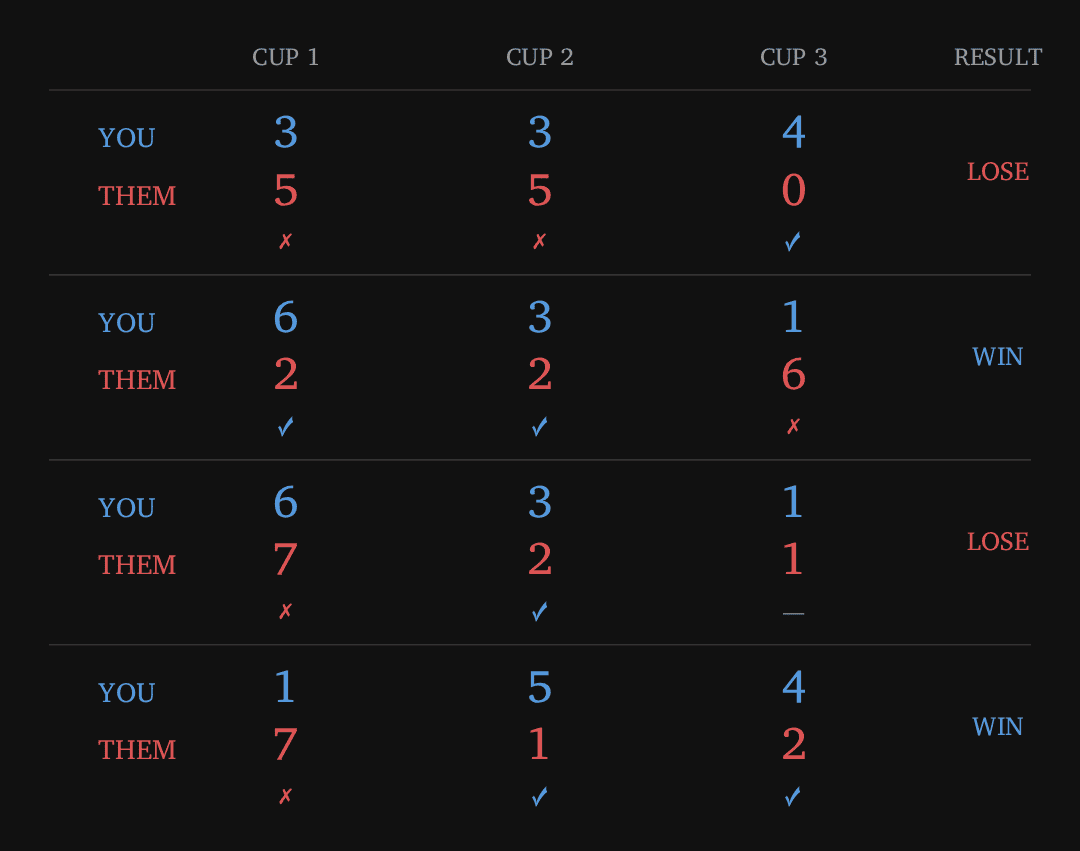
Here is what happens, every single time.
- Round one, most people spread fairly evenly. Three, three, four. It feels safe. It feels fair. And it works — until your opponent puts five in one cup and five in another and nothing in the third. They win two cups. You win one. They take the round despite having abandoned an entire battlefield. Your careful balance was a liability. Their reckless concentration was a weapon.
- Round two, you adjust. You concentrate more. Maybe six, three, one. Your opponent, having seen you spread last time, might try the same trick again — five, five, zero. Now you win the cup with six, they win the cup with five against your three, and you both have negligible force on the third. It is closer. It is messier. And you start to realise something uncomfortable: there is no perfect distribution. Every allocation you choose can be beaten by some other allocation your opponent might pick.
- Round three, you start trying to read your opponent. They put a lot in the first cup last time — will they do it again? You shift your weight to counter. But they anticipated your counter and shifted too. Now you are not just distributing coins. You are trying to think two moves ahead, modelling what your opponent expects you to do, and doing something else. This is the moment the game becomes properly strategic.
- Round four and five, something strange emerges. You start randomising. Not because you have given up, but because you realise predictability is fatal. If your opponent can read your pattern, they can beat it every time. The only defence against being read is to be genuinely unpredictable — to vary your allocations so no pattern exists to exploit. This is not chaos. It is discipline. It is the hardest and most counterintuitive lesson in the game: the optimal way to play is not to find the best fixed strategy, but to become impossible to predict.
Congratulations. You have just independently rediscovered what took some of the finest mathematical minds of the twentieth century decades to formalise. You have discovered mixed strategy equilibrium — the idea, proven by von Neumann and refined by generations of game theorists since, that in competitive allocation games, the winning approach is not a single allocation but a probability distribution across many possible allocations, chosen to make your opponent unable to exploit you regardless of what they do.
You did it with coins and cups in five minutes.
The Five Iron Laws of Colonel Blotto
Strip away the jargon and the mathematics, and what you discovered at the pub table reduces to five principles. These are not suggestions. They are laws — as unyielding as gravity, as ruthless as compound interest.
- First law: you cannot win everywhere. Ten coins across three cups means something must give. If you try to be strong everywhere, you are strong nowhere. Every coin placed on one battlefield is a coin stolen from another. This is not a tactical choice; it is an inescapable constraint. Resources are finite. Battlefields are multiple. You must choose.
- Second law: concentration beats distribution. The player who masses force on decisive battlefields and abandons the rest will, more often than not, defeat the player who spreads evenly. This is profoundly counterintuitive. Abandoning a battlefield feels like losing. It feels like giving up. But it is the prerequisite for winning the ones remaining. Sacrifice is not failure — it is strategy.
- Third law: winning by a landslide is waste. If you put eight coins in a cup and your opponent puts two, you win — but you win by six coins more than necessary. Those six surplus coins could have been deployed elsewhere, winning you a second or third cup. The optimal play is to win each cup by the smallest margin necessary and redeploy every spare coin to where it makes a difference. Efficiency, not dominance, is the goal.
- Fourth law: predictability is death. A fixed strategy, however clever, can always be countered by an opponent who knows what you will do. The moment you become readable, you become beatable. The only robust defence is structured unpredictability — varying your approach in ways your opponent cannot anticipate or exploit. This is why the mathematically optimal strategy is not a single allocation but a randomised mix of many allocations.
- Fifth law: the weaker player can win. This is the most explosive insight in the entire game. Even if your opponent has more coins than you — say, twelve to your ten — you can still win if you concentrate intelligently and they spread poorly. A player with fewer total resources who focuses them ruthlessly on decisive battlefields can defeat a stronger opponent who dilutes their advantage across too many fronts. Concentration does not merely help the underdog. It is the underdog's primary weapon.
These five laws are not merely academic observations. They govern every strategic contest where limited resources must be allocated across multiple fronts: warfare, business, law, career decisions, and — most immediately and most consequentially for everyone reading this — elections.
The Version Where Battlefields Are Not Equal
The pub version with three identical cups teaches the fundamentals. But real life is not three blank cups. Real life is messy, lopsided, and unequal. So let us make the game harder — and more honest.
Take a sheet of paper and draw ten boxes. Label them Seat A to Seat J. Now give each seat a "starting lean" — a number representing how much one side is already ahead before any coins are placed.
| Seat | Starting Lean |
|---|---|
| A | You +5 |
| B | Opponent +6 |
| C | Even |
| D | Opponent +2 |
| E | You +3 |
| F | Even |
| G | Opponent +4 |
| H | You +1 |
| I | Even |
| J | Opponent +3 |
Each player gets 20 coins. Coins shift the lean. If Seat D starts at Opponent +2, and you place 4 coins there while your opponent places 1, your net effect is +3 in your favour, overcoming the -2 lean and flipping the seat.
Play this version once, and something remarkable happens: you immediately stop caring about seats A and E. They are already yours. Extra coins there are wasted. You immediately abandon seats B and G. They are too far gone. Pouring coins in is futile. Your entire attention — every coin, every calculation — collapses onto the three even seats and the two close-leaning seats. C, D, F, H, I. These are where the game is decided.
You have just invented, through pure experience, the concept of the marginal seat. And you have just discovered why political parties ignore most of the country.
You Are Voting in One of 650 Tiny Wars
Ask the average person on the street how a British general election works, and they will say something like: "Everyone votes. The party with the most votes wins."
Wrong.
Britain does not hold one election. It holds 650 simultaneous, independent, local contests. Each parliamentary constituency elects one MP. Whichever party wins the most constituencies forms the government. The total national vote count is, constitutionally and practically, irrelevant. A party can win government with 35% of the national vote. Another party can receive millions more votes overall and sit in opposition. This is not a glitch. It is how the system is designed. It is called first-past-the-post, and it has governed Britain for centuries.
The structural equivalence with Colonel Blotto is exact:
- Each constituency is a battlefield. Campaign resources — money, leader visits, advertising, volunteer hours, candidate quality — are the soldiers. Winning a constituency is winning a battlefield. Winning a majority of constituencies is winning the war. And the total number of votes cast nationally, like the total number of soldiers across all battlefields, determines nothing on its own. Only the distribution matters.
- Winning a constituency by one vote gives you one seat. Winning it by 20,000 votes still gives you one seat. The extra 19,999 votes are wasted — they produce no additional power whatsoever. And losing a constituency by one vote gives you nothing, regardless of how many votes you received elsewhere.
Consider a football league. Two teams play 38 matches. Team A wins 20 of them by a single goal. Team B wins 18, but wins them 5-0, 4-0, 6-1. Team B scored far more goals overall. Team B was more dominant in every match they won. But Team A wins the league, because they won more matches.
British elections work identically. Seats are matches. Votes are goals. And winning the total goals scored column does not win you the trophy.
Why Parties Ignore Most of the Country
Each of the five Blotto laws maps directly onto electoral strategy, and once you see the mapping, you cannot unsee it.
- The first law — you cannot win everywhere — explains why no party campaigns equally across all 650 seats. They cannot afford to. Resources are finite. A party has one leader with a finite number of days in the campaign. It has a limited advertising budget. It has a limited number of strong, experienced candidates. Every hour the leader spends in a safe seat is an hour stolen from a marginal one. Every pound spent reinforcing a 20,000-vote majority is a pound unavailable to close a 500-vote gap.
- The second law — concentration beats distribution — explains why parties pour overwhelming resources into a small number of target seats. The Conservative Party in 2019 identified approximately 120 Labour-held marginals in the Midlands and northern England and concentrated everything on them. Leader visits. Advertising. Volunteers. Strong candidates. They did not meaningfully campaign in safe Labour seats in London or safe Conservative seats in the Home Counties. They picked their battlefields and fought there. Dozens of seats fell in a single night.
- The third law — winning by a landslide is waste — explains why parties do not try to maximise national vote share. Piling up an 80% majority in a safe seat produces no additional seats. It is strategically identical to sending a thousand soldiers to a battlefield already won by a hundred. Every surplus vote in a safe seat is a vote which, had it been cast elsewhere, might have swung a marginal. This is why vote efficiency — the ratio of seats won to votes cast — matters vastly more than raw vote totals.
- The fourth law — predictability is death — explains why parties use sophisticated modelling to vary campaign strategy. Modern campaigns run Monte Carlo simulations: thousands of projected election outcomes varying turnout, swing, tactical voting, and demographic shifts. They do not rely on a fixed playbook. They adapt constantly, reallocating resources as polling data shifts, probing for weaknesses, responding to their opponent's movements. Computational Colonel Blotto, in real time.
- The fifth law — the weaker player can win — explains how smaller parties can punch dramatically above their weight. The SNP in 2015 received approximately 1.45 million votes nationally — barely 4.7% of the UK total — yet won 56 out of 59 Scottish seats. Their support was geographically concentrated. Every soldier was on the same few battlefields. They won almost every fight they entered. UKIP, in the same election, received 3.9 million votes — nearly three times as many — and won a single seat. Their support was spread thinly and evenly across the country, concentrated nowhere. They committed the cardinal Blotto sin: a thin line across every battlefield, dominant in none.
The lesson is brutal and undeniable. In first-past-the-post, how your votes are distributed matters infinitely more than how many you have. Concentration beats magnitude. Geography beats popularity.
How Modern Campaigns Actually Compute Their Blotto Strategy
Behind the broad principles lies a precise computational apparatus. Modern campaign headquarters do not allocate resources by instinct or tradition. They operate as optimisation engines, running calculations equivalent to solving Colonel Blotto in real time with live data.
The process works in layers.
Layer One: Battlefield Valuation
Every constituency is assigned a win probability function — not a crude label like "safe" or "marginal" but a continuous estimate incorporating current vote share, expected swing, turnout probability, demographic volatility, and tactical voting likelihood. Seat A might sit at 48% win probability. Seat B at 62%. Seat C at 5%. These numbers are updated constantly as new polling data arrives.
Layer Two: Marginal Return Estimation
For each constituency, analysts estimate the marginal gain per unit of resource investment. The first £10,000 spent in a winnable marginal might shift win probability by 8%. The second £10,000 might add 5%. The third, 2%. The fourth, half a percent. The curve of diminishing returns is steep. Eventually, additional spending in a given seat produces almost nothing — every extra coin in a cup already overflowing with coins is pure waste.
Layer Three: Cross-Constituency Optimisation
Resources are allocated until the marginal return is equalised across all target seats. When the next pound spent in Seat A would produce less probability gain than the next pound spent in Seat E, resources flow to Seat E. This equalisation condition is the exact mathematical equilibrium of the Blotto game: you stop investing in one battlefield when investing elsewhere produces greater gain.
Layer Four: Simulation and Stress-Testing
Monte Carlo models project thousands of possible outcomes under varying conditions — different turnout levels, different swings, unexpected surges or collapses — and test whether the proposed allocation is robust. Not merely optimal in the expected case, but survivable in bad cases. This is minimax logic: maximising the minimum expected outcome, ensuring the party can still form government even if conditions worsen.
The resources being allocated are tangible: the leader's diary (each visit may shift a constituency's probability by 1-3%), regional advertising budgets, direct mail campaigns, volunteer deployments for door-knocking and voter registration drives, and candidate placement. Strong, experienced, charismatic candidates go into marginal seats. Safe seats — seats already won beyond doubt — often receive weaker candidates. The party cannot afford to waste its best people where the outcome is already decided.
Every serious political operation in Britain runs some version of this machine. The sophistication varies. The principle does not. They are all playing Colonel Blotto, whether they use the term or not.
Why Small Swings Produce Enormous Collapses
The most dangerous mathematical property of first-past-the-post is the nonlinear relationship between votes and seats. Understanding this is the difference between seeing election results as surprising and seeing them as inevitable.
Each constituency operates on a threshold: above 50% of the vote, you win the seat; below, you lose it entirely. There is no partial credit. No consolation prize. The relationship between vote share and seat outcome is not a gentle slope — it is a cliff.
Imagine the win probability curve for a single constituency. At 30% vote share, win probability is near zero. At 40%, it begins to rise. At 50%, it is a coin-toss. At 60%, it is near certain. The curve is steepest — the sensitivity is greatest — right around the 50% mark. A small shift near the threshold has enormous consequences. A small shift far from it has none.
Now consider a party holding 100 seats with the following margins: 20 seats at +15%, 30 at +8%, 25 at +4%, and 25 at +2%. Apply a uniform national swing of just 5% against them.
The 20 seats at +15% become +10%. Still safe. The 30 at +8% become +3%. Now dangerously exposed. The 25 at +4% become -1%. Lost. The 25 at +2% become -3%. Lost.
Fifty seats — half the total — gone. From a 5% swing. The relationship is savagely nonlinear. A modest, almost imperceptible shift in national opinion, when it pushes enough constituencies across the threshold simultaneously, produces catastrophic seat collapse.
And the collapse feeds on itself. Once formerly safe seats become competitive, the party must divert resources to defend them. Those resources are stripped from offensive campaigns in marginal seats held by the opposition. This weakens the attack, emboldens opponents, and exposes further seats to risk. More seats wobble. More resources are diverted. The spiral accelerates.
This is cascade failure. It is how the Conservative Party lost in 1997. It is how Labour lost in 2019. And it is the mechanism by which every dominant party in a first-past-the-post system eventually falls: not through gradual erosion, but through a sudden breach in the defensive line when too many seats cross the threshold at once and the resource allocation equation becomes unsolvable.
Optimal Strategy in a Fluid/Unstable Blotto Game
Everything discussed so far assumes a degree of stability — safe seats remain safe, marginals remain known, the battlefield map is broadly predictable. But what happens when stability breaks down? When formerly safe seats become competitive, when voter loyalties shift beneath the surface, when the established categories of safe, marginal, and hopeless dissolve into uncertainty?
This is where Colonel Blotto enters its most dangerous and most intellectually demanding regime. The mathematics shifts from static optimisation to adaptive probabilistic control under uncertainty. The strategies which worked in stable conditions become not merely suboptimal but actively destructive. And this is precisely the situation British politics appears to be entering.
- The first imperative is to abandon rigid classification. In stable conditions, labelling seats as safe, marginal, or hopeless is efficient shorthand. In unstable conditions, it is a trap. When the underlying voter distribution is shifting, yesterday's safe seat is today's marginal and tomorrow's loss. The categories must be replaced with continuous probability estimates — each seat treated as a live variable with its own volatility, its own sensitivity to investment, its own correlation with neighbouring seats. The map must become a heatmap, not a set of fixed territories.
- The second imperative is to allocate by probability gradient, not by category. The optimal target for resource investment is not "marginal seats" as a class, but specifically those constituencies where a small additional investment produces the largest change in win probability. This is the derivative — the rate at which probability changes per unit of resource. A seat sitting at 49% win probability where £10,000 shifts it to 55% is worth vastly more investment than a seat at 30% where the same money shifts it to 31%. The gradient, not the absolute level, determines allocation. In stable conditions, gradients are clustered predictably around the usual marginals. In unstable conditions, gradients appear in unexpected places — and vanish from expected ones.
- The third imperative is to hold strategic reserves. In stable Blotto, you can commit your full allocation before the battle begins. In unstable Blotto, conditions change faster than fixed plans can accommodate. The optimal strategy retains unallocated resources — a mobile reserve, in military terms — ready for rapid redeployment as the picture shifts. Rigid pre-commitment becomes a liability. Flexibility becomes a survival mechanism. This is why campaign "war chests" and late spending surges are not luxuries but necessities when the map is moving.
- The fourth imperative is to think in clusters, not individual seats. Constituencies are not independent. They are geographically and demographically correlated. If one seat in the West Midlands is swinging, its neighbours are likely swinging too. Stabilising a region — by investing in the most influential seats within a cluster — produces spillover effects on surrounding constituencies through shared media markets, shared volunteer networks, and shared voter psychology. The optimal unit of allocation in an unstable game is not the individual seat but the regional cluster. Winning or losing one seat in a cluster shifts the probability of its neighbours.
- The fifth imperative is to increase randomisation. When your opponent is also adapting — when both sides are reading live data and reallocating in real time — predictability becomes more dangerous than ever. The side whose moves can be anticipated will be countered. The optimal response is to increase the variance in allocation, making your campaign's deployment pattern harder to model and harder to counter. This is not indecision. It is deliberate strategic noise injected to prevent exploitation.
- The sixth imperative — and the hardest — is controlled retreat. When too many seats destabilise simultaneously, the resource equation becomes impossible: there is simply not enough money, time, or manpower to defend everything. Attempting to do so guarantees diffuse failure everywhere. The disciplined response is to triage ruthlessly. Identify seats which are past recovery and abandon them early, before they drain further resources. Concentrate everything on the seats where the outcome is still in play. Accept losses deliberately, in controlled fashion, to preserve decisive strength where it can still make a difference.
This is where most parties fail. The instinct — political, emotional, institutional — is to defend everything, to refuse to concede any seat, to fight on every front simultaneously. This instinct is catastrophic. It is the equivalent of a military commander reinforcing failure, pouring troops into a collapsing position rather than withdrawing to a defensible line. Every resource committed to a lost cause is a resource stolen from a winnable fight. - The seventh imperative is to exploit the opponent's defensive overstretch. When a dominant party is forced into defensive reallocation — scrambling to protect seats it previously took for granted — its offensive capacity collapses. Resources which would have been spent attacking are now spent defending. This creates opportunities. Seats which would have been heavily contested are suddenly undefended. A disciplined attacker, seeing the opponent's forces stretched thin, probes for weak points and concentrates where resistance has evaporated. The best moment to attack is precisely when the defender is most overwhelmed.
- The eighth imperative is to optimise for worst cases, not best cases. This is the minimax principle at the heart of von Neumann's original theorem. In unstable conditions, the temptation is to plan for the optimistic scenario — the scenario where your campaign message lands, turnout is favourable, and the swing falls your way. This is gambling, not strategy. The robust approach is to ask: what is the worst realistic outcome, and what allocation maximises my seat count even under those conditions? Maximising the minimum guaranteed outcome is not pessimism. It is the mathematically proven optimal approach under adversarial uncertainty.
When all eight imperatives are combined, the resulting strategy looks radically different from conventional campaigning. It is fluid rather than fixed. It is probabilistic rather than categorical. It accepts losses as the price of concentration. It values flexibility over commitment. And it requires a willingness to make decisions which look irrational to anyone observing a single battlefield in isolation but which are globally optimal when the full map is in view.
How Smaller Parties Can Shatter the Duopoly
Colonel Blotto contains one further insight with explosive implications for anyone frustrated by the two-party stranglehold on British politics: multiple weaker players can defeat a stronger one by coordinating their resource allocation.
At The Restorationist we've talked about the Cartel Effect and its legality before.
Imagine three opposition parties polling at 15%, 12%, and 10% in a constituency where the dominant party holds 38%. Individually, none can win. The dominant party takes the seat comfortably. But if two of those parties stand aside — formally through an electoral pact or informally through tactical voting — their supporters coalesce behind the third. The combined 37% comes within striking distance. Add differential turnout and you have a seat flip.
The mathematics are unambiguous:
Without coordination — votes split:
- Party A: 30%
- Party B: 20%
- Party C: 15%
- Dominant party: 35% → wins
With coordination — challenger unified:
- Combined opposition: 65% → wins easily
This already happens in Britain, albeit imperfectly. Labour voters in Liberal Democrat-facing constituencies sometimes switch to the Lib Dems to block a Conservative. Lib Dem voters do the reverse in Labour-facing seats. The effect is real and measurable. Where tactical coordination occurs effectively, vote-splitting is eliminated and dominant parties lose seats they would otherwise hold comfortably.
Formal electoral pacts — where parties explicitly agree not to stand candidates against each other in specific constituencies — would supercharge this effect. The SNP understood geographical concentration instinctively. UKIP never did. And the fate of both in 2015 illustrates the fifth law of Blotto as starkly as any academic paper ever could.
FPTP structurally punishes fragmentation and rewards consolidation. Smaller parties running candidates everywhere, spreading support thinly across all 650 constituencies, are committing the cardinal sin: a thin line of soldiers across every battlefield, dominant on none. Concentration — whether through pacts, tactical voting, or geographical focus — converts minority support into majority seats. It is the mechanism by which the weaker player defeats the stronger. And it is available to anyone willing to play the game with open eyes.
Why Your Vote Feels Pointless
Political apathy in Britain is real, deep, and growing. Millions of people believe elections do not matter. Millions more do not vote at all. The usual explanations trotted out involve disillusionment, distrust, a sense of powerlessness. These are symptoms. They are not the diagnosis.
The diagnosis is simpler: people do not understand how the game works.
If you believe elections are one big national vote, and your preferred party consistently fails to form government despite receiving millions of votes, of course you feel powerless. The system appears broken or rigged. UKIP's 3.9 million votes producing one seat looks like a scandal when viewed through the lens of national totals. Viewed through the lens of Colonel Blotto — through the logic of resource concentration across individual battlefields — it is entirely predictable. They spread thin and lost everywhere.
A voter in a safe seat — whether safely Labour or safely Conservative — has, in cold mathematical terms, far less influence over the outcome of government than a voter in a marginal constituency where the result is genuinely in doubt. This is not a moral judgement. It is a structural fact. It is the Blotto property of unequal battlefield value made tangible.
But knowing this changes everything. Once you understand the game, you stop asking "does my vote matter?" and start asking "where does my vote matter most?" You stop lamenting national vote shares and start examining constituency margins. You look up your seat. You find out the majority. You discover whether you live on a battlefield already decided or one where the next government will be won or lost.
And if your own seat is not where the action is, you know where to direct your time, your money, your energy, your conversations — toward the constituencies where every additional unit of effort shifts probability at the steepest gradient. You stop being a passive participant in a mystery and become a strategic actor in a game whose rules are knowable, whose dynamics are learnable, and whose outcomes are influenceable by anyone willing to engage with the reality of how power is actually allocated.
The Uncomfortable Truth About Power in Britain
Here it is, plainly. British governments are not chosen by the nation. They are chosen by a relatively small number of voters in a relatively small number of constituencies where the result is genuinely uncertain. Everyone else's vote — in the safe seats, in the hopeless causes — contributes to national vote share statistics and nothing else. It determines no seats. It shifts no power. It changes no government.
Parties know this. They have known it for decades. They spend their money accordingly. They deploy their leaders accordingly. They place their strongest candidates accordingly. Every serious political operation in Britain is, whether it uses the term or not, running a Colonel Blotto optimisation.
Voters, by and large, do not know this. They vote as if the election is one big national contest, are baffled when the result does not reflect the overall vote totals, and conclude the system is broken or pointless or rigged. And so they disengage. Turnout falls. Cynicism rises. The people who do understand the game — the party machines, the donors, the strategists — gain even more relative power, because they are playing with full knowledge of the rules while everyone else stumbles about blindfolded.
Stop Complaining About the Pitch and Learn the Rules of the Game
No school in Britain teaches children how first-past-the-post actually functions as a strategic system. No civic education programme explains why parties campaign where they do, why vote distribution matters more than vote totals, why safe seats exist, why marginal seats decide governments, or why tactical voting is not betrayal but basic arithmetic. The mechanics of power are left as a mystery, accessible only to those who seek them out or are initiated through party politics.
Colonel Blotto is not difficult. A child can play it with coins and cups. The insight it produces — you cannot win everywhere, concentrate where it matters, sacrifice where it doesn't — is immediately and viscerally obvious the moment you experience it. Five minutes of play delivers more genuine understanding of electoral mechanics than a lifetime of watching pundits on television.
The parties already play Colonel Blotto. The donors already play Colonel Blotto. The strategists, the pollsters, the data analysts — they all play Colonel Blotto. The only people who do not play Colonel Blotto are the voters themselves.
And until they do, they will keep losing a game they never knew they had entered.
Pick up ten coins. Set out three cups. Play. Then go find out what kind of seat you live in, what the margin was last time, and whether your vote is a wasted soldier on a battlefield already decided — or a decisive force on the ground where the next government will be won or lost.