Lockdown Must Never, Ever Happen Again — Ever
There are measures which may not be taken against a free people, even in an emergency or exigent circumstances. Lockdown was mass house arrest imposed by ministerial decree. England spent four centuries establishing limits on executive power. In 2020, we forgot why.
When state agents broke into the home of John Entick in 1765, ransacking his papers under a general warrant, Lord Camden delivered a judgment which echoes through every century since:
If it is law, it will be found in our books. If it is not to be found there, it is not law.
The principle is devastatingly simple. The state is not a magical creature possessed of inherent powers. It cannot conjure authority from thin air, nor from fear, nor from the say-so of advisers however credentialed. If the executive claims a power over the citizen, it must point to lawful authority for it. Otherwise what you have is not governance but trespass.
In March 2020, the British government claimed a power to confine the healthy. To forbid a son from holding his dying mother's hand. To criminalise sitting on a park bench. To send drones over the Peak District filming citizens from the sky to shame them into obedience. To make worship illegal, funerals impossible, and the ordinary rhythms of human life subject to ministerial permission.
By what right?
Not by Act of Parliament debated line-by-line in the Commons. The first English "lockdown" rules were given legal force through secondary legislation—Statutory Instruments—notably the Health Protection (Coronavirus, Restrictions) (England) Regulations 2020.
A free people were placed under movement and gathering prohibitions by ministerial regulation. The ancient liberties of Englishmen, purchased in blood across eight centuries, were switched off by a mechanism designed for technical amendments to drainage regulations.
Where were our barristers and jurists? Where were the constitution's guardians? Its teachers? Was not a single MP brave enough to explain hour hundred years of English history or what the government was doing it had no lawful authority to do?
Proclamation Power Returns in a Lab Coat
The Bill of Rights 1689 exists for a reason. It is not an old document, an anachronism, or a museum artifact. It is law. It declares, in terms impossible to misunderstand,
the pretended power of suspending laws or the execution of laws by regal authority without consent of Parliament is illegal.
Parliament did not invent this prohibition from theoretical anxiety. It was forged in the memory of actual tyranny—of Stuart kings who believed emergency and necessity could manufacture powers the constitution did not grant. The whole seventeenth-century struggle, the Civil War, the Glorious Revolution, the constitutional settlement itself, represented England's answer to a single question: may the executive suspend the ordinary freedoms of subjects by decree?
The answer was no. Emphatically, violently, conclusively no.
Yet in 2020 we witnessed the resurrection of precisely this pretended power, dressed in new costume. The proclamation no longer came sealed with the royal cipher; it came festooned with graphs and dashboards. The claim was no longer divine right but "following the science." The effect was identical: rule by announcement, coercion first, scrutiny later—if ever.
The Public Health (Control of Disease) Act 1984 contains an emergency procedure (45R) permitting regulations to come into force immediately, with parliamentary approval required afterwards. Ministers used this mechanism repeatedly. The result was government by emergency instrument: restrictions announced at press conferences, codified into law within hours, enforced by police who themselves did not understand what was and was not permitted.
This is not hyperbole. The Crown Prosecution Service reviewed every single prosecution brought under sections of the Coronavirus Act 2020 and found every one had been wrongly charged. Every single one. The Joint Committee on Human Rights warned Parliament many fixed penalty notices were likely unlawfully issued—and paid by citizens intimidated into compliance rather than informed of their rights.
When the law changes weekly, when enforcers cannot comprehend it, when penalties are levied and later admitted to be unlawful, you do not have rule of law. You have rule by confusion, which is worse than rule by decree because it adds caprice to coercion.
Necessity Is Not a Solvent for Fundamental Law
The nanny-state defence runs thus: we did this for your own good. We kept you safe. The emergency required it.
The English constitutional answer is brutally direct: you may not possess the power in the first place, and necessity cannot conjure it into existence.
In 1610, the Case of Proclamations established definitively the Crown:
hath no prerogative but that which the law of the land allows.
Emergency does not expand jurisdiction; it tests it. A government may respond to crisis with the powers it lawfully holds. It cannot mint new powers by declaring itself frightened.
Consider the grim logic of R v Dudley and Stephens in 1884. Shipwrecked sailors, facing certain death, killed and ate a cabin boy. The court refused necessity as a defence to murder. Even in extremis, English law declined to treat "it was necessary" as a moral solvent capable of dissolving fundamental prohibitions. The judges understood: if necessity can justify anything, it justifies everything—and then you have not law but expedience wearing law's robes.
Apply this principle to lockdown. Exigency can justify effort, speed, triage, resource mobilisation, targeted isolation of the actually infectious. It cannot justify converting free citizens into wards of state, criminalising ordinary life, and enforcing obedience as a public health instrument.
The government may warn, advise, inform. It may quarantine the contagious under narrowly defined circumstances with proper safeguards. What it may not do is claim ownership over adult risk decisions simply because death exists.
Death has always existed. Risk is the permanent condition of human life. A government empowered to eliminate all risk by restricting all liberty is a government with no limiting principle whatsoever—a government claiming not to serve citizens but to own them.
The Body as Regulated Object, the Home as Monitored Cell
The petty tyrannies of lockdown enforcement were not accidents or aberrations. They were the logical expression of a philosophy which had silently transformed the citizen from rights-bearer to managed unit.
Derbyshire Police deployed drones over the Peak District, filming walkers from the sky and publishing the footage to shame them into staying home.
Pause on the image: in a country which once transported men for poaching rabbits on the grounds freeborn Englishmen should not be subject to the humiliations of continental surveillance, police now operated aerial reconnaissance against families taking exercise. The drone footage was not evidence of any crime—walking in open countryside was, even under the regulations, permitted as exercise. The purpose was intimidation, the manufacturing of a climate where the innocent felt hunted.
Officers stopped shoppers to interrogate them about the contents of their trolleys. Was the item essential? Was the journey necessary? The government hastily clarified shops could sell what they stocked—but the damage was done. Citizens had been taught to understand their purchasing decisions as subject to police approval. In a free country, the question "why are you buying that?" should be met with "none of your business." In lockdown Britain, it became an occasion for showing papers.
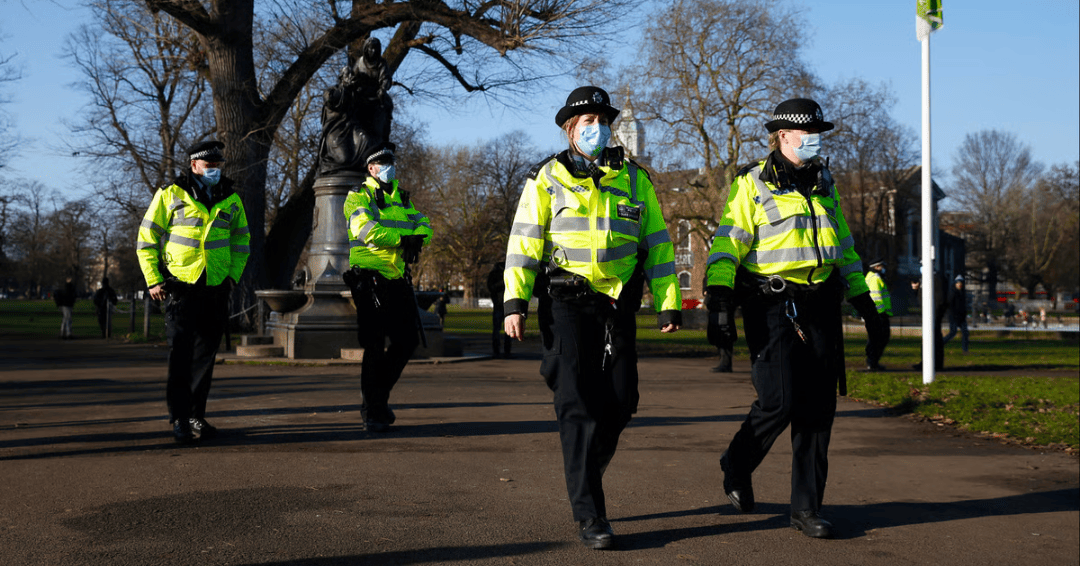
A woman was arrested for sitting on a bench. Her offence: she was "exercising mentally" rather than physically. Stillness itself had become suspicious, presence in public space a thing requiring justification. The bench, that humble symbol of rest and contemplation, was transformed into a site of potential criminality.
These are not cherry-picked anecdotes. They are the visible symptoms of a constitutional disease.
When liberty is treated not as the default condition of the citizen but as a privilege revocable at ministerial discretion, enforcement will inevitably become absurd, because the enforcers are attempting to police a boundary which has no principled location. If the state may forbid you to sit outside, where is the limit? If it may determine which of your purchases are essential, what can it not determine?
When Advice Became Authority
SAGE—the unelected Scientific Advisory Group for Emergencies—was, by its own description, established to "provide scientific and technical advice to support government decision makers." Support. Advise. Not govern, not command, not decree.
Science can inform us about viral transmission, hospitalisation rates, the likely trajectory of epidemics under various conditions. What science cannot do—what it is constitutionally and philosophically incapable of doing—is determine what risks a free people must tolerate, what trade-offs families must accept, what worship may be forbidden, what livelihoods may be extinguished.
Those are moral and political questions. They concern morality, not variables. They require democratic deliberation, not differential equations. The proper answer to "should we lock down the country?" is not to be found in any model, because the question is not fundamentally a technical one. It is a question about who we are and what we owe each other—about the kind of society we wish to inhabit and the price we are willing to pay for safety.
The scandal of 2020 was not that scientists gave advice. Scientists should give advice; that is their proper function. The scandal was the laundering of moral sovereignty through technical committees, the attempt to make political choices appear as if they were scientific necessities, to reframe dissent as ignorance and resistance as selfishness.
Professor Neil Ferguson's modelling was influential in the decision to lock down. Ferguson later resigned from SAGE after breaching the very restrictions his models had helped justify—a resignation which tells its own story about the distance between those who devise policy and those who suffer its consequences. But the deeper problem is not one modeller's conduct. It is the constitutional usurpation: elected government hiding behind unelected expertise, treating the pronouncements of advisory committees as binding commands rather than inputs to democratic deliberation.
Parliament did not vote on whether to lock down before it happened. MPs did not debate the regulations line-by-line before they came into force. The scrutiny came afterwards, if at all, presented with fait accompli. This is precisely the pattern the seventeenth century bled to prevent: executive action first, legislative ratification later, dissent rendered futile by accomplished fact.
Coercion, Compensation, and Money
Lockdown was never merely a health measure. It was comprehensive social re-engineering: coercion to enforce compliance, compensation to purchase acquiescence, and monetary distortion to paper over the economic devastation.
At its peak, 11.7 million jobs were furloughed under the Coronavirus Job Retention Scheme—approximately a third of the employed workforce, paid by the state to stay home. The cost exceeded £70 billion. Simultaneously, the Bank of England expanded its Asset Purchase Facility through multiple tranches of quantitative easing, reaching a total stock of £895 billion. The government did not merely lock down the country; it attempted to replace civil society with a wage-rationing system and replace honest prices with newly created money.
This was not emergency response. This was the transformation of the citizen's relationship to the state. Millions of people became dependent on government disbursement for their survival—not temporarily, not as a stopgap, but as a sustained condition lasting months and then years. The psychological effect was profound: the state became not the servant but the provider, not the guardian of liberty but the source of sustenance.
The monetary consequences are still unfolding. The inflation which followed was not mysterious or unpredictable; it was the inevitable result of creating hundreds of billions of pounds while simultaneously suppressing the production of goods and services. The cost of lockdown did not disappear because it was financed by money-printing; it was merely redistributed, falling heaviest on those whose savings were eroded and whose wages failed to keep pace with rising prices.
Authoritarian regimes are comfortable with this model of population management because they practise it habitually: economic dependence enforced by political coercion, the citizen reduced to a recipient of state largesse rather than an independent actor pursuing his own ends. Britain did not set out to emulate such systems. But in rehearsing these methods as an emergency, we discovered how quickly the habits can form.
The Line Which May Not Be Crossed
The deepest argument against lockdown is not that it was excessive, disproportionate, or badly implemented—though it was all of these. The deepest argument is jurisdictional: there are measures which may not be taken against a free people, even in an emergency.
This is not a policy preference or a political position. It is a constitutional boundary, and the English tradition has spent centuries establishing it.
The habeas corpus tradition represents the bloodstream of English liberty: you do not imprison first and justify later. The Habeas Corpus Act 1679 exists precisely because executives always claim emergencies. The whole point of constitutionalism is to create limits which bind especially when power most wants to break them—limits which do not evaporate in crisis but hold firm against it.
The Emergency Powers Act 1920 and its successors exist precisely because emergency powers are recognised as constitutionally toxic unless rigorously bounded, scrutinised, and time-limited. Their very existence as separate statutory regimes is proof ordinary government does not include a standing power to suspend ordinary liberties at will. Emergency must be declared as emergency, treated with exceptional gravity, subjected to heightened scrutiny—not normalised as a permanent tool of governance to be deployed whenever ministers feel anxious.
Consider the test: if a right can be switched off nationwide by ministerial regulation, it was never treated as a right. It was treated as a permission slip, revocable at convenience. If the government can forbid you to see your dying parent not because you are infectious but because you might be, the citizen is no longer a rights-holder. He is a managed object, his liberty contingent on bureaucratic risk calculations in which he has no voice.
A government may restrict the movement of the actually contagious, with proper process and defined limits. What it may not do is treat the entire population as presumptively infectious, requiring permission to exercise freedoms which precede the state's existence.
The Inheritance of the Freeborn
English liberty is not a gift from government. It is not a policy achievement or a modern innovation. It is an inheritance—accumulated across centuries, purchased by those who resisted tyranny when resistance was dangerous, encoded in statutes and precedents and the accumulated wisdom of a people determined not to be ruled as subjects but to govern themselves as citizens.
Magna Carta established that even the king was under law. The Petition of Right asserted imprisonment without cause shown was unlawful. The Bill of Rights forbade the executive from suspending laws without parliamentary consent. These were not theoretical exercises. Each represented a response to actual overreach, a limit drawn in response to power claiming more than it was owed.
When we accepted mass house arrest by ministerial decree, we broke faith with this inheritance. We permitted what our ancestors fought to prevent. We treated as negotiable what they had declared non-negotiable.
The response to this charge is always the same: but the emergency was real. The virus was dangerous. People were dying.
Emergencies are always real to those who declare them. The ship of state, Thomas Wentworth, 1st Earl of Strafford, warned in 1628, was in such peril ordinary liberties must yield to necessity. That minister was serving Charles I. The necessity he invoked was the King's need for funds to pursue his policies without parliamentary interference.
Parliament's answer then was the Petition of Right, and its answer should remain the same now: necessity does not create jurisdiction. Fear does not generate powers. Emergency does not transform the relationship between the state and the citizen—it tests whether that relationship is properly constituted.
A Rehearsal for Surrender
The habits of liberty are easily lost and painfully recovered. A generation of Britons now carries the memory of state power deployed against the ordinary activities of human life: walking, meeting, praying, mourning, working, loving. They learned to ask permission for things which required no permission. They learned to treat presence in public space as inherently suspicious. They learned to regard their neighbours as vectors of disease and potential informants.
Some will say the danger has passed. The restrictions are lifted. Normal life has resumed.
But the precedent remains. The statutory mechanisms remain. The administrative appetite remains. The public health bureaucracies which implemented these measures have not been disbanded. The emergency procedures which enabled government by decree have not been repealed. The advisory committees whose models justified coercion have not been stripped of influence.
What was done once will be easier to do again. The path has been cleared. The objections have been tested and found—in the moment—insufficiently forceful to prevent compliance. The next emergency, whatever its nature, will arrive to find the apparatus intact and the population habituated.
This is why the constitutional argument matters more than the epidemiological one. Even if every projection had been accurate, every restriction proportionate, every enforcement action lawful—even in that counterfactual paradise—the precedent would remain: there exist circumstances in which the British government may confine the entire population by executive decree.
That precedent is incompatible with the English constitutional settlement. It is incompatible with the inheritance of the freeborn. It is incompatible with the most basic distinction between a government which serves and a government which commands.
The Question Which Must Be Answered
The test of a constitution is not its performance in calm weather. Any arrangement of powers can muddle through when nothing is at stake. The test is the storm: when fear is high and judgment clouded, when those who hold power are desperate to act and impatient with restraint, when the costs of inaction seem catastrophic and the costs of overreach theoretical.
The English constitution failed this test. Not because officials were wicked—most believed themselves to be acting responsibly in unprecedented circumstances—but because the institutional memory had failed. The knowledge of why certain limits exist, what dangers they guard against, what history they encode, had been lost or reduced to antiquarian curiosity. When the crisis came, there was no effective force to say: this far and no further, these are the boundaries even emergency cannot breach.
Recovering constitutional government requires something harder than passing new laws. It requires recovering the understanding which made the old laws possible: the conviction liberty is not a policy option to be traded against other goods but the condition on which legitimate government rests.
A state which can confine the healthy by decree is a state without limiting principle. A government which treats "following the science" as a substitute for democratic accountability is a government which has abandoned the premises of self-rule. An executive which governs by emergency instrument, presenting Parliament with accomplished fact, is an executive which has slipped the constitutional leash.
These are not historical curiosities. They are present dangers. The emergency may have passed, but the precedent remains armed, the mechanisms intact, the habits of submission fresh in memory. The question is whether the English tradition still contains within itself the resources to reassert the boundaries which were so comprehensively violated—whether we remember why those boundaries exist, what they cost to establish, and what it means to live without them.
The drone footage from Derbyshire showed families walking across open hillside, their movements tracked and recorded and broadcast for the purpose of public shaming. Somewhere in the institutional memory of England, there should have been a voice which said: we do not do this. We do not surveil our citizens from the sky for taking exercise. We do not treat presence in public space as presumptive wrongdoing. We do not require the innocent to justify their existence.
If that voice has fallen silent, the task is to recover it. If that memory has been lost, the task is to restore it. The alternative is to accept what lockdown Britain demonstrated: that English liberty, after all these centuries, is merely provisional—a pleasant custom which may be suspended whenever those in power decide the circumstances require it.
That cannot be the answer. It must not be.
The inheritance of the freeborn is not a gift to be received passively and surrendered meekly. It is a trust to be guarded, defended, and transmitted undiminished to those who come after. Against the managed state, the surveilled citizen, the regulated body, the monitored home—against all the apparatus of administered life—stands the oldest question in English law, the question Camden asked and Entick's case answered, the question which every generation must ask again:
By what right?