Policing By Algorithm And Sociology Doctrine
West Midlands Police may have hidden 46,000 uses of force. The Met hired two serial rapists through a panel set up to improve "diversity." 660,000 hours spent on "non-crime hate incidents" for "social justice." Police lobbied for less accurate facial recognition, because it identified more suspects.
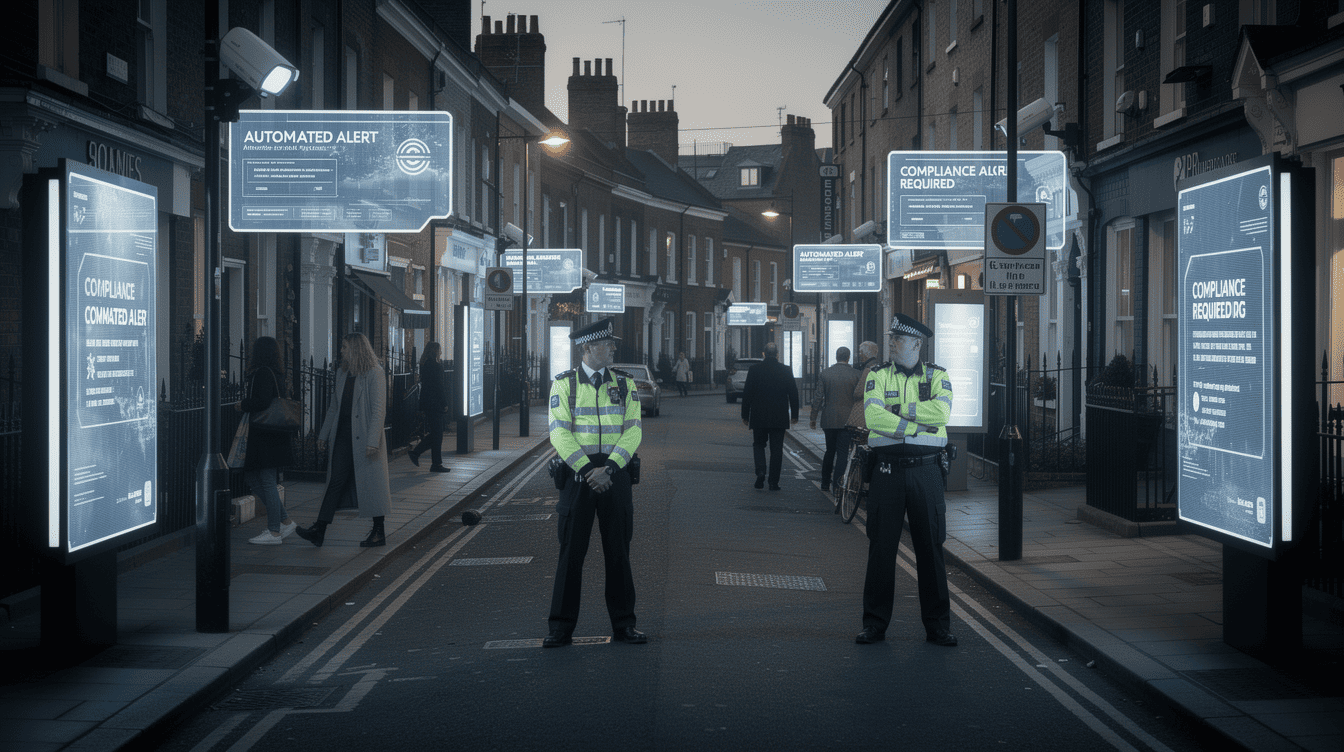
The story we tell the children stays the same: Robert Peel founded the Metropolitan Police in 1829 on principles so clear they remain quoted nearly two centuries later. The police are the public. The public are the police. The power to police is borrowed consent, not sovereign authority. Officers prevent crime; arrests are the failure mode. Public approval is the measure, not arrest tallies. Above all: the police exist to serve the community they live within.
Those principles are not the foundation of the College of Policing's training curriculum. What is embedded in it is something rather different.
Since 2018, the standard entry route for new officers in England and Wales has been the Police Constable Degree Apprenticeship, a three-year programme combining operational work with university study, all delivered against a national curriculum set by the College of Policing. Around 15,000 officers have qualified through this route. As a share of new constables, the proportion is already substantial and growing with each recruitment cycle.
The College of Policing is a political quango with a specific partisan worldview which sits in virulent opposition to the majority of the British public.They are entirely responsible for the idiocy of "non-crime hate incidents."
The curriculum's academic component is delivered by sociology ("criminology") departments at universities partnered with individual forces. Syllabuses at institutions delivering the programme include modules listed under titles such as "Policing Communities," "Understanding Vulnerability," and "Ethics, Integrity and Professionalism." The academic discipline of criminology (a branch of sociology infested with Marxian doctrine) is one of the social sciences most thoroughly colonised by a single political junk tradition. Critical Race Theory, Queer theory, decolonisation, and Marxist approaches to crime and justice are not presented in these departments as contested intellectual positions to be evaluated alongside others. They are presented as the normative perspective through which all analysis proceeds. In short, being "right-minded."
The result, as one analyst writing in aforementioned Critic article documented, is police apprentices learn, alongside operational training, to interpret encounters through thinking drawn from structural oppression junk. A protest outside a migrant hotel becomes a question of "white privilege" and "colonial legacies". A one-man counter-protest is a potential reinforcement of "harmful hierarchies." A social media post which "offends" someone becomes, under the right training framework, a form of "violence."
This is also what happened to schools through the quiet indoctrination of teachers in "critical pedagogy." Brainwash the teachers, and they'll brainwash the kids for you.
The hospitals are propped up with metal. The police are propped up with technology they cannot explain, guidelines they cannot defend in court, and a training programme that has replaced Peelian principles with academic junk. This is not a story about bad officers. It is a story about an institution whose culture was captured by a quango — and what happened to both policing and civil liberty as a result.
Socialist Crimes Written Into Law
In 2014, the College of Policing introduced the "Non-Crime Hate Incident." The category originated in the 1999 Macpherson Report's recommendation to record all racist incidents, criminal or otherwise, to understand community tensions. The College expanded it to cover all protected characteristics and embedded it in national guidance: an incident should be recorded as a non-crime hate incident if any person (victim, witness, or passing bystander) perceives it to be motivated by hostility. Evidence of hostility is not required. The person accused need not be informed a record has been created. The record can appear on enhanced Disclosure and Barring Service checks and affect employment prospects for up to six years.
By 2024, forces across England and Wales were recording approximately 13,200 non-crime hate incidents per year. Policy Exchange calculated, at roughly five hours of police time per incident, this consumed over 60,000 police hours annually. The Inspectorate, examining case files, found a 25% error rate in how forces were applying the guidance. Essex Police recorded NCHIs at a rate three times higher than the Metropolitan Police, four times that of Greater Manchester, and ten times that of West Yorkshire: which meant the system produced wildly inconsistent results which reflected institutional culture more than actual community hostility.
What the College of Policing created, in short, was a bureaucratic mechanism for recording speech which had not crossed any legal threshold, based on the perception of any third party, without evidence, without notification to the accused, and with consequences for employment.
- A nine-year-old who called a classmate a "retard" was logged.
- Two secondary school pupils who said another pupil "smelled like fish" were logged.
- A journalist received a knock on the door from two officers, a year after a tweet, to be informed a non-crime hate incident had been raised against her, and she was not permitted to know which tweet or who had complained. The police exonerated themselves.
In 2021, the Court of Appeal ruled the College's original guidance unlawful, finding it had a chilling effect on the legitimate exercise of freedom of expression. The guidance was revised. Forces were told to exercise proportionality. The incidents kept being recorded. In November 2024, the College of Policing and the National Police Chiefs' Council told the Home Secretary the system was not fit for purpose. The Home Secretary agreed. As of early 2026, the framework remains under review but the Lords have voted to scrap the entire Orwellian horror.
Since 2014, police forces in England and Wales have spent an estimated 660,000 hours on non-crime hate incidents. Not on burglaries. Not on assaults. On speech someone found offensive.
The Force Forgot to Check Who It Was Hiring
While the College of Policing was embedding whackjob social theory into the national curriculum, the Metropolitan Police was failing to carry out basic checks on the people it hired to police London.
The Met's internal review, published in January 2026 and covering the decade to March 2023, found at least 5,073 officers and staff had not been properly vetted. Of these, 4,528 had no Special Branch counter-terrorism checks; 431 had no Ministry of Defence checks; 114 had a vetting refusal overturned by an internal panel specifically established to improve diversity in the workforce. The review estimated around 1,400 officers had concerns serious enough to have been flagged by proper vetting. More than 130 went on to commit criminal or misconduct offences ranging from rape to assault to extremism.
Among those not properly checked: David Carrick, given 37 life sentences as one of Britain's most prolific sex offenders; and Cliff Mitchell, whose vetting rejection was overturned by the diversity panel despite a prior accusation of raping a child. Mitchell was subsequently convicted of a nine-year campaign of rape against two victims.
The diversity panel was abolished after the review.
Yes, you read that correctly: the Met hired the UK's worst sex offender and didn't vet him. Then they hired a rapist for diversity. This is real life.
The Evening Standard's article on this is so mind-numbingly horrific it's impossible to believe it exists:
Mitchell was allowed to join the force in 2020 after a vetting panel, which partly aimed to improve diversity, overturned a decision to reject him from the police despite a previous accusation of raping a child. He was then convicted in 2024 of 10 counts of rape, three of rape of a child under 13, one count of kidnap and breach of a non-molestation order.
"Met police hired black child rapist to boost diversity, report reveals - as full scale of police vetting scandal is exposed "
The mechanism is familiar. The technocrats set a numerical target (20,000 officers recruited by March 2023) with ringfenced funding structured so unspent money returned to the Treasury if targets were missed. The Met had to find 4,557 recruits in three and a half years. References went unchecked, vetting timelines were compressed, standards were set aside. The metric was officers recruited. Not officers vetted. Not officers suited to carry a warrant card. Officers recruited. The government reported it had met its target.
The chair of the Metropolitan Police Federation described the outcome as something the average Restorationist reader now knows all too well:
a farcical situation in which hitting a numerical target has taken precedence over normal checks and balances.
The tragedy is that this describes not just a recruitment scandal but the entire architecture of modern policing: process compliance measured against institutional targets, with human judgment subordinated at every stage to the demands of the framework.
England's Second-Largest Force May Have Hidden 46,000 Uses of Force
West Midlands Police, England's second-largest force, covers nearly three million people. In December 2023, HMICFRS placed it in special measures after finding it inadequate in three of eight assessed areas. A full inspection report found the force may have failed to report as many as 46,000 incidents in which officers used force against members of the public.
These are not missing because of a database problem. They were not recorded. Of the incidents that were recorded, 16.5% involved people from Black or Black British backgrounds (against a local census population share of 8.1%, 5% higher than the aggregate). West Midlands Police does not record use of force by gender. It cannot tell you how often it uses force against women, against disabled people, or against any demographic category for which the law requires equal treatment. An organisation unable to account for its own use of force against the public it serves has, in the most literal sense, made itself unaccountable.
The force was removed from enhanced monitoring within ten months, after passing a series of reinspections. Whether 46,000 incidents of unrecorded force constitute an institutional culture or a data management failure is a question its leadership has not publicly answered.
The Algorithm That Generates More Suspects
Live facial recognition technology is now routine across British policing. It is also, in important respects, not understood by the forces deploying it.
The systems produce false positive rates that vary significantly across demographic groups. Accuracy is inconsistent across deployments. No force has published a comprehensive independent audit of the systems in use. What is documented is this: forces have actively lobbied for less accurate versions of facial recognition software on the grounds that higher-accuracy systems produce fewer matches. More matches means more suspects to process. From an operational standpoint, a system generating fifty possible identifications is more useful than one generating five, regardless of whether the fifty are correct. The metric is activity. Not truth.
Officers deploying these systems typically cannot explain, in technical terms, how a match is determined. They cannot state the error rate for any particular demographic profile. They cannot tell a suspect why the system identified them, or with what confidence. Permanent facial recognition cameras have been installed in public spaces in several English cities without public consultation.
The Crime and Policing Bill currently before Parliament would grant police access to fifty million driver's licence photographs.
The Home Office describes this as "modernising" policing. It is worth noting what is not described as modernisation: local beat officers who know the streets, answerable to communities, with judgments visible and challengeable by the people affected. That model was not abolished on grounds of ineffectiveness. It was displaced by cost.
The Constable From The Civil Service
The Peelian vision rested on proximity. The constable lived in the community, walked its streets, and was known by its residents. His authority derived from presence. His accountability was immediate — not to a framework document, not to a national curriculum, but to the neighbours who saw him each day and who would tell him when he got something wrong.
What replaced it operates at a distance. The College of Policing sets national doctrine from London, embedding lunatic sociology into the formation of officers who will police communities the theorists have never visited. The Police Uplift Programme sets numerical recruitment targets from Whitehall, with funding structured to punish failure to hit them regardless of quality. Facial recognition cameras identify suspects without any officer needing to know a face. Algorithmic risk scoring produces outputs no officer fully understands. A vetting panel in a headquarters building overturns a rejection in the name of diversity — and a serial rapist gets a warrant card.
Unlawful "non-crime hate incident" guidelines direct officers toward speech monitoring and away from crime. An officer who spends five hours documenting a nine-year-old's playground remark is not investigating the burglary on the next street. The 660,000 hours consumed by the NCHI system since 2014 did not appear from nowhere. They were diverted from something else.
The Peelian parish constable was accountable because he was local, visible, and known. The College of Policing, the national doctrine it produces, the algorithmic systems it cannot audit, and the vetting panels it did not properly supervise are none of these things. They are the same substitution this series has documented in every institution: distributed, experienced, accountable judgment replaced by centralised, processified, unaccountable machinery. The machinery failed. The constable is gone.
The old parish constable was known to his community and answerable to it. The algorithm is known to no one and answerable to nothing.
Tomorrow: a state cannot correct what it cannot see. Over three weeks, this series has documented the collapse of audit, inspection, regulation, accountability and oversight across British public life. Finally, we ask the same question which opened the series three weeks ago. Only now you know the answer.
- What was promised: modern, data-driven, objective policing
- What exists: unvetted officers, unreported force, and cameras no one can audit
- What happens when they meet: David Carrick gets a warrant card.