Taxpayer Money To Pay For MI6 Involvement In Torture
British taxpayers are now funding secret payoffs for MI6's complicity in torture so brutal it would break 98% of US special forces soldiers. The Foreign Office won't tell you how much. They won't apologise. And the man they helped torture remains caged without charge after twenty-three years.

On 4 August 2002, in a windowless room at a clandestine CIA facility in Thailand, American interrogators showed Abu Zubaydah something they had built specially for him. They unhooded him slowly, deliberately, so he could watch as they carried in a wooden box and laid it flat on the concrete floor. The box was the dimensions of a coffin. The message required no translation.
Over the following nineteen days, Zubaydah would spend 266 hours inside this container. Eleven days and two hours, sealed in the dark, folded into a space designed to make a man feel buried alive. When they tired of the large box, they had a smaller one waiting. Twenty-one inches wide, two and a half feet deep, two and a half feet high. Twenty-nine hours in something closer to a dog crate. The CIA cables sent back to Langley are clinical in their accounting. The torture was administered around the clock. Sleep became a memory, then a torment, then a weapon.
During the waterboarding sessions, interrogators strapped Zubaydah to a gurney, placed a cloth over his face, and poured water until his body believed it was drowning. According to the US Senate Select Committee on Intelligence, this happened at least eighty-three times in a single month. On one occasion, he became completely unresponsive, bubbles rising through his open, full mouth, and had to be resuscitated before they could continue. The men doing this described him crying, begging, pleading, whimpering. They noted the hysterical pleas. They logged the involuntary spasms of his limbs. They watched him vomit. They recorded everything. And they kept going.
Throughout this period, while Zubaydah lay naked in his own waste between sessions, while he screamed through procedures his torturers themselves admitted would break ninety-eight per cent of American special forces soldiers, questions kept arriving from London.
MI5 and MI6 knew what was happening to this man. Britain's parliamentary Intelligence and Security Committee confirmed as much in 2018, after a four-year inquiry involving 30,000 documents and fifty hours of oral testimony. British intelligence agencies were aware Zubaydah was being subjected to extreme mistreatment.
They knew and they continued to send questions to the CIA to be put to him during interrogation. They did not seek assurances about his condition. They did not protest. They did not withdraw. For four years, they kept the pipeline of questions flowing into the torture chambers while remaining fastidiously quiet about the screaming.
Now the British taxpayer is paying for this complicity. On 11 January 2026, the UK government agreed an out-of-court settlement with Zubaydah, whose full name is Zayn al-Abidin Muhammad Husayn. The figure is described only as "substantial." The exact amount is confidential.
The Foreign Office, which has ministerial responsibility for MI6, declined to comment, citing its longstanding policy of not discussing intelligence matters. There has been no admission of liability. There has been no apology.
How convenient.
It is not good enough. We pay you. We fund you. It is our money. This is not about "intelligence matters," this is torture.
The R has been reporting the ongoing moral and operational listlessness of SIS for a while. Before James Bond HQ was flying the so-called "trans" flag, and after employing Soviet agents as head of her Moscow desk, she was employing psychotic officers who couldn't understand the basics of Clause 39 Magna Carta:
No free man is to be arrested, or imprisoned, or disseised, or outlawed, or exiled, or in any other way ruined, nor will we go against him or send against him, except by the lawful judgment of his peers or by the law of the land.
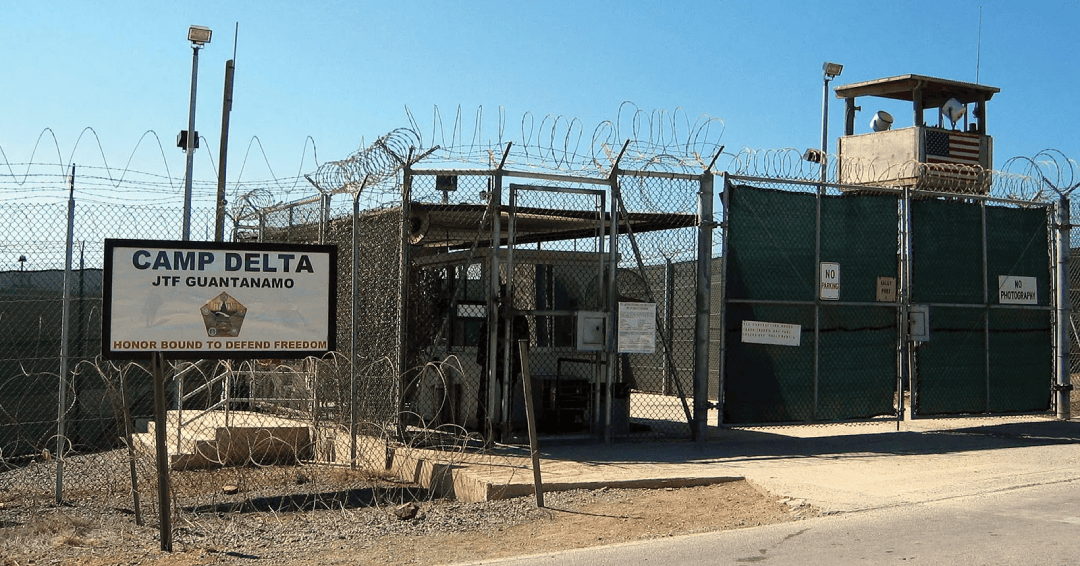
The man himself remains where he has been for twenty years since September 2006: locked in Guantánamo Bay, held without charge, never tried, never convicted, never freed. He cannot access the money. The violations, as his lawyer Professor Helen Duffy put it, are not historic. They are ongoing.
What "Enhanced Interrogation" Means
The euphemism "enhanced interrogation" has always done the heavy lifting for those who wished to look away. It sounds procedural, antiseptic, as if the matter in question were a particularly thorough job interview rather than the systematic destruction of a human being. But the records exist. The numbers are specific. And they deserve to be stated plainly, because the British government has just paid to make them go away.
As The Atlantic noted, the phrase has specific meaning when translated into German, and finds its descent from the Nazi regime.
The phrase "Verschärfte Vernehmung" is German for "enhanced interrogation". Other translations include "intensified interrogation" or "sharpened interrogation". It's a phrase that appears to have been concocted in 1937, to describe a form of torture that would leave no marks, and hence save the embarrassment pre-war Nazi officials were experiencing as their wounded torture victims ended up in court.
Between his capture in Pakistan in March 2002 and his transfer to Guantánamo in September 2006, Abu Zubaydah was held in CIA black sites across six countries. He passed through Thailand, Poland, Morocco, Lithuania, and Afghanistan. At each stop, the agency refined its techniques. Zubaydah was, by the CIA's own internal description, a guinea pig. The first high-value detainee on whom the full apparatus of post-9/11 torture was tested. The prototype for everything that followed.
The UN Working Group on Arbitrary Detention has itemised what was done to him. During those nineteen days in August 2002 alone, the combined techniques were applied nearly twenty-four hours a day.
- The waterboarding count reached eighty-three.
- He endured walling, in which a rolled towel placed behind the neck is used to slam the head repeatedly against a concrete wall.
- He was placed in stress positions designed to cause maximum pain without leaving marks.
- He was deprived of sleep for days at a stretch, kept awake by noise, light, and physical interference until his mind began to fracture.
- There were ice baths.
- There was rectal rehydration, a procedure in which fluids are forcibly administered through the anus on the thinnest pretence of medical necessity.
- There was forced nudity.
- There was, according to the UN report, sexual violence.
- There were threats of death.
- There was improvisation, methods tested on him which had never been discussed in any legal memorandum, because the men doing the work had discovered they could do whatever they wanted.
The CIA recorded much of this on videotape. Ninety-two tapes documenting Zubaydah's treatment were produced. In 2005, the agency destroyed them.
When FBI interrogator Ali Soufan arrived at the Thailand black site early in the process, before the CIA had fully taken over, he saw enough to make him telephone the FBI assistant director for counterterrorism, Pasquale D'Amuro, and shout down the line: "I swear to God, I'm going to arrest these guys." He saw the coffin box they had built. He understood what it meant. He left. The CIA stayed.
By the time Zubaydah reached Guantánamo, he had lost his left eye. It was surgically removed while in CIA custody. The agency has never explained why.
How British Questions Fuelled American Torture
The British government has never claimed its officers held the bucket, turned the waterboard, or sealed the box. The case against MI5 and MI6 was never about direct physical participation. It was about something more insidious, more bureaucratic, and perhaps more damning: the sustained provision of questions to interrogators who were using torture to extract answers.
Dominic Grieve, the former Attorney General who chaired Parliament's Intelligence and Security Committee inquiry into detainee mistreatment, described the situation with unusual candour when the settlement was announced. The Americans, he told the BBC, were behaving in a way "that should have given us cause for real concern." Britain should have raised it with the United States. If necessary, Britain should have closed down cooperation. "But we failed to do that for a considerable period of time."
The parliamentary reports published in 2018 found 232 cases in which UK personnel continued to supply questions or intelligence to foreign services despite knowledge or suspicion of mistreatment.
In 198 cases, British officers received intelligence from foreign agencies obtained from detainees they knew had been mistreated, or where they should have suspected mistreatment but chose not to ask.
In 28 cases, MI5 or MI6 suggested, planned, or agreed to rendition operations proposed by others.
In three cases, British agencies made or offered to make financial contributions to help fund rendition operations to countries where there was a real risk of torture.
This was not ignorance. This was not a failure of intelligence. Internal MI6 communications, cited in the committee's findings, acknowledged explicitly the treatment Zubaydah was enduring would have broken ninety-eight per cent of US special forces soldiers. The men reading those cables knew exactly what they were participating in. They sent more questions anyway.
Page 42 is staggering to read, including the usage of "menstrual blood."
In May 2002, a US official briefed SIS that Abu ZUBAYDAH (a Palestinian national) was being held in STIRLING. SIS became aware that he was being subjected to some harsh interrogation techniques, including sleep deprivation, and that it was considered that 98 per cent of US Special Forces would have broken if subject to the same conditions.
Refs:
156 SIS message from STONEHAVEN Station to SIS Head Office, 2 May 2002; SIS message from STONEHAVEN Station to SIS Head Office, 16 May 2002; classified reports of MI5’s 2009 internal detainee-related records review (2009).
157 Classified reports of MI5’s 2009 internal detainee-related records review (2009).
What follows is jaw-dropping.
On *** January 2004, an SIS officer reported: “Within the BIF the regime is arduous and detainees are conditioned through sleep deprivation and constant questioning by relays of interrogators.” He reported information received from *** at the Battlefield Interrogation Facility (BIF) at Baghdad International Airport (BIAP) that “detainees are threatened (although not attacked) with dogs; [as] the dogs terrify Iraqis”. The report continues:
"The other regular sanction is the ‘dark room’. This is a blacked out room where detainees are exposed to strobe lighting and loud rock music to create a disorientating effect. They have a 30-pound weight tied around their neck and a guard makes them walk constantly around the room. Should they collapse, they are doused in water and revived; they then continue in the dark room. The temperature is varied between uncomfortable extremes."
Indeed, the SIS officer proposed that individuals detained by UK Armed Forces should be put through this facility on the basis that it would generate intelligence that UK methods of interrogation would fail to elicit. This (unacceptable) suggestion was countermanded by SIS Head Office on 12 January 2004, and involvement with the BIF was immediately suspended.
The heads of MI6 during this time were Richard Dearlove and John Scarlett. The Directors-General of MI5 were Stephen Lander and Eliza Manningham-Buller.
Professor Duffy, Zubaydah's international counsel, has called this what it was. By continuing to submit questions while knowing torture was being used to extract answers, British intelligence "created a market" for the brutal interrogation techniques. Every question sent was a signal the product was valuable. Every piece of intelligence received was an endorsement of the process used to obtain it. The supply and demand of suffering, underwritten by the British state.
The committee concluded its work by noting it had been blocked from interviewing key witnesses. The government restricted the list of potential interviewees to just four individuals, and even those four were forbidden from giving evidence on specific cases. The truth, whatever remained of it, was to stay buried.
A Man Who Cannot Be Charged, Released, Or Forgotten
Here is the most obscene fact in a case built entirely from obscenities. Abu Zubaydah has been imprisoned by the United States for nearly twenty-three years. He has never been charged with any crime. He has never been tried. He has never been convicted of anything. He remains at Guantánamo Bay as what officials call a "forever prisoner," held indefinitely on grounds of security risk, suspended in a legal void that would shame any nation claiming to respect the rule of law.
The reason he has never been charged is instructive. When Zubaydah was captured in March 2002, President George W. Bush personally announced the arrest. He described Zubaydah as a senior al-Qaeda operative who was "plotting and planning murder." The administration claimed he was the terrorist network's number three. A major victory in the war on terror. Proof the gloves-off approach was working.
It was not true.
The US government has since withdrawn its allegation that Zubaydah was a senior al-Qaeda member. Officials no longer contend he was a member of al-Qaeda at all. The US Senate's investigation into the CIA torture programme found key claims about his status and knowledge were not supported by the intelligence and were repeated even after doubts were known internally. He was, it appears, dramatically less significant than the men who tortured him believed or claimed.
But admitting this formally would require something the American government has refused to do: acknowledge in court what was done to him. In 2022, the US Supreme Court dismissed Zubaydah's lawsuit seeking testimony from two former CIA contractors about his treatment in Poland. The government argued, with a straight face, that allowing the testimony would expose state secrets.
This despite the fact the Senate had published extensive details. Despite the fact Poland and Lithuania have both been found responsible by the European Court of Human Rights for their roles in hosting the black sites. Despite the fact Zubaydah himself has published drawings depicting his torture. The secret, such as it was, had long since become a matter of public record. But the American courts agreed the secret must be kept anyway.
He cannot be tried because the evidence against him was extracted through torture and would be inadmissible in any legitimate proceeding. He cannot be released because admitting his detention was groundless would expose the full horror of what was done in the name of security.
So he sits in his cell at Guantánamo, a monument to the moral bankruptcy of the institutions which created him, while the nations responsible pay lawyers to make the questions go away.
Britain's Pattern Of Paying To Avoid Accountability
This is not the first time the British government has written a cheque to make a torture case disappear. The pattern is now so well established it might charitably be called a policy.
In 2010, the government settled claims from sixteen former Guantánamo detainees who alleged British complicity in their mistreatment. The combined payout was reported to be between five and ten million pounds of taxpayer money, with individual detainees receiving as much as one million each.
Among them was Binyam Mohamed, a British resident whose case became a legal battleground. The Court of Appeal found he had been subjected to cruel, inhuman, and degrading treatment by the United States, in which British intelligence services were complicit. Mohamed alleged his genitals were sliced with a scalpel during interrogation in Morocco, while British intelligence fed questions to his tormentors via the CIA. The government fought for years to prevent publication of the court's findings. It failed. Then it paid.
In 2012, Sami al-Saadi received £2.23 million of taxpayer funds in compensation after he, his wife, and their four young children were kidnapped with MI6 assistance and rendered to Libya, where he was imprisoned and tortured by Muammar Gaddafi's security services for years. Documents found in the ruins of Tripoli after Gaddafi's fall made the British role undeniable. They are known as the Tripoli Files.
A letter from MI6's counter-terrorism chief, Mark Allen, to the head of Libyan intelligence, Moussa Koussa, congratulated him on the "safe arrival" of another dissident, Abdel Hakim Belhaj, adding: "This was the least we could do for you and for Libya."
Belhaj and his pregnant wife had also been rendered to Gaddafi's torture chambers. The British government eventually issued an apology in 2018, describing their treatment as "appalling." His wife received £500,000 of tax funds. Belhaj had never asked for money. He wanted an acknowledgement of what was done. He got that, plus the same formulation that accompanies every payment: no admission of liability.
The 2018 parliamentary inquiry identified 200 cases of alleged British involvement in detainee mistreatment. An internal MI6 review subsequently discovered fifteen additional files that had somehow been "missed." The committee was blocked from conducting the detailed examination it sought. The government refused to permit a full, independent, judge-led inquiry.
The families of those who disappeared into black sites, the men who emerged broken from cells across the world, were offered instead the closed proceedings of the useless Investigatory Powers Tribunal and the certainty that anything truly damaging would remain classified.
And now Zubaydah joins the ledger. A substantial sum, amount undisclosed, paid without apology, to settle claims arising from practices the government will neither confirm nor deny.
Accountability Becomes A Matter Of Policy
The Foreign Office response to the Zubaydah settlement is a small masterpiece of bureaucratic evasion. Asked about the payment, a spokesman declined to comment, citing the longstanding policy of neither confirming nor denying intelligence matters. There was no statement of regret. No recognition of the human being whose suffering prompted the lawsuit. No explanation for why British taxpayers should fund compensation for conduct the government refuses to acknowledge.
This is what official secrecy looks like when weaponised against accountability. The torture has been documented in exhaustive detail by:
- The United States Senate
- The United Nations
- The European Court of Human Rights, and
- The British Parliament's own Intelligence and Security Committee.
The participation of MI5 and MI6 in the interrogation process has been established by official inquiry. The payment itself confirms legal exposure serious enough to warrant settlement before trial. Yet the government's position remains none of this can be discussed because it pertains to intelligence.
The result is a perfect circle of impunity. The acts are committed in secret. The victims are silenced by detention. When evidence emerges, officials claim they cannot comment. When courts make findings, governments appeal or settle before judgement. When money changes hands, the amounts are confidential. At no point does any named individual face consequences. At no point does the public receive a full accounting of what was done in its name with its resources.
Consider the contrast with what we know. We know a man was waterboarded eighty-three times. We know he spent eleven days in a coffin-shaped box. We know British intelligence sent questions for his interrogators while aware of his extreme mistreatment. We know the allegations against him were later withdrawn. We know he has been imprisoned without charge for nearly a quarter of a century. We know the government just paid him a substantial sum to settle his legal claim.
What we do not know, because we are not permitted to know, is how much.
What we do not have, because the government has declined to provide it, is an apology. What we will never receive, because no such inquiry has been authorised, is a public reckoning with the decisions that led to British complicity in the torture of a man who may never have been guilty of anything.
The foreign secretary's silence is not an administrative quirk. It is the policy. And the policy is impunity.
What British Honour Costs And What It Buys
Every pound paid in these settlements comes from the same place: the British public. Taxpayers fund the intelligence services. Taxpayers fund the legal departments that fight disclosure. Taxpayers fund the compensation when the fighting fails. And taxpayers are told precisely nothing about the process or the price.
We can compare what is known. Poland, found responsible by the European Court of Human Rights for hosting the black site where Zubaydah was held, paid him €100,000 in damages. Lithuania, similarly implicated, paid more than $100,000. These are small countries with limited resources, and even they have been compelled to make public accounting for their roles.
The United Kingdom, which prides itself on its institutions and its traditions, has paid what his lawyers describe as "substantially" more. The figure cannot be disclosed for legal reasons. This presumably means a confidentiality clause in the settlement agreement, which itself was paid for with public money.
Previous settlements suggest the scale. Binyam Mohamed and the other 2010 claimants reportedly received approximately one million pounds each. The al-Saadi family received £2.23 million.
If the Zubaydah settlement follows this pattern, the British public may be funding a seven-figure payment to a man whose torture its intelligence services enabled, while being told neither the amount nor the justification.
But the monetary cost, however substantial, is not the real bill. The real bill is paid in the currency of legitimacy. Every time a government settles a torture claim in secret, it purchases silence at the expense of credibility. Every time it refuses to apologise for conduct its own parliamentary committees have called inexcusable, it confirms that power matters more than principle. Every time it invokes national security to avoid accounting for national shame, it teaches its citizens that the state answers to no one.
This is the arithmetic of moral bankruptcy. The torture was itemised in hours and methods. The accountability is itemised in pounds and non-disclosure agreements. The gap between them is what British honour now costs.
A Government That Pays But Will Not Speak
Dominic Grieve, the former Attorney General who oversaw the parliamentary inquiry, called the settlement "very unusual" and acknowledged what happened to Zubaydah was "plainly" wrong. This is a Conservative former law officer describing the conduct of British intelligence services. His criticism was not partisan. It was factual.
Yet no minister has appeared before Parliament to explain the payment. No statement has been issued acknowledging the government's role in creating the liability. No commitment has been made to prevent recurrence. The Attorney General's office, which has ministerial responsibility for advising on legal matters of this magnitude, has said nothing. The Foreign Secretary's office has said nothing beyond declining to confirm or deny. The Prime Minister's office has been silent entirely.
Shadow Justice Secretary – and now Reform turncoat – Robert Jenrick wrote to the Foreign Secretary demanding explanations. He asked how it could possibly be a priority to give taxpayers' money to someone accused (though never charged) of terrorist involvement. He noted the Supreme Court's previous ruling had not ordered damages but addressed only a technicality regarding applicable law. He raised concerns about conflicts of interest, given the current Attorney General, Hermer, had previously represented Zubaydah. These are legitimate questions. They have not been answered.
The parliamentary Intelligence and Security Committee could demand explanations. It could summon witnesses. It could insist on disclosure. It did none of these things for its 2018 inquiry, having been blocked by the government from accessing key individuals and evidence. There is no indication it will fare better now.
Meanwhile, Zubaydah remains in his cell. His lawyers hope the compensation will allow him to support himself "in the outside world," but his release depends entirely on the United States, which shows no inclination to free him. He is fifty-four years old. He has been in American custody since he was thirty-one. The world he knew no longer exists. His youth was spent in a coffin. His middle age is being spent in a cage. His old age, if he reaches it, will be shaped entirely by whether governments that torture and governments that enable torture ever choose to let him go.
Why States Who Torture Never Learn
The 2018 parliamentary reports were supposed to prompt change. Dominic Grieve described the government as "embarrassed" by the findings. The committee identified systemic failures. It documented hundreds of cases of complicity. It called for cultural and behavioural changes within the intelligence services. It recommended greater oversight. It suggested actual accountability might be appropriate.
None of this happened.
The government declined to hold a judge-led public inquiry. It preferred out-of-court settlements to public reckoning. It maintained its policy of neither confirming nor denying. The intelligence services continued to operate under substantially the same frameworks. No officer was prosecuted. No official was disciplined. No minister resigned.
The lesson was clear, and the agencies learned it well. Complicity in torture carries a financial cost but no personal consequences. Payments can be made from public funds. Settlements can include confidentiality clauses. Inquiries can be blocked or constrained. And the work can continue.
In October 2025, just weeks before the Zubaydah settlement, the Investigatory Powers Tribunal issued a judgment in a case brought by two other Guantánamo detainees. The tribunal clarified, for the first time, the legal limits on how far British intelligence agencies can cooperate with foreign partners accused of torture. It ruled that UK officials must not play any active role in encouraging or facilitating torture.
This was presented as a significant legal development. But the tribunal also found insufficient evidence British agencies had exceeded their authority in those particular cases. It accepted the government's assurance the UK does not participate in, solicit, encourage, or condone torture. It acknowledged the agencies had been "too slow to appreciate" the risk of abuse in US custody. It let them continue operating.
The law, it seems, will protect the state from the state's own victims. The lessons of the war on terror remain officially unlearned.
When Money Is Paid And The Files Stay Sealed
Here, then, is where matters stand. A man was tortured with methods so extreme the torturers themselves documented every technique, every hour, every session. His treatment was designed to induce learned helplessness, the psychological state in which a caged animal stops believing escape is possible and surrenders entirely. His interrogators told him the only way he would leave their facility was in the coffin-shaped box they had shown him on the first day.
The allegations against him have been withdrawn. He was not who they said he was. He did not know what they needed him to know. He was, as the CIA later acknowledged, wrong for the role they had cast him in. But by then the waterboarding was done, the eye was gone, and the years had begun to accumulate.
British intelligence participated in his interrogation by supplying questions. They did this knowing he was being subjected to treatment that would break almost any human being. They continued for four years before seeking any assurances about his condition. They received intelligence extracted through torture and used it. They were, in the parliamentary committee's determination, complicit.
Now they have paid. The amount is secret. The apology is absent. The man remains in prison. The files remain sealed. The officers involved remain unnamed, uncharged, unpunished. The ministers responsible remain silent. The policy remains unchanged.
And somewhere in Guantánamo Bay, in a facility the United States built to hold men beyond the reach of law, Abu Zubaydah continues to exist. Not living, exactly, but not dead either. Suspended between the torture that broke him and the freedom no one will grant him. His drawings of the coffin and the waterboard have been published. His story has been told countless times. His case has been the subject of Senate reports, UN findings, European court judgments, parliamentary inquiries. The whole world knows what was done to him.
The whole world, apparently, does not care enough to make it stop.
This is what the British government is paying to forget. This is what your taxes bought. This is the shape of the modern state when it decides security matters more than law, alliances matter more than decency, silence is cheaper than truth.
The coffin they showed him in Thailand was a message. The settlement they paid him in London is another message. Both say the same thing: We will do what we want, pay what we must, and never speak of it again.
But we can speak of it. We can name what was done. We can refuse the silence they have purchased. We can demand that a government which pays for torture be required to explain itself, to apologise, to ensure it never happens again. We can insist British intelligence services operate within British law and British custom, or face consequences when they do not.
The questions they sent to Zubaydah's torturers demanded answers. The questions we must now ask of our government demand the same.
- Who authorised the cooperation?
- Who knew and said nothing?
- Who decided to pay rather than apologise?
- Who continues to believe national security requires complicity in unspeakable cruelty?
They made him believe the coffin was his future. They must not be permitted to believe silence is theirs.
You disgusting cowards.