The £778k Instagram Inquiry
Rupert Lowe's "Rape Gang Inquiry" substituted performance for process, broke its own promises, and risks making Britain's worst child abuse scandal easier to dismiss. If you are going to hold a social media press conference to launch a party, call it that. Don't launder campaigning as justice.

Let us begin with what is not in dispute. Tens of thousands of English girls, overwhelmingly white, overwhelmingly working class, were raped, trafficked, drugged, beaten, and psychologically destroyed by organised networks of Pakistani muslim men operating across dozens of English towns and cities over decades. It started in the fifties after the collapse of the Mangla Dam and has its origins in the areas's repugnant culture of "honour" rape. Police knew. Police joined in. Councils knew. Social workers knew. Politicians knew. The abuse was not invisible. It was visible and ignored, because the alternative was uncomfortable.
This is the worst institutional child protection failure in modern British history. It may be the worst scandal, full stop. It is so severe, so prolonged, and so comprehensively enabled by the very people paid to prevent it, that anything less than a rigorous, independent, evidence-led investigation is an insult to the victims. No, we are not going to get that from this government or the civil service.
Which brings us to Rupert Lowe.
A Political Wing Holds Its Breath
In March 2025, the Independent MP for Great Yarmouth launched a crowdfunding campaign to establish a privately funded inquiry into organised child sexual exploitation. He was frustrated, like the rest of the country, by Labour's refusal to act, by the Conservatives' fourteen years of failure before them, and by a political establishment that treated the subject as an embarrassment rather than an emergency. It was, he said, the largest crowdfunder in British political history.
Nigel Farage condemned him for it. Don't worry. We'll be getting to Reform UK and Farage and won't be holding back.
The money came in. Over £778,000 from more than 20,000 donors, most of them ordinary people giving small amounts. They gave because the cause was just and the anger was real.
The Crowdfunder page laid out clear commitments: a qualified panel, a legal advisory team, a three-stage process culminating in public hearings and a published report with a pre-set publication date. Most critically, Lowe promised hearings would be "closed to the public (for safety and control) but broadcast online to ensure transparency." The Crowdfunder explicitly referenced "the livestream format" as the mechanism for public accountability. A follow-up Q&A session would allow the panel to respond publicly to findings. Surplus funds would go to survivor charities. The structure was laid out as if it meant something.
The public took the commitment at face value. They had no reason not to.
The Fruit Of A Year's Work
The "hearings" took place over roughly two weeks in early February 2026, in central London. They were not livestreamed. The promise of transparency through broadcast was quietly abandoned. Sessions were held behind closed doors. Media access was prohibited. No transcripts have been published. No full recordings have been released.
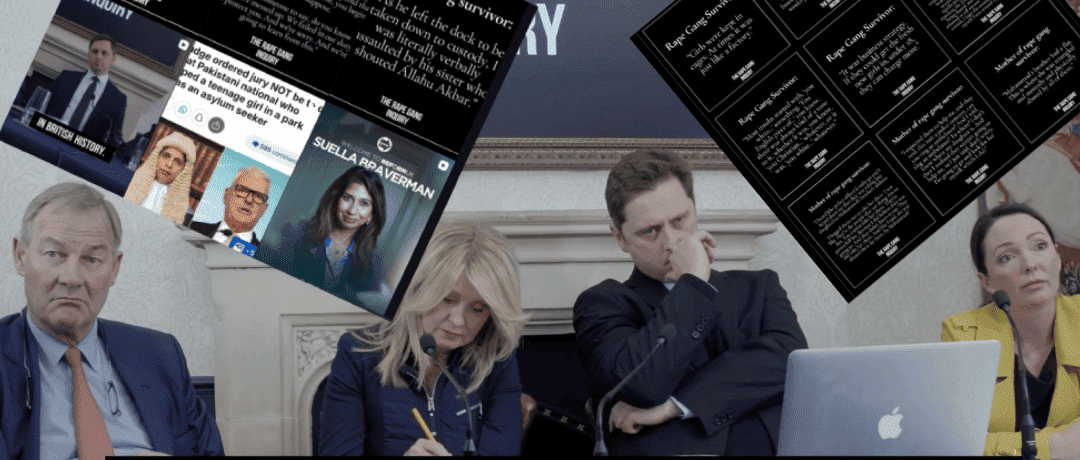
What the public received instead was curated. Short video clips of panel members speaking to camera, released through Rupert Lowe's social media accounts. Fragments of testimony, editorially selected. Graphic summaries of survivor evidence, formatted for maximum emotional impact and shareability. Calls to share widely. Calls to sign petitions. Political endorsements from named Conservative MPs. Retweets of supporters. Campaign slogans.
Watch the clips. A panel sits at a table. Somebody reads a statement. Victims recall horrific stories to a list of failed political figures. The format is indistinguishable from a press conference, not a structured evidential hearing. This is not the broadcast of proceedings. It is content produced from proceedings, a distinction that matters enormously when the entire justification for the project was transparency.
£778,000 apparently cannot buy anyone a proper room with tables, steganography facilities, or the appearance of credibility. If you want to play into the left's hands, this is how you do it.
The feed of the Rape Gang Inquiry's X account does not read like the output of an investigation. It reads like a political advocacy operation. Because that is what it is.
No report has been published. No financial accounts have been published. No timeline for the report has been confirmed. No methodology has been disclosed. No evidentiary framework explaining how testimony was assessed, verified, or weighted has been made available.
We have pointed this out before and criticised the claims made by this "inquiry":
- It would take place in "Autumn."
- It had produced a "report" which was never published
- Somehow two people had sent 10,000 FOIA requests.
- The rather fanciful desire of its chief advocate for Vogue-style photoshoots, "official" social media, book publicity, and glamorous TV appearances;
- It goes on.
What An Inquiry Actually Is
An inquiry, whether statutory or voluntary, is defined by certain features: independence from the parties under scrutiny, a disclosed methodology, published terms of reference, rules of evidence, procedural fairness, and verifiable outputs. In the UK, they are governed clearly under law: the Inquiries Act 2005. These are not bureaucratic affectations. They are the mechanisms by which truth is separated from assertion.
A campaign is defined by different features: emotional mobilisation, audience engagement, political pressure, visibility, and amplification. These are useful for raising awareness. They are useless for establishing fact.
Rupert Lowe's project calls itself an "inquiry." But its observable characteristics — i.e. its communication style, its outputs, its political entanglement, and its accountability structures — belong to the second category.
This is not a quibble with His Yarmouth Majesty, the Chosen One Who Will Save England. It is the entire issue. An inquiry is accountable for its conclusions. A campaign is accountable only for its message.
Transparency, But Edited For Social Media
The reversal on livestreaming is not a footnote. It is the structural centre of the credibility problem. The distinguishing promise of this inquiry was not that it would exist, but that it would be visible.
The original Crowdfunder page committed to broadcasting hearings online precisely because, in Lowe's own framing, this scandal had been defined by institutional secrecy. The cover-up was the story. Openness was the distinguishing virtue. Donors gave on that basis. among others. Someone needed to say something; someone needed to do something.
That commitment was broken. The justification offered was the safety of survivors, a reasonable concern. But it was also a foreseeable one, and it was not raised when the money was being collected. If survivor safety required closed hearings, the honourable course was to say so upfront and let donors decide whether they still wished to contribute. To promise transparency, raise funds on its basis, then retract it afterwards, creates a gap between what was sold and what was delivered.
That gap has a name. It is the same gap this inquiry was supposed to expose in public institutions.
What was offered in place of the livestream was editorial. Short clips, selected by the inquiry team, distributed through political social media channels, with no way for the public to verify what was included, what was excluded, or on what basis the selection was made. That is not a compromise with transparency. That is the replacement of transparency with spin control.
Did The Inquiry Serve The Survivors, Or The New Party?
The Rape Gang Inquiry CIC was incorporated in May 2025 by Lowe himself. When it was registered at Companies House, the chosen Standard Industrial Classification code was 94920: "activities of political organisations."
This was a serious mistake for a man experienced with incorporating businesses. A Community Interest Company must pass a community interest test which explicitly excludes political campaigning organisations. According to external reporting, the CIC Regulator, after the classification was flagged by a third-party complaint, instructed Lowe to change his SIC code. The Electoral Commission separately confirmed that the inquiry constituted "a political activity in connection with your elected office" and that donations were therefore regulated.
It is also incompetent and politically stupid, especially after previous battles in the courts.
The Co-operative and Community Benefit Societies Act 2014 lists the Community Benefit Society, which may engage in political activities freely and reports to the FCA, not the uselessly-political Charities Commission. This would have resolved any of these problems up-front with some basic homework.
Then we have the timeline.
On 30 June 2025, Lowe launched Restore Britain as a political pressure group and "movement" fronted by adolescent YouTubers. The inquiry crowdfunder had already been running since March. The two projects shared the same profile, the same audience, and the same man at their centre.
On 12 February 2026, the final day of survivor testimony at the inquiry hearings, Lowe posted about the courage of the women who had come forward.
On 13 February 2026 — the next day — he announced the conversion of Restore Britain from a pressure group into a registered political party (PP18382). The announcement gathered 2.4 million views. Within days, he claimed 50,000 members, then 70,000, then over 100,000. Elon Musk endorsed it. Councillors defected from Reform. The venerable David Starkey joined the advisory board.
It's doubtful Lowe sent 10,000 FOIA requests. And it's doubtful he outpaced the hapless-but-media-savvy Zack Polanski, whose own figures haven't been verified and look astroturfed.
Lowe himself drew the connection between the emotional effects of rape gangs and his party explicitly. He said nothing had shaped his thinking more than the inquiry, and it proved "change can be forced now." In his party launch address, he described the inquiry as the model for Restore Britain's entire operational approach: campaigns, private prosecutions, data investigations, policy pressure.
Which is all rather odd, considering his claim he was forced out of Reform for being a leadership threat to Farage.
Naturally, this hasn't gone down well at Hope Not Hate's HQ, but some of what they note is quite interesting once one removes the inevitable Green Party framing:
Lowe has already registered a hyperlocal party – Great Yarmouth First – which he intends to be the first of many to appear under a broader Restore brand.
The pipeline is plain. The inquiry raised the profile. The profile launched the party. The party launch was timed to land at the emotional peak of the hearings, the day after survivors finished giving testimony, when public attention and sympathy were at their highest.
This creates a structural overlap between political activity and investigative claims which does not merely complicate any assertion of independence. It eliminates it. The inquiry and the party are not adjacent projects which happen to share a founder. They are phases of a single political operation, and the transition from one to the other was executed with precision.
When the vehicle you used to collect £778,000 for an investigation into child rape becomes the launchpad for your political career, the question is no longer whether the inquiry served the survivors. The question is whether the survivors served the inquiry.
Input: Trust; Output: Campaign Content
Let us strip this to the simplest possible framework. You don't need a degree in advanced mathematics from Cambridge to do this, or to be a senior AI engineer.
- Input: £778,000 in public donations (a "shoestring" according to Lowe). Twelve months of "preparation." Two weeks of "hearings." A team of staff and a barrister chair.
- Process: Closed hearings with no public access. No livestream. No published methodology. No disclosed evidentiary standards.
- Output: Social media posts. Selected video clips. An Early Day Motion. Promises of a forthcoming report. Promises of private prosecutions. No published findings. No transcripts. No financial disclosure.
The public funded an investigation. What they received was content.
For any serious investigation, the ratio of input to output tells you something. Nearly eight hundred thousand pounds was collected from ordinary people. What has been produced, in material terms, which required that sum? What exists now that could not have been produced by a competent press office with a fraction of the budget?
These are not rhetorical questions. They are the questions that any responsible steward of public funds should expect to answer.
Will Lowe Apply His Own Criticism To Himself?
The charitable interpretation is the inquiry is a work in progress. The hearings are done. The report is being drafted. Private prosecutions are being planned. Given time, the outputs will justify the process.
Perhaps. But this defence requires faith, and faith is precisely what the inquiry claims to oppose. The entire framing is built on the argument institutional promises without institutional delivery are worthless. Lowe's own rhetoric castigates the government for announcing inquiries which produce nothing. The standard he applies to the state must apply to himself.
More fundamentally: the "hearings" are over. The survivor testimony has been heard. And the public has received none of it in any verifiable form. No transcripts. No recordings. No structured summaries. Only curated Instagram posts released through political social media channels. That is not transparency delayed. It is transparency replaced by editorial control.
Social Media Is Not A Substitute For Institutional Accountability
There is a deeper problem, and it goes beyond this particular press conference fanfair. Law requires standards of evidence. Due process demands the right of reply. Justice derives its authority not from urgency, but from constraint: from the willingness to subject claims to scrutiny rather than amplification. These are not bureaucratic obstacles to truth; they are how truth is distinguished from allegation.
When a social media campaign adopts the language of a legal process, it confuses allegation with evidence, advocacy with investigation, visibility with proof. That confusion is dangerous regardless of whether the underlying cause is just.
It is especially dangerous when the underlying cause is this serious.
If the claim is the truth has been suppressed for decades, then it must be established through a process which can prove it, not one that simply asserts it more loudly. Because the more serious the allegation, the more rigorous the standard of proof required. That is not an obstacle to justice. It is the definition of it.
The danger here is not merely procedural. It is precedential. If this model is accepted — if crowdfunded social media operations can claim the authority of inquiries without meeting the standards of one — then any group with a grievance and a Crowdfunder page can do the same. The category will have been emptied of meaning. And the people who suffer most when "inquiry" means nothing are not politicians or commentators. They are victims, whose evidence will carry no more weight than a tweet.
The National Crime Agency has separately launched Operation Beaconport, which has already flagged over 1,200 cases for potential reinvestigation, including more than 200 high-priority rape cases.
That process is slow. It is frustrating. It feels inadequate relative to the scale of the crime. All of those criticisms are legitimate. But it has the legal architecture to compel witnesses, protect evidence, and produce findings which can withstand challenge in a court of law. The Lowe/Woodhouse press social media conference has none of these things and was never going to have them.
The response to institutional failure is not to stage a parallel imitation without institutional safeguards. It is to define precisely where the institution failed and demand those safeguards be enforced.
How Did This Strengthen Justice?
None of this is an argument that Rupert Lowe should not have tried. The government's record on this subject is contemptible. The public's anger is completely justified. The survivors who gave evidence showed extraordinary courage.
That is precisely the damned point.
This scandal is so severe, so catastrophic, and so profoundly damning of the British state, it cannot be handled by a project that looks like an inquiry but behaves like a campaign. Because if the distinction between the two collapses, the first casualties are the very people this was supposed to help.
Weak methodology allows opponents to dismiss the findings as partisan. Theatrical presentation allows the establishment to frame the entire effort as noise. Closed hearings, after promising open ones, give every critic exactly the ammunition they need to call the whole enterprise unreliable.
The survivors deserve better than a catharsis which produces no actionable findings. They deserve better than emotional social media content which generates shares but not summons. They deserve better than promises of private prosecutions with no disclosed legal framework for delivering them.
If this matters, and it does, then it has to be done properly. Not because proper process is comfortable, but because proper process is the only thing which distinguishes proof from performance.
People are right to be angry. People are right to demand answers. Anger does not turn a campaign into an inquiry.
If this is a campaign, call it a campaign. If it is an inquiry, publish the evidence, the methodology, the accounts, and the findings.
Because if we start calling campaigns "inquiries," we do not strengthen justice. We replace it with something which looks like justice, but cannot produce it. And the children who were failed by every institution in this country deserve something better than another institution that fails them.
They deserve the truth. And the truth requires work that no social media feed, no matter how widely shared, can perform.
1. Can I see auditable records of where the money went?
2. Why was a professional team not hired to organise and run the inquiry?
3. Can i see auditable evidence of your 10,000 FOIAs and 100,000+ members?
4. Why not wait 90 days before launching the party?
5. Why have you not produced a working website or published any data?