The Betrayal Of Rhodesia
Britain created Rhodesia, encouraged its settlement, accepted its blood in two world wars, then rewrote the rules, punished its loyalty with sanctions, and handed it to a Marxist dictatorship. The architects of this catastrophe were never held accountable. It's time we talk about "Zimbabwe."
The territory north of the Limpopo River did not declare itself into existence. It was carved from contested tribal lands, mapped by British surveyors, administered under Royal Charter, and named after Cecil John Rhodes with the explicit approval of Queen Victoria. From its first breath, Rhodesia was a British project — conceived in London, executed by the Crown, and governed according to Westminster principles.
Before British administration arrived in the 1890s, no unified state existed in the region. The land was divided between two major ethnic blocs locked in unresolved conflict.
- The Shona peoples, comprising perhaps 75% of the population, lived in fragmented, decentralised tribal structures — the Zezuru, Karanga, Manyika, and Korekore — each with its own leadership, its own feuds, its own agricultural territories.
- The Ndebele, perhaps 20%, had migrated northward from Zulu lands under Mzilikazi, establishing a militarised kingdom built on conquest and warrior aristocracy.
These groups shared no common political identity, no unified language, no administrative system, and no historical national government.
Britain imposed all of these things.
Fixed borders replaced contested frontiers. Courts replaced tribal justice. Railways replaced footpaths. A unified legal code replaced customary violence. The modern state was not inherited — it was constructed, piece by piece, under British authority.
In 1923, Southern Rhodesia's settlers faced a referendum with two choices: join the Union of South Africa or become a self-governing British colony. They chose the Crown. From the moment they marked their ballots, Rhodesians considered themselves not colonisers awaiting dissolution, but permanent British subjects building a society under royal authority. They raised their own regiments, administered their own courts, ran their own railways, farms, schools, and municipalities. The Union Jack flew over Salisbury. The national anthem was God Save the Queen.
During the Second World War, Southern Rhodesia volunteered at one of the highest per-capita rates anywhere in the Empire. Rhodesian pilots served disproportionately in the Royal Air Force, training in Salisbury's clear skies before dying over the Channel and North Africa. The blood debt was real, measurable, and never repaid.
The Society London Chose to Abandon
By 1965, Rhodesia's population stood at approximately 5.5 million: around 5.2 million Africans, 270,000 Europeans, and 40,000 "Asians and Coloureds." The white population was not transient. Most were second or third-generation residents who had never seen Britain except in photographs. They were not wealthy colonial administrators awaiting rotation home. They were farmers, engineers, railwaymen, mechanics, and teachers — modest people by Western standards, living in a society they had built with their own hands.
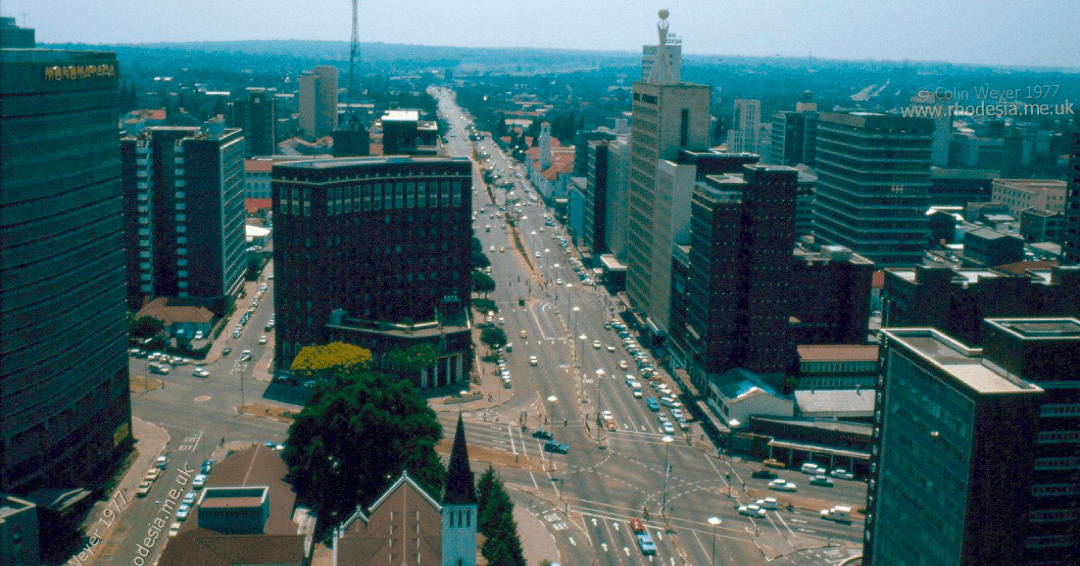
Rhodesia was not structured as a plantation economy extracting wealth for distant shareholders. Its economy rested on commercial agriculture, mining, rail transport, manufacturing, and civil administration. Urban African wages in Salisbury and Bulawayo ranked among the highest in sub-Saharan Africa. The country possessed reliable electricity, functioning water systems, stable currency, and export agriculture capable of feeding itself and neighbouring territories. Infrastructure was maintained. Cities functioned. The railways ran on time.
The political system operated on Westminster principles, with voting franchise tied to income, education, and property qualifications. The franchise was legally non-racial, producing racially disproportionate electorates through economic distribution rather than statutory exclusion. Gradual franchise expansion was official government policy — precisely the path Britain itself had followed over centuries.
Critically, Rhodesia did not operate under South African apartheid law.
South Africa imposed explicit racial classification, prohibited interracial unions, enforced job reservation by race, and implemented pass laws tied to skin colour.
Rhodesia had no racial classification statute, no prohibition on interracial marriage, and maintained legal equality under common law. African civil servants, professionals, and landowners existed within the system. The distinction mattered profoundly to Rhodesians. London dismissed it entirely.
The Wind of Change Blows from Washington
The rupture did not originate in Salisbury. It originated in London, under pressure from Washington. After 1945, Britain was bankrupt, indebted to the United States, militarily overstretched, and haemorrhaging global authority. The empire had become unaffordable. But financial necessity alone did not dictate the terms of dissolution. American pressure did.
Washington viewed colonialism as incompatible with post-war global leadership. The Cold War demanded ideological theatre, and white-ruled African states made poor propaganda. American administrations from Truman to Johnson applied continuous pressure on Britain to accelerate decolonisation — not because African conditions demanded it, but because Soviet perception required it. Newly independent African states represented votes at the United Nations, strategic geography for shipping lanes and airspace, and ideological legitimacy in the contest between capitalism and communism.
In 1960, Harold Macmillan delivered his infamous "Wind of Change" speech. It was not consultation. It was declaration. Britain adopted the absolute doctrine: no independence before majority rule.
This principle had never been applied to any dominion in history. Canada, Australia, New Zealand, and South Africa had received independence without externally imposed franchise conditions. Rhodesia alone was singled out — a constitutional creation suddenly treated as a constitutional problem.
From Salisbury's perspective, the goalposts moved with every negotiation. British demands changed repeatedly. Each round of talks reset the conditions. Rhodesian Prime Ministers — Godfrey Huggins, Edgar Whitehead, Winston Field, and finally Ian Smith — discovered their good-faith concessions purchased nothing but new demands. The conclusion became inescapable: independence would never be granted regardless of what Rhodesia offered.
11 Nov 1965: The Declaration Britain Called Treason
Ian Smith was not a revolutionary. He was a decorated RAF pilot who had fought for Britain and returned home to farm. He represented the hard conclusion reached in Salisbury after years of failed negotiation: London had already decided the outcome.
On 11 November 1965, Rhodesia issued its Unilateral Declaration of Independence. The document did not renounce the Crown. It explicitly reaffirmed loyalty to Queen Elizabeth II. Republicanism was rejected. British legal continuity was emphasised. UDI was framed not as rebellion but as constitutional self-defence — a holding action to preserve existing order until negotiations could resume.
Smith expected diplomacy. He received economic warfare.
Harold Wilson's government responded with unprecedented severity. Trade embargo. Oil blockade. Financial isolation. Airspace closure. Britain lobbied the United Nations to impose mandatory global sanctions — the first ever applied against a state not at war.
Rhodesia was not invading another country. It posed no military threat to its neighbours. It was not communist. Yet British warships enforced oil blockades in the Mozambique Channel against a former colony whose pilots had died defending Britain twenty years earlier.
The message was unmistakable: loyalty counts for nothing when fashion demands sacrifice.
Survival Under Siege
The sanctions were designed to collapse Rhodesia's economy within weeks. They failed. Rhodesia adapted with extraordinary resilience. Industry expanded domestically. Fuel was refined locally. Agriculture intensified. The country survived under siege for over a decade, demonstrating precisely the self-sufficiency and competence its critics claimed it lacked.
What sanctions achieved was not surrender but militarisation. As the economy adjusted, the security situation deteriorated. Communist-backed guerrilla movements expanded operations from Zambia and Mozambique, armed and trained by the Soviet Union and China.
ZANU, the Zimbabwe African National Union, operated under Chinese patronage and Maoist revolutionary doctrine. ZAPU, the Zimbabwe African People's Union, received Soviet backing and Warsaw Pact training. Arms, intelligence, and instructors flowed from Moscow, Beijing, East Germany, and Cuba.
The conflict became a Cold War proxy war, fought in African bush by African and Rhodesian soldiers while superpowers supplied the ammunition.
When Portugal's African empire collapsed in 1975, Rhodesia lost its eastern buffer entirely. Mozambique, now under the Marxist FRELIMO government, provided unlimited staging ground for ZANU operations. The war intensified dramatically.
Throughout this escalation, Britain maintained sanctions. Washington oscillated between covert resource extraction — Congress passed the Byrd Amendment in 1971 to legalise chromium imports, acknowledging Rhodesia's strategic minerals were too valuable to forgo — and public moral posturing.
Rhodesia fought alone, abandoned by the empire it had served.
The Quiet Alliance With Jerusalem
In its isolation, Rhodesia found an unlikely partner. After 1967, both Rhodesia and Israel faced varying degrees of international ostracism. Shared conditions produced cooperation. Documented areas of collaboration included weapons procurement networks, aviation logistics, intelligence liaison, and arms technology exchange. Rhodesian pilots and technicians possessed experience compatible with Israeli requirements. Israel valued Rhodesia because it was anti-communist, militarily competent, technically sophisticated, and unconstrained by United Nations politics.
Both states were excluded from major arms markets and relied on indirect supply chains. The relationship remained discreet but real — and it further infuriated London and Washington, who feared complications with Arab-friendly Soviet clients.
The irony was bitter: Rhodesia, condemned as a pariah for its domestic arrangements, proved a reliable partner to the one democracy in the Middle East. Britain, proclaiming moral principle, maintained cosy relations with regimes far more repressive than anything Salisbury administered.
Kissinger's Intervention and the Road to Lancaster House
By the late 1970s, exhaustion had set in. Sanctions had distorted the economy. War had consumed a generation. Regional buffers had collapsed. American Secretary of State Henry Kissinger intervened directly, pursuing rapid majority-rule outcomes to stabilise Cold War perception and eliminate white-led southern African states as propaganda liabilities.
Rhodesia was pressured into settlement under threat of permanent sanctions, total diplomatic isolation, and regional invasion. The 1978 Internal Settlement, which created a transitional government under Bishop Abel Muzorewa, was rejected by Britain and international actors despite producing the first black prime minister in the country's history.
In 1979, Margaret Thatcher's new government convened the Lancaster House Conference. Lord Carrington chaired negotiations designed to end Rhodesia permanently. Lord Soames arrived as Governor to oversee the transition.
Lancaster House was not negotiation between equals. It was capitulation under exhaustion, with Britain resuming legal authority over a territory it had sanctioned into submission for fourteen years. The agreement established ceasefire, supervised elections, constitutional transition, and temporary protections for property, civil service continuity, and political pluralism.
These guarantees would prove worthless.
The Revolution Devours Its Promises
Elections held in February 1980 delivered victory to Robert Mugabe and ZANU-PF. Rhodesia formally ceased to exist on 18 April 1980. The new state was named "Zimbabwe."
Robert Mugabe was not a traditional African nationalist. He was educated in England, trained explicitly in Marxist-Leninist doctrine, and politically formed inside the post-war British far-left intellectual ecosystem. Throughout the 1970s and 1980s, he identified publicly as a Marxist-Leninist, matched ZANU ideology with Maoist revolutionary theory, and received support from the People's Republic of China. ZANU training manuals and party constitutions were explicit: revolution precedes democracy; the party embodies the people; opposition equals counter-revolution.
This was textbook Leninism, taught in English lecture halls before being exported to African bush camps.
Marxism-Leninism is not simply an economic theory. It requires:
- A vanguard party with political monopoly;
- Centralised authority tolerating no competing legitimacy;
- Control of land and production through confiscation;
- Suppression of pluralism by defining opposition as reactionary, and;
- Permanent revolutionary legitimacy where power never expires.
Dictatorship is not the corruption of this system — it is the system's stabilised form.
Within three years of independence, Zimbabwe demonstrated the pattern. Political competition narrowed as the ruling party treated rivals not as normal opposition but as counter-revolutionary threats. Between 1983 and 1987, Mugabe's government carried out the Gukurahundi genocide campaign in Matabeleland, targeting Ndebele regions with the Fifth Brigade — a unit trained by North Korea. Death estimates range from ten thousand to twenty thousand civilians.
Britain remained silent. As it did during the post-independence Indian genocide.
The same government which had imposed sanctions in the name of democracy watched mass murder unfold and said nothing. The moral urgency applied to Rhodesia vanished overnight.
The Destruction of a Functioning State
The subsequent decades followed revolutionary logic with grim predictability. Which everyone saw coming, except the British establishment – again.
In 1991, Zimbabwe launched its Economic Structural Adjustment Programme under IMF and World Bank frameworks. The social effects were severe: employment collapsed, welfare deteriorated, and regime legitimacy eroded.
In 1997, unbudgeted payouts to war veterans triggered currency collapse. The Zimbabwe dollar plunged catastrophically in a single day — "Black Friday" — as the regime paid its liberation constituency in cash to maintain patronage networks.
In 1998, Zimbabwe intervened in the Democratic Republic of Congo conflict, draining resources into regional military adventures while domestic infrastructure crumbled.
In 2000, the Fast-Track Land Reform programme began. Land occupations and accelerated seizures targeted commercial agriculture — the core export engine and food system built over a century. Human Rights Watch and other organisations documented political violence around farm invasions: assaults, intimidation, and killings. The state framed land seizures as revolutionary justice, the "Third Chimurenga" — final revolutionary phase — using explicitly Marxist staging language.
Over four thousand mostly white-owned farms were seized. Commercial agriculture, which had made Rhodesia a net food exporter capable of feeding neighbouring territories, collapsed. Zimbabwe became a food importer dependent on international aid.
In 2005, Operation Murambatsvina — "Restore Order" — destroyed urban informal settlements. United Nations reporting estimated seven hundred thousand people lost homes and livelihoods, with millions indirectly affected. This was revolutionary discipline turned inward: destroy informal urban opposition ecosystems and reassert control.
Between 2007 and 2009, hyperinflation reached astronomical levels. Prices doubled on intervals measured in hours. The currency became worthless. Savings evaporated. The middle class — black and white — was obliterated.
In 2017, Mugabe was removed not by democratic election but by internal party-military mechanics. Emmerson Mnangagwa, a Gukurahundi-era genocide official, assumed the presidency. The system survived by swapping faces. Nothing structural changed.
The British Silence Condemns Itself
Throughout this descent — the massacres, the seizures, the hyperinflation, the starvation — Britain maintained studied indifference.
In 1997, Clare Short, Labour's International Development Secretary, sent a letter explicitly rejecting any "special responsibility" to fund land reform or honour Lancaster House commitments. Britain, having imposed the settlement, disowned its obligations within two decades.
The guarantees of 1979 — property protections, constitutional limits, political pluralism, civil service continuity — were dismantled one by one. Britain did not intervene. Sanctions were not reimposed. Moral lectures were not delivered. The politicians who had ended Rhodesia in the name of democracy discovered urgent business elsewhere when democracy died.
The contrast is damning. A functioning state with courts, railways, hospitals, and export agriculture was subjected to fourteen years of economic warfare for the sin of gradual franchise expansion. A revolutionary dictatorship practising mass murder, land confiscation, and economic destruction received diplomatic recognition, development aid, and polite silence.
The Accountability Void
Who bears responsibility for this catastrophe?
- The policy turn began with Harold Macmillan, whose "Wind of Change" signalled imperial surrender to American pressure.
- The punitive phase was driven by Harold Wilson, whose government led sanctions strategy and escalated Rhodesia into pariah status.
- The settlement was engineered by Margaret Thatcher and Lord Carrington, whose Lancaster House conference ended Rhodesia on terms London would not enforce.
- The abandonment was completed by Clare Short, whose letter formally repudiated British obligations.
These are not obscure figures. They held the highest offices in the land. Their decisions destroyed a country, displaced hundreds of thousands, and enabled decades of dictatorship. Not one has faced meaningful accountability. Not one has answered for the consequences.
The Rhodesian perspective, documented extensively in Ian Smith's memoirs The Great Betrayal and Bitter Harvest, is not that Rhodesia was perfect. It is that Britain abandoned process, precedent, and responsibility in favour of ideological fashion and diplomatic convenience. That charge has never been rebutted. It has only been morally dismissed, which is not the same thing.
The Pattern London Refuses to See
Rhodesia's fate was not unique. It was exemplary. Wherever Marxist-Leninist liberation movements have taken power — the Soviet Union, Maoist China, North Korea, Vietnam, Cuba, Cambodia, Ethiopia, Angola, Mozambique — the sequence has been identical. Revolution claims moral supremacy. Opposition becomes illegitimate. Violence becomes ideological necessity. Institutions hollow out. Power personalises. Dictatorship stabilises.
Different cultures. Different races. Different continents. Same structure. Same outcome.
Britain's socialist policy class made a catastrophic analytical error: they treated Marxism as rhetoric rather than operating system. They assumed ideology would soften after independence, elections would moderate power, institutions would restrain leaders, and Western norms would be absorbed naturally.
None of these assumptions had any basis in Leninist doctrine, which explicitly teaches elections are instruments rather than constraints, law serves the revolution, power is not temporary, and legitimacy flows from ideology rather than consent.
This was not ignorance in Africa. It was ignorance in London — ignorance cultivated in the same universities where Mugabe learned his trade.
What Remains When the Lights Go Out
The people who paid the price were not those making speeches in London, New York, or Washington. They were the farmers — black and white — who had built commercial agriculture into a continental asset and watched it burned. They were the civil servants who had maintained functional government and found themselves purged. They were the professionals who had staffed hospitals and schools and fled to exile. They were the ordinary citizens — millions of them — who endured hyperinflation, political violence, and economic collapse while the architects of their destruction collected honours and wrote memoirs.
Rhodesia did not fail. It was dismantled.
The country was sacrificed not to African self-determination but to international fashion. What replaced it was not what had been promised. And the British establishment, having performed its moral theatre, walked away from the wreckage without a backward glance.
The Question That Will Not Die
The unresolved question is not whether Rhodesia was perfect. No state is perfect. The unresolved question is this:
Why was a functioning, strategically vital, loyal state destroyed in the name of democracy, only to be replaced by dictatorship, without anyone in London ever answering for the decision?
That question remains politically inconvenient. Which is why the story is told, when it is told at all, only from the perspective of those who destroyed Rhodesia — never from those who built it, defended it, and watched it die.
The bitterness endures because accountability never came. The politicians who changed policy mid-century, the diplomats who engineered isolation, the governments who promised safeguards they would not enforce — all escaped judgment. They retired to comfortable lives while their victims scattered across the earth.
Britain created the state. Britain encouraged settlement. Britain accepted loyalty in war. Britain rewrote the rules unilaterally. Britain punished resistance. Britain transferred sovereignty. Britain withdrew responsibility.
In ordinary language, this sequence has a name.
It is time the name was spoken aloud, and the men who earned it were made to hear it.