The Defence & Protection Act: Royal Armoury Guilds And Dangerous Tools
Self-defence in Britain protects ideology, not people. Force must be equalised: women allowed tools to resist rape, firearms treated as dangerous tools earned through mastery via royal weaponry guilds—not police licensing or politics—deciding who may wield force when survival is at stake.


For seven decades, British firearms law has evolved through crisis and panic, each tragedy spawning another layer of restriction until the edifice became incoherent. A woman carrying pepper spray faces prosecution for possession of an offensive weapon. A householder who injures a burglar risks criminal charges. An elderly man cannot lawfully possess the means to defend himself against a violent younger attacker. Meanwhile, the state insists it maintains order and safety, yet police response times average twelve minutes nationally and far longer in rural areas. When a woman faces rape, when the disabled confront assault, when any citizen meets unlawful violence, the law tells them they should not have prepared to defend themselves.
The Defence and Protection Act proposes comprehensive repeal and replacement of this failed system. It abolishes approximately sixty years of accumulated firearms legislation, codifies and strengthens self-defence law, liberalises access to non-lethal defensive instruments, and introduces a guild-based competence certification system for firearms.
This is not incremental reform. It is constitutional reconstruction, replacing state licensing discretion with technical mastery, replacing administrative permission with demonstrated competence, and replacing the presumption of state monopoly on force with recognition of the natural right to self-preservation.
The architecture rests on three pillars.
- First, reformed self-defence law eliminates the duty to retreat, clarifies the test for reasonable force, and creates presumptions favouring defenders in their own homes.
- Second, non-lethal defensive instruments become accessible to any law-abiding adult without bureaucratic barriers, ending the absurdity whereby carrying pepper spray constitutes a criminal offence.
- Third, firearms possession depends not on police discretion but on certification from Chartered Armoury Guilds—statutory competence authorities whose determinations have direct legal effect.
This framework assumes a fundamental shift from the proposition the state permits self-defence reluctantly to recognition individuals possess inherent rights to defend themselves and others. The state retains residual sovereign authority over prohibition, enforcement, and emergency intervention, but it does not decide who may possess the means of self-defence. That question turns on demonstrated technical competence certified by chartered bodies exercising delegated authority under statutory framework.
The guild system is the innovation which makes this possible. By separating competence assessment from state licensing, the framework eliminates administrative discretion whilst maintaining rigorous standards. Guilds are neither government agencies dispensing permissions nor purely private trainers lacking legal authority. They are chartered corporations whose certifications operate as conditions precedent to lawful possession. Parliament defines the conditions; guilds assess whether individuals meet them; police enforce violations; courts adjudicate disputes. Each institution operates within defined boundaries, and none replaces the others.
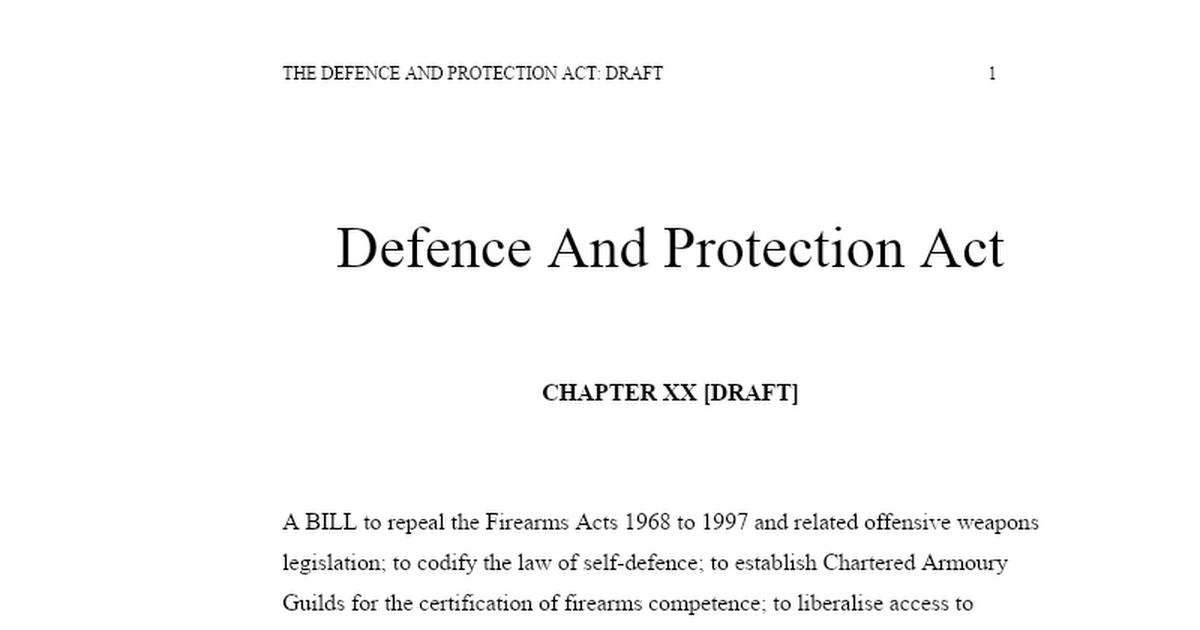
Read the full Defence and Protection Act (167 pages) by Alex Coppen here:

The Incoherence of Current Self-Defence Law
English common law historically recognised robust rights of self-defence. Blackstone's Commentaries affirmed the natural right to repel force with force, and the common law imposed no duty to retreat from an aggressor. A man's home was his castle, and he could defend it. The 1967 Criminal Law Act codified self-defence by permitting "such force as is reasonable in the circumstances" for prevention of crime or lawful arrest, but this seemingly straightforward principle has been eroded through judicial interpretation and prosecutorial practice.
The Prevention of Crime Act 1953 criminalised carrying offensive weapons without lawful excuse, and courts interpreted "lawful excuse" so narrowly as to exclude self-defence.
A person may carry a weapon only for a specific, immediate purpose—a cricket bat to the match, a kitchen knife home from the shop. Carrying for general self-defence constitutes an offence punishable by imprisonment. This creates a paradox: you may lawfully defend yourself if attacked, but preparing to do so by carrying defensive instruments is illegal. The law permits defensive force in extremis whilst criminalising the means to exercise it.
Women bear the greatest burden of this incoherence.
Sexual violence remains endemic. Official statistics record tens of thousands of rapes annually, with conviction rates below two per cent. Women walking alone at night face genuine risk of assault, yet if a woman carries pepper spray she commits a criminal offence. If she carries a personal alarm with electrical discharge capability, she commits a more serious offence. The law tells her to wait for police who will arrive—if at all—long after violence has occurred. Her physical disadvantage relative to male attackers means unarmed resistance is often futile, yet she may not lawfully arm herself.
This contrasts sharply with jurisdictions which recognise force equalisation as morally necessary. Many American states permit concealed carry of firearms for self-defence, recognising smaller, weaker, or disabled persons require tools to match larger, stronger attackers. Even jurisdictions with stricter gun control often permit pepper spray and other non-lethal instruments.
Canadian law, whilst restrictive on firearms, does not criminalise carrying pepper spray where the purpose is defence against animals. British law uniquely combines restrictive firearms regulation with criminalisation of non-lethal defensive instruments, leaving citizens defenceless.
The householder provisions introduced in 2013 attempted to address concerns about homeowners prosecuted for defending their property. The Criminal Justice and Immigration Act 2008 was amended to provide that force used by householders is reasonable unless "grossly disproportionate". This created a two-tier system: householders may use force which would be disproportionate in other contexts, but other persons defending themselves in public spaces receive no such latitude. The reform also failed to address the underlying problem: police still arrest householders who use force, prosecutors still charge them, and they must endure expensive trials to establish that their conduct fell within legal bounds.
Courts assess reasonableness with the benefit of hindsight, creating pressure to second-guess split-second decisions made under conditions of fear and surprise. Though the law states circumstances should be judged as the defendant believed them to be, prosecutors routinely adduce evidence of what actually occurred to undermine claims of honest belief. Juries struggle to ignore outcomes when assessing whether initial perceptions were reasonable.
A person who shoots an intruder genuinely believed to be armed, only to discover the intruder was unarmed, faces potential conviction for manslaughter despite acting on honest belief.
The availability of retreat remains legally relevant even where no formal duty to retreat exists. Prosecutors argue failure to retreat demonstrates the defender was not genuinely in fear or that force was unnecessary. Juries consider whether the defendant could have escaped, and convictions follow where retreat appeared possible. In practice, the absence of a formal duty to retreat provides little protection when prosecutors and courts treat retreat as evidence of necessity.
Firearms As Tools Requiring Mastery
The debate over firearms in Britain has become tribal and unproductive. One side views guns as instruments of liberty, essential to free citizens. The other sees them as engines of death, proper only to military and police. Both positions miss the essential point: firearms are dangerous tools requiring technical mastery, like chainsaws or industrial machinery. The question is not whether citizens have a right to own guns, but whether they possess the competence to use them safely.
The Second Amendment to the United States Constitution has no equivalent in British law. The 1689 Bill of Rights states:
That the raising or keeping a standing army within the kingdom in time of peace, unless it be with consent of Parliament, is against law;
That the subjects which are Protestants may have arms for their defence suitable to their conditions and as allowed by law;
That election of members of Parliament ought to be free;
This is expressly subject to statutory limitation and creates no individual right against the state. Parliamentary sovereignty means Parliament may regulate or prohibit firearms as it sees fit. The question is not constitutional entitlement but practical policy: under what conditions should possession be lawful?
Framing firearms as tools rather than rights changes the analysis.
A chainsaw operator requires training and certification not because of moral entitlement but because incompetent use kills people. The same applies to firearms. The current licensing system treats firearms possession as a privilege granted by police discretion, subject to vague criteria like "good reason" and "no danger to public safety". This invites inconsistent application, regional variation, and rent-seeking by officials with power to grant or deny.
Replacing discretionary licensing with competence certification removes administrative gatekeeping whilst maintaining rigorous standards. If a person demonstrates technical mastery—safe handling, accurate shooting, sound judgement under pressure—then possession is lawful. If the person fails to demonstrate competence, or is prohibited by operation of law, then possession remains unlawful. The question is objective and technical, not subjective and political.
This approach acknowledges firearms serve legitimate purposes:
- Target shooting is an Olympic sport with centuries of tradition;
- Hunting provides pest control and food;
- Collecting preserves historical artifacts;
- Self-defence, though controversial, represents the most fundamental use: the preservation of life against unlawful violence. Women facing rape, the elderly facing robbery, the disabled facing assault—all may need force equalisers when physical disparity makes unarmed resistance futile.
Guilds are not gun clubs advocating for enthusiasts. They are statutory competence authorities whose function is to assess mastery.
An armourer's guild trains apprentices to journeymen to masters, ensuring each stage demonstrates increasing skill and responsibility. Firearms guilds operate similarly: they assess whether individuals possess the knowledge, skill, and temperament necessary to possess firearms safely. Those who meet the standard are certified. Those who do not are refused. Politics plays no role.
The Evolution of British Firearms Regulation
Firearms were largely unregulated in Britain until the First World War. The Pistols Act 1903 required a licence to carry a pistol outside one's dwelling or place of business, primarily to address concerns about armed criminals rather than to restrict general possession. The Defence of the Realm Act 1914 introduced wartime controls, and the Firearms Act 1920 made permanent a licensing system requiring certificates from police for possession of firearms and ammunition.
The 1920 Act arose from post-war fears of revolutionary violence following the Bolshevik Revolution. The government worried about demobilised soldiers possessing military rifles and about political extremists arming themselves. The licensing system gave police discretion to refuse certificates to persons deemed unreliable or dangerous. "Good reason" for possession became a criterion, and self-defence was initially accepted as good reason in many cases.
The Firearms Act 1968 consolidated previous legislation and tightened controls following concerns about rising crime. Shotguns required separate certification, and the "good reason" test became more stringent. Police discretion expanded, and self-defence became less acceptable as good reason. The Act created the framework still in force: police issue certificates on being satisfied the applicant has good reason, is not prohibited, and poses no danger to public safety.
Subsequent amendments tightened controls further. The Firearms (Amendment) Act 1988 followed the Hungerford massacre, banning semi-automatic and pump-action rifles and restricting shotgun magazine capacity. The Firearms (Amendment) Act 1997 followed the Dunblane massacre, banning most handguns. The Firearms (Amendment) (No. 2) Act 1997 extended the ban to small-calibre handguns.
These Acts removed entire categories of firearms from civilian possession, leaving only shotguns and certain rifles available under certificate.
Each restriction followed a horrific crime and public outcry. Policymakers responded to outrage rather than evidence, banning weapons based on their use in particular incidents rather than systematic assessment of risk.
The result is incoherent: antique rifles requiring complex loading procedures remain legal whilst modern pistols efficient for self-defence are banned. Target shooters may possess rifles of substantial power but not handguns. The law focuses on types of weapons rather than competence of users.
The licensing system became increasingly restrictive as police interpreted "good reason" narrowly and "no danger to public safety" broadly. Self-defence ceased to be accepted as good reason. Applicants must demonstrate specific need—membership in a shooting club, ownership of land for pest control, historical collecting. Police visit applicants' homes to inspect storage arrangements, interview family members, and assess suitability. The process is intrusive, expensive, and slow, with some forces taking months to process applications.
This system creates two problems:
- First, it vests enormous discretion in police, permitting inconsistent application and potential abuse. Different forces apply different standards. Some are accommodating; others are obstructive. Applicants lack effective recourse against refusal except expensive judicial review.
- Second, the system assumes restriction of lawful possession reduces criminal misuse, yet most firearms crime involves illegally possessed weapons. Law-abiding certificate holders commit firearms offences at rates far below the general population. The law burdens the compliant whilst failing to address actual threats.
The Guild Solution: Competence Without Discretion
The Chartered Armoury Guild system solves these problems by separating competence assessment from state authorisation. Guilds are neither government agencies nor purely private organisations. They are statutory corporations exercising delegated technical authority under criteria defined by Parliament.
Their certifications have direct legal effect: possession with a valid Defensive Competence Instrument satisfies the first condition for lawful possession. The state retains authority over prohibition, classification, and enforcement, but it does not decide who may possess firearms.
This model draws on historical precedent. Medieval guilds regulated trades, assessed competence, and maintained standards without state involvement. Modern professional bodies—the General Medical Council, the Law Society, the Royal Institution of Chartered Surveyors—exercise statutory authority to certify competence and discipline members. Classification societies in maritime law, approved inspectors in building control, certifying authorities in aviation—all exercise technical authority with legal effect. The guild model is orthodox, not radical.
Guilds must meet stringent approval criteria specified in Schedule 4 to the Act. They require minimum capital reserves and insurance, qualified instructors meeting statutory standards, training facilities with appropriate safety equipment, governance arrangements ensuring democratic accountability, and fit-and-proper persons as officers and directors. These criteria are hardened against gaming: guilds cannot be paper organisations or fronts for commercial interests. They must have genuine capacity to assess competence rigorously.
Competition between guilds prevents complacency and monopolistic abuse. The Act does not cap guild numbers. Any organisation meeting the approval criteria receives a charter. This creates market dynamics: guilds compete on training quality, assessment rigour, facility standards, and member services. Poor performers lose members to superior guilds. Excellent performers attract members and grow. Peer reporting obligations ensure guilds monitor each other, preventing races to the bottom through negligent certification.
Crucially, guilds cannot refuse membership arbitrarily. They assess competence against statutory minimum standards prescribed in Schedule 6. If an applicant demonstrates safe handling, accurate shooting, sound judgement, and knowledge of legal principles, the guild issues a Defensive Competence Instrument. If the applicant fails to meet standards, the guild refuses certification. Competence is objective and technical. The guild exercises no discretion over who "deserves" to possess firearms or whether possession serves sufficiently important purposes.
This eliminates the most pernicious aspect of current law: administrative gatekeeping based on vague criteria interpreted by officials with unchecked power.
Police no longer decide whether your reason is "good" or whether you present "danger to public safety". Those questions are either answered by objective standards (prohibited persons categories) or replaced by technical assessment (competence certification). The system becomes predictable, consistent, and resistant to corruption.
Guilds face criminal liability for negligent certification: officers who issue instruments to incompetent persons, or who fail to revoke instruments when required, commit indictable offences carrying substantial custody. This creates powerful incentives for rigorous assessment. A guild which certifies dangerous persons faces charter revocation, criminal prosecution of officers, and civil liability if certified persons cause harm through incompetence. The skin in the game is real.
A Law To Legislate Lethal Competence
The Act's repeals sweep away not merely individual statutes but an entire philosophy of governance—the notion citizens require official approval to prepare for their own survival. What follows is not amendment but replacement, not reform but reconstruction, establishing parliamentary sovereignty over fundamental questions of self-preservation whilst delegating technical assessment to chartered bodies with genuine expertise and accountability.
Part 1: Preliminary Provisions
The opening provisions establish the Act's scope and fundamental principles. The legislation extends throughout the United Kingdom, with territorial provisions addressing differences in Scottish and Northern Irish criminal justice systems. Commencement is staged over three years to permit orderly transition from current licensing to the guild system. Definitions introduce key concepts: "defensive instrument" encompasses both firearms and non-lethal devices; "Defensive Competence Instrument" is the certification issued by guilds; "prohibited person" describes individuals who cannot lawfully possess firearms regardless of competence.
The repeals provision lists approximately sixty years of firearms legislation swept away by this Act. The Firearms Acts from 1968 through 1997 disappear entirely. The Prevention of Crime Act 1953 section criminalising offensive weapons is replaced by the conformity-based regime for non-lethal instruments and the explicit knife provisions. The self-defence sections of the Criminal Justice and Immigration Act 2008 are superseded by the comprehensive framework in Part 2. This is total replacement, not incremental reform.
Savings provisions ensure that existing convictions, court orders, and prohibitions remain valid. A person convicted under the 1968 Act remains prohibited if the conviction falls within Schedule 2. Ongoing prosecutions continue under repealed legislation unless applying this Act would be more favourable to defendants. The law does not operate retrospectively to criminalise previously lawful conduct, but it also does not erase the consequences of prior unlawful conduct.
The relationship with common law is clarified: common law continues except where modified by statute. Self-defence at common law is partially codified but not wholly replaced. Where the Act is silent, common law principles apply. This preserves flexibility and judicial development whilst providing statutory certainty on core issues.
Part 2: Self-Defence Law Reform
This Part codifies and strengthens self-defence law, removing obstacles that currently deter lawful defensive action. The core principle is simple: force used in self-defence or defence of others is lawful if the person honestly believed such force was immediately necessary to defend against unlawful force, and the degree of force was not grossly disproportionate in the circumstances as honestly believed.
Honest belief is central. The law assesses circumstances as the defendant believed them to be, even if that belief was objectively unreasonable or subsequently proved mistaken. Reasonableness of belief goes to credibility—whether the belief was genuinely held—not to whether it met objective standards. This protects defenders who make honest mistakes under pressure. A woman who shoots an intruder she genuinely believes is armed cannot be convicted merely because the intruder was in fact unarmed.
The duty to retreat is abolished explicitly. The availability of retreat is "wholly irrelevant to the assessment of whether force was reasonable" and may not be considered by courts or juries for any purpose. Prosecutors cannot argue that failure to retreat demonstrates lack of genuine fear or that force was unnecessary. This provision goes further than current law, which eliminates formal duty to retreat but permits retreat to be considered as circumstantial evidence.
Pre-emptive force is lawfully justified. A person may strike first if honestly believing that waiting would create unacceptable risk. The test is whether force was "immediately necessary to prevent unlawful force", not whether attack was actually occurring. This recognises that defenders facing physical disparity or tactical disadvantage may need to act before being struck. A smaller person confronting a larger aggressor need not wait to be hit when striking first offers the only realistic chance of successful defence.
Householder provisions create a presumption in favour of defenders. Where an intruder enters or attempts to enter a dwelling without authority, the occupier is presumed to have honestly believed force was immediately necessary and to have faced threat of death or serious harm. This presumption is rebuttable only by prosecution proving beyond reasonable doubt that the belief was not genuine. The effect is dramatic: instead of defendants proving they acted reasonably, prosecutors must prove they did not genuinely fear for their safety.
Civil immunity protects persons who use defensive force from subsequent lawsuits. Where criminal charges are not brought, or where defendants are acquitted or charges are withdrawn, the defender has complete immunity from civil liability for any harm caused by defensive force. This prevents double jeopardy through civil suits brought by families of attackers after criminal acquittal. The immunity applies even where the defender's belief was mistaken, provided it was honestly held.
Possession of defensive instruments does not constitute evidence of intent to use unlawful force or undermine self-defence claims. Prosecutors cannot argue that carrying a weapon demonstrates aggressive temperament or planning to engage in confrontation. Carrying is neutral. Intent must be proved by conduct, statements, and context—not by mere possession.
Prosecutorial guidance requires prosecutors to consider the fundamental right to self-defence when deciding whether to charge. Charges should not be brought unless there is sufficient evidence to disprove self-defence beyond reasonable doubt and prosecution serves the public interest. Investigative detention is limited to twenty-four hours unless charges are filed, preventing extended custody whilst police investigate whether self-defence applies.
Part 3: Non-Lethal Defensive Instruments
This Part liberalises access to non-lethal defensive instruments, ending the absurdity whereby carrying pepper spray constitutes a criminal offence. The framework establishes a conformity-based system: instruments meeting technical standards may be carried lawfully by adults without certification or permission.
A non-lethal defensive instrument is defined objectively: probability of causing death or grievous bodily harm under typical deployment scenarios must be less than five per cent. This threshold is assessed by reference to physiological effects, energy transfer, medical evidence, and testing by approved laboratories. The definition excludes instruments where lethality is inherent design feature rather than misuse risk.
The Secretary of State maintains a published list of permitted instruments meeting conformity standards. Instruments are added to the list when testing laboratories certified by the United Kingdom Accreditation Service verify compliance with British or ISO standards. This creates a pathway for innovation: manufacturers develop new instruments, submit them for testing, and upon certification they become lawful to carry. The default is that unclassified instruments may not be carried for defence, preventing proliferation of untested devices.
Bladed articles receive explicit treatment. Knives are not non-lethal defensive instruments. Carrying bladed articles in public places remains an offence except where lawful authority or reasonable excuse exists. Defensive carrying is explicitly excluded as reasonable excuse: self-defence may be effected through non-lethal instruments or firearms, but not knives. This maintains restrictions on blade-carrying whilst liberalising access to genuinely non-lethal tools.
Age restrictions limit purchase and carrying to persons aged eighteen and over. Retailers verify age and maintain sales records for seven years. Younger persons may possess non-lethal instruments under supervision for training purposes. Online sales are permitted with electronic age verification.
Carrying of permitted instruments is lawful in any location where the person has aPart 11: Transitional Provisions and Repeals
Implementation timeline spans three years. Year 1 is guild establishment: charter applications, approval of first guilds, National Verification Gateway development, police and court training. Year 2 is interim certification: existing certificate holders obtain interim Defensive Competence Instruments valid for two years whilst retaining old certificates. Year 3 is full transition: all interim arrangements expire and the new regime operates entirely.
Existing certificate holders may apply for interim instruments through abbreviated assessment. Guilds treat existing certificates as evidence of prior competence, conducting interviews, legal updates, and practical verification rather than full curriculum. Interim instruments expire after two years, requiring holders to complete full training and assessment for permanent instruments.uthority to be present, except secure premises (courts, prisons, police stations), aircraft and airports beyond security checkpoints, schools during operational hours, and private premises where owners prohibit carrying by notice. Location restrictions are narrow and justified by security imperatives or property rights.
Use of non-lethal instruments in self-defence is governed by Part 2. The instruments are force equalisers permitting smaller or weaker persons to defend themselves effectively. Use is lawful where the self-defence criteria are satisfied. Misuse—assault, intimidation, unlawful threats—constitutes criminal offence with sentencing enhancement.
Assault on constables or officials using non-lethal instruments carries enhanced penalties: seven years maximum on indictment. This recognises the increased risk to officers from armed confrontations whilst preserving a defence where the defendant honestly believed the officer was not acting lawfully or was using unlawful force.
Part 4: Firearms General Provisions
The firearms framework establishes four conditions for lawful possession: valid Defensive Competence Instrument, correct tier endorsement, not a prohibited person, and compliance with storage requirements. All four must be satisfied. This is the core legality test replacing discretionary licensing.
The Defensive Competence Instrument evidences technical competence only. It is not authorisation or permission from the state. Its legal effect is to satisfy the first condition for lawful possession. Competence is necessary but not sufficient. A person holding an instrument may nonetheless be prohibited from possession if falling within prohibited categories.
Prohibited person status operates automatically by application of statutory criteria in Schedule 2. No administrative determination is required. Courts, medical practitioners, and other authorities notify the prohibited persons database when events triggering prohibition occur. The person becomes prohibited by operation of law, and the Defensive Competence Instrument has no effect during the prohibition period.
Crucially, guilds do not determine prohibited status. They assess competence. The state determines prohibition. These functions are cleanly separated. A guild verifies that a person can safely handle firearms; police verify that the person is not prohibited; both checks must be satisfied. This prevents guilds from needing access to criminal records or medical databases, minimising privacy intrusion whilst maintaining safety.
Weapon classification divides firearms into three tiers. Tier A comprises weapons suitable for home storage and general use including self-defence, hunting, and sport. Tier B comprises weapons suitable only for ranges or organised hunting, which must be stored in guild armories. Tier C comprises prohibited weapons that may not be possessed under any circumstances. Classification is determined by primary legislation in Schedule 1, with amendments by affirmative statutory instrument. This keeps classification under parliamentary control whilst permitting technical adjustments.
Tier endorsements are added to Defensive Competence Instruments when holders complete tier-specific training and assessment. A single instrument may carry multiple endorsements. This permits progressive skill development: holders certified for Tier A weapons may later train for Tier B and receive endorsement without obtaining a separate certificate.
Storage requirements are tier-specific. Tier A weapons must be stored in approved safes or cabinets meeting specifications in Schedule 3, with firearms and ammunition separated, safes anchored to building structure, and access limited to certificated persons. Tier B weapons may not be stored at home under any circumstances. They must be kept in guild armories or approved commercial facilities, with members checking weapons out for use and returning them immediately after.
Transportation requirements apply to all tiers. Weapons must be unloaded, stored in locked containers, transported with ammunition separate, and not readily accessible during transit. Direct route only; no unnecessary stops. This prevents weapons being "ready to hand" in public whilst permitting lawful transport between locations.
Part 5: Chartered Armoury Guilds
This Part establishes the institutional framework for guilds, including chartering criteria, functions, governance, and accountability. Guilds are statutory corporations with perpetual succession, capable of suing and being sued. They are not government bodies, and their officers are not Crown servants. They are non-profit organisations applying surplus revenues to guild purposes rather than distributing profits.
Functions include assessing competence, issuing and revoking Defensive Competence Instruments, maintaining training facilities, employing qualified instructors, setting guild-specific standards exceeding statutory minimums, disciplining members, maintaining records, cooperating with police verification, and reporting criminal conduct. Guilds operate as competence authorities with direct legal effect.
Functions guilds do not have are equally important. They exercise no police powers: no arrest, detention, search, seizure, or prosecution. They do not classify weapons into tiers. They do not determine prohibited person status. They do not override court orders or statutory prohibitions. Their authority is technical assessment of competence, nothing more.
Charter approval criteria in Schedule 4 are hardened against gaming. Applicants must demonstrate minimum capital reserves and insurance (suggested £100,000 reserves and £5 million liability coverage), qualified instructor cadre with minimum ratios preventing gaming through low membership, training facilities meeting specifications, mandatory independent annual audit, safeguarding policies with fair hearing procedures, constitutional governance with democratic member participation, conflict-of-interest rules preventing dealers from controlling certification, and fit-and-proper persons as officers and directors.
The fit-and-proper test disqualifies persons convicted of serious offences listed in Schedule 2 as lifetime prohibitions, undischarged bankrupts, prohibited persons, and persons with established organised crime links. This prevents guilds from being captured by criminal elements or operated by unsuitable persons.
Approval is mandatory where criteria are met. The Secretary of State has no discretion to refuse approval on policy grounds, political considerations, or assessment of whether additional guilds are needed. If an applicant meets all criteria, approval follows. Refusal is limited to failure to meet statutory criteria or failure of officers to meet the fit-and-proper test. This prevents regulatory capture and ensures guilds can form freely.
No numerical caps exist. As many guilds as meet the criteria may receive charters. This ensures competition and prevents monopolistic abuse. The target is fifty to one hundred guilds nationally, providing sufficient scale for viability whilst ensuring geographic coverage and competitive pressure.
Guild officer accountability includes criminal liability for negligent certification, failure to revoke when required, maintaining false records, and unlawful disclosure of member information. Penalties range from twelve months summary conviction to seven years on indictment for serious breaches. Corporate liability applies to guilds themselves, with fines and potential charter revocation for institutional failures.
Record-keeping requirements oblige guilds to maintain accurate records of members, training provided, assessments conducted, instruments issued and revoked, and reports made to authorities. Records must be retained for twenty years and made available to police and the Secretary of State on request, subject to data protection compliance.
Cooperation with verification procedures requires guilds to establish systems permitting police to verify instrument validity in real time. Systems must be available twenty-four hours daily with 99.9 per cent uptime, respond within five seconds, employ cryptographic authentication, and log all queries. Technical standards are prescribed in Schedule 5.
Reporting obligations require guilds to notify police of criminal conduct, public safety concerns, prohibited persons attempting certification, and dangerous incidents. Cross-guild peer reporting ensures guilds monitor each other, preventing systemic failures through mutual oversight.
Charter revocation is criteria-based. Grounds include ceasing to meet approval criteria, repeated or serious statutory breaches, officer convictions or unfitness, systematic negligent certification, financial insolvency, or conduct bringing the system into disrepute. Revocation follows procedural safeguards: written notice with reasons, ninety days to make representations, written reasoned decision, and judicial review available.
Part 6: Competence Certification and Training
Training standards focus on assessment outcomes rather than hours completed. Schedule 6 prescribes minimum curriculum components: legal and ethical framework, technical competence, marksmanship, and judgement and scenario training. Assessment requirements include written examination (eighty per cent pass mark), practical demonstration (zero tolerance for safety violations), marksmanship qualification (defined accuracy standards), scenario assessment (judgement under pressure), and instructor evaluation (overall fitness and temperament).
Crucially, no minimum hours are prescribed. Guilds determine training duration necessary to achieve pass standards. Experienced shooters or persons with relevant prior training may complete assessment faster than novices. Competition between guilds focuses on quality of training and success rates, not speed or convenience. This prevents races to the bottom through inadequate preparation whilst avoiding arbitrary hour requirements.
Roles are separated. Instructors provide training. Assessors conduct assessments. Armoury custodians manage Tier B weapon storage. The same person may not perform multiple roles for the same individual. An instructor may not assess someone they trained. An assessor may not assess someone they instructed within twelve months. Custodians may not assess members storing weapons at their armoury. This separation prevents conflicts of interest and ensures independent assessment.
Instructor qualifications require holding valid Defensive Competence Instruments, completing instructor training programmes covering pedagogy and safety management, undergoing enhanced criminal records checks, and demonstrating teaching ability. Military or police firearms instructors receive credit toward civilian instructor certification but must complete civilian-specific training in legal frameworks and teaching methods.
Defensive Competence Instruments are physical cards with security features: photograph, unique number, guild identifier, tier endorsements, and cryptographic signatures verifiable using guild public keys. Security features prevent forgery and alteration. Technical specifications in Schedule 5 ensure consistency across guilds and interoperability with verification systems.
Renewal occurs every five years. Holders complete refresher training covering legal updates and technical requalification, undergo practical reassessment demonstrating maintained competence, make statutory declarations of no disqualifying conditions arising, and pay renewal fees. Failure to renew results in expiry and automatic cessation of legal effect.
Triggered review permits guilds to require competence reassessment before scheduled renewal if incidents occur involving the holder, significant gaps in usage suggest skill deterioration, medical concerns are reported, or behavioural issues arise. Members refusing review or failing reassessment face suspension or revocation.
Guild-initiated suspension and revocation address failures to meet continuing competence standards, medical conditions giving rise to prohibition, serious safety concerns, or non-payment of fees. Suspension operates immediately upon notice. Revocation terminates instruments permanently, with twelve months minimum before reapplication. Procedural safeguards include written notice with reasons, opportunity to make representations, written reasoned decisions, internal appeals, and judicial review availability.
Part 7: Verification Infrastructure and Prohibited Persons Database
The National Verification Gateway sits within existing Police National Computer infrastructure rather than creating a separate quango. It maintains public key infrastructure for cryptographic authentication, endpoint routing tables directing queries to correct guilds, credential revocation lists for suspended instruments, and uptime logs providing evidential audit trails. Critically, it does not store holder identities, weapons owned, training records, or competence assessments. It exists solely to facilitate routing and maintain the prohibited persons database.
Guild verification protocols employ distributed architecture. Each guild maintains its own member database and responds to verification queries from police. The Gateway routes queries based on guild identifiers and aggregates responses. This prevents creation of a central registry whilst enabling real-time verification. Guilds cannot see queries to other guilds, and police cannot aggregate data across guilds except through individual queries.
Police verification procedure requires officers encountering armed persons to query both the relevant guild (instrument validity and tier endorsements) and the prohibited persons database (prohibition status). Both checks must be satisfied. If either indicates unlawful possession, officers may seize firearms and arrest for offences under Part 9.
The prohibited persons database contains only: identity, prohibition category, commencement date, expiry date if time-limited, and source of prohibition. It does not contain information about instrument holders who are not prohibited, weapons owned, or any data beyond the specified fields. This minimises privacy intrusion whilst enabling enforcement.
Database population occurs automatically. Courts notify the database upon convictions or court orders triggering prohibition. Medical practitioners notify upon diagnosing conditions listed in Schedule 2 as prohibiting, where they know or reasonably believe the person possesses or seeks firearms. Notification is a professional duty imposed by statute, with criminal penalties for failure to comply and immunity from damages for good-faith notifications.
Medical certification and review procedures permit persons diagnosed with prohibiting conditions to seek second opinions from specialists. Where opinions conflict, independent medical tribunals of three practitioners determine whether the condition exists. Persons may apply for medical review annually, submitting fresh evidence of resolution or control. Tribunals may direct removal from the database if prohibition is no longer justified.
Restoration of rights follows time-limited prohibitions expiring automatically. Lifetime prohibitions may be lifted through court applications after fifteen years from sentence completion. Courts grant restoration only where applicants demonstrate substantial rehabilitation, no reoffending, stable community ties, and no ongoing risk. Burden of proof lies with applicants on the balance of probabilities.
Data protection and access controls restrict database access to police conducting verification checks, court officials processing restoration applications, database administrators, and such other persons as the Secretary of State authorises for specific purposes. All access is logged with user identity, timestamp, record accessed, and purpose. Logs are audited regularly to detect unauthorised access.
Criminal offences punish unauthorised database access (twelve months maximum), access for improper purposes (two years maximum), and unauthorised disclosure (five years maximum). These apply to all persons including police officers and officials. No exemptions exist based on official position.
Explicit prohibition on central firearms registry ensures the Gateway and database contain no information about weapons owned or possessed. No central registry shall be created or maintained. Guilds keep their own member records; dealers keep sales records; but these remain distributed and are not aggregated centrally.
Part 8: State Override and Emergency Powers
Residual state authority permits emergency suspension of Defensive Competence Instruments in individual cases on exhaustive grounds: court orders prohibiting possession, statutory prohibition triggered by conviction or medical diagnosis, or police-initiated emergency suspension based on reasonable suspicion of imminent risk to life or serious harm.
Police emergency suspension requires inspector rank or above, reasonable suspicion based on specific intelligence or observed conduct (not speculation or stereotype), and written order specifying grounds with sufficient particularity. Duration is seventy-two hours maximum from service on the person.
Mandatory judicial review follows within seventy-two hours. Police present evidence supporting suspension; the subject may attend, be represented, challenge evidence, and make submissions. Courts may affirm and extend suspension (twenty-eight days maximum), lift suspension and order firearm return, or convert suspension to prohibition if statutory grounds exist.
Legal aid is available regardless of means for suspension review hearings. Firearms access affects fundamental rights, justifying automatic legal aid without means or merits tests. Unrepresented persons receive court assistance in presenting their cases.
Weapon custody during suspension requires immediate transfer to police custody or guild armoury at the person's election. Guilds may refuse if capacity is insufficient. Police issue receipts itemising firearms and recording condition. Ownership is retained; firearms are returned within seven days of suspension lifting unless forfeiture is ordered.
Forfeiture follows conversion to permanent prohibition, with compensation at fair market value paid by the Secretary of State. This prevents uncompensated taking whilst recognising that prohibition makes possession unlawful.
Seizure powers permit police to apply for warrants authorising entry and seizure where persons refuse surrender or cannot be located and imminent risk exists. Exigent circumstances permit seizure without warrant where immediate action is necessary to prevent death or serious harm and obtaining a warrant would defeat the purpose.
Part 9: Offences and Penalties
Firearms offences include possession without valid instrument (five years maximum), possession without correct tier endorsement (five years maximum), possession whilst prohibited (ten years maximum with custody expected), Tier C prohibited weapon possession (ten years maximum with custody expected), unsafe storage (twelve months maximum, strict liability with due diligence defence), and unlawful supply (seven years maximum, strict liability with verification defence).
Guild officer offences include negligent certification (seven years maximum for gross negligence standard), failure to revoke when required (five years maximum for intentional omission), false records or certification documents (five years maximum), unlawful disclosure of member information (twelve months maximum), and false verification responses (five years maximum with strict liability but technical error defence).
Forfeiture is mandatory for convictions under serious offences (possession whilst prohibited, Tier C possession, unlawful supply, resisting seizure). Discretionary forfeiture applies to other offences where appropriate. Deprivation of Defensive Competence Instruments by court order creates prohibited person status for specified periods or indefinitely.
Sentencing framework identifies aggravating factors (loaded weapon, brandishing, public place, multiple weapons, organised crime connection, previous convictions, breach of trust) and mitigating factors (first offence, guilty plea, voluntary surrender, cooperation, no harm caused, genuine ignorance where reasonable). The Sentencing Council will issue definitive guidelines within twelve months.
Part 10: Dealers, Commercial Operations, and Ancillary Matters
Dealer authorisation replaces Firearms Act 1968 registration. Dealers must hold statutory authorisation granted by the Secretary of State upon demonstrating adequate premises meeting security standards, insurance, guild affiliation, and fit-and-proper person status. Approval is mandatory where criteria are met.
Guild affiliation obligations require dealers to affiliate with one or more guilds for supplying members. Affiliation is commercial arrangement with terms negotiated between parties. Guilds may not unreasonably refuse affiliation with dealers meeting reasonable standards.
Verification duties impose strict liability on dealers to verify purchaser certification before sales. Dealers query guilds and the prohibited persons database. Defence exists where verification was conducted in good faith and systems returned valid responses. This incentivises proper verification whilst protecting dealers from liability for system failures.
Record-keeping requirements oblige dealers to maintain registers of stock, sales, and repairs for twenty years. Records include dates, firearm descriptions, recipient details, and verification confirmations. Failure to maintain or providing false records constitutes criminal offence.
Ammunition control provisions require verification before ammunition sales, with reasonable quantity limits preventing stockpiling. Dealers must refuse sales where reasonable grounds exist to suspect unlawful purposes.
Tier B weapons ownership and custodianship provisions permit owners to possess Tier B weapons but not retain physical custody. Weapons must be deposited with guild armories or approved commercial facilities. Owners may collect weapons for lawful use (range sessions, organised hunting) and must return them immediately after. Custodians verify identity and certification before permitting collection.
Exemptions cover diplomatic personnel under Vienna Convention immunity, military personnel on official duties, police firearms officers on operational deployment, and close protection operatives with separate authorisation. Exemptions apply only in official capacity; personal possession requires ordinary certification.
Antique and deactivated firearms provisions exempt pre-1900 antiques with obsolete ammunition kept as curiosities and firearms deactivated to proof house specifications. Reactivation constitutes serious offence (ten years maximum).
Transfer, inheritance, and temporary visitor provisions permit private transfers with verification obligations, executors may hold firearms temporarily (six months) pending distribution or sale, and temporary visitors from jurisdictions with mutual recognition agreements may bring firearms for up to ninety days annually subject to notification.
Part 11: Transitional Provisions and Repeals
Implementation timeline spans three years. Year 1 is guild establishment: charter applications, approval of first guilds, National Verification Gateway development, police and court training. Year 2 is interim certification: existing certificate holders obtain interim Defensive Competence Instruments valid for two years whilst retaining old certificates. Year 3 is full transition: all interim arrangements expire and the new regime operates entirely.
Existing certificate holders may apply for interim instruments through abbreviated assessment. Guilds treat existing certificates as evidence of prior competence, conducting interviews, legal updates, and practical verification rather than full curriculum. Interim instruments expire after two years, requiring holders to complete full training and assessment for permanent instruments.
Dealer transition permits existing registered dealers to operate under transitional authorisation during Years 2 and 3 whilst establishing guild affiliations and meeting new standards. Applications for dealer authorisation must be submitted by end of Year 2. Transitional authorisation expires at start of Year 3.
Weapons surrender and amnesty provisions apply where Schedule 1 reclassifies previously lawful weapons into Tier C. Six-month amnesty permits surrender without penalty. Compensation at fair market value is paid for surrendered weapons. Possession after amnesty expiry constitutes Tier C possession offence.
Post-implementation review requires the Secretary of State to appoint an independent reviewer five years after full implementation. Review scope includes guild effectiveness, self-defence law operation, non-lethal instrument accessibility, verification infrastructure security, and transitional completion. The reviewer reports to Parliament within twelve months. Government must respond within six months, indicating which recommendations are accepted.
Comprehensive repeals eliminate the Firearms Acts 1968 through 1997 entirely, Prevention of Crime Act 1953 section 1, Criminal Justice Act 1988 section 139, Criminal Justice and Immigration Act 2008 sections 76-77, and relevant provisions of the Anti-social Behaviour, Crime and Policing Act 2014. Savings provisions preserve existing convictions, prohibitions, and ongoing proceedings whilst preventing retrospective criminalisation.
A Sensible Constitutional Settlement
The Defence and Protection Act represents more than firearms reform. It embodies a fundamental rebalancing of individual liberty and state authority. For seven decades, the presumption has been that the state permits self-defence reluctantly, that citizens require permission to prepare for their own protection, and that administrative discretion should determine who may possess the means of defence.
This Act reverses those presumptions.
The right to defend oneself and others against unlawful violence is inherent, not granted. The state may not interfere except to prevent abuse through clear, objective prohibitions and competence standards. Those standards are assessed by chartered bodies exercising technical authority, not by officials dispensing permissions based on vague criteria. The result is a system that respects both individual autonomy and public safety, neither sacrificing liberty for security nor permitting dangerous persons access to lethal tools.
The guild system solves the fundamental problem of firearms regulation: how to maintain rigorous standards without administrative gatekeeping. By separating competence from authorisation, technical assessment from political discretion, the framework achieves what licensing systems cannot. It creates predictable rules, consistent application, and accountability through multiple layers: statutory criteria, guild assessment, peer oversight, criminal liability, judicial review, and ultimate parliamentary control through primary legislation.
This is not absolutism. Prohibited persons remain prohibited. Dangerous weapons remain banned. Emergency powers permit suspension where imminent risks exist. But these restrictions operate through law, not discretion. They apply equally to all, not arbitrarily to some. They are reviewable by courts, not immune from challenge. The system treats citizens as responsible adults capable of mastery rather than as subjects requiring permission.
Women gain most from this reform. The liberalisation of non-lethal instruments provides immediate protection against the endemic threat of sexual violence. The reformed self-defence law removes legal obstacles to effective resistance. The guild system, by eliminating "good reason" requirements, permits women to obtain firearms competence without justifying why they "need" force equalisers—as if the disparity between female and male physical strength were not justification enough.
The framework assumes a sovereign Parliament acting in the interests of citizens, not subject to external constraints from Strasbourg or other supranational bodies. It assumes that British constitutional traditions of individual liberty, common law rights, and parliamentary supremacy provide adequate foundation for just governance. It assumes that technical competence matters more than political correctness, that objective standards outperform subjective discretion, and that liberty lost is rarely regained without struggle.
Whether this Act becomes law depends on political will. Whether it succeeds depends on implementation. The guilds must form and operate with integrity. The verification systems must function reliably. Police and courts must adapt to new frameworks. Citizens must embrace responsibility along with rights. None of this is guaranteed. But the architecture is sound, the principles are defensible, and the need is urgent. A nation that cannot defend itself will not long remain free.