The Chagos Catastrophe: When Britain's Idiot Class Manufactured Surrender
Britain did not lose the Chagos Islands. It volunteered them away—paying billions for the privilege—only to watch the entire deal collapse when Washington noticed what London's lawyers had dismissed. It became a masterclass in institutional suicide.
On 20 January 2026, four days before the House of Lords was due to debate legislation ratifying Britain's handover of the Chagos Archipelago to Mauritius, President Donald Trump posted a message to his Truth Social account. The deal, he declared, was "an act of GREAT STUPIDITY" and a sign of "total weakness." He linked the giveaway to his own territorial ambitions in Greenland, suggesting China and Russia had noticed London's capitulation.
Within seventy-two hours, Sir Keir Starmer's government had pulled the Diego Garcia Military Base and British Indian Ocean Territory Bill from the Lords' order paper. Conservative peers had tabled a motion warning the treaty might violate binding defence agreements with the United States stretching back sixty years. Government lawyers scrambled to examine whether they had negotiated away territory without first securing Washington's consent to overhaul the foundational treaties upon which the entire base architecture rested.
The humiliation was total. A Prime Minister who had framed the handover as a triumph of international law found himself confronting a more brutal truth: sovereignty is not a legal abstraction. It is a political fact, defended or surrendered according to the will of those who hold it.
The Crown Jewel Britain Decided to Give Away
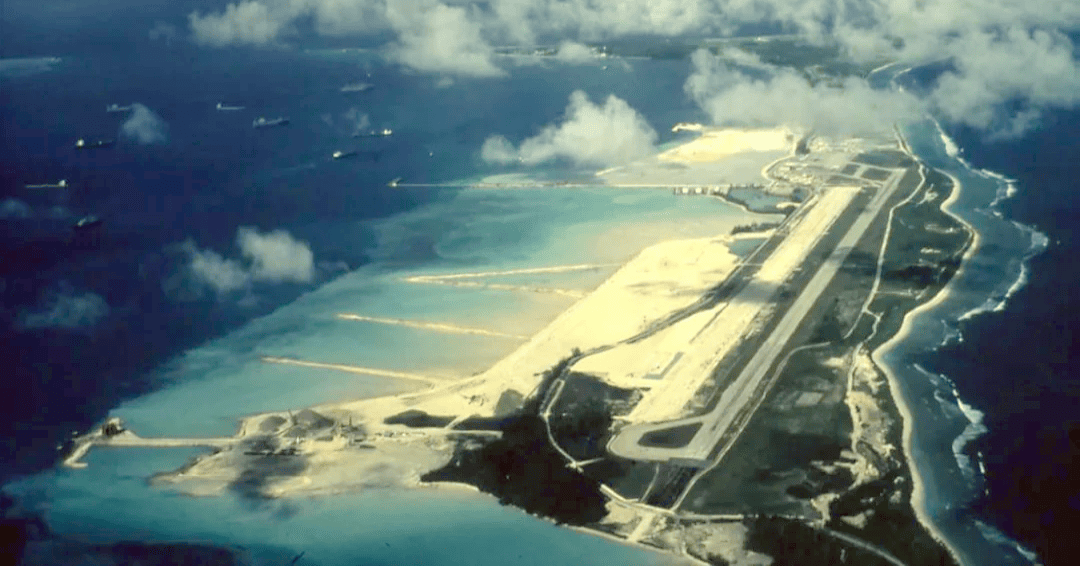
Diego Garcia sits nearly equidistant from East Africa, the Persian Gulf, and Southeast Asia. There is no other location on Earth capable of providing the same strategic reach into three theatres simultaneously. The atoll's runway exceeds 3,600 metres—long enough to launch fully laden B-52s, B-1 Lancers, and B-2 Spirit stealth bombers without aerial refuelling to reach targets across the Middle East and South Asia.
The base has served as the launchpad for American air power in nearly every major conflict since the Cold War. B-52s flew from Diego Garcia during Operation Desert Storm. B-2 Spirit bombers launched the opening salvoes of the Afghan campaign on 7 October 2001. The island's deep-water harbour can resupply nuclear submarines, and its position allows American commanders to sustain operations across the Indian Ocean without reliance on politically sensitive hosts in the Gulf states.
In Pentagon planning documents, Diego Garcia is described as "an all but indispensable platform" for projecting Western power across a theatre through which two-thirds of global oil shipments and more than one-third of the world's bulk cargo pass annually. Approximately 4,000 American and British personnel operate the facility. It monitors every nuclear test on the planet through Comprehensive Nuclear Test Ban Treaty equipment and provides irreplaceable intelligence-gathering capabilities.
This is what Sir Keir Starmer proposed to hand over—for a lease. Not because Britain had been defeated, but because its lawyers advised surrender would satisfy international legal opinion.
The Treaty Britain's Barristers Overlooked
In December 1966, the United Kingdom and the United States signed an Exchange of Notes in London, creating one of the most significant bilateral defence arrangements of the Cold War era. Under its terms, the British Indian Ocean Territory—created the previous year specifically to house the Diego Garcia facility—would remain under United Kingdom sovereignty and be available to meet the defence needs of both governments "for an indefinitely long period."
The initial term ran fifty years, with automatic extension for a further twenty unless either government gave notice of termination between 2014 and 2016. No such notice was given. The agreement renewed automatically, binding both parties until at least 2036.
Subsequent agreements in 1972, 1976, and 1987 expanded the facility from a naval communications station to a full naval support base, then refined arrangements for construction, personnel, and operational coordination. Across every instrument, one assumption remained constant: the United Kingdom retained sovereignty over the territory.
The entire legal structure rests on this foundation. American use of Diego Garcia depends upon British ownership. Washington was granted exclusive defence rights over territory owned by London—not territory administered by London under some temporary colonial arrangement subject to international revision.
When Sir Keir Starmer's government signed a treaty on 22 May 2025 transferring sovereignty of the Chagos Archipelago to Mauritius, it proposed to replace ownership with a lease. From Washington's perspective, this was not a technical adjustment. It was the demolition of the legal foundations upon which six decades of defence planning had been constructed.
The Barrister's Mind: Why Lawyers Make Useless Statesmen
Sir Keir Starmer came to Downing Street from chambers, via the Crown Prosecution Service and the directorship of Public Prosecutions. His intellectual formation occurred in courtrooms, not war rooms. The difference matters.
The barrister's worldview treats law as supreme. Courts are moral arbiters. Adverse rulings require compliance. Reputation matters more than the exercise of power. Losses must be managed, mitigated, explained away—never resisted on principle.
This is how a lawyer thinks. It is not how states survive.
In 2019, the International Court of Justice issued an advisory opinion finding the United Kingdom's continued administration of the Chagos Archipelago contrary to international law. The Court determined the 1965 separation of the islands from Mauritius had violated the right of self-determination, and Britain should end its presence "as rapidly as possible."
The ruling was not binding. Advisory opinions carry weight but impose no legal obligation. Britain could have treated the judgment as one factor among many in its strategic calculus—acknowledging the finding, expressing regret for historical actions, while firmly maintaining its position and explaining why Diego Garcia's continued operation under British sovereignty served wider security interests.
Instead, successive cowardly governments—first under the Conservatives, then accelerating under Labour—treated the ICJ opinion as though it were a court order requiring immediate execution. Ministers spoke of "legal pressure" mounting, of challenges they could not win, of the necessity to pre-empt litigation by conceding the underlying claim.
The statesman's worldview operates differently.
Courts interpret; they do not command. Advisory opinions are weighed, not automatically obeyed. Sovereignty is defended politically, not outsourced to judicial processes. Strategic assets are never treated as litigation risks to be settled out of court.
Sir Keir Starmer never made the leap from advocate to statesman. Faced with international criticism, his instinct was to concede. The legal argument looked difficult; therefore, resistance was futile.
This is not leadership. It is the reflexive surrender of a man trained to accept judges' verdicts without question. This man is, and always has been, entirely unsuitable for any kind of political leadership.
The Financial Terms of Surrender
Under the terms of the treaty signed on 22 May 2025, Britain agreed to make payments to Mauritius averaging £101 million annually over ninety-nine years. The Government claims a net present value of £3.4 billion. Freedom of Information releases from the Government Actuary's Department reveal the nominal total across the full term reaches £34.7 billion.
The sums break down into several components. For the first three years, Britain pays £165 million annually. From year four, annual lease payments of £120 million commence, with built-in inflation adjustments. A £40 million one-off payment funds a Chagossian trust. Annual grants of £45 million run for twenty-five years toward Mauritian development.
No serious businessman would even contemplate a "deal" this stupid. Any basic street trader or child would balk or laugh.
Britain is paying billions of pounds for the privilege of leasing back military facilities it already owned. The taxpayer is subsidising the surrender of sovereignty over strategically vital territory while hoping Mauritius will honour the terms of a lease stretching beyond the lifetimes of everyone involved in its negotiation.
Consider the absurdity.
Britain possessed full sovereignty over Diego Garcia. No court had ordered Britain to leave. No military force threatened to expel British personnel. The 1966 agreement with the United States remained in force until at least 2036. Britain chose to give up ownership and pay for the privilege of remaining as a tenant.
Legal Pressure Nobody Could Define
Ministers consistently justified the handover by reference to mounting "legal pressure." They warned of challenges in the International Tribunal for the Law of the Sea. They spoke darkly of provisional measures orders arriving "within a matter of weeks" unless Britain acted.
What is this collective institutional cowardice? Did anyone even vote for this?
Examine this claim closely. The ICJ's 2019 opinion was advisory and non-binding. The subsequent UN General Assembly resolution calling on Britain to withdraw within six months carried no legal force. Britain is a permanent member of the Security Council with veto power; no enforcement mechanism exists.
The International Tribunal for the Law of the Sea adjudicates maritime boundary disputes, not sovereignty questions. Mauritius might have pursued claims regarding exclusive economic zones, but such proceedings would not have evicted Britain from Diego Garcia or invalidated the 1966 defence agreements with Washington.
What ministers characterised as irresistible legal pressure was, in truth, diplomatic discomfort. Britain faced criticism in international forums, like a high school girl panicked about gossip. Non-binding resolutions passed condemning its continued presence. NGOs campaigned. UN officials issued statements.
None of this constituted compulsion. None of it required surrender. A government confident in its position would have weathered criticism while firmly articulating why Diego Garcia's continued operation under British sovereignty served regional stability and Western security. Instead, ministers treated reputational damage as equivalent to military defeat. Like a fifteen year-old girl.
The Chagossians: Forgotten Twice Over
Between 1968 and 1973, approximately 2,000 Chagossians were forcibly removed from their homes across the archipelago to make way for the military base on Diego Garcia. Colonial administrators claimed the islands had no permanent population—a documented lie designed to avoid accountability to the United Nations for the expulsion. Families were shipped to Mauritius and the Seychelles, their pets killed, their homes demolished.
This was an ugly chapter in British history. No serious person disputes the injustice inflicted upon a community torn from its homeland without consent or compensation.
Yet the treaty signed in May 2025 does almost nothing to remedy these wrongs. Chagossians were excluded from the negotiations between London and Port Louis. UN human rights experts described their engagement as "tokenistic" and "superficial." The agreement allows Mauritius to "implement a programme of resettlement" on the outer islands—but explicitly bars any return to Diego Garcia, the very island from which most Chagossians were expelled.
The £40 million trust fund established for Chagossians represents a derisory sum compared to the billions flowing to the Mauritian government. In effect, Britain pays Mauritius handsomely while offering the displaced community a fraction of the promised support.
UN Special Rapporteurs called for the treaty's suspension, warning it "fails to guarantee and protect the rights of the Chagossian people, including their right to return to Diego Garcia." The UN Committee on the Elimination of Racial Discrimination urged both governments to halt ratification and renegotiate terms ensuring Chagossian consent and participation.
The Chagos surrender was presented as an act of decolonisation, rectifying historical injustice. In practice, it transferred sovereignty from one party accused of wrongdoing to another, while the victims themselves received neither a seat at the table nor meaningful restitution.
Trump As Trigger, Not Cause
Donald Trump's denunciation of the Chagos deal on 20 January 2026 did not create the crisis. It exposed fault lines present from the beginning.
His administration had initially supported the agreement. Secretary of State Marco Rubio issued a statement in May 2025 welcoming the treaty, confirming Washington had determined the deal "secures the long-term, stable, and effective operation of the joint U.S.-UK military facility at Diego Garcia." During a February 2025 meeting with Sir Keir Starmer in the Oval Office, Trump himself had expressed willingness to "go along with" British plans.
By January 2026, that position had reversed.
Reports indicate Conservative leaders, including Kemi Badenoch, engaged in "quiet diplomacy" with Republican officials, flagging concerns over the treaty's implications for American security interests.
Nigel Farage spoke with the Speaker of the House of Representatives and Treasury Secretary Scott Bessent, emphasising risks to submarine operations. The message reached the Oval Office: Britain was dismantling the legal architecture upon which Diego Garcia's operational security depended.
Trump's reversal was strategic, not capricious. American defence planners recognise the difference between owning a forward operating base and leasing one. A lease can be challenged, litigated, reinterpreted, or revoked by a future Mauritian government under UN pressure. The Pentagon has always treated Diego Garcia as sovereign territory beyond the reach of regional politics. Sir Keir Starmer's treaty demolished this assumption.
Washington did not object to the original announcement because lawyers at the State Department believed the 99-year leaseback preserved operational continuity. Only when the implications became clear—when Conservative peers warned the handover might violate the 1966 treaty's assumption of British sovereignty—did American objections crystallise.
The Government Admits Defeat
Late on the Friday before the scheduled Lords debate, government lawyers conceded the obvious. In a letter to Conservative peers, ministers acknowledged the Chagos deal could not proceed without American agreement to overhaul the 1966 defence arrangements. The treaty Britain had signed with Mauritius depended upon Washington consenting to fundamental changes in the legal relationship between the two allies.
No such consent had been secured.
Sir Keir Starmer's government had negotiated the surrender of British sovereign territory without first obtaining its principal ally's agreement to the new arrangements. Ministers presented the handover as a fait accompli, expecting Washington to adapt. When Trump called their bluff, the entire edifice collapsed.
Government sources blamed Conservative peers for "irresponsible and reckless behaviour" in tabling amendments and demanding assurances. In fact, the Conservatives had done what the government's own lawyers should have done before signing any treaty: verify compatibility with existing binding obligations.
Yes, scrutiny, according to this idiot schoolgirl class, is "irresponsible and reckless."
Sovereignty as Embarrassment
How does a government volunteer the surrender of strategic territory, pay billions for the privilege, and fail to secure its principal ally's consent to the arrangements? The answer lies not in external pressure but in internal conviction.
Britain's governing class no longer believes sovereignty is something worth defending. International criticism is treated as intolerable. Legal challenge is assumed to be unwinnable before any fight begins. Strategic assets are viewed through the perspective of reputational risk rather than national interest.
Ministers approached the Chagos negotiations believing they had no choice. The ICJ had spoken. World opinion had turned against Britain. Better to concede gracefully than suffer further embarrassment in international forums.
This psychology of preemptive surrender explains why no minister asked the obvious questions:
- What would concession actually achieve?
- Would handing sovereignty to Mauritius satisfy Chagossian demands?
- Would it improve regional security?
- Would it strengthen the alliance with Washington?
The answer to each question was no.
The handover satisfied nobody except those committed to the abstract principle of completing decolonisation regardless of practical consequences. Chagossians gained nothing. Washington lost the stable legal foundation for its most important Indian Ocean facility. British taxpayers faced billions in payments for territory Britain already controlled.
What Genuine Statesmanship Demands
The collapse of the Chagos bill tears open a path toward different choices—requiring the kind of moral clarity and political nerve the current administration has demonstrated itself incapable of providing.
Britain must acknowledge historical wrongs honestly. The expulsion of the Chagossians was shameful. Apologise unambiguously. Establish generous compensation funds directly for affected families—not channelled through Port Louis, where the money will vanish into ministerial discretion.
Britain must reject the premise of inevitable defeat. The ICJ opinion is advisory. UN resolutions are non-binding. No legal mechanism compels surrender of Diego Garcia. The position is defensible for any government willing to mount a defence.
Britain must articulate why Diego Garcia matters—clearly, forcefully, without apology. Two-thirds of global oil shipments transit the Indian Ocean. Western security depends upon maintaining presence in waters increasingly contested by China's expanding naval reach. Diego Garcia is not a colonial relic requiring embarrassed disposal. It is a cornerstone of the defence architecture protecting free navigation and deterring aggression from Aden to the Strait of Malacca.
Britain must negotiate directly with the Chagossians. Any honourable settlement includes their full participation, guarantees meaningful return rights to the outer islands, and provides employment opportunities on Diego Garcia itself. Address legitimate grievances without surrendering the strategic position those grievances do not require us to abandon.
Britain must strengthen, not undermine, the alliance with Washington. The 1966 framework served both nations for sixty years. Its continuation serves both nations still. Any future arrangement proceeds from British ownership—not Mauritian sufferance, not the goodwill of governments yet unborn, not the hope that a piece of paper will bind parties whose interests may diverge.
The Reckoning Which Needs To Come
Sir Keir Starmer entered Downing Street promising competent government after years of chaos. He has delivered instead one of the most extraordinary diplomatic humiliations in modern British history—a treaty signed to great fanfare, unravelling within months when an American president noticed what Britain's own lawyers had overlooked: you cannot dismantle the legal foundations of your principal ally's defence infrastructure and expect applause.
The Chagos catastrophe was not inevitable. Britain did not lose these islands to military defeat, economic collapse, or irresistible legal compulsion. Its governing class chose to surrender them, convinced sovereignty had become an embarrassment too painful to bear in polite international company.
This is not governance. It is abdication dressed in legal robes.
When the Prime Minister addresses the wreckage of his policy—if he possesses the courage to address it at all—he faces the choice every leader confronts when tested: defend the nation's interests against criticism, or retreat into the comfortable posture of managed decline while calling it progress.
The eyes of allies and adversaries alike are fixed upon London. China has noted the surrender and drawn conclusions. Russia has noted the weakness and filed the lesson. Washington—for the moment—has pulled Britain back from the brink.
But there will be no American president on hand to rescue every failure of British nerve. The next test will come, and the next, and the question will always be the same: whether those governing Britain believe their country possesses anything worth fighting for, or whether sovereignty itself has become one more legacy to be liquidated, one more asset to be written off, one more principle to be surrendered before the first shot is fired.
The Chagos Islands await an answer. So does Britain's future as a nation capable of defending its interests in a world where weakness is never rewarded and retreat never satisfies those demanding it.
The choice belongs to the British people now. Their government has demonstrated its preference. The question is whether the country will permit its leaders to continue volunteering surrender—or demand something better than the managed disgrace of a great nation paying billions for the privilege of its own defeat.