How Britain Sabotaged Its Own Scientific and Forensic Capacity
Britain once led the world in forensic science. Now labs fail quality checks, digital evidence sits unexamined for years, and patient data flows to US spy-tech firms. This is the anatomy of multidisciplinary institutional collapse spreading across dozens of areas while our politicians do nothing.
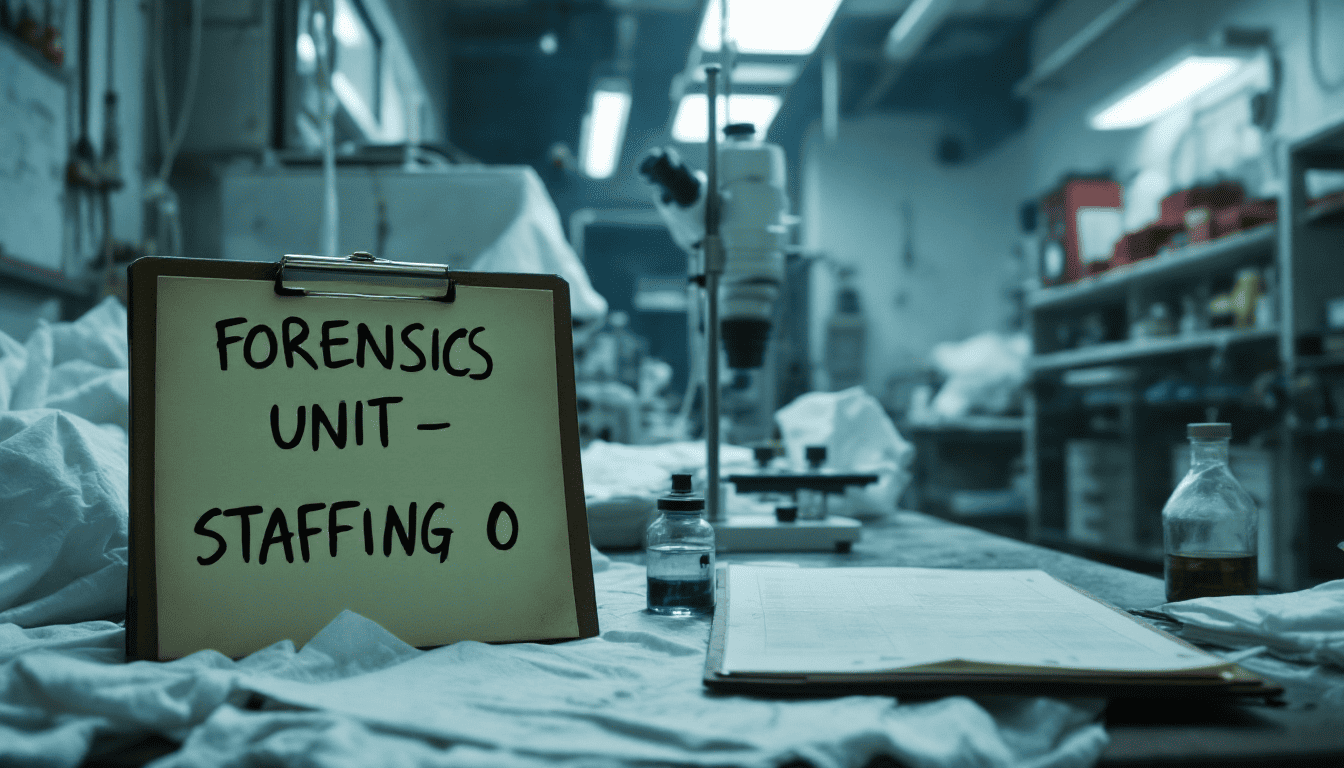
The lights were still on at the Forensic Science Service when the government shut it down in 2012. Staff arrived at work one morning to discover via parliamentary announcement what they'd suspected for months: the world-renowned laboratory, pioneer of DNA fingerprinting and home to Britain's forensic expertise, would cease operations within weeks. Ministers insisted the private sector would absorb the work seamlessly. Contracts would be awarded. Services would continue. Justice would be served.
Twelve years later, forensic science in England and Wales teeters on collapse.
Private providers experience serious financial difficulties and face potential business failure. Police forces routinely cancel prosecutions because laboratories miss deadlines. Data manipulation at testing facilities has affected more than 10,000 criminal cases, including murders and sexual offences. The House of Lords Science and Technology Committee deployed language rarely seen in parliamentary reports: "embarrassing" failures revealing "an abdication of responsibility".
A free society is dependent on the rule of law which in turn relies on equality of access to justice. The evidence received by this committee points to failings in the use of forensic science in the criminal justice system and these can be attributed to an absence of high-level leadership, a lack of funding and an insufficient level of research and development.
This is not merely administrative incompetence. It represents something more fundamental: the hollowing out of scientific capacity within the British state itself. Forensics serves as the most visible symptom, but the disease runs deeper. Across law enforcement, healthcare, and public administration,
Britain has systematically dismantled the specialised expertise required to run a modern country. Science has been displaced by procurement. Capability by contracting. Competence by rhetoric.
The consequences are now materialising simultaneously across multiple domains: a justice system unable to investigate crime, a health service that cannot provide basic access, and a digital infrastructure driven by commercial extraction rather than public service. Together, these failures reveal a state that has lost the ability to perform its core functions.
Abdication Of World Leadership
Britain invented modern forensic science. Arthur Lewis Dixon established the first systematic approach to criminal evidence collection in the 1930s. The FSS developed DNA fingerprinting, created the national footprint database, and set international standards for decades. The country moved from "pole position to banana republic" in forensic capability following the closure.
The decision to shut the FSS was presented as financial necessity. The service was losing £2 million monthly and stood £68 million in debt. But financial losses resulted directly from government policy: police forces were encouraged to bring forensic work in-house whilst the FSS competed against private contractors in a market deliberately structured to undercut its prices. The organisation was systematically starved before being declared unviable.
What followed was entirely predictable. Private providers failed to invest in specialist skills under the short-term contract model. Research funding, previously provided by the FSS at several million pounds annually, evaporated. The total forensics budget collapsed from approximately £128 million in 2008 to no more than £55 million within a decade. Niche specialisms—fibres, glass, toolmark comparison, paint analysis—began disappearing entirely from England and Wales.
The human cost was immediate. Over 1,600 FSS forensic scientists were made redundant, with many leaving the profession permanently. The institutional knowledge built over 70 years vanished within months.
Universities found themselves unable to validate new forensic techniques without the FSS proving ground. The FSS archive, containing 1.7 million case files used regularly for cold cases and miscarriage reviews, faced uncertain preservation with no clear commitment to long-term storage or management.
Following data manipulation at Randox Testing Services and Trimega Laboratories, retesting is expected to take two to three years due to limited skilled expert capacity. The scandal—affecting drug driving cases, violent crimes, sexual offences, and unexplained deaths—exposed how privatisation created conditions for systematic fraud.
Greater Manchester Police announced up to 27,000 cases could ultimately be impacted, though the criminal investigation was abandoned in 2024 due to insufficient funding to analyse the evidence.
Private provision has not generated the efficiency gains promised. One provider, Eurofins, now controls approximately 86% of external forensic provision—a near-monopoly whose collapse would paralyse the entire criminal justice system. Meanwhile, South West Forensics Services (a collaboration between four police forces in the UK—Avon and Somerset, Devon & Cornwall, Dorset, and Wiltshire) reported more than 800 cases waiting for analysis in 2019, a backlog only marginally improved today.
The 2019 House of Lords report was unequivocal. The forensic science market had reached a "state of crisis" requiring urgent reform.
Five years later, the crisis endures.
The useless Forensic Science Regulator quango still lacks the statutory powers promised in 2012. Research and development remains chronically underfunded. Defence experts are leaving the sector entirely due to woeful legal aid rates. Trials collapse because evidence cannot be processed in time—or processed reliably at all.
Digital Evidence and the Unexamined Backlog
If forensic science represents systematic degradation, digital forensics reveals outright paralysis. Modern criminality is inseparable from digital devices: phones contain evidence of conspiracies, computers store abuse images, encrypted drives hold trafficking records. Yet British law enforcement cannot examine the devices it seizes.
HMICFRS discovered a national backlog of over 25,000 devices awaiting examination, though inspectors acknowledged this figure excluded devices already within the processing system. Some forces reported delays so severe that victims and prosecutions were being failed systematically. Victims' phones were kept for many months, with inspectors finding no clear national plan for improvement.
The variation between forces approaches lottery status. Some begin digital forensic examinations within weeks whilst others take 18 months for similar cases. Greater Manchester Police had 1,349 devices seized at crime scenes awaiting analysis, whilst 112 devices at the Police Service of Northern Ireland had waited over a year, with eight languishing beyond two years. In contrast, City of London Police maintained a backlog of merely 76 devices, none waiting longer than a month.
Sexual violence investigations suffer acutely, with rape prosecutions at record lows. One victim's phone was held by Suffolk Police for more than four-and-a-half years after she reported an attack. Child abuse material remains unanalysed. Trafficking victims stay unidentified. Organised criminals evade prosecution because the digital evidence sits unexamined in storage facilities.
Around half of digital forensic units reported staff vacancies, with Hertfordshire Constabulary needing 11 more officers for 23 full-time staff and Kent Police requiring 10 additional officers. Those remaining report crushing workloads. One investigator described the role as "a sinking ship, fighting fires right, left and centre," with promised IT systems delayed five or six years whilst backlogs worsen weekly.
Every Apple software update requires investigators to adapt extraction techniques. Encrypted devices demand specialist tools and expertise. The volume of data per device grows exponentially—a single smartphone may contain hundreds of thousands of messages, images, and location records requiring analysis. One investigator noted "the most stressful thing was knowing when to stop," struggling to determine sufficient evidence before moving to the next urgent case.
£10.4 million was allocated in 2022 for a Digital Forensics Programme, £5 million for mobile forensic vans under Operation Soteria. These sums are trivial against the scale of need. By 2023, Deloitte won a £2.3 million contract to support the programme—consultancy fees rather than frontline capacity. Meanwhile, forces increasingly outsource analysis to private contractors, creating dependencies on commercial providers with no guaranteed continuity.
The broader pattern emerges clearly: technological advancement outstrips institutional capacity, government responds with procurement rather than capability-building, and the gap widens inexorably. Digital forensics represents the future of criminal investigation—yet Britain cannot perform it at scale.
NHS Data and Palantir
Whilst justice struggles to examine seized evidence, the NHS races to commercialise patient records. The Federated Data Platform represents the largest healthcare data centralisation programme in British history: a £330 million seven-year contract awarded to Palantir Technologies, the US surveillance firm founded with CIA venture capital and chaired by Trump ally Peter Thiel.
The contract's opacity shocked even hardened observers. Of 586 pages, 417 were completely redacted, including critical sections on data protection and privacy. When published, entire paragraphs under "protection of personal data" appeared as solid black bars. Following legal action by Good Law Project, NHS England committed to republishing with fewer redactions, though the full terms remain concealed from patients and clinicians alike.
Hundreds of NHS hospitals were ordered to share confidential medical records with the company through the "Faster Data Flows" pilot, uploading patient information daily to a central portal built on Palantir's Foundry software. NHS documents admit Palantir will "collect and process confidential patient information", though the precise nature of this processing remains undisclosed.
NHS England initially claimed reforms to patient choice and opt-out mechanisms were high priorities. These commitments evaporated. Ministers flip-flopped about whether patients could opt out of data sharing beyond direct care, and the National Data Opt-Out programme faces legal challenge over GDPR compliance. Previous attempts at mass data extraction—Care.data in 2014, GPDPR in 2021—collapsed under public opposition. The FDP, yet again, seeks to achieve the same outcome through less visible implementation.
NHS trusts have resisted adoption with remarkable consistency. Leeds Teaching Hospitals stated adopting FDP products would mean losing functionality rather than gaining it. Greater Manchester Integrated Care Board reported Palantir's platform lacked system-level products offering equivalent functionality to their existing custom-built system, with officials warning adoption "may represent a time-consuming and possibly retrograde step."
Yet resistance may prove futile. In summer 2024, NHS England's chief operating officer wrote to trust executives requiring confirmation of FDP adoption plans by 5 August 2024, effectively making implementation mandatory. KPMG received an £8.5 million contract to "promote adoption" whilst many trusts were cutting management staff.
The British Medical Association voted in June 2025 to oppose the FDP rollout, lobbying nationally against Palantir's introduction into health data systems and seeking contract termination. Their opposition reflects deeper concerns about commercialisation trajectories. Palantir's business model centres on data analysis for intelligence agencies, militaries, and corporations. The company chaired by Peter Thiel, who publicly advocates NHS privatisation, now processes the medical records of 61 million people.
What prevents this data from being monetised later? The redacted contract offers no assurances visible to the public. NHS England insists patient data will be "pseudonymised"—identifying details removed or altered. Lawyers note pseudonymised data remains easy to re-identify, requiring protection under GDPR consent requirements. Those requirements appear violated systematically.
The FDP represents something more troubling than poor procurement: the deliberate construction of infrastructure for data extraction at population scale. Patient records become assets for analysis, aggregation, and potential commercial licensing. The architecture enables surveillance, whether by state agencies or corporate actors. And the entire programme proceeds without democratic debate, public consultation, or meaningful patient involvement.
This is commercialisation by stealth—a pattern repeated across government. Proprietary systems replace public infrastructure. Private companies gain control over essential data. Accountability vanishes behind commercial confidentiality. And the British state surrenders core sovereign capabilities to foreign corporations whose interests diverge fundamentally from public service.
The Vanishing Doctors
Data commercialisation might seem abstract until confronting its human cost: the collapse of primary care access. As of October 2025, there were 773 fewer fully qualified full-time GPs in England than in September 2015, whilst registered patients increased by 7.04 million. The arithmetic is brutal: each GP now serves 2,236 patients on average, an increase of 299 patients (15.4%) since 2015.
Since 2015, 1,442 GP practices have permanently closed. Many survivors closed their lists to new patients years ago. In some areas, no practice accepts registrations. Appointment waits extend weeks. Telephone queues operate first-come systems where patients redial hundreds of times seeking slots released at 8am.
Yet paradoxically, Britain trains more GPs than ever. Between 2015 and 2024, nearly 20,000 licensed GPs were not working in NHS general practice by headcount, rising to over 30,000 by full-time equivalent hours. For every five additional licensed GPs, NHS general practice gained only one by headcount and actually lost one by FTE hours. With GP training costing approximately £430,540, this represents a loss of up to £13.1 billion in training investment.
Where do trained GPs go?
Some work in private practice, urgent care centres, or occupational health—roles offering better pay and conditions. Others reduce hours drastically or leave medicine entirely. The number working full-time has decreased steadily since 2017 whilst part-time working climbs, driven by stress, burnout, and work-life balance concerns. The GP partner workforce has shrunk by 6,364 FTE since 2015, with 502 FTE lost in the last year alone.
Workforce surveys reveal why. UK GPs report amongst the highest stress levels and departure intentions internationally. The 2024 NHS staff survey found 42.19% of medical staff experience work-related stress and 30.24% felt burnt out. A third of doctors felt unable to cope with workload at least weekly, and 63% regularly worked beyond rostered hours. Only 32.05% were satisfied with pay, and less than half felt valued by their organisation.
The Health Foundation projects shortfalls worsening substantially. Nearly 9,000 GPs will be missing by 2030, with NHS England's own modelling suggesting 15,000 by the mid-2030s. Meanwhile, the UK has approximately three doctors per 1,000 people—far below the EU average of 4.2—a gap amounting to roughly 82,000 missing doctors.
Despite severe shortages, medical school places remain capped and training posts limited. In 2024, over 24,000 people applied for just 10,000 medical school places in England. Rather than expanding training, £1.44 billion was spent in 2024 on physician associates and nursing associates—less-qualified roles intended to plug gaps created by doctor shortages but competing for scarce training opportunities and linked to multiple deaths and serious incidents when deployed beyond competence.
By December 2020, there were 1.4 fewer FTE GPs per 10,000 patients in the most deprived areas compared to least deprived, with this gap widening over time. Populations facing greatest health needs receive least access—a feedback loop guaranteeing worsening outcomes.
GPs lack time for consultations because caseloads have ballooned. Rushed appointments compromise care quality. Patients unable to access GPs attend A&E, overwhelming emergency departments. The Royal College of Emergency Medicine estimates extended A&E waits contributed to over 800 deaths in Scotland alone last year. Meanwhile, their medical records flow into Palantir's systems for purposes they cannot control or even comprehend.
The Architecture of Failure
These crises—forensics, digital evidence, data commercialisation, GP shortages—appear distinct but share underlying structural causes. Each represents deliberate policy choices made over decades, driven by ideological commitments to marketisation, outsourcing, and cost reduction regardless of systemic consequences.
The disaster of socialism and its inability to produce.
Trying to "modernise" and "fix" socialism with technocracy.
- Forensic science collapsed because government created a procurement framework designed to drive down costs through competition, then shut the public provider whilst private contractors proved unwilling to invest in R&D or niche specialisms.
- Digital forensics fails because law enforcement received no capacity-building despite exponential growth in digital crime, leaving forces to improvise locally with inadequate resources.
- Patient data commercialisation proceeds because NHS England prioritises corporate partnerships over patient consent, constructing infrastructure enabling extraction rather than care.
- Primary care crumbles because training remains capped whilst workloads multiply, pushing doctors into part-time work or departure.
The pattern holds across domains: expertise is treated as disposable, capability as purchasable, and specialisation as an inefficiency to eliminate through management restructuring. Scientific knowledge becomes a procurement problem rather than a sovereign necessity. Institutional memory vanishes when organisations close or outsource. Research funding evaporates because quarterly results matter more than long-term capability. And the state hollows itself out, retaining contracts management functions whilst surrendering operational capacity to private providers whose interests diverge fundamentally from public service.
When forensic labs fail quality checks, who bears responsibility—the company, the police force, the Home Office? When digital evidence remains unexamined, which institution answers for collapsed prosecutions? When patient data flows to US corporations, who ensures protection? When GPs cannot be accessed, whose failure is it—the practice, the integrated care board, NHS England, the Treasury?
The answer is: everyone and no one. How convenient.
Fragmentation creates plausible deniability. Ministers point to operational independence. Organisations cite resource constraints. Private contractors invoke commercial confidentiality. Regulators lack enforcement powers.
And the British public confronts a justice system unable to investigate crime, a health service unable to provide access, and data infrastructure governed by redacted contracts with foreign surveillance firms.
The Talent Has Fled
This represents more than administrative failure. It constitutes a loss of sovereign capability—the ability of the British state to perform core functions without dependence on external actors whose interests may conflict with public welfare. Forensic science, criminal investigation, healthcare data, and medical provision are not peripheral government activities. They form the irreducible core of statehood: maintaining justice, protecting health, securing information.
Yet Britain has outsourced or degraded each systematically. Forensic capacity now depends on private contractors experiencing financial difficulties and operating effective monopolies. Digital investigation relies on police forces with backlogs measured in years and vacancies measured in hundreds. Patient data is processed by CIA-backed technology companies. And primary care functions despite, rather than because of, government policy—sustained entirely by GPs working unsustainable hours until they cannot continue.
Rebuilding requires acknowledging what has been lost and committing to systematic reconstruction. Forensic science needs a publicly-funded research institution with statutory powers for the regulator, ring-fenced R&D investment, and an end to procurement frameworks prioritising cost over quality. Digital forensics demands massive expansion of investigator training, investment in tools and infrastructure, and national coordination replacing force-by-force improvisation. Data governance requires primary legislation establishing patient consent as sacrosanct, prohibiting commercialisation without democratic authorisation, and terminating contracts with companies whose business models centre on surveillance. Primary care needs uncapped medical training, workload reduction through increased staffing, and reversal of the cost-driven undermining of general practice.
None of this will happen under current political economy. Rebuilding state capacity requires spending significant sums on long-term capability with no immediate electoral return. It means challenging powerful private interests holding lucrative contracts. It demands rejecting the marketisation logic that government should steer whilst private sector rows. And it involves admitting that two decades of policy across multiple governments produced systematic failure.
The consequences of inaction are already visible. Criminals evade justice because evidence cannot be examined. Patients cannot access doctors. Medical records become commodities for corporate analysis. And Britain descends from world leadership in forensic science to a fragmented marketplace lurching between scandals whilst Parliament issues reports noting "embarrassing" failures with no meaningful response.
The hollow state persists because hollowing serves interests: private contractors profit from service provision, consultancies from endless transformation programmes, technology firms from data access, and politicians from avoiding difficult funding decisions. What it does not serve is justice, health, security, or the basic functions of government.
Britain must choose.
Either rebuild scientific and investigative capacity as a sovereign priority, accepting the costs and political difficulty involved, or continue the managed decline until core state functions cease operating entirely. The evidence suggests the latter trajectory is well advanced. Reversing it requires political will, public investment, and recognition that some capabilities cannot be outsourced without destroying the institutional competence required to govern at all.
The Forensic Science Service closed in 2012. Its absence grows more catastrophic yearly. Digital backlogs mount whilst crimes go unsolved. Patient data flows to foreign corporations. Doctors leave exhausted and demoralised. And the British state, stripped of expertise, administers contracts it cannot monitor for services it no longer understands, delivering justice it cannot investigate and healthcare it cannot provide.
This is the hollow state.
Not a temporary crisis but a structural condition—the consequence of treating governance as procurement, expertise as expenditure, and sovereignty as negotiable. Until Britain rebuilds the scientific and institutional capacity it has systematically destroyed, these failures will not be exceptions but the operating reality of a country that abandoned the competence required to function as a modern state.