The International “Rules-Based Order” Was Always Delusion
The Davos crowd now mourns a "rules-based international order" they claim is dying. They are mistaken. It was never alive. What they called law was American hegemony dressed in bureaucratic costume—and when power fades, the paperwork floats free, unsupported by anything but memory.
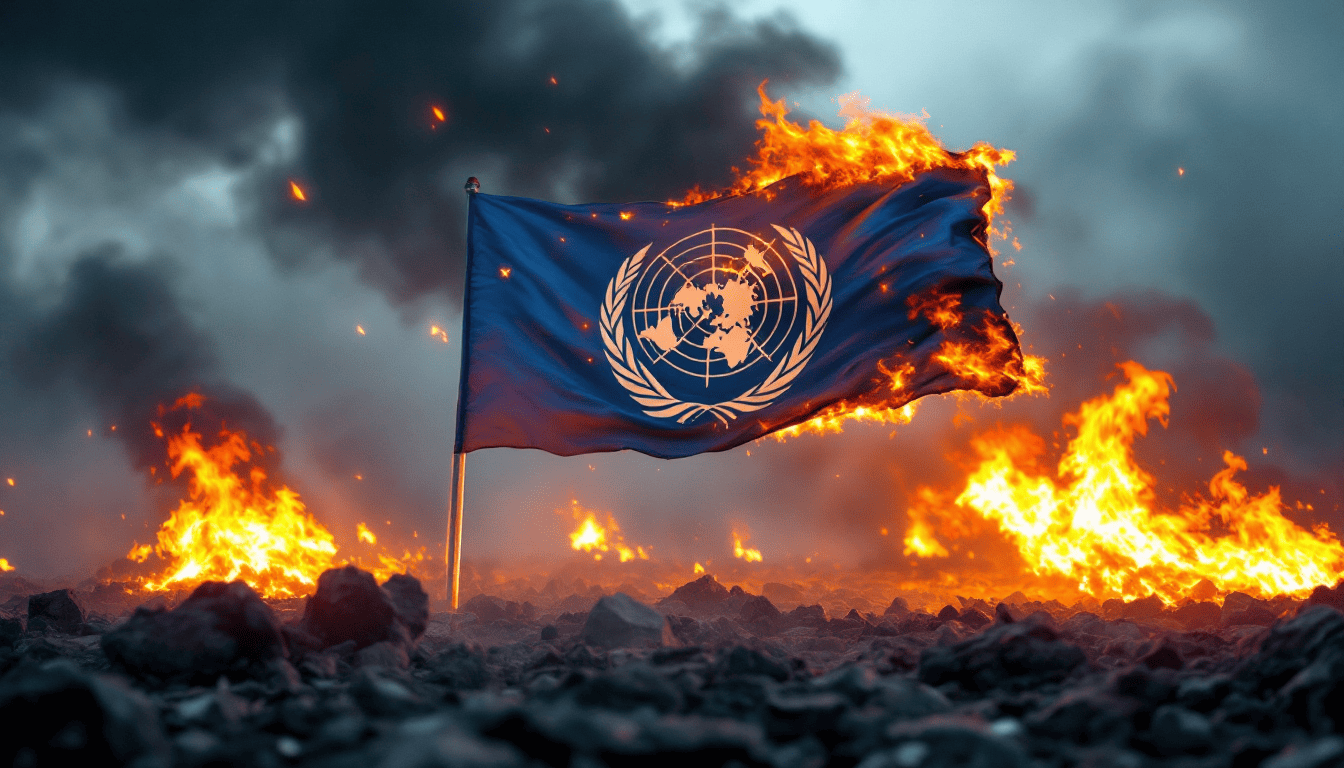
The narcissistic Baby Boomer "Imagine" generation had an enormous laundry list of stupid ideas – promiscuity, self-help psychology, foeticide, neo-Marxist identity politics, open borders, euthanasia, neoliberalism – but none dumber than the notion a cacophony of nations could be neatly organised into a technocracy of well-behaved schoolchildren at the United Nations.
There is no such thing as a rules-based international order. There never was.
What exists instead is a sentimental post-war myth—a bedtime story invented by exhausted Western elites who mistook temporary American dominance for moral progress, and bureaucracy for civilisation. The phrase is now repeated with priestly reverence by diplomats, NGOs, civil servants, and a certain vintage of foreign correspondent who sincerely believes history ended sometime around 1991 and the world has been politely queueing ever since.
It hasn't.
Mark Carney, Canada's arch-globalist Prime Minister, recently delivered a speech at Davos reading the last rites over what he called the "rules-based international order." He was refreshingly candid:
We knew the story of the international rules-based order was partially false. That the strongest would exempt themselves when convenient. That trade rules were enforced asymmetrically. And we knew that international law applied with varying rigour depending on the identity of the accused or the victim.
This is a remarkable admission from someone standing at the altar of global technocracy. But Carney still speaks as though something real has collapsed—as though a functioning edifice has crumbled. The truth is simpler and more brutal: there was never any edifice. There was only scaffolding around American power, decorated with legal bunting.
The Phantom Constitution Nobody Voted For
When defenders invoke the "rules-based international order," they gesture vaguely towards the United Nations Charter, the Bretton Woods institutions, the various conventions and declarations accumulated like sediment since 1945. These documents are treated as a kind of "global constitution," or a higher law binding sovereign nations to civilised conduct like their heroes of the Comintern fabled by the alternative society.
But constitutions require ratification. They require consent. They require enforcement mechanisms answerable to the governed.
None of these conditions were met.
The post-war settlement emerged from a narrow elite consensus negotiated by victorious powers exhausted by war and desperate to freeze a temporary balance of power into permanent moral architecture. In July 1944, delegates from forty-four Allied nations gathered at the Mount Washington Hotel in Bretton Woods, New Hampshire. They established the International Monetary Fund and what became the World Bank. The United Nations Charter followed a year later.
These were not democratic exercises. No global electorate was consulted. No referendum legitimised the transfer of sovereignty implied by phrases like "international peace and security." The populations of the world were informed, not asked. The architects were State Department lawyers, British Foreign Office mandarins, European technocrats, and—later—NGO executives and UN agency officials with no electoral mandate whatsoever.
The Soviet Union, notably, signed the Bretton Woods Final Act but refused to ratify it. Soviet representatives charged the institutions were "branches of Wall Street." This may have been ideologically motivated, but it was not factually wrong. The United States, controlling two-thirds of the world's gold reserves, designed a system centred on American financial dominance. The rules reflected American interests because America wrote them.
Enforcement Is the Soul of Law
Every functioning legal system depends on coercion. Domestic law works because the state maintains a monopoly on legitimate violence. Courts do not persuade criminals with vibes. They operate under the implicit threat of men with guns. If you ignore a court order, armed officials will eventually arrive at your door. Remove enforcement, and "law" instantly reverts to suggestion.
International law, by contrast, possesses no such mechanism.
No police. No prisons. No enforcement authority with compulsory jurisdiction.
The International Court of Justice operates on voluntary submission. States must consent to its jurisdiction—and may withdraw consent at any time. When the ICJ ruled against the United States in 1986, finding Washington had violated international law by supporting the Contra rebels in Nicaragua and mining Nicaraguan harbours, America's response was immediate and instructive.
The United States refused to participate in the merits phase of the proceedings. When the Court ruled against it anyway, Washington ignored the judgment entirely. The State Department's legal adviser announced the US would no longer recognise the ICJ's compulsory jurisdiction. When Nicaragua brought the matter to the UN Security Council, the United States vetoed a resolution calling for compliance. Only Israel joined America in opposing adherence to the ruling.
Nothing happened. No sanctions. No enforcement. No consequences.
Because none exist.
As the political theorist Hans Morgenthau observed, international law is fundamentally:
a primitive system of law where the enforcement of the law is left to the vicissitudes of the distribution of power between the violator of the law and the victim of the violation.
Strong states find it easy to both violate the law and enforce it; weak states must rely on powerful friends for the protection of their rights.Carney and his fellow Davos attendees speak constantly of the "international community"—as though humanity has achieved some form of collective consciousness expressed through UN resolutions and G20 communiqués.
This is not cynicism. It is structural reality.
The South China Sea: A Ruling Written on Water
If international law possessed binding force, the 2016 South China Sea arbitration would have settled the matter.
The Philippines brought a case before the Permanent Court of Arbitration in The Hague, challenging China's expansive claims over the contested waterway. The tribunal ruled overwhelmingly in Manila's favour, determining major elements of China's claim—including its infamous nine-dash line and artificial island construction—were unlawful.
China's response was immediate and honest:
The ruling is null and void.
Then Beijing built military bases anyway.
Nearly a decade later, China still refuses to comply. The ruling exists as a PDF circulating through academic journals and diplomatic briefings, occasionally invoked by Western commentators as evidence of Chinese lawlessness. But it constrains nothing. Filipino fishermen are still harassed by Chinese coast guard vessels in waters the tribunal declared to be Philippine territory. The artificial islands bristle with radar installations and aircraft hangars.
This was not an anomaly. As the scholar Graham Allison observed in 2016:
None of the five permanent members of the UN Security Council have ever accepted any international court's ruling when, in their view, it infringed their sovereignty or national security interests. Thus, when China rejects the Court's decision in this case, it will be doing just what the other great powers have repeatedly done for decades.
The rules apply only to those too weak to refuse them.
Kosovo: The Moment the Mask Slipped
The 1999 NATO bombing of Yugoslavia is often cited as a triumph of humanitarian intervention—the international community finally acting to prevent ethnic cleansing.
In legal terms, it was nothing of the sort.
NATO launched its campaign without UN Security Council authorisation. The reason was simple: Russia would veto any resolution permitting military action against its Serbian ally. So NATO simply bypassed the United Nations entirely and bombed Yugoslavia for seventy-eight days.
The UN Charter explicitly prohibits the use of force except in self-defence or when authorised by the Security Council under Chapter VII. NATO was not acting in self-defence. No Chapter VII authorisation existed.
At the Security Council's first debate after hostilities began, the Yugoslav representative stated the obvious:
NATO has been unmasked. It ceased to be a defensive military alliance and became an aggressive military alliance—disregarding its own statute, the United Nations Charter, and the structure of the OSCE.
Three days after the bombing commenced, Russia, Belarus, and India demanded a Security Council resolution calling for the cessation of force. The motion failed—not because it lacked legal merit, but because NATO powers had the votes to block it.
The Independent International Commission on Kosovo later delivered its verdict with admirable clarity: the intervention was "illegal but legitimate." This formulation is revealing. It acknowledges the legal violation while asserting a higher moral authority—precisely the kind of reasoning international law was supposedly designed to prevent.
When rules conflict with power, power wins. Every time.
Iraq 2003: The End of Pretence
If the "rules-based international order" ever functioned as described, the 2003 invasion of Iraq would have demolished it beyond repair.
No UN authorisation existed. The Security Council explicitly refused to sanction military action. France, Russia, and China made clear they would veto any resolution endorsing invasion. UN weapons inspectors, still actively working in Iraq, had found no evidence of weapons of mass destruction.
Yet the world's dominant power, backed by Britain and a "coalition of the willing," invaded anyway.
UN Secretary-General Kofi Annan later stated unequivocally: "From our point of view and the UN Charter point of view, it was illegal." In 2016, Britain's Deputy Prime Minister at the time of the invasion, John Prescott, wrote:
In 2004, the UN Secretary-General Kofi Annan said that as regime change was the prime aim of the Iraq War, it was illegal. With great sadness and anger, I now believe him to be right.
No tribunal prosecuted the architects. No sanctions followed. No enforcement mechanism activated.
The invasion was, in the assessment of numerous international legal scholars, a war of aggression—the "supreme international crime" according to the Nuremberg Tribunal, differing from other war crimes only in containing within itself the accumulated evil of the whole.
Yet George W. Bush lives comfortably in Texas. Tony Blair advises governments on strategy. The system did not fail. It behaved exactly as designed.
The Veto: Power Wearing Judicial Robes
The Security Council's structure reveals the entire architecture as fraud. Five permanent members—the United States, Russia, China, France, and the United Kingdom—possess absolute veto power over any substantive resolution. Since 1945, over three hundred vetoes have been cast. Russia has used the power most frequently, followed by the United States, the United Kingdom, China, and France.
The veto means the Council cannot act against any permanent member or its allies without that member's consent. When Israel faces criticism, America vetoes. When Syria faces intervention, Russia vetoes. When anyone threatens Chinese interests, Beijing vetoes.
This is not rule of law. It is veto politics dressed in judicial costume.
The UN was designed this way deliberately. At the founding conferences, the major Allied powers insisted on retaining ultimate authority. They understood the League of Nations had failed partly because it attempted to constrain great powers without possessing the means to enforce its decisions. The UN's founders drew the obvious lesson: great powers would not submit to institutions capable of overruling them.
The result is an organisation which can authorise action only when the permanent members agree—which means only when their interests converge. On questions where great powers disagree, the Security Council is structurally paralysed.
This is not dysfunction. It is the system working as intended.
The Boomer Truth "Imagine" Regime
Michel Foucault, the most cited scholar in social science (and also a serial child rapist), argued each society operates under what he called a "régime de vérité"—a truth regime. This describes the network of institutions, credentials, language norms, and social pressures determining which statements may be spoken, which are unsayable, and which are treated as self-evident fact.
The "rules-based international order" is precisely such a regime.
It functions not as description but as incantation—a ritual phrase endlessly repeated until disagreement itself becomes heresy. One is not required to prove the "rules-based order" exists. One is merely required to affirm it.
To question it is to be labelled reckless, populist, dangerous, "anti-international," threatening the global order. Notice the structure: the accusation is never factual—only moral. Truth regimes do not defend propositions. They defend legitimacy.
This particular truth regime emerged between roughly 1968 and 1995, when a generation intoxicated by post-war prosperity, American dominance, and managerial expansion mistook stability for morality and process for wisdom. For one brief historical moment, it appeared to work.
From 1945 to roughly 2008, the US Navy guaranteed trade routes. American military power deterred invasions. The dollar anchored global finance. Security guarantees froze territorial rivalries.
Those raised in this period did not inherit peace. They inherited hegemony.
But they mistook hegemony for moral achievement. When American power enforced order, they attributed success to treaties. When deterrence prevented war, they credited dialogue. When fear of annihilation restrained conflict, they celebrated norms.
They confused cause and effect.
Now American dominance is contested. China builds military installations in defiance of international rulings. Russia annexes territory despite universal condemnation. The paperwork floats free, unsupported by force.
The Davos guardians declare the order "under threat" or "ending." But what they witness is not collapse. It is exposure.
Why Powerful States Cannot Be Bound
The fundamental problem is structural, not moral. International law cannot restrain hegemons because hegemons have no incentive to submit.
- The United States possesses global force projection unmatched in human history.
- China is a civilisational state pursuing strategic expansion across the Indo-Pacific.
- Russia maintains a nuclear arsenal capable of ending civilisation.
Why would any of these powers accept permanent restraint by third-party legal institutions?
Domestic law binds citizens because the state monopolises legitimate violence. A corporation cannot challenge the Supreme Court with tanks. An individual cannot resist arrest with nuclear weapons. The asymmetry is absolute.
Between sovereign states, no such asymmetry exists. America possesses eleven aircraft carrier strike groups. China fields the world's largest navy by hull count. Russia has deployed hypersonic missiles.
International law possesses... strongly worded letters.
Treaties function only when keeping them serves state interests. When compliance becomes costly, powerful states defect. When defection carries consequences, they calculate whether those consequences exceed the benefits of violation. When consequences are absent—as they almost always are for great powers—nothing constrains behaviour except prudence and reputation.
This is not corruption of an otherwise functional system. It is the system's inherent logic.
The "International Community" Does Not Exist
Carney and his fellow Davos attendees speak constantly of the "international community"—as though humanity has achieved some form of collective consciousness expressed through UN resolutions and G20 communiqués.
The phrase is pure fiction. One from the Comintern days.
There is no global demos. There are no shared moral premises. There is no collective will.
There are approximately 190 sovereign states operating under radically different incentives, cultures, demographics, and power constraints. Some value expansion. Some value stability. Some value honour. Some value conquest. Many value none of the things Western diplomats project onto them.
Saudi Arabia attempts to sit on UN human rights councils. China drafts resolutions on religious freedom. Iran lectures about peace. This is not global governance. It is theatre.
The assumption underlying calls for renewed commitment to international rules is the belief all nations share fundamental moral premises and merely require proper institutional channels to express them. This belief is false.
To assume otherwise is not enlightened. It is arrogant—the projection of Western liberal values onto civilisations which explicitly reject them.
The World Returns to Normal
Multipolar competition is not an anomaly. It is the default state of human history.
For seventy-five years following 1945, American hegemony created unusual conditions: a single dominant power capable of enforcing certain norms across much of the globe. This was mistaken for progress toward permanent global governance.
It was nothing of the sort. It was a historical aberration produced by the specific circumstances of post-war exhaustion, nuclear deterrence, and American industrial supremacy. Those circumstances are passing.
China's economy now rivals America's. Russia has demonstrated willingness to absorb massive costs to achieve territorial objectives. India emerges as a power unwilling to accept Western tutelage. The Gulf states pursue independent foreign policies. Even American allies hedge their bets, as Carney's speech at Davos demonstrates.
The world is not sliding into chaos because rules are being broken. It is returning to normality now the illusion has cracked.
Order Has Always Required Force
History teaches one consistent lesson: order is not produced by consensus. It is produced by deterrence.
Every stable system—Roman, British, American—rested on the credible threat of overwhelming force exercised selectively and decisively. The Pax Romana endured because legions crushed resistance. The Pax Britannica held because the Royal Navy commanded the seas. The Pax Americana lasted while American power remained unchallengeable.
When military supremacy fades, order fragments. Not because humanity is evil, but because power vacuums invite occupation.
The treaties and conventions accumulated since 1945 were downstream of American power—not the other way around. No resolution can replace an aircraft carrier. No declaration can substitute for deterrence. The paperwork codified arrangements made possible by force; it did not create them.
Those who mourn the death of the "rules-based international order" mourn the fading of conditions which made certain rules convenient for powerful states to follow. They are not witnessing the collapse of some higher moral architecture. They are watching the exposure of its absence.
The Tragedy of Belief
The tragedy is not the order's failure. The tragedy is believing in it at all. A generation of foreign policy professionals, journalists, academics, and civil servants built careers around servicing institutions they genuinely believed were governing the world. They drafted resolutions, attended conferences, published analyses, collected salaries—all while the actual determinants of international behaviour remained unchanged: power, interest, geography, demography.
The humanitarian disasters they failed to prevent—Rwanda, Syria, Yemen, Sudan—were not malfunctions. They were the system working exactly as designed: incapable of acting where great powers disagreed, effective only against states too weak to resist.
The "rules-based international order" served one genuine function: it legitimised American hegemony by draping it in universal language. It allowed Washington to present its interests as mankind's interests, its preferences as international law, its wars as police actions.
This was useful while it lasted. But the costume no longer fits. American power, though still formidable, can no longer command universal deference. Other great powers now possess the means to resist.
The nauseating phrase "rules-based international order" will continue appearing in speeches and editorials for years to come. Diplomats will invoke it. Professors will teach it. Journalists will treat its decline as news.
But the obituary describes a fiction. And fictions cannot die—only be abandoned.
There are no rules without power. There are no rights without enforcement. And there is no international order without someone willing to impose one.
Everything else is paperwork pretending to be civilisation.