The Prison Catastrophe Is Far Worse Than Early Release
Britain's Victorian-age prison system is collapsing not from crime but from decades of political cowardice. While headlines scream about early releases, the real catastrophes—porous security, remand lists, religious gang warfare, pregnant women in cells—also remain carefully hidden away.
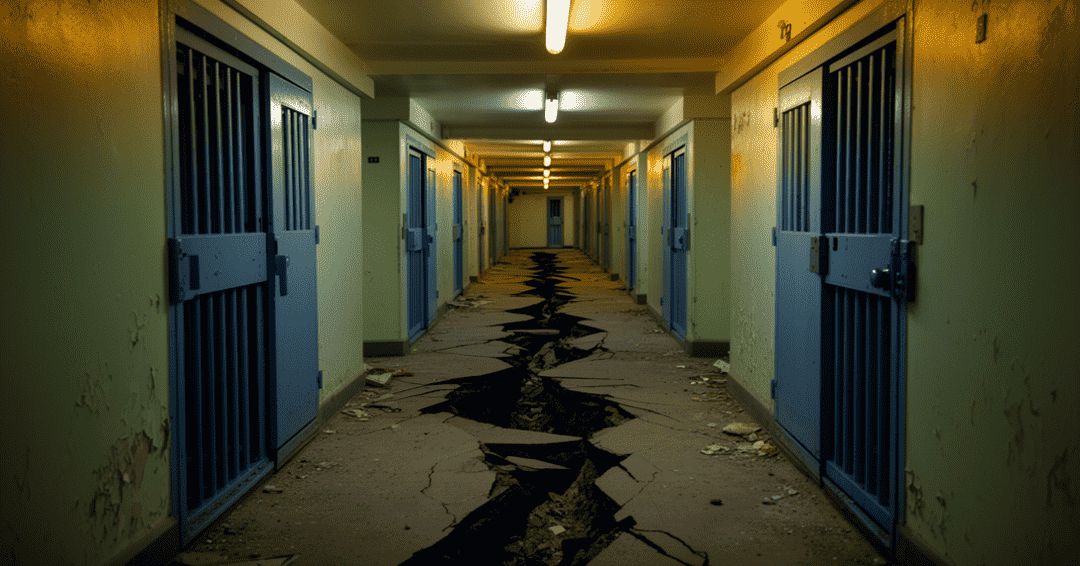
The British state can no longer enforce its own sentencing policy. This is not hyperbole. This is the mechanical reality of a prison system operating at 99% capacity with 17,700 unconvicted people absorbing space, 96 self-inflicted deaths in a year, and officers so inexperienced they cannot maintain control of Victorian cellblocks designed for a smaller, more compliant age. The headlines fixate on early release schemes as though they were acts of mercy or madness, depending on which newspaper you read. They are neither. They are the administrative confession of a state unable to house the consequences of its own laws.
The crisis is not a crime wave. It is a management apocalypse fifty years in the making, accelerated by political choices so obviously catastrophic that their architects must rely on collective amnesia to avoid accountability. Between 2000 and 2024, the population of England and Wales grew from at least 53 million to nearly 60 million or more. Prison numbers rose in rough proportion. Nobody built the cells. Nobody trained the staff. Nobody planned for the obvious arithmetic.
Instead, successive governments passed legislation making sentences longer, recall mechanisms tighter, and release criteria harder—all while raiding capital budgets and cancelling construction projects to fund immediate political priorities. The result is a system where 21,498 prisoners are doubled up in cells designed for one, where 79,027 self-harm incidents occurred in a single year, and where staff are assaulted at a rate of 121 per 1,000 prisoners annually, the highest on record.
This is not a story about criminals. This is a story about the collapse of state capacity, and the lies politicians tell to avoid admitting it.
Britain Imported a Population Without Infrastructure
The most important number in British prison statistics is not the total population. It is the gap between what was built and what was needed. England and Wales added millions of residents through immigration over two decades while prison construction stalled, planning applications languished, and Treasury officials eyed prison budgets as easy savings. The political class celebrated "tough on crime" rhetoric whilst systematically defunding the apparatus required to make it real.
By 2025, the system held 87,465 prisoners against a Certified Normal Accommodation of roughly 88,500—a margin so thin it evaporates daily due to staffing shortages, maintenance failures, and safety closures.
Certified Normal Accommodation is a bureaucratic fiction. It measures cells physically present, not operationally usable. Hundreds, sometimes thousands, of cells sit empty because there are not enough officers to staff the wings, not enough maintenance crews to repair the plumbing, not enough psychiatric capacity to manage prisoners whose behaviour makes them unsafe to house in general population.
The "available" capacity diverges from the "built" capacity by whatever margin the system is failing on any given day. Some mornings, governors wake to discover they have 200 fewer usable cells than the previous night because an officer called in sick and two wings had to lock down.
The public has been told the problem is crime. The problem is not crime. Recorded offences have been broadly stable or declining for years. The problem is the state's refusal to plan infrastructure for demographic reality.
Mass immigration without mass construction is not a policy; it is simply negligence with a border attached. Between 2000 and 2020, net migration added millions to Britain's population. The prison estate added capacity in the low thousands. The gap was predictable, quantifiable, and entirely ignored until crisis forced emergency legislation. By then, the system was already in free fall.
Running Prisons on Concrete
You cannot operate a maximum-security prison with inexperienced teenagers. Yet this is the workforce profile in much of the male estate. After 2010, headcount fell sharply as austerity hit. Recruitment surged post-2018 to repair the damage, but the result was a cadre of officers so young and inexperienced they lacked the situational awareness to maintain order without resorting to lockdowns.
In some prisons, 30–40% of officers have less than three years' service. The proportion with over a decade's experience hovers around a quarter. The institutional memory required to run a functioning prison—how to de-escalate, when to negotiate, which prisoners to separate before violence erupts—has been bled out and replaced with recruits who have never seen the system operate under anything other than emergency conditions.
Officers work in environments where assaults are routine, contraband is everywhere, and management response is often a directive to "manage the regime" with fewer staff. The predictable consequence: wings close, prisoners locked up for 22 or 23 hours daily, and the psychological pressure cooker intensifies until someone snaps.
Self-harm incidents reached 79,027 in the year to December 2024, a rate of 910 per 1,000 prisoners. Deaths in custody hit 411 in the twelve months to September 2025, up from 317 the previous year. The death rate climbed from 3.6 to 4.7 per 1,000. These are not random tragedies. They are the statistical signature of systemic overload.
Violence follows the same curve. Assaults on staff reached 10,477 in the year to June 2025, a rate of 121 per 1,000 prisoners and a new peak. Prisoner-on-prisoner assaults totalled 31,268, a rate of 361 per 1,000. In women's prisons, the assault rate on staff hit 287 per 1,000—nearly one in three female prisoners assaulted an officer in a year. This is not pathology. This is what happens when human beings are caged in intolerable conditions with no prospect of rehabilitation, employment, or hope, managed by staff too inexperienced to do anything except lock doors and call for backup.
The National Tactical Response Group—the prison system's riot squad—deploys routinely now, not as a last resort. Emergency measures are normalised. Restricted regimes are standard. Control loss is managed, not prevented.
Drones, Phones, and the Collapse of Physical Security
The Victorian architects of Britain's prison estate did not anticipate aerial resupply. Modern criminal organisations have no such limitations. Drone deliveries of mobile phones, drugs, and weapons are now routine. Many prisons lack effective counter-drone systems. Those with defences find them unevenly deployed and technologically outpaced by consumer-grade quadcopters available for a few hundred pounds online.
The statistics are stark: in the twelve months to March 2025, there were 74,746 contraband find incidents, up 13% year-on-year. Drug finds rose 25% to 26,348. Mobile phone finds climbed 14% to 12,166. Weapon finds increased 12% to 13,014.
These are detected incidents, not total prevalence. The dark figure is unknowable but certainly higher. Every phone represents a node in a network of organised crime, witness intimidation, and extremist coordination. Prisoners with phones can order hits, intimidate jurors, direct county lines operations, and communicate with terrorist cells outside. They can also coordinate resistance inside. When officers search a wing, prisoners receive real-time alerts on encrypted messaging apps. When transfers occur, gang hierarchies rearrange themselves with the efficiency of a corporate reshuffle.
The perimeter is porous. The walls are decorative. Physical security has collapsed not because the architecture failed but because the state refused to invest in the technology and staffing required to maintain it. Counter-drone systems exist. They are expensive. Treasury balked. The result is a custodial estate where illegal supply chains operate with less friction than the legitimate canteen system.
Corruption as Industrial Process
When pay is low, supervision is weak, and criminal incentives are high, corruption becomes inevitable. It is not a moral failing. It is microeconomics. Young officers earning £28,000 annually face organised criminals offering £1,000 for a single phone delivery. The temptation is structural. The consequences are predictable. Staff bribery for contraband, sexual relationships between officers and prisoners, coercion of junior staff by gangs—these are no longer scandals. They are documented patterns.
HM Inspectorate of Prisons reports detail the mechanisms. Gangs target new recruits during probation. They offer small favours, then escalate. An officer who accepts £50 for looking the other way once becomes an asset. Refusal after that point risks exposure or violence. The system creates the conditions for its own subversion, then expresses shock when individuals behave rationally within them.
This is what happens when a state runs critical infrastructure on poverty wages and hope.
Islam.
There are subjects British politicians will not touch. Religious gang organisation in prisons is one. Yet HM Inspectorate of Prisons has documented it repeatedly. Strong religiously organised gangs operate in several male prisons. Prisoners are pressured to convert for protection. Governors quietly segregate wings along faith lines to maintain order. Chaplaincy services strain under the weight of managing what are effectively parallel power structures.
This is not a theological debate. This is a security problem. When religious identity becomes the organising principle for gang membership, the usual tools of prison management fail. You cannot break up a gang by moving individuals if the structure is ideological rather than territorial. You cannot disrupt communication if the network operates through prayer groups and religious services. You cannot co-opt leaders if their authority derives from doctrinal interpretation rather than violence.
The Inspectorate's cowardly language is careful and euphemistic. It speaks of "faith-based grouping" and "informal power hierarchies." The operational reality is blunter. In some prisons, Muslim gangs control wings. Conversion is not always voluntary. Officers fear accusations of religious discrimination if they intervene. Governors manage the problem by conceding space, effectively running segregated regimes without formal policy authorisation. The public is not told because the political cost of honesty is considered unacceptable.
Meanwhile, radicalisation proceeds unchecked. Extremist networks recruit. Vulnerable prisoners join for safety and emerge with ideology. The prison system has become an incubator for precisely the threat it was meant to contain.
The Foreigner Deportation Fiction
The British state holds 10,737 foreign nationals in custody as of September 2025, roughly 12% of the total prison population. Many are eligible for deportation. Most remain. The barriers are administrative: missing documentation, uncooperative origin states, legal challenges, Home Office backlogs.
The largest groups are Albanians, Poles, Irish, Romanians, and Indians.
Some have committed serious offences and should never have been granted entry. Others overstayed visas or violated immigration conditions. All consume prison capacity the system cannot spare.
This is capacity management as farce. The state incarcerates people it intends to deport, then fails to deport them, then releases British offenders early to create space for foreign nationals it still will not deport. The Home Office and Ministry of Justice operate in bureaucratic silos, each optimising for metrics the other undermines. Removal rates lag far behind eligibility.
The gap is measured in thousands of prison places annually. Planes sit on tarmacs. Deportation flights are cancelled for legal or diplomatic reasons. Prisoners serve full sentences, then enter immigration detention, then sometimes win appeals and remain in the UK anyway.
The public watches this pantomime and concludes the state is either incompetent or unserious. Both are true.
Punishing the Presumed Innocent
Seventeen thousand seven hundred people sit in British prisons unconvicted. They are on remand, awaiting trial or sentencing. Some will be acquitted. Many will receive non-custodial sentences. All are presumed innocent under law. All absorb scarce prison capacity, worsening conditions for everyone. This is one of the least reported failures in the system, perhaps because it exposes the absurdity most starkly.
Remand times have ballooned. Court backlogs stretch for months, sometimes years. Crown Prosecution Service disclosure delays are endemic. Legal aid deserts mean defendants lack representation. Prisoners wait in doubled-up cells, locked down for most of the day, unable to work or access rehabilitative programs because they have not been convicted of anything. The psychological toll is extreme. Self-harm rates among remand prisoners are disproportionately high.
The legal paradox is grotesque: those presumed innocent experience worse conditions than sentenced prisoners because the system prioritises the convicted.
This is not justice. This is administrative cruelty driven by institutional failure. The courts do not have enough judges. The CPS does not have enough lawyers. Legal aid does not have enough funding. The prison system does not have enough space. Everyone suffers, but remand prisoners suffer most because they fall between bureaucratic cracks nobody wants to acknowledge.
The Silence Over Pregnancy
The women's estate holds roughly 3–4% of the total prison population but presents disproportionate complexity. Rates of trauma, abuse histories, mental illness, and substance dependency are far higher than in the male estate. Pregnant women are routinely held in facilities not designed for maternity care.
At the end of March 2024, there were 38 mothers and 36 babies in Mother and Baby Units across England. Six units serve the entire estate. This is the hard capacity constraint on maternal custody. Women give birth shackled or in prison healthcare wings.
Babies are separated from mothers at 18 months regardless of developmental need.
The causes of pregnancy in custody—often exploitation, coercive relationships, or abuse predating incarceration—are not discussed publicly because the conversation would implicate failures far beyond prison walls.
Healthcare provision in women's prisons is worse than in the male estate, which is itself catastrophic. Severe psychiatric cases languish on wings because secure hospital transfers take months. Prison GPs manage patients who would qualify for inpatient care in any other setting. Some "early releases" for women are not mercy; they are clinical risk management. The alternative is death in custody, and the publicity is worse.
Nobody wants to talk about women's prisons because doing so requires confronting uncomfortable truths about how the state treats its most vulnerable female citizens.
It is easier to focus on male violence and early release headlines than to ask why pregnant women are in cells at all, or why babies are being raised behind bars, or why the suicide rate among female prisoners is so stubbornly, horrifyingly high.
Why We Haven't Built Anything
New prisons take ten to fifteen years from conception to operation. Planning objections, local political resistance, and capital budget raids slow everything. There is no electoral reward for building prisons.
Ribbon-cuttings attract protests, not applause. "Tough on crime" rhetoric is cheaper than concrete. The political incentive structure encourages legislation over infrastructure. Every government since 2000 has passed laws increasing sentence lengths, tightening parole, expanding recall criteria—all without parallel construction programmes.
The Ministry of Justice and HM Prison and Probation Service scaled expansion plans from 13,400 to 20,000 additional places in 2020–2021, for delivery by the mid-2020s. The NAO concluded the plan was "unrealistic" and "not prioritised." The estate has not increased capacity in line with demand. The system has operated at or near full capacity for extended periods not because of unforeseen events but because of documented execution failure.
This is political cowardice calcified into policy. Every minister knows the numbers. Every Treasury official understands the trajectory. Every Prime Minister has received the briefings. The decision, consistently, has been to defer, delay, and deflect. Emergency legislation is preferable to admitting the state cannot build what it needs to function. Early release schemes are politically cheaper than construction contracts. The result is a system lurching from crisis to crisis, managing symptoms because addressing causes would require honesty the electorate is not thought capable of tolerating.
Risk Creep as Capacity Management
When the closed estate overflows, prisoners migrate to open conditions earlier and with weaker risk assessments. This is not rehabilitation policy. This is capacity management masquerading as reform. Absconds increase. Recalls spike. Risk thresholds are quietly lowered because there is nowhere else to put people. The public learns about failures when an absconder commits a serious further offence. The structural driver—pressure on the closed estate forcing premature transfers—remains unspoken.
Open prisons were designed for low-risk offenders approaching release. They are now receiving medium-risk prisoners because the alternative is leaving them doubled up in overcrowded Category B wings where violence is endemic. Governors make impossible calculations daily: accept a marginal abscond risk or tolerate conditions likely to produce mental health crises and serious assaults. Neither option is safe. Both are consequences of systemic overload.
The debate pretends this is about sentencing philosophy or "progressive" justice. It is not. It is about the state's inability to house the people it convicts.
Healthcare as Hidden Driver of Release Policy
Prison healthcare is an NHS responsibility poorly integrated with custodial operations. Severe psychiatrist shortages mean mentally ill prisoners wait months for secure hospital transfers. Prison GPs manage patients with conditions requiring specialist inpatient care. The waiting lists are absurd. The clinical risk is extreme.
Some early releases are explicitly driven by health considerations the system cannot manage. This is not announced because it would require admitting the state is releasing dangerous people not because they are safe but because leaving them inside risks medical negligence lawsuits.
Physical health is scarcely better. The prison population is aging. Chronic disease prevalence far exceeds the general population. Diabetes, heart disease, respiratory conditions—these require ongoing management the system cannot provide. Elderly prisoners languish in cells up staircases they can barely climb, attended by officers with no medical training and healthcare staff stretched beyond breaking point.
NHS England's prison healthcare reports confirm systemic overload. The data exists. The political will to act on it does not.
The Compounding Disaster
Britain's prison crisis is not a single failure. It is – yet again – a cascade.
- Population growth without construction.
- Sentencing inflation without capacity expansion.
- Staffing collapse without recruitment planning.
- Security failure without technological investment.
- Healthcare overload without NHS integration.
- Deportation backlog without Home Office coordination.
- Remand explosion without court reform.
Each problem is documented. Each has been reported. What has not been done is assembling them into a coherent indictment of state incapacity.
Media reporting treats symptoms as causes. Early release schemes are not the crisis; they are the confession. The real story is decades of political cowardice compounded by demographic change the state refused to plan for. Mass immigration without mass construction is not policy; it is abdication. Sentencing laws without prison capacity are not justice; they are theatre. Rhetoric without infrastructure is not governance; it is fraud.
The British state can no longer enforce its own sentencing policy. It cannot protect its own staff. It cannot prevent contraband reaching prisoners. It cannot deport foreign nationals it has convicted. It cannot try remand prisoners in reasonable time. It cannot provide healthcare to the sick or safety to the vulnerable. It cannot build the infrastructure it needs because the political system rewards immediate gratification over long-term planning.
This is what state failure looks like in a wealthy democracy. Not sudden collapse, but compounding decay masked by emergency measures and statistical manipulation. The public is told the problem is crime, or early release, or soft judges. The problem is the state's systematic refusal to match policy to capacity, rhetoric to reality, law to infrastructure. Fifty years of demographic change, twenty years of sentencing inflation, fifteen years of austerity, ten years of staffing collapse—all predictable, all quantifiable, all ignored until crisis forced acknowledgement.
The solution is not another review, another commission, another white paper. The solution is building prisons, training staff, integrating healthcare, streamlining deportations, clearing court backlogs, and investing in counter-drone technology. The solution is matching the custodial estate to the population it serves and the laws it enforces. The solution is politicians admitting they have lied for decades about the state's capacity to incarcerate, and voters demanding they stop.
The alternative is watching the system devour itself whilst pretending the problem is criminals, not the state's refusal to house them. Britain has chosen the latter. The statistics document the consequences. The only question now is how many more deaths, assaults, and absconds are required before honesty becomes politically affordable.
The prisons are full because the state is broken. Fix the state, or stop pretending the law means anything at all.