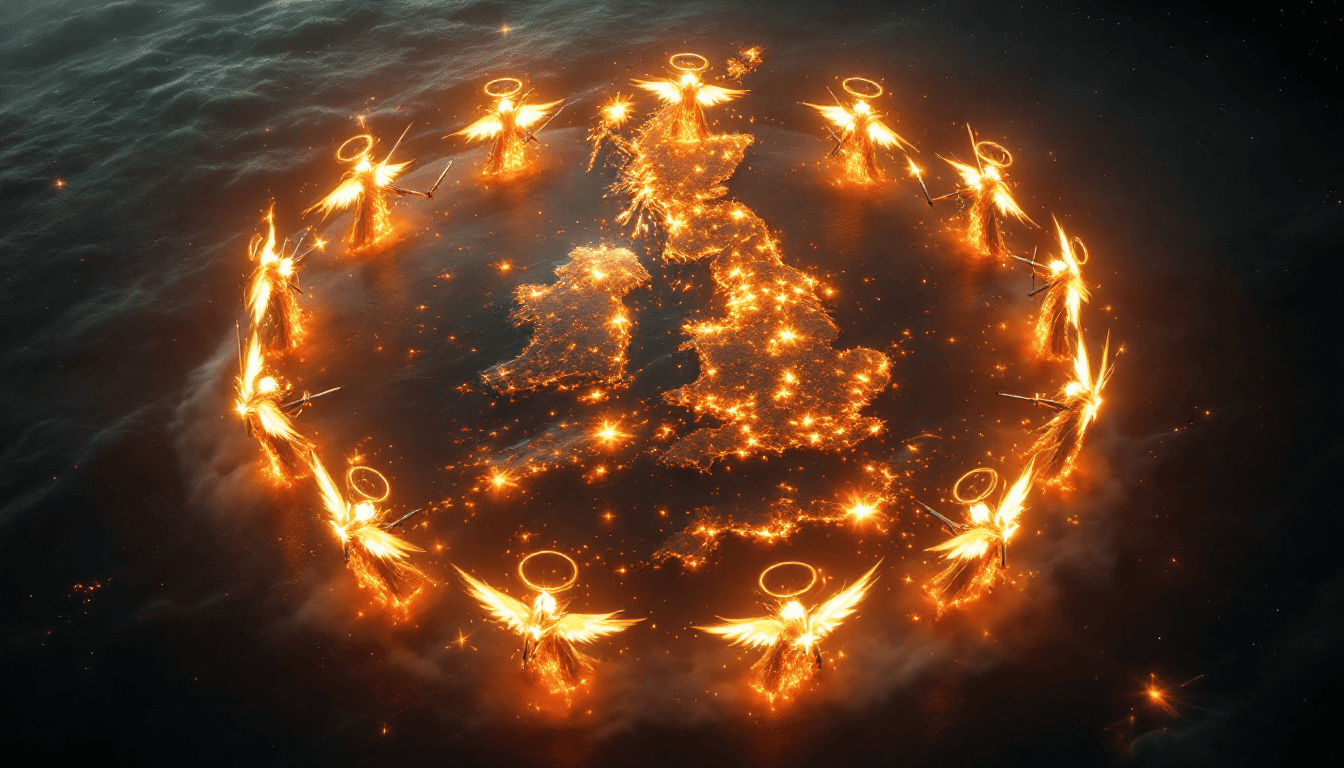
The Twelve Archangels Of Lethal British Military Force
Political power grows out of the barrel of a gun. Boudica and Cromwell carriers. Fighters which dive into the ocean. Drone swarms which attach to enemy hulls like parasites. Underground farms to survive nuclear winter. And EREBUS — a weapon too terrible to name which brings eternal darkness.

Our islands have always been one catastrophic failure away from subjugation. Alfred understood. Elizabeth understood. Churchill understood. Britain survives when it commands its waters — and falls when it doesn't.
This is the fact upon which all British strategic thinking must rest, however uncomfortable it proves for those who prefer to imagine our geography as impregnable. The twenty-one miles of the English Channel have never constituted a wall. They constitute a moat—and moats can be crossed by those with sufficient will, sufficient force, and sufficient patience to wait for the defenders to grow complacent.
We know this because it has happened before. Not once, but repeatedly. The Romans came and stayed for four centuries. The Angles, Saxons, and Jutes came and never left at all—they became us, or rather, we became them. The Danes carved out half the kingdom. The Normans took the whole thing in an afternoon. Each invasion reshaped the entire character of these islands, their laws, their language, their ruling class, their sense of themselves.
The notion of British inviolability is not ancient wisdom. It is Victorian sentiment, born of a century in which the Royal Navy happened to outgun every rival and no serious continental power possessed the amphibious capability to test our shores.
The Victorians could afford their complacency. We cannot.
Alfred's Revelation: The Sea Is the Frontier
Alfred the Great understood what was at stake when the Great Heathen Army reduced Wessex to the last unconquered Anglo-Saxon kingdom. A man of books and learning, he became a man of war because circumstance demanded it. But Alfred's genius lay not merely in fighting the Danes to a standstill at Edington—it lay in recognising why they had come so close to total victory.
The Vikings were a seaborne people. They struck from the water, exploited the rivers, and retreated to their ships before any organised resistance could form. To defeat them permanently required not simply a better army, but a better understanding of where the true frontier lay.
It was not on land. It was at sea.
Alfred's construction of a proto-navy—longships designed specifically to outmatch the Danish vessels in English coastal waters—represented the first coherent articulation of what would become the foundational principle of British defence: the battle for Britain is won or lost upon the waves. Control the approaches and you control the islands. Lose the approaches and you lose everything.
The Armada, Napoleon, Hitler: A Lesson Repeated
This principle held for a thousand years. When Philip II assembled the Spanish Armada in 1588, the largest invasion fleet Europe had ever seen, it was not the English army massing in Tilbury which saved Elizabeth's throne. It was the Channel weather, certainly, but also the harrying English fleet which had pursued the Armada up from Plymouth, denying it any safe anchorage, any opportunity to link with Parma's invasion force waiting in the Spanish Netherlands.
The army never embarked. The army was never needed. The battle was decided at sea.
When Napoleon stood at Boulogne in 1805, gazing across at the white cliffs with the Grande Armée at his back—the finest military instrument Europe had produced since the Roman legions—he declared he needed only "six hours' possession of the Strait" to end the war and remake the world. He never got them. Trafalgar ensured he never would.
The army never embarked. The army was never needed. Once again, the battle was decided at sea.
When Hitler's generals drew up Operation Sea Lion in 1940, they recognised immediately what Napoleon had learned: crossing the Channel against a hostile navy was not an amphibious operation but a suicide mission. The Luftwaffe was tasked with destroying the Royal Air Force not because air superiority was the ultimate objective, but because it was the necessary precondition for destroying the Royal Navy, which was itself the necessary precondition for any landing. When the RAF refused to die, Sea Lion was postponed indefinitely.
The army never embarked. The army was never needed.
Three existential threats in four centuries. Three times the same lesson. Britain survives when it commands its surrounding waters and the skies above them. Britain falls when it does not.
The Nuclear Age Changed Everything
But here we must confront an uncomfortable evolution in the nature of warfare which our political class has spent eighty years refusing to honestly address.
The advent of nuclear weapons, intercontinental ballistic missiles, hypersonic delivery systems, and satellite-guided precision munitions has rendered the traditional calculus of amphibious invasion almost quaint. An enemy need no longer command the Channel for six hours to bring Britain to its knees. An enemy need only possess sufficient nuclear capability to threaten annihilation—and sufficient confidence we lack the means or will to respond in kind.
During the Cold War, Britain sheltered beneath the American nuclear umbrella, contributing our own modest deterrent to NATO's collective defence while quietly understanding the real guarantee of our survival lay in Washington's willingness to trade New York for London. This was always a psychologically uncomfortable arrangement, but it functioned adequately so long as the Soviet Union remained the only existential threat and the Atlantic alliance remained solid.
Neither condition now holds.
Russia retains thousands of nuclear warheads and has, under Putin, demonstrated a willingness to engage in military adventurism which would have been unthinkable in the late Soviet period. China is engaged in the largest peacetime military expansion in human history, constructing a navy which will soon dwarf anything the Royal Navy can field, whilst developing hypersonic missiles, anti-satellite weapons, and cyber capabilities designed explicitly to neutralise American power projection in the Pacific—and, by extension, American guarantees to allies further afield.
The United States itself, meanwhile, has begun the long retreat from global hegemony which all empires eventually undertake. Whether through strategic choice or political dysfunction, American attention and resources are pivoting toward the Pacific and toward domestic concerns. European security is becoming a European problem. British security is becoming a British problem.
And Britain, at this precise moment of maximum danger, finds itself with a military hollowed out by decades of Treasury-driven cuts, a nuclear deterrent of questionable reliability, no missile defence whatsoever, a navy smaller than France's, and a political class which cannot even articulate what an independent British defence posture would look like, let alone fund one.
Who Could Actually Invade Us?
Only four entities currently possess the theoretical capability to mount an existential military threat to the British Isles: the United States, Russia, China, and a hypothetically united regional (European or Islamic) force operating without British participation. Of these, the United States can be discounted as a direct threat for the foreseeable future, however much we might worry about the reliability of American security guarantees. A unified hostile European force remains improbable, though the long-term trajectory of European integration means it cannot be dismissed entirely from strategic planning conducted on generational timescales.
Russia and China, however, are present dangers.
Russia possesses approximately 5,500 nuclear warheads, the largest arsenal on Earth, along with extensive cyber warfare capabilities, a demonstrated willingness to use military force against neighbouring states, and a political leadership which views NATO—and by extension Britain—as an existential enemy. The Russian conventional military has revealed itself in Ukraine to be far less capable than Cold War assumptions suggested, but nuclear capability is not conventional capability. A Russia facing regime collapse, or a Russia led by someone even less constrained than Putin, remains capable of ending British civilisation in an afternoon.
China does not currently possess the force projection capability to threaten Britain directly, but this is a temporary condition. The People's Liberation Army Navy is commissioning warships at a rate not seen since the Second World War. Chinese hypersonic missiles can already strike targets at ranges and speeds which render existing defensive systems obsolete. Chinese space and cyber capabilities are designed to blind and paralyse technologically advanced adversaries in the opening hours of any conflict. Within two decades, China will possess the ability to project decisive military power anywhere on Earth. The question is not whether China could threaten Britain, but when—and whether we will have prepared for the possibility.
Beyond these state actors lies the newer threat of non-state or quasi-state forces acquiring weapons of mass destruction, the possibility of catastrophic cyberattacks on critical national infrastructure, and the wild card of technologies not yet invented but certain to emerge: autonomous weapons systems, directed energy weapons, space-based strike platforms, and developments we cannot currently imagine.
The comfortable assumption of British invulnerability, sustained by institutional memory of the Empire and the residual glow of 1940, is not merely outdated. It is suicidal.
The Twelve Archangels Of War
In the Abrahamic traditions, archangels are the supreme messengers of God—beings of terrible power dispatched at moments of ultimate crisis to deliver the faithful from destruction.
The term itself derives from the Greek archangelos, meaning "chief messenger," but this clinical etymology undersells the visceral role these figures play in Christian eschatology. Michael, prince of the heavenly host, who cast Satan from paradise and will command the armies of God at the end of days. Gabriel, who announced to Mary she would bear the Christ. Raphael, the healer, who restored Tobit's sight and bound the demon Asmodeus. Uriel, the light of God, who guards the gates of Eden with a flaming sword.
These are not gentle spirits. These are weapons.
In the Book of Revelation, it is angels who pour out the seven bowls of God's wrath upon the Earth. In 2 Kings, a single angel of the Lord slays 185,000 Assyrian soldiers in a single night to save Jerusalem from Sennacherib. In Exodus, it is the destroying angel who passes over Egypt and kills the firstborn of every household not marked with lamb's blood.
Archangels are instruments of deliverance through overwhelming force. They are the last resort when all other hope is spent. They do not negotiate. They do not compromise. They do not lose.
It is in this spirit—not with hubris, but with cold acknowledgment of what genuine security requires— we propose the twelve structural pillars of a new British defence doctrine. These are not policies. They are archangels: each one capable, if the others should fall, of preserving the nation alone.
I. The Armed Populace: 40 Million Soldiers in Reserve
Every British Adult a Trained Defender. Every Home a Fortress.
Israel, a nation of nine million surrounded by hostile powers, maintains one of the most formidable military forces on Earth through the simple expedient of requiring virtually every citizen to serve. At any given moment, the Israel Defence Forces can mobilise over 600,000 trained personnel from a total population smaller than London's. The ratio of trained reservists to total population approaches one in fifteen.
Britain's current reserve forces number approximately 30,000. Our population is (supposedly) sixty-seven million. The ratio is one in two thousand.
This is not a serious country.
A genuine commitment to national defence would require the establishment of universal basic military training for all British citizens upon reaching adulthood—not as conscription into standing forces, but as preparation for existential emergency. Every man and woman would spend twelve months learning the fundamentals: weapons handling and marksmanship, basic tactics and fieldcraft, first aid and trauma medicine, secure communications and cybersecurity, and the operation of aerial drones which have transformed modern warfare.
Professional soldiers would remain the core of our standing military. But to produce a population which could, if the hour demanded it, field an army of five hundred thousand trained reservists within seventy-two hours of mobilisation. A population which could not be subdued by occupation even if our professional forces were destroyed. A population which understood, in its bones, what was being asked of it and why.
The Swiss model provides partial precedent: a nation of eight million which maintains the ability to mobilise 150,000 trained soldiers within days, where military rifles are kept in private homes, where the entire geography of the country is designed around defensive warfare. But the Swiss model is purely defensive. Britain's strategic requirements demand the capacity for power projection. Our trained populace would need competence not merely in infantry skills, but in the technical domains—aviation, cyber operations, naval systems—which define twenty-first-century warfare.
The political objections are obvious. Compulsory service offends liberal sensibilities. Widespread firearms training terrifies a political class which has spent decades disarming its own population. The cost would be substantial.
But what is the cost of lacking such a force when the hour comes? What is the cost of discovering, too late, professional forces alone cannot hold against an enemy willing to absorb casualties we cannot replace?
II. The Churchill and Thatcher Classes: Five Nuclear Leviathans
Command of the Seas Requires Ships. We Have Almost None.
The Royal Navy currently operates two aircraft carriers: HMS Queen Elizabeth and HMS Prince of Wales. Both are conventionally powered, requiring frequent refuelling which limits their operational range and endurance. Both carry fewer than forty aircraft in their standard configuration. Neither has ever operated in contested waters against a peer adversary.
The United States Navy operates eleven nuclear-powered supercarriers, each capable of carrying over seventy aircraft and remaining at sea indefinitely without refuelling. China is building its third carrier and has announced plans for at least six. Even France operates a nuclear carrier, the Charles de Gaulle.
Britain, the nation which invented the aircraft carrier, which once commanded the largest navy in human history, which depends for its survival upon control of the seas surrounding it, operates two medium-sized conventional carriers and pretends this constitutes a serious maritime force.
Two Churchill-class vessels would be the most powerful warships ever constructed by a European nation. Nuclear-powered, displacing over 100,000 tonnes, each would carry one hundred hybrid hypersonic stealth unmanned aerial vehicles capable of speeds exceeding Mach 5 and operating envelopes ranging from 80,000 feet to wave-top level. These are not traditional carriers in the sense of floating airfields. They would be mobile sovereign bases—self-contained projection platforms capable of sustained independent operations anywhere on Earth's oceans for years at a time without resupply of fuel.
- HMS Boudica — The Iceni queen who burned Londinium to ash and slaughtered seventy thousand Romans. Her name means "victory" — the Romans learned to fear it.
- HMS Cromwell — The Lord Protector who beheaded a king, broke the Irish, and proved British wrath answers to no crown. Controversial. Unforgettable. Terrifying to those who remember.
The three Thatcher-class vessels would be smaller but still nuclear-powered, each carrying sixty aircraft and serving as the workhorses of routine patrol and presence operations. At any given moment, three carriers would patrol the waters surrounding the British Isles in overlapping coverage patterns, while the remaining two operate globally or undergo refit.
- HMS Retribution — Not a person but a promise. What comes for those who strike first.
- HMS Imperia — The word itself a statement: we bow to none.
- HMS Vesper — James Bond's girlfriend, for fun, because she was deadly, but honest. Even if we used it before.
Crucially, these vessels would not be merely naval platforms. The traditional division of British forces into separate Army, Navy, and Air Force commands—each with its own bureaucracy, procurement systems, and institutional jealousies—is an artefact of early twentieth-century organisational thinking wholly unsuited to modern warfare.
Each carrier group would instead operate as an integrated multi-domain force: embarked marines for amphibious operations, integrated air defence and strike capabilities, organic cyber and electronic warfare units, and the command-and-control infrastructure to coordinate all elements seamlessly. A floating fortress. A moving city. A self-sufficient instrument of national power capable of operating independently for extended periods in any environment on Earth.
A single American Gerald R. Ford-class carrier costs approximately thirteen billion dollars. Five carriers of the scale proposed here, plus their air wings, escort vessels, and support infrastructure, might approach one hundred billion pounds over two decades of construction.
About three months of NHS spending.
Approximately what the British government spends on interest payments for the national debt every eighteen months, each.
The question is not whether we can afford such a force. The question is whether we can afford to remain a serious nation without one.
III. Seraph: Vehicles That Own Two Domains
Fighters That Swim. Submarines That Fly.
The division of military vehicles into those which operate in the air and those which operate beneath the water is not a law of physics. It is a limitation of engineering imagination which advances in propulsion, materials science, and autonomous systems are beginning to overcome.
The third archangel requires the development of a revolutionary multi-modal hypersonic vehicle class capable of seamless transition between atmospheric and underwater operation. Picture a craft which launches from a carrier deck, accelerates to Mach 6 at 60,000 feet, dives like a gannet into the ocean, transitions to supercavitating underwater propulsion at three hundred knots, approaches an enemy fleet undetected from below, and surfaces to strike before any defensive system can respond.
From the Hebrew śārāf, meaning "burning one." In Isaiah, the seraphim have six wings and voices that shake the foundations of heaven. They are not gentle messengers. They are living fire in humanoid form, the closest beings to the throne of God, terrible in their holiness.
A craft which plunges from the edge of space at Mach 6, dives into the ocean, and rises again to strike without warning deserves nothing less.
This is not science fiction. The component technologies already exist in various stages of development.
Supercavitation—the creation of a gas bubble around a submerged vehicle which dramatically reduces hydrodynamic drag—has been explored since the Soviet Shkval torpedo of the 1970s. Modern research suggests supercavitating vehicles could achieve underwater speeds exceeding 300 knots, roughly five times faster than any conventional submarine. Hypersonic atmospheric flight, meanwhile, has been demonstrated by multiple nations; China's DF-ZF and Russia's Avangard represent merely the first generation of such weapons.
The engineering challenge lies in combining these capabilities into a single airframe, with propulsion systems which function in both media, materials which withstand the thermal stresses of hypersonic atmospheric flight and the pressure stresses of deep submersion, and control systems capable of managing the transition between radically different operating environments.
Britain once led the world in aerospace innovation. The Harrier jump jet, the Concorde, the jet engine itself—these were British inventions which other nations subsequently developed further while we rested upon fading laurels. The Seraph programme would represent a commitment to regaining such technological leadership, not through incremental improvements to existing platforms, but through a leap into capabilities no other nation yet possesses.
A fleet of such vehicles, operating from the Churchill and Thatcher-class carriers, would render traditional naval defence calculus obsolete. An enemy fleet could be approached from any direction, any altitude, any depth. The first warning of attack would be the attack itself.
Critically, these vehicles must not depend upon petroleum-based fuels. The strategic vulnerability of oil dependency has been demonstrated repeatedly, from the U-boat campaigns against Atlantic convoys to the oil shocks of the 1970s. Nuclear propulsion, hydrogen fuel cells, advanced battery technologies—the specific solution matters less than the imperative of energy independence for our most critical military systems.
IV. The Lion Dome: A Shield Over Britain
We Cannot Shoot Down a Single Incoming Missile. Not One.
This is perhaps the most scandalous gap in British defences, the one which most clearly reveals the fundamental unseriousness of our strategic posture.
Britain possesses no national missile defence capability whatsoever.
If a ballistic missile were launched at London tomorrow—whether by a state actor, a terrorist organisation which had acquired such capability, or an accidental launch from a malfunctioning system—there is precisely nothing we could do to stop it. We would watch it come. We would die.
Israel, facing persistent rocket attacks from Hamas and Hezbollah, developed the Iron Dome system which has intercepted thousands of incoming projectiles with a success rate exceeding ninety percent. The United States has invested hundreds of billions in layered missile defence, from the ground-based midcourse system designed to intercept ICBMs to the Patriot and THAAD systems protecting against shorter-range threats. Even Saudi Arabia operates significant missile defence capabilities.
Britain—a nuclear-armed permanent member of the UN Security Council, a nation which likes to imagine itself a serious military power—operates nothing. We are naked.
The fourth archangel demands a comprehensive, sovereign missile defence architecture capable of detecting, tracking, and intercepting the full spectrum of aerial threats: subsonic cruise missiles, supersonic anti-ship missiles, hypersonic glide vehicles, ballistic missiles of all ranges, and the drone swarms which have transformed recent conflicts in Ukraine and the Middle East.
This cannot be a purchased American system operated under American licence with American software we cannot modify or fully understand. It must be a British system, designed and built in Britain, controlled entirely by British authorities, integrated with but not dependent upon allied networks.
The technical challenges are formidable. Hypersonic weapons travel at speeds exceeding Mach 5, leaving mere seconds for detection, tracking, and intercept. Stealth technologies reduce radar cross-sections to the point where traditional detection systems may not see a threat until it is too late. Ballistic missiles in their terminal phase descend at velocities which push the limits of kinetic interceptors.
But these are engineering problems, not impossibilities. The physics of interception are well understood. What has been lacking is the political will to fund development and the strategic imagination to recognise the necessity.
A Britain without missile defence is a Britain which has accepted, whether consciously or through negligence, its own potential annihilation. This is not deterrence. This is surrender in advance.
V. Argus: One Thousand Sentinels in Orbit
If We Cannot See Them Coming, We Cannot Stop Them.
Space has become the ultimate high ground of modern warfare. The nation which controls orbital space controls the information environment upon which all modern military operations depend: communications, navigation, reconnaissance, targeting, early warning. Conversely, the nation which loses access to space is blind, deaf, and mute—unable to coordinate forces, detect threats, or guide precision weapons.
Britain's current space capabilities are, to put it charitably, modest. We operate a handful of military communications satellites through the Skynet system. We have limited indigenous reconnaissance capability. We depend almost entirely upon American systems for the GPS navigation which guides everything from civilian smartphones to military cruise missiles.
This dependency is a strategic vulnerability of the first order.
In any serious conflict with a peer adversary, one of the first actions would be the destruction or disabling of satellite constellations. China has repeatedly demonstrated anti-satellite weapons capable of destroying spacecraft in low Earth orbit. Russia has tested similar systems. Cyber attacks on satellite ground stations represent an even simpler vector for disrupting space-based capabilities.
If American satellites go dark—whether through enemy action, American strategic choice, or simple technical failure—Britain loses the ability to navigate its own ships, guide its own weapons, or see beyond its own horizon.
The fifth archangel therefore requires the deployment of a sovereign British satellite constellation of approximately one thousand spacecraft providing comprehensive, redundant coverage of the entire Earth's surface with real-time imaging, signals intelligence, and communications relay capabilities.
In Greek mythology, Argus Panoptes — "Argus the All-Seeing" — was a giant with one hundred eyes covering his body. He never slept; when some eyes closed, others remained open. Hera set him to watch over Io, and nothing escaped his gaze.
Zeus had to send Hermes to kill him. It was the only way.
One thousand sounds ambitious until one considers SpaceX's Starlink constellation already exceeds five thousand satellites, launched at a rate which would have seemed impossible a decade ago. The miniaturisation of satellite components, the reduction in launch costs, and the development of satellite manufacturing at scale have transformed what is achievable.
A properly designed constellation would be resilient against attack through sheer numbers—destroying a handful of satellites would degrade but not eliminate capability. It would provide persistent surveillance of every potential threat vector, from Russian naval movements in the Arctic to Chinese fleet deployments in the Pacific. It would give Britain independent intelligence, independent communications, independent navigation: the prerequisites for independent action.
We would see everything. We would always see everything. And an enemy would know we see.
VI. A Nuclear Arsenal Worthy of the Name
160 Warheads. Questionable Reliability. Zero Independence. This Is Not a Deterrent.
Britain's nuclear deterrent consists of four Vanguard-class submarines, of which one is always at sea, carrying Trident II D5 missiles armed with approximately 160 warheads.
This sounds formidable until one examines the details.
The Trident missiles themselves are not British. They are American-made, maintained at a shared facility in Georgia, and dependent upon American technical support for their continued function. The warheads are British-designed but manufactured using American components and knowledge. The submarines require American reactor technology.
If the United States decided tomorrow to withdraw support—whether through strategic realignment, political upheaval, or simple bureaucratic dysfunction—Britain's nuclear deterrent would begin degrading immediately and might become non-functional within years.
This is not independence. This is nuclear capability on American sufferance.
Furthermore, 160 warheads represents the smallest arsenal of any declared nuclear power except North Korea. Russia operates approximately 5,500. The United States approximately 5,000. China is rapidly expanding toward parity. Even France maintains roughly 300.
The theory behind Britain's minimal deterrent is it provides sufficient second-strike capability to deter any rational adversary: even if Britain were destroyed in a first strike, the surviving submarine could inflict unacceptable damage in retaliation. This theory depends upon several assumptions which may not hold:
- the adversary is rational,
- they believe our submarines would survive their first strike,
- they believe we would actually retaliate given the futility of doing so after our destruction, and
- 160 warheads—or realistically, the forty or so which a single submarine could deliver—constitutes "unacceptable damage" to a nation the size of Russia or China.
The sixth archangel demands a nuclear arsenal of 1,500 warheads, wholly independent of American supply chains, diversified across multiple delivery systems, and including tactical as well as strategic weapons.
Five hundred warheads would be strategic—high-yield thermonuclear weapons deliverable by submarine-launched ballistic missile, air-launched cruise missile, and land-based mobile launchers. Of these, two hundred would be thermonuclear devices in the megaton range, capable of destroying any hardened target on Earth.
One thousand warheads would be tactical—lower-yield weapons deployable by aircraft, ship-launched cruise missile, and portable systems which could be positioned wherever British interests required protection. The Falkland Islands, for instance, could be rendered permanently inviolable by the quiet deployment of tactical nuclear weapons with the clear message any attempt at reconquest would result in nuclear retaliation.
Manufacturing independence would be achieved through deep partnership with Australia, leveraging their uranium reserves and shared interest in countering Chinese expansion. A joint UK-Australia weapons programme, conducted entirely outside American oversight, would provide both nations with genuine nuclear sovereignty whilst transforming Australia into a nuclear power capable of anchoring Indo-Pacific security.
This is not warmongering. This is deterrence taken seriously. A Britain with 1,500 independent warheads, deliverable by multiple means from multiple locations, is a Britain which no adversary could hope to disarm in a first strike. The logic of mutually assured destruction, to function at all, requires assured destruction be genuinely mutual. Our current posture does not meet that standard.
VII. A Planned Exodus for Seventy Per Cent
If the Worst Comes, the Nation Must Survive Even If the Land Does Not.
There exists a scenario—improbable but not impossible—in which warning of a catastrophic nuclear strike provides hours rather than minutes of notice. A massive first strike, intended to destroy Britain as a functioning state, would involve hundreds of warheads targeting military installations, government facilities, industrial centres, and population concentrations. Against such an attack, no missile defence could intercept more than a fraction. No bunker network could shelter more than a tiny elite.
But if warning came early enough—through satellite detection of mass launch preparations, through intelligence penetration of enemy command structures, through the simple logic of recognising the pre-war crisis phase—something unprecedented might be attempted.
The evacuation of the British population.
The seventh archangel requires the pre-positioning of plans, agreements, and logistics which would enable the emergency evacuation of approximately seventy percent of the British population—forty-five million people—to friendly nations within twenty-four hours of a decision to execute.
This sounds insane. It is not. We did it in WWII.
The Dunkirk evacuation of 1940 moved 338,000 soldiers across the Channel in nine days using every available vessel from destroyers to private yachts. Modern civilian aviation moves approximately four million passengers through UK airports on a typical summer day. The logistics of mass movement, while staggering in scale, are not beyond the capacity of a nation which genuinely prioritised survival.
The destination would be primarily Canada and Australia—Commonwealth realms which share our head of state, our common law traditions, and deep ties of kinship and history. Pre-negotiated agreements would provide evacuees with immediate immigration status and the right to work. Pre-positioned supplies and shelter arrangements would ease the initial resettlement. The continuity of government—the Crown, Parliament, the courts—would be maintained through institutions already prepared for relocation.
What would be left behind is the physical territory of Britain: the buildings, the infrastructure, the land itself. What would survive is the nation: the people, the institutions, the culture, the will to eventually return.
This is not defeatism. This is the ultimate form of resilience. An enemy might destroy every city in Britain with nuclear fire, but if the British people survived elsewhere, the nation would survive. And a nation which survived would eventually return to reclaim and rebuild its homeland, however many generations that might require.
The psychological value of such a plan, publicly known, should not be underestimated. It tells any potential adversary destroying Britain's territory would not destroy Britain itself— the most they could achieve through nuclear attack is temporary displacement, not annihilation. It removes the logic of nuclear blackmail entirely. You cannot coerce a nation which has already prepared to abandon its land rather than submit.
VIII. Revelation: Defeating Stealth Before It Defeats Us
Their Sixth-Generation Fighters Are Already Invisible to Our Radars.
Stealth technology has advanced to the point where the most sophisticated aircraft and naval vessels of peer competitors are effectively invisible to the radar and sonar systems upon which British defence has relied for eighty years.
The American F-22 Raptor, introduced in 2005, already possessed a radar cross-section comparable to a small bird. The F-35, now in widespread service, improved upon this. China's J-20 and Russia's Su-57 represent their own advances in low-observable technology. The sixth-generation fighters currently under development in the United States, China, and Europe will push these capabilities further still.
Meanwhile, Britain continues to operate Typhoon aircraft designed in the 1980s, defend its waters with Type 23 frigates commissioned in the 1990s, and rely upon sensor systems whose fundamental principles date to the Second World War.
The eighth archangel requires a crash programme to develop and deploy revolutionary sensing technologies capable of detecting stealth aircraft, submarines, and surface vessels regardless of their radar or acoustic signature reduction measures.
Passive radar systems, which detect aircraft by analysing disturbances in ambient radio signals from television and mobile phone transmissions, cannot be defeated by traditional radar-absorbent materials. Low-frequency radar, while lacking the precision of higher frequencies, can detect stealth aircraft at longer ranges because the physical dimensions of the aircraft interact differently with longer wavelengths. Quantum sensing technologies, still in early development, offer the possibility of detecting minute gravitational or electromagnetic disturbances which no stealth coating could mask.
The specific technical solution matters less than the strategic imperative: Britain must not be blind to approaching threats simply because those threats were designed to be invisible. Our survival cannot depend upon an adversary's restraint in deploying their most advanced capabilities.
A comprehensive anti-stealth sensing network, deployed across the British Isles, in our territorial waters, and aboard our naval vessels, would restore the fundamental advantage which geography provides: the ability to see an enemy approaching while they are still far away, while response options remain open, while defence is still possible.
IX. Charybdis: Underwater Armies Approaching Unseen
They Will Never See the Invasion Coming. It Will Rise From the Depths.
Amphibious assault in the traditional sense—landing craft approaching beaches under covering fire—has been rendered suicidal by modern precision weapons. Any surface approach to a defended coastline would face anti-ship missiles, coastal artillery, minefields, and air attack. The losses would be catastrophic before a single soldier reached the shore.
But what if the assault force never approached on the surface at all?
The ninth archangel envisions a revolutionary underwater transport capability: submarine vessels of unprecedented size, capable of carrying two thousand troops with full equipment including armoured vehicles, approaching enemy coastlines at depths below detection, and discharging their forces either through underwater lock-out systems or by surfacing directly onto beaches.
In Homer, Charybdis was the monster beneath the Strait of Messina who swallowed the sea itself three times daily, creating a whirlpool which devoured ships whole. Odysseus lost six men to Scylla specifically to avoid Charybdis, because Charybdis meant total annihilation.
A vessel that emerges from the depths to disgorge two thousand soldiers onto an enemy beach deserves a name that evokes the terror of the deep.
Think of a submerged Hercules transport aircraft, or rather a Globemaster, Galaxy or Antonov, moving slowly and silently through the ocean depths. A force of ten such vessels could deliver twenty thousand troops onto an enemy shore with no warning whatsoever.
The troops themselves would not be conventional infantry. They would be a specially selected and trained force of approximately ten thousand personnel, equipped and prepared for the most demanding operations imaginable: deep penetration raids, seizure of critical infrastructure, elimination of enemy leadership, and the kind of dispersed cellular warfare which has proven so effective for insurgent forces but has rarely been attempted by advanced militaries.
These operators would be trained to function in small autonomous units, making decisions without communication with higher command, operating behind enemy lines for extended periods, and employing the full range of twenty-first-century technologies: drones, cyber weapons, directed energy devices, and systems not yet publicly acknowledged.
The mere existence of such a capability would transform the strategic calculations of any potential adversary. Every coastline would become vulnerable. No enemy homeland would be safe from direct British military action. The ability to strike anywhere, from beneath the waves, without warning, provides coercive leverage far exceeding our conventional force size.
X. Lamia: Autonomous Swarms Beneath the Waves
A Million Mines That Hunt. That Think. That Wait.
The waters surrounding the British Isles are our greatest natural defence, but only if we control them. An enemy fleet approaching our shores must be destroyed before it can land troops or launch missiles. Traditionally, this required a navy capable of meeting and defeating the enemy in surface engagement. But there is another way.
The tenth archangel proposes the development and deployment of a vast fleet of autonomous underwater drones, small enough to evade detection, intelligent enough to coordinate their actions, and numerous enough to overwhelm any surface fleet through sheer mass.
In Greek mythology, Lamia was a queen transformed by Hera's jealousy into a creature who devoured children. Later traditions multiplied her into the lamiae — a swarm of female demons who hunted in packs, seducing and consuming the unwary.
The name captures both the horror of the swarm and its patient, predatory nature. The drones wait. They watch. They attach themselves to their prey. And then, on command, they feed.
Picture a drone the size of a torpedo, propelled by silent electric motors, capable of operating autonomously for months while awaiting activation. Thousands of such drones, positioned throughout the waters surrounding Britain in a three-dimensional mapped grid, connected by secure underwater communication networks, lying dormant until needed.
Upon detection of a hostile fleet, these drones would activate, converging on the enemy vessels from every direction. Some would attach themselves to hulls, awaiting a coordinated detonation command. Others would trail the fleet, reporting its position and composition. Others would actively attack, striking propellers, rudders, and other vulnerable systems.
The effect would be less like a minefield and more like an immune response: thousands of autonomous agents swarming to neutralise a foreign intrusion. The enemy fleet would find itself suddenly surrounded by a cloud of threats too numerous to destroy, too small to reliably detect, too distributed to eliminate through any single countermeasure.
The Armada was scattered by fireships. A modern Armada would be consumed by the Hornet's Nest.
The ethical implications of fully autonomous weapons are significant and deserve serious debate. But the practical reality is such systems are already under development by multiple nations. Britain can choose to possess this capability or to be vulnerable to adversaries who possess it. There is no third option in which autonomous weapons simply do not exist.
XI. The Gardens Below: Food Independence Under Fire
Germany Nearly Starved Us Twice. We Learned Nothing.
In both World Wars, Germany attempted to defeat Britain not through invasion but through starvation. U-boats in the Atlantic targeted merchant shipping bringing food from America, Canada, and the Empire. At the height of the Battle of the Atlantic in 1942, Britain came within weeks of running out of supplies. Only the eventual defeat of the submarine threat preserved the nation from capitulation.
Today, Britain imports approximately forty percent of its food. Our strategic food reserves are minimal. A sustained blockade—or even the threat of one—could bring the nation to its knees within months.
The eleventh archangel addresses this vulnerability through the construction of ten massive subterranean hydroponic farming complexes, each capable of producing sufficient food to sustain five million people indefinitely, located deep underground where they would survive any conceivable attack.
Modern vertical farming and hydroponic technology can produce crop yields dramatically higher than traditional agriculture, independent of weather, season, or external conditions. LED lighting tuned to optimal growth spectrums, nutrient solutions precisely calibrated for each crop variety, and controlled atmospheric conditions can produce multiple harvests per year in a fraction of the space required by conventional farms.
A single underground complex the size of a large shopping centre, using existing technology, could produce sufficient calories to feed a million people. China is already doing it.
Ten such complexes, hardened against nuclear attack, supplied with independent power from small modular nuclear reactors, and staffed by rotating crews trained in their operation, would provide absolute food security regardless of external conditions.
If this sounds eccentric, consider in 1955 Britain built a full underground city in Wiltshire to house 4,000 people.
Beyond food, these facilities would anchor a broader programme of infrastructure independence. Water purification and recycling systems independent of mains supply. Emergency power generation independent of the national grid. Secure communications independent of surface infrastructure. Medical facilities, manufacturing capability, government continuity operations—everything needed for the nation to function indefinitely even if every surface installation were destroyed.
Britain would become, in extremis, a nation capable of retreating beneath the earth and sustaining itself until conditions permitted resurgence. The besieging enemy, having destroyed everything visible, would find they had destroyed nothing essential. The nation would endure, fed by gardens they never knew existed, waiting for the moment to re-emerge.
XII. EREBUS, The Final Option: A Weapon Too Terrible to Name
If Everything Else Fails, Mutual Assured Destruction Must Be Truly Mutual.
There must exist, as the ultimate guarantor of British survival, a doomsday weapon of such catastrophic power its deployment would end not merely the war but the possibility of war—a weapon which renders irrelevant the physical size of an adversary's nuclear arsenal because it threatens consequences beyond any conceivable strategic objective.
Israel's Samson Option, never officially acknowledged but widely understood, provides the template. If Israel were to face imminent destruction, it would take its enemies—and perhaps much of the region—with it. The name references the biblical Samson, who brought down the temple upon himself and his Philistine captors, preferring mutual annihilation to defeat.
The logic is cold but compelling. A small nation facing larger adversaries cannot match them warhead for warhead. But it can ensure its destruction would cost the adversary more than any possible gain. If conquering Britain would result in consequences so catastrophic victory itself becomes meaningless, then no rational adversary would attempt conquest.
What form might such a weapon take? Several possibilities exist within the boundaries of known physics.
Edward Teller imagined the terrifying prospect of 10-gigaton Project SUNDIAL: enough hydrogen bombs chained together to destroy a planet. The 2018 Russian RS-28 Sarmat, or SATAN-II, is designed to carry 10-18 warheads – in one missile.
Cobalt bombs—nuclear weapons designed to maximise radioactive fallout rather than blast damage—could render entire continents uninhabitable for decades. A sufficient number of such weapons, detonated simultaneously, might trigger effects approaching an extinction-level event.
Autonomous systems, pre-positioned in adversary territories during peacetime, could be programmed to activate upon loss of communication with British command authority—a dead man's switch writ continental.
More exotic possibilities—orbital kinetic bombardment, engineered pathogens, genetic weapons, manipulation of geological fault lines—remain in the realm of speculation but cannot be dismissed as permanently impossible.
In Greek primordial cosmology, Erebus was not merely darkness but the darkness — the absolute void from which nothing returns, older than the Olympian gods, older than the Titans, born directly from Chaos at the beginning of existence.
Erebus is not a place. Erebus is the end of places.
The weapon's automated activation protocol, triggered by loss of communication with British command authority, is designated ORPHEUS DESCENDING — because Orpheus entered Erebus and proved even love cannot return from absolute darkness.
The physical installations housing the weapon would be called Lazarus Vaults — named not for resurrection but for the four days Lazarus spent in death before Christ called him forth. The implication: whatever enters these vaults will wait in death until the end of days.
The weapon's final-stage deployment sequence is called simply THE WORD.
"In the beginning was the Word, and the Word was with God, and the Word was God."
And at the end, there will be a Word as well. One which no adversary will survive to hear.
The specific mechanism matters less than the certainty of its existence and the absolute credibility of its use. An adversary must believe, with no room for doubt, destroying Britain would trigger their own destruction. Not as a proportional response, not as retaliation, but as an automatic and unsurvivable consequence.
Such a weapon must, obviously, be designed to function only outside British territory. Its purpose is not defence in any conventional sense but the elimination of any conceivable incentive to attack. It is the final archangel: not a deliverer from destruction, but a guarantor destruction, if it comes, will be universal.
Why Parliament Will Never Debate This
A doctrine like this will strike many readers as fantastical, extreme, or dangerous. It will be dismissed as science fiction by those who believe serious defence policy must remain within the narrow bounds of current capabilities. It will be attacked as warmongering by those who imagine defence preparedness causes rather than deters conflict. It will be ignored by a political class which has forgotten what existential threat feels like and cannot imagine circumstances requiring such measures.
All of these responses miss the point.
Archangel doctrine is not a prediction of what Britain will do. It is a provocation toward what Britain should discuss. The specific proposals matter less than the underlying questions they force us to confront:
Are we serious about national defence, or are we content to shelter beneath American protection until such protection is withdrawn?
Have we genuinely considered the implications of nuclear weapons and hypersonic delivery systems, or do we still imagine the Channel will protect us as it protected our grandparents?
Are we prepared to invest the resources necessary for genuine security, or do we prefer to spend those resources on present consumption whilst leaving future generations to face the consequences?
Do we have the imagination to recognise the nature of warfare is changing in ways which render our current capabilities obsolete, or will we cling to legacy systems until they fail catastrophically?
These are questions which Parliament should debate openly, rigorously, and without the constraint of pretending all answers are equally acceptable. They are questions which the British public deserves to hear discussed, so democratic consent can be given—or withheld—for the strategic choices which will determine whether the nation survives the century.
Until the sky fills with missiles we cannot stop, until the waters fill with enemies we cannot see, until the hour of deliverance has passed and we are left with only the memory of what we might have been.
Britain has faced annihilation before. Britain has always found a way to survive. But survival has never been automatic. It has always required foresight, sacrifice, and the will to do what the hour demands.
The hour is coming. The only question is whether we will be ready.