They Borrowed Against the Rain
Britain’s biggest water company has debt of roughly £17.6 billion and gearing of 85.9%: far above the level Ofwat says is consistent with long-term resilience. It serves 16 million customers and has been kept afloat by emergency funding while creditors and regulators search for a rescue.
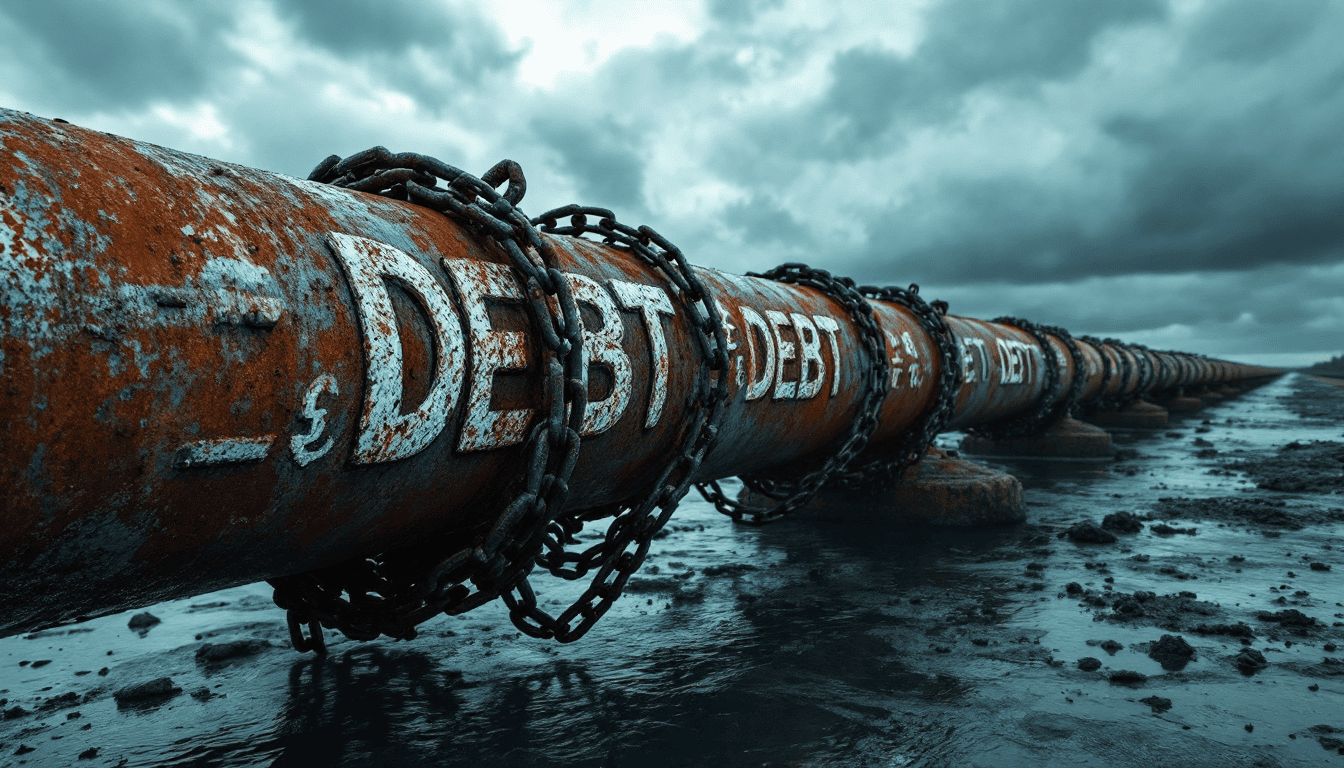
Thames Water does not have a cash flow problem. Thames Water has a business model problem. And the business model is debt.
The company serves roughly sixteen million people across London and the Thames Valley. It is the largest water and wastewater provider in the country. It is also, at the time of writing, carrying approximately £17.6 billion in net debt at a senior gearing ratio of 85.9 per cent. Ofwat, the economic regulator, considers gearing above 70 per cent inconsistent with long-term financial resilience. For the next regulatory period it has lowered its notional benchmark to 55 per cent. Thames is running at nearly thirty points above even the old threshold.
This is not a company struggling with an unexpected downturn. This is a company built on leverage.
How a Monopoly Became a Financial Vehicle
To understand how Thames Water arrived here, you need to understand what Macquarie Infrastructure did with it between 2006 and 2017. During those eleven years, according to Reuters, Thames Water paid approximately £2.7 billion in dividends to its investors while its debt pile roughly tripled — from around £3.4 billion to almost £11 billion. The Guardian puts the dividend figure at £2.8 billion. The numbers differ slightly depending on the method of calculation. The direction is not in dispute.
What happened is structurally simple. A consortium led by Macquarie acquired a regulated monopoly: a company whose customers cannot leave, whose revenue is set by a regulator, and whose product falls from the sky. They loaded it with debt. They extracted dividends. They underinvested in pipes. And when they sold their stake, the debt remained.
This is not a scandal of mismanagement in the conventional sense. Nobody stole the money. The dividends were declared lawfully. The debt was accumulated within regulatory limits as they then existed. The trick was not illegality. It was architecture. Private equity discovered you could treat a regulated utility the way you would treat a leveraged buyout target: borrow against the captive revenue, extract the spread, and leave. The extractors move on. The infrastructure stays behind. So does the debt.
The Regulator Who Watched
Ofwat was created for precisely this situation. Its purpose is to regulate in the public interest — to ensure companies invest, maintain resilience, and charge fair prices. For years it prioritised keeping bills low. The effect, as the National Audit Office observed in April 2025, was a sector pulled between low bills, environmental compliance, investor returns, and infrastructure needs — with the result being weak resilience, ageing assets, low trust, and rising bills regardless.
That last detail matters. Bills are now expected to rise at the fastest rate in twenty years (an average of £31 per year over the next five) while around 20 per cent of customers already struggle to pay. The public got neither cheap water nor well-maintained pipes. It got the worst of the bargain: rising costs on decTomorrow: the body supposed to tell you whether your hospital, care home, or GP surgery is safe. It lost 500 inspection reports inside its own computer system.aying infrastructure.
Ofwat did eventually act on dividends, but only after the crisis was advanced. In December 2024 it found Thames Water had breached dividend payment rules and imposed an £18 million penalty, while also moving to claw back value connected to £131.3 million in dividend payments. In May 2025 it announced penalties on Thames totalling £122.7 million, including a major wastewater penalty. It said these costs should be borne by the company and investors, not customers.
The penalties are real. They are also late. When the regulator moves against a company already insolvent in all but name, the fines do not punish the people who extracted the money. The extractors left years ago. The fines land on the restructuring pile, alongside everything else.
Seven Hundred Years To Rebuild
The physical reality behind the financial engineering is worse than the balance sheet suggests.
The NAO said in April 2025 it found no regulator proactively inspecting wastewater assets to prevent harm. It said regulators do not have a good understanding of the condition of infrastructure assets. At current replacement rates, the NAO calculated it would take approximately 700 years to renew the existing water network.
Seven hundred years.
The mains beneath English streets were in many cases laid by the Victorians. At the pace the system now operates, they will not be fully replaced until after the year 2700. By then the Victorians will have been dead longer than the Roman Empire lasted.
This is what underinvestment looks like when it compounds across decades. Every pound extracted in dividends, every year of deferred maintenance, every regulatory cycle in which investment was traded off against bill increases — all of it is embedded in the physical state of the network. The pipes do not forget. The sewers do not forget. The treatment works do not forget.
And the public is beginning to understand. The NAO concluded outright: regulators have failed to deliver a trusted and resilient water sector. The Public Accounts Committee went further. It said regulators appeared to be "missing in action." It found ten of the sixteen major water and sewerage companies could not generate enough income to cover their interest payments.
Ten out of sixteen. 63%.
Desperately Looking For Rescue
Thames Water's immediate future depends on a restructuring whose terms keep shifting. In June 2025, KKR withdrew from the equity raise process. Thames turned to its creditors. Reuters later reported a creditor-led proposal to write off £7.5 billion of debt and inject £3.15 billion in new equity. Creditors have argued a viable turnaround would require leniency on fines and penalties — Thames reportedly expects around £1.4 billion in pollution-related penalties over the current five-year regulatory period, and creditors have sought relief from up to £900 million of that liability.
This is the crux.
The people proposing to rescue Thames Water are telling the regulator: ease up on environmental enforcement, or the rescue does not work.
The regulator (whose entire purpose is environmental enforcement) is being asked to trade compliance for solvency. If the restructuring fails, the company enters the Special Administration Regime: temporary government-directed control to keep water and wastewater services running for sixteen million customers. De facto nationalisation, in other words, triggered not by political decision but by financial collapse.
The public pays either way. If the rescue succeeds, customers face rising bills and potentially weakened environmental enforcement for years. If it fails, taxpayers absorb the cost of keeping a privatised monopoly operating under state direction while its debts are unwound. The dividend payments left the building with Macquarie. The consequences did not.
Not Just Thames: The Whole Sector
Thames is simply the point where the pressures become impossible to hide. The NAO reported in April 2025 Ofwat was concerned about the financial resilience of ten of the sixteen major companies during 2023–24. The PAC found ten companies unable to cover their interest payments from operating income. Environment Agency enforcement actions have declined by 84 per cent over the past decade, according to analysis by Good Jobs First — and the Agency itself has said there are too many offences to prosecute every wastewater company. The PAC said regulators appeared unable to deter unlawful behaviour.
The enforcement figure deserves careful handling. The 84 per cent decline is drawn from Good Jobs First's Violation Tracker UK database, not from official Environment Agency statistics. But it tracks with the direction of every other dataset. ENDS Report found a 76 per cent decline in prosecutions alone over a comparable period. The Environment Agency's own budget has been cut by roughly half in real terms over the past decade. Fewer staff, fewer inspections, fewer prosecutions, fewer consequences. The same pattern documented in every other institution in this series. The machinery was supposed to replace the people. The machinery broke. The people are gone.
What This Was Supposed to Be
Privatisation in 1989 was premised on a simple idea: private capital and market discipline would deliver investment the state could not. For a time, at least partially, it did. Capital spending rose. Some infrastructure improved. But the model contained a structural flaw nobody corrected until it was too late.
The flaw was gearing.
A regulated monopoly with captive customers and guaranteed revenue is the perfect platform for debt. The revenue stream is as reliable as rainfall. The customers cannot switch providers. The regulator sets prices on a five-year cycle, providing visibility. For a financial buyer, this is not a water company. It is a bond with pipes attached.
The regulatory architecture was not designed to prevent this. Ofwat's price reviews controlled bills but did not cap gearing at levels consistent with long-term resilience until the damage was done. The Environment Agency enforced pollution rules but saw its budget halved and its prosecutions collapse. No single regulator held the whole picture. The NAO and PAC have both said as much.
The result is a sector where the ownership model extracted value, the regulatory model failed to prevent it, the infrastructure decayed, public trust collapsed, and the state now faces the possible necessity of stepping in — not because nationalisation was chosen, but because the alternative has failed.
The Pattern At Work
Councils hid billions in debt behind an accounting trick. The water companies did something more ambitious. They hid billions in debt behind your water bill.
The structure is different. The outcome is the same. A regulated system optimised for appearances rather than reality. Financial engineering mistaken for financial health. Oversight bodies too distant, too fragmented, or too underfunded to catch the deterioration until it became a crisis. And at the end, the public holding the cost — through higher bills, through restructuring, through degraded infrastructure, through rivers full of sewage, through a system so decayed it would take seven centuries to replace at the pace it is currently being renewed.
This is what happens when a monopoly on an essential service is treated as a financial vehicle. The vehicle breaks down. The monopoly endures. And somebody still has to pay.
Tomorrow: the body supposed to tell you whether your hospital, care home, or GP surgery is safe. It lost 500 inspection reports inside its own computer system.
What failed here?
- Old competence was displaced by a privatisation model combining monopoly provision with leveraged financial engineering, overseen by fragmented regulators.
- Infrastructure investment, environmental enforcement, financial resilience, and public trust then failed
- The public was told instead "private capital will deliver what the state cannot"