Trial Date: 2030
The justice system cannot try a rape case within four years. It cannot prosecute fraud at all. It let grooming gangs operate for decades. But it arrested 33 people a day for speech, and jailed a childminder longer than the man who threw bricks at police. The government's solution: remove juries.
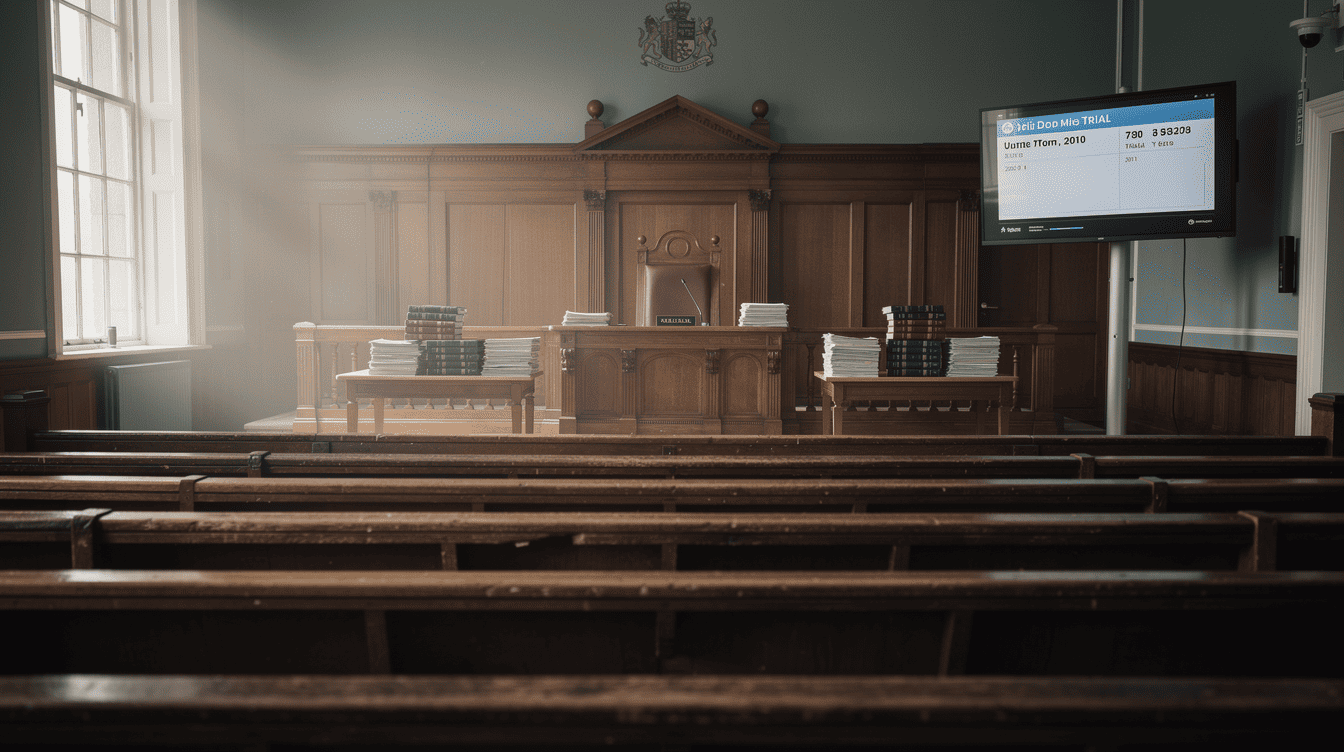
The armed forces cannot sustain combat for more than a week. The justice system cannot deliver a verdict within five years. The first is a crisis of ammunition. The second is a crisis of something older: the state's basic capacity to identify a crime, charge a suspect, try them, and manage them afterwards. Every stage of that process is now failing every stage after it. And the system has found a use for what capacity it has left.
Nearly 80,000 criminal cases are waiting to be heard in the Crown Courts, a number set to rise to 100,000 by 2028. The backlog figure still understates the true scale of failure. It only counts the cases still in the system. The larger category is cases that never made it there.
Charge rates have declined across multiple offence categories over the past decade. Forces under workload pressure triage out lower-priority crimes. "No further action" is applied more readily. Serious and complex investigations require time and specialist expertise. Both are constrained. The Serious Fraud Office did not conclude a single major case in 2024. Economic crime, by and large, is not being prosecuted.
The grooming gang cases are the most sombre version of the same pattern, and they predate the current crisis by decades. The Rotherham and Rochdale inquiries did not find a system overwhelmed by too many cases. They found a system which refused to treat the cases as cases at all. Police reluctance to pursue allegations, institutional hesitation, evidence accumulated and then not used: known offenders not prosecuted, victims not protected.
This is not backlog. It is a prior question: whether the system was willing to act. The answer, across those towns, across those years, was no. None of the grooming gang offences were ever prosecuted as racially or religiously aggravated, despite extensive evidence ethnicity and religious contempt for victims shaped the offending. The institutional conditions which produced that failure have not been structurally reformed.
The Prosecution Dumpster Fire
The Crown Prosecution Service sits between police investigation and the courts. It is the system's pressure valve, and the valve is failing.
Substantial cuts in spending and staff were made in the early 2010s. Slow increases after Covid have not prevented spiralling backlogs. CPS case preparation timescales have lengthened. Evidential thresholds have risen, not because standards improved but because capacity shrank and risk-aversion grew. Weaker, later, more attenuated cases enter the court pipeline. Some are already compromised before they arrive.
The criminal defence bar tells the same story from the other side.
Legal aid rates were suppressed over a decade to below the point at which a junior lawyer could sustain a career in criminal law. The 2022 barristers' strike was not an external shock. It was the profession's response to deliberate, sustained underfunding. The system spent years making criminal law financially unviable, then expressed surprise when there were not enough criminal lawyers.
A Queue That Cannot Clear
The Crown Court open caseload is 77% higher than at the end of 2019. The Ministry of Justice set a target to reduce it to 53,000 by March 2025. The backlog is higher than when the target was set. The government has not set a new one.
Courts are processing fewer cases per day than before the pandemic, even though average case complexity has fallen since 2016. More resources, lower output. The explanation lies in interlocking shortages across every component. As the Law Society put it:
Decades of underinvestment by successive governments have caused restrictions on sitting days, a chronic shortage of judges, court staff, prosecuting and defence lawyers, and court rooms in serious disrepair. Victims, witnesses and defendants are being denied swift and fair justice with cases being listed in 2030.
Courtrooms sit idle not because there are no cases but because there are no lawyers to fill them. The proportion of ineffective trials increased from 16% in 2019 to 27% in 2023: witness unavailability, poor case preparation, over-listing, prisoner transport services failing to get defendants to court on time. Labour backbenchers have pointed out around 130,000 sitting days are available but are being restricted by 20,000 a year, an idle-capacity problem the government has not explained.
The backlog contains 13,238 sexual offence cases. Each represents a person who reported a crime, gave a statement, identified a perpetrator, and was told to wait. The Victims' Commissioner found delays caused significant physical and mental health deterioration, with some victims turning to drugs, alcohol, or self-harm, and some attempting suicide. Repeated adjournments forced victims to relive their trauma. Many withdraw before the trial date arrives. The system records this as attrition. The person accused records it as a result.
A Doom Loop Nobody Designed
The prisons are not approaching capacity. They are at it, or beyond it. In the twelve months to December 2025, there were 394 deaths in prison custody, a 15% increase on the previous year and the highest number ever recorded. Seven were murders, the highest count in a decade. In the twelve months to March 2025 the death toll reached 399, a 37% increase, with the rate rising from 3.3 to 4.6 deaths per 1,000 prisoners. Self-harm incidents rose 11% to 891 per 1,000 prisoners. The Chief Inspector of Prisons found despite the increases, work to identify and address root causes often lacked any real grip from leaders in the riskiest establishments.
The government has been running emergency early release schemes to prevent the estate from rupturing entirely.
A prison population released early does not disappear.
It moves to the Probation Service.
The Probation Service met 7 of its 27 targets. It conducted adequate risk assessments in roughly 28% of cases. In the period under review, 770 people under active supervision committed serious further offences. These are not people the system failed to catch. They are people it was actively managing when they reoffended. The service was part-privatised under the Transforming Rehabilitation programme, sold to private operators on the theory market incentives would improve outcomes. Serious further offences rose. It was renationalised as yet another "disastrous" idea. Institutional continuity was lost in both directions.
Each of those 770 serious further offences generated new police work, new CPS decisions, new court listings, new custodial sentences, adding to the queue, increasing prison pressure, triggering more early releases, returning more people to a service already failing to supervise the ones it had. The loop closes. It keeps closing.
Sentencing is increasingly a matter of capacity management. Judicial awareness of prison overcrowding bears on the use of custodial sentences, and the emergency early release schemes have decoupled the sentence handed down from the sentence actually served. The deterrent and punitive signals in the sentencing framework are being eroded not by policy but by the physical impossibility of incarcerating everyone the courts have decided should be incarcerated. The system maintains the form of justice while the substance evaporates behind the paperwork.
The System Finds a Use for Its Remaining Capacity
A justice system running at minimum capacity does not abandon all enforcement equally. It makes choices. The pattern of those choices is instructive.
In 2023, there were 12,183 arrests under the Communications Act and the Malicious Communications Act, an average of 33 per day. At least 30 people are arrested each day for "grossly offensive" speech. These are not terrorists or serious organised criminals. They are people who posted things online.
Following the Southport child stabbings in July 2024, the government moved swiftly. Lucy Connolly, a Northampton childminder, posted a tweet on the night of the attacks stating she did not care if hotels housing migrants were set on fire. She received 31 months for stirring up racial hatred, a sentence longer than handed to Philip Prescott, who was physically present at the Southport riots and threw missiles at police. Tyler Kay received 38 months for copying and pasting Connolly's tweet to 127 followers. Julie Sweeney, 53, a woman with no previous convictions who was her husband's primary carer, received 15 months for posting a mosque should be "blown up with the adults in it" on a community Facebook group.
Prosecutions for stirring up racial hatred require the personal sign-off of the Attorney General. Lord Hermer, an avowed ideologue for Searchlight magazine, approved Connolly's prosecution whilst declining to refer to the Court of Appeal the sentences of a rapist, a paedophile, and a terrorist fundraiser, each of whom received shorter custodial sentences than she did. When challenged on the pattern, Hermer told the BBC the claims of two-tier justice were "frankly disgusting" and "offensive" to police, prosecutors, and the courts.
Which is, coincidentally, how the British public would describe Hermer's behaviour towards them.
The Hamit Coskun case sharpens the picture. Coskun, a Kurdish-Armenian asylum seeker, burned a Quran outside the Turkish consulate in London in February 2024 as a protest against Erdoğan. He was convicted of a religiously aggravated public order offence.
The man who attacked him with a knife on seeing the burning was spared jail.
Coskun's conviction was overturned on appeal, his lawyers backed by the National Secular Society and the Free Speech Union arguing the prosecution amounted to blasphemy law by the back door. The CPS appealed the acquittal to the High Court, arguing anyone not distressed by the burning of a Quran is not "right-minded" (read that again a few times). The man who tried to stab Coskun is not in prison.
Jamie Michael, a former Royal Marine from south Wales, was arrested after posting a Facebook video following Southport in which he called for a public meeting to discuss the threat posed by illegal migration and the need for security at parks and schools. He was held in custody for 17 days. A jury acquitted him in 17 minutes. There are no doubt many Jamie Michaels the public never hears about.
A system that cannot try rape cases within four years, cannot prosecute fraud at all, and allowed industrial-scale child sexual exploitation to go unpunished for decades, and then finds the resources to pursue a childminder for a tweet and a Kurdish asylum seeker for blasphemy, is not operating on a principle of law. It is operating on a principle of political priority.
Adjusting the Constitution to Fit the Failure
The government's primary legislative response is the horrific Courts and Tribunals Bill, introduced in February 2026 by high IQ scholar David Lammy. Its central provision: jury trials for defendants facing custodial sentences of up to three years will be removed. New "swift courts" will hear these cases with a judge sitting alone, estimated to run 20% faster than jury trials.
The Criminal Bar Association found 88.5% of its members oppose it. The Institute for Government warned the approach could make England and Wales an international outlier. The bill goes beyond the recommendations of Sir Brian Leveson's 2025 review, which suggested some lower-level cases be heard by a judge sitting with magistrates. The government went further.
The justice secretary and courts minister have presented the reforms not only as implementing Leveson's report, but as the only option to prevent the collapse of criminal courts and as an indivisible package that can only be adopted wholesale. Both propositions can be contested. Critics argue the plan changes the trial process rather than addressing the causes of the backlog. Reopen unused courts. Invest in legal aid. Recruit more judges. All of these address causes. None of them remove ancient rights.
There is a specific concern about race. Lammy, in his own 2017 review of racial equality in the criminal justice system, found juries narrow rather than exacerbate racial disparities in verdicts. Judges skew heavily towards their 50s, skew male, skew white, and are all middle class – proportionate to the country's demography. Removing community participation from verdicts in cases where defendants are already statistically disadvantaged is not an administrative adjustment. Lammy has not explained how his 2017 findings square with his 2026 proposals, if he could spell them. A November 2025 YouGov poll found 54% of the public would prefer a jury to decide the verdict if they were accused of a crime. The bill proceeds regardless.
The Lord Chancellor has acknowledged in Parliament there comes a point at which additional money cannot buy the ability to go faster, that you cannot simply sit your way out of the problem. She is correct. The system has been hollowed so comprehensively that the infrastructure of justice cannot be rebuilt within a parliamentary term. So the constitution is being adjusted to fit the limits of the system.
Trial by jury in England can be traced to the Magna Carta of 1215. The English Bill of Rights in 1689 further entrenched it as a safeguard against the Crown. As the Empire expanded, the jury system travelled with it, shaping judicial systems in the United States, Canada, Australia, India, and parts of Africa and the Caribbean. Its purpose is to interpose the community between state power and the individual, to force the state to make its case to people with no professional interest in the outcome, drawn from every background, every experience, every part of society. Eight centuries of constitutional development, adjusted downward because the Ministry of Justice ran out of sitting days.
The system still produces verdicts. It no longer produces justice on time. And it has found other uses for the time it has left.
- What was promised: a justice system that protects the public, tries the guilty, and treats the law equally
- What exists: 80,000 cases unheard, grooming gangs unpunished, and a childminder jailed longer than the man who threw bricks at police
- What happens when they meet: the constitution gets rewritten to fit the failure
Tomorrow: Queen Elizabeth Hospital in King's Lynn is held up by 56 areas of metal propping. The NHS maintenance backlog reached £15.9 billion last year — up 15.7% in twelve months. £3.5 billion of it is classified as catastrophic risk. The buildings are telling you what the dashboards will not.