What This Clown Parliament Has In Store For 2026
Over three thousand Bills clogging the arteries of British democracy—and most of them deserve to die there. This doesn't even cover the latest stupidity, only what's on the books of Westminster. Starmer has already caved on EU travel, Chagos, the military, Northern Ireland, and more.


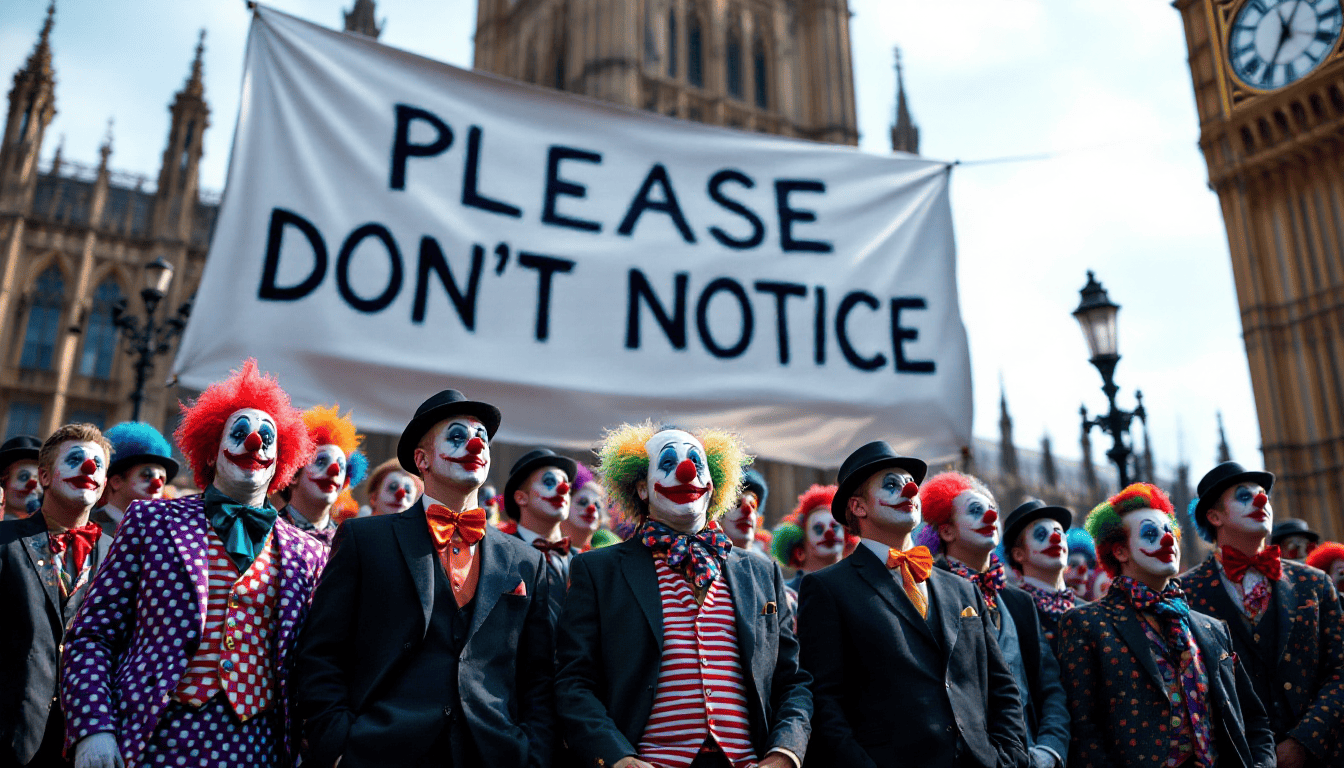
Somewhere in the bowels of Westminster, a clerk is drowning. Not in water, but in paper—or rather, in the digital equivalent: over three thousand pieces of proposed legislation awaiting parliamentary attention. This is what your elected representatives have planned for 2026. This is what they want to spend their time on whilst the NHS crumbles, the borders leak, and the economy flatlines.
Parliament speaks its mind and will in legislation. And if this is anything to go by, it has no mind of note, and if this is their will, God help us. Out of touch would be a polite way to put it. Staggeringly idiotic, mindlessly useless, vanity-obsessed would be more accurate. If this is our collective mind, we all deserve to be in special needs class. An uncomfortable ugly truth raises its head when one scrutinises OurDemocracy™ – it is a panoply of women of a certain age and weak "men" who believe their life mission is to "manage" the lives of everyone else as they grow increasingly enraged at the state of their country. The alternative would be actually doing something about it.
Let us begin with what Labour's new Britain has in store.
Kim Leadbeater wants to help you die. Her Terminally Ill Adults (End of Life) Bill has raced through Parliament at a speed usually reserved for emergency counter-terrorism measures—certainly faster than any attempt to fix social care or build houses. Diana Johnson wants more abortions, submitting both the Abortion Bill and the Reproductive Health (Access to Terminations) Bill. Lloyd Russell-Moyle wants to criminalise conversations about sexuality with the Conversion Practices (Prohibition) Bill. Wes Streeting, the Health Secretary himself, is coming for your vapes with the Tobacco and Vapes Bill.
The climate zealots are busy. Siân Berry (Green, Brighton Pavilion) offers the Clean Air (Human Rights) Bill—yes, a legal right to breathe clean air, enforceable in courts. Carla Denyer (Green, Bristol Central) wants to shut down North Sea oil and gas with her Energy and Employment Rights Bill. Ellie Chowns (Green, North Herefordshire) brings the Carbon Emissions from Buildings (Net Zero) Bill, because what homeowners really need is more regulation.
The Liberal Democrats, drunk on their own irrelevance, submit the UK-EU Customs Union (Duty to Negotiate) Bill from Dr Al Pinkerton—Brexit reversal through the back door. James MacCleary wants free movement for the young with his Youth Mobility Scheme (EU Countries) Bill. Sarah Olney demands we ban night flights with the Airports (Prohibition of Night Flights) Bill and overthrow the electoral system with the Elections (Proportional Representation) Bill.
The Palestine obsessives have been prolific. Richard Burgon (Labour) submits the International Court of Justice Advisory Opinion on Policies and Practices of Israel (Sanctions and Other Measures) Bill and the Israel Arms Trade (Prohibition) Bill. Jeremy Corbyn—now an Independent, ejected from the party he once led—brings the Gaza (Independent Public Inquiry) Bill. Layla Moran has submitted three separate Palestine Statehood (Recognition) Bills, as if Parliament hadn't heard her the first two times.
And then there is the trivia. Sarah Dyke (Liberal Democrat, appropriately named) wants to regulate reindeer with the Reindeer (Licensing for Exhibition) Bill. Anneliese Midgley (Labour) has identified Britain's real crisis: letterboxes, with her Letter Boxes (Positioning) Bill mandating compliance with Standard BS EN 13724:2013. Joe Morris (Labour) wants a register of "iconic trees." Peter Dowd (Labour) wants 24-hour staffing at every multi-storey car park in Britain.
Three Labour MPs have submitted four separate Bills to regulate fireworks. Someone in Cheltenham wants to repeal section 83 of the Cheltenham Improvement Act 1852. A Conservative backbencher wants to bring back hanging. Another wants a Margaret Thatcher Day. A third has submitted 142 Bills, including three about bat habitats and one demanding we classify fruit and vegetables.
This is your Parliament. This is 2026.
The Professional Time-Wasters: A Rogues' Gallery
Every parliament has its backbench eccentrics, but some MPs have elevated legislative spam to an art form. At the pinnacle stand three Conservative MPs whose combined output accounts for well over two hundred separate Bills: Sir Christopher Chope (Christchurch), Peter Bone (Wellingborough), and Philip Hollobone (Kettering).
Chope is responsible for 142 Bills—more than many parliaments produce in their entirety. His obsessions are varied but recurring: mobile homes (at least seven separate Bills), bats (three Bills to deregulate bat habitats), the BBC (privatise it, decriminalise the licence fee for over-75s, or just abolish it entirely), and an extensive series of attempts to exempt things from VAT. The Exemption from Value Added Tax (Public Electric Vehicle Charging Points) Bill sits alongside the Exemption from Value Added Tax (Listed Places of Worship) Bill and the Children's Clothing (Value Added Tax) Bill in a portfolio demonstrating either a deep commitment to tax reform or an inability to accept legislative defeat.
His more exotic offerings include the Anxiety (Environmental Concerns) Bill, the Anxiety in Schools (Environmental Concerns) Bill—presumably for when the first didn't cover enough anxious people—the Coastal Path (Definition) Bill, and the Fruit and Vegetables (Classification) Bill. One shudders to imagine the parliamentary time consumed debating whether a tomato is legally a fruit.
Bone, with 110 Bills to his name, prefers grander gestures. His legislative legacy includes the June Bank Holiday (Creation) Bill, the Margaret Thatcher Day Bill, the BBC Licence Fee (Abolition) Bill, the Electoral Commission (Abolition) Bill, and—in a touching display of self-regard—the Prime Minister (Accountability to House of Commons) Bill. He has submitted Bills concerning his own constituency's bypass (the Isham Bypass Bill), his local clinical commissioning groups (the Northamptonshire Clinical Commissioning Groups Merger Bill), and urgent care facilities (the North Northamptonshire Urgent Care Facilities Bill). Local politics elevated to national legislation.
But for sheer concentrated eccentricity, Philip Hollobone of Kettering deserves special mention. His 29 Bills include the Capital Punishment Bill (bringing back hanging in the twenty-first century), the Face Coverings (Prohibition) Bill and its sequel the Face Coverings (Regulation) Bill, the National Service Bill (conscription redux), and the Prisoners (Completion of Custodial Sentences) Bill—because apparently early release is the real crime. His Equality and Diversity (Reform) Bill presumably reforms equality and diversity in a direction his colleagues in the Conservative Party might prefer not to advertise too loudly.
These three men, between them, have produced more legislation than most European countries manage in a decade. None of it will pass. None of it is meant to. It exists purely to clog the system, generate local headlines, and provide the illusion of activity.
Reindeer, Letterboxes, and Other National Emergencies
Some Bills address problems so obscure, so magnificently niche, one wonders how the sponsoring MP discovered them at all. Liberal Democrat Sarah Dyke of Glastonbury and Somerton brings us the Reindeer (Licensing for Exhibition) Bill, which seeks to clarify whether domesticated reindeer are "wild animals" for the purposes of the Zoo Licensing Act 1981. The nation breathes easier.
Meanwhile, Labour's Anneliese Midgley (Knowsley) has identified Britain's real crisis: letterboxes. Her Letter Boxes (Positioning) Bill would amend building regulations to require letterboxes in new buildings to comply with Standard BS EN 13724:2013. This is presumably vital legislation, though one struggles to identify the epidemic of poorly-positioned letterboxes afflicting the nation. Her Conservative colleague Vicky Ford has approached from the opposite direction with the Low-level Letter Boxes (Prohibition) Bill. Between them, they have the letterbox question thoroughly covered.
The fireworks lobby—if such a thing exists—must be trembling. Yasmin Qureshi (Labour, Bolton South and Walkden) wants to regulate firework noise levels in her Fireworks (Noise Control etc) Bill, citing the welfare of veterans, neurodivergent people, and animals. Sarah Owen (Labour, Luton North) has submitted both a Fireworks Bill and a Misuse of Fireworks Bill. Judith Cummins (Labour, Bradford South) adds the Fireworks (Noise Limits) Bill. Three MPs, four Bills, one bonfire night. The Labour Party's legislative priorities laid bare. Lonely single women of a certain age concerned about their pets, presumably.
Then there's Joe Morris (Labour, Hexham) and his Iconic Trees and Nature Education Bill, which would create a register of "iconic trees" and designate them for protection. One imagines civil servants solemnly assessing the iconicity of oaks nationwide. Labour's Peter Dowd (Bootle) contributes the Multi-Storey Car Parks (Safety) Bill, which would mandate 24-hour staffing of multi-storey car parks and increase the minimum height of guarding. The economics of this—full-time staff at every car park in Britain—appear not to have troubled him.
Olivia Bailey (Labour, Reading West and Mid Berkshire) contributes the A34 Slip Road Safety (East Ilsley and Beedon) Bill—yes, a Bill about specific slip roads on a specific stretch of the A34. The Cheltenham Borough Council (Markets) Bill seeks to repeal section 83 of the Cheltenham Improvement Act 1852. One hundred and seventy-three years later, Cheltenham's market regulations apparently require urgent parliamentary attention.
The Lib Dems: A Party Daydreaming in Public
The Liberal Democrats, perhaps sensing they will never wield real power, have used the parliamentary order paper as a wish-list. Tim Farron (Westmorland and Lonsdale) leads the charge with 19 Bills, including the Water Regulation Bill (abolishing Ofwat and creating a "Clean Water Authority", based), the Thames Water (Public Benefit Corporation) Bill (nationalisation in all but name, not based), and the Coal Extraction and Use Bill (banning coal, presumably to the distress of Britain's zero remaining coal miners).
Dr Al Pinkerton of Surrey Heath submits the UK-EU Customs Union (Duty to Negotiate) Bill—a straightforward attempt to reverse Brexit through the back door. His colleague James MacCleary (Lewes) offers the Youth Mobility Scheme (EU Countries) Bill, whilst the Festivals Bill from Max Wilkinson (Cheltenham) would require the government to negotiate visa waivers for musicians. The European question, relitigated one obscure Bill at a time.
Layla Moran (Oxford West and Abingdon), with 13 Bills, contributes three separate Palestine Statehood (Recognition) Bills—numbers one, two, and three—as if repetition might accomplish what persuasion could not. Daisy Cooper (St Albans) offers the Chalk Streams (Sewerage Investment) Bill, requiring water companies to prioritise areas with chalk streams when investing in sewerage systems. The chalk stream lobby may celebrate; everyone else may wonder whether this is really a matter for primary legislation.
Sarah Olney (Richmond Park) brings the Airports (Prohibition of Night Flights) Bill, the Elections (Proportional Representation) Bill, and the Victims of Rape and Serious Sexual Offences (Free Access to Sentencing Remarks) Bill. Ben Maguire (North Cornwall) offers the Short-term Lets (Planning Permission) Bill—because what Airbnb really needs is more planning bureaucracy—and the Planning and Development (Community Infrastructure) Bill. Munira Wilson (Twickenham) submits the Special Educational Needs and Disabilities Education (Profit Cap) Bill, capping profits at eight per cent for SEND providers, and the Poly and Perfluorinated Alkyl Substances (Guidance) Bill, concerning chemicals most voters have never heard of.
Christine Jardine (Edinburgh West) contributes 12 Bills, including the Non-gender-specific Passports Bill, the Gender-based Pricing (Prohibition) Bill, the Bereavement Support (Children and Young People) Bill, and the Online Abuse (Reporting) Bill. The Liberal Democrat conviction is clear: there is no aspect of human existence too small for Westminster to regulate.
Labour's Progressive Dystopia
The Labour government's legislative programme reveals its priorities with uncomfortable clarity. Death, abortion, gender, climate. These are the causes animating the governing party's backbenches.
At the apex sits Kim Leadbeater's Terminally Ill Adults (End of Life) Bill—the mercy killing NHS-saving legislation whose rapid advancement through Parliament has attracted controversy from medical professionals, disability advocates, and religious groups alike. Whatever one's view on the principle, the speed of the Bill's progress contrasts sharply with the glacial pace of, say, immigration reform or infrastructure investment. The message is unmistakable: helping people die is a higher priority than helping them live.
The abortion lobby has not been idle. Diana Johnson (Labour, Hull North) submits both the Abortion Bill and the Reproductive Health (Access to Terminations) Bill, seeking to expand access. From the Lords comes the Abortion Bill [HL] from Baroness Barker (Liberal Democrat). Labour's Dr Rupa Huq contributes the Demonstrations (Abortion Clinics) Bill, seeking buffer zones around clinics—which Parliament has since enacted. The direction of travel is unmistakable: more abortion, fewer obstacles, less debate.
Gender ideology finds its champions too. Lloyd Russell-Moyle (Labour, Brighton Kemptown) brings the Conversion Practices (Prohibition) Bill, which would criminalise attempts to help people accept their biological sex. Christine Jardine (Liberal Democrat, Edinburgh West) offers the Non-gender-specific Passports Bill and the Gender-based Pricing (Prohibition) Bill. From the Lords, Baroness Barker submits the Gender Recognition Act 2004 (Amendment) Bill [HL], seeking to make gender self-identification easier. Baroness Burt of Solihull (Liberal Democrat) adds the Conversion Therapy Prohibition (Sexual Orientation and Gender Identity) Bill [HL].
The climate agenda generates its own legislative avalanche. The Green Party's four MPs punch well above their weight: Siân Berry (Brighton Pavilion) submits the Clean Air (Human Rights) Bill, which would establish a legal "right to breathe clean air" enforceable in courts; Carla Denyer (Bristol Central) brings the Energy and Employment Rights Bill, which would set timelines for "phasing out" UK oil and gas production and mandate "sectoral collective bargaining" in the energy industry; Ellie Chowns (North Herefordshire) contributes the Carbon Emissions from Buildings (Net Zero) Bill and the Water (Agricultural Pollution) Bill; Adrian Ramsay (Waveney Valley) adds the Nature-based Solutions (Water and Flooding) Bill. Labour's Olivia Blake submits the Climate and Ecology (No. 2) Bill. Former Green leader Caroline Lucas (now departed from the Commons) left behind the Climate and Ecology Bill and the Decarbonisation and Economic Strategy Bill.
And the favourite of our own Will Turing, who spotted Conservative Helen Grant's hilarious gambit, the Banknote Diversity Bill:
A Bill to require the Bank of England to meet standards for the representation of ethnic minority persons on banknotes; and for connected purposes.
This is what "progress" looks like: death on demand, abortion on demand, gender self-identification on demand, and the systematic destruction of the energy industry. All whilst the trains don't run and the hospitals overflow.
The Palestine Obsessives
Few topics consume more backbench energy than the Middle East. British parliamentarians, unable to fix potholes in their own constituencies, have decided they hold the key to peace between the Jordan and the Mediterranean.
Richard Burgon (Labour, Leeds East) submits the International Court of Justice Advisory Opinion on Policies and Practices of Israel (Sanctions and Other Measures) Bill—a title so unwieldy it seems designed to obscure its purpose. He follows this with the Israel Arms Trade (Prohibition) Bill and, for good measure, the Members of Parliament (Oil and Gas Companies) Bill, apparently connecting fossil fuels to Zionism in ways not immediately apparent. He also offers the Climate Finance Fund (Fossil Fuels and Pollution) Bill, because why address one obsession when you can combine two?
Jeremy Corbyn—now an Independent MP for Islington North, ejected from the party he once led—contributes the Gaza (Independent Public Inquiry) Bill, seeking an inquiry into "UK involvement in Israeli military operations." His fellow traveller comrade Zarah Sultana (Independent) adds the Arms Trade (Inquiry and Suspension) Bill.
Layla Moran's three Palestine Statehood (Recognition) Bills have already been noted—numbered one, two, and three, submitted with the persistence of a child asking "are we there yet?" From the Lords comes Baroness Northover's Palestine Statehood (Recognition) Bill [HL]. Independent MP Shockat Adam adds his own Palestine Statehood (Recognition) (No. 2) Bill.
One might think the Foreign Office has a view on Middle Eastern diplomacy, but Parliament's freelancers are undeterred. Five Bills to recognise Palestine. Multiple Bills to ban arms sales. An inquiry into military cooperation. All whilst British foreign policy is actually made elsewhere, by people these backbenchers have no power to influence.
Conservatives for Big Government
The Conservative Party's legislative offerings reveal how thoroughly the party has abandoned free-market principles. These are supposed to be the heirs of Thatcher, the defenders of limited government, the champions of individual liberty. Look upon their works and despair.
Michael Gove (Surrey Heath)—yes, that Michael Gove—sponsored 15 Bills during his ministerial career, including the Levelling-up and Regeneration Act 2023, which expanded planning bureaucracy to eye-watering complexity, and the Economic Activity of Public Bodies (Overseas Matters) Bill, which tells councils what they may and may not boycott. Limited government, this is not.
Andrew Rosindell (Romford), with 17 Bills, offers the Transport for London (Extension of Concessions) Bill—extending free travel subsidies—alongside the Public Festivals, Holidays and Commemorations Bill and two separate Bills demanding jubilee celebrations for the late Queen. He also brings us the Public Houses (Electrical Safety) Bill, mandating electrical testing in pubs. Bob Blackman (Conservative, Harrow East) submits the Sale of Tobacco (Licensing) Bill, expanding the regulatory state, and the Homelessness Prevention Bill, expanding the welfare state.
Priti Patel (Witham) has 12 Bills to her name, including the British Indian Ocean Territory (Sovereignty and Constitutional Arrangements) Bill and the Economic Crime and Corporate Transparency Act 2023. Karen Bradley (Staffordshire Moorlands) contributed 10 Bills, including the Company Transparency (Carbon in Supply Chains) Bill—a Conservative MP demanding companies report their carbon footprints. Greg Clark (Tunbridge Wells) sponsored 10 Bills including the Protection from Sex-based Harassment in Public Act 2023.
The Conservatives have also produced Bills to regulate managing agents, license animal shelters, cap profits for SEND education providers, impose minimum staffing at car parks, and the sale of hunting trophies. Dr Andrew Murrison (Conservative, South West Wiltshire) submits both the Leases (Integrated Retirement Communities) Bill and the Waste Incinerators Bill. Dame Caroline Dinenage (Conservative, Gosport) brings the Human Fertilisation and Embryology (Regulation) Bill.
The party of Thatcher has become the party of micro-management. They have learned nothing and forgotten nothing.
The House of Lords: Unelected and Unaccountable
The upper house contributes 570 Bills to the parliamentary pile—nearly a fifth of the total. Some are serious attempts at legislation; many are vanity projects from people who need never face voters.
Lord Bird (Crossbench)—the Big Issue founder—submits the Ministry for Poverty Prevention Bill [HL], because what the Cabinet really needs is another department. His Wellbeing of Future Generations Bill [HL] would require the government to consider the wellbeing of people not yet born when making policy decisions—a noble sentiment, perhaps, but one wonders how it would be enforced. Who speaks for the unborn? Lord Bird, apparently.
Lord Moylan (Conservative) brings the Complications from Abortions (Annual Report) Bill [HL] and the Foetal Sentience Committee Bill [HL], seeking to establish parliamentary scrutiny of when foetuses can feel pain. Baroness O'Loan (Crossbench) offers the Abortion (Gestational Time Limit Reduction) Bill [HL]. Baroness Eaton (Conservative) adds the At-Home Early Medical Abortion (Review) Bill [HL]. The Lords remain a battleground for the abortion debate—the one place in Parliament where pro-life voices still find expression.
Do we need a slew of bills to tell us we need to ban evil?
From Lord Holmes (Conservative) comes the Artificial Intelligence (Regulation) Bill [HL]. Lord Hogan-Howe—the former Metropolitan Police Commissioner—submits the Regulation of Cycling Bill [HL], seeking to impose insurance requirements and registration on cyclists. Lord Clement-Jones (Liberal Democrat) offers the Public Authority Algorithmic and Automated Decision-Making Systems Bill [HL], whose title alone suggests years of committee deliberation.
Baroness Bennett of Manor Castle (Green Party) brings the Consumer Products (Control of Biocides) Bill [HL] and the House of Lords (Elections and Reform) Bill [HL]. Lord Wigley (Plaid Cymru) submits the Crown Estate (Wales) Bill [HL], the Government of Wales (Devolved Powers) Bill [HL], and the Learning Disabilities (Access to Services) Bill [HL]. Lord Lucas (Conservative) offers the Permitted Development Rights (Extension) Bill [HL] and, intriguingly, the Equality (Titles) Bill [HL] and the Hereditary Peerages and Baronetcies (Equality of Inheritance) Bill [HL]—a hereditary peer concerned about equality of inheritance.
An unelected chamber, legislating without mandate or accountability, on matters ranging from the profound to the preposterous. And Labour wants to reform it by... adding more appointed members.
The SNP: Legislating for a Country They Don't Govern
With 104 Bills, the Scottish National Party contributes disproportionately to the parliamentary backlog. These are MPs who want Scotland to leave the United Kingdom, spending their time proposing laws for a Parliament they wish didn't exist.
Chris Stephens (Glasgow South West) leads with 20 Bills, including the Food Poverty Strategy Bill, the Social Security Benefits (Healthy Eating) Bill, the Evictions (Universal Credit) Bill, the Asylum Seekers (Permission to Work) Bill, the Asylum Seekers (Accommodation Eviction Procedures) Bill, and the Housing Standards (Refugees and Asylum Seekers) Bill. His focus on welfare expansion is relentless—and would be better directed at Holyrood, where the SNP actually governs.
Owen Thompson (Midlothian) contributes the Nuclear Veterans (Compensation) Bill, the Veterans (Non-custodial Sentences) Bill, the Transport of Nuclear Weapons Bill, the Ministerial Interests (Public Appointments) Bill, and the War Pension Scheme and Armed Forces Compensation Scheme (Public Inquiry) Bill. Stephen Flynn brings the Women's State Pension Age (Ombudsman Report and Compensation Scheme) Bill. Alan Brown offers the State Pension Age (Compensation) Bill and the Electricity Grid (Review) Bill. Kirsty Blackman (Aberdeen North) submits the Child Poverty Strategy (Removal of Two Child Limit) Bill.
The SNP also contributes the Supervised Drug Consumption Facilities Bill from Alison Thewliss, the Devolution (Immigration) (Scotland) Bill from Stephen Gethins, the Broadcasting (Listed Sporting Events) (Scotland) Bill from Alba's Kenny MacAskill, and the Scotland (Self-Determination) Bill from Alba's Neale Hanvey.
Scotland's nationalist MPs, elected to represent Scottish constituencies at Westminster, spend their time either demanding powers be transferred away from Westminster or proposing laws Westminster will never pass. The futility is the point.
The Nanny State Rides Again
A recurring obsession among MPs of all parties is protecting people from themselves—and protecting children from their parents' judgment.
Peter Bone's Child Safety (Cycle Helmets) Bill and Mark Pawsey's (Conservative) Road Safety (Cycle Helmets) Bill would mandate protective headgear. Former Liberal Democrat Annette Brooke submitted the Cycles (Protective Headgear for Children) Bill. Conservative Andrea Leadsom brings the Dangerous and Reckless Cycling (Offences) Bill. Lord Hogan-Howe wants to register and insure cyclists. Three parties, multiple Bills, one determination to regulate two-wheeled transport.
The safety agenda extends further. Chris Bloore (Labour, Redditch) brings the Schools (Allergy Safety) Bill, requiring allergy management policies and adrenaline auto-injectors in every school. Wes Streeting—the usurper—sponsors the Tobacco and Vapes Bill, continuing the war on adult choice. The Sugar in Food and Drinks (Targets, Labelling and Advertising) Bill from Geraint Davies (Labour) would regulate what manufacturers put in food and how they advertise it. Kerry McCarthy (Labour, obese) submits the Food Waste (Reduction) Bill, the Food Waste Bill, and the Animals (Recognition of Sentience) Bill.
Layla Moran's School Food Bill and School Toilets (Access During Lessons) Bill reveal the Liberal Democrat conviction Westminster should manage every aspect of school administration. Munira Wilson brings the Schools (Mental Health Professionals) (No. 2) Bill. Adam Dance (Liberal Democrat, Yeovil) offers the Neurodivergence (Screening and Teacher Training) Bill. Baroness Tyler of Enfield (Liberal Democrat) submits the Schools (Mental Health Professionals) Bill [HL] and the Schools (Mental Health and Wellbeing) Bill [HL] from the Lords.
The assumption underlying all these Bills is identical: parents cannot be trusted, teachers cannot be trusted, local authorities cannot be trusted. Only Parliament—infinite in wisdom, boundless in reach—can protect British citizens from the perils of unhelmeted cycling, sugary drinks, and unrestricted toilet access.
HR wants to ensure we've filled in all the forms. While the country burns.
The Zombie Bills
Some Bills in the parliamentary system date back decades, introduced by MPs who have since retired, lost their seats, or died. The database includes Bills from the Brown and Blair governments, Bills from the Coalition years, Bills from the Cameron-May-Johnson-Truss-Sunak Conservative era. They accumulate like sediment, never formally rejected, never properly debated, simply sitting there.
There are Bills from MPs no longer in Parliament: Alistair Darling (12 Bills), George Osborne (16 Bills), Nick Clegg (7 Bills), Theresa May (13 Bills). There are Bills from MPs who defected: Frank Field, who left Labour for independence. There are Bills from MPs who lost their seats in 2024's Conservative wipeout, their legislative legacies orphaned but not erased—Rishi Sunak still has 9 Bills on the books, Sajid Javid has 10, Chris Grayling has 10.
The European Union (Implications of Withdrawal) Bill [HL] from Lord Pearson of Rannoch—a UKIP peer—remains on the books. The EU Membership Bill [HL] from Lord Saatchi (Conservative) lingers. The European Union (Return of Contributions) Bill from Peter Bone awaits a debate it will never receive. Brexit has happened; the Bills remain.
The Mental Health Act 2007, sponsored by Lord Warner (Labour), sits in the database alongside the Life Peerages (Residency for Taxation Purposes) Bill [HL] from Lord Oakeshott of Seagrove Bay (Liberal Democrat). Legislation from 2007. Legislation from a Parliament five general elections ago. The system never truly forgets, and never truly cleans itself.
The Paralysis of Democracy
Three thousand Bills. Over 1,400 from the Conservative Party, 927 from Labour, 412 from the Liberal Democrats, 104 from the SNP, 73 from Crossbench peers, 28 from the Greens. Bills on reindeer and letterboxes, on iconic trees and firework noise limits, on Margaret Thatcher Day and the positioning of slip roads on the A34. Bills to bring back hanging and Bills to legalise cannabis. Bills to recognise Palestine five separate times and Bills to repeal the 1852 Cheltenham Improvement Act.
The sheer volume tells a story: a political class disconnected from governance, from administration, from the patient work of running a country. Instead of fixing what is broken—the NHS waiting lists, the immigration system, the housing shortage, the crumbling infrastructure—our representatives produce Bills. Bills are easy. Bills generate headlines. Bills demonstrate to constituents Something Is Being Done. They cost nothing to propose and less to ignore.
The result is a legislature stuffed with ambition and starved of achievement. The prolific Bill-producers—the Chopes and Bones and Hollobones—would doubtless argue they are raising important issues, holding government to account, representing their constituents' concerns. Perhaps so. But there is a difference between raising issues and governing, between gesture politics and actual policy. A parliament drowning in Bills is a parliament unable to prioritise, unable to focus, unable to accomplish much of anything.
Labour swept to power promising competence and delivery. Instead, its backbenchers submit Bills on fireworks and car park staffing whilst the government advances assisted dying and gender ideology. The Liberal Democrats dream of rejoining Europe one private member's Bill at a time. The Conservatives—supposedly the party of limited government—have bequeathed a legislative corpus of regulation, intervention, and state expansion. The SNP advances independence through procedural attrition. The Greens demand we dismantle the energy industry. And the Lords, unelected and unaccountable, add their own contributions to the pile.
This is your Parliament. This is what your representatives do with their time. These are the priorities of British democracy in 2026: death, abortion, Palestine, reindeer, letterboxes, and the eternal question of whether a tomato is legally a fruit.
And you wonder why nothing works.