With Advice Like This, Who Needs Enemies?
Britain was never forced to hand over the Chagos Islands. No fleet threatened it. No army compelled it. Its own advisers simply could not imagine saying "no" — they blame Trump and call their failure "realpolitik." This brain rot and cowardice apologism has to stop. These people need to be fired.

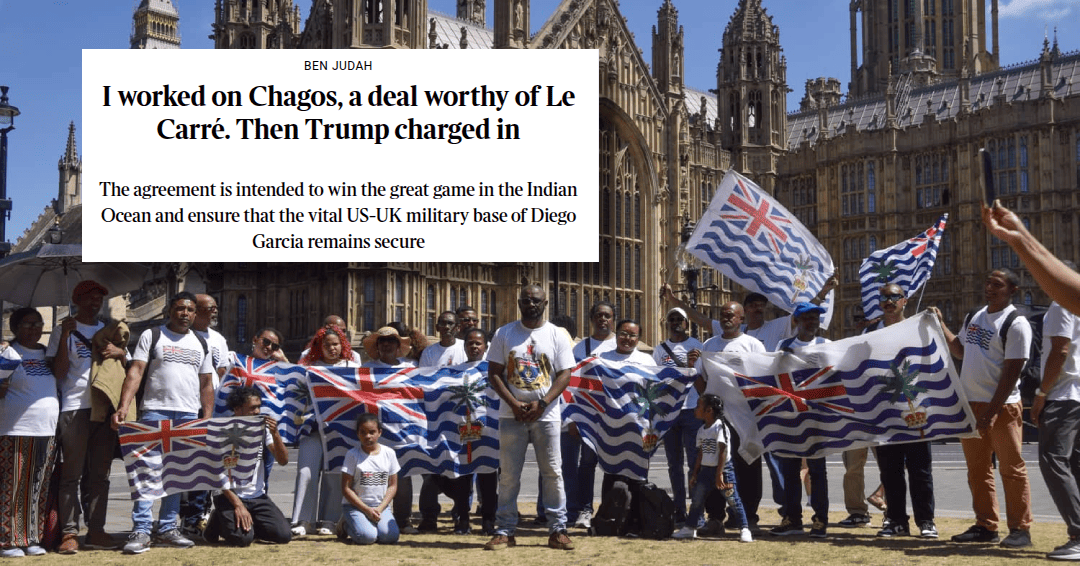
Ben Judah, until recently a special adviser to the utterly useless Foreign Secretary, has written what he believes to be a vindication of the Chagos surrender. His article in The Times, thick with le Carré references and insider mystique, presents itself as a hard-headed confession from inside the machinery of state. The classified logic. The geopolitical chess. The realpolitik too complex for a tweet.
Read it carefully and something altogether different emerges. Not strategic brilliance under pressure, but a confession of psychological incapacity. Every line contains a quiet admission dressed as justification. Every appeal to realpolitik rests on an assumption so fragile it collapses the moment you push against it.
The assumption is this: when the voluntary International Court of Justice disapproves of you, you must obey — even when no one on Earth can make you.
Judah never states this openly. He does not defend it. He does not seem to notice it is there. Yet his entire argument depends on it completely. Without it, the case for surrender evaporates. Britain was not outmanoeuvred, overpowered, blockaded, or besieged. It was advised to give in, by people who could not conceive of doing otherwise. Then it angered the one ally they needed for the deal by blocking use of their shared facilities.
This is not an attack on one man. Judah has come under fire from all the usual tedious apparatchiks for pointing out the uncomfortable truth. Our friends at The Spectator have made their displeasure about it quite clear. It's a call for him, and the others, to sober up.
There are tens of thousands of people in Whitehall, in think tanks, in international law faculties, and in the lobbies of Westminster who become contaminated by this line of thinking. Judah simply had the honesty — or the vanity — to write it down. The mindset is the target. The man is merely the messenger.
The Invisible Fleet Nobody Can Name
Judah's central fear is the ICJ. Britain's legal position was "collapsing internationally." A binding judgment loomed. "They were certain Britain would lose." Resupplying Diego Garcia would be "deemed unlawful." Enemies could "campaign against our suppliers." The base would become "more expensive and challenging to operate."
Take this slowly, because it reveals everything.
He is not claiming Britain and the United States would be physically unable to supply Diego Garcia. He is claiming they would face legal challenges, diplomatic pressure, and supplier hesitation. Contractors might get nervous. Third-party countries might face lobbying.
These are obstacles. They are not prohibitions.
The shift he performs — and it is the central sleight of hand — is the redefinition of "more difficult" as "impossible." One concerns discomfort. The other concerns capability. He treats them as identical. They are not.
The ICJ does not command navies. It does not ground aircraft. It does not interdict supply chains. It issues legal opinions, and those opinions acquire force only to the extent powerful states choose to comply. The United States itself withdrew from the Court's compulsory jurisdiction in 1986 after an adverse ruling in Nicaragua v. United States. It did not comply. Nothing happened.
So the devastating question — the one Judah never asks, because asking it demolishes his entire thesis — is this:
Who exactly was going to stop Britain and the United States from supplying the base?
Not rhetorically. Literally. Which navy? Which air force? Which enforcement mechanism?
There is no answer. Because none exists.
- Turkey holds Northern Cyprus despite decades of UN resolutions.
- China militarised artificial reefs in the South China Sea despite an explicit ruling by the Permanent Court of Arbitration.
- Russia held Crimea.
- The United States operates Guantánamo Bay on Cuban soil against Cuba's explicit objection.
In none of these cases did legal opinion produce operational impossibility. Power determined outcomes. Law did not.
Judah implicitly asks us to believe Britain is in a uniquely weak position — weaker than Turkey, weaker than China — unable to sustain a military posture on an atoll jointly operated with the most powerful military force in human history.
The proposition is absurd. Its absurdity is concealed only by the tone of insider gravity in which it is delivered.
Paying £35 Billion to Rent Your Own House
The material costs deserve their own autopsy. The nominal cost of leasing back Diego Garcia — a base Britain already controlled, on territory it already administered — is approximately £34.7 billion of tax funds over the 99-year term, per the Government Actuary's Department. The government prefers a "net present value" of £3.4 billion, conjured through Treasury discounting. Even on the lower figure, the taxpayer pays roughly £101 million per year for a century — in exchange for renting something it previously possessed for nothing.
This is as if a homeowner, upon receiving a solicitor's letter disputing their title, responded by handing the keys over and signing a 99-year lease to live in the spare bedroom. The legal letter did not compel the surrender. The homeowner simply could not tolerate the discomfort of being disputed.
The money is the symptom. The disease is the thinking.
Sovereignty Is Not a Line on a Map — It Is the Lock on the Door
Judah dismisses British sovereignty over the Chagos Archipelago as a "fiction" because the base is American-operated. This misunderstands sovereignty at the most fundamental level.
Sovereignty is not about who occupies every square metre. It is about who holds ultimate legal authority — who can grant access, deny access, impose conditions, revoke permissions. Once sovereignty transfers, those powers move permanently. The new sovereign may honour existing arrangements. Or it may not. Leases expire. Governments change. Geopolitical pressures shift.
Britain itself was expelled from Suez, from Aden, from Singapore, from dozens of positions once considered permanent. In every case, the loss began the same way: with the transfer of legal authority to a government whose long-term interests did not permanently coincide with Britain's.
The 99-year lease sounds reassuring in a press briefing. In strategic terms, it is a countdown. Every decade, every shift in Mauritian politics or Chinese economic influence creates a new pressure point, a new opportunity for renegotiation, a new demand. Mauritius has already signed a cooperation agreement with Moscow. It has growing economic ties to Beijing. The lease is not a guarantee. It is a slowly tightening dependency.
Control follows sovereignty over time. Always.
The American Tail Wagging the British Dog
Perhaps the most revealing passage is Judah's account of Kurt Campbell telling him:
The only way the United Kingdom can actually hurt the United States would be by not doing the deal.
Judah presents this as justification. It is actually an admission of subordinate positioning so complete it should alarm anyone who takes British sovereignty seriously. If Britain's primary strategic calculation is avoiding American displeasure, sovereignty has ceased to function as sovereignty. It has become delegated authority — valid only insofar as Washington approves.
And even on its own terms, the American position was incoherent. Trump criticised the deal, then approved it, then criticised it again within days. The State Department endorsed it; the President countermanded the endorsement via social media. Britain surrendered permanent sovereign authority to satisfy an American preference it could not even reliably identify.
Judah admits this himself, ruefully noting Britain
...felt it had a deal with Trump to proceed, only to be thrown off balance by one Truth Social post.
Sovereignty traded for a social media post reversed within the week. If le Carré had written it, his editor would have rejected it as implausible.
The Signal the World Received
What is entirely absent from Judah's framework is deterrence — the foundation upon which all strategic thinking rests. Deterrence shapes adversary expectations. Its credibility depends on demonstrated willingness to endure costs and hold positions under pressure.
When a state pre-emptively surrenders a strategic asset to avoid anticipated legal friction, it does not merely lose one position. It sends a signal to every future adversary, every future litigant, every diplomatic campaign: pressure works. File the case. Organise the General Assembly vote. Generate the headlines. Britain will fold.
Judah's article is, in effect, a public confirmation the playbook works. He has written, for the world to read, a detailed account of how legal and diplomatic pressure caused Britain to surrender territory of supreme military importance without a shot fired, without a ship deployed, without a single act of physical coercion.
The precedent extends to the Falklands, to Gibraltar, to the Sovereign Base Areas in Cyprus — every contested British overseas territory. If the governing logic is concession under legal discomfort, the only variable is timing. The Chagos precedent tells every claimant: do not bother with an invasion. File a case. Pass a resolution. Wait. Britain will do the rest to itself.
What "Realpolitik" Actually Means
Judah calls the deal realpolitik. The word has a specific meaning: statecraft driven by power realities and material interests, unencumbered by legal formalism or moral abstraction.
By this definition, the Chagos deal is the precise opposite of realpolitik. The entire justification rests on legal risk, diplomatic legitimacy, bureaucratic consensus, and fear of reputational consequences — exactly the abstractions realpolitik was designed to override.
A genuine realpolitik analysis would begin and end with a single observation: Britain and the United States can hold Diego Garcia, and no one on Earth can make them leave. Everything else — the advisory opinions, the General Assembly votes, the diplomatic noise — is friction. It is cost. It is not compulsion.
What Judah describes is not statecraft. It is reputational risk management inside an international legal framework. The difference between the two is the difference between a country with a future and a country managing its decline.
The Cage They Built Themselves
Strip away the classified references and the insider phrasing, and the article reads as a case study in learned limitation — the process by which a governing elite absorbs external constraints so deeply it ceases to recognise them as choices and begins treating them as physical laws.
Notice the language throughout. Passive voice dominates. Agency disappears. Britain does not decide; it reacts. It does not choose; it faces "all routes leading to a binding judgment." It does not act; it manages. At no point does Britain appear as an actor shaping events — only as a system managing constraints imposed by others. It is the philosophy of a teenage schoolgirl.
This is not the mindset of a sovereign nation. At best, it is the mindset of a mid-level systems administrator trying to avoid a service ticket.
And it is not confined to one adviser. Judah's article is valuable not for its conclusions, which are wrong, but for what it reveals about the culture producing them when one comes in touch with it. A foreign policy establishment where risk management has replaced strategic ambition. Where classified briefings produce not spine but vertigo. Where officials describe the surrender of sovereign territory over one of the world's most important military bases as "the best traditions of perfidious Albion" — apparently without embarrassment.
Judah himself proposed integrating overseas territories more closely with the United Kingdom. His colleagues thought him mad. He was sidelined to prison communications. The one man in the system with an expansionist impulse was treated as an eccentric. The system did not want expansion. It wanted contraction, conducted tidily, with legal cover and the appearance of cleverness.
Credit where credit is due. The boy done good here. If people like this think you're mad, you're ironically on the right track. Sheep don't tend to appreciate lions in the room.
Two Words the Establishment Cannot Bring Itself to Say
The entire strategic situation distils to a single exchange.
Judah's position: "It would all be declared illegal and nobody would approve."
The rebuttal: So what?
Restated for serious debate: illegality without enforcement does not alter physical reality. The ICJ can declare a base unlawful. It cannot make it disappear. Only power can do it. And no power on Earth was prepared to try.
Britain faced not a military threat but a diplomatic headache. Not an invading fleet but a legal opinion. Not coercion but disapproval. The entire mechanism of pressure was normative — it operated through reputation and moral sentiment — not material. It did not sink ships or ground bombers.
The proposition before the government was whether to sacrifice permanent sovereign control of irreplaceable strategic territory to avoid temporary discomfort in the domain of opinion.
The answer should have been obvious. It was not — because the people making it could no longer distinguish between discomfort and defeat.
The enabling legislation has not passed. The treaty is unratified. There is still time. But reversing the deal is the smaller challenge. The larger one is reversing the culture of learned surrender running through British foreign policy like a slow poison — the culture where advisory opinions are treated as orders, allied displeasure as prohibition, and legal friction as operational impossibility.
Britain does not need more advisers of the kind Judah represents — intelligent, articulate, internationally minded, and constitutionally unable to say no. It needs people willing to look at a legal opinion, assess the power realities behind it, and respond with the two words nobody in Whitehall dares to utter. Then the one-word full sentence reply the claimant deserves.
So what?
No.
The country's future depends on whether it can recover the capacity and the guts to be Englishmen again.