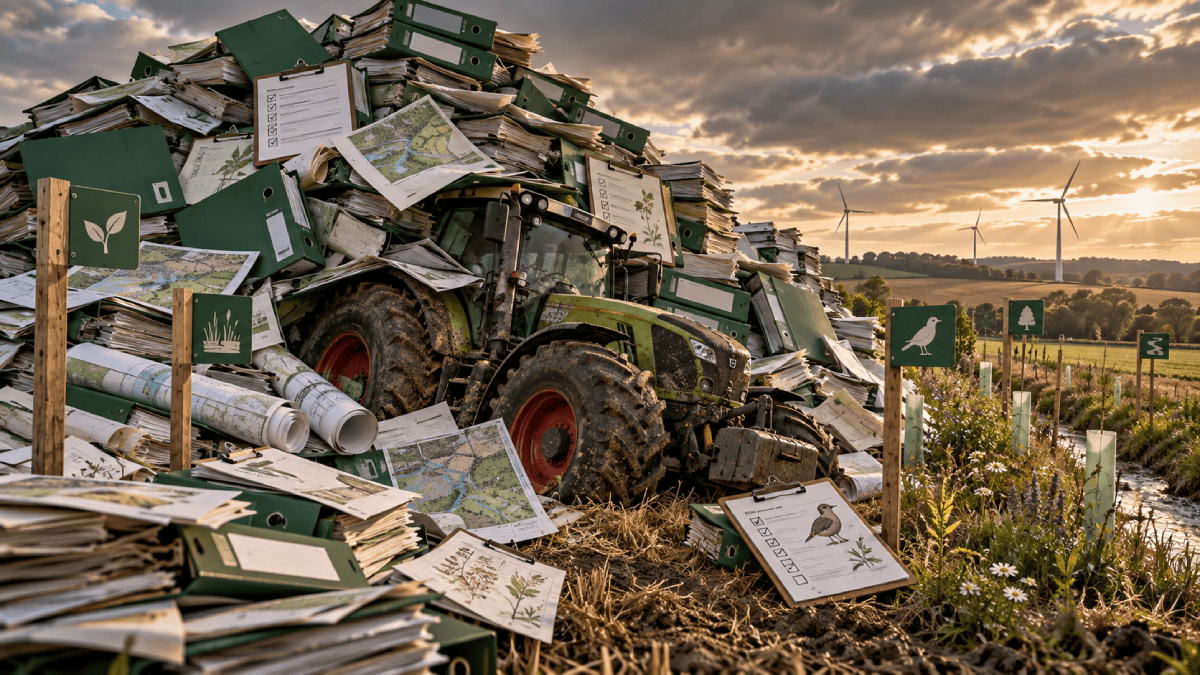
High-Tech Agriculture: Island Weakness As Space Civilisation
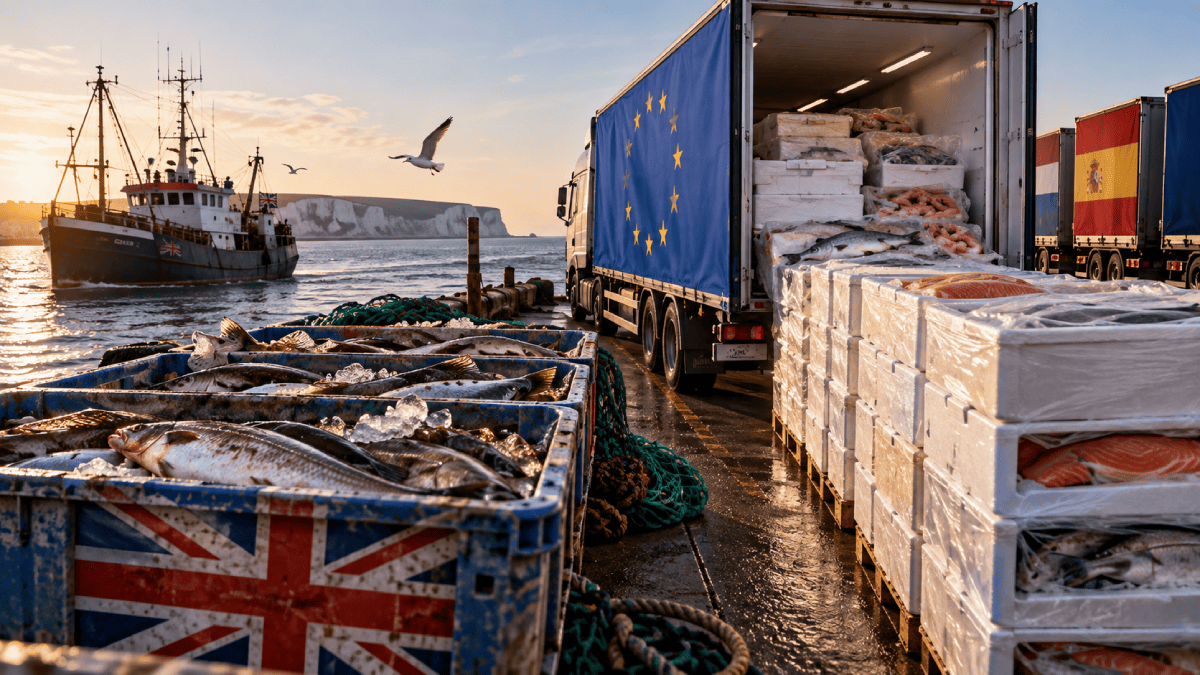
Britain is an island which has been nearly starved twice during wartime by submarine blockade. The space age technology to prevent a third time is also the same kind humanity needs to live underwater, in space, and on other planets. And fix our sewer problem.


There is an old vulnerability at the centre of British life, and nobody talks about it because the supermarkets are full.
Britain is an island. Islands import food. Enemies sink ships. This is not a historical observation. It is a permanent strategic fact, and it has nearly killed the country twice in living memory.
In both world wars, the German strategy was elegant and obvious: cut the sea lanes, starve the population, force surrender without invasion. U-boats came terrifyingly close to succeeding. Rationing, "Dig for Victory," and the sheer bloody-mindedness of convoy escorts held the line; but it was closer than most people realise, and success depended on factors Britain could not fully control.
Today the threat looks different, but the underlying geometry has not changed. Britain remains heavily dependent on imports for fruit, vegetables, and seafood. Domestic fresh fruit production covers roughly sixteen per cent of total UK supply. The logistics system is just-in-time, optimised for efficiency rather than resilience, and built on the assumption of uninterrupted global trade.
It is, in other words, a peacetime system. And peacetime systems break in war.
Closed-Loop Life Support, Not Gimmick
Vertical farming has a reputation problem. It sounds like something a venture-capital fund pitches to gullible investors in Shoreditch, accompanied by renders of glass towers full of basil. The sector has earned some of the scepticism: Infarm's contraction, energy-cost blowouts, and a trail of overpromising startups have made serious people suspicious.
They are right to be suspicious of the business model. They are wrong to dismiss the technology.
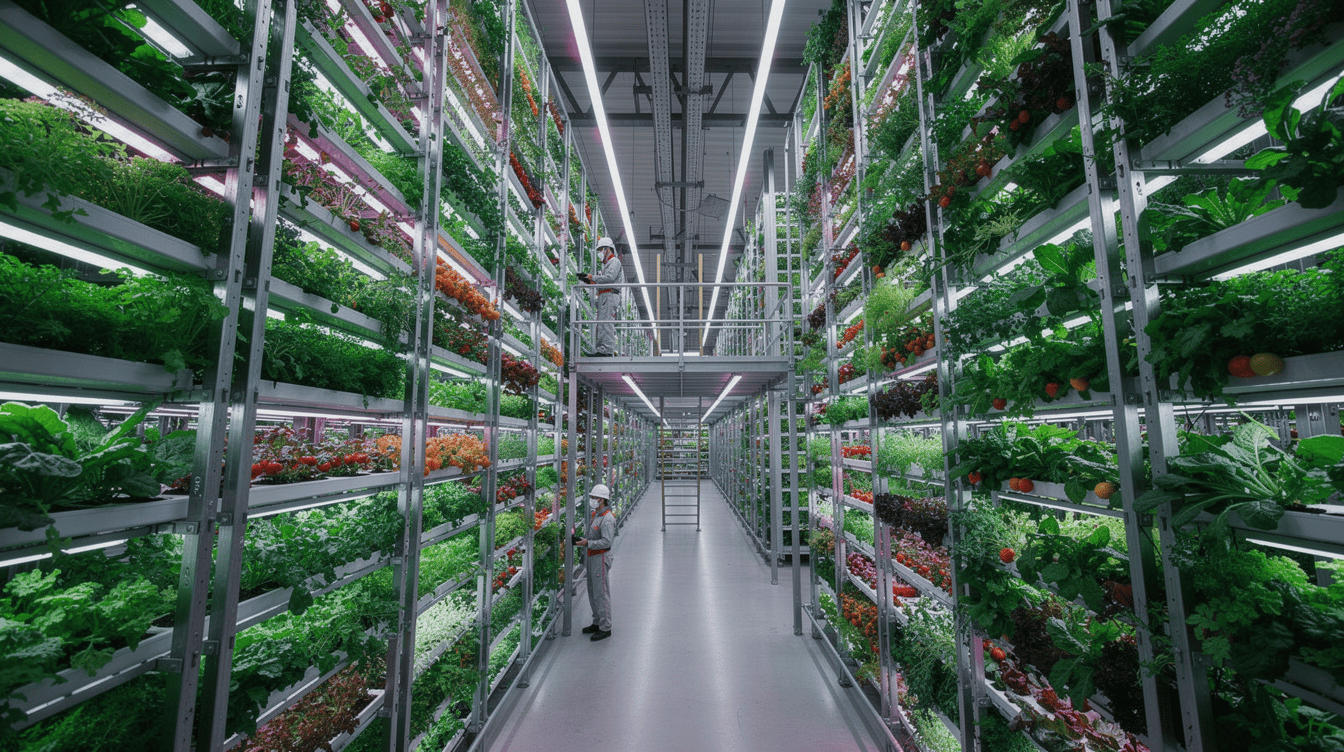
Because vertical farming, stripped of the marketing language, is not farming at all. It is controlled-environment biology. A closed-loop system in which you replace sunlight with electricity, soil with nutrient solution, weather with climate computers, and seasons with software. The inputs are power, water, minerals, CO₂, and seeds. The output is food. Everything else — pests, frost, drought, heatwaves, rainfall — is deliberately excluded.
At a systems level, it is life-support engineering with plants instead of people. And once you see it in those terms, the comparison to spacecraft and submarines becomes not a metaphor but a technical description.
Dutch Precision Needs British Ingenuity
The Netherlands is the world's second-largest agricultural exporter by value, from a country smaller than Yorkshire and Lincolnshire combined. Dutch farmers are the best in the world, bar none. This is not a miracle of fertile soil. It is a miracle of control.
Dutch agriculture is a systems-integration achievement.
- Climate computers manage temperature, humidity, and CO₂ in real time.
- LED arrays deliver tuned light recipes: specific spectral mixes of red, blue, and far-red wavelengths calibrated to each crop's growth stage.
- Hydroponic systems circulate nutrient-rich water with ninety-per-cent-plus recycling rates.
- Biological pest control replaces pesticides.
- Seed genetics are optimised for indoor performance.
- Growers are trained as precision engineers, not as inheritors of ancestral fields.
Companies like Priva sell integrated climate, lighting, irrigation, energy, and water-management systems. Signify builds horticultural LED platforms. And behind all of it sits Wageningen University, which functions as a permanent research engine for the entire sector, testing fully controlled indoor cultivation systems independent of weather, climate, and land availability.
The importable Dutch expertise is not "vertical farms." It is the whole stack: climate control, light physics, hydroponics, nutrient dosing, CO₂ enrichment, sensor networks, automation, cultivar selection, and grower training. A country serious about controlled-environment food production would import all of it.
33 Metres Beneath Clapham
The world's largest farm is in Dubai. The Dutch created a billion-dollar company and want to feed the whole world. Britain already has proof of concept, and it is not theoretical.
Zero Carbon Farms operated an underground farm thirty-three metres below Clapham High Street, in old Second World War air-raid shelters. Hydroponics, LED lighting, and tight environmental optimisation produced microgreens and baby leaf salads for retailers and restaurants. The model worked. It was small, but it proved the engineering was sound.
More recently, the University of Sheffield and Farm Urban secured research funding to explore underground food production at the Boulby Underground Laboratory (1.1 kilometres below the surface) using the naturally stable mine environment to reduce heating and ventilation costs.
Underground matters because it offers something no surface farm can: thermal stability, physical protection from storms and attack, and total environmental isolation. In wartime terms, these are hardened facilities.
Plants Do Not Need Sunlight
Now for the honest part: this technology has a hard constraint, and pretending otherwise would be dishonest.
Vertical farming replaces sunlight with electricity. Every photon hitting every leaf comes from a power socket. The governing equation is brutally simple:
Energy –-> Light –-> Photosynthesis -–> BiomassLED efficiency sits at roughly forty to sixty per cent. Photosynthetic efficiency in plants is one to five per cent. Respiration and metabolic overhead eat further into the yield. You are constrained by physics in how much edible mass you can produce per kilowatt-hour, and no amount of software optimisation changes the thermodynamics.
A critical review in the Journal of Cleaner Production confirmed what the physics already says: staple crops vital for bulk calories cannot be economically grown in vertical farms under current conditions. Leafy vegetables can. The distinction matters enormously, and any serious proposal must respect it.
- Leafy greens, herbs, microgreens, seedlings, mushrooms, strawberries, tomato and cucumber propagation, medicinal plants, and high-nutrition emergency crops are all viable.
- Wheat, barley, potatoes at national scale, oilseed rape, and animal feed are not, at least not yet, and not without a transformation in energy economics.
Feeding 100,000 People In A Disaster
The question we want to ask is not what vertical farming can do today as a commercial venture. It is what controlled-environment food production could do as national survival infrastructure, built deliberately, at scale, over decades.
So let us do the mathematics for a wartime scenario:
- Submarines are sinking cargo ships.
- Imports have collapsed.
- A hundred thousand people need feeding from a sealed underground system.
The NHS planning figure for a mixed adult population is roughly 2,300 kilocalories per person per day. Ergo, for a hundred thousand people, the daily requirement is 230 million kilocalories, or about 84 billion per year.
NASA's controlled-environment research, designed for exactly this category of problem (feeding humans in sealed habitats), gives a useful planning figure: roughly thirty square metres of continuous crop area per person, producing around 2,800 kilocalories per day with protein adequacy. Those numbers come from decades of closed-loop life-support research, and they are the most honest benchmarks available because NASA had no commercial incentive to exaggerate.
For a hundred thousand people, the requirement is three million square metres of active crop surface. Stack it ten layers high and you need 300,000 square metres of grow-room floor. Add aisles, HVAC, water treatment, nutrient tanks, seedling rooms, packing areas, cold storage, maintenance corridors, biosecurity zones, and loading bays, and the total facility footprint lands at sixty to a hundred hectares.
Large, but not fantastical. Comparable to a mid-sized industrial estate.
The wartime crop mix would be austere: sixty per cent potatoes and sweet potatoes for calorie density, twenty per cent wheat or dwarf grain, ten per cent legumes for protein, ten per cent greens and mushrooms for micronutrients and morale. Not pleasant. Not varied. But alive.
Crop biology sets the clock. Microgreens appear in one to three weeks. Leafy greens in a month. Potatoes and wheat take three to five months. A stable full-ration output would need six to nine months after commissioning.
You cannot start building when the torpedoes are already in the water.
600 Food Reactors For A Nation
Now let us scale it. Sixty million people. Six hundred bases, each feeding a hundred thousand. We're in obviously hypothetical territory here, so we can look at heuristics rather than forensic auditing.
The national numbers are large but not physically absurd. Roughly 1,800 square kilometres of active crop surface, achievable with vertical stacking across 360 to 600 square kilometres of total facility footprint. For context, 600 square kilometres is about a quarter of one per cent of UK land area, less than three per cent of Wales.
The build programme would take fifteen to twenty-five years for the full network. A prototype base could be operational in three to five years. The first industrial generation in five to seven.
These are not farms. They are food reactors: hardened biological production units, each one a self-contained system converting power, water, minerals, and CO₂ into calories. The language of agriculture does not apply. The language of infrastructure does.
The Bill Of Materials Per Reactor
Every one of those six hundred bases needs a specific set of components for it to function which are inescapable, and engineering challenges to solve.
Power, and quite a lot of it
Each base would consume 340 to 685 megawatts of continuous electricity: comparable to a small power station dedicated solely to photosynthesis. Nationally, the system requires 1,800 to 3,600 terawatt-hours per year. This is a second national electricity grid bolted to agriculture, and it is the single largest obstacle. Without sovereign, abundant, secure energy (nuclear, waste heat, geothermal, whatever works) the entire concept is academic.
This is an insane amount of power, as we will discuss later.
Water, or the usual rainy weather
Plants transpire enormous volumes, but closed-loop systems recapture ninety per cent or more. Each base would need 1,600 to 2,700 cubic metres per day of fresh makeup water, with 50,000 to 150,000 cubic metres held in tanks, pipes, and nutrient loops at any given time. Nationally, fresh water consumption lands at 360 to 600 million cubic metres per year; large but manageable for an island with no shortage of rain.
Nutrients, or electrolytes
Hydroponics replaces soil fertility with industrial chemistry. Each base needs 3,000 to 6,000 tonnes per year of nutrient salts: nitrogen, phosphorus, potassium, calcium, magnesium, sulphur, and trace elements. Nationally, 1.8 to 3.6 million tonnes per year. Every base requires a chemical supply chain, not just seeds and sunlight.
CO₂, or what the net zero religious nuts hate
Plants need carbon. In a sealed system, carbon dioxide becomes a feedstock. Each base cycles 35,000 to 60,000 tonnes of CO₂ per year through crops. Nationally, 21 to 36 million tonnes; and if the system is properly closed-loop, much of it comes from human respiration and waste digestion, creating a carbon metabolism rather than a carbon problem.
People, wanting to build the space age
This is biological manufacturing, not low-labour field agriculture. Each base needs 1,100 to 2,500 staff: growers, plant scientists, HVAC engineers, automation specialists, water and nutrient technicians, biosecurity teams, harvest and processing workers, logistics operators, and management. Nationally: 660,000 to 1.5 million direct workers. An entire profession, created from scratch.
The sewage dividend
We have written about the 700 year problem of Britain attempting to fix its drains and sewers. Yes, seven centuries of work according to the NAO; you read it correctly. Perhaps instead of seven centuries and your toilet's contents flowing into the street, we could be a little more British and practical.
Feel free to Google this subject. But make sure you are sitting down.
The UK’s privatized water sector has been so slow in fixing the nation’s network that it would take 700 years and billions of pounds to replace its aging pipelines at current rates, according to a watchdog. Water firms have often overshot their allowed expenditure — adding some of those costs to consumers’ bills — but they’ve failed to keep pace with what’s needed, the National Audit Office said in a report on Friday.
Human waste contains nitrogen, phosphorus, potassium, organic carbon, water, and trace minerals. Britain currently treats sewage as a disposal problem: badly, given the state of the rivers. In a closed-loop food system, sewage becomes a nutrient mine.
The pathway:
- Sewage enters anaerobic digestion, producing biogas and digestate.
- Biogas feeds back into power or chemical feedstock.
- Digestate goes through nutrient recovery:
- Struvite extraction for phosphorus and magnesium.
- Ammonia capture for nitrogen.
- Water reclamation for process use.
- Residual solids converted to biochar or safely disposed of.
Three problems addressed at once: less raw sewage entering rivers and seas, domestic nutrient sovereignty reducing dependence on imported fertiliser, and closed-loop food production drawing its inputs from the waste stream of the population it feeds.
This is national metabolism; power, water, sewage, carbon, and food fused into a single engineered cycle.
The Real Fruit: The Expertise For The Space Age
And here is the pivot, and the reason this is not really about agriculture at all. If Britain builds this capability at national scale, the food is almost a byproduct. What you actually create is something far rarer and far more valuable: industrial-scale expertise in running closed biological systems under constraint.
Consider what the workforce and the engineering base would actually know how to do after two decades of building and operating six hundred food reactors:
- Plant physiology under entirely artificial conditions.
- Atmosphere control: CO₂, oxygen, humidity, pressure dynamics, all at industrial density.
- Water recycling at near-total recovery.
- Nutrient-loop engineering, turning waste streams into growth inputs.
- Thermal management at power-station scale.
- Fault-tolerant biological systems with no tolerance for seasonal failure.
- Biosecurity in sealed environments.
- Continuous food production without weather, without soil, without seasons.
- Human-biosphere coupling: the integration of human waste, respiration, and consumption into a single managed cycle.
This is habitat engineering. And it transfers directly with minimal adaptation to every environment where conventional agriculture is impossible.
Living Underwater: We're Going There
Submarine habitats face identical constraints: sealed environments, no sunlight, limited resupply, waste recycling, tight oxygen and CO₂ management. The only additional factors are pressure and corrosion.
A country with six hundred operational food reactors already knows how to do everything an underwater habitat requires except hull engineering. The food systems, the atmosphere management, the water loops, the nutrient cycles, the biosecurity protocols: all of it transfers wholesale.
This is not speculation, it is an engineering observation.
The hard part of living underwater is not keeping the water out. It is keeping the people alive inside. And keeping people alive inside sealed environments is precisely what a national controlled-environment food network would train an entire workforce to do.
Why would we want to live underwater? We already do. It´s called being a submariner, and thousands live there for months at a time.
ET Phone Home: America & China Speed Dial
The same logic extends further. A lunar base, a Mars settlement, or any long-duration space mission faces the same core problem: maintain biological output in a hostile external environment.
NASA has been working on closed-loop life-support agriculture for decades, but only at experimental scale. Small chambers, limited crop variety, short-duration trials. The gap between a laboratory experiment and a functioning food system for thousands of people is enormous, It is a gap of operational experience, not theoretical knowledge.
What Britain would be building, if it pursued this programme seriously, is industrial-scale validation of closed-loop biological systems on Earth.
Tested under real conditions. Operated continuously. Refined through failure. Staffed by people who have actually run these systems under pressure, not merely published papers about them.
The export potential is extraordinary:
- Turnkey underground food systems for allied nations.
- Desert agriculture packages.
- Arctic and remote-base sustainment.
- Disaster-response food infrastructure,
- Submarine and naval long-duration support, and
- Full habitat modules for space agencies.
Not technology sales; capability transfer. The kind of sovereign expertise other countries cannot easily replicate because it depends on decades of accumulated operational knowledge.
A New Phase Of Human Civilisation
Historically, civilisation has depended on three things: arable land, predictable climate, and open trade routes. Every empire, every famine, every war of territorial expansion has been shaped by those dependencies.
What controlled-environment food production does, at sufficient scale, is partially break all three.
Food becomes a function of engineering and energy rather than geography and weather. You can produce it underground, in deserts, in the Arctic, on the ocean floor, on the Moon. Location becomes a logistics decision, not an agricultural constraint. Seasons become irrelevant. Soil becomes optional.
This is the same kind of transition shipping underwent when it moved from sail to engine. The wind stopped mattering. The ocean became traversable on human terms rather than nature's. Food production has never undergone an equivalent shift; it has remained, for ten thousand years, fundamentally dependent on what falls from the sky and what grows in the dirt.
Until... the English.
If any country is going to lead the transition away from sky-dependent agriculture, an island with a history of nearly being starved to death has a better reason than most.
The Objections Never Stopped Us Before
The energy requirement is staggering. Two to four thousand terawatt-hours per year is a second national grid, and Britain cannot currently keep its existing grid stable. This is true, and it is the reason any serious version of this programme is an energy policy first and an agriculture policy second. Without a massive expansion in generation capacity, almost certainly tidal and nuclear-led, the concept remains theoretical.
That is a simple engineering problem. And the answer is almost certainly hydro tidal generation. We are sitting on roughly 30GW of untapped capacity or 100% of today's demand. UK electricity consumption is roughly 250–300 TWh/year currently as it is; 30GW equates to 262.8 TWh/year at full capacity. We are talking a tenfold generation multiplier for 60 million, at least. But we're not talking about feeding everyone, merely looking at how things need to be densified and scaled.
The cost would be extraordinary, but so it was for everything else we did. Six hundred industrial-scale biological facilities, built over decades, staffed by over a million workers, supplied by dedicated chemical and logistics chains. No government currently thinks in these terms about food. But then, no government currently thinks in these terms about anything except defence — and this is a defence argument.
A British answer to that problem: so what?
The technology is not ready for calorie-scale staple production. Correct. Today's vertical farming works for leafy greens, herbs, and high-value crops. Potatoes and wheat at national scale remain beyond current economics. But the purpose of a twenty-five-year programme is precisely to close the gap between current capability and future need.
And the deepest objection: Britain will probably never face another Atlantic blockade.
Perhaps.
In 1929, nobody thought there would be another World War either. How has that approach been working out for us so far?
The country's food system is also vulnerable to climate disruption, pandemic supply-chain failure, geopolitical instability in supplier regions, and any number of peacetime crises less dramatic than submarine warfare but equally capable of emptying shelves. Resilience is not only a wartime concept.
National Resilience Infrastructure
A parallel food-production system — hardened, controlled, independent of weather and imports — is national infrastructure. The same category as power stations, water treatment plants, and data centres. Except the output is food.
And unlike power stations and data centres, this infrastructure would generate a sovereign capability with direct application to undersea habitats, planetary settlement, and extreme-environment operations. No other infrastructure investment offers the same breadth of strategic return.
Britain does not need underground farms because the future is urban and fashionable. It needs them because it is an island, because islands get starved, and because the engineering required to prevent starvation happens to be the same engineering humanity needs to live in places where nothing grows.
The choice is between building food reactors and hoping the shipping lanes stay open. We know what our short-sighted midwit politicians always decide, and why we always end up destitute because of it.
History suggests which option an island should choose. We could waste hundreds of billions on interest payments, useless rail schemes, administrators for a bloated and geriatric health system. Or we could feed hungry children, protect our grandchildren against invasion, and teach the world how to live in space.
Ambitious? Yes. Necessary? We won't know until it's too late. Doable? If there's one country on Earth who can, it's us.