The Extinction Of British Pubs
The Britannic tavern is the community's living room where our class system dissolves. Britain didn't lose them to changing tastes. It taxed them, financialised them, stripped them of their regulars, and converted them into flats; then watched alcohol deaths hit record highs at home.
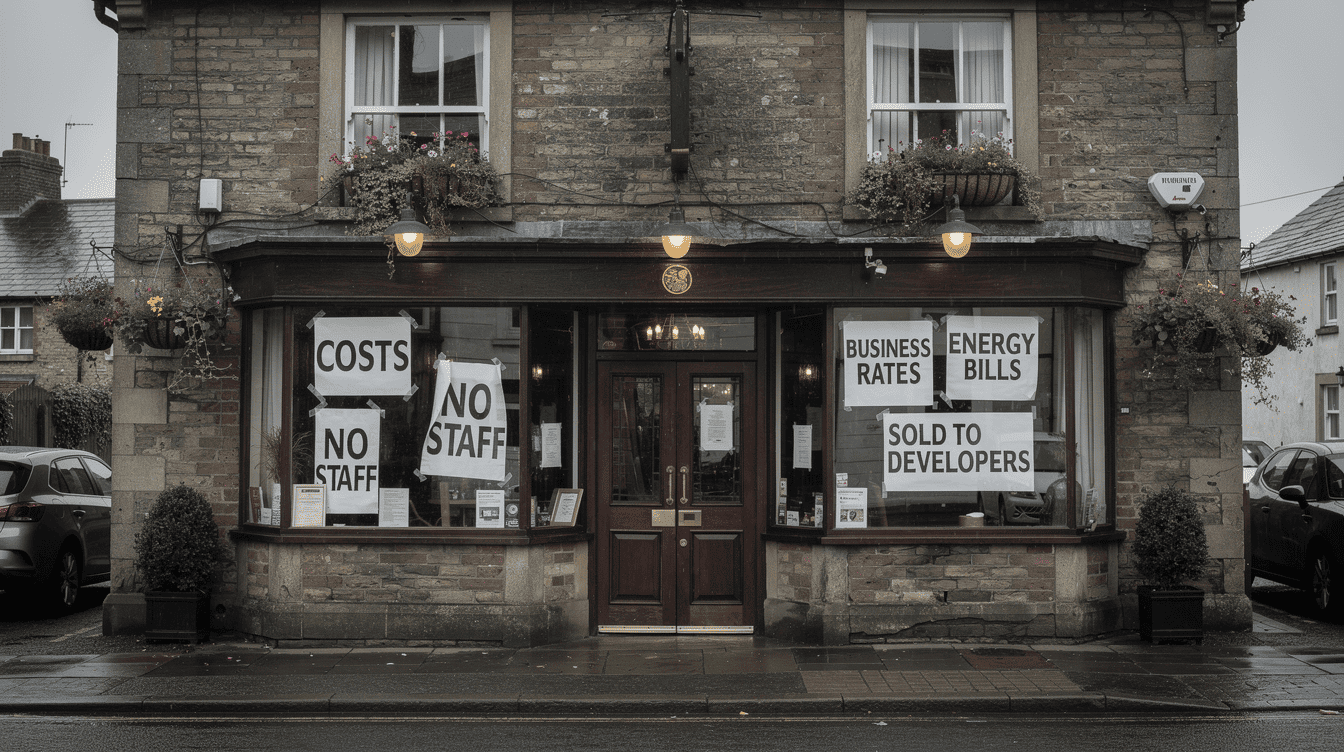
England and Wales had nearly 100,000 pubs at the turn of the twentieth century. By 1950, the figure had dropped to around 73,500. By 2019, it was roughly 47,200. By the end of 2024, it fell below 39,000 for the first time. In Q1 of 2026, licensed venues dropped by another 305, or an average of 3.4 closures a day. The BBPA projected 378 permanent pub closures in 2025 alone, up from 350 in 2024. One pub, every day, turning off its lights for good.
But the numbers alone are too bureaucratic. They hide something worse.
Between 2001 and 2018, employment in pubs with fewer than ten staff fell by 41 per cent. Britain did not simply lose "pub capacity." It lost the small, local, human-scale pub — the kind where the landlord knew your name, your dog, and your usual — and substituted some of the demand with managed chain venues, gastropubs, and bars serving cocktails to a clientele who would not recognise a dartboard if one hit them.
The small pub was not outcompeted. It was structurally eliminated.
Thatcher's Good Intentions And Ruinous Plan
The original sin, which not enough people know about because it is incredible boring, was the Supply of Beer Orders of 1989.
By the late 1980s, six national brewers dominated the market. They owned vast estates of tied pubs, that is, venues contractually bound to sell only their products. The Monopolies and Mergers Commission investigated and concluded the arrangement was anti-competitive. The Thatcher government responded with the Beer Orders, which forced any brewer owning more than 2,000 tied pubs to divest a share of them or release tenants from the supply obligation.
The aim was competition. The result was financialisation.
Rather than creating a free market of independent publicans, the Beer Orders triggered a mass sell-off into the hands of pub-owning companies: pubcos. Punch Taverns, Enterprise Inns, Admiral Taverns. These were not brewers. They did not make beer, market beer, or care about beer. They owned property. They collected rent. And because they were not brewers, they fell outside the scope of the Beer Orders entirely. The legislation never saw them coming.
Within a decade, pubcos controlled enormous estates. By 2004, Punch Taverns and Enterprise Inns each held more than 8,000 tied pubs. The tenant-publican, already stretched, now faced a landlord whose entire business model rested on extracting maximum yield from each lease. The beer tie survived in a different suit: tenants still had to buy through the landlord's supply chain, at prices well above wholesale. A 2009 Commons committee described the tie as, in practice, an additional income stream for the pubco. Not a partnership. Not a support structure. A squeeze.
The state tried to break brewer monopoly and accidentally helped build landlord monopoly.
The pubcos then discovered securitisation, aka borrowing against future rents to fund acquisition of more pubs. It was a debt engine masquerading as a hospitality business. And when trade weakened, the model did not bend. It shattered. The pubs at the bottom of the estate (the ones in struggling towns, with low footfall and thin margins) were the first to be abandoned or sold for conversion. The pubco did not grieve. It rationalised.
Liberalised Hours, Unliberated Pubs
The Licensing Act 2003 replaced fixed national closing times from World War I with a locally administered premises licence system. In theory, it was meant to smooth out the infamous 11pm stampede. You know it; the nightly ritual of mass ejection onto the high street. In practice, it did something else. As technocratic intervention always does.
It helped create a late-night drinking economy; city centres full of vertical drinking bars and chain operations running until two or three in the morning, The ordinary community pub gained nothing. The village local did not want to stay open until 1am. It wanted to survive until closing time without losing money.
Flexible licensing was a gift to the nightlife industry. It was irrelevant to the publican in a market town whose problem was not hours, but margins.
The law liberalised when you could drink. It did nothing for where you could afford to drink.
The Treasury, Yet Again
Every pint sold in a pub carries alcohol duty, VAT at 20 per cent, and the overhead of business rates, staffing costs, energy bills, insurance, licensing fees, and regulatory compliance. The BBPA estimates one pound of every three spent in a pub goes directly to the taxman.
And here is the cruelty of it: the pub's competitor, the supermarket, sells alcohol under the same duty and VAT regime, but does so as a loss leader within a diversified retail operation. The supermarket can absorb thin margins on drink. The pub cannot. It has nothing else.
The result is a policy-induced substitution.
- Taxation makes the pub pint expensive.
- Supermarkets make the alternative cheap.
- The customer does the rational thing and drinks at home.
The pub does not die of unpopularity. It dies of arithmetic.
Astute readers will notice immediately this is exactly the same pattern which occurs with the illegal tobacco trade.
Business rates (i.e. property taxes) compound the problem. They are calculated on property value, not profitability. A barely viable village pub in a desirable area pays rates as though it were a thriving commercial enterprise. In April 2025, hospitality business rates relief dropped from 75 to 40 per cent. The difference was immediate and savage. Small pubs already running on fumes watched their overheads jump overnight.
Then there are the employment costs. The national minimum wage rose 6.7 per cent in April 2025, to £12.21 an hour. Employer National Insurance contributions increased from 13.8 to 15 per cent. For a labour-intensive, low-margin business these were not adjustments. They were technocrat verdicts.
Where Pubs Are Dying Matters
The decline is not random. It follows the map of deindustrialisation with grim precision. The East Midlands lost more pubs than any other English region in 2025: 69 gone. The North West followed close behind with 52. Yorkshire and the Humber, the South West, the West Midlands, all haemorrhaging. The North East, the smallest region, lost 19. London, by contrast, lost 32: a city of nine million people losing fewer pubs than Leicestershire and Nottinghamshire combined.
The reason is, as readers are now intimately aware, structural; not cultural.
In post-industrial England (the Midlands, the North, parts of the South West) the pub's core customer base was built on dense, shift-based, manual-labour communities. Regular trade. Midweek footfall. Working men who went to the pub not as an event, but as a habit. When the mines closed, the mills stopped, the steelworks shut, the shipyards emptied, the pubs lost their regulars. And once the regulars go, the economics do not recover. The pub becomes a weekend proposition, and weekend trade alone does not cover the rent.
Lower incomes make it worse. These regions are more price-sensitive. When costs rise, customers defect to supermarket alcohol first and fastest in poorer areas. The same tax policy produces radically different outcomes depending on where you live.
And then there is the property calculus. In London, a pub can still be wildly profitable; location, density, tourism, high per-head spend. In deep rural areas, land value may not justify conversion. But in the middle (commuter-belt towns, mid-value Midlands boroughs, edges of northern cities) pub trade is weak and land value is just high enough to make redevelopment rational. The equation becomes simple: pub income is less than housing conversion value. Sell.
Pubcos and chains accelerate this. They do not close randomly. They prune. They shed underperforming assets. And the underperforming assets are concentrated in exactly the places where the pub mattered most.
London, meanwhile, has not saved the pub. It has rebranded it. The traditional London local has been replaced by gastropubs, craft beer bars, and hotel lounge concepts. The building is still there. The institution is not.
The Working Men's Clubs
You cannot tell this story without telling the club story. The two are siblings. At its peak in the 1970s, the Club and Institute Union had over 4,000 affiliated working men's clubs and roughly four million members: ten per cent of the country's adult population. By 2010, the CIU counted 2,200 affiliated clubs. By 2024, 1,175.
The working men's club was never just a place to drink cheaply, though it was certainly that. It was a co-operative, member-run, with elected committees, enforced rules, and institutional identity. Clubs hosted concerts, gigs, bingo, raffles, snooker tournaments, weddings, wakes, Christmas parties. They offered function rooms, games rooms, sports screenings, and social trips. They were the civic infrastructure of industrial Britain; the place where the community organised itself without needing permission from anyone.
And they depended on a world which no longer exists. Coal, steel, shipbuilding, manufacturing, or the industries which created dense, settled, male-dominated labour communities sustained the club movement. When the industry went, the social base went with it. The club did not adapt because it could not: its membership model, its committee structure, its entire reason for being was woven into a fabric of work, neighbourhood, and routine which deindustrialisation tore apart.
The smoking ban of 2007 accelerated the collapse. Clubs which had survived thirty years of economic decline could not survive their regulars standing outside in the rain. The ban was, for private members' clubs, a behavioural rupture. The CIU lobbied for exemption and lost. Pubs demanded a level playing field. Parliament gave them one, and levelled both into the ground.
Alcoholism And Binge Drinking At Home
The public-health case for higher alcohol prices and tighter regulation rests on one central claim: it reduces harm. And there is evidence, partially, in its favour. NHS survey data shows drinking at hazardous levels among adults in England fell from 26.1 per cent in 2000 to 18.9 per cent by 2023/24.
But the other side of the ledger is a horror.
In 2023, 10,473 alcohol-specific deaths were recorded in the UK at the highest number ever registered. In England alone, those deaths rose from 5,050 in 2006 to 8,274 in 2023, an increase of 63.8 per cent. In 2024, there were 7,673 alcohol-specific deaths in England and nearly 22,000 alcohol-related deaths. Scotland's alcohol death rate stands at over 20 per 100,000: the highest in the United Kingdom, and in the most deprived Scottish areas, the rate is 4.5 times higher than in the least deprived.
Presentations for alcohol treatment in England hit record highs. Hospital admissions for alcohol-related conditions run into the hundreds of thousands. People in the most deprived areas are seven times more likely to be admitted than those in the least deprived.
Britain succeeded in making casual, social, moderate drinking less common. It did not succeed at curing destructive drinking. It weakened the institution where drinking was communal, moderated, and visible, and left the drinking behind. The alcoholic moved from the bar to the sofa. The harm concentrated among the older, the poorer, the more isolated, the more desperate. These are not people who were going to be saved by a higher pint price.
These are people who needed precisely the kind of informal social infrastructure the pub once provided.
Public policy treated alcohol as the enemy. But the pub was never just alcohol. It was social control, community cohesion, informal welfare, local identity, human contact. It was the place where someone might notice you were drinking too much before you ended up in a hospital bed. Removing it did not remove the drinking. It removed the witnesses.
The Village Pub: Death by Strangulation
Zoom in further and you find the most painful version of this story: the ordinary village pub. It is not dying because villagers stopped wanting a drink. It is being compressed between forces no single publican can resist.
Business rates, calculated on property value, punish it for existing in a desirable area. Alcohol duty and VAT make every pint an exercise in diminishing returns. Energy costs (a large, old, poorly insulated building open long hours) have become ruinous since 2022. Staffing costs rise with every minimum wage increase and NI adjustment. Licensing conditions impose administrative burdens a chain absorbs and a sole operator drowns in.
Planning law treats the struggling pub not as cultural infrastructure, but as a development opportunity. Once converted to flats, offices, or a nursery, the pub is gone permanently. Even the "asset of community value" designation (designed to give locals a chance to bid) is frequently overwhelmed by developers with deeper pockets and faster lawyers.
And then, the final insult of success: if the village becomes fashionable, if house prices rise, if new residents arrive from the city, the pub site becomes more valuable as housing than as a going concern. Desirability kills the pub as surely as neglect.
The village publican faces a choice between slow failure and immediate conversion. Neither option preserves the institution.
The Crossroads And Community Living Room
The pub was the place where neighbours met without arranging to meet. Where news circulated before anyone had a smartphone. Where arguments happened face to face. Where old men sat in the corner because they had nowhere else to go. Where the darts team gave young men something to belong to. Where the harvest supper, the charity quiz, the wake, the wedding reception, the retirement do, and the christening party all took place in the same back room with the same sticky carpet.
A millionaire could sit next to a rubbish collector. Equally. Both with their similar worries, like their difficult wife, or their annoying husband. The class divide melted at the door, if only for a moment. People from all walks of life, on the same footing, in the same culture, mixing for the same reasons in the same tradition.
It was the informal parliament of the parish. The unofficial employment exchange. The place where the plumber met the electrician and both met the farmer. Where people who disagreed about everything drank beside one another because they lived beside one another.
It was, in short, civil society: and not the kind written about in policy papers, but the kind made of darts, dominoes, gossip, mild bitter, and the slow accumulation of trust between people who see each other every week for thirty years.
Britain did not replace this. It simply allowed it to die and then wondered why loneliness became an epidemic, why community bonds weakened, why social isolation turned lethal, and why alcohol deaths climbed to record levels among exactly the population most likely to have once been propping up the bar.
The pub was the last institution in many communities where people gathered without a transaction, an agenda, or an algorithm deciding who they spoke to. It was radically local. It was stubbornly physical. It required nothing but showing up.
What replaced it? Nothing. The coffee shop is a workplace. The gym is solitary. Social media is not social. The restaurant requires booking. The home is private. There is no modern equivalent of walking into a room where you already know half the people and the other half know someone you know.
The British state spent thirty years attacking alcohol as a public-health problem, a competition problem, and a licensing problem. It never once asked whether the pub was something more than a place where alcohol was sold. It regulated the commodity and killed the institution.
The pub did not simply close. It was converted. First into a lease, then into a tax target, then into a property play, and finally into flats.
And the drinking continued. Just alone, at home, in silence, where nobody could see.