RICU: The Home Office's £70M Propaganda Wing Aimed At You
A 22-person Home Office team. £70 million of declared spend in five years. A contractor roster comfortably north of £100 million. PR firms, behavioural science houses, social-media analytics vendors and undercover production agencies. Boybands, hashtags, fake bystanders, and family statements.

Our country has been transformed over time into an open prison, and that requires considerable management to ensure the ordinary reasonable man is the offender for thinking so. The Research, Information and Communications Unit is not a rumour. It is not the invention of conspiracists. The Home Office has confirmed when it was set up, why it was set up, who authorised it, who runs the directorate above it, and roughly what it has cost the public purse.
Senior Whitehall figures have given it leadership, signed letters under its title, and submitted written answers to Parliament defending its existence. Its contracts appear on Contracts Finder. Its staff appear on LinkedIn. Its handiwork has appeared after every major terrorist incident in Britain since 2014, and now, on the testimony of police sources, after disorder in Belfast and Southampton.
What is in question is whether a free country should permit such a unit to exist on the present terms: a small civil-service core embedded in the Prevent Directorate of the Homeland Security Group, served by an industrial pipeline of audience-research firms, behavioural strategists, social-media analytics vendors and unbranded production houses, whose products are withheld on the basis publishing them would compromise "HMG [His Majesty's Government] capabilities".
Capabilities deployed against whom is the obvious question, and the obvious answer is the only audience available to a domestic communications unit.
Against us.
A Wartime Method With A New Postcode
In 1942 the Political Warfare Executive ran white, grey, and black propaganda against the Axis. White propaganda carried His Majesty's Government's brand. Grey propaganda had a deniable origin. Black propaganda was forgery dressed as the enemy's own voice. In 1948 Clement Attlee's government created the Information Research Department to do the same to communism, placing material into friendly newspapers, broadcasters, trade journals and third-party outlets across the world, often without attribution. The IRD operated for nearly thirty years before press exposure killed it in 1977.
RICU is the direct lineal descendant, and the descent is not a matter of vague resemblance. It is documented, and the documentation is faintly comic.
According to former officials, the men who built RICU in 2007 found their template in a history book warning against the very thing they went on to build. The book was Who Paid the Piper?, published in the United States as The Cultural Cold War, in which the historian Frances Stonor Saunders set out how the IRD and the CIA quietly co-opted Western artists, writers and intellectuals to fight the Soviet Union in the realm of culture. One of the more celebrated fronts was the literary magazine Encounter, funded covertly by the CIA. Saunders wrote it as a caution about what propaganda does to intellectual freedom.
Home Office officials are said to have come across the book because Gordon Brown was seen carrying it into Downing Street when he succeeded Tony Blair in 2007. Whitehall being Whitehall, ministerial reading habits became required reading, and a generation of younger civil servants discovered the IRD through a volume condemning it. Some of them, on the testimony of their own colleagues, read the warning as a manual. The speculation in the corridors, one source recalled, was whether RICU could simply recreate the thing.
It was created that year by Charles Farr, a former MI6 officer then serving as Director General of the Office for Security and Counter-Terrorism (renamed Homeland Security). The diplomat Jonathan Allen was tasked with standing it up, a fact his own Foreign, Commonwealth and Development Office biography records in language leaving nothing to interpretation: he "established and led" the unit.
In 2006, Jonathan was seconded to the Home Office as Assistant Director in the Home Office’s International Directorate. In 2007 he moved to the Office for Security and Counter-terrorism (OSCT), where he established and led the Research Information and Communications Unit (RICU), a cross-departmental strategic communications body.
The same 2007 restructure produced a monthly ministerial security committee chaired by the Prime Minister (Ministerial Committee on Security and Terrorism) and a weekly board chaired by the Home Secretary, attended by MI5, senior police and Cabinet Office officials. The framing was the post-7/7 threat picture: MI5 publicly tracking around four thousand individuals, British nationals heading for Iraq, the spectre of homegrown Al Qaeda recruitment.
The original purpose was specific. Monitor jihadist propaganda. Vet the language officials used when describing terrorism. Build counter-messaging capacity in Muslim communities considered at risk. A defensible founding story. The lineage was not lost on the people inside it.
Asked by the Sunday Times in 2008 about the new approach, one RICU official conceded the obvious: "It does sound horribly Cold War."
That lineage is not only rhetorical. RICU's back story runs through two military figures.
Steve Tatham was the Ministry of Defence lead on strategic communications, seconded in 2009 to the Cabinet Office's Strategic Horizons Unit inside the Joint Intelligence Organisation; he had developed his thinking at the Defence Academy think tank Advanced Research and Assessment Group (ARAG).
His superior there, Dr Jamie Macintosh, was described in a Defence Academy note as instrumental in creating both the Office for Security and Counter-Terrorism and RICU itself, and had earlier helped design the equally-sinister Civil Contingencies Secretariat, the very machinery which would later produce the "controlled spontaneity" playbook discussed below.
The doctrine these men worked in is explicit in their own writing. Strategic communication, in Tatham's account, is no polite word for public information: its object is "behavioural change", its effect is "amplified by threats of kinetic activity", and it is aimed not only at an enemy abroad but at internal audiences, meaning sections of the domestic public.
Two features of the founding deserve to be held onto, because both widen the unit's reach beyond the impression the founding story gives.
- The first is that RICU, though housed in the Home Office, has never belonged to it alone: early parliamentary material describes the unit as "jointly owned" by the Home Office, the Foreign Office and the Department for Communities and Local Government, a three-way line of accountability unusual for a domestic communications body and one that quietly wires a counter-terrorism unit into the department responsible for local councils and community cohesion.
- The second is in its earliest form it behaved like a press office, clipping newspapers and circulating them to government missions abroad.
It became something closer to the IRD only after a new head arrived in 2012, and that man brought a particular professional pedigree with him.
From Baghdad To Marsham Street
The man was Richard Chalk, appointed to run RICU in 2012 as part of an effort to revamp the government's counter-extremism communications. Before Whitehall, Chalk had spent 2005 and 2006 in Baghdad working for Bell Pottinger, the British public relations firm later revealed by the Bureau of Investigative Journalism and the Sunday Times to have earned hundreds of millions of dollars from the United States Department of Defense during the occupation of Iraq. By the BIJ's account, Bell Pottinger was paid around $540 million between 2007 and 2011 for "information operations and psychological operations".
What those operations involved is not in serious dispute, because Bell Pottinger's own chairman boasted of it. According to a former employee, the firm produced fake Al Qaeda videos, copied them onto CDs, and had American soldiers drop them in the streets on patrol. Each CD carried a Google Analytics code, so anyone who played the disc could be geolocated and flagged as a potential militant. A former contractor described such false-attribution work in the plainest available terms: black ops, and a standard part of the industry toolkit.
Lord Bell, who quit the firm in 2015, called it a covert military operation and said his people had been proud to be part of the American propaganda machinery. He also offered, on the firm's entry into Iraq, the immortal observation there was no Arabic word for democracy, which tells you most of what you need to know about the cultural sensitivity on offer.
There is no Arabic word for democracy – they use the word ‘democratier’, which is not Arabic. It is certainly a very big comms challenge. It is not going to be easy but it will be rewarding.
The Bell Pottinger orbit was there before Chalk arrived.
As early as October 2008, RICU's founding head Jonathan Allen shared a platform at a Wilton Park conference on changing public behaviour with David Kenning, billed as chief strategist of Bell Pottinger Sans Frontieres ("Public Diplomacy: Meeting New Challenges"). The firm who ran the Pentagon's black-ops shop in Baghdad and the new Home Office communications unit were, from the unit's first full year, moving in the same small professional world.
Chalk did not arrive at RICU alone in carrying this inheritance. Breakthrough Media (renamed later), the production company that would become RICU's favoured contractor, employed Scott Brown, who worked in Bell Pottinger's Baghdad team in 2006, and Andrew Sharples, a Bell Pottinger campaign manager in Iraq in 2010 whose own corporate biography boasted of work with the US Army and Department of Defense on counter-extremism, experience he then drew on, the biography continued, to help build a new British counter-terrorism strategy in 2012.
The line from a Pentagon psyops contract to a Home Office communications unit aimed at British Muslims runs through identifiable people who moved from one to the other and said so in public.
The intellectual scaffolding moved across too. In 2011 Chatham House and Bell Pottinger jointly produced a paper, "Strategic Communications and National Strategy", recommending influence be "subtle and not perceived to be an attempt on the part of the state" to manage a situation. The paper proposed private firms carry messaging precisely where the desired outcome should not be seen to be connected to government, for fear of alienating the audience.
Read that recommendation against everything the unit went on to do, and the concealment stops looking like operational caution and starts looking like founding doctrine.
The doctrine was stated openly by people senior enough to know better.
Richard Mottram, the Cabinet Office permanent secretary responsible for intelligence, security and resilience, explained the work could be done without it looking like government propaganda, because if it looked too much like government propaganda nobody would listen, "nor should they".
The candour is the tell. A unit confident its messages would survive being attributed to the state would have no reason to hide. The hiding is an admission the messages would not. These dirty individuals cluster together and can be mapped.
Under Chalk, in the words of the Guardian's reporting, RICU began communicating with British Muslims in a manner closer to counter-insurgency than to public information. That is the pedigree. A method built to undermine insurgents in an occupied country was brought home, handed a Home Office postcode, and pointed at a section of the British population.
What The Home Office Admits
The Home Office has, under parliamentary pressure, conceded the following on the record via Tom Tugendhat:
The Research, Information and Communications Unit (RICU) was established in 2007 under the Prevent strand of HMG’s CONTEST strategy. RICU aims to understand and counter terrorist and extremist ideologies to reduce the risk to the UK, its citizens, and its interests overseas.
RICU provides analysis on terrorist use of propaganda and exploitation of the internet to inform the UK’s counter-terrorism system. To support this crucial objective RICU undertakes open-source monitoring to better understand the media, online and communications environment as it relates to terrorism and extremism. This open-source monitoring identifies a range of material that is shared and discussed within these spaces, including topics or media that terrorist and extremist groups are seeking to exploit.
All RICU data collection and analysis complies with relevant legislation. Ministers have authorised RICU’s work since it was established in 2007, and through subsequent updates to the CONTEST strategy (in 2011 and 2018) and regularly receive RICU outputs.
The work of RICU is crucial to the delivery of Prevent and has helped to position the UK at the forefront of the battle against terrorist propaganda, particularly online terrorist content.
A 2017 government response to the Home Affairs Committee went further, describing RICU as a "government strategic communications unit based in the Home Office" working not only on counter-terrorism and counter-extremism but on "organised immigration crime, cyber crime and money laundering", and confirming the unit worked with private-sector experts to build the communications capacity of civil-society groups through creative support, production, PR expertise and social-media training.
Strategic communications. You'll keep seeing that everywhere.
Giving evidence to a Home Affairs Committee in 2009, Charles Farr explained RICU's task was how to communicate the terror threat "in and through Muslim communities" using language that was true to the threat yet "resonates with the communities we need to work with", and officials had dropped phrases such as "war on terror" and "Islamic terrorism" because such language "admits of a number of interpretations which are not always helpful to us".
Farr added communicating with Muslim communities was not the unit's sole purpose, but it had "made sense for us to start there because that was the most difficult communications task". The unit, in its own founder's account, existed to manage how a section of the British population understood the state's actions, and chose its words accordingly.
The earliest budgets, supposedly disclosed under the Freedom of Information Act (via private email, unverified), suggest who was paying. The reported 2009/10 programme budget of £5.7 million was split across the three owning departments, and the largest single contributor was not the Home Office but the Foreign Office, which put in £3 million, against £1.5 million from the Department for Communities and Local Government and £1.2 million from the Home Office itself.
A domestic counter-terrorism communications unit was, in its formative years, majority-funded by the foreign-affairs department, which is not where one would look for a body whose only audience is the British public.
In 2023 the Home Office disclosed staffing of 22 allocated personnel and a spend series stretching from 2010/11 to 2022/23. Read it carefully.
| Financial year | Disclosed spend |
|---|---|
| 2010/11 | £888,707.64 |
| 2017/18 | £23,358,239.69 |
| 2018/19 | £19.09 million |
| 2019/20 | £17.40 million |
| 2020/21 | £20.46 million |
| 2021/22 | £8.60 million |
| 2022/23 (year to date) | £5.07 million |
Five financial years from 2018/19 to 2022/23 covered roughly £70.6 million of public money. The earlier disclosures fill in the trajectory: Home Office funding rose from £3.66 million in 2008/09 to £16.1 million in 2017/18, with further money thought to come from the Foreign Office. The department attributed the climb to the Daesh threat and the 2017 attacks on Westminster, Manchester Arena, and London Bridge.
None of this is contested.
Note it was not in the place one might typically look, which is another tell.
What the Home Office has refused to disclose, repeatedly, is the analytical output itself, the campaigns funded, the targets selected, the contractors retained, and the operational rules under which the unit conducts its monitoring of the British public.
The refusal language used is "HMG capabilities". File that phrase away for later.
A Small Office With Many Mouths To Feed
Twenty-two staff cannot generate a contractor footprint of this size by themselves. The unit's defining operational feature is the gap between its slim Home Office headcount and its industrial outsourcing pipeline. Public procurement records, parliamentary answers, trade-press reporting and government transparency extracts identify the following.
| Supplier | Value | Period | Function |
|---|---|---|---|
| Four Communications Group | £4.2 million | July 2018 to July 2020 | PR and capacity-building for community organisations |
| Moonshot | £4.9 million | from October 2019, three years | Social-media analysis |
| Kantar | £14.9 million | from October 2019, three years | Research and evaluation |
| Ipsos MORI | £2 million | from October 2019, three years | International operations research |
| Ripjar | £1.66 million | 2016 to 2019 | Propaganda tracker and dashboard |
| M&C Saatchi | £50 million | from 2019, three years | Communications services |
| Adam Smith International | £30 million | two years to March 2021 | Global delivery partner |
| Press Data | £1.07 million | from January 2022, two years | Media monitoring |
| Press Data | £800,000 | award published February 2026 | RICU media monitoring |
To this disclosed list must be added Breakthrough Media Network, the contractor named in 2016 Guardian reporting as the recipient of much of RICU's externally delivered work. Breakthrough produced websites, leaflets, videos, films, Facebook pages, Twitter feeds and online radio. Its internal documents described the objective as "attitudinal and behavioural change", with the Home Office retaining editorial control, the overall aim being to promote a "reconciled British Muslim identity" and to influence online conversation by being "embedded within target communities" through a network of moderate organisations sympathetic to the unit's goals.
The company worked hard to conceal the fact its client was RICU rather than the groups through which it pushed its material, assuring the unit it understood the sensitive nature of the work and accepting exposure would wreck the credibility of any messaging traced back to the state.
The firm's own history is instructive. It was incorporated in 2008 as Camden Creative, a maker of reality television and documentaries, including a Channel 5 series and an Al Jazeera film about the mayor of Mogadishu, and renamed Breakthrough Media in November 2012, the same year a new head took over at RICU.
It ran offices in London, Nairobi, and Mogadishu and employed around a hundred people across Europe and East Africa, with a client list spanning the UK, US, EU, African Union and United Nations. Its founding managing director was Robert Elliot; its chief executive, appointed in August 2012, as mentioned, was Scott Brown, previously an M&C Saatchi account director and a Bell Pottinger deputy chief of staff.
The pattern recurs at every level of the contractor: the people building Britain's domestic counter-messaging had learned the trade in commercial PR and in wartime information operations abroad.
The concealment was not informal.
A now-deleted post by a Breakthrough employee, archived before it vanished, recorded staff were required to sign (affirm) the Official Secrets Act on joining, precisely because what they did and for whom was governed by it. A communications agency producing leaflets and Facebook pages does not ordinarily place its junior staff under the Official Secrets Act. A unit using that agency to hide the government's hand from the citizens being messaged has an obvious reason to.
Nor is the link to RICU a matter of inference. Eric Pickles, then communities secretary, told Parliament in 2014 his department had run social-media workshops jointly with the Home Office's Research Information and Communication Unit and Breakthrough Media, naming all three in a single breath on the record.
Nor was the common hand only a matter of testimony.
When Cage's researchers examined the technical plumbing behind a set of ostensibly unconnected community websites, including Help for Syria, Families Matter and Open Your Eyes, they found the sites resolving through the same pair of name servers as Breakthrough Media's own domain. Of the tens of millions of servers on the internet, these particular grassroots campaigns happened to share Breakthrough's. It is the digital equivalent of finding the same fingerprints on every anonymous letter.
Breakthrough later rebranded as Zinc Network, a move begun in Australia after the firm was caught running federal-government campaigns there without disclosing the government's hand, and subsequently carried into Britain. The same name change appears in the record at the precise moment exposure made the old brand inconvenient, which is the kind of detail a unit committed to candour would not need.
Horizon PR, incorporated in March 2015 as a joint venture between Breakthrough and the M&C Saatchi group, was used to push messaging through co-operating civil-society groups and, as we will see, to brief journalists at a police cordon. Its directors included Breakthrough's Robert Elliot and Scott Brown alongside senior figures from M&C Saatchi's World Services division, a unit built to apply the agency's "creative capabilities" to fragile states and developing markets, and whose people had advised the Treasury, the Foreign Office, the Home Office and Number 10 and run the cross-party campaign to keep Scotland in the Union.
The same behavioural-influence shop which helped fight the Scottish independence referendum was, through Horizon, in the business of communicating government messages on terrorism and extremism without the government's name attached. REOC Communications surfaces in the later career of at least one former RICU staff member (r Chalk). None of these fronts carries Home Office branding. None invites a member of the public to query its independence.
Elliott, incredibly, wrote for the Guardian about resisting disinformation.
In 2025, Zinc Media Network was still up to its old tricks, bribing YouTube influencers to repeat government content.
The Home Office accepted, in its response to William Shawcross's Independent Review of Prevent published in 2023, the recommendation Prevent become "less reliant on consultancy and public relations firms", promised a new in-house communications strategy, and committed to bringing management of Prevent-funded civil-society networks back inside the department.
The department's own position, in plain English, became: until now we outsourced functions sufficiently sensitive they ought never to have been outside the department. It is one of the most damaging admissions the British state has made about itself in recent memory, and almost nobody outside the trade press noticed.
Twelve Contract Lines, One Self-Description
The named suppliers tell the public who is paid. They do not tell the public what is paid for. The categories of work tendered, the unit's own functional taxonomy, are a different and more revealing record.
In June 2019 journalist Stephen Delahunty submitted a Freedom of Information request to the Home Office asking for a full list of current RICU contracts and any correspondence with Horizon PR, Zinc Network, and Breakthrough Media. The Home Office refused the correspondence portion on cost grounds, citing data "stored across multiple locations, many of which are not readily accessible", a tacit admission of a substantial internal operational archive.
It did, however, disclose the contract titles in full.
| Contract | Length |
|---|---|
| RICU-I Global Delivery Partner | 3 years |
| RICU-I Project Management Services | 1 year |
| CT Media Analysis | 2 years |
| SOC News Monitoring | 2 years |
| Research to Support Campaign Delivery | 4 years, 6 months |
| Cyber Streetwise Market Research | 4 years, 6 months |
| Public Attitudes & Community Insight | 2 years, 6 months |
| RICU Communications | 3 years |
| Media Buying (Advertising Services) | 3 years, 7 months |
| PR & CSO Capacity Building | 2 years |
| Social Media Analytics | 1 year, 6 months |
| RICU/CEU Tracker & Dashboard | 2 years, 5 months |
They do not describe an analytical office. They describe an integrated communications-operations pipeline: campaign delivery, market research, public-attitude surveying, community insight, counter-terrorism media analysis, news monitoring, social-media analytics, advertising procurement, civil-society-organisation capacity-building, communications products, and a tracker-and-dashboard to monitor the impact of the lot.
The taxonomy covers the full sequence of an audience-influence operation:
- Insight at the front.
- Message development in the middle.
- Channel buying and delivery at the back.
- Surveillance of effect to close the loop.
The list is structurally indistinguishable from the operational organogram of a large commercial marketing department, with the addition of "CT Media Analysis" at the front and a shared dashboard with a second internal Home Office unit at the rear.
Two acronyms in the list warrant separate attention.
"CEU" appears in the final entry as one half of an internal "Tracker & Dashboard" jointly serving RICU and a parallel office; CEU is the Counter Extremism Unit, the Home Office's separate counter-extremism arm (along with CEG), indicating RICU and CEU share monitoring infrastructure on the operational side.
"RICU-I", which appears in the two largest delivery contracts including the Global Delivery Partner award, is the unit's international wing. The Home Office has nowhere troubled to expand the letter in a parliamentary answer, but the contract documents underpinning RICU's overseas programme, examined by Middle East Eye, are explicit: RICU-I is RICU International, the arm tasked with exporting the British model abroad and pressing allied governments to adopt it.
That a materially funded line of work spanning at least a dozen countries should reach the public identified only by a single appended letter, never expanded in a written answer, is itself the point. The meaning is now established. The scope, the budget and the current contractors are not, and we return to RICU International in its own right below.
The letterhead on the Delahunty reply, signed on 20 June 2019, reads "Office for Security and Counter-Terrorism". The unit had not yet been formally migrated into the Homeland Security Group, which followed later that year. The address, 2 Marsham Street, is the same throughout.
The same operational form appears in the one internal organogram the Home Office has ever released.
A 2009 chart, disclosed under the Freedom of Information Act to the researchers David Miller and Rizwaan Sabir, shows the unit divided into two branches beneath the head and his assistant.
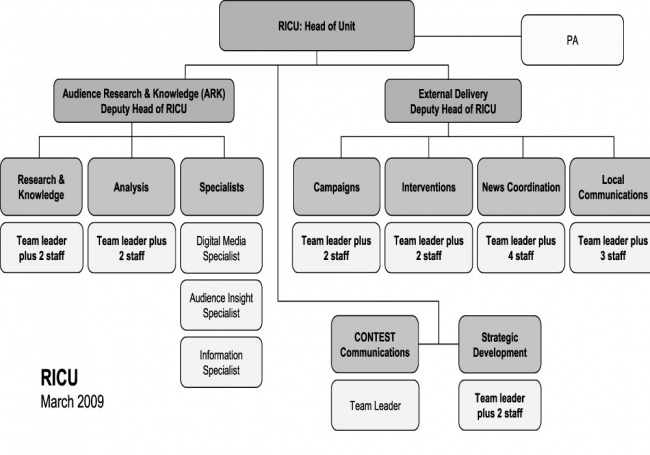
The first, Audience Research and Knowledge, ran teams for research, analysis, CONTEST communications and strategic development, plus digital-media, audience-insight and information specialists. The second, External Delivery, ran teams for Campaigns, Interventions, News Coordination and Local Communications. An office that monitors and analyses does not need a Campaigns team, an Interventions team and a Local Communications team.
The output had a catalogue, too.
The unit produced a numbered guidance series, running from RICU-01-07 through to RICU-22-08, with titles such as "Core Counter Terrorism Language and Messages", "Framing the Debate (Hearts and Minds)", "Muslim Grievances" and an "Evaluation Framework". Of the early series, the titles of seven papers were withheld from disclosure under the national-security exemption.
The public is not permitted to know what a 2007 internal communications paper was even called, on the ground that the name itself would imperil the realm.
A Greatest Hits Of British Counter-Messaging
The disclosed and reported campaigns, taken together, show the unit's tonal and methodological range, and they are worth setting out in some detail, because the abstraction of "strategic communications" dissolves the moment you look at the actual products.
The full list – at least the earliest tranch – has been exhaustively documented by CAGE.
Return to Somalia
The earliest documented case is also the most revealing about what the method is for. In January 2013, ahead of a London donor conference, RICU circulated talking points instructing ministers and officials to talk up Somalia's recovery and to stress the diaspora was returning home.
To carry that same message to the diaspora itself, the unit turned to the Anti-Tribalism Movement, a British Somali charity, and Breakthrough produced documentaries (“Return to Somalia: Adam & Abdi’s Story” and “Return to Somalia: Aliya’s Story”), presenting the country as a place of opportunity drawing its exiles back.
In October 2013, weeks after the films appeared, the Home Office declared parts of Somalia safe for the return of refugees and began a deportation pilot. This was two years after the European Court of Human Rights had ruled removals to Mogadishu would breach the prohibition on inhuman treatment, and two months after Médecins Sans Frontières had abandoned the country entirely over attacks on its staff.
Somalia as a place of “opportunities and optimism that are attracting thousands of other Somalis to return home”
A covert media campaign telling Somalis it was time to go home ran in step with a policy designed to send some of them back against their will. The pattern is the whole story in baby size: the message to the public and the message to the diaspora were drafted in the same building.
Help for Syria
Between 2013 and 2016 a website, Facebook page, YouTube channel and Twitter feed presented themselves as the work of a charity raising awareness of the suffering of Syrians. The operation was RICU's, produced through Breakthrough, and its stated objective was to influence conversations among young British Muslims so as to reduce the desire to travel to Syria.
It was fronted by three real charities, Hand in Hand for Syria, Syria Relief, and Human Care Syria, which were offered media support and even funding, then fell out with Breakthrough over the message, stopped receiving replies to their emails, and were never told who was paying.
A former employee of one of the charities later described the experience: everything produced under their logo had to carry the line that people should not travel to Syria but help from the UK instead, the Breakthrough team lead chased them daily for footage, and when the charities pressed on who the "private funders" were, they were told they were not permitted to know.
Sitting in on the meeting where their concerns were aired was a consultant from Faith Associates, taking notes. The reach was not modest. Stalls were set up at universities across the country, where staff spoke with more than 10,000 students. The Facebook presence reached 1,138,000 users a week. Leaflets went to 760,000 households, chosen for their "geographic interest" to the government, which is to say areas with large Muslim populations.
Nobody contacted was told the campaign was a government initiative. The Facebook page outlived the operation and at last count was liked by more than 56,000 people who, in all likelihood, still have no idea who built it.
The Truth About ISIS
When BBC Radio 4's Today programme gave airtime to the convicted extremist Anjem Choudary in December 2013, a set of short videos appeared on YouTube within hours, featuring Muslims condemning both Choudary and the BBC. A number of the participants were working with the Prevent programme. The spontaneity was the product.
Families Matter and Change the Picture #ChangeThePicture
The Syria messaging ran on more than one front. Families Matter, fronted by the charity Families Against Stress and Trauma, was launched at a July 2014 event attended by Theresa May, produced by Breakthrough, and funded by the Home Office through RICU, and reached over 160,000 views with a campaign built around the anguish of families whose children had travelled to Syria.
Change the Picture, fronted by the Muslim Charities Forum and funded by the Charity Commission, pressed the parallel message that British Muslims should give only to registered charities, the same line the Commission was pushing through its own Safer Giving for Syria material.
Only give to legitimate charities by checking the charity’s name and registration number against the online charity search tool.
Taken together with Help for Syria, they show a deliberate, co-ordinated effort across the Home Office, the Charity Commission, and a single PR contractor to keep every strand of the government's Syria messaging consistent while keeping the government's hand out of sight.
Fightback Starts Here #FightbackStartsHere
In July 2015 a campaign presented as a Muslim-led coalition against extremism was launched, fronted by the Leicester-based Federation of Muslim Organisations and lent weight by a Guardian letter signed by charities, safeguarding groups and relatives of the murdered hostages David Haines and Alan Henning.
The FMO's spokesman contrasted it favourably with the top-down Prevent strategy, calling it grassroots.
It had in fact been approached, funded and organised by Breakthrough, which also built the Federation an online radio station, Ummah Sonic.
The FMO says it never received a penny and supported the work in good faith because it opposed extremism in all its forms, which is precisely the point: the sincerity of the people fronting these campaigns is the very thing the concealment exploits.
Open Your Eyes and Not Another Brother #NotAnotherBrother
The same model recurs. Open Your Eyes, a web video project on the realities of IS, was launched by a Birmingham group, Upstanding Neighbourhoods, which Theresa May singled out for praise on a 2015 visit as exactly the kind of community volunteering the government could not manage on its own.
The group's coordinator (Sulaimaan Samuel), presented as a community activist, had in fact spent years embedded in the Ministry of Justice and police diversity work, which makes the Home Secretary praising his "grassroots" effort less a coincidence than a closed loop.
ISIS is lying to you. Open Your Eyes to the real story. Upstanding Neighbourhoods is exposing the truth. Hear from people telling their personal stories of how ISIS has affected their lives. We are working with young people, activists, bloggers and filmmakers to raise our voices against ISIS. Join us on our mission: get involved, start filming, share your views. Together we will crush ISIS propaganda.
Not Another Brother, an IS-themed film for the Quilliam think tank, itself a past recipient of Home Office money, was produced by the agency Verbalisation (run by army propagandist Sven Hughes) with Breakthrough as consultant, deliberately launched unbranded and styled to echo how IS released its own films so as to seed interest before Quilliam's involvement was revealed.
The £12,000 cost was described as crowdfunded, though no crowdfunding campaign could be found. The film then won a marketing award whose write-up claimed a global reach of "over half a billion people"; the video itself had been watched about sixty-two thousand times.
No matter how much disseminating ISIL’s propaganda might make you feel you’re part of an Islamist ‘brotherhood’, that reward is nothing compared with the cost of losing an actual brother as a result.
The gap between the boast and the view count is its own small monument to the genre. The Home Secretary praised the volunteers. The volunteers, in part, had been produced.
The Union Jack hijab #MakingAStand
After the British aid worker Alan Henning was murdered by Islamic State in October 2014, RICU reached for an image its contractor had already prepared: a woman wearing a Union Jack hijab.
Making A Stand, the women's organisation fronting the work, took the image to the Sun, which surrendered its entire front page to it and a further six pages inside.
RICU monitored the reaction and its staff referred to the front page, in internal correspondence later released under FOI, as "our product". Breakthrough was so pleased it hung a framed copy on the office wall.
That a tabloid front page presented as a grassroots stand against terror was logged internally by a government unit as merchandise tells you how the unit understands the British press, and how it understands the British public.
This Is Woke #woke #staywoke
Launched in 2019, as a Facebook page and Instagram feed describing itself as a youthful "media/news company" engaging in critical discussion of Muslim identity. It was created by Breakthrough for the Office for Security and Counter-Terrorism.
The camouflage was elaborate: videos about a trillion-tonne iceberg breaking off Antarctica and millions of pangolins hunted each year, panel discussions on veganism and dating apps, uplifting quotations from Martin Luther King, Nelson Mandela and the caliph Umar ibn al-Khattab.
Tucked among them, a video arguing it was time to hold extremism rather than Islam to account for terrorism went on to be viewed 1.7 million times. The women filmed for a feature on what wearing a hijab meant to them had been approached on the campus of SOAS and told they were taking part in a film for International Women's Day.
Under FOI, the OSCT refused to explain, citing national security, and would not so much as engage with the suggestion the site amounted to fake news.
Mr Meanor #ThinkAboutIt
A British-American boyband, secretly funded in 2016, toured Muslim-majority areas singing anti-radicalisation songs, performing in schools including Parrs Wood High in Manchester, whose former pupil had travelled to Syria. The lyrics referenced 9/11 and 7/7.
No, this is not a joke, Read the previous sentence again. The Home Office paid a boyband to sing about terrorism in British secondary schools without telling anyone the government was behind it.
Finsbury Park #WeStandTogether
On 19 June 2017 Darren Osborne drove a van into men near Finsbury Park Mosque, killing one and injuring ten. Young men at the scene restrained him until the imam, Mohammed Mahmoud, arrived.
Within hours, journalists at the police cordon were approached by a woman calling herself Gabbie, from a firm calling itself Horizon PR, who introduced them to a man named Shaukat Warraich of an organisation called Faith Associates. Warraich pressed the imam's pacifying role, and that angle came to dominate the coverage.
What Gabbie did not mention was Horizon PR had been created by Breakthrough and M&C Saatchi, that Faith Associates was part-funded by government contracts, and that the chain led back to RICU.
As Cobain revealed, it was all the work of a team within the British Home Office. Horizon PR, the apparent workplace of “Gabbie”, was created by Breakthrough Media, a communications company in London. And Breakthrough Media was operating under a contract with the Home Office’s Research, Information and Communications Unit (RICU).
Faith Associates was not a stranger to this world: the same outfit, in the person of the same Shaukat Warraich, had turned up a year earlier taking notes in the meeting where the Syria charities aired their misgivings about Help for Syria.
The young men who had actually restrained the killer felt they had been recast as a mob, and are now rarely seen at the mosque.
London Bridge #TurnToLove, #ForLondon, #LoveWillWin
Two weeks earlier, after the attack of June 2017 in which eight people were murdered, men in an unmarked van were admitted behind the police cordon and papered the area with posters bearing hashtags already circulating on Twitter: #TurnToLove, #ForLondon, #LoveWillWin.
Fly-posting is a minor criminal offence; the police took no action. When the cordon lifted, the public returned to find themselves surrounded by apparently impromptu signs of unity.
A government official then telephoned Southwark Council with the memorable line,
We're sending you a hundred imams.
Two days later about a hundred imams duly appeared on the bridge, and one read a statement condemning the attack.
The following weekend, Muslims handed out thousands of red roses in what an organiser described as a spontaneous gesture of love. She did not mention she worked in law enforcement at the Home Office.
Take Five and Cyber Aware
The method did not stay in the counter-terror lane. Take Five, an anti-fraud campaign, and Cyber Aware, a cyber-security campaign led from within RICU, show the same audience-influence machinery ported into consumer protection, fronted as ordinary public-information work and connected to the unit only through the career paths of the people running them.
2025: Zinc Network, YouTube, and £9.4 Million
None of this has stopped. the always-excellent Martin Williams at UK Declassified reported a year ago in July 2025 the UK government is secretly paying foreign YouTube stars to publish “propaganda” videos.
Disinformation? Well, they're the experts.
Details of Zinc Network’s projects for the government have been a highly guarded secret. In 2022, the company signed a £9,450,000 contract with the Foreign Office, which is due to end in December this year. Usually, large contracts are published in full on the government’s website, but in this instance the contract was kept under wraps.
For almost two years, the Foreign Office tried to prevent it from being released under the Freedom of Information Act, leading to three separate reprimands from the Information Commissioner’s Office (ICO) who ruled in favour of transparency each time.
The documents show that Zinc was contracted to help counter disinformation in 22 countries across Central, Eastern and Southern Europe, and in the Baltics. This is done partly by “providing a greater variety” of reliable information, as well as by “increasing societal and general public resilience to disinformation”.
This is just part of the "strategic messaging" catalogue produced by a unit the Home Office now describes, with a straight face, as an analytical office which undertakes open-source monitoring.
Controlled Spontaneity
The London Bridge posters and the Finsbury Park roses were not improvised. They belong to a pre-planned discipline contingency planners themselves call "controlled spontaneity", and the people who built it have described it with discomforting candour.
Hashtags are tested before attacks happen. Instagram images are selected in advance. "Impromptu" street posters are printed and held ready. Politicians' statements, vigils and inter-faith events are negotiated and drafted before there is anything to respond to.
The purpose, according to people involved in the work, is to channel public feeling towards empathy and unity and away from anger, and the system has been deployed, in variant form, after every major incident in Britain in recent years.
Its origins lie in planning for the 2012 London Olympics.
The 2011 riots had, by one senior planner's account, terrified the government, and Theresa May in particular. The Olympics plan was designed to "corral the Princess Dianaesque grief" expected after any mass-casualty attack, a phrase one planner used while describing the exercise, without flinching, as an attempt at mind control.
The model the Home Office reached for was the spontaneous outpouring of support for the footballer Fabrice Muamba, who collapsed on the pitch in March 2012; officials wanted, in the words of a planner present, to make people respond like that, so the Games could carry on.
The legal frame is the Civil Contingencies Act 2004, born of the panic of the 2000 fuel protests and the 2001 foot-and-mouth crisis, under which a National Recovery Working Group in the Cabinet Office produced protocols for "recovery" as a distinct, plannable phase of any disaster.
Lucy Easthope, who wrote government recovery plans for over a decade, has since recorded her own misgivings, suggesting the fight rhetoric has gone too far and the reflexive insistence on a "we shall overcome" message may not serve the bereaved.
Another planner put it more bluntly: the hashtag is an anaesthetic for the wider community, no replacement for real humanitarian care, and a way of ensuring the public feels it has done something, changes its profile picture, and stops agitating the government.
The discipline is not always imposed successfully.
In Salisbury, after the 2018 Novichok poisoning, locals reportedly told planners they did not want T-shirts proclaiming love for the town, they wanted the nerve agent cleared up. The planners, by their own account, played the hashtag game in Manchester after the Arena attack, where there were a lot of young people who liked it, and left the recovery stuff in the cupboard in Salisbury, where there was a lot of ex-military and, as the source put it, good sense.
Hold all of this in mind, because the 2026 reporting from Belfast and Southampton is not a novel allegation. It is the documented method of a decade, applied to a new kind of incident.
Exporting the Method: RICU International
If the domestic record were the whole of it, the constitutional objection would be serious enough. It is not the whole of it. Through RICU International, the British state has spent years building the same machinery abroad and pressing foreign governments to adopt it.
The export instinct was present almost from the start. In November 2008, the then home secretary Jacqui Smith met Pakistan's information minister Sherry Rehman to set out the British counter-terrorism communications model, and offered support for Pakistan to build a similar organisation of its own.
A unit barely a year old, still finding its feet at home, was already being marketed abroad as a template. What MEE later documented as RICU International was the maturing of an impulse visible in 2008: the conviction the British way of managing a population's perception of terrorism was an export good.
Much of the early production ran out of a "production hub" in Brussels, staffed by communications specialists and partners from EU institutions and member states. The individuals in the civil-society organisations delivering the messaging were expected to sign non-disclosure agreements, the express purpose being to conceal the governments' involvement. The same instinct for concealment, exported wholesale.
The respectable public face of the overseas work is the British Council, the body which promotes the United Kingdom abroad and is part-funded by the Foreign Office.
Through a programme called "Strengthening Resilience in MENA", funded by the European Union since 2016, the British Council fronted campaigns in Tunisia, Morocco and Lebanon while RICU played a key but less visible role behind the scenes.
The relationship was described, in an assessment report briefly posted to the British Council's website and then removed, as a partnership in which the Council engaged civil society and RICU engaged national governments "as a peer". The same report described local organisations being used as "buffer organisations" between a foreign government body and the communities it wished to reach.
Campaigns used rap music and graffiti to shift the attitudes of the young. One project, Ala Khatrek Tounsi ("Because You Are Tunisian"), ran during Ramadan in 2016 and 2017 and was held up internally as the programme's great success, complete with a commissioned rapper, Djappa Man, whose lyrics were critical enough of the police he insisted "There is no one can tell me what I say in my music".
The graffiti artist painting the campaign slogan on publicly owned walls was, according to the assessment, discreetly protected by police.
The campaign's own founder, Amina el-Abed ("strategic communications'), disputed the official account, insisting the idea was hers and the British Council and the Tunisian government had exaggerated their role, which only sharpens the point: the people on the ground and the people writing the assessment reports did not even agree on who was steering.
The export was not confined to North Africa.
By the end of 2018, RICU-I operations were under way in Jordan, Algeria and Pakistan, with events organised in Finland and the Netherlands.
The unit had drawn up plans to begin operating in France, where it had developed a football coaching programme through which counter-extremism messaging was being quietly disseminated. The contract to run the French, Belgian and wider operation was won by a consortium led by Adam Smith International, a foreign-aid contractor whose founders had earlier been compelled to stand down after the firm was found using leaked official documents for commercial advantage, and which was separately accused of allowing British aid money to reach militant groups in Syria.
Breakthrough Media, by then Zinc, was in the consortium. The contractor was expected to demonstrate an ability to operate in France, Belgium, Kenya, Bangladesh and Indonesia; the broader uptake of the model, on later reporting, stretched to Iraq, Kosovo, Spain and Estonia.
The most revealing line in the entire overseas archive is the statement of purpose. The contract told its private-sector deliverer the object was to build the capacity of partners to run such operations independently, and that RICU-I expected to see "evidence of increased political will" and "willingness to act on UK priorities".
The networks of civil-society organisations the contractor was to build abroad were to focus on diaspora communities with the most influence on the United Kingdom. The ultimate purpose of the overseas programme, in other words, loops back home: the contractors were told their operations should "deliver impact in UK priority areas".
One internal document went so far as to claim no other country had capabilities as developed as RICU's, calling it the most advanced strategic communications unit in the world. The self-regard is its own kind of evidence.
Update June 30 2026. The Home Office responded to a Freedom of Information request by this magazine about RICU-I.
In answer to points 1, 2, and 4, we can disclose that ‘RICU-I’ previously referred to the Research Information Communications Unit - International team, which was situated within the Office for Security and Counter Terrorism (OSCT). Both the team and this directorate no longer exist.
Regarding point 3, RICU-I was operational between 2016-2022. The team regularly
engaged and collaborated with international partners, and its remit was expanded in 2016 to both lead engagement with international partners on Prevent, as well as identify opportunities to work with those partners to deliver Prevent-type programmes, which aimed to reduce the risks of radicalisation. This programme element ceased mid-2022.
The information you request in point 5 is already publicly available, via the ‘Contracts Finder’ function on gov.uk, available here: Contracts Finder
The reaction in the target countries was not gratitude.
French commentators were unsettled to learn of British plans for counter-radicalisation on their soil. Fateh Kimouche, editor of the French Muslim site Al-Kanz, asked whether graffiti and rap could possibly address radicalisation and suggested the harder questions concerned Western foreign policy. Houria Bouteldja warned such campaigns breed self-criticism in the targeted communities, and that the spread of the model across borders had turned the fight against radicalisation into, in her phrase, a fig leaf for the real causes of extremism.
A unit founded to deter British teenagers from joining a foreign terrorist army had, within a decade, become an exporter of covert influence operations, teaching the technique to other governments and quietly hoping they would come to see the world as London does.
Who Has Actually Run This
The personnel record breaks into three tiers by evidential strength. Names confirmed by official biographies, parliamentary records or signed letters appear with high confidence. Names confirmed by reputable secondary reporting appear with medium confidence. Names confirmed only by indexed LinkedIn snippets appear with low confidence and are flagged as such.
The pattern itself is revealing: the senior leadership is identifiable, the bridge figures between the civil service and the contractor estate are partially identifiable, and operational staff are visible only through the personal career fragments those staff have themselves published on professional networking sites. A unit of this kind in a healthy democracy would be accountable to its citizens by name, role and remit, not by LinkedIn.
| Person | Role | Period | Confidence |
|---|---|---|---|
| Charles Farr | Director General, OSCT; RICU architect | 2007 to 2015 | High |
| Jonathan Allen | Established and led RICU | 2007 to circa 2009 | High |
| Dr Jamie Macintosh | Defence Academy (ARAG); named "instrumental" in creating OSCT and RICU | circa 2007 | Medium |
| Stephen Rimmer | Director of Prevent and RICU, OSCT | circa 2008 to 2009 | Medium |
| Phil Bastable | Strategic Communications Adviser, RICU (per LinkedIn) | August 2008 to December 2009 | Low |
| Peter Wilson | Senior RICU figure; Head of RICU by 2017 | circa 2009 to 2018 | High by 2017 |
| Ben Maitland | Head of News Coordination, RICU (per LinkedIn) | 2010 to 2011 | Low |
| Christopher Wainwright | Deputy Director, Strategic Communications, Home Office | 2010 to 2012 | Medium |
| Richard Chalk | Head of RICU; former Bell Pottinger, Baghdad | circa 2012 to 2015/16 | Medium |
| Jonathan Benjamin | RICU staff (per LinkedIn) | August 2013 to August 2016 | Low |
| Paul Wilson | Possible head, surfaces in Marine A court material | circa 2013 to 2015 | Unverified |
| Matt Collins | Director of Prevent and RICU, OSCT | by September 2016 | High |
| Miriam Wraight | Head of RICU; Cyber Aware lead | 2018 | Medium-high |
| Sara Skodbo | Acting Director Prevent, RICU and JEXU | from January 2019 | High |
| Michael Stewart | Head of Prevent (above RICU) | September 2020 to March 2025 | High |
| Dr Michelle Haslem | Director General, Homeland Security Group | from 2025 | High |
| Successor to Stewart | Director, Prevent Directorate | from 2025 | Not publicly identified |
| Current Head of RICU | Operational lead | present | Not publicly identified |
- Charles Farr went from OSCT to chair the Joint Intelligence Committee, the apex body coordinating Britain's intelligence assessment, before his death.
- Matt Collins, once Director of Prevent and RICU, is now Deputy National Security Adviser, having spent 2018 leading work with technology firms on automated terrorist-content moderation. He's recently been in hot water around the collapse of the China spy case.
- Sara Skodbo signed the June 2019 joint Home Office and Counter Terrorism Policing letter introducing the category of "mixed, unstable or unclear" ideologies into Prevent processing.
- Peter Wilson appeared on the agenda of the Club of Venice strategic communications seminar in 2017 and on the Joint Fraud Taskforce Oversight Board, the body linking RICU to the Take Five anti-fraud campaign.
- Michelle Haslem, currently Director General of the Homeland Security Group and the Home Office's Ethics Adviser (!!!!!), sits on the departmental Executive Committee and provides system leadership for counter-terrorism. She comes from the Foreign Office, which oversees MI6.
The chain of command above the unit therefore runs through identifiable people. The chain inside the unit does not. And two names complicate the picture in a way that goes to the heart of the unit's claims about its own independence from the organisations it funds.
Sabin Malik, "now known as Sabin Khan" per parliamentary committee written evidence, was identified as deputy head of RICU, having previously served as a Hounslow community-cohesion officer in 2008, exactly the kind of local Prevent pathfinder role then being scaled into national policy.
She is also the sister of activist Sara Khan, co-director of Inspire, the women's organisation which fronted the 2014 Making A Stand campaign and whose director was later appointed by the Home Office to lead its Commission for Countering Extremism.
Inspire has strenuously maintained it is independent of government. The Labour MP Naz Shah pointed to the obvious difficulty: an organisation championed by the Home Secretary and funded by the Home Office had a close family member in a senior post in the very Home Office unit producing covert counter-extremism campaigns.
Sara Khan's book The Battle for British Islam was, for good measure, co-authored by Tony McMahon, a Breakthrough Media consultant whose own indexed LinkedIn profile describes a project, the Network Hub, as "mainly funded by RICU":
An innovative program that took the UK's Prevent counter-terrorism model into the European Union. This was mainly funded by RICU, part of the UK Home Office, but certain activities were co-funded or supported by EU governments. I was involved in several activities. These included a campaign in Finland to promote the country's National Action Plan on countering radicalisation; a sports-based youth initiative in Paris Saint Denis and several events to convene civil society groups from across Europe.
The web of relationships between the unit, its contractor and its favoured civil-society faces was, on this evidence, a great deal closer than any of the parties cared to volunteer.
Joanna Shields, the former Facebook executive who served as Minister for Internet Safety and Security from May 2015 to June 2017, sat ministerially above the same online policy space and on her own LinkedIn claimed to have "Led the Research Information and Communication Unit", a claim better read as ministerial responsibility than line management, given she was not a civil servant.
Developed AI cyber intelligence tools used in counterterrorism efforts to identify extremist and hate speech on public social media platforms to determine how terrorist groups spread influence and misinformation across social networks and encrypted platforms. Led the Research Information and Communication Unit (RICU) in the Office for Security and Counter-Terrorism (Home Office).
She's now a baroness with an Orwellian startup.
Below the leadership tier sits a layer of names traceable only via professional networking sites: Phil Bastable, Ben Maitland, Georgina Cotton on the Online Policy Team; Peri Derby in Home Office programme support; Jonathan Benjamin from 2013 to 2016; and a small group of external producers including Jane Preston, whose indexed profile describes her producing Prevent films for RICU, the Home Office and the Foreign Office.
None of these names appears on a public Home Office staff list. None has been required to answer for the work.
Sixth Floor, Two Marsham Street
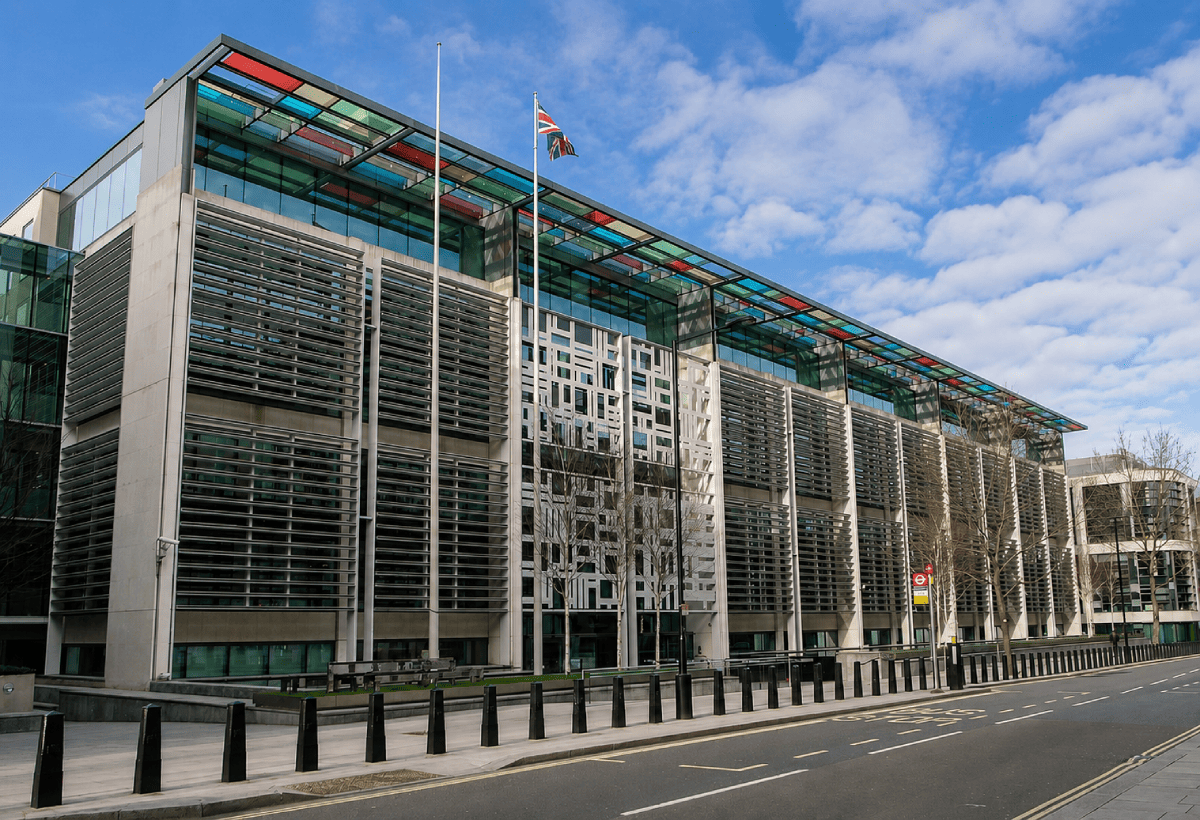
The building is no mystery. RICU sits at 2 Marsham Street, the Home Office headquarters since 2005, a grotesquely-ugly, postmodern, seven-storey block of glass and pale stone running half the length of the western government estate. The Information Commissioner confirmed the address in 2022 while upholding the department's refusal to answer a substantive RICU question on national-security grounds; the address sat, as ICO addresses do, in the header of the refusal notice itself.
The address chain runs back further.
In late 2008 the Associated Press's London political correspondent David Stringer asked the Home Office for basic information about RICU. The reply, eventually re-sent in early 2009, came on letterhead reading "Direct Communications Unit, 2 Marsham Street", and disclosed thirty-one full-time and one part-time staff, a 2008/09 admin budget of £959,305 plus a further £3.66 million allocation, and nothing at all spent on publications, advertising, promotion or events during the unit's first full year.
Two details deserve note.
- The institutional one is the routing: RICU correspondence was going out under the headed paper of the Home Office's Direct Communications Unit, the department's general press and PR team, meaning the unit was administratively bound up with the open communications arm while doing classified-track work invisible to that arm's normal output.
- The operational one is the headcount trajectory. Three staff in June 2007. Thirty-two by late 2008. Twenty-two by 2023. The unit appears to have been getting smaller. The contractor footprint outside it has gone the other way.
The floor is more interesting
On 20 and 21 April 2016 the US Department of Homeland Security sent its Deputy Secretary, Alejandro Mayorkas, and a delegation to London for a Joint Contact Group meeting at the Home Office. The agenda, later released through American Freedom of Information litigation and posted by the American Civil Liberties Union, records the Permanent Secretary escorting the delegation to Conference Room 2 on the sixth floor for a working lunch built around a single agenda item: "RICU Presentation on Strategic Communications".
JOINT CONTACT GROUP
@ The Home Office, 2 Marsham Street, 20-21 April 2016
Wednesday 20 April
1200 The Permanent Secretary will greet Deputy Secretary Mayorkas and escort the delegation to Conference Room 2 (6th Floor)
1200-1300 Working Lunch • RICU Presentation on Strategic Communications
1300-1330 Intelligence Briefing • Overview of the Threat Picture
Emerging Trends
EU Migrant Crisis
JT AC-OHS Paper on Citizens of the Caliphate Paper
That places RICU, in April 2016, hosting senior visiting American officials in what looks very much like its own working territory.
- The address came from a regulator's refusal notice and a citizen FOI answered on the Direct Communications Unit's headed paper.
- The floor came from a leaked American meeting agenda.
- The cross-departmental reach, into the Foreign Office and the then Department for Communities and Local Government, came from Guardian reporting.
None of it came from a Home Office organogram, because no organogram identifying the unit has been published. None came from an estates entry, because none exists. None came from a unit webpage, because none exists either. The building has a postcode. It does not have a public door.
From ISIS Brides to 60% Of The Country
In 2007 MI5 publicly disclosed around two thousand individuals of concern. In 2014 an ISIS caliphate drew British teenagers, including a notorious cohort of young women, into Syrian territory. In 2015 came the Bethnal Green Academy schoolgirls. In 2017, three Islamist attacks in twelve weeks killed 36 people across Westminster, Manchester, and London Bridge.
The unit had a target population numbering in the low thousands and a remit grounded in preventing recruitment into a designated terrorist organisation conducting a sectarian war abroad and inspiring atrocities at home.
Whatever objections one might raise to the methods, the population being addressed was narrow, the threat was specific, and the public could readily understand the connection between the two.
The messaging matched. The four "key messages" RICU set itself in 2007/8, recovered under the Freedom of Information Act by Miller and Sabir, each paired a line to promote with the line it was meant to counter.
| Message to promote | Message to counter |
|---|---|
| Terrorism is a real and serious threat to us all | The threat is exaggerated by the UK government |
| Terrorists are criminals and murderers | Attacks against the UK are legitimate |
| Terrorists attack the values that we all share | Attacks are justified by "Muslim values" |
| We all need to work together to tackle the challenge | The challenge is for Muslims alone to address |
One might quarrel with the state scripting civic sentiment at all, but the messages are at least about terrorism, and an evaluation found only a single government press release across fifteen months had strayed off them, which tells you how tightly the lines were held. Hold that 2007 grid in mind, because what the unit came to treat as a "message to counter" did not stay still.
The 2024 picture is unrecognisable.
The unit's analytical product, as revealed through leaks and Shawcross's review, now classifies vast swathes of ordinary British cultural and political life under headings imported from American academic activism.
"Cultural nationalism" is the key phrase.
This garbage sociology originated in critical race theory and post-colonial studies as a category for examining identity formation in newly independent states. RICU has redeployed it as a domestic risk classification, a sub-criminal index of suspicion attaching to people who watch the wrong television, read the wrong novels, or vote the wrong way.
The categorisations published in leaked RICU documents include the following:
| RICU-flagged item | Stated significance |
|---|---|
| Michael Portillo's Great British Railway Journeys | Indicator of susceptibility to far-right views |
| Yes Minister | Indicator of susceptibility to far-right views |
| The Thick of It | Indicator of susceptibility to far-right views |
| Shakespeare | "Key text" of interest to white nationalists/supremacists |
| Chaucer | "Key text" of interest to white nationalists/supremacists |
| Milton | "Key text" of interest to white nationalists/supremacists |
| Sir Jacob Rees-Mogg (in a 2019 document) | "Associated with far-Right sympathetic audiences and Brexit" |
| Rod Liddle, Douglas Murray, Peter Hitchens | Contributing to "negative views about Islam and Muslims via the pages of mainstream publications" |
| Book on the Rotherham rape gangs | Cited in same analytical frame |
The list reads less like a counter-terrorism risk register than a graduate-school reading list cobbled together in the grip of an undergraduate enthusiasm. Each item is, at the latest, part of the British cultural mainstream. Several are explicitly part of the GCSE and A-level curricula. Yes Minister was Margaret Thatcher's favourite programme; it satirises Whitehall, and the comedy was once treated as a sign of a healthy democracy rather than a flag in a Home Office radicalisation database.
The Brexit vote secured 17.4 million ballots. The Reform vote at the 2024 general election added a further four million. Polling on net immigration has shown majorities in the high fifties to low seventies opposing current levels for over a decade. Concern about grooming gangs is documented in courtrooms from Rotherham to Telford.
If "cultural nationalism" includes a preference for Shakespeare, Brexit, lower migration, the prosecution of organised paedophile networks and BBC1 at six o'clock, the category covers something close to sixty per cent of the country.
William Shawcross's published finding was that the unit's bar for inclusion was "comparably low" for the extreme right and "relatively high" for Islamism, and that much of the extreme-right material fell "well below the threshold for even non-violent extremism".
The asymmetry has a practical meaning.
A Home Office unit funded for nineteen years to address Islamist recruitment is now, by its own internal analysis, treating a majority of the resident population as adjacent to a radicalisation pipeline. Staff training, Shawcross noted, had included an essay by the campaign group Hope Not Hate citing the work of mainstream columnists as contributing to "negative views about Islam and Muslims".
Michael Portillo, seeing his railway programme on the list, asked with characteristic restraint why senior officials were not stopping this sort of thing before it surfaced and embarrassed ministers. The answer, presumably, is that the senior officials commissioned it.
Sir Jacob Rees-Mogg was sharper, accusing the unit of squandering effort on elected politicians and diverting resources from genuine wrongdoers.
Professor Anthony Glees identified the constitutional anomaly precisely, describing the unit as occupying a shadowy area between what the Home Office does and what MI5, or the old Special Branch, ought to be doing.
The drift did not stop being a live policy matter once Shawcross had reported.
In August 2024 the Home Secretary, Yvette Cooper, commissioned what officials called a "rapid analytical sprint" to extend a new counter-extremism strategy. When the resulting papers leaked to the think tank Policy Exchange in January 2025, RICU turned out to be one of their authors, working alongside the Home Office Prevent section and a body called Homeland Security Analysis and Insight.
The longest of the documents seen by Policy Exchange is entitled “CounterExtremism Sprint: Understand”, which was jointly authored by the Home Office Prevent section, the Research, Information and Communications Unit (RICU), and Homeland Security Analysis and Insight (HSAI). There is minimal information in the public domain about the latter two bodies and in this respect, the documents offer a fascinating glimpse into a world about which little is known.
The papers were widely read as an attempt to downplay Islamism, which on the leakers' own figures accounts for the overwhelming majority of terrorism deaths, injuries and MI5 casework in Britain, in favour of a sprawling field of supposed extremisms taking in "misogyny," an interest in gore, the "manosphere" and the making of "claims of 'two-tier' policing".
Indeed, much of this is risible. It is absurd.
The sections on Islamist and Far Right extremism are followed by a page devoted to extreme misogyny, much of which details the harms flowing from the “manosphere”, men’s rights activists, pick up artists and Incels (the involuntary celibate).
Beyond this, it is striking – given the recent political furore around the issue – that the discussion of “extreme misogyny” has almost nothing to say about ‘grooming gangs’. It would be hard to think of a more obvious set of harms arising from what in other contexts the Sprint would term “extremist” views about young girls. Yet on this subject, the text is mostly silent.
Later, under the list of harms which result from extremism, we are informed child sexual exploitation and abuse as a result of extremist beliefs is perpetrated by Satanist groups such as the Order of 9 Angles, 764 and Com Network.
Among the recommendations was the reversal of recent protections against the recording of non-crime hate incidents, the police-database entries a person can acquire simply because someone disliked what they said.
Along with Labour MPs, it names the following Whitehall mandarins:
- Chloe Squires – Director General, Homeland Security Group, Home Office
- Michael Stewart – Director, Prevent and Counter-Extremism, Home Office
- Scott Storrie – Deputy Director, Counter Radicalisation and Enablers Unit, Home Office
- DAC Victoria Evans – Senior National Coordinator, Counter Terrorism Policing\
- Paul Gianassi OBE – Hate Crime Advisor, Nationall Police Chiefs Council
- A Joint Terrorism Analysis Centre representative (?)
- A Security Service (MI5) representative (spycatching)
- A GCHQ representative (wiretapping)
- Robin Simcox – Commissioner, Commission for Countering Extremism
- Helen Earner – Charity Commission
A unit set up to taint the Al Qaeda brand was now helping to draft the case for logging more lawful opinions on police systems.
Belfast, Southampton, and the Rioters Who Were Never Going to Be Heard
In June 2026 the streets of Belfast filled with anti-immigration protesters after the stabbing of Stephen Ogilvie, allegedly by Hadi Alodid, a 30-year-old Sudanese asylum seeker. Police deployed water cannons.
Reporting based on Whitehall sourcing has placed RICU at work with the Police Service of Ireland's C3 intelligence unit, identifying online "calls to protest" and supplying:
strategic messages to the police to ensure the protesters were portrayed as unsympathetic thugs, rather than activists, and effecting behavioural change.
Similar sourcing places the unit advising Hampshire family-liaison officers following the killing of Henry Nowak by Vickrum Digwa, who claimed false racial abuse and self-defence and now serves a life sentence.
A unit set up to deter the recruitment of British teenagers into a foreign terrorist army is now reportedly briefing a Belfast police force on how to characterise furious citizens responding to the alleged stabbing of a man by an asylum seeker.
Whether one regards the protesters as legitimate or thuggish is beside the question. The Home Office has not been authorised by Parliament to determine which citizens count as activists and which count as thugs.
The framing of public anger is meant to be the work of public debate, contested in newspapers, on broadcast platforms, in pulpits and pubs, and ultimately at the ballot box.
When a state "strategic communications" unit assumes the work of deciding the legitimacy of a public reaction in advance, public debate is no longer the mechanism by which the country reaches its judgement. The mechanism is the Home Office reaching it on the country's behalf and seeding the conclusion through unbranded intermediaries.
The Belfast and Southampton claims are single-sourced and unverified at the documentary level. Treat them as the reporting presents them.
What does not require anonymous sourcing, because it is the documented controlled-spontaneity record of the previous decade set out above, is the linguistic uniformity of post-incident statements.
- Families ask for privacy.
- They appeal for calm.
- They reject hatred.
- They refuse to let the perpetrator divide communities.
- The hashtags rotate; one is always trending within forty-eight hours.
- The vocabulary is so reliable a competent press officer could draft it without knowing the names of the dead.
The proper public response to a paid Home Office unit with a contractor pipeline including PR firms specialising in capacity-building for civil-society organisations is not to assume each statement is rehearsed.
It is to demand a public account of when the unit or its contractors have shaped a public-facing statement, briefed a family-liaison team, prepared talking points or seeded a hashtag, and when they have not. No such account exists. No mechanism for obtaining one exists either.
Behavioural Science Becomes Statecraft
RICU did not arrive in a vacuum. The wider Whitehall behavioural-influence ecosystem has been built piece by piece over two decades.
| Year | Capability | Net effect |
|---|---|---|
| 2000 | Terrorism Act and RIPA | A legal architecture for treating threats as warranting extraordinary measures |
| 2007 | RICU and counter-terror communications guidance | Domestic strategic communications inside the counter-terror remit |
| 2010 | Behavioural Insights Team, Cabinet Office | Behavioural economics as a routine governing instrument |
| 2010s | RIPA local council use | 186 councils, more than 55,000 days of covert surveillance over five years (Guardian FOI) |
| 2013 | Snowden disclosures | The public sees the scale of state surveillance |
| 2014 | BIT partly spun out | Methodological diffusion into private contracting |
| 2015 onwards | 77 Brigade established | Military information operations enter the domestic policy imagination |
| 2016 onwards | Investigatory Powers Act and Technical Capability Notices | Statutory compulsion of communications providers |
| 2020 to 2022 | Covid behavioural campaigns | Population-scale behavioural messaging is normalised |
| 2021 | BIT wholly owned by Nesta | Further diffusion |
No personnel or document trail in the public record connects RICU institutionally to the Behavioural Insights Team.
The link is methodological convergence: the proposition governments can model their own populations as audiences whose behaviour is to be reshaped through carefully calibrated message design, distribution, channel selection and reinforcement.
- 77 Brigade is a military formation.
- RICU is a civilian unit.
- BIT is a Cabinet Office descendant now wholly owned by a charity.
Each is governed under different rules. The cumulative cultural effect is identical: the line between informing the public and managing the public has eroded so quietly almost nobody noticed it going.
The Restorationist will be documenting every addition to the Orwell State over time in a forthcoming project.
A Word About State "Capabilities"
When the Home Office is pressed on RICU's analytical output, the boilerplate refusal cites "HMG capabilities". This is the vocabulary of intelligence sources and methods, of military hardware, of cyber tooling.
A communications department briefs the public, explains policy and publishes its evaluations. It does not protect its work product on the basis disclosure would degrade an operational capability against an adversary.
RICU's defenders cannot have it both ways.
- Either the unit is a "strategic communications" office answerable to the same propriety standards as the Government Communication Service, whose Civil Service Code values require communications to be objective, explanatory and a justifiable use of public funds; or
- It is an intelligence-style capability operating against a target.
The Home Office is using the second vocabulary while claiming the first remit. The target, by necessary inference, is the British public, because the British public is the only audience available to a domestic communications unit.
Section 24 Applied To A Job Title
Citizens, journalists, and researchers have spent the past decade lodging Freedom of Information requests about basic governance questions concerning RICU, and the Home Office's pattern of replies is a record in its own right.
In May 2020 the researcher Dr Emma L Briant submitted a four-part request asking who heads RICU, who the head's direct line manager is, how many staff the unit has, the budget for the current financial year, and the cost of publications, advertising and events in 2019.
The Home Office's first response was an extension letter invoking Section 24 (national security) and Section 31 (law enforcement) and announcing it needed more time to apply the public-interest test. A head's name. A line manager. A headcount. A budget figure. These were treated as plausibly engaging national-security and law-enforcement exemptions before any substantive reply was attempted. No comparable extension would attach to the same questions asked of the Direct Communications Unit upstairs in the same building.
Six weeks later Dr Briant received a substantive reply to a separate FOI on Covid-19 disinformation. The pattern there is sharper than the substance. RICU's Covid disinformation advertising budget was disclosed: zero. The number of contractors assigned to it since December 2019 was disclosed: also zero.
But the number of RICU personnel working on Covid counter-disinformation was refused under Section 24. A budget will be disclosed. A contractor count will be disclosed. A headcount will not. The boundary is unprincipled on its face: it suggests the Home Office regards the number of staff working on a topic as more sensitive than the money the same staff have spent on it.
In December 2018, after a six-month delay, the Home Office confirmed RICU had reviewed drafts of the 2018 CONTEST strategy and recommended changes to the document's language; the drafts themselves were refused under Section 24 and Section 35(1)(a) (formulation of government policy).
The founding rationale of the unit in 2007 included vetting the language officials used about terrorism. The 2018 confirmation extends that role into the drafting of the United Kingdom's principal published counter-terrorism strategy. The unit shapes the words the state uses about its own work.
In May 2026 researcher Meika Nozaki asked for any lists identifying specific media as associated with right-wing or left-wing radicalisation since January 2015, naming the kinds of analytical product the Shawcross review had already partly exposed. The Home Office's reply was a neither-confirm-nor-deny under Section 24(2). The substantive refusal described the unit only as analytical and observational, undertaking open-source monitoring to understand the terrorist and extremist media environment.
There was no acknowledgement of campaign delivery, media buying, advertising procurement, PR consultancy, civil-society capacity-building or communications product development, all of which the 2019 contract list shows the unit had under live contract at the time. The public-facing self-description and the operational contract list belong to two different organisations sharing the same acronym.
The four refusals form a pattern:
- Asking who runs the unit triggers national security.
- Asking how many people work on a topic triggers national security.
- Asking what is on a reading list triggers a national-security neither-confirm-nor-deny, even when the answer has already partly leaked through an independent review.
- Asking what the unit advised on a public strategy document triggers a combined national-security and policy-formulation refusal.
The exemptions are statutory and the Home Office is entitled to invoke them. The question is whether routine governance information ought, in a parliamentary democracy, to be plausibly capable of attracting them at all.
Zero Basis In Law
Regardless of how clearly absurd it has become, Prevent at least has a statutory base in section 29 of the Counter-Terrorism and Security Act 2015, imposing the Prevent duty on schools, universities, NHS trusts, councils and other specified bodies.
RICU has nothing comparable. No statutory instrument creates it. No published code of practice constrains it. No dedicated governance framework appears in the public domain. What does appear, in repeated parliamentary answers, is ministerial authorisation given privately in 2007 and refreshed through CONTEST updates in 2011, 2013 and 2018.
RICU's working is described thus over time:
2011:
The cross-departmental Research, Information and Communications Unit (RICU) has had a central role in developing counterideological or counter-narrative work. We believe that their track record has been mixed. Research has enhanced understanding of audiences here and the impact of specific messages. But RICU’s counter-narrative work has not always been successful. Some projects struggled to have an impact and were difficult to evaluate. Insufficient work has been done to understand how to rebut the more complex texts circulating in this country which justify terrorism. Government has a key role to play here in providing information about what those texts are. Communities and theologians have a role to play in explaining why they are wrong.
2018:
Civil society groups provide credible voices to counter radicalising and extremist narratives. Our Research, Information and Communications Unit (RICU) helps these groups to amplify their voices both in communities and online. RICU brings together our civil society partners with industry experts to provide them with the digital and communications support they need to deliver their own campaigns. This support can include creative advice, production capabilities, website building, media training and public relations support.
The work of the Research, Information and Communications Unit (RICU) based in the Home Office, and the Global Coalition Against Daesh Communications Cell, based in the Foreign and Commonwealth Office, has positioned the UK at the forefront of the battle against terrorist propaganda, including specifically online terrorist content. Working with international partners, we continue to push industry to take a more proactive approach to terrorist content on their platforms.
By 2023, very little was appearing to name this organisation at all:
As the challenge of detecting and disrupting potential terrorists increases, the role of the public and industry has become increasingly more important – working alongside partners, Home Office Communications play an increasingly important role communicating about CONTEST and supporting the public and private sector’s capability and willingness to contribute to the collective response. Home Office Communications does this by maintaining oversight and co-ordination of communications activity to ensure consistency and quality of messaging reaching the public and private sector.
To further support the public and private sector in their role, Home Office Communications will strengthen its co-ordination and delivery of public communications related to counterterrorism – this includes new communications initiatives on Prevent reaching the public and sectors, supporting further synergies and improvements across communications campaigns to ensure their effectiveness with audiences, and championing improvements to information sources and reporting touchpoints for the public and private sector.
A unit running for nineteen years, spending nine figures cumulatively, operating across counter-terrorism, organised immigration crime, cyber crime and money laundering, briefing police and family-liaison teams during national incidents, and exporting its method to a dozen foreign governments, has nothing more than internal ministerial sign-off as its public legal anchor.
Public-law oversight is, in theory, available from three places:
- the Home Affairs Select Committee,
- the Intelligence and Security Committee, and
- the Information Commissioner.
In practice none produces routine, public, RICU-specific scrutiny. The Home Affairs Committee is broad. The ISC's counter-terrorism work is necessarily closed. FOI requests run into "HMG capabilities".
The Information Commissioner's guidance on data protection is unambiguous: publicly available personal data remains personal data, and a public authority processing it requires a lawful basis and transparency.
If RICU is processing identifiable or inferable personal data through open-source monitoring of the British online environment, data-protection law is engaged whether the source is public or not. The public has seen no Data Protection Impact Assessment, no privacy notice, no retention schedule and no lawful-basis assessment covering the unit's monitoring. They may exist internally. They are not visible. They have not been audited by anyone outside the department.
The Current Chain of Command
The 2026 picture, so far as it is publicly traceable.
| Tier | Office | Holder |
|---|---|---|
| Cabinet | Home Secretary | Shabana Mahmood |
| Ministerial | Security Minister | Dame Angela Eagle, appointed 12 June 2026 |
| Civil service apex | Permanent Secretary, Home Office | (per departmental record) |
| Group level | Director General, Homeland Security Group | Dr Michelle Haslem |
| Directorate | Director, Prevent Directorate | Not publicly identified after Michael Stewart's March 2025 departure |
| Operational | Head of RICU | Not publicly identified |
| Staff | RICU allocated personnel | 22 (per 2023 disclosure) plus contractors; at least four further analyst and researcher posts advertised in 2025 |
| Sub-structure | Internal placement (per 2025 recruitment) | RICU "Knowledge Hub", within the Counter-Radicalisation and Enablers Unit, Homeland Security Group |
| Premises | Office locations | 2 Marsham Street, London SW1P 4DF (confirmed via ICO decision notice and leaked US DHS meeting agenda; specific floor undisclosed in current period), plus a Manchester site confirmed by the 2025 recruitment |
Michael Stewart departed as head of Prevent in March 2025 following the Southport inquiry. His successor has not been publicly identified. Nor has the named current head of RICU.
A unit of this importance and footprint should not be a question whose answers require investigative reporting. The names should appear on the front page of an organogram. The address should appear in a public estates register. The biographies, professional histories and signed published guidance should be available to any citizen whose taxes pay for them.
Whatever the silence around the leadership implies, the unit is not winding down. In the summer of 2025 the Home Office advertised openly, on Civil Service Jobs and on LinkedIn, for three senior counter-terrorism analysts and a researcher to join what the advert called RICU's "Knowledge Hub" within the "Counter-Radicalisation and Enablers Unit" of the Homeland Security Group. It was posted in The Investigator magazine. A comment links it directly to the Civil Service jobs portal.
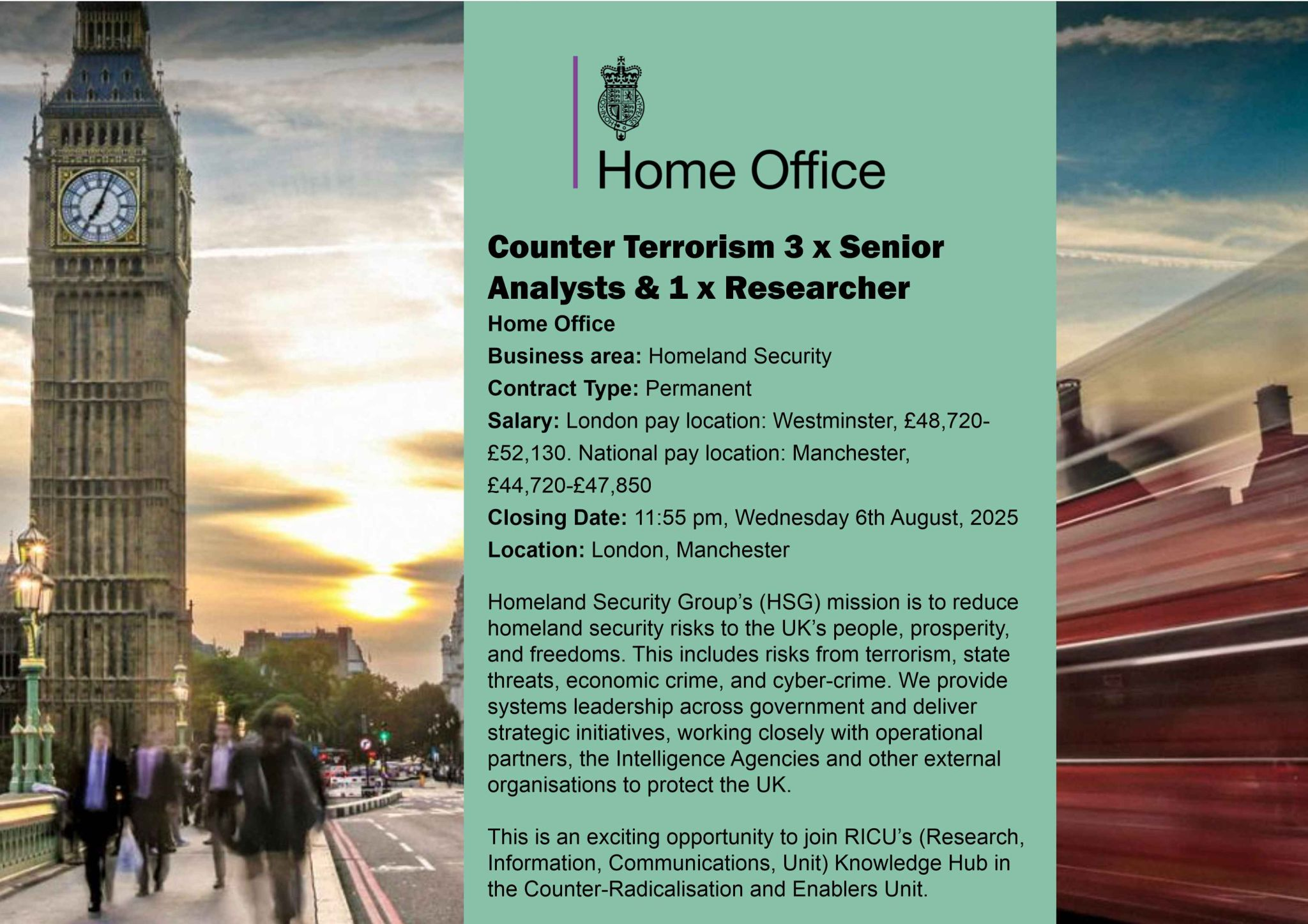
The posts were permanent, based in London or Manchester, on analyst salaries running from roughly £44,720 to £52,130, with a closing date of 6 August 2025, and the advert restated the group's remit in the now-familiar widening terms: terrorism, state threats, economic crime and cyber-crime.
It was also posted on StudySmarter, and the content is very revealing:
The advert is the freshest public sighting of where the unit sits and what it calls itself, and it names a sub-unit, the Counter-Radicalisation and Enablers Unit, and an internal brand, the Knowledge Hub, that appear in no published departmental structure.
It also confirms a London unit now recruits to a second site in Manchester, a fact recoverable only because a recruiter needed to state a pay band. The contradiction is total.
A unit that will name its sub-teams, its salary scales and its office cities in a LinkedIn job post cannot coherently maintain that the very same structural facts would threaten national security the moment a citizen asks for them under the Freedom of Information Act. The recruiter and the disclosure officer work in the same building. They cannot both be right.
The fuller researcher advert from the same 2025 round, closing on 10 August, fills in the structure the department has never published. It places the Counter-Radicalisation and Enablers Unit inside the Prevent Directorate within the Homeland Security Group, which finally fixes the chain:
- Homeland Security Group,
- then Prevent Directorate,
- then the Counter-Radicalisation and Enablers Unit,
- then RICU's Knowledge Hub.
The Knowledge Hub, the advert explains, is an "insight and research-led" team built to supply the evidence base for Prevent interventions, and it is itself made of three teams:
- Research,
- News and Analysis, and
- Data and Innovation.
The 2009 organogram had an Audience Research and Knowledge branch with research, analysis and digital-specialist teams. Sixteen years on, under a fresh name, the same three functions sit in the same place. The continuity is the point: the analytical core the Home Office describes as benign open-source monitoring has carried the same form since the unit's first full year.
The duties listed are harder to square with the word "monitoring".
The researcher is to:
- Analyse how terrorist content is built and how it lands with its intended audiences
- Commission and lead external research through "academia and commercial partners",
- Horizon-scan for emerging risks, including the post-Southport category of "Violence Fascinated Individuals" and the supposed "links between state threats, terrorism and extremism".
The contractor pipeline this whole piece has traced is, in the advert, simply a line in a job description. So is the unit's reach into ministers' red boxes. The successful candidate must provide out-of-hours analysis in response to terrorism and national-security incidents, working with Homeland Security Operations to "feed into ministerial briefings" and holding 24/7 cover, with on-call duty roughly one weekend in two.
That last detail is the one to keep in mind.
A team the department characterises, when refusing Freedom of Information requests, as an "observational research" function turns out to run a rota feeding real-time analysis into ministerial submissions during live incidents.
That is precisely the configuration the Belfast and Southampton reporting describes, set down in the Home Office's own words to attract a researcher on a civil-service salary. The unit's public self-description and its recruitment prospectus are, once again, two different organisations sharing an acronym.
Questions Parliament Has Not Yet Asked
The following ought to be obtainable through a combination of well-drafted Freedom of Information requests, written parliamentary questions and Home Affairs Committee correspondence. None touches genuinely sensitive intelligence material. All are routine in any well-governed democracy.
- The current RICU organogram, grade structure and headcount, including the named operational head
- The named current Director of the Prevent Directorate
- The specific floor and room locations occupied by RICU within 2 Marsham Street, the offices it has occupied since 2007, and whether it is currently co-located with the Prevent Directorate, the wider Homeland Security Group, or any other operational unit
- A full account of the "Knowledge Hub" and the "Counter-Radicalisation and Enablers Unit" named in the 2025 recruitment, including how they relate to the Prevent Directorate, what the RICU Manchester site is, when it opened and how many staff it holds
- All live contracts and framework call-offs in use by RICU or the Prevent Directorate since April 2023, with values, periods and contracting routes
- Every Data Protection Impact Assessment, privacy notice, retention schedule and lawful-basis assessment covering the unit's open-source monitoring
- The full list of Prevent-funded civil-society organisations managed via RICU programmes since 2015, with funding, dates and contractual route
- The number of campaigns since 2020 delivered through third parties without overt Home Office branding
- The proportion of RICU output now produced in-house following the 2023 Shawcross response
- Ministerial submissions and governance papers approving major RICU campaigns since January 2023
- Whether police forces, family-liaison teams, hospital trusts, schools or local authorities have received RICU communications support in the past five years, and on what authority
- The legal basis under which RICU processes open-source personal data on British residents
- The frequency, format and recipient list of regular written RICU output to ministers
- A specific account of the methodology by which "cultural nationalism" entered the RICU classification scheme, who approved its inclusion, and the empirical basis on which Shakespeare, Chaucer and Milton came to be described as "key texts" of white supremacism
- RICU's full contribution to the 2024 "rapid analytical sprint" commissioned by the Home Secretary, including every draft, recommendation and supporting analysis it authored on extremism thresholds and on the recording of non-crime hate incidents
- The unit's current internal branch and team structure, set against the 2009 organogram (Audience Research and Knowledge; External Delivery), and the present function of each delivery team
- The full operational scope of RICU International, its current contracts, its budget and its staffing, the complete list of countries in which it has operated since 2014, and the basis on which a domestic counter-terrorism unit came to run influence operations across a dozen foreign states
- A full account of the use of unbranded intermediaries, including Breakthrough Media, Zinc Network, Horizon PR and any successor vehicles, to disseminate government messaging to British audiences without disclosure
- The current contract list using the taxonomy disclosed in 2019, with values, periods, contracting routes and the identity of the supplier holding each line
A department willing to answer those questions has nothing to hide. A department unwilling to answer them is making the constitutional argument for those of us who have been making it without help.
Time For Full Disclosure
There is a legitimate state interest in contesting jihadist propaganda. There is a legitimate state interest in clear official communication during disorder. There is a legitimate state interest in accurate public-health messaging during crises.
None of those interests requires what currently exists.
They do not require:
- A unit operating on private ministerial authorisation.
- A contractor pipeline whose ultimate paymaster is invisible to journalists at a police cordon.
- Boybands.
- A tabloid front page logged internally as "our product".
- A hundred imams summoned by telephone, or roses handed out by a Home Office official posing as a member of the public.
- Rap videos and graffiti in Tunis, a production hub in Brussels, or non-disclosure agreements designed to hide a British government's hand from the citizens of other countries.
- The categorisation of Chaucer as the reading material of white supremacists, Yes Minister as an indicator of latent extremism, or Sir Jacob Rees-Mogg's name in a Home Office briefing on far-right sympathisers.
- The inclusion of opinions held by the majority of the country in a sub-criminal risk register.
- The establishment of a London office address being a fact recoverable only via leaked American documents.
- The language of "HMG capabilities" to shield a communications unit from public examination.
What they do require is statutory underpinning, a named public code of practice, independent inspection by a body with the powers to demand documents, regular published reporting of expenditure broken down by campaign and contractor, a hard prohibition on the use of unbranded third-party intermediaries to influence British audiences without disclosure, and an explicit statutory limit confining the unit's analytical remit to proscribed organisations and the lawful definition of terrorism rather than to the political and cultural attitudes of British citizens.
None of this is radical. It is the minimum a constitutional democracy owes itself.
Until those minimums are in place, the only honest description of the Research, Information and Communications Unit is a government propaganda department permitted to flourish because its initials are boring, its founding remit was defensible, and almost nobody in Parliament has been willing to do the unglamorous work of bringing it under proper control.
A unit conceived to contest the recruitment of British teenagers into a foreign terrorist army has, on its own documented analytical record, expanded its register of suspect cultural markers until it covers something close to a national majority, while exporting the same covert method to a dozen governments abroad. Boring initials are not a constitution. A defensible founding story is not a perpetual licence.
Nineteen years of quiet expansion in the shadow of the Home Office should now end. Sooner or later, a Parliament willing to act like one will need to say so out loud.