What Does A Properly Configured State Look Like?
Why does the state exist? Not what it currently does. Why does it exist at all? Begin there and the entire British fiscal debate transforms from arguing over socialist programmes to asking whether a trillion-pound administrative machine has fulfilled a single core obligation competently.

It's the oldest question in political philosophy, and the one most carefully avoided by modern politicians: why does the state exist? Not what it currently does. Not what voters want it to do. Not what Treasury projections assume it will continue doing. Why does it exist at all?
The answer precedes democracy, precedes Parliament, precedes Magna Carta. It is older than England. Paul gives it in Romans 13, which also reinforces the guidance to avoid revolutionaries: human government is ordained by God to act as a divine agent for maintaining order, restraining evil, and serving the common good.
Let everyone be subject to the governing authorities, for there is no authority except that which God has established. The authorities that exist have been established by God. Consequently, whoever rebels against the authority is rebelling against what God has instituted, and those who do so will bring judgment on themselves.
For rulers hold no terror for those who do right, but for those who do wrong. Do you want to be free from fear of the one in authority? Then do what is right and you will be commended. For the one in authority is God’s servant for your good. But if you do wrong, be afraid, for rulers do not bear the sword for no reason. They are God’s servants, agents of wrath to bring punishment on the wrongdoer. Therefore, it is necessary to submit to the authorities, not only because of possible punishment but also as a matter of conscience.
This is also why you pay taxes, for the authorities are God’s servants, who give their full time to governing. Give to everyone what you owe them: If you owe taxes, pay taxes; if revenue, then revenue; if respect, then respect; if honour, then honour.
Without a single, recognised, lawful authority possessing final power over violence, you do not have civilisation. You have competing force centres. Clans, cartels, warlords, private coercion, protection rackets dressed in local custom. History is not short of examples. The Thirty Years' War killed a third of Central Europe. The collapse of Roman authority produced centuries of localised predation. Somalia, Libya, and parts of Mexico demonstrate the principle today. Wherever the monopoly on lawful force fragments, human life becomes measurably worse. Not theoretically, not philosophically, but in body counts, displacement, and economic collapse.
The state exists because somebody must hold final authority over organised violence. The alternative is not freedom. It is government by whoever proves most willing to use force without restraint. This is why nations who have embraced Marxism have always collapsed into violence and tyranny; Lenin's declaration, "While the state exists there is no freedom. Where there is freedom there will no state" was canonical folly.
This is not an argument for authoritarianism. Order is the precondition for everything else, including liberty. Rights mean nothing if no institution can enforce them against those strong enough to ignore them. Property means nothing if no court can compel restitution. Contract means nothing if no power can punish fraud. The entire architecture of civil society rests on a single uncomfortable foundation: somewhere, ultimately, sits the lawful right to compel.
But — and this is the qualification on which all constitutional history turns, the legitimacy of the monopoly depends entirely on how it is exercised. Law must apply equally. Enforcement must be predictable. Punishment must be proportionate. Due process must exist. Political enemies must not be selectively targeted. Force must be bounded by constitution and custom.
The moment law becomes selectively applied, the state ceases to function as an impartial sovereign and begins behaving as a faction with uniforms.
The Restraint Of Evil
Once you accept the monopoly, a second question follows immediately: what is it for? The modern instinct is to answer expansively. Welfare. Equality. Regulation. Social transformation. Cultural stewardship. The list grows by decade.
But the original answer is narrower and more honest.
The state exists to restrain evil.
Not to eliminate it. Not to perfect human nature through administration. Not to construct paradise by expenditure. The state exists because some people will murder, defraud, coerce, exploit, and prey upon others; and individuals alone cannot consistently resist organised predation. A society of saints would need no state. We do not live in one, have never lived in one, and no quantity of public spending will produce one.
The purpose of the state is not to create heaven. It is to prevent hell.
Define evil practically rather than metaphysically: murder, organised violence, predation, corruption, coercion, exploitation, invasion, fraud, systemic criminality, political intimidation. The state exists to suppress these behaviours at scale, reliably, across generations. Everything else is secondary. Everything else depends on this being done competently first.
Law, then, is not merely regulation. It is civilisation's defensive immune system: the mechanism by which a society identifies threats to its continued existence and neutralises them before they metastasise. A society without enforceable law does not become free. It becomes an ungovernable chaos where ordinary people become prey.
What Follows From Monopoly
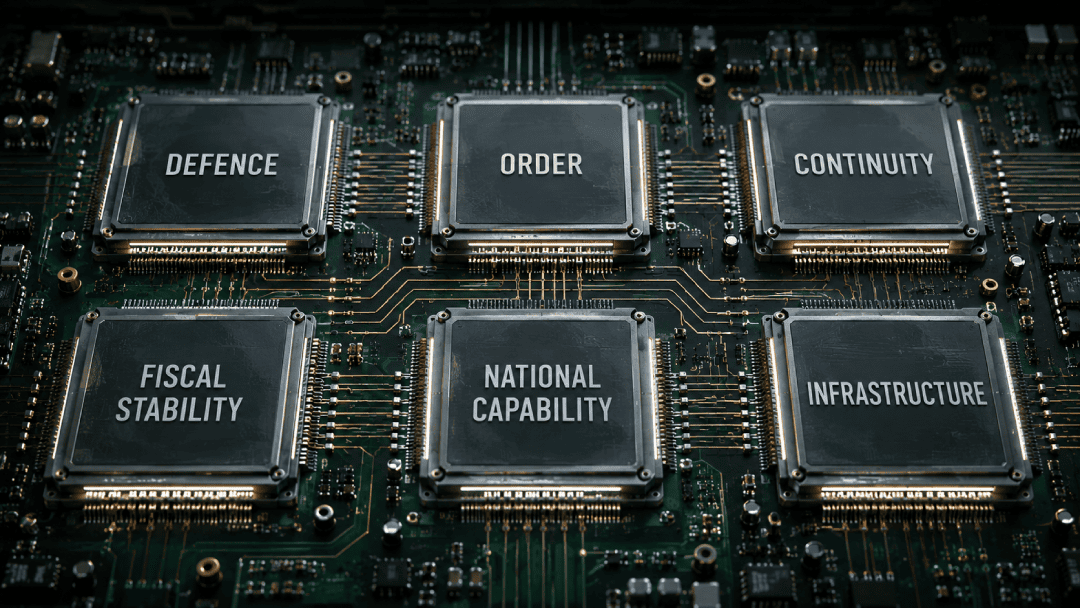
If the state exists to hold the monopoly on lawful force and to restrain evil, its essential functions derive directly from those premises. Not from electoral promises. Not from spending inertia. Not from what the previous government happened to fund. From the logic of the thing itself.
Defence
If the state holds the monopoly on force, it must be capable of defending the territory and population against external threats. An undefended state is a contradiction: it claims sovereign authority but cannot exercise the most basic function sovereignty requires. Defence is not one department among many. It is the precondition for all the others.
Order
Internally, the monopoly on force translates into policing, courts, prisons, and borders. These are not social services. They are the infrastructure of civilisational stability. Without them, every other function collapses. You cannot run schools in a war zone. You cannot maintain hospitals amid systemic criminality. You cannot collect taxes from a population which has lost confidence in the state's ability to protect it.
Continuity
A civilisation which cannot reproduce itself is dying. Continuity means education capable of transmitting knowledge and competence across generations. It means demographic conditions in which families can form and sustain themselves. It means research, resilience, and the long-term capacity to adapt. A state consumed entirely by the present is consuming its own future.
Monetary and fiscal stability
The state issues currency, collects taxation, and services debt. If it does these things incompetently (debasing money, borrowing beyond repayment capacity, taxing beyond productive tolerance) it destroys the economic foundation on which every other function depends.
National capability
A serious state builds things. It maintains sovereign capacity in energy, manufacturing, transport, and communication. It does not outsource the ability to feed, power, arm, and connect itself to foreign suppliers whose interests may diverge at the worst possible moment.
Infrastructure and ambition
Roads, bridges, ports, railways, hospitals, schools, water systems, power grids, digital networks. These are not luxuries. They are the physical expression of civilisational confidence. A state which cannot build is a state in retreat.
These six functions are not a political programme. They are the minimum viable specification for a sovereign civilisation. A state which fulfils them competently has justified its existence and its claim on the citizen's labour through taxation. A state which neglects them has not.
The Hierarchy Of Obligation
This produces a natural hierarchy; not of ideology, but of logic. The individual retains natural rights: life, liberty, property, conscience, expression. These are not gifts from the state. They precede it.
The community provides culture, norms, voluntary cooperation, mutual aid, and local self-governance. Most human life is and should be conducted here, beyond the state's direct intervention.
The state provides final arbitration and enforcement where voluntary systems fail. It intervenes not because people are incapable of self-organisation, but because some actors will always exploit the absence of enforcement. A confident state acts decisively against violence, cautiously against liberty, and rarely where society can govern itself.
A weak state fails to restrain evil. An overextended state manufactures new forms of it. The task is configuration, not expansion.
The Question Of Surplus
A properly configured state fulfilling its six essential functions against an annual revenue of approximately £1 trillion might allocate something like the following in the simplest possible terms a child could understand:
| Function | Approx. allocation |
|---|---|
| Defence and strategic security | £100bn |
| Order: courts, policing, prisons, borders | £100bn |
| Continuity: education, research, resilience | £100bn |
| Debt servicing and monetary stability | £100bn |
| National capability investment | £100bn |
| Infrastructure and national ambition | £100bn |
| National surplus | £400bn |
Even at £600 billion, this is already an enormous state by historical standards. But notice the final line.
Not "discretionary spending." Not "social programmes." Surplus.
The word matters. "Discretionary" implies optional political preference: money waiting to be claimed by whichever coalition assembles the loudest demand. This is the same linguistic sleight of hand the socialist employs when citing the "profit motive," implying a criminal mens rea for wanting to make money.
"Surplus" implies something entirely different: everything essential has already been secured. The core obligations have been met. The monopoly on force is maintained. Order is enforced. Continuity is funded. The currency is stable. The nation can build, defend, and sustain itself. Only then does surplus emerge.
This reframes every spending debate in the country. The question stops being "what programmes do we want?" and becomes something far harder for the modern administrative state to answer: has the state fulfilled its foundational obligations competently enough to justify additional expansion?
Surplus As Civilisational Signal
Surplus is not merely leftover money. It is proof of health. A thriving civilisation generates surplus across every dimension: fiscal surplus, energy surplus, housing surplus, food surplus, military surplus, industrial surplus, demographic surplus, scientific surplus. It produces more order, capability, resilience, and value than it consumes. Its citizens perceive abundance being created. They tolerate taxation because they can see what it builds.
A declining civilisation consumes its surpluses. Sacrifice rises. Competence falls. Visible deterioration accelerates. No surplus ever appears despite record extraction. Resentment becomes rational rather than emotional.
A properly functioning state should produce increasingly capable citizens, families, communities, and institutions, reducing the need for intervention over time. A permanently expanding state implicitly requires permanent social failure to justify its own growth.
This is not a conspiracy. It is an incentive structure. And it is corrosive.
Where Is The Money Going?
Against these assumptions, if one agrees with them, ask a simple question: what is the British state actually spending nearly £1 trillion a year on?
Not in departmental detail. In behaviour.
Defence
Britain historically maintained global naval supremacy, strategic industrial capacity, energy resilience, civil defence, and sovereign manufacturing. Today: shrinking armed forces, procurement dysfunction, ammunition shortages, dependency on external manufacturing, degraded naval readiness, collapsing recruitment, fragile supply chains. Yet overall spending continues rising.
Where is the money going?
Order
Police and court spending remains enormous. Administrative justice systems expand continuously. Yet case backlogs explode, visible disorder increases, shoplifting becomes normalised, prisons overflow, public trust collapses, fraud enforcement remains feeble, anti-social behaviour proliferates.
Where is the money going?
Continuity
Britain spends heavily on education and healthcare. Yet literacy concerns rise, numeracy stagnates, infrastructure ages, fertility collapses, productivity weakens, energy costs soar, scientific talent emigrates, and housing formation declines.
Where is the money going?
The answer is consistent across every domain. Increasing proportions of modern state expenditure are no longer directed toward building capability. They are directed toward managing instability.
Britain increasingly spends money on administrative mediation, compensatory transfers, behavioural management, procedural compliance, debt servicing, demographic pressure absorption, healthcare consequences rather than health, welfare dependency maintenance, bureaucratic duplication, and regulatory expansion.
The state has become reactive instead of developmental. A confident civilisation builds. An exhausted one administers decline.
Imagine a household earning £100,000 a year. Very little goes toward expanding the family business, repairing the house, educating the children, building savings, or creating future income. Instead, most spending services debt, covers emergency repairs, manages ongoing crises, maintains dependency, pays penalties, and funds temporary patches. No one looking at the household's accounts would call it healthy. They would call it trapped.
Britain is trapped.
The crisis is not simply overspending. It is misallocation at civilisational scale. A trillion pounds is consumed annually by one of the most expensive administrative systems in human history. Yet Britain increasingly struggles to build, enforce, defend, manufacture, house, or repair at the level its predecessors considered routine.
This is not primarily a corruption problem. It is not merely a left–right problem. It is a systems-configuration issue from first principles.
Britain is increasingly configured as a vast managerial apparatus for balancing accumulated contradictions, rather than a civilisation-scale engine designed to build long-term national strength. The state metabolises surplus without converting it into enduring sovereign capability, social cohesion, infrastructure, resilience, or national confidence.
A state which absorbs national surplus without producing national strength is not governing efficiently. It is metabolising the future.
Architecture, Reconfiguration, Testing
The point of this is not yet another spending review. Spending reviews accept the existing configuration and argue over marginal adjustments. Reconfiguration asks a different question: does the architecture of the state reflect its actual purpose?
Three principles follow.
- First, obligation precedes ambition. No expansion of the state into secondary functions is legitimate while primary functions remain degraded. You do not build a conservatory while the roof leaks. A government which cannot defend, police, or build has no business administering lifestyle, culture, or sentiment.
- Second, surplus must be visible. Citizens must be able to perceive, in infrastructure, in safety, in institutional competence, in national capability, the return on their compelled contribution. When the connection between taxation and visible national strength disappears, legitimacy follows it. The so-called social contract is not a direct debit mandate. It is a reciprocal obligation, and the state is currently in default.
- Third, the test of the state is not its size but its fruit. A large state producing surplus, capability, and confidence is preferable to a small state producing none of them. The question is never how much the state spends. It is what the spending yields. Does it produce citizens more capable than the generation before? Communities more resilient? Institutions more competent? A nation more confident?
If the answer to all of these is no — and in Britain today, it increasingly is — then the configuration has failed, regardless of how much money passes through it.
Our task is not to abolish the state. It is to reconfigure it properly for what it is actually for.