The Right Wing Politics Of Grave-Robbing
Himmler built an academic empire inside the SS to prove what the regime already believed. They measured skulls in Tibet, hunted the Grail in Iceland, and employed a clairvoyant who recalled 228,000 years of tribal memory. The organisation died at Nuremberg. The instinct behind it did not.
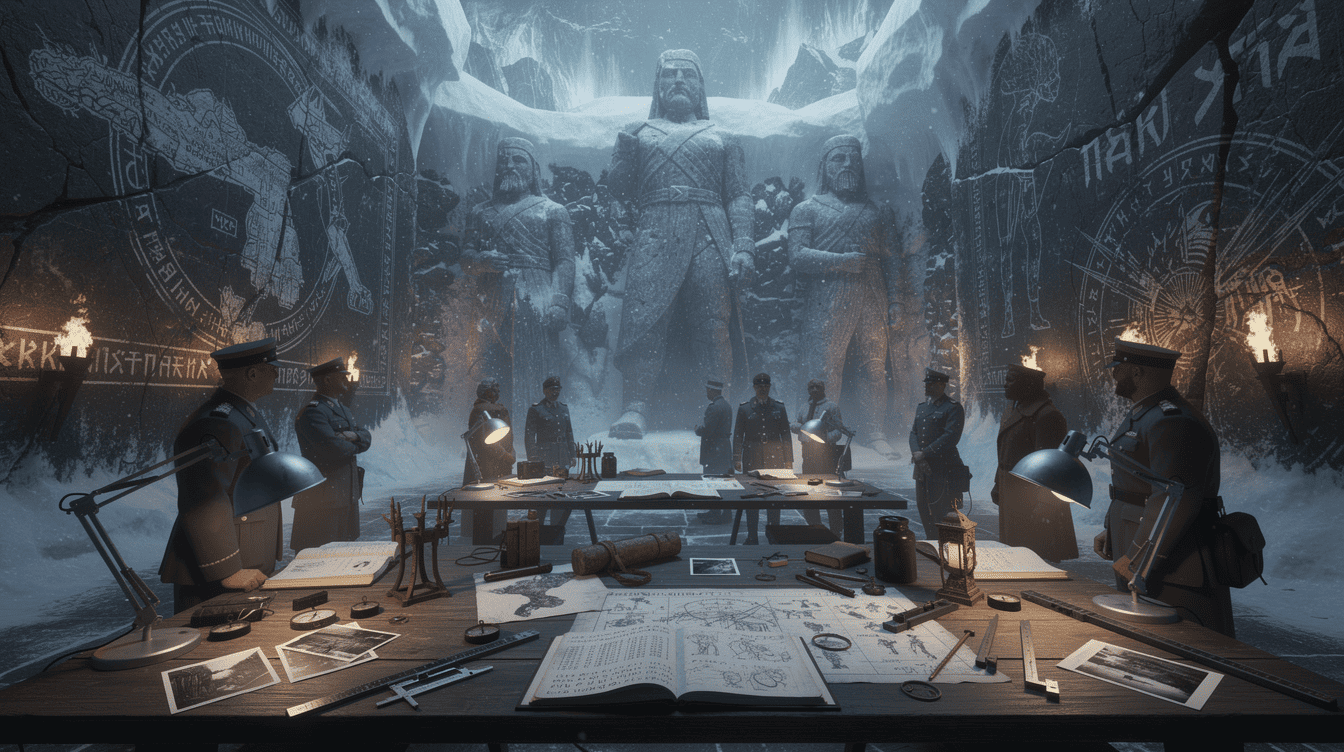
On 1 July 1935, Heinrich Himmler founded the Studiengesellschaft für Geistesurgeschichte Deutsches Ahnenerbe: the Society for the Study of Primordial Intellectual History: German Ancestral Heritage. Its stated mission was to uncover evidence of Germanic ancestral achievement "using exact scientific methods." Its actual function was the opposite. The Ahnenerbe existed to generate proof for claims already made. Adolf Hitler had declared the Aryan race responsible for virtually every significant advance in human civilisation (agriculture, art, writing, architecture, etc) and the academic establishment had, inconveniently, failed to cooperate. The Ahnenerbe was the remedy: a sprawling research bureaucracy designed not to discover truth but to manufacture it to order.
Himmler provided the SS apparatus and the money. Herman Wirth, a Dutch-German historian fixated on Atlantis and the supposed primordial script of a lost Nordic civilisation, provided the scholarly veneer. Richard Walther Darré, architect of the Blood and Soil ideology and head of the Race and Settlement Office, provided the political framework. Each brought a different enthusiasm. Together they created something new in the history of state-sponsored intellectual fraud: a research institution whose conclusions were contractual obligations.
By 1937, when the Ahnenerbe became an official branch of the SS, it had ballooned to more than fifty departments covering over a hundred research projects. Archaeologists, anthropologists, linguists, musicologists, biologists and folklorists were sent across Germany, occupied Europe, the Middle East, North Africa, South America and the Himalayas. Their mandate was not curiosity. It was confirmation.
Cranks With State Funding
The intellectual roots of the Ahnenerbe are older than the party itself. Gustaf Kossinna, a German philologist who died in 1931, four years before the organisation's founding, had already laid the methodological groundwork. Kossinna's "settlement archaeology" insisted on a seductive proposition: sharply defined zones of archaeological artefacts correspond directly and permanently to specific ethnic groups. A pot style is a people. A brooch pattern is a bloodline. The method was crude, the conclusions were nationalist, and the appeal to the Nazis was obvious. If material culture equals ethnicity, then digging up the right ceramics in the right place proves ancestral ownership of territory. Kossinna's work became foundational doctrine for both the Ahnenerbe and Alfred Rosenberg's rival Amt Rosenberg, which conducted its own parallel excavations in a bureaucratic turf war over who got to own the Germanic past.
What made the Ahnenerbe distinctive was not its pseudoscience. Plenty of regimes have indulged in creative history. The scale and institutional seriousness of the enterprise defined it. Himmler wanted it to become the ideological powerhouse of the SS, the organisational centre for the education of all future officers. It was not a fringe project. It was core infrastructure. Open-air museums reconstructing Neolithic lake settlements were built for the German public. Journals were published. Lectures were toured through occupied "Germanic" countries (Norway, Denmark, the Netherlands) to promote the Ahnenerbe worldview and recruit for the Waffen-SS. Academics who dissented were censored. Those who complied were rewarded. It was confirmation bias raised to the level of national policy.
The personnel tell the story. Assien Bohmers, a Frisian nationalist archaeologist, claimed he could trace "Nordic" origins to the Palaeolithic era in Germany, alongside woolly mammoths and cave bears. Karl Maria Wiligut, Himmler's personal mystic, claimed he could clairvoyantly recall 228,000 years of his tribe's history. Legitimate academics within the Ahnenerbe despised Wiligut (they called him "the worst kind of fantasist") but they were forced to collaborate with him anyway, because the organisation's authority derived from the Reichsführer's patronage, not from peer review.
Even Hitler grew uneasy. He mocked Himmler's archaeological obsessions, complaining they drew unwanted attention to the fact Germanic tribes had been living in mud huts while the Greeks and Romans were building in marble.
Why do we call the whole world's attention to the fact that we have no past? It isn't enough that the Romans were erecting great buildings when our forefathers were still living in mud huts; now Himmler is starting to dig up these villages of mud huts and goes into raptures over every potsherd and stone axe he finds.
The Führer preferred to claim direct continuity with Greco-Roman civilisation. The Ahnenerbe preferred the mystic North. The contradiction did not trouble anyone enough to shut the machine down.
Tibet, Skulls, and the Racial Filing Cabinet
The 1938–39 expedition to Tibet captures the Ahnenerbe's methods in its canonical form. Led by the zoologist and SS officer Ernst Schäfer, the five-man team travelled through British India and into the Himalayas, ostensibly to conduct research in zoology, botany, geology, geography and anthropology. In practice, the expedition's purpose was to investigate supposed traces of Aryan origins among Tibetan highland populations, to probe the Indo-Germanic theories Himmler found so intoxicating.
The anthropologist Bruno Beger was the expedition's racial specialist. Influenced by Hans F.K. Günther's theory of a "northern race" persisting in Central Asia, Beger had proposed the trip to investigate the racial characteristics of Tibetans. Once in Tibet and Sikkim, he measured the skulls of 376 people, took plaster casts of the heads, faces, hands and ears of seventeen more, and collected fingerprints and handprints from 350 others. To secure cooperation, he posed as a physician, dispensing medicines and treating monks. The Tibetans, by Beger's own testimony, were friendly and cooperative. They had no reason to suspect they were being catalogued as data points in a racial filing system designed to demonstrate their biological inferiority.
Beger concluded the Tibetans occupied an "intermediary position" between Mongol and European racial types, with European traits supposedly most visible among the aristocracy. The finding was meaningless as science. As political material, it was precisely what Himmler wanted: the suggestion of Aryan genetic echoes recoverable in remote populations, evidence of a once-global Nordic supremacy now degraded but still faintly legible in bone structure and skull shape.
Beger's later career reveals where this kind of work leads when the constraints are removed. In 1943, he collaborated with the anatomist August Hirt to select approximately 115 Jewish men, women and children from Auschwitz based on racial criteria. They were transported to Natzweiler-Struthof concentration camp, gassed, and their bodies processed to produce skeletons for an anthropological exhibit. Beger was never successfully prosecuted. He died in 2009, aged 98.
Indiana Jones And The Occult
It is tempting to treat the Ahnenerbe as primarily an occult organisation. It makes for better cinema. But the occult dimension, though real, has been culturally inflated far beyond its institutional weight.
Himmler was genuinely interested in the esoteric. He promoted Wewelsburg Castle in Westphalia as a kind of Camelot for his order of SS "knights." He established the SS Witches Division (Hexen-Sonderauftrag) to investigate the persecution of pagan wise women at the hands of Jews and Catholics, hoping to recover pre-Christian incantations for a planned replacement religion. He sent Otto Rahn to Iceland in 1936 to search for the Holy Grail. Rahn reported back glumly that the Icelandic people had lost their Viking ways. Himmler saw Thor's hammer as a weapon whose power might be recoverable, writing in earnest he was
convinced this is not based on natural thunder and lightning, but rather an early, highly developed form of war weapon of our forefathers.
None of this was mainstream Nazi governance. It was one man's fixation, indulged because that man controlled the SS. The real Third Reich (doing the killing) was tedious bureaucracy, logistics, industrial warfare, census offices, railway timetables and paperwork. The occult layer was comparatively small. But it was visually and psychologically unforgettable: torchlight, ruins, runes, expeditions, forbidden texts, secret ceremonies. It became culturally oversized in the post-war imagination precisely because it was dramatic, and drama is what survives in popular memory.
The Method Survives the Regime
Strip away the SS uniforms, the Tibetan skulls, the castle rituals and the rune fetishism, and the Ahnenerbe's operational logic reduces to a six-step cycle:
- Our people are losing status.
- Modern society is corrupt and artificial.
- There was once a purer ancestral order.
- Evidence of it has been hidden, suppressed or forgotten.
- We must recover our true origins.
- Blood and heritage determine who legitimately belongs.
The conclusion precedes the evidence. The evidence is then selected, distorted or fabricated to validate the conclusion. Contradictions are ignored or reframed. And myth, dressed in the vocabulary of science, serves as emotional authentication for political claims.
This method did not die in 1945. The vocabulary changed. It had to. Explicit biological race hierarchy became politically toxic after the war.
The British National Party under John Tyndall in the 1980s and early 1990s stated its position plainly:
Our nationalism is ethnic as well as political — in fact it is ethnic before being political.
Tyndall believed in white dominance of the world and said so. When Nick Griffin displaced him in 1999, the language was overhauled. Race became ethnicity. Supremacy became preservation. Repatriation became voluntary. The BNP's manifestos shifted from racial premises to civic vocabulary (sovereignty, the rule of law, indigenous rights) while the underlying demographic anxieties and ancestral claims remained structurally intact. Griffin spoke of "the home people" and "the folk." He insisted the issue was "nothing to do with colour." Academics at the London School of Economics clumsily noted the rhetorical manoeuvre in the jargon-drowning way most lunatic left-wing institutions tend to: the BNP had made:
a discursive choice to shift the emphasis from ethnic to civic elements of British national identity.
The modern "ethnic nationalist versus civic nationalist" distinction now functions, in much of the debate, as a polite proxy for the older question of whether ancestry determines who belongs to a nation. It is a valid political and constitutional question. The answer offered by ethnic nationalism is yes. The terminology has been laundered. The instinct has not.
Hyperborea and the Secular Eden
The myth of Hyperborea is the clearest thread connecting Nazi-era racial mysticism to its contemporary descendants. It is also the most mad.
In Greek mythology, Hyperborea was a paradise beyond the north wind. A land of perpetual sunshine, inhabited by a blessed people who lived without labour or sorrow. It was literary. It was allegorical. It was not meant as geography. But from Madame Blavatsky's Theosophy in the late nineteenth century to the Ahnenerbe's expeditions, the myth was progressively literalised: Hyperborea became the supposed ancestral homeland of the Aryan race, a northern super-civilisation whose descendants seeded all later cultures and whose fall from purity explains the present degeneracy of the world.
The appeal is obvious. Hyperborea functions as a secular Eden. It provides a creation myth, a fall, and the possibility of restoration without requiring Christian theology. It offers ancient northern super-civilisation, primordial purity, lost greatness, secret origins. It is emotionally satisfying in the way all lost-paradise stories are. And it provides something the political right has always found useful: a mythic justification for hierarchy rooted in ancestry rather than achievement.
The Nazis did not invent the Hyperborean myth. They industrialised it. And it has returned. Christopher Forth, a left-wing historian at the University of Kansas, has documented its resurgence in online culture, where Hyperborean imagery circulates through memes, ambient self-help videos and TikTok edits combining esoteric mythology, conspiracy theory and fast-paced historical montage.
The Dutch politician Thierry Baudet invoked it in a victory speech. YouTube channels offer "Hyperborean Gnosis" playlists: hours of ambient-scored affirmations promising the regeneration of white masculinity through connection with a primordial northern homeland. The content is decentralised, semi-ironic, aesthetically driven and memetically viral. And mostly idiotic. It is also, structurally, the same proposition the Ahnenerbe was trying to validate with state funding in 1937.
Paganism's English Recruits
English paganism and druidism follows a parallel track. Woden's Folk, founded in 1998, has drawn media attention for rituals attended by members of extremist groups. The Odinic Rite, the most prominent folkish heathen organisation in Britain, was co-founded in 1973 by John Yeowell, a former member of Oswald Mosley's British Union of Fascists who had served as Mosley's bodyguard. The organisation defines Odinism as the "natural religion" of northern European peoples, limits membership to whites, discourages mixed-race relationships, and states explicitly: "nationality is biological, not geographical." Its literature compares immigrants to invasive species.
None of these sentiments are unfamiliar to the English. They are simply concentrated in their least attractive form. As a tort reminder, despite the enormous and ongoing efforts by secular socialist forces to portray it otherwise, England is a Christian country whose King is head of the Church of England and swears an oath to profess and defend the Gospel.
This is also not the whole of modern heathenry. The majority of British practitioners, lunatic eccentrics as they may be, are politically moderate and increasingly vocal in their opposition to folkish misinterpretation. Asatru UK vets potential members for political associations. The international Declaration 127, signed by 180 heathen organisations in twenty countries, formally disavowed the folkish Asatru Folk Assembly. The distinction matters. Most people drawn to the folly of Norse religion are lured in by the mythology, the aesthetics, and the pre-Christian spirituality.
How any of these people will square their ancestral patriotism ideas with Alfred the Great's drives against pagan Vikings, Richard the Lionheart's crusades, Henry VIII's establishment of the One True Faith, James I's hatred of witches, or the Christian-led abolition of slavery, is anyone's guess.
The argument goes something like
this mythology belongs to my biological lineage, and my biological lineage determines my right to practise it, and my right to practise it demonstrates my ancestral legitimacy, and my ancestral legitimacy is the basis for political claims about who belongs in this country.
Heritage becomes biology. Biology becomes destiny. Destiny becomes policy.
The structure is the Ahnenerbe's. The conclusion arrives first. The scholarship, such as it is, follows.
Confirmation Bias As Political Programme
The instinct to weaponise ancestry, myth and selective science for political purposes pools disproportionately on the right. This is not because conservatism is inherently pseudoscientific: serious conservative philosophy from Burke to Oakeshott treats tradition as accumulated practical wisdom, not as racial destiny. It is because the right, more than the left, makes foundational claims about inherited belonging, continuity and legitimate descent, and those claims create a structural appetite for historical and biological validation. The left weaponises the opposite via "progressivism."
The modern ecosystem uses different tools (population genetics, IQ studies, evolutionary psychology, ancestry DNA testing, demographic statistics) but the epistemic behaviour is recognisable.
- The conclusion (our people are exceptional and threatened) exists before the data is consulted.
- The data is then curated to confirm it.
- Contradictory findings are dismissed or reframed.
And the entire apparatus is sustained by a psychological need whose power should not be underestimated: the desire to feel part of something ancient, continuous and under siege.
The Ahnenerbe spent a decade and vast resources trying to prove something nobody had asked to be proved, because nobody competent believed it was true. Its Tibet expedition measured hundreds of skulls to demonstrate racial affinities its anthropologist had already assumed before he left Germany. Its archaeologists excavated sites across Europe and declared everything advanced to be Aryan by definition. Its folklorists scoured the Eddas for descriptions of ancient super-weapons. Its mystics claimed psychic access to 228,000 years of tribal memory. And its institutional machinery, i.e. the journals, the lectures, the museum exhibits, the censorship of dissent, ensured the conclusions were never seriously challenged from within.
The organisation's managing director, Wolfram Sievers, was tried at Nuremberg and executed for his role in overseeing the medical experiments on concentration camp prisoners. The Ahnenerbe's documents were scattered. Many were destroyed. The institution did not survive the war.
The method did.
It survives wherever ancestry becomes biological legitimacy, wherever myth masquerades as evidence, wherever the search for origins is actually a search for permission. The uniforms are gone. The instinct to begin with the conclusion and build the science around it, or to go grave-robbing for political authority, has proven remarkably persistent.