10% Of Everything: Independence As The Midwife Of Kleptocracy
Roughly fifty countries have already taken the poison offered in Cardiff Bay this week. The flags went up, the contracts changed hands, and the people in whose name it was done spent the next forty years paying interest on the difference. As soon as politicians get discretion, economies collapse.
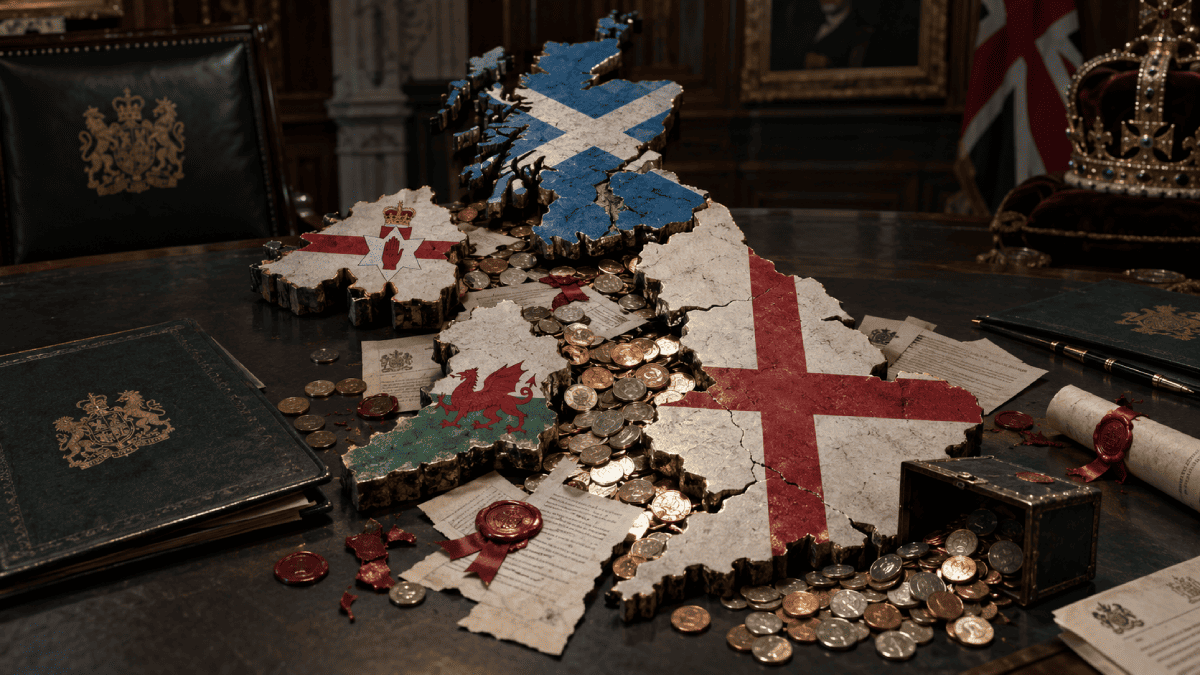
The delightful trio of John Swinney, Rhun ap Iorwerth, and Michelle O'Neill met at the five-star St David's Hotel overlooking Cardiff Bay, joined by Sinn Féin's Mary Lou McDonald, and signed a memorandum of understanding announcing Westminster's time is coming to an end.
The text calls on Andy Burnham's government to prepare for, plan, and facilitate constitutional change; rejects what it describes as Whitehall's broken economic model; promises cooperation on energy and economic growth; and asserts the future of the three nations belongs in the European Union against the declared wishes of the electorate.
Swinney put it like so:
For the first time ever, Scotland, Wales and Northern Ireland are led by pro-independence first ministers. There could be no clearer sign that the status quo is not sustainable – and that Westminster must prepare for a post-UK future.
The four attended as party leaders rather than as heads of government. A fastidious distinction given each of them commands a government payroll, a procurement budget, a grants machine, and a portfolio of public land. Emma Little-Pengelly, who shares the headship of the Stormont Executive with O'Neill, accused her of weaponising the office of First Minister.
Each are nationalists. A Scottish nationalist; a Welsh nationalist; and Irish nationalists. It's comic their nationalism is acceptable whereas English, British, French, German, Italian, or any other kind of white nationalism is entirely taboo.
The President of the United States this week helpfully announced in Dublin how much he would love to see a united Ireland, a man whose acquaintance with the Belfast Agreement can be measured in golf courses.
Plaid Cymru's accompanying demand is the revealing one.
The party wants the revenues of the Crown Estate transferred to Cardiff, including the seabed on which magic offshore wind farms are built (Gwynt y Mor, Rhyl Flats, and North Hoyle). Somebody in Cardiff will then decide which developer receives which patch of seabed, on what terms, and for how long.
Nobody at the summit volunteered a name, a tender process, an appeals mechanism, or a register of interests.
Roughly fifty post-war British decolonisations lie behind this proposal, running from Jordan in 1946 to Brunei in 1984 on the Foreign Office's own chronology. They constitute the only body of evidence anybody possesses about what happens when a movement organised for decades around obtaining sovereignty finally obtains it.
The record is not a tragedy of external sabotage. It is a record of what small political classes do when nobody above them can any longer say no.
Decolonisation Has Always Meant Robbery
Nigeria became independent on 1st October 1960 but the looting started earlier. Nigeria's own anti-corruption commission records the Coker inquiry of 1962 finding roughly £6.5 million moved out of Western Region public institutions and into Action Group structures between 1958 and 1960, while the Union Jack still flew and Britain retained formal sovereignty.
Nigerians controlled regional ministries, marketing boards, and public corporations. Control of the money arrived first. Control of the anthem arrived second.
When the army seized power in January 1966, the coup broadcast attacked politicians who sought bribes and demanded ten per cent. The phrase stuck.
Nigerians called them the ten-percenters.
The economically significant moments are the ones at which local ministers acquired the payroll, the marketing board, the development bank, the land registry, and the procurement office.
Independence transfers discretion, and graft begins when valuable discretion changes hands, frequently years before anybody lowers a flag.
Paul Kenny's comparative work on British decolonisation, published in the British Journal of Political Science, finds the pattern across the empire: where the handover gave local elites room to entrench patronage, the patronage outlived independence by generations.
Politicians getting hold of discretion is what incites the stealing.
Kenya's Truth, Justice and Reconciliation Commission found officials in the newly independent state converting settlement schemes intended for displaced communities into personal holdings, and public land migrating steadily into politically privileged hands.
The liberation movement had argued Kenyan land should belong to Kenyans. Somebody still had to decide which Kenyan, and guess who it was: the man with the pen made himself rich.
Ghana entered independence in 1957 with around $500 million in foreign reserves and almost no external debt. By the fall of Nkrumah in 1966, World Bank records show the reserves gone and external debt near $480 million, with state enterprises stuffed full of party loyalists. Naturally, Britain was to blame.
Sierra Leone produced the undiluted version: the World Bank's history describes the All People's Congress using state power to control the diamond trade and to co-opt the security forces, judiciary, and press until, in its phrase, the state became an instrument of wealth accumulation.
In Uganda, the Bank found an indigenous political elite pursuing wealth, patronage, and privilege through parastatals controlling producer prices, import licences, foreign currency, electricity, and cement, before Amin reduced the entire apparatus to a rent-collection scheme.
Every one of those movements had a legitimate grievance, an eloquent leadership, and an inspiring founding document.
None of it mattered a great deal to the clerk in Freetown whose salary stopped arriving.
Corrupt Monarchy Vs Corrupt Republic
A familiar Third World complaint proceeds like so: the country becomes a republic, the Crown safeguard vanishes, and the treasury is emptied. The first half of the sentence is wrong. The second half is frequently correct.
Jamaica never became a republic and suffered one of the region's worst collapses anyway. Barbados kept the monarchy until 2021 and still required a debt restructuring in 2018. Belize and Antigua have the King on their coins and a sovereign-debt history to make a bond trader weep.
| Country | Independence | Head of state | Public finances afterwards |
|---|---|---|---|
| Jamaica | 1962 | Monarchy throughout | Government spending rose from 23% to 45% of GDP after 1972; GDP per head fell by almost a third between 1972 and 1980; debt eventually approached 200% of GDP (IMF) |
| Guyana | 1966 | Republic from 1970 | Real GDP per head fell 31% between 1976 and 1988; public debt rose from 31% to 475% of GDP; reserves fell below a week of imports (IMF) |
| Trinidad and Tobago | 1962 | Republic from 1976 | An oil windfall converted into subsidies, state firms, and public employment; reserves fell from roughly $3bn to $200m; real GDP fell by more than a quarter between 1982 and 1993 (IMF) |
| Antigua and Barbuda | 1981 | Monarchy | Growth of about 10.5% a year between 1983 and 1989 alongside external public debt rising from 32% to 80% of GDP; arrears alone reached roughly 68% of GDP by 1994 (IMF) |
| Belize | 1981 | Monarchy | Public debt rose from 52% of GDP in 1999 to 109% in 2003; the state absorbed about US$210m of Development Finance Corporation liabilities, over 20% of GDP |
| Barbados | 1966 | Monarchy until 2021 | Debt reached roughly 157% of GDP by 2018 and was restructured, three years before the republic (IMF) |
| Bahamas | 1973 | Monarchy | Around $2.5bn of VAT collected between 2015 and 2018 while national debt continued climbing |
The governor-general of an independent country is not a colonial governor. He acts on the advice of the local cabinet.
Whatever restraint Britain once exercised had already gone by the time anybody got round to designing a presidential sash.
How Treasuries Get Robbed By Skim & Graft
A hypothetical road costs £90 million to build properly. The connected contractor understands a percentage must reach politicians, intermediaries, or party accounts, so the contract is written at £105 million.
The contractor then prices in eighteen months of late payment by an unreliable ministry and a further squeeze later in the build, and it becomes £115 million.
Government borrows the £115 million.
Citizens repay perhaps £160 million over twenty years for £90 million of road.
Nobody has taken anything from a vault. The public has been robbed by invoice, and the invoice was countersigned by a patriot.
The mechanisms recur with tedious consistency across five continents.
| What the politician controls | How value leaves the public |
|---|---|
| Procurement | Inflated tenders, sham competition, unnecessary change orders, directed awards |
| State land and mineral rights | Assets transferred below market value to buyers chosen by ministers |
| Licences and permits | Artificial scarcity turns official permission into a saleable favour |
| Tax and customs enforcement | Politically useful debtors are not pursued; exemptions and waivers are granted |
| Development banks and state credit | Cheap loans to connected borrowers, defaults absorbed by the sovereign |
| State-owned companies | Jobs, board seats, and supply contracts become patronage currency |
| Public employment | Supporters become permanent liabilities on the payroll |
| Sovereign borrowing | Extraction today, financed by taxpayers who cannot yet vote |
Trinidad's Piarco airport scandal supplies the most dramatic procurement example. United States investigators found a conspirator submitting a bid of roughly $30 million, then arranging a bogus competing bid of about $35 million so the first would look reasonable. A congressional account put the total fraud against the Trinidadian government at more than $100 million, run through shell companies and the bribery of the airport bid committee. A Florida appellate decision in 2025 records a politically influential Trinidadian steering a consultant towards an airport contract and demanding a $1 million kickback, eventually receiving over $1.1 million through front firms.
The Bahamas produced its own.
Alstom's plea agreement with the US Department of Justice records the company retaining a consultant with no power-industry expertise whose sole qualification was personal closeness to a board member of the Bahamas Electricity Corporation, for the purpose of channelling bribes to the official able to influence contracts.
The American State Department had already noted in 2016 how Bahamian procurement carried no requirement for open public tender and no mechanism for reviewing awards.
Britain Spent Two Centuries Wiping Corruption
Chesterton described a fence standing across a road, and a reformer announcing he cannot see its use and proposes to clear it away. The reply Chesterton recommended was four words:
Go away and think.
The fence did not grow there. Somebody put it up, at expense, for a reason, and it was usually a disaster nobody now remembers because the fence prevented its repetition.
The British state was, within living memory of its own institutions, a spectacularly corrupt organisation. Offices were property. Commissions were bought. Contracts went to cousins.
What eventually stopped it was not moral improvement but a century and a half of grinding, unglamorous, deeply boring institutional construction.
- The Northcote-Trevelyan Report of 1854 proposed recruiting civil servants by open competitive examination rather than ministerial favour, and a Civil Service Commission followed the next year.
- Gladstone's Exchequer and Audit Departments Act 1866 created a Comptroller and Auditor General forbidden to hold any other office or sit in Parliament, and required departments to produce accounts examined and reported to the Commons.
- The Public Bodies Corrupt Practices Act 1889 criminalised bribing or being bribed as a member or officer of a public body, after municipal Britain demonstrated what happens when gas, water, and building contracts fall to committees of local worthies.
- The Prevention of Corruption Act 1906 extended the offence to agents generally.
- The National Audit Act 1983 made the Comptroller and Auditor General an officer of the House of Commons with the run of the books.
- The Freedom of Information Act 2000 gave every citizen a statutory right to the paperwork.
- The Bribery Act 2010 consolidated the lot and is the statute under which a Welsh MEP was recently sent down for a decade.
That is Chesterton's fence, and it's a strange one for The Restorationist to praise.
Not the flag, not the anthem, and not a sentimental attachment to Britishness.
- A permanent administrative class which cannot be sacked for refusing an instruction (this obviously went very, very wrong – we know).
- An auditor nobody in government appoints, pays, or can dismiss.
- A parliamentary committee with the power to compel documents.
- A criminal statute with teeth.
- A right of access to the file.
- A press outside the family circle of the governing party, and courts outside its reach.
Every item took decades and a scandal apiece.
Any of it can be dismantled in an afternoon by four people with a hotel booking and a photographer.
Demolition is easy, cheap, and photogenic, which is precisely why it attracts the kind of politician who has never in his life built anything more demanding than a press release.
Constructing an honest state is the hardest thing a political class ever does, and it confers no glory whatsoever, since its entire output consists of crimes which never happened.
Botswana Built the Restraints Before the Money
Botswana became independent in 1966 as one of the poorest places on earth, then discovered diamonds. Every condition for kleptocracy was present. The IMF's public financial management analysis credits professional officials, transparent fiscal rules, limited off-budget spending, and outside expertise in the negotiations with De Beers for preventing the usual outcome.
World Bank research identifies the decisive sequence: political institutions and constraints on elite appropriation were consolidated before the revenues arrived.
A poor country which builds an audit office, a merit-recruited civil service, and a competitive tender regime, and only afterwards discovers something worth stealing, has a fighting chance.
A country which acquires the asset first and promises the institutions later usually finds by then the people who would have to build the institutions are the ones profiting from their absence.
Singapore inherited widespread corruption at the end of colonial rule and deliberately built a highly paid meritocratic bureaucracy and a fierce enforcement regime to strangle it.
Mauritius began with ethnic division, monocrop dependence, and unemployment, and preserved budgets presented to legislators, audited accounts, merit recruitment, and a civil service insulated from political interference.
Tanzania draws the other necessary line.
Nyerere's economic programme was a catastrophe, yet the World Bank's history records no marked rise in high-level corruption during his early years. It was restrained by a leadership code and a president who genuinely despised graft.
An ideology can wreck a country without its ministers stealing a penny, and treating every collapse as theft would be as lazy as treating every theft as an accident.
A colony inherits the machinery of the modern British state at the moment of independence: a treasury, a procurement department, a tax service, planning authorities, public corporations.
It does not automatically inherit the informal habits which made the machinery difficult to loot. Handing over a Rolls-Royce is not the same as handing over the brakes.
Turks & Caicos Shows What A King Is For
The Commission of Inquiry into the Turks and Caicos Islands reported a high probability of systemic corruption. Overseas developers were alleged to have bribed ministers and officials for Crown land on favourable terms and for development approval. Ministers held broad discretion over the exaction or waiver of government taxes and dues.
Public spending became extravagant, deficits accumulated, and reserves approached collapse.
This is not news to anyone in the Turks, the Caribbean, or, in fact, anyone in Third World politics. It is the norm.
British status prevented none of it, and it allowed constitutional reversal.
In 2009, London suspended the constitution to impose direct rule, and guaranteed £160 million of financing while the territory was stabilised. No equivalent lever existed in Georgetown, St John's, or Belmopan.
The British Virgin Islands inquiry of 2022 found the same architecture: elected politicians wielding enormous discretionary power over contracts, grants, public land, appointments, and residency, with criteria either inadequate or absent altogether, and safeguards routinely bypassed.
Removal of the last external authority capable of pulling an emergency brake is one consequence of the Cardiff programme, and it attracts remarkably little attention from the people proposing it.
Devolution Has Already Comprehensively Failed
Britain has been running the same trial at home since 1999. Scotland, Wales, and Northern Ireland acquired the economically valuable components of sovereignty in instalments, with no flag lowered and no anthem changed.
| Episode | Public exposure | Mechanism |
|---|---|---|
| NHS Scotland and Oricom | Two NHS managers and two company directors bribed and defrauded their way to £6m of health board contracts between 2010 and 2017; 29 years of imprisonment between them | Procurement bribery |
| Peter Murrell | The governing party's chief executive embezzled £400,310.65 between August 2010 and October 2022, including a £124,550 motorhome; jailed for five years and three months on 23rd June 2026 | Financial control inside a governing party |
| Regeneration Investment Fund for Wales | Fifteen public land and property assets sold in 2012 for £21.75m without open marketing, against a District Valuer assessment of £36.38m; the Senedd committee found fundamental flaws | Public asset disposal |
| Vaughan Gething and Dauson | A £200,000 leadership campaign donation, about 79% of his reportable income, from a group whose subsidiary had a £400,000 Development Bank of Wales loan; the bank lends independently of ministers and no evidence exists he procured it; he lost a confidence vote after 77 days | Political finance and conflict |
| Cardiff waste bribery | £1,700 a week paid to council staff to falsify waste weights and classifications; £175,000 of bribes produced roughly £417,000 of losses | Bribery on the revenue side |
| Red Sky and the Housing Executive | An Assembly committee found the minister acted inappropriately in seeking to extend a contractor's term against official advice, and the intervention was politically motivated; audit estimated roughly £18m of contractor overpayments across maintenance | Political entry into contracting |
| Social Investment Fund | £79m across 68 projects with unresolved conflicts of interest, weak documentation, and no audit trail showing how money was prioritised | Conflicted grant allocation |
| Ian Paisley and Sri Lanka | Family visits worth over £50,000 by his own estimate, unregistered, followed by lobbying the Prime Minister against a UN resolution; found in breach of the rules on paid advocacy | Benefit received, service supplied |
The list runs a great deal further. Scotland has produced:
- A First Minister resigning over undeclared sublet income,
- A Health Secretary suspended for 27 sitting days over £10,941.74 of iPad roaming charges run up by his children watching football;
- An airport bought for £1 which then absorbed £43.4m of public loans,
- A fabrication yard which took £13.5m and went into administration with £9m written off,
- A £512,250 legal bill after its own investigation of a former First Minister was conceded to be unlawful and tainted by apparent bias,
- A police authority criticised over relocation payments and procurement,
- A tram inquiry lasting longer than the trams took to build, and
- A 25-year guarantee to Sanjeev Gupta's aluminium business which Holyrood's Public Audit Committee was still calling opaque and profoundly concerning in March 2026.
Wales has produced:
- £7 million of grants to an organisation whose governance collapsed under inspection;
- Timber contracts handed to an operator without market testing after he had lost a competitive tender;
- Senior pay arrangements ruled unlawful at one council and an unlawful indemnity at another,
- A waste company relationship at Blaenau Gwent involving procurement breaches, conflicts, and termination payments,
- A failed industrial investment costing £1.5m, and
- A road whose price rose from £223m to £327m.
Northern Ireland has produced:
- An industrial tribunal finding religious discrimination in a ministerial appointment process,
- A public events company collapsing with £1.6m of taxpayer cost amid what the Public Accounts Committee called massive deception,
- Community grants paid without letters of offer or supporting invoices,
- A badger survey tender awarded amid a clear conflict of interest,
- Agency staffing at the police service rising from a hundred to more than eight hundred with no corporate policy governing it,
- A serving MP taking £50,000 from two property developers for a young friend's café in council-owned premises, and
- £435,000 reaching a governing party's Brexit campaign through a body whose ultimate funders the law forbade anybody from naming.
Four episodes belong on the other side of the ledger. The distinction between graft and incompetence is what separates a real point from a smear.
| Episode | What was established |
|---|---|
| Ferguson Marine | Two ferries contracted at about £97m, estimated at £293m by 2023, ministers having waived refund guarantees; £87,000 of bonuses paid without proper approval. No bribery alleged against anybody |
| Renewable Heat Incentive | The public inquiry attributed the disaster to accumulated errors, omissions, and failures of attention rather than corruption; the Audit Office was still counting unimplemented recommendations in October 2024 |
| Northern Ireland Water | 74 procurement breaches worth £45.9m between December 2005 and August 2010, of which 41 originated before the body existed, with £11.3m of the spending falling under direct rule from London |
| Circuit of Wales | A Welsh Government guarantee called for £7.33m in 2016 after inadequate safeguards around public money |
Northern Ireland Water settles one question permanently: British ministers are not a disinfectant. Westminster ran the department for part of those years and the breaches happened anyway.
Restraint elsewhere is equally necessary: Frank Cushnahan was acquitted in Belfast in February 2026, and the Project Eagle commission did not find the £1.3 billion sale price had been depressed by the conflicts it criticised.
Murrell stole from his party rather than from the Scottish consolidated fund, which will be a considerable comfort to the members who donated for a referendum and bought a motorhome.
Almost every figure comes from the same family of institutions.
- Audit Scotland
- Audit Wales
- the Northern Ireland Audit Office
- the Crown Office
- the Commons Committee on Standards, and
- An Information Commissioner.
The machinery works, because it was built by somebody else, in another century, and placed beyond the reach of the ministers it exists to inconvenience.
The scale of the opportunity for corruption is the point.
The Audit Office's 2023 verdict on a procurement function consuming roughly a quarter of the Northern Ireland budget was blunt: leadership, governance, and accountability arrangements were not working effectively.
In 2024-25 the health sector alone issued 588 direct-award contracts worth £329m without competition.
Direct awards are not corruption. They are the foundation on which corruption becomes possible, and nobody in Belfast appears able to say how deep it ought to be.
No Paperwork, Never Happened
Every safeguard depends on documents existing afterwards. Auditors examine files. Committees demand correspondence. Journalists submit requests. Remove the record and the rest of the apparatus grinds air.
The Scottish Information Commissioner examined 7,318 freedom of information requests handled by the Scottish Government between 2014 and 2017 and found requests from journalists, MSPs, and researchers routed through special clearance procedures inconsistent with the applicant-blind principle, with the involvement of special advisers unclear and journalists waiting longer for answers.
Identity of the requester determined treatment of the request, which is the precise inverse of the statutory design.
Wales produced something worse.
On 17th August 2020, as health minister, Vaughan Gething wrote in a ministerial group chat:
I'm deleting the messages in this group. They can be captured in an FOI and I think we are all in the right place on the choice being made.
The message surfaced in 2024 after he had told the UK Covid-19 Inquiry his lost material had gone during an IT rebuild of a Senedd phone. He denied wrongdoing and told the Senedd the chat concerned internal Labour group business falling outside the Act. Opposition members disagreed loudly and the Inquiry was notified.
Whatever the merits of the particular row, a governing culture in which the disclosability of a message is a reason for its deletion has removed the evidence base for every audit which follows.
Nobody needs to prove a bribe when no file survives to examine.
The men proposing to build new states out of the wreckage of this one might be asked what happens to the paperwork when the auditor is appointed by a cabinet of nine in a country of three million.
Spending Powers Tempt Before Tax Powers
The Scotland Act 1998 handed over health, justice, transport, local government, and economic development immediately. The Oricom bribery ran from 2010. Murrell's embezzlement began in August 2010. Both predate the Scotland Act 2016 powers under which Scottish rates and bands took effect in April 2017.
Wales is simpler.
The Government of Wales Act 1998 granted executive powers only, with no primary legislature and no taxation. The public land portfolio was sold in March 2012 and the Circuit of Wales guarantee was called in May 2016. Welsh rates of income tax did not begin until 2019, under the Wales Act 2014.
Once the tax powers arrived, the trouble stayed exactly where it had always been: assets, grants, guarantees, and economic intervention.
Gilestone Farm was bought for £4.25m in March 2022 under end-of-year budget pressure and is now valued at £3.75m.
Formal sovereignty is the final stage of this process rather than the first.
By the time an anthem changes, the interesting decisions have been taken by the same people for a quarter of a century.
No Referendum, No Problem
Barbados became a republic on 30th November 2021 without asking its people at the ballot box. The corrupt Barbados Labour Party held all thirty seats in the House of Assembly and passed the amendment by twenty-five votes to nil, having argued from opposition a referendum would be required.
A transition committee took submissions and held meetings; a referendum was never contemplated. The electorate was sent to a general election a matter of weeks afterwards, its opinion on the constitution having been established by acclamation from the government benches.
St Vincent and the Grenadines put an equivalent change to a referendum in 2009 and the public rejected it.
Populations declining to endorse constitutional upheaval are routinely accused of timidity, false consciousness, or colonial hangover by people who have never once explained what replaces the fence.
All Power But No Accountability
Scotland, Wales, and Northern Ireland are small political systems with dense personal networks, dominant parties, thin opposition benches, thinning local media, and an unusually large state. Wales has been governed by one party for the whole devolution era. Scotland has been governed by another for nearly two decades.
Northern Ireland's failures cut across unionism, nationalism, and the permanent civil service alike, which disposes of any suggestion nationalists are uniquely light-fingered.
Every additional power the Cardiff signatories demand is a power to decide something valuable. Who receives the seabed lease; wins the grid contract; buys the surplus public land. Whose loan is approved by the development bank; tax arrears are quietly parked; which company is awarded work without competition, and whose inconvenient records turn out to be unrecoverable after a phone rebuild.
Kenya, Guyana, Ghana, Nigeria, and Sierra Leone all had "liberation" movements led by serious men with serious grievances against London; some of them entirely justified.
The flags went up. Control of the land registries, marketing boards, development banks, import licences, and construction contracts changed hands.
In too many of those countries the powers became sources of private or party wealth, and the citizens in whose name the whole thing had been done were left paying interest on the difference.
An agreement between fanatical Marxist nationalists itemises powers and constitutional changes.
Audit independence, procurement safeguards, conflict-of-interest rules, and record retention are absent from its published commitments, which is a remarkable omission in a document signed by three administrations whose auditors have spent a quarter of a century writing about very little else.
It's simple to tear down and "deconstruct." It's easy to be a brainwashed postmodernist with no ideas of your own other than to parasitise what braver people have created.
It's difficult and risky to build. It takes enormous sweat and sacrifice.
Which explains perfectly who these people are. The parasites who want their name on the wrecking ball, so their name can be on something.