£11 Billion On A 999 Network That Still Doesn’t Work
In 2011, the Home Office set out to replace Britain's emergency radio system with a cheaper, modern 4G network. Fifteen years, three resets, five billion pounds and one monopoly supplier later, the old radios are still there, the replacement still is not, and the bill is heading for eleven billion.
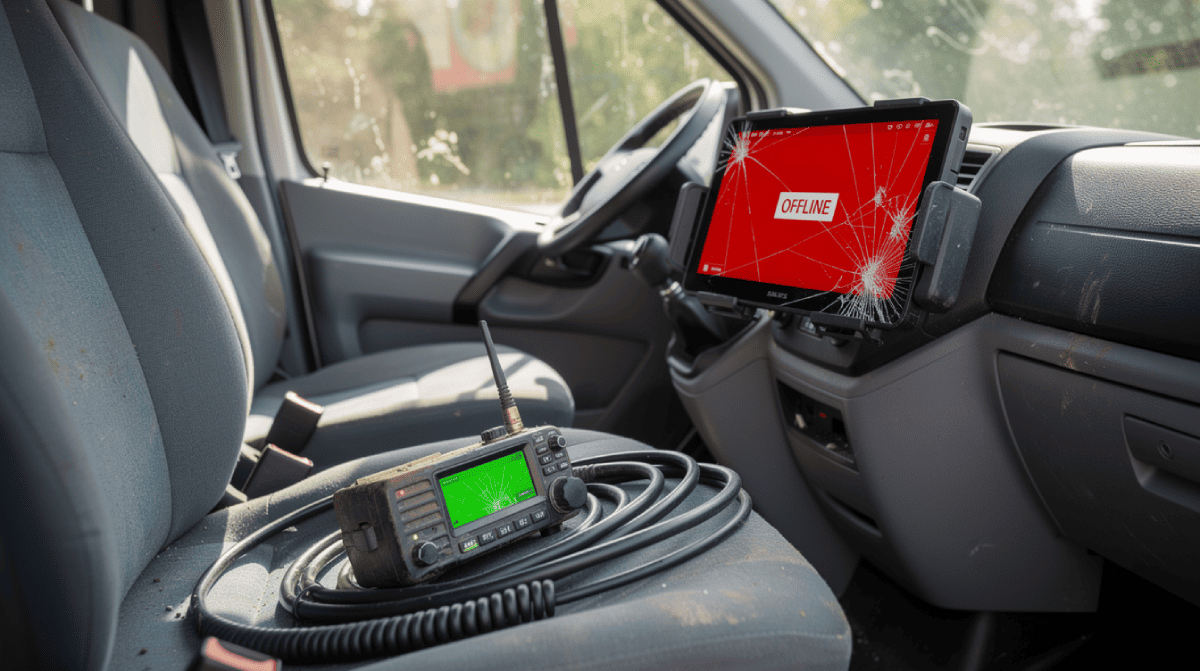
When a police officer presses a radio button during a pursuit, when a paramedic calls control from the back of an ambulance, when a firefighter requests backup inside a burning building, the system carrying their voice is Airwave. It is a TETRA-based radio network, purpose-built for emergency services, completed in 2005 and fully operational across all British forces by 2010. The National Audit Office recorded its availability since April 2010 at 99.9 per cent. It is not fashionable. It is not modern. It works.
The British state decided to replace it. Not because it was failing. Because it was expensive and unfashionable, and someone in Whitehall thought a commercial 4G network would do the job for a fraction of the cost.
This is the decision from which all subsequent catastrophe flows, and it is worth lingering on, because it contains the entire pathology of modern British governance: the conviction, held with religious certainty and no supporting evidence, that an untested system will outperform a proven one simply because it is newer.
£70 Million A Year, Said The Civil Servant
The origins of the Emergency Services Network sit in a 2011 programme called ESMCP, the Emergency Services Mobile Communications Programme. The premise was straightforward enough to fit on a slide. Airwave was expensive, running at roughly £450 million a year, and it offered limited data capability. A modern 4G system, riding on EE's commercial mobile network with priority access for blue-light users, could do more for less. Much less.
In 2014, the government's chief technology officer, Liam Maxwell, told the Public Accounts Committee the £450 million annual Airwave bill could be brought down to £70 million with modern technology. Seventy million. A reduction of more than eighty per cent.
One might have expected at least one member of the committee to ask how a replacement system of this scale could possibly cost six times less than the one it was replacing, particularly when no country on earth had deployed one. Nobody did, or if they did, the answer was not illuminating, because the Home Office pressed on regardless.
The NAO, to its credit, did attempt a reality check. Its 2016 report warned the Home Office it was attempting to deploy a system "not yet in use nationwide anywhere in the world" and flagged the programme as inherently high risk. This was polite auditor language for: you are betting the communications infrastructure on which every emergency service in Great Britain depends on a technology nobody has proven works.
Contracts were awarded in 2015 to EE for the mobile network and to Motorola Solutions for user services. The original plan was for emergency services to begin migrating away from Airwave by September 2017, with the old system switched off entirely by December 2019.
Neither date was met. Neither was close. Neither, in retrospect, was ever plausible.
The Programme Resets Itself Into The Future
By February 2017, the Home Office admitted the programme had slipped by nine months. By September 2018, it had abandoned the original approach entirely and launched what it euphemistically called a "reset." This is a word government uses when a programme has failed but nobody wishes to say so. A programme is never cancelled, never admitted to be misconceived. It is reset, as though the problem were merely one of timing rather than fundamental design.
The NAO assessed the reset in 2019 and delivered its verdict: the programme remained high risk, the Home Office's management represented poor value for money, and the total forecast cost had ballooned to £9.3 billion, some £3.1 billion more than planned. Of this, £1.4 billion was being spent simply on keeping Airwave alive while its replacement failed to materialise.
The Public Accounts Committee was brutal. Its 2019 report concluded the programme was at least three years late and had put the Home Office in a position where there was "little option but to progress with ESN." Read the logic carefully. The programme had already failed to deliver, already exceeded its budget, and was already years behind schedule. The committee's conclusion was not to reconsider. It was to continue, because too much had been spent to stop.
This is not project management. It is the sunk cost fallacy elevated to national policy.
By 2023, the NAO returned for a third assessment. It found the Home Office had spent approximately £2 billion on ESN since 2015 and a further £2.9 billion maintaining Airwave. Nearly five billion pounds, and the auditors' summary was devastating: the Home Office was still "a long way from having a functioning network to replace Airwave." The 2018 reset, the NAO confirmed, "did not work."
So the programme had failed, been reset, and then the reset had also failed. At which point, naturally, the Home Office... reset it again.
Motorola's Exquisite Arrangement
No account of this disaster is complete without Motorola Solutions, which occupies a commercial position so perfectly perverse it borders on satire.
In February 2016, Motorola acquired Airwave Solutions from Macquarie for approximately £818 million. This gave Motorola ownership of the old emergency radio network, the very system ESN was being built to replace. Motorola was simultaneously contracted to deliver key components of ESN itself. The company profiting from every single day the old system survived was also responsible for building the new system intended to kill it.
Ahaa, yes. The Restorationist reader will recognise this name and situation (Macquarie) instantly. It's the same Australian infrastructure fund previously responsible for the "stewardship" of Thames Water and the disaster behind National Car Parks.
 Evan Griffiths
One does not need a degree in commercial incentives to smell a rat. The NAO flagged it from the beginning. The CMA later went further, identifying an explicit incentive structure: Motorola stood to gain more from Airwave's indefinite extension than from ESN's timely completion. It is the equivalent of hiring an arsonist to run the fire brigade, then expressing surprise when the fires keep burning.
The numbers bear this out with almost comic clarity.
When ESN's delays forced the Home Office to extend Airwave beyond its original 2019 expiry, Motorola admitted the extension could deliver it £1.2 billion in profits. The CMA's investigation, opened in 2021, provisionally estimated Motorola was extracting approximately £160 million a year in excess profits from the extended contract, totalling around £1.1 billion in supernormal returns between 2020 and 2026 alone. The emergency services had no alternative supplier. Motorola held all the leverage. And every year ESN slipped was another year the meter ran.
Then, in November 2021, Motorola walked away from ESN entirely. The timing was exquisite. The CMA was investigating whether to force Motorola to divest Airwave. By exiting ESN voluntarily, Motorola removed the basis for a divestiture order while retaining the far more lucrative Airwave operation.
The Home Office agreed to end the contract in December 2022, paying Motorola £45 million for the privilege, including £27 million to settle disputes.
The PAC later estimated the taxpayer had paid Motorola approximately £140 million without receiving full value.
Pause to admire the sequence.
- The Home Office paid Motorola to build the replacement.
- Then paid Motorola to stop building the replacement.
- Then continued paying Motorola to run the thing the replacement was supposed to replace.
- And throughout, Motorola was extracting profits the CMA would later describe as excessive, supernormal, and above competitive levels.
If a novelist had submitted this as fiction, an editor would have sent it back for being too on the nose.
The Courts Discover The Obvious
The CMA's investigation concluded in April 2023 with a finding most observers had expected for years: Motorola held a monopoly position and had been charging well above competitive levels. Quelle surprise.
The original Airwave contract, signed in 2000, included capital costs for building the network. By the time the initial agreement period ended, those costs should have been recouped and the price should have fallen substantially, in the same way a consumer's mobile tariff drops once the handset is paid off. This did not happen. Prices stayed roughly the same, and the emergency services had nowhere else to go.
The CMA imposed a soviet price cap, estimated to save approximately £200 million a year. Motorola challenged this at the Competition Appeal Tribunal and lost. It appealed to the Court of Appeal and lost again, unanimously, in January 2025. The court confirmed Motorola had generated "supernormal" profits and had exploited its dominant position. There is no further avenue of appeal.
It took the British state over two decades, a formal market investigation, a tribunal hearing and a Court of Appeal ruling to establish what was visible from the contract structure on the day it was signed: a monopoly supplier of essential emergency communications, given no competitive pressure and every incentive to delay, would charge whatever it pleased. One might call this a failure of foresight. One might also call it negligence.
Meanwhile, On The Actual Front Line
While Whitehall debated contracts and the courts adjudicated profit margins, the 300,000 emergency service personnel who actually depend on the system were left carrying the cost of institutional paralysis.
Police forces estimated their Airwave device costs at £125 million since 2018, with a further £25 million expected by 2026. The ambulance service reported £9.5 million in transition costs. Fire services spent £6 million on transition and a further £2 million on early ESN equipment subsequently rendered useless when the programme changed direction. The PAC noted current hardware would be obsolete by 2028 and might need replacing yet again before ESN was ready, meaning forces could end up buying three generations of equipment to get through a single upgrade.
These are not abstract accounting entries from a student antiracism sociology handbook. They are resources stripped from frontline policing, from ambulance response times, from fire service capability. Every pound spent maintaining obsolete Airwave handsets or purchasing throwaway ESN prototypes is a pound not spent on officers, vehicles, training or kit. The programme designed to save the emergency services money has, to date, cost them more than Airwave alone ever did.
Nobody in the Home Office will face consequences for this. Nobody ever does.
It Rises From The Undead, Again
The programme is not dead. It is undead, like Bram Stoker's creation. It has simply been reborn, for the third time, wearing a new suit and carrying fresh contracts. Because, of course.
- In late 2024, BT/EE signed a new £1.29 billion contract to provide mobile services for ESN over seven years, including an upgrade from 4G to 5G.
- In January 2025, IBM was selected to replace Motorola as lead supplier, winning a £1.362 billion contract running until December 2031, with options to extend to 2033.
- IBM's consortium includes Samsung, Ericsson, Frequentis, Exponential-E and Palo Alto Networks.
The Home Office described the partnership as following "a series of delays by previous suppliers," which is one way to characterise a decade of institutional incompetence.
A Home Office parliamentary answer from February 2026 confirmed ESN was still not operational, with phased deployment planned to begin in 2027 and full transition from Airwave targeted for completion by 31 December 2029.
A programme formed in 2011 to replace emergency radios is now targeting completion at the end of 2029. Eighteen years. To replace radios. And the 2029 date carries an asterisk the size of the Marsham Street building, given every single previous deadline has been missed by years. There is no reason to believe this one will be different, and every reason to believe it will not.
Eleven Billion Pounds And Counting
The 2021 Full Business Case estimated the total cost of providing emergency services communications between 2015/16 and 2036/37 at £11.3 billion. This includes ESN delivery, Airwave maintenance, legacy contracts and the ongoing cost of the replacement service once operational.
Let's track back a little.
- The original justification for ESN was saving money. Airwave cost £450 million a year and the new system would cost roughly £250 million.
- Instead, the state has spent billions failing to build the cheaper system while simultaneously paying to maintain the expensive one.
- The NAO found savings would not outweigh costs until at least 2029, already seven years later than originally intended.
- If the programme slips again, as every previous iteration has, the savings may never arrive at all.
The Home Office did not replace an expensive system with a cheaper one. It added the cost of the cheaper one on top of the expensive one, and kept both running.
Reliability, Converted To Risk
Dame Meg Hillier, then chair of the Public Accounts Committee, provided the summary judgement in 2023:
The ESN project is a classic case of optimism bias in Government. There has never been a realistic plan for ESN and no evidence that it will work as well as the current system.
There has never been a realistic plan. No evidence it will work as well as the current system. This is the chair of Parliament's spending watchdog describing a programme the state has been funding for over a decade. And the programme continues. Because the alternative, admitting it was misconceived, is something the British administrative state is constitutionally incapable of doing.
The system it was replacing worked. The replacement still does not.
Airwave was expensive. ESN made it more expensive.
The old system became the contingency plan for the failed replacement of the old system.
This is how government waste achieves immortality. The failure becomes too expensive to abandon, the abandonment too embarrassing to contemplate, and so the programme shuffles forward, consuming billions, producing nothing, justified only by the money already spent and the political impossibility of admitting it was wasted.
The Home Office did not build a new emergency network. It commissioned eighteen years of transition to nowhere, at a cost of eleven billion pounds, while the radios it was replacing carried on working perfectly well.
They are still there. They will be there for some time yet.