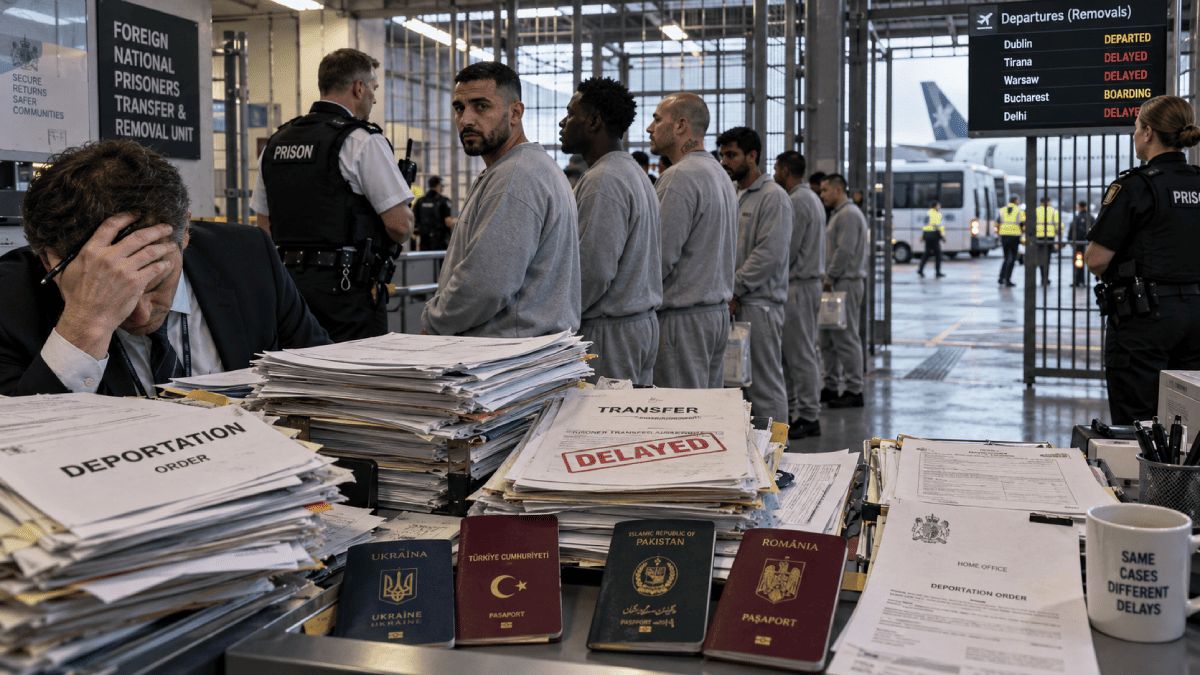
Why Do The Left Infantilise Minorities & Migrants?
He is brave, resilient, and somehow unfit to read a visa form or answer for a crime. The progressive loves the minority as he loves a rescued dog, and it is no accident: from Rousseau to Fanon to the marking of an essay, one doctrine keeps evil Western so the stranger can stay a child.
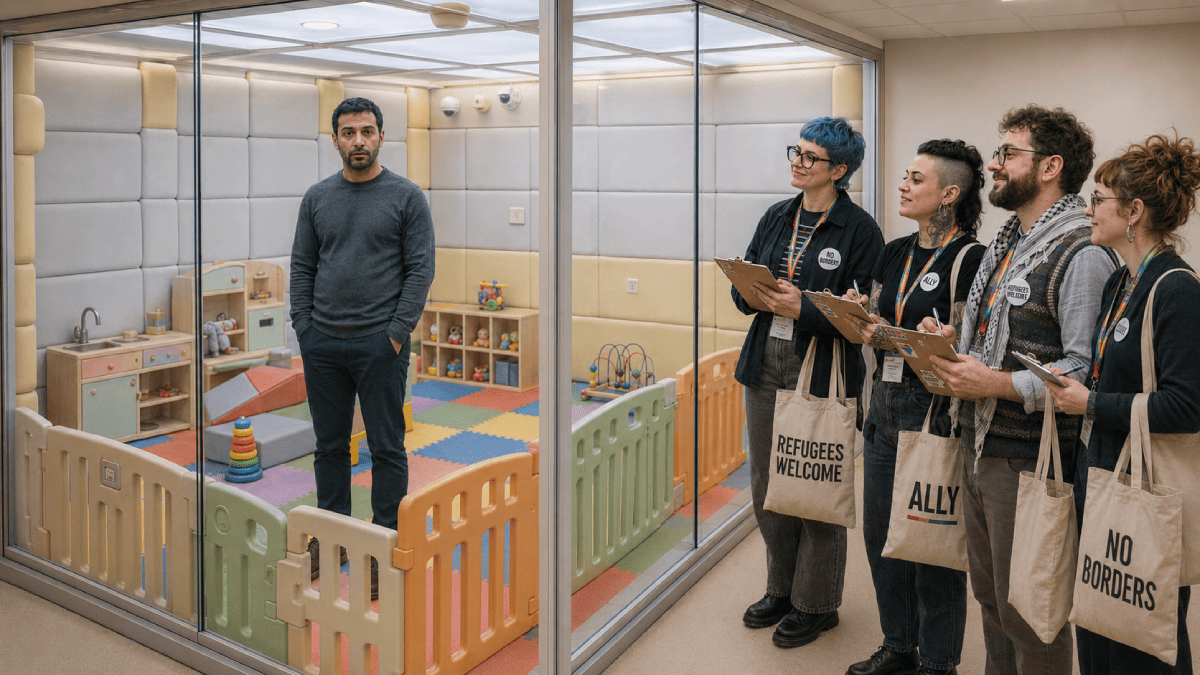
Listen to how the enlightened Westerner talks about the economic migrant or the passport-less small boat asylum seeker. He is brave. He is resilient. He enriches us. He does the work we will not do. He asks for little and gives so much.
He is also, going by the same speaker, incapable of reading a visa form, weighing one country against another, harbouring a mercenary motive, holding a coarse opinion, or committing a crime for which he alone must answer.
He is praised in the vocabulary reserved for a gifted child or a rescued greyhound, and when he does something monstrous the blame lands anywhere except on the man who did it.
Some of the best-educated people in the country cannot see the adult standing in front of them. This phenomenon re-occurs entire demographics which map onto Marxist subgroups.
Two things about the failure are worth pinning down. It has a pedigree built by serious men across four centuries, which is what makes it durable rather than merely daft. It also leaves fingerprints on the conduct of the people who carry it, and those fingerprints can be measured.
Montaigne & Dryden Capture The Noble Savage
The founding gesture belongs to Montaigne. In his essay on the cannibals of Brazil, written around 1580, he took the traveller's tales of New World savagery and turned them into a mirror for Europe. The Tupinambá did eat their enemies' corpses, but they did so cleanly and after death, whereas the civilised Frenchman racked and burned living men in the name of religion. The savage lived nearer to original virtue, and civilisation was the true barbarism.
The move matters more than the verdict. Montaigne discovered the primitive could serve as a stick with which the intellectual beats his own society. The more innocent the primitive, the heavier the stick.
The phrase itself came from Dryden, whose heroic play of 1672 sends a noble savage running wild and free through the woods. The idea acquired its label and its glamour.
I am as free as Nature first made man,
Ere the base laws of servitude began,
When wild in woods the noble savage ran
Rousseau gets the credit for the whole business, yet he never once used the words. The correction is small, and it exposes how loosely the myth is held even by those who peddle it. What Rousseau did was worse, and more lasting.
Rousseau Moves Evil Out of the Man
In the Discourse on Inequality of 1755, Rousseau proposed man in his natural condition was neither good nor wicked but simply innocent, self-sufficient, and content. Everything foul in human conduct entered later, manufactured by society, property, and the poison of comparison. Vice was not native to the person. It was installed in him by his circumstances.
Grasp the size of the claim and the rest follows. If men are made bad by the conditions around them, no man is fully answerable for what he does because the real author of his conduct is the arrangement he was born into. Blame slides off the individual and onto the system.
Every modern excuse begins here, from the explanation which dwells on the criminal's deprivation and forgets to arrive at the criminal, to the report which reads like a defence brief for the accused.
Rousseau took evil out of the human breast and hid it in the machinery of civilisation. In doing so he made innocence the default condition of anyone the machinery had not yet reached, or had reached only to wound.
The savage was innocent because civilisation had not touched him.
The victim was innocent because civilisation had touched him and done its damage.
Either way the person himself came out clean.
Marx Adds The Halo
Marx took the move off the single man and fitted it to whole populations. The worker does not choose his misery. The mode of production imposes it. Guilt and innocence stop being questions of what a man decides and become properties of where he stands in the structure.
The proletariat is innocent by its position, ground down and therefore blameless. The bourgeoisie is guilty by its position, whatever any particular bourgeois intends. A grammar of oppressor and oppressed enters politics. With it comes the promise you can read a man's moral standing straight off his group, without needing to know anything about the man himself.
Once virtue and villainy attach to categories rather than to choices, the intellectual gains a permanent supply of the innocent to champion and the guilty to denounce, and he need never meet either.
Like the noble savage before it, the oppressed class is loved in the abstract and required to stay in its assigned condition. A proletarian who prospers and votes his own way has spoilt the arrangement as surely as a savage who asks for a rifle and a bank account.
Dialling Down Frantz Fanon
Frantz Fanon carried the inheritance into the age of empire and race. In Black Skin, White Masks and then in The Wretched of the Earth, he anatomised how colonial rule hollowed out the colonised man, taught him to loathe his own skin, and left him a stranger to himself.
Fanon is routinely conscripted into a cause he would have spat at. He did not make the colonised a child. He demanded the reverse. His colonised subject was to seize himself back through violent action and become the frightening author of his own liberation.
Fanon granted the wretched of the earth a full and terrible agency. Sartre wrote the preface and made the violence sound like a sacrament.
Safe in their universities, Fanon's Western admirers (e.g. Homi K. Bhabha, Stuart Hall, Lewis Gordon, Nigel Gibson) kept the victimhood and quietly binned the agency. They wanted the halo without the man who might raise his hand. A colonised subject who acts, who chooses, and who answers for his violence as well as his suffering is too dangerous to sentimentalise.
Far easier to keep the wound and drop the will, to venerate the oppressed as a being things are done to and never as a being who does.
The migrant of today inherits the colonised man's innocence with the teeth pulled out of it. He is permitted the suffering and denied the agency, which is precisely the mutilation Fanon spent his life raging against.
Said: Reverence Is Contempt With Manners
Edward Said supplied the closing irony, and did not mean to. In Orientalism (reverse of Occidentalism) he charged the West with two crimes.
- It had built the Eastern man into a passive, exotic, sensual, and childlike figure who forever needed Western management.
- And it had dressed the portrait up as scholarship while the portrait served power. The charge stuck.
The comedy runs deeper still.
The progressive who most reveres Said now reproduces the very thing Said condemned, having merely flipped the sign.
Where the old Orientalist found the Other backward and fit for the whip, the new one (i.e. the Californian obsessed with New Age ideas) finds him authentic, spiritual, and fit for protection.
The essentialising is identical. The Other stays a flat figure onto which the Westerner projects his fantasies, still denied the ordinary complexity of a person who might be admirable on Monday and contemptible on Tuesday.
Contempt has learned to smile, and calls itself respect.
| Thinker | Text | The move | Effect on the Other's agency |
|---|---|---|---|
| Montaigne | On Cannibals, c. 1580 | Uses the primitive to indict European civilisation | Becomes a moral instrument, not a person |
| Dryden | The Conquest of Granada, 1672 | Coins the noble savage, gives the myth its glamour | Idealised, therefore fixed in innocence |
| Rousseau | Discourse on Inequality, 1755 | Relocates evil from the man to society | Innocent by default, never answerable |
| Marx | From the 1840s | Attaches guilt and innocence to class position | Blameless as a category, kept in place |
| Fanon | The Wretched of the Earth, 1961 | Diagnoses colonial damage, demands agency | Granted agency, then stripped of it by his readers |
| Said | Orientalism, 1978 | Exposes the patronising Western gaze | Reproduced under a reverent sign |
Keeping The Stranger Innocent
Assemble the philosophical inheritance and the reason for the infantilising the minotity becomes plain. It is a matter of logic rather than temperament. The left's ideology claims serious evil is Western, structural, and historical. Evil is the property of the coloniser, the capitalist, the majority, and the system.
Grant that, and a hard consequence lands at once. The non-Western, the minority, and the newcomer cannot be given full moral agency: it includes the freedom to choose wrong. The freedom to choose has already been made the oppressor's exclusive possession. Wickedness has an owner.
To let the minority be capable of real evil would be to admit evil is not the monopoly of the powerful, and the whole edifice rests on the monopoly.
The stranger must therefore be kept innocent, and innocence on this scale is available only to beings who cannot sin.
Infants cannot sin. Animals cannot sin. The mad cannot sin.
Neither can the noble savage; uncorrupted by the civilisation which alone manufactures vice.
To keep the immigrant permanently innocent, the creed is forced to freeze him permanently childlike, and the affection follows from the demotion rather than from any assessment of the man.
He is loved as one loves a creature which cannot be blamed, because being unblameable is the quality the ideology needs him to have.
We adore the dog. We credit it with loyalty, courage, and love. We defend it against all comers. And we never once hold it morally responsible, because it is not a moral adult. When it bites the postman we do not indict the dog. We ask what was done to it, who owned it, how it was raised, what cruelty made it snap.
The search runs straight past the animal to the human behind the animal.
Read the coverage of almost any crime by a favoured group and the same reflex is at work.
The hunt for the root cause is the hunt for the owner. The man who did the thing thins into a symptom, and society is called to stand in the dock in his place. Tenderness and the denial of agency arrive together, because in this creed they are one thing.
Warmth Handed Out, Competence Withheld
An ideology kept only in the head would be harmless. This one governs behaviour, and the behaviour has been measured. The prediction is clean. People who must keep the stranger innocent will treat him as warm but not capable, and will feel toward him the soft custodial emotion we reserve for the harmless.
Psychologists mapping how we judge groups keep arriving at two separate scales rather than one. We rate others for warmth and for competence.
- Warmth is their intentions towards us.
- Competence is their power to act.
The two do not move together, and the box for the warm but incompetent produces pity, protection, and management. Or, the posture of a Victorian gentleman towards the deserving poor.
| Warmth | Competence | Emotion produced | Behaviour towards the group |
|---|---|---|---|
| High | High | Admiration | Cooperation between equals |
| High | Low | Pity | Protection and management |
| Low | High | Envy | Suspicion and resentment |
| Low | Low | Contempt | Avoidance and exclusion |
The minority of the progressive imagination is filed in the second row by design: brave, warm, and never quite able.
Cydney Dupree and Susan Fiske examined how American politicians and ordinary people spoke across racial lines, using five experiments and an analysis of campaign speeches. They found Democratic candidates used less competence-related language before minority audiences than before white ones, while Republicans did not adjust.
In the laboratory, white liberals made themselves sound less competent when addressing a black listener than a white one. White conservatives did not. The liberals were not sneering. They were reaching for warmth, and to seem warm they talked down. They did it only to the person they had quietly filed as lower.
The same reflex governs judgement. Kent Harber ran a simple test, and Croft and Schmader later repeated it. Assessors were handed an identical essay, attributed sometimes to a white author and sometimes to a black one. The well-meaning markers went easier on the minority author, flagged fewer faults, and awarded higher grades.
What drove the leniency was the marker's fear of seeming prejudiced.
Kindness of that sort does not teach. It withholds the correction a student needs in order to improve, and it does so to protect the marker's self-image rather than the pupil.
There is a nastier turn in the praise itself.
Schoneveld and Brummelman found teachers heaped more inflated praise on successful poorer children than on equally successful richer ones. The children watching concluded the praised child must be less clever, since ordinary work drew such astonishment. Exaggerated encouragement broadcasts the low expectation it was meant to hide.
Applaud a migrant for learning basic English or opening a shop, and you may be advertising how little you expected of him to begin with.
Help Which Takes The Grateful Hostage
Assistance is not automatically the gift of an equal. Arie Nadler spent a career dividing the help we give each other socially into two kinds.
- Autonomy-oriented help hands a man the tools to solve the problem himself next time. Teach a man to fish.
- Dependency-oriented help hands over the whole solution and leaves him reliant on the helper for the next round. It also carries a buried verdict: the recipient could never have coped alone. Feed a man a fish.
Nadler went further and showed high-status groups can hold their position precisely by becoming the indispensable helpers of low-status ones. The generosity is real. The ladder it builds is real too, and the helper stays on the top rung.
An entire professional order now runs on the dependent kind.
The approved minority reaches the public through an intermediary almost every time. It might be a charity, an immigration solicitor, an academic, a community liaison, or a diversity officer, and each one's standing rests on the represented population staying voiceless and in need.
Let the minority speak for himself, and let him turn out religious, commercially sharp, socially conservative, and firmly against further immigration, then he has broken the arrangement.
At that point the people who demanded minority voices be heard begin carefully deciding which minority voices are the authentic ones. The authentic minority is simply the one who says what the rescuer needs to hear.
Charities lead with vulnerability because it moves money.
The same image teaches the audience to see the refugee as dependent by nature, rather than as a man who happens to need help now.
A passing condition hardens into a fixed character. Medicine shows the hardening cleanly.
Bauer, Wienke, and Führer gave advanced German medical students a case to complete about a young man with abdominal pain. Told simply he was a patient, they reasoned as normal. Told he was a refugee they grew warmer, more sympathetic, and looser in their clinical thinking.
The ordinary standard of care slipped, and they ended up treating a refugee who happened to be a patient rather than a patient who happened to be a refugee. No hostility anywhere. The compassion itself did the damage.
When The Innocent Do Something Guilty
The left's minority-as-pet worldview meets its hardest collision with reality when a favoured group commits a real and ugly crime. The studies show exactly how the mind refuses to let the fact revise the zealotry.
In their work, prior victimhood reduced blame even for a later and unrelated wrong, while prior heroism bought no such mercy. Cast a group firmly as the wronged party, and evidence of wrong done by one of its members meets a wall. The same man would have to occupy the forbidden second role of wrongdoer.
Jordan and Kouchaki added a further twist: people simply assume victims are morally good, though suffering proves nothing of the sort. The leap runs from suffered an injustice, to is a victim, to is therefore good, and the last step is a straight non sequitur.
Cornered, the pathology reaches for four moves.
- The guilty conduct is excused; its cause relocated into deprivation or trauma or a failing society.
- The guilty conduct is reinterpreted; with its plain meaning swapped for a gentler one, so religious hatred becomes economic grievance and calculated exploitation becomes survival.
- The guilty conduct is met with silence; because naming it might feed prejudice or arm opponents.
- Or the talk is redirected onto the motives of whoever raised it; which settles nothing about whether the thing raised is true.
One test cuts through all four.
Would the leftist explain an identical crime by an affluent native opponent chiefly through his childhood, his exclusion, and the structures around him?
If not, the favoured man is being handed less agency than the disliked one, and therefore less adulthood.
In the clever the resistance grows stronger still.
Thaler found the identical bias running through attitudes to immigration and crime, where people rated information more truthful precisely when it flattered their existing beliefs.
For the educated progressive, being "right" about minorities or immigration has fused with being a good person. A fact about migrant criminality threatens far more than a policy. It threatens his standing in his own eyes, and conceding it feels like confessing to being the bigot he has spent a lifetime despising.
Worse still, once he has publicly committed to the innocent verdict, admitting error later means admitting both the fact and the earlier refusal to see it.
Danger stops reading as proof the trust was misplaced and starts reading as proof insufficient trust was extended, and the prescription becomes another dose of the medicine which already failed.
Rotherham, and the Innocence Which Blinded
The pathology carries a bill, and in Rotherham it was paid by children. Professor Alexis Jay's inquiry estimated at least 1,400 girls were sexually exploited in the town between 1997 and 2013.
The perpetrators came overwhelmingly from a group the left files under innocent, and group guilt is a thing the ideology cannot process because guilt belongs to the white majority alone.
Officials feared being called racist, coloniser, or bigot more than they feared being the functionary who let a girl be raped for another year.
The abstract innocence of a protected category outweighed the concrete agony of real children, because the category had been declared incapable of the very crime it was committing.
Baroness Louise Casey's audit of 2025 found the evasion barely mended. Ethnicity was missing from around two-thirds of the relevant records, and the subject was still handled like a live wire.
This was never about one group offending and another staying clean.
An ideology reserving all guilt for the white British imperialist nationalist majority had to go blind to guilt anywhere else, and the blindness was a faithful application of the creed rather than an accident of incompetence.
When you have decided in advance who is exclusively capable of evil, you will not see evil in anyone else, even as it happens in front of you. Even when the victims are the very children you imagine yourself protecting.
Why Leftists Gleefully Celebrate Murder
The same logic which strips agency from the innocent hands it whole and undiluted to the guilty. Someone must be capable of evil, because evil plainly exists and the ideology has already excused its favourites.
That leaves the ordinary white Christian Western adult on the wrong side of the argument. He alone keeps the full moral agency the immigrant is denied, and he therefore becomes the one being the creed permits itself to hate without limit.
Charlie Kirk was shot dead in front of three thousand students in September 2025. Ann Widdecombe was bludgeoned to death in her home in July 2026. Both were ideal recipients of the hatred in the pathological mind.
Articulate, capable, freely public, and opposed to the ideology, both held exactly the adult agency the framework confiscates from the protected,. They could be blamed, and so their deaths could be cheered.
In America the leftist celebrants were sacked. In Britain a university employee leftist was charged over posts welcoming Widdecombe's death before anyone even knew it was murder.
The glee took nothing away from the compassion the same people lavish on strangers. It was compassion read from the other end, the same ideology turned to face its enemies.
A creed which can love only the guiltless must find somewhere to put all the guilt, and it puts it on people like them. The celebration was ideologically correct, and that is the part which should chill anyone of any political stripe. A cruelty reasoned into existence is far steadier than a cruelty flung out in rage.
Protection At The Price Of Adulthood
The left’s error is not excessive sympathy. It is a theory of human beings in which sympathy depends upon diminished agency. The minority receives protection at the price of adulthood. His suffering is recognised, but his capacity for choice, responsibility, vice, and danger is repeatedly withdrawn whenever it becomes politically inconvenient.
This is presented as respect, yet it denies him the moral status granted without ceremony to everyone else.
The intentions may be good. The consequences remain paternalistic. Expectations are lowered, criticism is softened, and dependency is mistaken for care. The activist, official, or professional becomes interpreter and guardian; while the immigrant becomes the object of an endless humanitarian administration.
He may speak, but someone else explains what he really means. He may act, but someone else decides which circumstances acted through him.
Criminality is excused as deprivation; hostility translated into alienation, and cultural conflict attributed to failed integration. Facts capable of disturbing the model are qualified, suppressed, or treated as more dangerous than the conduct itself. Compassion ceases to guide judgment and begins to prevent it.
None of this requires collective blame. Individuals should answer for individual acts, while genuine patterns should be examined without implicating innocent people who share an ethnicity, nationality, or religion.
Accurate judgment lies between romantic innocence and indiscriminate suspicion. Refusing one error does not require embracing the other.
A man cannot be equal if only his innocence is permitted. Equality includes the right to be judged accurately, helped without being infantilised, praised without condescension, and blamed without collective suspicion. It permits a person to possess virtues he genuinely chose, and vices he genuinely owns.
Anything less is not "solidarity." It is custody.