After Schools Disappear: Personal AI Education And Capability Centres
Comprehensive schools abolished excellence in the name of "equality." AI tutoring and shared community capability centres offer something older and better: universal access to discovery, genuine social mixing, and a country which stops wasting its own talent.

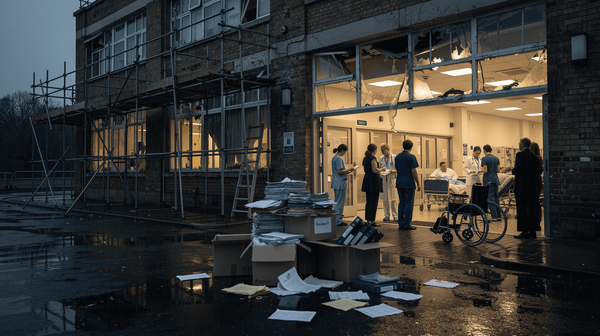
The English school is a Victorian invention solving a Victorian problem. Mass industrialisation required a workforce trained in punctuality, basic literacy, and compliance. The solution was elegant for its era: gather children by age into a single building, move them between rooms on a bell schedule, test them uniformly, and release them at sixteen into factories, offices, or, for the fortunate, universities. The model was designed to produce interchangeable workers at national scale, and it succeeded.
The factories are gone. The model remains.
For over a century, reformers have tried to fix the school from within. Smaller classes. Better curricula. Longer hours. Shorter hours. Phonics. Whole-word reading. Streaming. Mixed ability. Academies. Free schools. Grammar schools back, grammar schools abolished, grammar schools back again. None of it has altered the fundamental architecture: children sorted by birth year, confined to a single institution, moved through subjects in fixed blocks, assessed on recall, and processed in batches like components on an assembly line.
The reason reform always fails is simple. The constraint is the building itself. Everything flows from the assumption of a contained, timetabled institution staffed by generalist adults attempting to teach thirty children simultaneously. No amount of policy innovation can overcome the physics of one teacher, one room, and thirty different minds forced to move at the same speed.
Something has now changed, and it is not another policy paper.
The Comprehensive Socialist Catastrophe
Before describing what comes next, it is worth understanding precisely how we arrived at what we have because the current system is not merely outdated. It is the product of a specific ideological project, and its failures are not accidental. That project being the new religious movement of secular equality.
The grammar school system, for all its imperfections, operated on a simple and powerful principle: identify ability wherever it appears and cultivate it intensively. A child from a terraced house in Salford who demonstrated exceptional aptitude at eleven entered the same educational environment as a child from a professional family in Altrincham. The mechanism was imperfect: the eleven-plus was a crude instrument, late developers were missed, secondary moderns were neglected; but the animating principle was sound. Find talent. Develop it. Waste nothing.
The comprehensive revolution of the 1960s and 1970s did not fix these imperfections. It abolished the principle altogether. It began with the slow abolition of the tripartite system via the appropriately Soviet-named Circular 10/65 in 1965. Its text reads like the Party reorganising the socialist future:
The Government’s objective is to end selection at eleven plus and to eliminate separatism in secondary education.
The argument was straightforward and superficially compassionate: selective education is socially divisive, grammar schools entrench class distinction, and every child deserves equal provision. The solution was to merge everything into a single institution serving all abilities, all temperaments, and all aspirations simultaneously.
The result was predictable to everyone except ideologues.
A school required to serve the future engineer and the future hairdresser in the same classroom, at the same pace, using the same materials, inevitably teaches to the middle. Exceptional children are under-stimulated. Struggling children are dragged through material they cannot absorb. The broad middle receives adequate but uninspired provision. Standards converge... downward.
This was not a failure of implementation. It was the logical consequence of a philosophy which valued equal treatment above equal opportunity and which confused identical provision with fairness. The comprehensive school did not raise the floor. It lowered the ceiling and called it justice. This is the same problem repeated: continental theory attempting to make reality conform.
Fifty years of evidence confirms the result. British education produces fewer exceptional mathematicians, fewer top-rank scientists, fewer world-class engineers per capita than countries which maintained selective or specialist systems. The private school sector (exempt from comprehensive ideology) continues to dominate elite university entry, senior professions, and public life, not because private schools are magical but because they are the only institutions in England still permitted to teach ambitiously without apology.
The socialist contribution to English education has been, in sum, to ensure universal mediocrity in the state sector while leaving private privilege entirely intact. The grammar school threatened both: it offered excellence to children whose parents could not buy it. This was intolerable to magically-thinking left-wing types for whom the existence of measurable difference (i.e. reality) is itself offensive, regardless of whether the difference reflects genuine cultivation of ability.
The model proposed here is not a return to the grammar school, though it shares its animating conviction: human capability is unevenly distributed, and a civilisation which refuses to identify and develop it is choosing to be weaker than it needs to be. We need something better.
What personal AI and community capability centres offer is something the grammar school could not: universal access to the discovery mechanism itself, without the crude binary of an exam at eleven dividing children into sheep and goats.
The comprehensive school levelled down. This model levels up. The difference is not rhetorical. It is, as The Restorationist loves to say, structural.
The Tutor Returns At Infinite Scale
For most of recorded history, education was personal. A child learned from a parent, a master craftsman, a tutor, a clergyman, a local scholar. The wealthy had private instruction. The poor had apprenticeships, parish schooling, and the accumulated knowledge of working life. Education was embedded in community, tailored to the individual, and paced according to ability. The industrial school replaced all of this with something cheaper and more uniform; but never better.
Personal artificial intelligence restores the oldest model of education in human history: one mind guiding one child.
An AI tutor does not wait for the slowest pupil. It does not bore the fastest. It does not teach to the middle of a class because there is no class. It explains a concept seven different ways until one of them works. It recognises when a child is struggling before the child does. It adjusts vocabulary, pacing, abstraction, and difficulty in real time. It never loses patience, never has an off day, and never teaches a subject it does not understand because the timetable demanded it.
The underlying capability exists now and improves monthly. Within a decade, a child with a tablet and an internet connection will have access to instruction more responsive, more patient, and more individually calibrated than anything available in the most expensive private school in England.
The question is not whether this technology will arrive. It is what happens to everything built around the assumption it would not. It has plenty of critics, who do not understand the economics of educating en masse. Or the simple fact kids enjoy computers more than they like teachers.
The classroom ceases to be the primary site of knowledge transfer. The school building ceases to be where children learn most of what they know. The teacher, in the industrial sense, the adult standing before rows of seated children delivering information, ceases to be the bottleneck through which all education must pass.
This does not mean adults become irrelevant. It means their role transforms entirely.
An Ordinary Day In The Life Of
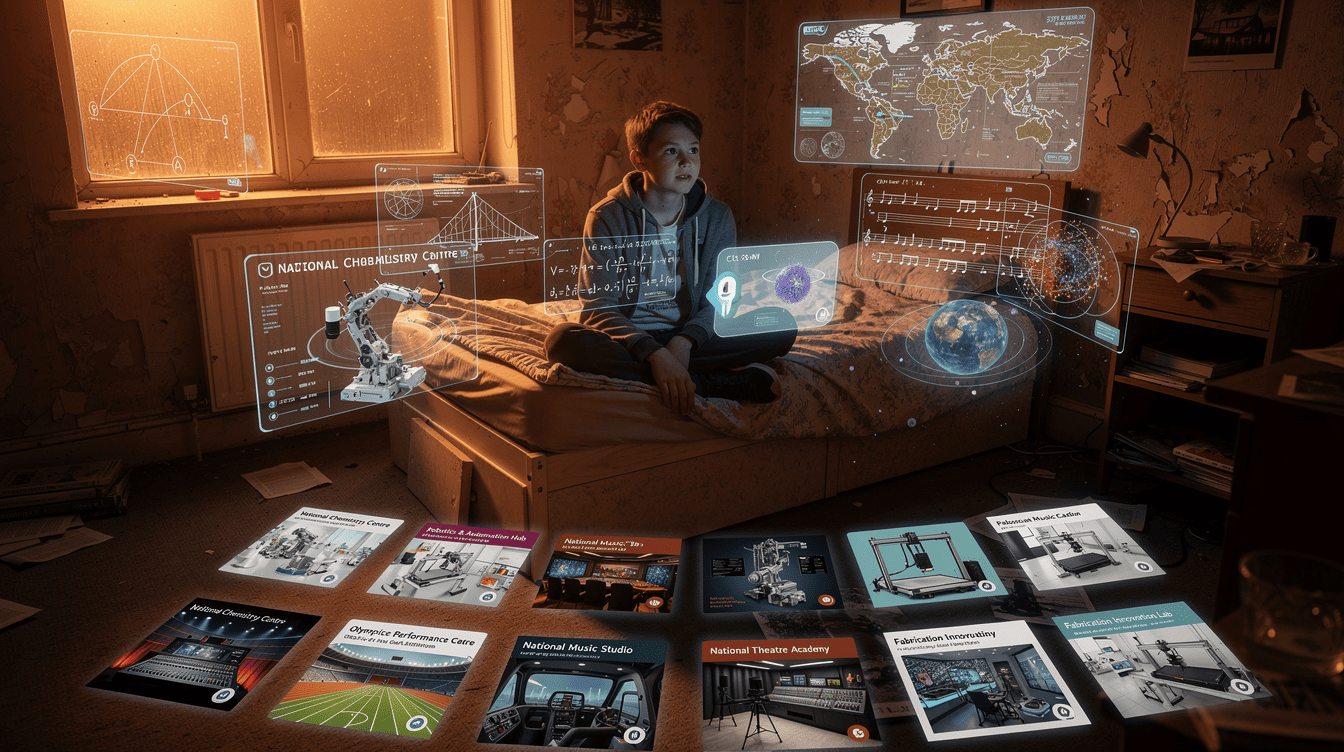
Let's say a thirteen-year-old in Stoke-on-Trent in 2030. Monday morning she works through mathematics at home, guided by her AI tutor, which knows she grasps geometry intuitively but needs more time with algebra. She is two years ahead of where the old curriculum would have placed her in one domain and six months behind in another. Nobody cares. The pace is hers.
Monday afternoon she walks to the district science centre: a properly equipped laboratory, not a school classroom with a Bunsen burner and a poster of the periodic table. She is working on a water-filtration project with four other children aged between eleven and fifteen. A retired chemical engineer supervises. They are designing something real.
Tuesday she spends entirely on independent reading and AI-guided history, pausing to investigate a question about canal engineering which leads her into two hours of self-directed research. The AI logs the diversion, recognises her emerging interest, and suggests a weekend visit to the Anderton Boat Lift.
Wednesday morning is orchestra rehearsal at the regional music centre, eight miles away. She plays cello. The other players come from across the county. Wednesday afternoon she is back home, working through biology.
Thursday she attends a debate workshop at a community centre in Newcastle-under-Lyme. The group is mixed: ages twelve to seventeen, drawn from several districts. A local solicitor volunteers as coach.
Friday is open. She spends it coding: something she discovered three months ago when the AI introduced her to logic puzzles and noticed she solved them unusually fast. Her AI has already flagged this to the regional assessment team, which has offered her a place in an advanced computing workshop starting next month.
Saturday morning she plays football.
No bells. No uniform. No sitting in a French lesson she does not need because everyone born in September 2027 must take French on Wednesdays at 10am.
This child is not unschooled. She is not neglected. She is not isolated. She encounters more adults, more peers, more disciplines, and more genuine challenge in a week than most children currently meet in a term. The difference is structural: nobody is forcing her development through a single institutional pipe.
Community Capability Centres
If the school building is no longer the site of primary instruction, what replaces it?
The answer is something closer to a public library, a mechanics' institute, or a guild workshop than a school. A place where children go to access equipment, expertise, and social experience unavailable at home; not to sit in rows receiving information they could receive better elsewhere.
A centre might contain:
- A properly equipped science laboratory shared across a district, open to children of any age working on supervised projects.
- A theatre and rehearsal space.
- A woodworking and engineering workshop.
- A sports hall with qualified coaching.
- A recording studio.
- A ceramics kiln.
- A darkroom.
- A commercial kitchen for culinary training.
- Meeting rooms for debate, languages, and collaborative projects.
These are not schools. They have no year groups, no registration, no uniform, no house system. Children attend for specific purposes, .e.g a chemistry project, an orchestra rehearsal, a robotics competition, and leave when the work is done. Adults present are specialists, not generalist classroom teachers: engineers, musicians, chefs, athletes, scientists, craftspeople, many of them retired professionals contributing to their communities.
The critical difference from a school is this: no centre attempts to provide everything. Each develops genuine excellence in particular domains. One district becomes known for its engineering workshop. Another for its theatre. A third for elite athletics coaching. A fourth for marine biology, or music, or mathematics.
Children move between centres according to interest and developing ability, not according to postcode.
The Equality Problem, Solved Properly
The obvious objection arrives immediately: wealthy areas will build magnificent centres and poor areas will not. Without intervention, the model simply recreates private schooling in community clothing.
This is correct, and any honest proposal must confront it directly.
The solution is not to pretend the problem away or to impose uniform mediocrity (the comprehensive instinct) but to design interdependence into the architecture of the system itself.
Every community centre receiving public funding must provide inter-communal access. This obligation operates reciprocally.
- If a prosperous district in Surrey builds a superb robotics laboratory, children from neighbouring areas must be able to attend, for modest fees subsidised where necessary.
- If a less affluent district in the same county produces extraordinary football coaching or a thriving youth theatre, children from the wealthy district with aspiring footballers but only robotics labs must have equal access.
No community is educationally self-sufficient. This is not a flaw. It is the design.
The effect could be striking if configured wisely.
- Wealthy parents cannot hoard opportunity behind a postcode because their children need facilities their own area chose not to build.
- Less affluent areas are not merely recipients of charity; they are contributors to a shared ecosystem, valued for what they produce.
- A former mining town with brilliant boxing coaches and a strong brass band tradition is not a deficit to be remedied. It is a node in a national network, and children from comfortable suburbs travel there because the coaching is exceptional.
This reciprocal obligation achieves something the current system has never managed. It creates genuine social mixing. Not by fiat, not by lottery admissions, not by forcing children into schools they do not want to attend; but by making interdependence structurally unavoidable. Children from different backgrounds encounter each other because they share interests and abilities, not because a bureaucrat drew a catchment boundary.
The comparison to a public library network is precise. Libraries are distributed, specialised, publicly regulated, and universally accessible. Nobody expects every branch to stock every book. Readers move between them. The system works because it is interoperable, not because every unit is identical.
The comprehensive model sought social mixing through institutional uniformity: put every child in the same school and equality follows. It never did.
Catchment areas track house prices. House prices track wealth. The comprehensive school became the most efficient engine of residential segregation in English history, with parents bidding up property values near desirable schools and fleeing those deemed inadequate. The model proposed here achieves what comprehensivisation promised and never delivered: children from different backgrounds learning together because they genuinely want to be in the same room.
Clustering Talent: Funding, Fees, and Transport
Not everything can be equal. Nor is anything simple or easily solved cleanly. Problems are where legislation lives and the more detailed research is needed.
Funding
The state typically continues to bear primary responsibility for educational provision, but the distribution model changes fundamentally. Instead of funding institutions uniformly (every school receiving broadly similar per-pupil allocations regardless of what it produces) the state funds capability infrastructure strategically. This means deliberate overinvestment in areas where private wealth is scarce. A gifted child in Hartlepool or Merthyr Tydfil is a national asset. Funding their development properly is not redistribution; it is sound resource allocation, no different in principle from placing a research facility or military installation where strategic logic demands rather than where political convenience suggests.
The current system spends vast sums maintaining duplicated mediocre infrastructure in every district. Every secondary school has a science laboratory; almost none of them are equipped to the standard a serious student requires. Every school has a sports hall; few offer coaching beyond the competence of a PE generalist. The resources consumed by universal institutional duplication could instead fund fewer, better, genuinely excellent shared facilities; properly equipped, professionally staffed, and open to every child in the region.
Fees
Community capability centres charge modest participation fees, subsidised or waived entirely for children from low-income families in a way which do not visibly mark out the child as a recipient. The fee mechanism serves three purposes:
- It creates scheduling discipline and reduces casual non-attendance;
- It permits private and community initiative to supplement public provision without full dependence on state funding; and
- It establishes a price signal allowing popular centres to expand and underused ones to adapt.
Completely free systems tend toward rationing, bureaucratic allocation, and the political capture which accompanies any monopoly provider. Modest fees with generous subsidies combine the accessibility of public provision with the responsiveness of a functioning market.
Transport
If geography ceases to determine educational destiny, then movement infrastructure becomes essential. A child in a rural village cannot access a regional science centre without reliable transport. A child in an urban estate cannot reach an athletics facility in a neighbouring district without affordable travel.
The state guarantees subsidised or free transport to any publicly funded capability centre within a defined regional radius. For younger children, supervised group transport operates on scheduled routes. For older children, subsidised public transport passes provide independence. Autonomous vehicle networks, as they mature, may eventually make this trivially cheap. In the interim, transport subsidies are not an afterthought but a core component of the system: the circulatory system without which the body cannot function.
The State As Guardian Of Open Architecture
If the state is no longer running classrooms, its responsibilities do not diminish. They change in character and arguably increase in strategic importance.
The state funds access to community capability centres and sets national standards for equipment, safety, and safeguarding. It enforces open-access obligations, preventing any publicly funded centre from operating as a covert private school. Anti-exclusivity rules, transparent pricing, mandatory inter-communal access, and regular inspection ensure the system remains genuinely open.
Anti-cartel provisions prevent affluent communities from informally restricting access through reputation sorting, waiting lists, or social gatekeeping; the mechanisms by which any decentralised system, left unregulated, will naturally reconstitute hierarchy. The state does not operate the centres. It guarantees the architecture remains open.
National accreditation standards ensure centres meet minimum thresholds for equipment, supervision, and safeguarding, without prescribing method. A centre achieves accreditation by demonstrating safe, well-equipped, professionally supervised environments, not by following a mandated curriculum or teaching in a prescribed style.
The state conducts developmental oversight through annual reviews. These are closer to a developmental audit than a school report card. The questions change entirely from the current model:
- Which domains has this child encountered this year?
- Where do unusual aptitudes appear?
- Are social competencies developing?
- Is curiosity broadening or narrowing?
- Is physical health adequate?
- Are opportunities being denied or restricted?
- What capabilities emerged?
- Is the child over-specialising?
- Are any signs of neglect, intellectual narrowing, or welfare concern present?
This is human development mapping, not grade assignment. It protects against neglect and parental restriction without prescribing method, pace, or institutional form. A child whose parents are narrowing their exposure or denying opportunity is identified not by attendance records but by developmental trajectory. A far more sensitive and meaningful measure.
AI As Safeguarding Infrastructure
The AI tutor is not merely an instructional tool. It is, potentially, the most powerful safeguarding instrument ever deployed in English education.
Continuous individualised interaction with a child generates extraordinary insight into wellbeing, engagement, and emerging difficulty. A sudden change in learning behaviour, motivation, concentration, or emotional tone becomes visible almost immediately: far earlier than it would in a classroom of thirty, where a quiet child can vanish entirely from adult attention for months or even years.
The AI does not diagnose. It does not intervene directly. It flags. A trained human reviews the flag and determines whether further action is warranted. But the detection capacity is orders of magnitude beyond anything a classroom teacher (however dedicated) can achieve with thirty children, six hours a day, across dozens of subjects.
Children at risk of abuse, neglect, political indoctrination, or deteriorating mental health become visible to the system in ways the current model simply cannot match. The industrial school's safeguarding capacity is limited by the attention bandwidth of overworked adults in crowded rooms. An AI system monitoring individual learning behaviour has no such constraint.
This capacity must be governed carefully. Data protection, parental rights, proportionality, and the prevention of state overreach all require robust legal frameworks. But the basic proposition, i.e. an attentive, individualised system notices distress faster than a batch-processing one, is difficult to dispute.
Talent Discovery Without Algorithms
One of the most powerful, and most dangerous, possibilities of this model is talent identification at population scale.
Currently, talent discovery in Britain is largely a function of parental wealth. The child who receives violin lessons, joins a rowing club, attends science camps, and enters mathematics competitions is overwhelmingly likely to come from a family which can afford these things. Innate capability distributes itself across the population without regard for income. Access to its discovery does not.
An AI system interacting individually with every child in the country would, over time, notice things no classroom teacher can. Exceptional spatial reasoning. Unusual pattern retention. Advanced mechanical intuition. Precocious mathematical abstraction. Strong social leadership. The system sees these things not because it is testing for them but because they emerge naturally during years of individualised interaction.
This is where caution becomes essential.
The AI must discover, never classify. It opens doors; it does not sort children into categories.
- A child showing early mathematical promise is offered access to advanced workshops. She is not labelled "mathematician" and tracked accordingly.
- A boy whose musical ability emerges at fourteen is not told he "missed the window."
The system must preserve human unpredictability: the stubborn, glorious fact of late bloomers, unexpected obsessions, and capabilities nobody predicted.
The distinction matters enormously. A system designed to identify and cultivate capability is liberating. A system designed to classify and predict is dystopian. The technology is identical. The governance philosophy is everything.
Done well, this becomes the most radical equaliser in British educational history. The discovery mechanism itself, i.e. currently available only to those who can afford instruments, clubs, tutors, coaches, and camps, becomes universal. A child in a tower block in Salford has the same probability of being noticed as a child in a townhouse in Richmond. Not because anyone decided to be generous, but because the architecture of the system makes invisibility almost impossible.
This is what the comprehensive school claimed to offer and never did. Equal access to discovery. Not equal outcomes, the egalitarian fantasy, but equal probability of being seen. The grammar school attempted this with a single exam at eleven. The comprehensive school abandoned the attempt entirely and called it "progress." The AI tutor achieves it continuously, from the age of four onward, without a single high-stakes test.
The Socialist Cul-De-Sac
It is worth pausing to understand precisely why the socialist model of education cannot produce what this one can, because the objection will inevitably be raised in those terms.
The socialist idea of education begins with a correct observation: access to excellent education in Britain has always been distributed unequally, and wealth has always been the primary determinant. From this accurate premise, socialist education policy draws an entirely wrong conclusion, as all Marxian critique does: the solution is to abolish excellence and distribute adequacy uniformly.
The comprehensive school is the purest expression of this logic. If some children receive better teaching than others, eliminate the better teaching. If some schools produce exceptional results, dilute them. If selection identifies and cultivates talent, abolish selection; because the act of recognising unequal ability is itself regarded as an injustice.
This is the Marxian blinker at work. The problem is never framed as "how do we extend excellence to everyone?" It is always framed as "how do we prevent anyone from having more than anyone else?" The policy instrument is always equalisation of provision, never universalisation of opportunity. The comprehensive model does not ask how a gifted child in Burnley might access the same quality of scientific training available in Winchester. It asks how the child in Winchester might be prevented from receiving anything the child in Burnley cannot.
The result, after five decades, is a state education system which produces excellence almost nowhere and adequacy almost everywhere: while the private sector, entirely untouched by comprehensive ideology, continues to educate the governing class. The socialist project in education has achieved the precise opposite of its stated aim. It has entrenched privilege by ensuring the only route to genuine excellence is the one which costs money.
The model proposed here escapes this trap entirely, because it does not begin with equality of provision. It begins with universality of access.
- Equality of provision says: every child receives the same thing.
- Universality of access says: every child can reach the best available thing.
The first produces uniform mediocrity. The second produces a population in which excellence can emerge from anywhere; and frequently does, because the discovery mechanism operates everywhere, continuously, without reference to postcode or parental income.
This is not the conservative argument against state education. It is the argument against the specific philosophical error which has governed state education for half a century: the belief fairness requires identical treatment rather than open opportunity. A system which gives every child the same lesson is not fair. A system which gives every child the best possible chance of discovering and developing their own capabilities is fair. The comprehensive school provides the former. The model described here provides the latter.
Restoration, Not Revolution
Before the industrial school colonised childhood, education in England was local, personal, and embedded in community life; typically entrusted to the Church. Children learned from people who knew things, such as craftsmen, clergymen, scholars, parents, neighbours. They learned at different speeds, in different ways, for different purposes. They moved between masters, workshops, and institutions as ability and interest dictated. The mechanics' institutes of the nineteenth century were community capability centres by another name: places where working people accessed knowledge, equipment, and expertise their homes could not provide.
The grammar school, at its best, was a talent-discovery engine: identifying capable children regardless of background and routing them toward opportunity. The apprenticeship system was personalised vocational education, embedded in real work, paced to individual competence. The parish school, the dame school, the dissenting academy; all were local, various, and adapted to circumstance.
Industrial schooling swept this ecology away and replaced it with something more uniform, more legible to the state, and vastly less responsive to the individual child. For a century, the trade-off was defensible. Mass literacy and numeracy required mass systems. The factory economy demanded standardised preparation.
Neither condition still holds.
Put it simply, the Marxian over-correction for the problems of the industrial age made it worse; the cure was worse than the disease; the prescription was disastrous even if the diagnosis was correct.
The so-called knowledge economy does not need interchangeable workers. It needs people with deep capability, unusual combinations of skill, and the capacity to learn continuously. The AI revolution does not reduce the need for human excellence; it raises it, by automating everything routine and leaving only the exceptional.
A system designed to cultivate maximum human capability across an entire population (not to produce minimum viable competence in batches) is not a utopian fantasy. It is a strategic necessity. And it happens to resemble, far more closely than the current model, the educational traditions this country abandoned in the name of industrial efficiency and then degraded further in the name of ideological equality.
The school was a machine-age solution to a machine-age problem. The comprehensive school was a socialist solution to a problem socialism itself misidentified. The machine age is over, and the misidentification is now visible to everyone except those professionally committed to it.
The building can close. What replaces it may be something much older, and much better, than what we have now.
And for when this "new" model of education is vehemently opposed by ideologues, radicalised teaching unions, and the usual suspects, it is with glorious irony Sir Humphrey also made their argument some time ago.