Crab Mentality: The Right's Chronic Infectious Disease
Every time someone on the right builds something visible, the first people to tear it down are other people on the right. This isn't bad luck. It's a documented psychological pathology called crab mentality, and it thrives under exactly the conditions British conservatism has created for itself.
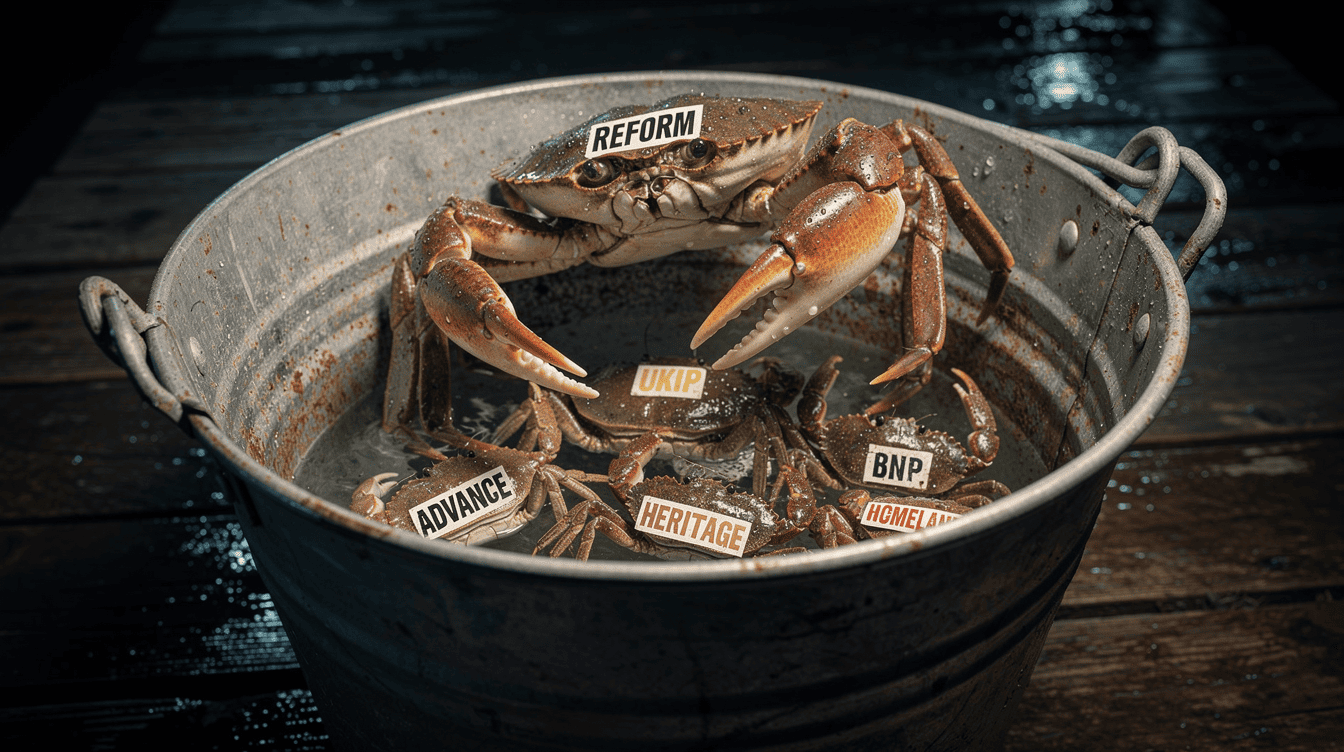
There is a species of self-destruction so reliable, so predictable, and so devastatingly effective it ought to carry a clinical classification. It does not require external enemies. It does not require state suppression, media hostility, or electoral fraud. It requires only a small group of people who share roughly the same goals, roughly the same enemies, and roughly the same frustrations, placed together in conditions of scarcity with no plausible route to power.
The result is crab mentality. And the British right has been dying of it for decades.
What The Crab Does
The term comes from an observation about crabs in a bucket. No lid is required. Whenever one crab begins climbing toward the rim, the others pull it back down. Not because they benefit from doing so. Not because they have a plan. Simply because escape by one is experienced as an intolerable accusation by the rest.
This phenomenon has different names all over the world, but almost all cultures have some kind of terminology for it. In the Caribbean, it is known as Black Crab Syndrome.
Psychology does not use the phrase "crab mentality" in formal literature, but the behaviours it describes are thoroughly documented under several overlapping headings. Social comparison theory, developed by Leon Festinger in the 1950s, established humans evaluate themselves not in absolute terms but relative to those around them. Self-evaluation maintenance theory refined this further: the closer the comparison target, the more psychologically threatening their success becomes. A stranger's promotion is neutral. A peer's promotion is personal.
Then there is zero-sum bias, the deeply wired instinct to treat status and opportunity as finite. One person's rise becomes, subconsciously, another person's fall ("if you win, i lose"). Even when the objective situation contradicts this entirely, the feeling persists. And feelings, in politics, are operational facts.
Relative deprivation theory adds a counterintuitive layer. People do not become most resentful when everyone suffers equally. Resentment spikes when inequality becomes visible and proximal, when someone nearby escapes, especially someone who was supposed to be stuck in the same position. Mobility itself can destabilise a group. Not because success is wrong, but because it breaks the psychological equilibrium of shared failure.
Finally there is Tall Poppy Syndrome, Britain's native contribution to the taxonomy. Where crab mentality says "if I cannot escape, neither can you," Tall Poppy Syndrome says "who do you think you are?" The first is driven by scarcity. The second is driven by conformity. Britain has generous supplies of both.
How The Petri Dish Dysfunctions
Crab mentality does not emerge randomly. It flourishes under specific, reproducible conditions: stagnation, bottlenecked prestige, low institutional trust, chronic defeat, and visible inequality combined with blocked mobility. Remove any one of these ingredients and the pathology weakens. Combine them all and internal cannibalism becomes not just likely but rational.
Consider the structural position of the British right outside the Conservative Party. It operates with minimal funding, negligible media legitimacy, fragmented organisations, weak local infrastructure, and almost no institutional access. There are vanishingly few leadership positions, media platforms, speaking engagements, or electoral victories available. Attention itself becomes scarce capital. And scarce capital environments become territorial with extraordinary speed.
The Conservative Party has compounded the problem by functioning as both gatekeeper and graveyard. It absorbed ambitious talent from the broader right, disciplined it into managerial centrism, and either neutralised it or expelled it once it became inconvenient. The party operated as a credentialing monopoly: the single viable route to elected office for anyone right of centre. This created a prestige bottleneck of enormous intensity. Everyone who wanted to matter must have passed through one gate, and the gate was controlled by people whose principal interest was preventing anything interesting from happening.
Reform UK adsorbed this and have now become it, which is a clever move. Sadly, it changes nothing except the colour of the tie from dark blue to teal.
Outside theses parties, the ecosystem is worse. Pressure groups, think tanks, media outlets, campaign organisations, and online communities all compete for the same tiny pool of donors, audiences, and relevance (about 12-15% of the vote, or 4M voters). The pie is not growing. It has not grown significantly for years outside of Reform UK's rise. And when the pie stops growing, people stop cooperating over ingredients and start fighting over crumbs.
Britain's Native Antibodies (Are Missing)
Other countries with comparable right-wing fragmentation have partially inoculated themselves through cultural mechanisms Britain lacks.
The United States has a deep cultural admiration for entrepreneurial ambition. American conservatism, for all its own pathologies, has historically celebrated competence and rewarded builders. The result is a sprawling ecosystem of competing institutions, media organisations, legal foundations, and policy shops, each with its own prestige hierarchy. There are enough ladders for ambitious people to climb without needing to pull others off theirs.
Britain does not work like this. We have a very old cultural discomfort with overt ambition. Anti-boast norms, class-coded behavioural expectations, and suspicion of self-promotion run deep across all British political cultures. But outsider movements feel this most acutely, because they already perceive themselves as excluded from institutional respectability. The man or woman who builds something visible on the right is not merely ambitious. He or she is uppity. He or she is getting above his or her station. He or she is, in the parlance, "a grifter."
The word "grifter" deserves special attention here, because it has become the British political all-purpose anaesthetic for competence. Anyone who builds a platform, attracts an audience, raises money, or gains visibility is immediately suspect. The accusation requires no evidence. It functions as pure status levelling: a way to reframe success as moral failure without engaging with the substance of what was built.
Naturally, the Left play into this extremely effectively to fuel the problem and make it a lot worse. They weaponise stigma in a brutal fashion. Notice how their are never any "grifters" who are socialist or communist. They have righteous intentions or make mistakes.
In a healthy political culture, the question would be "what did they build and is it useful?" In a crab culture, the question is "why them and not me?"
A Fatal Autoimmune Response
What makes crab mentality so lethal is its resemblance to an autoimmune disease. The organism's defence mechanisms turn inward, attacking its own functional cells because it can no longer distinguish productive growth from hostile invasion.
The symptoms are clinically consistent.
Constant factional splitting
Disagreements which should remain tactical become existential. Minor differences in emphasis escalate into accusations of betrayal, infiltration, controlled opposition, selling out. The movement lacks external victories, so internal hierarchy becomes the primary battlefield. Energy which should flow outward toward persuasion flows inward toward purges.
Destruction of emerging talent
The moment someone becomes articulate, organised, media-capable, or disciplined, they become a status threat. Instead of recognising a useful asset, the group perceives a rival. Rumour campaigns begin. Purity tests materialise. Loyalty interrogations commence. The immune system attacks precisely the cells the organism needs most.
Preference for purity over scale
Growth introduces compromise, coalition management, ambiguity, and institutionalisation. All of these redistribute status. Small movements often prefer remaining ideologically immaculate because purity protects existing hierarchies. The movement unconsciously chooses moral satisfaction over political power, then wonders why it never wins anything.
Addiction to opposition identity
The movement psychologically adapts to being outsiders, persecuted, embattled, righteous in defeat. Eventually opposition itself becomes the identity. Actual success becomes destabilising, because success requires governance, discipline, bureaucracy, compromise, and strategic patience. The movement fears the transition from rebellion to responsibility, because responsibility exposes whether anyone can actually do anything.
Rewarding destruction over construction
People gain status not by building institutions, organising locally, fundraising, recruiting, or creating policy, but by exposing, denouncing, criticising, and attacking rivals. Destruction is faster, emotionally rewarding, socially visible, and algorithmically amplified. Building is slower and less theatrical. So the incentive structure selects for destroyers.
"Who Do You Think You Are?"
At the psychological root of all this is a question most people on the right will recognise but few will admit to asking. If someone else succeeded under the same conditions, what does it imply about me?
This is the hidden payload. Success nearby threatens the stories people tell themselves about why they have not succeeded.
- "The system made it impossible."
- "Nobody could do better."
- "Hard work does not matter."
- "People like us cannot win."
The successful person becomes emotionally dangerous not because they harmed anyone, but because they contradict the equilibrium of shared failure.
This is why movements in chronic defeat often develop a perverse inversion: failure becomes proof of authenticity, and success becomes evidence of corruption. The person who builds something is suspect precisely because they built something. If building were possible, then everyone's failure to build requires an explanation more uncomfortable than "the system is rigged." The crab does not pull the climbing crab down out of malice. It pulls it down out of existential terror.
Social media has industrialised this process. Platforms function as comparison engines operating at a scale human psychology was never designed to handle. Humans evolved to manage status hierarchies of roughly 150 people. They now compare themselves against thousands daily. Podcast audiences, speaking invitations, follower counts, subscriber numbers, and conference appearances become surrogate status hierarchies, and people fight over them with a ferocity inversely proportional to their actual importance.
The British right's online ecosystem is a particularly concentrated example. Outrage and denunciation generate engagement. Attacking adjacent rivals produces more attention than persuading undecided voters. The incentive is to destroy the person one rung above you on a ladder leading nowhere, rather than to build a staircase leading anywhere useful.
Getting Out Of The Bucket
If crab mentality is an autoimmune disease, the cure is not motivational sloganeering. Telling people to "unite" or "stop infighting" is as useful as telling someone with lupus to stop having lupus. The pathology is Restorationist Bingo.... structural. The cure must be structural.
Credible possibility
The single most powerful inhibitor of crab mentality is believable upward movement. Not slogans. Not propaganda. People must repeatedly observe competence rewarded, builders advancing, serious work producing outcomes, and institutions actually being created. Hope cannot be abstract. It must be evidenced. The moment people conclude there is no real path upward, the immune system turns inward.
Expansion
Crab mentality is fundamentally intensified by bottlenecks. Durable movements continuously create new ladders, new prestige routes, new institutions, new opportunities for contribution and recognition. If there are only two visible leaders, three podcast hosts, and five candidates, status warfare is inevitable. The more ways people can matter, the less they cannibalise each other.
Legitimising competence
A movement dies psychologically when achievement loses moral legitimacy. If every successful person is assumed to be a grifter, a careerist, or a sellout, then ambitious people either hide, leave, become cynical, or become the very predators the movement feared. Healthy political cultures distinguish earned competence from inherited privilege and celebrate the former without apology.
Converting envy into apprenticeship
This may be the deepest cultural mechanism available. Healthy movements teach proximity to competence is opportunity. Crab cultures teach proximity to competence is humiliation. The question "how did you do it?" must replace "who do you think you are?" If the British right cannot make this transition, no amount of policy brilliance will save it.
Shared mission larger than ego
Movements stabilise when people subordinate themselves to something bigger than their own status. This is why frontier eras, nation-building periods, and great reform movements often produce unusually cooperative ambition. People feel they are building something larger than themselves. The British right desperately needs a constructive project, not merely a list of things it opposes. Opposition identity fragments naturally once the initial enemy fades. Construction creates durable bonds because the project outlasts any individual.
Institutional memory
One hallmark of crab systems is constant destruction of internal talent. Nobody mentors successors. Nobody builds durable structures. Everything resets every few years and the next generation starts from rubble, resenting anyone who climbs faster. Movements survive when senior figures actively produce successors rather than hoarding status. Crab movements consume their young. Healthy movements raise them.
Decentralisation
When all prestige concentrates into a few platforms, a few personalities, and a few organisations, social aggression intensifies. Distributed systems reduce this. Regional opportunity, local prestige, multiple pathways, parallel institutions, independent projects. The more ways people can win, the less they fight over single ladders leading to single rooms.
Learning To Build As Well As Tear Down
The British right's fundamental challenge is not ideological. It is organisational and psychological. The ideas are broadly popular. Immigration restriction, institutional reform, cultural confidence, national sovereignty, fiscal responsibility, and constitutional seriousness all command majority or near-majority support among the British public. The right does not lose because its ideas are bad. It loses because it cannot stop eating itself.
Movements become durable when they cross a single threshold: from "who is the most authentic believer?" to "who can actually build functioning systems?" Most movements never cross it. The transition requires ego restraint, delayed gratification, competence recognition, institutional trust, tolerance for imperfection, and willingness to subordinate personal status to collective scale. These are precisely the traits crab mentality erodes first.
The deeper truth is crab mentality is not a character flaw. It is an environmental response to scarcity, stagnation, and blocked possibility. People do not attack success because success exists. They attack success when success feels like an accusation against them. Change the environment, and the behaviour changes. Build real institutions with real pathways and real rewards for competence, and the crabs start climbing instead of pulling.
The right has spent decades proving it can tear things down. Reputations, organisations, alliances, coalitions, careers. It has become world-class at demolition.
What it has not yet proved is whether it can build anything durable enough to survive its own inhabitants.