The Disaster Parliament
Rejoining the EU. Digital ID cards. A British FBI with facial recognition. Jury trials abolished. Two separate bills for one railway which does not exist. It is the most ambitious expansion of state power in a generation, and not one word of it was voted for. We read them all so you did not have to.

The bond markets have made their opinion clear. Another left-wing Prime Minister, and it's ‘Good night UK.’ Three major funds began evacuating their gilt positions in the last week with yields at record levels far exceeding the Truss debacle. Yields are a price signal: the market is demanding a higher price for the elevated risk and lowered confidence in the state's ability to manage its affairs competently.
They're not wrong. At the same time, the British government announced taxpayers are going to pay a billion pounds for guns to replace the ones they already gave away to Ukraine. This was after two officials were convicted of spying for China, Buckingham Palace didn't know whether the King should speak at the opening of Parliament, and Henry VIII powers to bypass Parliament were tabled to begin rejoining the EU.
It would be comical if it weren't so serious. What is even more serious, if it were possible, concerns the contents of Labour's latest slate of disaster bills for this Parliamentary term.
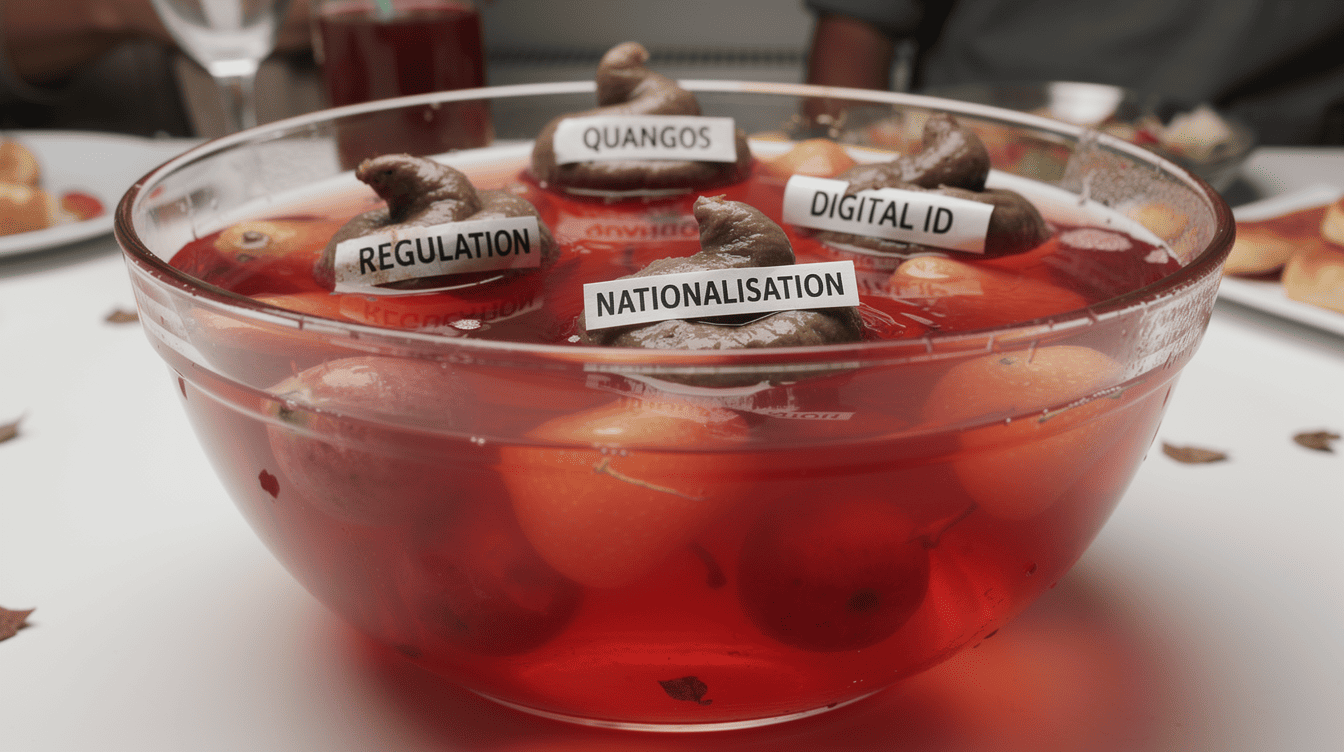
Most terms carry their share of reasonable to bad, with the occasional stench of trash. This parade of horror is pure foul stench with little redeeming value at all. There are 4000+ bills in the basket to choose from; mostly unprofessional slop from radicals and grey men. Starmer, in his political death throes, has managed to assemble 37 of the most egregiously ideological turds floating in the fruit punch. They range from the stupid, to the inexplicable, to the offensive.
One note of humorous relief, however, is the hapless boob-increaser, Zack Polanski, who was indicted by the press for, like every good socialist, also lying about being a Red Cross spokesperson, paying his council tax, and working at the Ministry of Justice.
Anyway. Back to the punch.
Back Into The EU Against Your Consent
Brexit is over. Not because Britain has moved on, but because the government has quietly moved back.
European Partnership Bill
The masterpiece. Eight years after the country voted to leave the European Union, the government has found a way back in without asking permission. Ministers will gain the power to rewrite British law automatically to match whatever Brussels produces. No debate required. No vote needed. Just quiet capitulation dressed up as "partnership." The 2016 referendum, it turns out, was advisory in both directions.
The Quango Graveyard
Six bills to reform public services. Each one abolishes something, creates something new, and costs more than the thing it replaced.
Police Reform Bill (FBI)
Forty-three police forces is far too many for a government which prefers its power concentrated, so they will be crushed down to twelve and absorbed into a new "British FBI" called the National Police Service like the National Health Service and the National Broadband Service and the National Insert Thing Here Service. Mass facial recognition will be rolled out under a brand new legal framework (i.e. it is not currently legal), because nothing says public trust like giving a state which cannot secure its own databases the power to scan your face on the high street. The same people who brought you the Post Office prosecution want to run a domestic intelligence agency. Sleep well.
Courts Modernisation Bill (Jury Trials)
Trial by jury, one of the oldest liberties in English law, older than Parliament itself, will be removed for defendants facing up to three years in prison. A judge sitting alone will decide your fate. Magistrates will be handed sentencing powers of up to two years. The Crown Court backlog is real. The "solution" is to abolish a right predating Magna Carta and hope nobody important notices. This is "modernisation."
NHS Modernisation Bill
NHS England, the useless quango invented barely a decade ago to keep politicians away from the health service, will be scrapped so politicians can get back to running the health service. Every patient's health and social care records will be merged into a single system accessible through an app. If this sounds familiar, it is because the NHS has attempted and catastrophically failed at large-scale IT integration roughly once per parliament since 1998. But this time will be different. It is always different.
Digital Access to Services Bill (Digital ID)
Not, despite the title, a bill about digital access. This is the Digital ID Bill. The government will issue every citizen a single app to prove who they are and interact with state services. Ministers swear it will not be mandatory. The same ministers swore council tax would be temporary. The same ministers swore income tax would end after Napoleon.
Clean Water Bill
A full year after announcing a "serious shake-up" of water regulation, the government has finally got round to the legislation. Bonuses will be banned for evil capitalists who pollute. Covering up pollution will become a criminal offence. One hundred billion pounds of your money will be poured into the crumbling pipe network to fix the 700 YEAR TIMELINE. The water companies will, naturally, pass every penny on to you, the customer. Your bills will go up. The rivers will remain brown. The executives will restructure their compensation packages.
Education for All Bill (SEND)
Not, despite the title, about education for all. This is the SEND cuts bill. Its purpose is to reduce the spiralling cost of special educational needs provision which bankrupted councils by herding more children with complex needs into mainstream classrooms. It's a fudge to offset the inevitable financial collapse, again. Ministers named it "Education for All" because "Saving Money on Disabled Children" did not survive the focus group.
Moving Things Slowly
Five transport bills. No new transport. Just new ways of promising transport at some unspecified point in the future.
Northern Powerhouse Rail Bill (HS3)
A high-speed rail link between Liverpool, Manchester, Leeds, Sheffield and York. First promised over a decade ago. Not one yard of track laid. This bill authorises the government to start compulsorily purchasing land, which means the project has graduated from "talking about it" to "talking about it while evicting farmers." Passengers in the North should expect to see a functioning service around the time their grandchildren retire. Yes, we're getting.... HS3.
High Speed Rail (Crewe–Manchester) Bill
The same non-existent railway, but a different section of it, requiring its own separate bill because one piece of legislation for one train line would have been too efficient for this government. Two bills. Zero trains. Infinite consultants. And now we have HS4.
Highways (Financing) Bill
Private companies will fund new roads, including the Lower Thames Crossing, and will "ultimately be paid back by consumers." You. This is a toll road. The government has drafted an entire Act of Parliament to avoid using the word "toll."
Railways and Passenger Benefits Bill (British Rail)
Great British Railways – that is, British Rail – will be re-established. Franchises will be renationalised. Fares will be simplified. Pay-as-you-go will be rolled out nationwide. Every single one of these promises has been made before, by every single government, going back further than most passengers can remember. British railway policy is a séance in which the living repeatedly summon the same dead ideas and act surprised when nothing moves.
Civil Aviation Bill
Airport expansion will be "unlocked." Passenger rights will be "strengthened." Slot regulation will be "reformed." Three gerunds. Zero commitments. The aviation equivalent of a corporate away day and more paperwork shuffling.
Growth at Desperate Gunpoint
Five bills to encourage economic growth. Four of them add regulation. The fifth raises taxes. Nobody in the Treasury sees the contradiction.
Regulating for Growth Bill (Slowing Down For Speed)
Regulation is a tool to stabilise volatile and fast-moving output flow. The Treasury has decided Britain suffers from too much regulation, and will solve the problem by introducing new regulation requiring the regulators to regulate less. Growth will become a statutory aim for every regulatory body in the country. This is the legislative equivalent of flooring the accelerator while stamping on the brake: the engine screams, the exhaust belches smoke, the car shudders violently, and you go absolutely nowhere. But the noise is very impressive.
Competition Reform Bill
The absurd Competition and Markets Authority is too slow and too powerful, so its processes will be rewritten to prioritise economic growth. This is the same government which believes in an "active state." The active state, it seems, is active in all directions except the ones which annoy the Chancellor.
Enhancing Financial Services Bill
Financial regulation will be reduced to promote growth. Credit unions will find it easier to expand. The bill is so technical and so boring it will pass through both Houses without a single journalist reading it, which is the entire legislative strategy.
Small Business Protections (Late Payments) Bill
Large companies will face maximum payment periods and mandatory interest on late invoices. A genuinely decent idea. Governments have been promising to fix late payments since Blair was in Downing Street. The small businesses currently waiting ninety days for their invoices to be acknowledged should not expect a cheque any time soon.
Electricity Generator Levy Bill
A windfall tax on electricity generators, jacked up to fifty-five per cent. In a country with the highest energy bills in the world. The government simultaneously wants billions in private investment in clean energy and wants to confiscate the profits of anyone who actually generates it. These two ambitions have not been introduced to one another.
Your Home Is Our Business
Three housing bills, each promising what the last three governments promised. The houses remain unbuilt. The promises remain in print.
Commonhold and Leasehold Reform Bill
Leasehold, the feudal protection racket which allows freeholders to charge you rent on a flat you already own, will be abolished for new builds and capped at two hundred and fifty pounds for existing leases. Leaseholders will gain the right to convert to commonhold. The developers are furious. Good. Leasehold is legalised extortion and everyone involved in perpetuating it knows it.
Social Housing Renewal Bill
More socialist housing will be built with your money. Right to Buy eligibility will be extended to ten years. New builds will be exempt from Right to Buy for thirty-five years. The targets are grand. The funding is a mystery, as is how a housing crisis will be solved by yet more government intervention in the market. Labour promised the same thing last time. And the time before that. And the time before that. At this point, the pledge to build more social housing is itself a form of social housing: millions of people live in it but nobody ever improves it.
Remediation Bill (Grenfell)
Seven years after Grenfell, the government is still introducing legislation to compel freeholders to remove the cladding which killed seventy-two people. Seven years. The fact criminal prosecution is necessary to make building owners take flammable material off the outside of occupied homes tells you everything about the people who own the buildings. The fact it took seven years to legislate for it tells you everything about the people who run the country.
Papers, Please
Four bills to keep the country safe. Each one expands state power. None of them include a sunset clause.
Immigration and Asylum Bill
Article 8 of the European Convention on Human Rights will be reinterpreted to cover only a "core family unit." A new single appeals quango will replace the current two-tier shambles. Failed asylum seekers will be forced to pay towards their own accommodation. None of this addresses how people keep crossing the Channel in dinghies, but it will produce some excellent headlines and several thousand pages of case law. The boats will continue. Criminals and asylees will adapt to be "core family units."
Tackling State Threats Bill (Proscribed Groups)
The Home Secretary will gain the power to ban state-backed groups like Iran's Islamic Revolutionary Guard Corps. But not grooming gangs, China, or communist radicals. Membership will carry up to fourteen years in prison. A separate power will allow punishment of anyone acting on behalf of a foreign intelligence service, even if they had no idea who was ultimately paying them. That last clause is doing an enormous amount of work and nobody in government seems troubled by it.
National Security Bill (Banning of Speech)
More speech gets banned. Not terrorism anymore; now it's content which "glorifies, trivialises or normalises serious violence" which will be criminal. Police will receive increased "terror-like powers" to disrupt individuals who "encourage violence." Born from the Southport attack, which was genuinely horrific. But "terror-like powers" is a phrase which should make the hairs on the back of your neck stand up regardless of how sympathetic the cause. Powers granted in grief are rarely returned in calm.
Cyber Security and Resilience Bill
More regulation and higher costs for companies. BusinTheesses and critical infrastructure operators will face tougher obligations and higher penalties for cyber security breaches. The government's own departments are hacked with metronomic regularity. The irony of Westminster lecturing the private sector on digital hygiene while running half its systems on expired software is apparently lost on everyone involved.
More Green Garbage
Two energy bills. One for renewables that will not be built fast enough. One for nuclear plants that will not be built at all.
Energy Independence Bill
Renewable energy will be "scaled up." Homes will be upgraded. Infrastructure will be built faster. Bills will fall. This is the same announcement the government made two years ago, recycled with fresh typography. The phrase "energy independence" is doing heroic rhetorical work for a country which still imports roughly half its gas and has precisely one nuclear power station under construction.
Nuclear Regulation Bill
The nuclear regulatory framework will be "modernised" to speed up approvals by adding paperwork to slow them down. Britain has been trying to build new nuclear power stations for twenty years. The obstacle was never the paperwork. Nobody wants to pay for them, nobody wants them built nearby, and every estimate turns out to be a fantasy within eighteen months of publication. Streamlining the regulations for projects which do not exist is a very Starmer solution.
Tinkering With the Constitution
Four bills to "modernise" democracy. One of them lets children vote. Another lets the King take a pay cut. The bar for constitutional reform has never been lower.
Representation of the People Bill (Child Voting)
Sixteen-year-olds will be given the vote. Foreign political donations will face tougher scrutiny, a provision aimed with exquisite precision at Elon Musk and Reform UK. Voter ID requirements will be loosened to.... include bank cards. Lowering the voting age is not a democratic reform. It is an electoral strategy disguised as a principle. Labour is not enfranchising the young because it believes in their judgment. It is enfranchising the young because it believes children are more likely to vote for them.
Removal of Peerages Bill
Already nicknamed the Lord Mandelson Law. Disgraced peers will be stripped of their titles without a bespoke Act of Parliament each time. Good. Let's start with "Sir" Tony Blair, "Sir" John Major, and every politician over the last three decades – batching them for efficiency.
Sovereign Grant Bill
The public money given to the Royal Family will be permitted to decrease once Buckingham Palace has finished being refurbished. Under current rules, the Sovereign Grant can never go down from one year to the next. Which should make you wonder when you voted for that.
Public Office (Accountability) Bill (Hillsborough)
The Hillsborough Law. A legal "duty of candour" for public servants which won't be obeyed, and help invent whole new methodologies for lying. Delayed from the last session over a row about whether it would apply to the security services, which tells you precisely who was objecting. It has been thirty-seven years since Hillsborough. The pace of justice in this country is not a failing of the system. It is the system working as designed.
Miscellaneous Meddling
Seven bills which did not fit anywhere else, which tells you how carefully this programme was assembled.
Steel Industry (Nationalisation) Bill
The state will take power to nationalise steel companies as a "last resort." The immediate target is British Steel, whose Chinese owners have proved as interested in running a steel works as they were in buying one: not very. Nationalisation of a loss-making heavy industry in 2026. The ghost of Clement Attlee is smiling. The ghost of the Treasury is reaching for the gin.
Armed Forces Bill
The five-yearly renewal of the legal framework for the chaps, plus enshrining the Armed Forces Covenant in statute. The least controversial bill on the list. Also the least any government could do for the people it deploys to fight.
Overnight Visitor Levy Bill (Tourism Tax)
Mayors and councils will be empowered to impose a tourist tax on hotels, B&Bs and holiday rentals. The British hospitality industry, already bleeding from post-pandemic costs, energy prices and staff shortages, will now explain to tourists why their room is more expensive than the one across the Channel. Visit Britain. Bring your wallet. Leave your expectations at the border.
Sporting Events Bill
An Act of Parliament to help the country deliver Euro 2028 without embarrassing itself. State involvement in sport. Ticket touting for major events will be banned. The very existence of this bill is an admission Britain cannot organise a football tournament without statutory intervention. The motherland of the game needs legislation to host a match.
Draft Conversion Practices Bill
Criminal and civil protections against so-called "conversion therapy" to appease the lunatics who won't be increasing the birth rate and aren't suffering "conversion" in any backstreet clinics. Published in draft, meaning the government wants the credit for acting without the inconvenience of actually acting. Consultation will follow. And then more consultation. And then, perhaps, if the polling holds, a bill. For a practice based on free association, speech, and conscience – and doesn't exist in England.
Draft Taxi and Private Hire Vehicle Bill
MORE regulation. Taxi licensing rules last updated when the motor car was still a novelty will be brought into the present century (yet more technocratic "modernisation"). Also published in draft, because apparently updating minicab regulations demands the same ponderous caution as banning conversion therapy. Both are too difficult. Both will be studied further.
Northern Ireland Troubles Bill (Soldier Ambulance Chasing)
Legacy mechanisms. Victims' rights. Prosecutions. Reconciliation. Every government since the Good Friday Agreement has promised to resolve this. None has managed it. This bill will join its predecessors in the long, ignominious queue of legislation which is introduced with solemnity and abandoned without apology. Our bravest men have repetitively condemned this carve out for human rights lawyers to go after them decades later for decisions they made in the heat of battle.
The Disaster Parliament
Thirty-seven bills. Not an unusually large number. Governments over the past century have routinely introduced fifty, eighty, even over a hundred bills in a single session. Thirty-seven is a modest haul by historical standards. What makes it remarkable is not the quantity but the quality: the sheer density of centralisation, surveillance, and bureaucratic expansion packed into a programme the government apparently considers restrained.
Every ministry has received its toy. Every think tank has been tossed its biscuit. Every focus group finding has been laundered through the parliamentary drafting process and emerged as a bill so blandly titled you could read all thirty-seven and still have no idea what country you will be living in by Christmas.
The pattern never changes. Identify a crisis. Announce a "fundamental reform." Wrap it in language so deliberately bloodless objecting makes you sound unhinged. Then hand the detail to the same permanent administrative class which built the crisis in the first place, and wait. Wait for the implementation delays. Wait for the cost overruns. Wait for the judicial reviews. Wait for the next King's Speech, where a fresh set of bills will be introduced to fix the damage done by this set.
Where there should be principle, there is positioning. Where there should be restraint, there is appetite. The state grows fatter. The quangos breed. The citizen will be issued a digital identity, monitored by facial recognition cameras, taxed upon arrival, stripped of his right to a jury trial, and assured at every turn all of this is for his own protection.
Starmer's government does not trust the country it governs. It does not trust the market to function without supervision. It does not trust parents to choose schools without direction. It does not trust water companies to stop poisoning rivers without a new regulator. It does not trust sixteen-year-olds to stay home on polling day without being lured to the ballot box. Every bill on this list proceeds from the same assumption: the British people are a problem to be administered, and the state is the only instrument qualified to administer them.
The tragedy is not every bill is a catastrophe. Some are overdue. A handful are necessary. The Hillsborough Law should have been passed a generation ago. The cladding crisis is a national disgrace. The Armed Forces Covenant belongs in statute. But scatter a few necessary measures among thirty-seven bills and what you get is not a programme of government. It is a programme of expansion, decorated with just enough decency to make opposition feel churlish.
This government has no philosophy of government. It has instincts. Centralise. Regulate. Spend. Create a new body. Impose a new duty. Invent a new offence. Grant a new power. But it has no limiting principle, no boundary, no internal voice which whispers "enough." It does not know where the state should stop and the citizen should begin, because it does not believe the citizen should begin.
A labyrinth of legislation, built by people who mistake complexity for competence and expansion for strength. A government which needs thirty-seven new laws to feel secure is a government not secure in anything at all.
The only good thing? At least this time we're not trying to kill unborn children and the elderly.
The Disaster Parliament is now open. God help the poor fools who have to live in it.