Does A Civilisation Owe Rights To Those Who Won't Continue It?
If you are otherwise able, but not willing to create new humans which continue Britannic civilisation, what claim do you have to it and the rights it gifts you through petition? The bill for indulgently renouncing participation as a generational terminus is now due. Who will pay your balance?
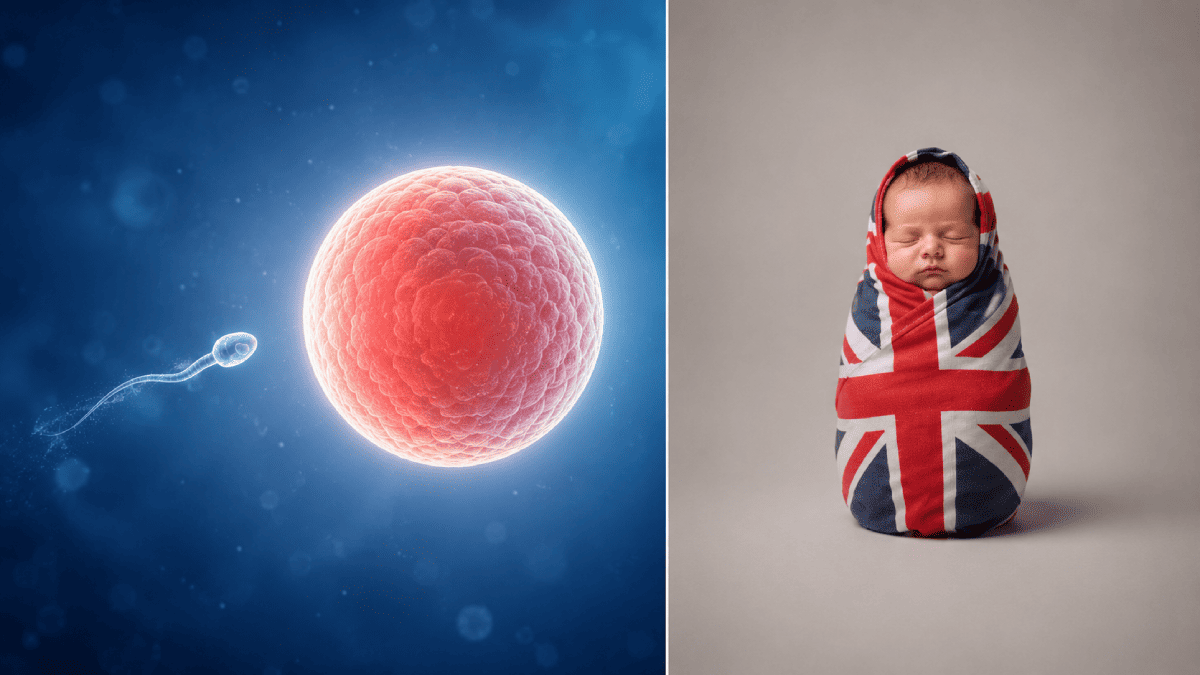
Strip away everything else, and civilisation comes down to a brutally simple formula. It's the fundamentally building block of all sophisticated organic life on Earth, and there is no philosophy or ideology which can change or bypass it.
Sperm cell from male + egg cell from female = new human.
That's it. It sounds crude, but no new life means no civilisation to embody it, continue it, or experience it. Nature does not care for your idea or preferences; she doesn't even care if you ever existed at all. Your feelings or opinions simply don't matter, and neither do you. It was the English who explained this over two centuries.
Nature is not egalitarian or altruistic; nor does she not care about your fictional "orientation," because no such concept exists in her at all. Neither does she care if you adopt silly abstract jargon like "sexual partner," "civil partner," or "co-parent" to describe your husband or wife; nor your plans to delay parenthood for two decades to so you can spend them in an office; nor your luxury belief conceits about cross-dressing, drug interventions, who you obsessively rub your genitals with, or transcending her morally and technologically.
All Nature is concerned with, is the transmission of DNA through sexual recombination: sperm and egg each carry a recombined half-genome from meiosis, and fertilisation shuffles them into a new genetic individual which lives or dies. It happens, or it doesn't. You die off as a genetic branch, or your DNA is inherited by a new human.
What follows is a difficult conversation, which is necessary.
British birth rates are at catastrophic levels. Child killing is at an all-time high. The volume of women reaching 30 without achieving motherhood has triggered the demographic alarm. Homosexuality and cross-dressing are unusually prevalent in two generational cohorts after intense propagandising.
If you voluntarily self-sterilise, and/or willingly divorce yourself from your own lineage, is it not an act of renunciation where one concedes forfeiture of belonging? If not, what alternative buttress forms one's claim to belong?
Let's put it in a much simpler way which will offend the sanctimonious Oxbridge undergraduate even more than the state of Israel: why should a civilisation legally recognise sterile same-sex "marriage" or sterile opposite-sex "civil partnership" between those who explicitly reject continuing it?
Or the tougher version: why should a civilisation recognise, in any way, your "throuple", your primate "polycule", adultery as operating principle, your cartoon fetishes, your imagined right to kill your own offspring, or any of your fictions?
If you reject replicating your own civilisation, why should it recognise you? If you hate our culture and renounce it, why should you retain its inheritance or your place in it?
The State May Only Record, Not Create
Civilisation is continuity, and continuity is not a sentiment. It is a mechanism, narrow and unforgiving, by which one generation produces the next, binds itself to the children it makes, and hands on a working inheritance of law, property, language and memory.
Everything a country admires about itself sits downstream of this single function.
The cathedrals were built by people who had children to build them for. The common law was refined by men handing their work to successors they had sired or taught. Strike out the function and the rest follows within a century, not by argument but by simple absence, because a civilisation which stops producing its own people produces, in time, nobody to inhabit it.
The state did not invent this arrangement and cannot claim authorship of it.
It found marriage already in existence, the social covenant by which sex becomes family, family becomes lineage, and lineage becomes continuity, and it attached legal consequence to the covenant because lineage, inheritance, and the protection of children are matters on which courts must eventually rule.
Recognition followed function. The function came first, and the recognition was always a record of something the state encountered, never a thing the state made.
This is the distinction modern law has lost, and the loss is the origin of the whole disorder. The state has mistaken its power to record for a power to create.
- It can write parent on a form; it cannot make a man a mother.
- It can write spouse on a certificate; it cannot make a non-generative union the lineage-forming institution of marriage.
- It can write citizen on a passport; it cannot conjure a people out of administrative ink.
Nationality, like family, is not first a document. It is birth, descent, household, inheritance and memory, and the passport is merely the record of it.
What exists before the state may be recognised by the state. What requires the state in order to exist should be treated with suspicion the moment it claims the standing of nature.
Liberalism Broke Marriage First
Same-sex "marriage" did not break the institution. It walked through a wall already demolished, and the demolition was the work of liberalism across the preceding half-century.
- Marriage was emptied of children by contraception treated as a sacrament and fertility reframed as an imposition.
- It was emptied of permanence by no-fault divorce, which converted the most solemn covenant a person could make into the only contract dissoluble at the unilateral whim of either party.
- It was emptied of duty by a culture which misled the young their twenties and thirties belonged to career and self-discovery and the deferral of every obligation.
- It was emptied of lineage by abortion reclassified as healthcare and childlessness reframed as liberation.
By the time the question of same-sex "marriage" arrived, marriage had already been redefined as adult companionship plus state recognition.
Once it meant only that, the exclusion of same-sex couples became genuinely difficult to defend on liberal terms, because the liberal terms had already conceded everything which made the male-female form distinctive.
The decisive surrender was not made by homosexuals, but by a civilisation which had already agreed to treat fertility as optional, divorce as administrative, child killing as a service, and children as one lifestyle among several.
Same-sex "marriage" is not the disease.
It is the most legible late symptom of a sexual entropy the ordinary majority had embraced for two generations and preferred not to examine. To blame the symptom and absolve the cause is to misunderstand the whole illness.
Sex For The Self, Sex For Continuity
Underneath the confusion lies a category error so fundamental the modern mind no longer perceives it as a distinction at all.
- There is sexual behaviour curved inward toward the self: appetite, identity, pleasure, companionship, self-expression, the desire to be wanted and seen and completed by another.
- And there is sexual order directed outward, beyond the self entirely: toward the child, the household, inheritance, duty, sacrifice and the continuation of a people across time.
The first is about what a person feels. The second is about what a civilisation becomes.
They overlap in the ordinary married life, which is precisely why they are so easily confused, but they are not the same thing, and the institution of marriage exists to serve the second, not the first.
Modern law has collapsed the two, treating adult intimacy and civilisational function as a single object because it can no longer see the difference between them.
The forms point in different directions. Sex ordered toward the self says my fulfilment, my identity, my recognition.
Sex ordered toward continuity says wife, husband, child, mother, father, home, inheritance, future.
Liberalism has treated the two as interchangeable because it has forgotten a civilisation is made by the second and merely entertained by the first.
Recognition Is Classification, Not Compassion
Identity is not asserted. It is not invented. It is not subjective to the individual and self-perceived. It is recognised. The modern mind hears the word recognition and supplies the wrong meaning. It imagines a kindness withheld, a hand not extended, a citizen left out in the cold by a bigoted officialdom. Recognition is nothing of the sort.
Recognition is classification.
When the state recognises a union it does not bless it; it files it into a legal category which triggers consequences across inheritance, immigration, parental status, taxation and the standing of children.
Classification is administrative machinery, and machinery requires a reason to exist beyond the warmth of the people operating it. The question a serious state asks of any proposed category is never whether refusal would wound someone's feelings.
It is what public function the category performs.
The state has no natural interest whatsoever in whether two adults feel complete, seen, validated or loved. None. It has an interest in children, parentage, inheritance, dependency, immigration, legitimacy and the continuity of the people, and its concern with marriage was only ever derived from these.
The moment recognition is detached from them, the state ceases to classify public realities and begins distributing emotional status, handing out validation like a registrar of the heart.
This is not a small drift in function. It is the abandonment of the only ground on which the state had any business in the matter at all. Love may explain perfectly well why two people wish to share a roof, a bed and a life, and the explanation is irrelevant to the institutional question, because the state was never charged with certifying affection as sincere. Love is not a legal ontology.
The sincerity of adult feeling, however deep, however true, cannot be the thing around which a civilisation organises nationality, parenthood and lineage, because feeling builds nothing outlasting the people who feel it, and a civilisation is precisely the thing which must outlast them.
Once this is understood, the supposed cruelty of refusing a category dissolves.
A government may tolerate every private arrangement it has no reason to record. It may protect adults from violence, blackmail, and contempt without converting their arrangements into public categories.
Protection from cruelty is owed to persons. It is not a title deed to public truth.
Recognition is not compassion; it is classification; and classification requires function. Where the civilisational function is absent, private liberty may remain entire, and public equivalence simply does not follow from it.
Equal Persons Do Not Require Equal Institutions
There is a confusion on which the entire modern settlement rests, and it is a confusion of categories so basic stating it plainly is now treated as an offence.
Persons are equal before the law. Forms of union are not.
A civilisation may owe identical protection to every citizen and owe nothing whatever in the way of identical status to every arrangement those citizens enter, because the equality of persons and the equality of institutions are different claims resting on different grounds, and the second does not follow from the first by any law of logic.
A union incapable by its nature of continuing the civilisation cannot be made the legal equivalent of the union-form by which the civilisation is in fact continued.
No quantity of statute can close that gap, because it is not a matter of sentiment but of function.
The objection infertile male-female marriages exist, are recognised, and produce no children either, misunderstands what marriage classifies. Marriage is defined by the type of union, not by "proof of fertility" in the individual case.
- A childless marriage is still the kind of union ordered toward generation, frustrated by age or illness or sorrow.
- A same-sex union is not a frustrated instance of the generative form. It is a different form altogether.
- The difference is the whole point, because the state classifies forms and not feelings, kinds and not cases.
Equal dignity of persons does not require equal dignity of forms.
The law may protect a non-generative union, may shield it from cruelty, may leave it wholly in peace. It cannot truthfully call it equal to the lineage-forming union on which the law itself depends for the existence of future citizens to be governed.
To insist otherwise is to demand the state certify as identical two things differing in the one respect the state had reason to care about in the first place.
Toleration Became Compulsion By Attrition
What began as decency has not stayed decency, because the logic set in motion does not rest. The decriminalising of private conduct was just, a withdrawal of the state's power to persecute, and it asked of the rest of society nothing but restraint.
What followed inverted the direction of every demand.
- Because an act may be tolerated in private, it must be recognised in law.
- Because it is recognised in law, it must be affirmed in public.
- Because it is affirmed in public, it must be taught in schools as settled good.
- Because it is taught as settled good, dissent from it must be reclassified as harm, and the dissenter handled as a danger.
Each step is presented as the unforced unfolding of the one before, the next plain instalment of fairness, and not one of them is anything of the kind. It is escalation.
This tendency was recognised in 1989 by the authors of the modern gay rights movement's tactics, who explicitly confronted what they termed "gay fascism." The entry on page 348 of its last section scolding the nation's bathhouses for narcissism and revolting public behaviour ("The State Of Our Community: Gay Pride Goeth Before A Fall") is titled "Gay Political Fascism and the Oppression of P.C."
While we wouldn't go so far as to call them devils, so it has been with the leaders of the gay press and their activist sidekicks—heavily overlapping groups, in fact—for twenty years. Ever since we began to read and listen to such, we have felt strongly that something was horribly wrong—myopic, overemotional, and destructive—with their whole worldview and tactics.
This was written over thirty years ago in 1989, describing the radicals across the seventies and eighties. These behaviours have become infinitely worse, but now they have institutional governmental backing.
The tell is the legal demand never stops.
Toleration asks only to be left alone and is satisfied the instant the asking is granted; it has a natural terminus, the point at which the citizen is in fact unmolested.
A demand which continues to escalate after the point has been reached is no longer a demand for liberty, because liberty's appetite is finite and this appetite is not. It is a demand for power, and it has borrowed the vocabulary of liberty because the vocabulary still commands respect it has not earned.
England's settlement was reached this way, not by consent but by politeness exploited: a tolerant people were informed protecting individuals from cruelty required.... redefining marriage, erasing lineage, licensing the manufacture of children, and treating Christian dissent as a threat to public order.
Tolerance is not assent. Decency is not surrender. A people may be generous and still have been imposed upon.
Surrogacy Is The Deliberate Manufacture Of Loss
Adoption marks the limit of the state's legitimate power over lineage and shows precisely where the line runs. Adoption creates real love, real obligation and real legal kinship; what it cannot create is natural lineage, and it does not pretend to.
It is a remedy after rupture, mercy extended to a child who has already lost the original thing through death, abandonment, or incapacity. The fiction is remedial, entered into to repair a wound the child already carries, and it is honourable for exactly that reason.
Surrogacy inverts the mercy into a wrong, because it is rupture by design. It brings a child into being under a contract whose founding premise is the child's natural claims may be severed before he draws his first breath.
Where adoption finds a wound and dresses it, surrogacy opens the wound deliberately, as a condition of the transaction, and then asks the law to ratify the wounding as a service freely rendered.
The child is commissioned, gestated, and handed over according to terms agreed by adults before he existed to object, his mother contracted in advance to surrender him, his lineage treated from conception as transferable property to be assigned at the convenience of the purchasing party.
The wrong has nothing to do with whether the commissioning adults are homosexual, infertile, single, elderly, or merely desperate, and the modern habit of routing every such question through the feelings of the adults is itself the disease.
The wrong is done to the child.
He is created inside a legal fiction treating his bloodline as a chattel, his mother as a vendor, and his own deepest natural claim, to be raised by the people who made him, as a clause to be waived.
A state may step in to protect a child after lineage has failed. It may not arrange for lineage to fail in order to supply a child to those who want one. The first is the work of a guardian. The second is the work of a procurer with a statute book.
Abortion Arms The Strong Against The Weakest
The same principle, followed without flinching, reaches abortion, and reaches it with more force rather than less. Let us put aside the absurdity of believing one has a "right" of any kind to kill one's own offspring.
If the child's claim is natural rather than granted by statute, then the state cannot manufacture a parental licence to destroy him, because the state does not own what it did not create.
The unborn child is not a private object lying within a zone of adult discretion. He is the weakest member of the lineage, the one with the least power and the most to lose, and the entire purpose of law, stripped of every embellishment, is to stand between the strong and the weak rather than to hand the strong a warrant.
A government permitting parents to kill the child has not remained neutral, whatever it tells itself. Neutrality is impossible where one party can end the other's existence; to license the killing is to take the side of the one holding the power, and to abandon the one who has none.
The unborn child holds the most basic negative right there is, anterior to every positive entitlement the modern state showers on the adults around him: the right not to be deliberately destroyed.
A civilisation which suspends the right for its smallest members, on the reasoning the destruction is convenient to the powerful ones, has announced in advance the terms on which it will treat everyone else when they too become inconvenient.
Put the three together and the pattern is unmistakable.
Children may be destroyed when unwanted, commissioned when wanted, and stripped of their lineage when it suits the adults involved, and each of these is defended in the language of compassion and choice.
A civilisation begins to dissolve the moment it consents to treat children as products of adult will, because it has thereby inverted the one relation on which its continuity depends.
The child exists for the sake of the line. He has been redefined as existing for the sake of the adults, to be made, unmade, or reassigned as their desires dictate.
Marriage Made Sterile By Design
Exceptions can live inside continuity. They cannot replace it. A healthy reproductive order absorbs a measure of non-generative union without strain, the way a sound body carries a number of cells which never divide, and for most of history this is exactly what happened, quietly, without anyone proposing to rebuild the institution of marriage around the exception.
The danger is not the existence of the non-generative union, per se.
The danger is its elevation to the cultural and legal equal of the generative one, because the moment a civilisation declares the two equivalent it loses the capacity to notice which of them is keeping it alive.
Take the arithmetic to its conclusion.
Were a third of the population to enter unions incapable of generation by design, the matter would no longer be one of private tolerance; it would be a lineage event, a third of the marriage structure producing no successors at all.
- Adoption would not repair it, because adoption redistributes children who already exist and manufactures no new lineage.
- Surrogacy would not repair it, because surrogacy purchases the appearance of lineage by fracturing someone else's.
- Immigration would not repair it, because demographic replacement is the substitution of one people for another and not the continuation of the first.
A society in the condition would have chosen, freely and proudly, a set of legal forms depending for their very survival on the fertility of people who declined to adopt them.
The point is not the percentage is likely; same-sex couples are nowhere near a third of the population and never will be. The point is an institution's civilisational status can be tested by generalising its principle and asking what becomes of the society if everyone follows it.
- The male-female marriage passes the test: generalise it and the people continue.
- The non-generative union fails it: generalise it and the people end.
A principle survivable only so long as most people ignore it is not a foundation. The fruits of our the tree are bad, which means the tree itself is bad.
Britain need not run the test in the abstract. It requires 2.1 children per woman to hold steady and produces 1.41, the lowest figure ever recorded and falling for three years together; half the women born in 1990 reached thirty with no child at all, the first cohort in the history of the records to do so.
This is the condition in which a civilisation chose to spend its institutional energy declaring the non-generative form equal to the generative one.
It is madness to organise a civilisation around what cannot reproduce it, at the precise moment it is conspicuously failing to reproduce itself by any means at all.
The Christian Crown And Its Treachery
England's contradiction is sharper than the general civilisational one, because England has not declared itself neutral. It retains a Christian Crown and an established Church, and the monarch swears before God at the Coronation to maintain the Protestant Reformed Religion established by law.
Yet Royal Assent has been given, statute after statute, to laws which hollow out the Christian understanding of marriage, parenthood and lineage from within the very constitutional order built to uphold it. Many of these statutes are unambiguously and staggeringly wicked in character.
The result is not the clean separation of a secular state from a private faith. It is a Christian constitution conscripted to ratify post-Christian law, an established Church presiding over the legal dismantling of the anthropology it exists to teach, a Defender of the Faith assenting to the steady abolition of the faith's account of the family.
A secular republic which legislated all of this would at least be coherent. England has done it while keeping the cross on the crown, and the incoherence is not a quaint survival.
It is a wound at the centre of the constitution, an oath and a statute book pointed in opposite directions, with the law winning every year.
What The State May Not Invent
A civilisation continues by more than rights, and the modern conviction rights alone can sustain it is the deepest error of the age. It continues by honour and shame, permission and prohibition, marriage and inheritance, manners and taboo, the praise of what reproduces it and the disapproval of what does not.
Stigma (plural: stigmata) is not, as the age insists, intrinsically a cruelty. It can be unjust, certainly, but it can equally be a civilisation's immune response, the means by which a people marks certain acts and arrangements as lying outside the pattern it intends to carry forward.
The distinction must be held with care: stigma properly attaches to conduct, to arrangements, to public claims, never to the irreducible worth of persons.
A society which has forbidden itself every form of disapproval of any conduct whatsoever has not become kind. It has disarmed itself, and called the disarmament "progress."
Let private society be plural without limit insofar as it is not criminal. Let adults form whatever ceremonies, households and covenants they please, in any church or mosque or private hall which will have them, and let the state regard it as none of its concern, because liberty of association, contract, cohabitation, and conscience is real and worth defending.
What the state owes is protection to persons. What it does not owe is metaphysical equality to every form of relationship, nor a manufactured public truth, nor the conversion of every private covenant into a legal ontology.
It recognises marriage because marriage performs a public function, the ordering of sex, children, inheritance, and lineage toward the continuation of the people. Where the function is present, recognition is owed.
Where it is absent, private liberty may remain entire and public equivalence need not follow; a country which has forgotten how to say so plainly has forgotten the difference between protecting its citizens and dismantling the institution by which it acquires any.
The question is whether the state was ever entitled to redefine the central reproductive institution of a civilisation as a neutral platform for adult recognition, then require every public body to celebrate the redefinition as moral advance.
England is free to protect every person within its borders, and it should. It is not required to lie about marriage to do it.