The Clown Parliament Gets A New Wig And Costume
Westminster has a new Prime Minister, defectors in fresh rosettes, and 188 new Bills since May. Every Bill to reach Royal Assent came from a minister. Waiting behind them: Ofcom permits for social media, a superintelligence ban, private road tolls, a tourist tax, and two identical Bills about hares.


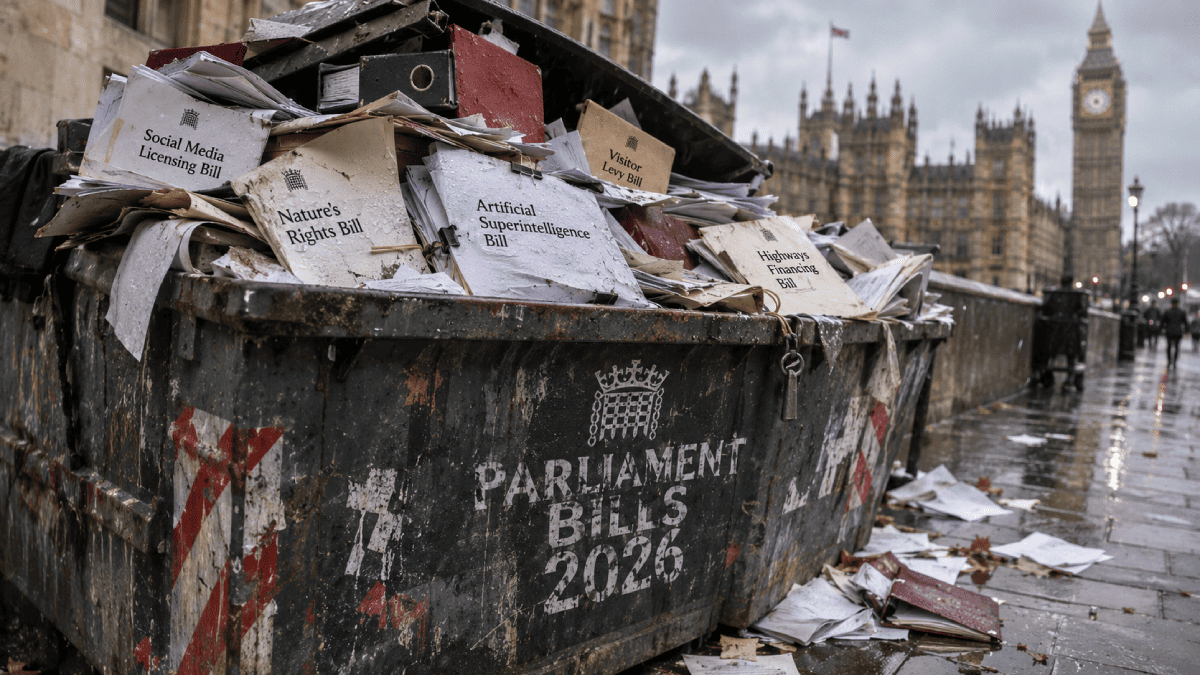
Before one digs deeper into this spaghetti junction shitshow, it is important to remind oneself about the state of Britain. Westminster owes £3 trillion in national debt or £5 trillion in liabilities. We are overpopulated by 20 million. A million kids are unemployed. 24 million people are on benefits. £1.4 trillion is being wasted on net zero. And we're even borrowing money to pay off £100 billion of interest every year.
Now with that in mind, how exactly are our elected representatives spending their time?
The influence of women is finally being felt in government. And predictably, it's not good. That's an understatement. It's catastrophic and pernicious.
January's tour of Westminster's legislative attic found more than 3,000 Bills on the shelves, among them reindeer licensing, the permitted height of a letterbox, and a Member for Christchurch apparently paid by the title.
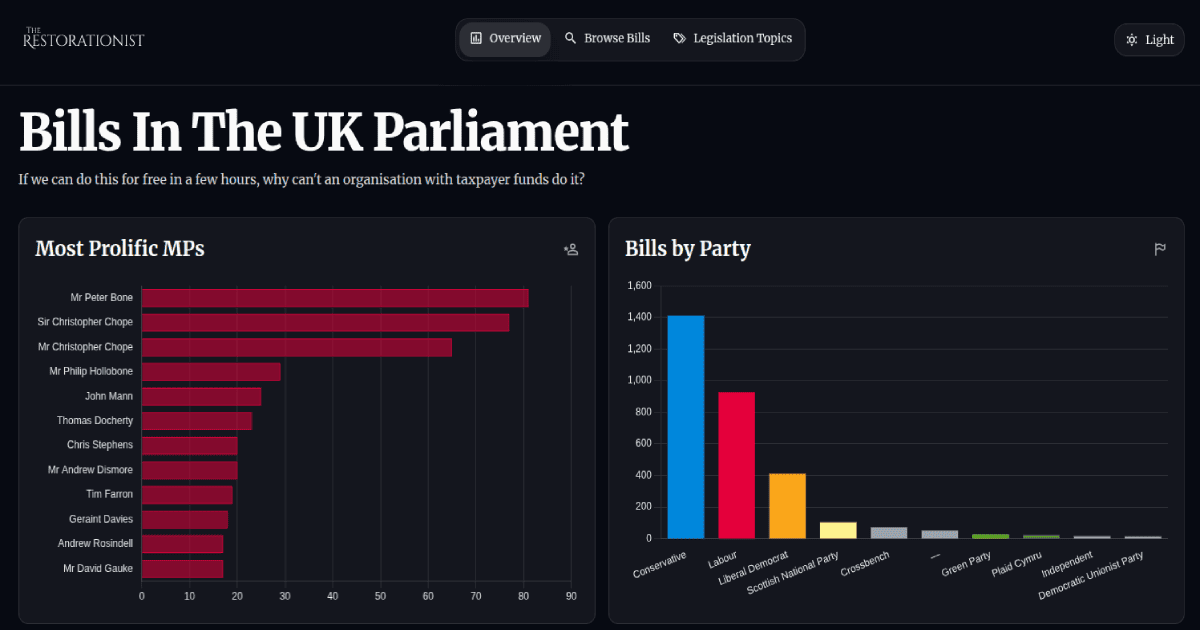
The Restorationist Bills dashboard now holds 4,072 records, and only 696 of them ever became Acts of Parliament.
 William Turing
 Oliver Kerr
The reindeer are gone. Sarah Dyke's Reindeer (Licensing for Exhibition) Bill died when the old session was prorogued in April, and Anneliese Midgley's Letter Boxes (Positioning) Bill went with it.
Ms Midgley has since been made Chief Whip, responsible for getting the Government's legislation through the Commons. Government legislation may yet arrive at a sensible height.
Almost everything else has returned.
Some of it wears a fresh wig, some of it last season's costume, and it has been joined by a new cast: a licence to run a social media platform, a ban on a form of intelligence nobody has built, legal personhood for Nature, private tolls on trunk roads, a tourist tax, and a Government Bill drafted so the Prime Minister can do the whole of his own job.
The Prime Minister is new as well. And just as idiotic.
New Government, Same Civil Service
The King opened the 2026-27 session on 13th May with a programme of 37 Bills, eight of them carried over from the session before. Labour had just lost more than 1,000 council seats, and its MPs were writing to Sir Keir Starmer to ask him to leave.
Burnham's first appointment sent John Healey to the Treasury, a month after Healey had resigned as Defence Secretary in protest at the money the Treasury would not give him.
Rachel Reeves, whose name sits on three of this year's Acts, was removed from the Cabinet.
Ange returned to run housing and local government, and has since found a new tax to administer. She's definitely getting tougher on those evil capitalists she wants to be like.
Robert Jenrick was sacked from the Conservative front bench in January and joined Reform UK the same day.
Jeremy Corbyn has reintroduced his Gaza (Independent Public Inquiry) Bill, this time under the banner of Your Party.
By the dashboard's November update, Parliament had received 188 new Bills since the State Opening. Five had become law.
| Type of Bill | > 13th May | Royal Assent |
|---|---|---|
| Government Bills | 18 | 5 |
| Presentation Bills | 103 | 0 |
| Lords Private Members' Bills | 30 | 0 |
| Ballot Bills | 20 | 0 |
| Ten Minute Rule Bills | 17 | 0 |
| Total | 188 | 5 |
Seven further Government Bills were carried over from the last session.
One of them, the Public Office (Accountability) Bill, is the "Hillsborough Law" Labour promised in 2024. It is still short of Royal Assent.
Five Acts Since May
The National Security (State Threats) Act 2026 received Royal Assent on 8th July. It gives the Home Secretary a proscription-style power to designate bodies working for foreign states, and supporting a designated body now carries up to 14 years in prison.
On 17th July the Islamic Revolutionary Guard Corps, Russia's GRU Volunteer Corps, and a third group became the first bodies designated.
The Steel Industry (Nationalisation) Act 2026 followed on 15th July, and British Steel passed into public ownership the next morning. An independent valuer will now decide whether its Chinese owners are owed any compensation.
The same day brought the Taxation (Energy and Vehicles) Act 2026, which raises the electricity generator levy, and the Supply and Appropriation (Main Estimates) Act 2026, the annual Act authorising spending for a financial year which had already been running since April.
The fifth is the Sovereign Grant Act 2026, which sets the funding of the monarchy. It raises the share of Crown Estate profits used in the calculation from 12% to 20.5%, while the grant itself falls from £137.9 million to £99.9 million in 2027-28.
Two of the five are money Acts any government must pass every year, and a third adjusts the King's allowance.
Backbenchers in both Houses have added nothing to the statute book since May.
Across the whole calendar year, the dashboard records 28 Acts with a 2026 Royal Assent date, and 23 of them began life as Government Bills. Nine received Royal Assent on a single day, 29th April, as the old session ran out of days.
They covered tobacco and vapes, crime and policing, pensions, English devolution, and a Ministerial Salaries (Amendment) Act.
Six weeks earlier, the Universal Credit (Removal of Two Child Limit) Act 2026 and the House of Lords (Hereditary Peers) Act 2026 received Royal Assent on the same afternoon.
1/40 Bills Ever Become Law
The previous session ran from July 2024 to the end of April 2026 and produced 386 Bills. Ministers introduced 61 and saw 53 become law. Backbenchers in both Houses introduced 320 and passed eight.
The odds depend almost entirely on the route a Bill takes.
| Route into Parliament | Bills on record | Became Acts | Success rate |
|---|---|---|---|
| Government Bill | 591 | 522 | 88% |
| Ballot Bill | 338 | 102 | 30% |
| Presentation Bill | 1,328 | 21 | 1.6% |
| Lords Private Members' Bill | 676 | 9 | 1.3% |
| Ten Minute Rule Bill | 1,088 | 5 | 0.5% |
Ballot Bills belong to the twenty MPs drawn by lot at the start of each session, who get first claim on the Fridays set aside for backbench legislation.
Ten Minute Rule Bills get a short speech in prime time and very rarely anything else. Presentation Bills need no speech and no debate. An MP hands in a title, the Bill is printed, and it joins a queue for a Friday on which, if it is reached at all, a single shout of "Object" will stop it.
Chope Has Tabled 305 Bills and Passed... One
Christopher Chope remains the undisputed master of the Presentation Bill. January's count gave him 142. The dashboard now credits him with 178 Bills as Sir Christopher and another 127 from his years as plain Mr Chope, a career total of 305.
One became law: the Mobile Homes (Pitch Fees) Act 2023, which tied park-home pitch fee rises to the consumer prices index, and which cleared its remaining Commons stages in a little over three minutes.
He has tabled 38 of the 188 Bills in the new session, one in five of the total, and 29 of the 38 carry titles he has used before. Thirteen were listed for second reading on Friday 13th November. The rest are spread across Fridays as far ahead as 19th March 2027.
The venerable collection includes:
- Eight Bills to cut or exempt taxes, among them VAT on domestic energy, children's clothing, and repairs to listed places of worship;
- Four separate Bills on Covid-19 vaccine damage compensation;
- A Bill to privatise the BBC tabled for the fifth time;
- An Illegal Immigration (Offences) Bill making its seventh appearance;
- The Bank of England (Inflation Targets) Bill would impose penalties on the Bank's Court of Directors whenever it misses the inflation target, which would make the Court of Directors the only people in Britain held responsible for inflation.
The Regulatory Impact Assessments Bill would require an impact assessment for every piece of Government legislation, primary and secondary, with sanctions for skipping one.
The Rule of Law (Enforcement by Public Authorities) Bill would oblige public bodies to use the enforcement powers Parliament has already given them.
The Arm's-Length Bodies (Review) Bill would force a review of every quango in existence on 22nd June 2026.
He has tabled the first five times and the second six.
Chope is rapidly becoming a Restorationist favourite for his desire to absolutely carpet bomb the legislature into oblivion.
Chope's method gives his sensible ideas and his eccentric ones exactly the same prospects: about one in sixty.
76 "New" Bills Are Reruns
Of the 188 Bills introduced since May, 76 share a title with a Bill from an earlier session. The Genocide Determination Bill, now in the hands of Lord Alton, is on its eighth outing. Lord Marks's Cohabitation Rights Bill is on its seventh as yet another dreadful Boomer idea to finally destroy marriage completely.
The Pets (Microchips) Bill has now been tabled six times by two different Conservatives.
Dysgenic Maria Eagle's hopeless Multi-Storey Car Parks (Safety) Bill, which would require multi-storey car parks to be staffed around the clock, is back for a fourth time. January's version belonged to Peter Dowd; Ms Eagle had tabled it twice before him and has now taken it back.
Patricia Ferguson's Fireworks Bill joins six earlier attempts to legislate on fireworks, none of which went off. Go home, dear.
There are two Bills to repeal the Climate Change Act 2008, one from Chope and one from Bradley Thomas. Good work, gentlemen. Carry on.
There are two Bills against strategic lawsuits designed to silence critics, from Baroness Stowell in the Lords and John Whittingdale in the Commons.
There are two on chalk streams, from Pippa Heylings and Daisy Cooper, and two cutting VAT on hospitality, from Seamus Logan of the SNP and, naturally, Chope.
Then there are the hares.
Ruth Jones's Hares Bill in the Commons and Baroness Helic's Hares (Close Season) Bill in the Lords carry almost identical long titles. Both would ban killing brown hares from February to September, protect mountain hares, and repeal a seasonal sale ban in the Hares Preservation Act 1892.
Parliament insists it lacks the time to legislate properly. It has found the time to introduce the same hare Bill twice in one season.
Ofcom Licences for Social Media
Baroness Benjamin, the Liberal Democrat peer, introduced the idiotic Social Media Platforms (Ofcom Licensing) Bill on 7th September. Its first clause makes it an offence to operate a social media platform available to users in the United Kingdom without a licence from Ofcom, punishable on indictment by up to two years in prison.
Licences would run for up to ten years, and renewal would depend on Ofcom's view of the platform's past conduct.
Licence holders would have to keep content within the law, keep off anything harmful to users or to the public interest, and run systems to minimise "materially false or misleading information". Anything Ofcom identifies as harmful would have to be removed or restricted within whatever deadline Ofcom sets.
Ofcom could suspend or revoke a licence, and after revocation could ask a court to order internet providers to block the platform across the country.
This is Parliament at its worst. Pretentious, ignorant, moronic. Trying to regulate... the Internet. Floella Benjamin is very stupid. But she is not alone.
The Bill does not define the public interest, and it does not say who decides what counts as materially false. Ofcom would.
A regulator which licenses television channels would become the licensing authority for every social media platform used in Britain, and Benjamin has been pressing for exactly this arrangement since the spring. Because she's an idiot.
The proposal matters less for its chances than for what it reveals: a sitting legislator thinks the right answer to online speech is a state permit, revocable at the regulator's discretion, enforced by a prison sentence.
Regulating Superintelligence Before It Exists
Alex Sobel used the Ten Minute Rule on 8th September to introduce the Artificial Superintelligence Bill. It would prohibit the development, deployment, and operation of artificial superintelligence systems, and give ministers powers to monitor and control them.
Truly, this is another moment of idiocy. They want to regulate something which doesn't exist, before it even gets close to existing.
Such is the zeal of our politicians to regulate, they will regulate the hypothetical.
The text was drafted by ControlAI, a campaign group which warns of extinction risk from advanced AI. More than 70 MPs and peers wrote to Burnham urging him to back it.
The Government says it is not the right approach. They are correct.
The Bill defines superintelligence by what a system could do rather than how it is built.
How a British court would establish a machine had crossed the line, or how a statute in Westminster would bind a laboratory in California, is left for later.
Its second reading was listed for 13th November and has since been moved to 27th November. Ten Minute Rule Bills have become law five times in 1,088 attempts.
Westminster cannot decide whether to ban the machines, license them, or put them on a list, and has a Bill for each option.
- Chi Onwurah's Personal Data (Digital Twins) Bill would regulate software which models a person's preferences and behaviour.
- Dawn Butler's Artificial Intelligence (Consent and Misuse) Bill would require consent before anyone uses AI to generate a person's likeness, with civil remedies and criminal offences for deepfakes. Presumably to stop people making deepfakes of.... Dawn Butler.
- Damian Hinds's Automated Online Software (Access and Transparency) Bill would require operators of specified automated software to sign up to an official list.
Endless government interference in things politicians do not understand.
Only one of the four concerns a technology which does not yet exist.
Tolls, A Tourist Tax, And 11 Tax Cuts
Ange did too much and introduced the Visitor Levy (England) Bill on 4th November, with no-one stopping her as should be obvious. It would let mayors and leaders of Foundation Strategic Authorities charge a percentage of the price of every overnight stay, collected and paid over by hotels, guesthouses, and holiday lets.
This is obviously a horrendous idea which will destroy the industry and the jobs it sustains. These MPs should know better than to let Ange try to do anything. The last time was a disaster.
This bill is suicidal.
There is no national cap; ten mayors have merely promised to stay at or below 5%. The charge applies to the first 28 nights of a stay, and Ange insists:
every pound raised through these levies will stay in the local area.
No it won't. We all know it won't.
Edinburgh's 5% levy has been running since July, which gives English mayors a precedent and a starting rate.
Heidi Alexander introduced the Highways (Financing) Bill on 10th September. It would license private companies to build or improve trunk roads in England and charge tolls in return, under the regulated asset base model used for utilities.
Tolls would be collected without barriers, by remote payment, and the Bill includes a special administration regime for toll operators which fail. Ministers say they have no plans to toll roads which are currently free.
The AA's Edmund King pointed out drivers already pay £34 billion in fuel duty and vehicle excise duty.
Add the higher electricity generator levy already enacted, and the Government's contribution to this session's fiscal debate is a new local tax, a new road charge, and a bigger levy on power stations.
Backbenchers have gone the other way.
Eleven Private Members' Bills propose to cut or exempt taxes: VAT on domestic energy, children's clothing, hospitality (twice), sport, gyms and leisure centres, listed churches, public car chargers, and home cooling, insurance premium tax on health insurance, and a general Tax Reliefs Bill covering school fees, private healthcare, mortgage interest, and pension contributions.
Eight of the eleven are Chope's.
Ministers' tax rises get committee stages. Backbench tax cuts get a Friday in March.
"Nature" Gets Personhood And A Tribunal
Baroness Bennett of Manor Castle, the Green peer, introduced the Nature's Rights Bill on 1st June. It would recognise Nature as a legal subject with enforceable rights, place a legal duty of care on public bodies, businesses, and individuals, and create a Nature Guardianship Council, a set of Bioregional Councils, and a Nature's Rights Tribunal. It was written by Mumta Ito, founder of the campaign group Nature's Rights.
Now it is important to understand why this is as catastrophically stupid, low IQ, and reprehensible as it is.
A fallacy is broken thinking. This is a living, breathing example of reification fallacy.
When an abstraction (abstract belief or hypothetical construct) is treated as if it were a concrete, real event or physical entity – when an idea is treated as if had a real existence.
Not only that. The example of "Nature" is given as a canonical form of this error.
Logical Form: Abstraction X is treated as if it were concrete, a real event, or a physical entity. Because the abstraction is seen as if it were concrete, a real event, or a physical entity, the conclusion is true.
Example #1:
Dr. Simmons: I am working on a way to lengthen the human lifespan to about 200 years.
Misty: You are declaring war on Mother Nature, and Mother Nature always wins!
Explanation:
Here, “Mother Nature” is being portrayed as an autonomous being capable of going to war with humanity. If this were the case, it would seem that messing with Mother Nature is futile. In reality, we are part of nature and can and always have changed nature, sometimes for the worse, but often for the better.
The Bill's own text sets an order of precedence. Human rights come second, to be protected within the ecological conditions necessary for life. Economic, corporate, and property rights come third.
In a country where a housing scheme can already be held up by a bat survey or a judicial review, the Bill would add a tribunal at which the newt has standing.
Who would instruct counsel for a river, and whose rights prevail when a fox meets a hen, are matters for the Nature Guardianship Council.
We simply cannot afford people like this with the country in the state it is in.
Catholic Prime Ministers Can Advise on Bishops
The Roman Catholic Relief Act 1829 and the Jews Relief Act 1858 bar Catholics and Jews from advising the Crown on appointments in the Church of England and the Church of Scotland.
The Government announced a repeal in September. Convicted fraudster and Burnham mastermind Louise Haigh introduced the Church Appointments (Repeal of Discriminatory Provision) Bill (of course it's discrimination!) on 15th September, it cleared the Commons within weeks, and it has passed second reading in the Lords.
The Hillsborough Law, carried over from the last session, is still waiting.
A Bill which removes a restriction on the Prime Minister personally took a matter of weeks.
No National Suicide Service This Year
Kim Leadbeater's evil Terminally Ill Adults (End of Life) Bill passed the Commons twice. In the Lords, peers tabled more than 1,200 amendments, and the Bill ran out of time when Parliament was prorogued in April. Good.
Lauren Edwards, second in the new session's ballot, reintroduced it on 17th June. On 11th September the Commons rejected it by 286 votes to 270.
The official Bills data still lists it as awaiting second reading.
Two years, three Commons votes, and a Lords marathon of amendments produced no change in the law. Supporters blame the peers, and opponents credit their own campaign.
Parliament finished exactly where it started.
In this instance, evil was resisted and overcome. It's a rare moment for sanity.
Barbers, Wet Wipes, Ponds, And Submarines
Vikki Slade wants compulsory registration of every barber and hairdresser in England through her Barbers and Hairdressers (Registration) Bill. It's not immediately clear why the government needs to interfere with hairdessing.
After the letterbox, the short back and sides.
David Burton-Sampson has a Wet Wipes (Labelling, Sale and Marketing) Bill.
Rebecca Smith's Ponds (Permitted Development) Bill would let householders dig wildlife ponds of up to 0.2 hectares without planning permission. A fifth of a hectare is 2,000 square metres, which in most English gardens would be called a lake.
Graeme Downie wants a Submarine Recycling Strategy, and Gareth Snell has revived the Ceramics (Country of Origin Marking) Bill, which he also tabled last session.
The Green MP Hannah Spencer ("loony crumpet") has a Maximum Workplace Temperature Bill which sets no maximum temperature. It creates a quango to recommend one.
Repulsive Richard Burgon's Members of Parliament (Prohibition of Second Jobs) (Motion) Bill does not ban second jobs either. It would require the Leader of the House to move a motion inviting MPs to ban them, which makes it a Bill to compel Parliament to debate whether Parliament should restrict... Parliament.
God help us.
Tories Write Half the Backbench Bills
Conservatives lead 84 of the 170 backbench Bills introduced since May.
| Party of lead sponsor | Bills |
|---|---|
| Conservative | 84 (38 of them Chope's) |
| Liberal Democrat | 38 |
| Labour | 32 |
| Crossbench | 4 |
| Green, SNP | 3 each |
| DUP | 2 |
| Plaid Cymru, Reform UK, Your Party | 1 each |
The Conservative list holds the most interesting serious material, and none of it will pass.
Dysgenic Mike Wood's European Convention on Human Rights (Notification of Withdrawal) Bill would give the Prime Minister power to give notice of withdrawal under Article 58.
Katie Lam's Data Publication and Quality (Immigration, Nationality and Country of Birth) Bill would require ministers to publish the immigration status, nationality, and country of birth of benefit claimants, prisoners, and users of certain public services.
Nick Timothy's Early Release of Prisoners (Restriction) Bill would curb early release for specified offences.
All three are Presentation Bills.
Reform UK's entire legislative output this session is a single Bill: Robert Jenrick's Group-based Child Sexual Offences (Mandatory Life Sentences) Bill, which would make whole life orders the starting point for adult offenders.
Its sponsor was a Conservative shadow cabinet minister until January.
The Government, meanwhile, is pushing its own Immigration and Asylum Bill through the Commons. It cleared report stage in mid-November and would create another quango: an independent immigration appeals authority to hear asylum appeals.
Ministers legislate. Everyone else tables.
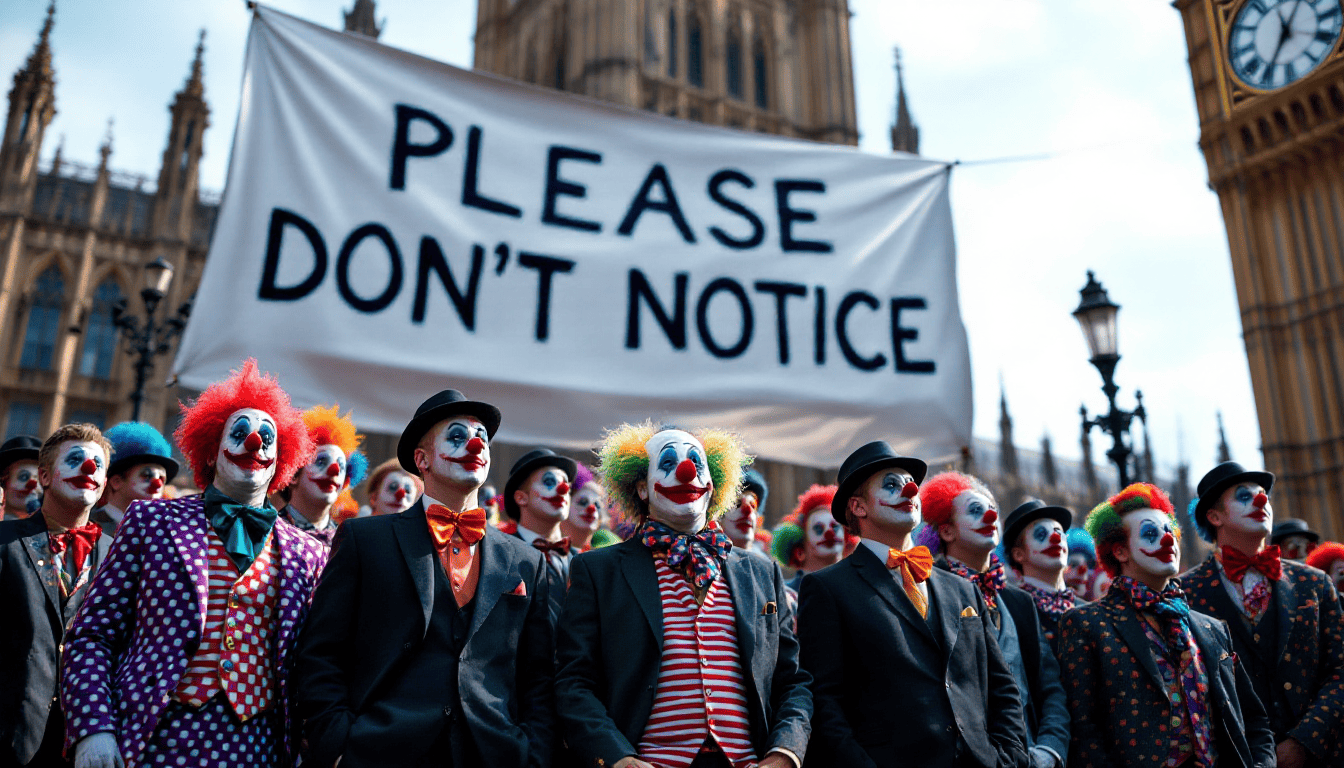
All Of You Are Clowns
Since May, 188 new Bills have entered Parliament and five have left as law. All five came from ministers: a nationalised steelworks, a power to outlaw support for foreign state bodies, a higher levy on electricity generators, the annual spending authority, and the King's allowance.
The Government's next instalment brings tolls, a tourist tax, and a new appeals authority.
The backbenches have produced 170 Bills, and about 30 of them would require a minister to publish a report, a review, or a strategy.
Westminster's preferred remedy for submarines, hospices, rural council funding, cancer, flooding, and Covid vaccine injuries is a document.
The second favourite is a new council, office, or tribunal.
On Friday 27th November the Commons may find a few minutes to consider banning superintelligence which doesn't exist. Ironically, something Parliament desperately needs as it clearly has none of its own.