Milburn's New Deal: The Death Of Beveridge And Its £6 Billion Funeral
Ministers cheered Alan Milburn’s spending plans within hours and began briefing against his only tax cut within two days. Britain’s young were priced out of work by a state which knew the cost in advance, and the same state now wants the taxpayer to pay for letting them back in.

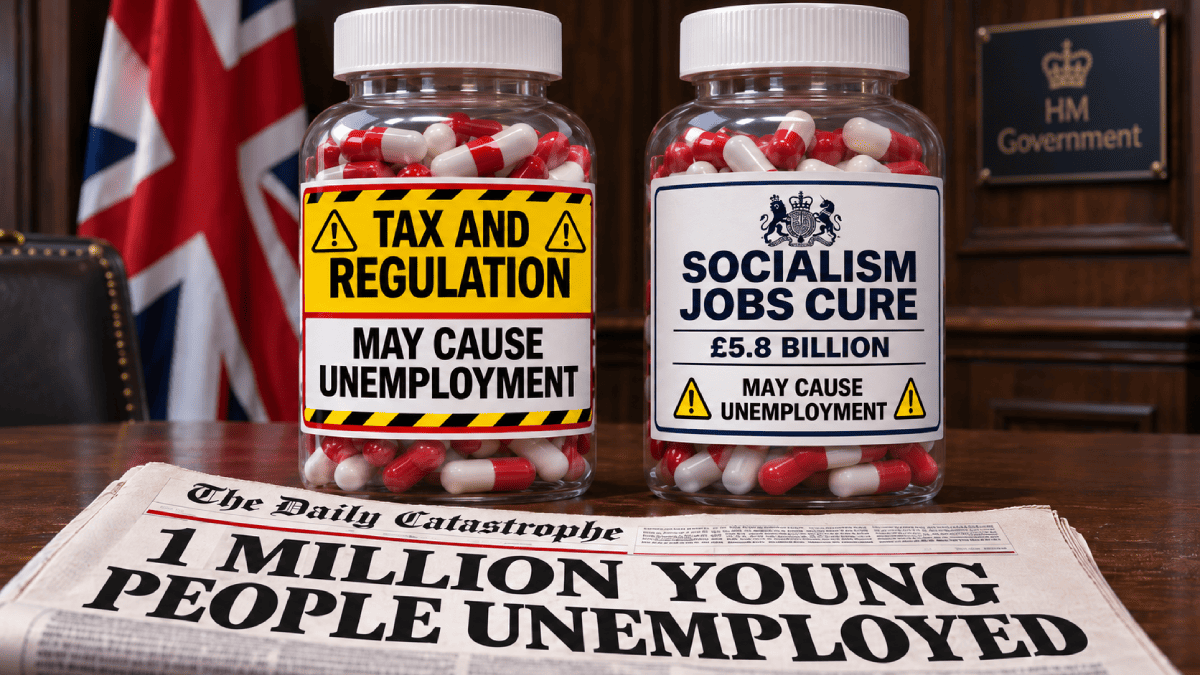
On Monday night Alan Milburn addressed the Parliamentary Labour Party and, by the account of West Yorkshire mayor Tracy Brabin, sat down to a standing ovation. On Tuesday, 17th November, he published From a Welfare State to a Working State. By the afternoon Pat McFadden had hailed it in the Commons as a "landmark report" and accepted its guarantees, its new local bureaucracy, and a fresh unit reporting to the Prime Minister.
Labour MPs who sank last year's welfare cuts lined up to coo over it.
By Thursday the Treasury was briefing the Financial Times against the one recommendation which touched the cause of the problem: a modest cut in employer National Insurance for young workers. Officials called it "hugely expensive".
The spending won a ministerial welcome within hours.
Within two days the tax cut was being knifed by its own side.
Beveridge built the welfare state on one condition: plentiful work. Eighty-four years later the state has taxed and regulated the first job beyond the reach of a million young people, and Alan Milburn’s cure is to have the welfare state manufacture the work instead.
Milburn has written a 278-page charge sheet against the British state, listed four of its institutions among the five culprits, and recommended the state be given billions more to put things right.
Labour MPs gave him a standing ovation.
Every part of the story is in those 48 hours.
A government has commissioned a 278-page admission the future for Britain's young looks grim, read it, applauded it, and chosen to keep the policies which made it grim while spending money it has not yet found to soften the consequences.
A Confession Of Catastrophic Failure
Read as a manifesto, Milburn's report is ambitious. Read as evidence, it is devastating. Nearly one million 16 to 24-year-olds, one in eight, are neither working nor studying. Six in ten have never had a job.
Across Europe only Romania does worse.
Without change, Milburn's own forecasting has the rate climbing to 16.3%, or 1.27 million young people, by 2031. He calls it "a whole system failure", warns of a lost generation, and concludes the existing system "has failed too many of them".
There are five culprits:
- A labour market which has "moved against young people"
- An education system unfit for a modern economy
- A health service built to diagnose rather than prevent
- A welfare system which traps the young in "a lifetime on benefits", and
- A jumble of agencies which is "not a system at all".
Four of the five are state institutions outright. The fifth, the labour market, runs on a price list the state writes.
Milburn's summary is the product of "failure on the part of the State and on the part of the market".
Strike out the market, and the sentence becomes true.
Beveridge Welfare Required Full Employment
William Beveridge never pretended the welfare state could survive without work. His 1942 report rested on three assumptions, and the third, Assumption C, was the maintenance of employment and the avoidance of mass unemployment. Unemployment, he wrote, was the worst form of waste, because it inflated the benefits bill while shrinking the income needed to pay it.
On 2nd December 1942, Ministry of Labour officials predicted industry would argue the whole plan stood or fell on Assumption C, and would push "for decreasing tax on employment rather than increasing it."
After 1944 every government, Labour and Conservative alike, committed itself to high and stable employment as the foundation beneath the settlement.
Attlee's National Insurance Act 1946 then financed the new order through contributions levied on workers and employers.
Eighty years on, the employer contribution stands at 15% after the 2025 rise.
Under-21s and apprentices under 25 are spared it on earnings up to £50,270, which leaves the toll falling on every 21 to 24-year-old at the gate of a first proper job. The tax take is heading past its previous record.
Assumption C, for the young at least, has failed outright: youth unemployment stood at 15% this week against 4.6% for the workforce as a whole.
Milburn would never put it this way, but his evidence makes the case against the post-war settlement better than any of its critics have managed.
A welfare state built on the assumption of plentiful work grew, under governments of both colours, until its taxes and rules began to choke the work it depended upon. Its answer now is to grow a new limb to manufacture the employment it was meant to rest on.
Beveridge put a safety net beneath a working economy.
Milburn proposes to weave the working economy out of the safety net.
Stop Interfering In What You Don't Understand
Milburn's third chapter lays out the cost of hiring a young person in 2026 with a candour no minister would risk:
| Change to the cost of hiring | Effect |
|---|---|
| Employer National Insurance rate | 13.8% raised to 15% |
| Earnings level where employer NI begins | £9,100 cut to £5,000 |
| Extra yearly cost of a FT National Living Wage worker | about £800 |
| Minimum wage for 18 to 20-year-olds | up 65% in five years |
| OBR forecast hit to labour supply | about 50,000 average-hours equivalents by 2029-30 |
The Office for Budget Responsibility told ministers in advance the National Insurance rise would cut labour supply by around 50,000 full-time equivalents. They took the £25.7 billion a year regardless.
Employers in retail and hospitality, which between them supply 37% of jobs for 16 to 24-year-olds, told Milburn the higher payroll bill had made recruitment harder.
The Employment Rights Act 2025 added its own charges. Milburn records estimates of £350 million to £2.9 billion a year for its guaranteed-hours rules alone, and the CIPD found more than a third of employers planned to take on fewer permanent staff because of the Act.
The Low Pay Commission quango is working to the government's ambition of abolishing the lower 18 to 20 rate within this Parliament, pushing the youngest and least experienced workers onto the full adult wage.
The NEET problem predates Rachel Reeves; the rate has barely dipped below 10% in a quarter of a century of governments of every stripe.
The 2024 Budget took a labour market already failing the young and stamped on its fingers. Milburn's verdict is admirably blunt:
There is nothing progressive about pricing young people out of work.
Quite.
A government which raises the price of something and then expresses alarm at how little of it gets bought does not need a new settlement.
It needs a calculator.
The Treasury Plans To Poison The Crib
Having named the disease, Milburn flinches from the cure. He considered extending the existing exemption from employer National Insurance, which covers under-21s and apprentices under 25, to everyone aged 21 to 24.
Resolution Foundation modelling priced it at £5.1 billion a year for 38,000 extra jobs, and Milburn rejected it as money spent on jobs which would have existed anyway.
What he chose instead costs more.
His programme runs to £5.8 billion a year at full tilt, more than the tax cut he dismissed as unaffordable. If £5.1 billion is too much to leave with the businesses which hire the young, £5.8 billion is too much to spend on grants, guarantees, advisers, and a new public service in every corner of England.
Deadweight, apparently, only counts when the money stays in private hands.
What survived his scruples was a "five-year glide path", beginning only "when fiscal conditions allow", to double the National Insurance threshold from £5,000 to £10,000 for 21 to 24-year-olds starting in retail and hospitality. A crumb, rationed by sector and age, deferred to an undated future.
The Treasury is already trying to snatch the crumb away.
The decision formally rests with the Chancellor. But ministers welcomed the new spending on the day of publication, while the only measure addressing the cost of hiring is being strangled in its cot by officials.
Anyone wondering which half of the Milburn report will survive contact with Whitehall has the early returns.
Bribing Employers To Ignore State Costs
With the cost of hiring left intact, the plan falls back on paying employers to swallow it. The review's own research found 72% of employers who had used a hiring incentive said it made no difference to how many young people they took on.
Milburn's response deserves contempt: this is not an argument against incentives, "it is an argument for better ones."
The better ones are bigger, broader versions of the same instrument. A £3,000 grant for hiring anyone out of work or study for six months, a £2,000 premium for harder cases, another £2,000 for small firms, and £2,500 per apprenticeship: £1.1 billion a year, promising 170,000 "opportunities".
The word is chosen with care.
The Institute for Fiscal Studies warns some would come at the expense of other young people and workers over 25, whose apprenticeship funding falls by at least a quarter to pay for the switch.
Any young person out of work or study for twelve months will be offered a six-month job which the state secures and pays for, and McFadden has already cut the wait from eighteen months.
Subsidies. More government money out. You cannot subsidise a country into prosperity. This blind obsession with the divine state as the golden hammer for every nail has cost us so dearly it defies belief.
Britain has run this experiment.
The Kickstart Scheme paid for 163,000 six-month placements. Two years later, 11 in every 100 participants were in unsubsidised work who otherwise would not have been.
Milburn cites Kickstart with approval, boasting of its £1.18 return to society for every pound spent.
He omits the column the Treasury actually banks:
| ROI per £1 spent | Observed, two years | Projected, five years |
|---|---|---|
| Treasury | £0.27 | £0.49 |
| Society | £1.18 | £3.15 |
Even on the Department for Work and Pensions' own projection, the Exchequer gets back less than half its money after five years.
The slogan of the Milburn report is "Investment first, payback later". Its closest precedent never paid back.
A £5.8 Billion Bill With Nobody To Pay It
Milburn's own figures for 2036-37, the year the programme is meant to break even, read as follows:
| 2036-37, at 2026 prices | £ billion |
|---|---|
| Annual spending on the programme | 5.8 |
| Savings booked from benefit reform | 3.6 |
| Extra tax and lower benefits | 2.4 |
| Net annual saving | 0.2 |
Spending ramps up from 2027. Welfare savings begin trickling in from 2029-30. The package only claws its way into the black a decade from now, and three-fifths of the claimed payback comes from rebuilding benefits rather than from anyone finding work.
The IFS calls the long-run savings "highly uncertain" and warns the bill could exceed the model even in the long run.
Much of the benefit saving falls on young people with health conditions. The health top-up in Universal Credit would be abolished for the under-25s and Personal Independence Payment replaced by a narrower allowance.
The IFS counts around 390,000 young claimants receiving an average of £9,500 a year, many of whom face large initial losses with only some recovering them through work.
- A pound saved because a claimant found work is evidence the programme succeeded.
- A pound saved because the claimant's entitlement was cut is evidence of nothing except a cut.
Nor has anyone found the money, for a decade-long commitment rising to £5.8 billion a year.
The first £500 million, for 2027-28, comes from "reprioritising" existing budgets. The multi-billion sums for later years are deferred to three future Spending Reviews.
Milburn offers a handful of candidates and assures readers they are "the tip of a far bigger iceberg" of efficiencies. Icebergs have a mixed record as a navigational aid. The main report puts cumulative welfare savings at £13.7 billion by 2036-37, and puts no cumulative figure at all on the decade of spending needed to reach them.
Even the target relies on luck.
Milburn wants the NEET rate down to 5% by 2036. His own modelling reaches 6.8%. The rest, he writes, will come from "potentially higher levels of economic growth" and "new momentum".
A scheme built to compensate for the absence of growth needs growth to finish the job.
The OBR's October forecast has public debt at 96% of GDP, borrowing of £133 billion this year, and the Chancellor clearing his main fiscal rule by a margin of £15 billion with a 56% chance of success. Debt interest rises from £109 billion to £160 billion a year by 2031-32.
A one-point move in interest rates shifts borrowing by about £16 billion, eighty times Milburn's projected surplus.
War, Inflation, And A Nervous Bond Market
Energy prices have surged on the back of the war between the United States and Iran. Inflation reached 3.6% in October, the fourth monthly rise running. On 5th November the Bank of England raised Bank Rate to 4%, its first increase since 2023, and now expects inflation of around 5% by the middle of next year.
Ten-year gilt yields hit 5.44% in September, the highest since July 2007, and were back above 5.35% the day before Milburn published.
These are disastrous numbers.
Then comes rearmament.
In his Budget on 28th October, John Healey promised 3% of GDP on defence by 2030 and 3.5% by 2035, and postponed any explanation of how to pay for it until next year's Spending Review.
Reaching 3% alone needs an extra £17.3 billion in 2029-30. The IFS says Milburn's reforms must also be prioritised at the very same Spending Review.
Andy Burnham has resolved the dilemma by declaring it imaginary. National security, he told the Commons on 9th September, cannot come "at the expense of social security". The religion of socialism must remain sacred and holy as the state's operating system., despite all evidence and consequences.
Rearmament against Russia, a jobs guarantee for the young, debt interest heading for £160 billion, and a tax burden at a record, all funded from one exhausted purse. Something will give, and the bond market will not be the one doing the giving.
Nowhere does the main report test its sums against a decade of higher rates, war spending, and stubborn inflation arriving together. A ten-year promise which assumes the next ten years will behave is a fantasy.
A Guaranteed Job Will Not Pay The Rent
A 20-year-old spends a year out of work, gets a guaranteed six-month job, and turns up every day. The existing Jobs Guarantee covers wages for up to 25 hours a week. Set the pay against the average UK private rent of £1,388 a month:
| 25 hours a week @ Min Wage | Gross monthly pay |
|---|---|
| Aged 18 to 20, at £10.85 an hour | about £1,175 |
| Aged 21 and over, at £12.71 an hour | about £1,377 |
| Average UK private rent, June 2026 | £1,388 |
Before tax, food, travel, or a single bill, the guaranteed job does not cover the average rent. Rooms, flatshares, and the parental spare bedroom exist, of course, and they are where this generation will stay.
Independence means a place of one's own, and on these numbers it is out of reach.
Milburn's ambition is a generation of independent working adults. Independence needs a home near the work, and the planning system which rations homes is, like the payroll tax, the minimum wage, and the benefits trap, a creation of the state.
The report acknowledges housing as a barrier to participation. It offers nothing which would build a single house.
A young person can be counted as "participating" while living in a childhood bedroom indefinitely, and the statistics will call it success.
Socialism cannot produce; the state cannot guarantee or subsidise magic jobs; and the horrific problems here are caused by the state itself.
AI Is Going To Wipe Out 15-30% Of Jobs
In its November Monetary Policy Report, the Bank of England found firms adopting artificial intelligence were not sacking staff in large numbers. They were hiring fewer people and leaving vacancies unfilled.
Routine administrative work, the traditional first rung for school-leavers and graduates alike, is precisely where the software is landing.
A £3,000 grant may tip a marginal hire. It cannot buy back a permanent job an AI model has already absorbed. The six-month placement ends, the subsidy stops, and the employer returns to the headcount its software allows.
A guarantee to "secure and pay for" a job then leaves the state as employer of last resort for every school-leaver the market has stopped needing, and Milburn openly invokes the heritage of Remploy for the hardest cases.
His answer to the biggest shift in the labour market since the factory is AI skills training, retraining pilots for call-centre staff, and "a small AI Youth Observatory" to publish an annual report on which entry routes are disappearing.
The programme cannot stop the junior jobs going, but it will at least count them as they leave.
More Socialism To Fix Socialism
The most revealing passage in the entire review sits on page 71. Each government decision, Milburn observes, may be reasonable in isolation, but employers experience them together as "cost, complexity and risk".
It is as accurate a description of the British state's effect on hiring as anyone in government has committed to paper.
His remedy is more of the same. And more "fruitful work" for an enlarged civil service.
- A statutory Youth Opportunity Test would oblige every department to assess its decisions for their effect on the young before taking them.
- A Young People First Act would force ministers to publish youth employment impact assessments and report annually to Parliament on "the health of the first rung".
- A Youth Employment Cost Index would appear every two years. McFadden has already promised a Youth Opportunities Unit reporting to the Prime Minister.
The checks on regulation arrive bundled with fresh burdensome regulation.
- Youth hiring would become a mandatory scoring criterion on public contracts above £5 million, with explicit hiring commitments compulsory above £50 million and on major defence, energy, and infrastructure contracts.
- Every department and arm's-length body would publish a three-year youth workforce plan.
- The civil service would aim for 11% of its entry-level workforce to be aged 16 to 24 by 2032.
- Work visas in some sectors might depend on proof of serious attempts to hire young people out of work.
- Large employers who make too little progress in hiring young disabled people within five years could face consultation on a mandatory quota.
More socialism to fix the problems caused by socialism. Five year plans, dashboards, state quotas, and central command economy planning.
The welfare state is drowning; Whitehall has ordered more water.
A review which correctly identifies the accumulated weight of government as the problem ends by proposing a Youth Opportunity Service in every place in England, a new central unit, a new Act, a new index, new contract conditions, and a law requiring the government to think before it acts.
The state has diagnosed itself as the illness and prescribed a larger dose.
Hong Kong, Singapore: We Already Know How
It speaks volumes about the average IQ of British MPs when one examines who cheers this kind of stupidity. We do not need three hundred pages to learn the lesson of Hong Kong: the relationship between governmental interference and economic prosperity is inversely proportional.
At the end of the Second World War, Hong Kong lived up to its description as “the barren island.” It had few natural resources, its trade and infrastructure lay in tatters, its small manufacturing base had been destroyed and its income per capita was less than a quarter of its mother country, Britain. But by the time of the handover of Hong Kong to China in 1997, it was one of the most prosperous nations on Earth. By 2015 its GDP per capita was over 40% higher than Britain’s. How did that happen?
Around the world, post-war governments were turning to industrial planning, Keynesian deficits and high inflation to stimulate their economies. How much did the civil servants in Hong Kong adopt from this emerging global consensus?
Virtually nothing. They rejected the idea that governments should play an active role in industrial planning - instead believing in the ability of entrepreneurs to find the best opportunities. They rejected the idea of spending more than the government raised in taxes - instead aiming to keep a year’s spending as a reserve. They rejected the idea of high taxes - instead keeping taxes low, believing that private investment would earn high returns, and expand the long-term tax base. This strategy was created and implemented by no more than a handful of men over a fifty-year period.
We have the answer. We do not need another report.
Kemi Badenoch, a Nigerian, put the alternative in a single line:
We don't need costly government schemes to fix Labour's own mistakes.
The London Chamber of Commerce and Industry has asked for employer National Insurance to be scrapped for every worker under 25.
Retailers and hospitality firms, the very sectors Milburn wants to recruit, have spent two years pleading for the 2025 changes to be reversed.
A job exists when an employer has work worth more than its cost.
Every grant, guarantee, and placement in the Milburn plan tries to bridge the gap between the two with public money, while leaving the state's own share of the cost untouched.
- Lift employer National Insurance from the young, paid for by declining to build the apparatus.
- Stop dragging 18-year-olds onto the adult wage before employers can afford them.
- Spare entry-level and seasonal work from the guaranteed-hours rules.
- Let builders build where the jobs are.
None of it needs a new office, a new adviser, or a new statutory duty, and none of it needs an observatory.
Milburn asks the country for a decade of faith: spend now, save later, trust growth to turn up, and assume the gilt market, the Kremlin, Tehran, and the software companies will all wait politely until 2036.
Beveridge warned in 1942 his actuarial settlement would fail without work.
Eighty-four years later, his heirs have proved him right, and their solution is to send the bill to the generation they priced out.