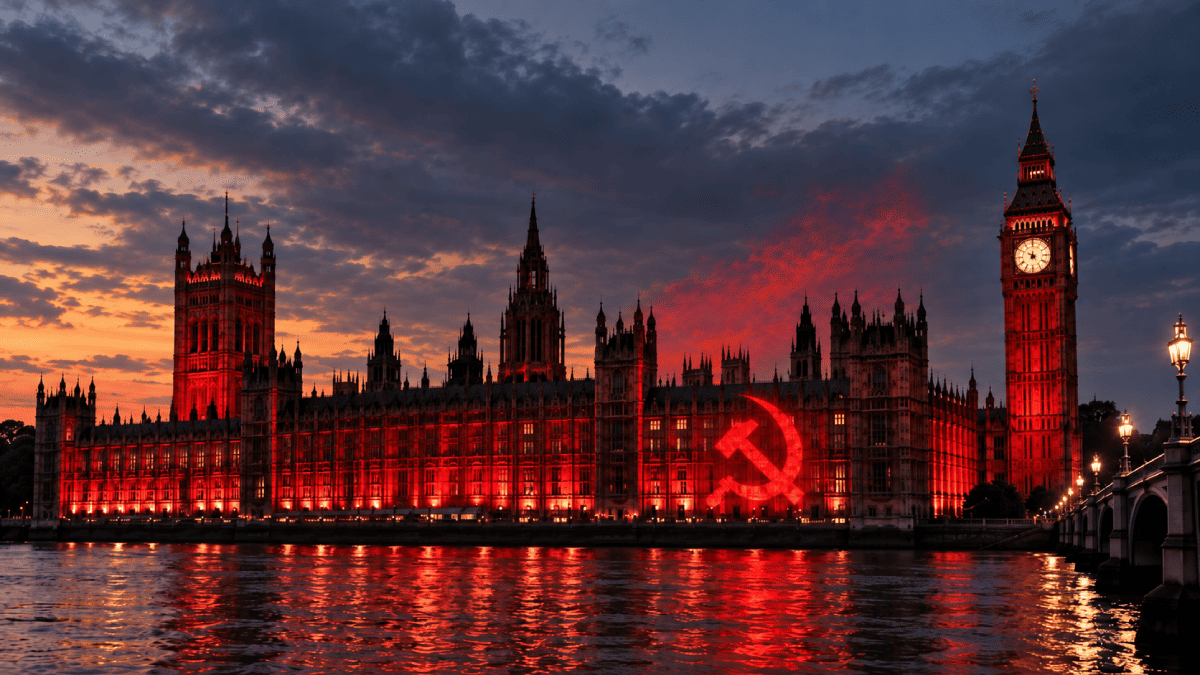
The Not-So-Subtle Backdooring of Britain Back Into The EU
They didn't need a second referendum. While Britain argued about slogans, Whitehall quietly renamed 6,925 EU laws, signed up to EU defence structures, and began handing food regulation back to Brussels — permanently, automatically, without a vote. The paperwork coup is already underway.

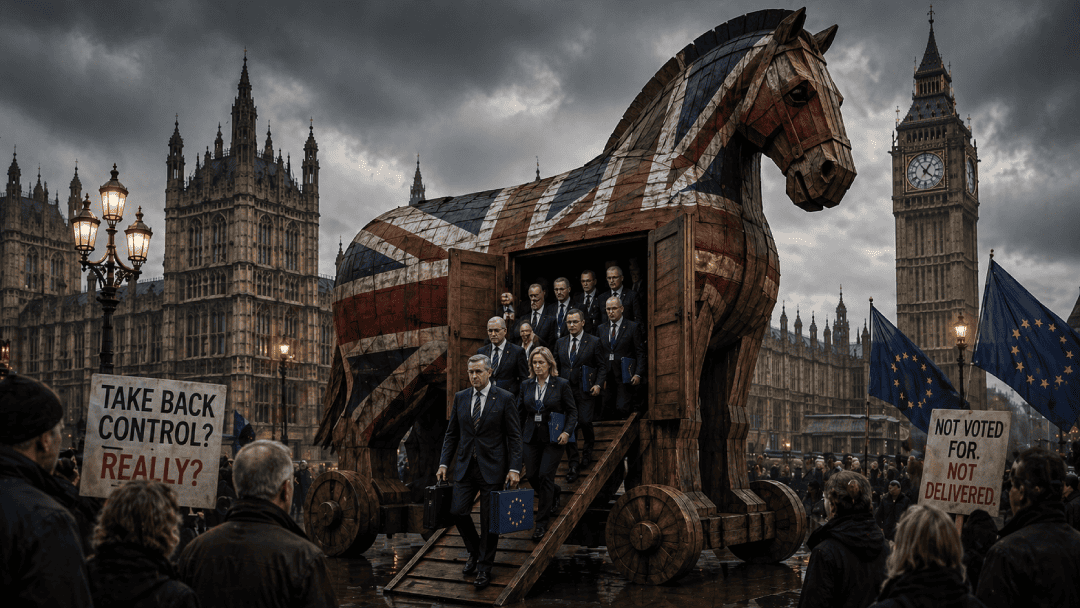
On 23 June 2016, 17.4 million people voted to leave the European Union. It was the largest democratic exercise in British history. More people voted Leave than have ever voted for anything in this country. More than voted for Attlee's welfare state. More than voted for Thatcher. More than have ever voted for a single party at a general election.
Ten years later, the men who were paid to implement the result are writing columns in the British press explaining why it should be reversed.
Philip Rycroft, formerly the Sir Humphrey at the Department for Exiting the European Union, the most senior civil servant responsible for allegedly "delivering" Brexit, declared this week Britain should consider rejoining the EU. He called for "patient work" to build the case. He said "the argument is there to be won."
Not "the evidence suggests." Not "the public may wish to reconsider." The argument is there to be won. A campaign to be executed. A population to be moved.
This is not analysis, it is operational political language. And it comes from the man who was somehow mysteriously given the job to get Britain out.
Rycroft's intervention deserves attention; not for what he says, but for what it reveals. He ran the department. He built the legal scaffolding. He managed the paperwork. And now he tells the country the "project" was a failure and should be undone — "gradually," he stresses, over time, through consensus-building and incremental steps. This is ironic, naturally, for a permanent secretary of an organisation which is infamous for failure.
The will of the People in Britain is not a "project."
Just sit back and consider this for a moment. This mandarin never believed in executing his instructions. He doesn't believe in them now. He calls your will a "project." This kind of condescending arrogance is a distillation of the contempt the civil service has for the country it serves.
Strip out the genteel prose and the meaning is blunt: the people who administered Britain's departure are now describing, in public, how to reverse it without another vote. The method is not confrontation. It is procedure; a technical cooperation. It is sectoral deals and regulatory convergence and quiet administrative gravity, dressed in the language of pragmatism and partnership.
Starmer is on maneuvers for the campaign, claiming it is in the "national interest" to reverse democratic will for "ever closer union" again. It was his hero Harold Wilson's original idea to join it in in the first place, after all.
Meanwhile, at the operational level, the machinery is already moving. There is even a Leftipedia page for it: "Potential re-accession of the United Kingdom to the European Union."
Brussels Writes Tomorrow's Food Rules
The most advanced example of administrative re-entry is the SPS deal: the Sanitary and Phytosanitary agreement the Government is negotiating with the EU right now.
On the surface it sounds tedious. Food standards. Veterinary checks. Pesticide limits. The sort of thing no one puts on a placard. And the Government knows it. Their own guidance is careful, practical, bureaucratic:
We want every business in the agri-food sector to start getting ready now.
But the substance is extraordinary. Under the proposed agreement, Britain would "dynamically align" with EU food safety law. Not harmonise. Not approximate. Dynamically align: meaning every time Brussels updates a regulation on additives, labelling, pesticide residue, food contact materials, animal health, or plant passporting, the United Kingdom must follow. Automatically. Without a vote.
The Government's own published scope list runs through food and feed safety, hygiene standards, nutrition and health claims, labelling, marketing standards, organics, compositional standards, food supplements, pesticides, and biocides. The EU rules will replace — not supplement — the rules currently applicable in Great Britain.
This is not a trade facilitation measure. It is the wholesale import of a foreign legislature's regulatory output into domestic law, with no representation, no veto, and no democratic consent beyond whatever a Cabinet Office minister mutters in a committee room.
Hansard records the concern plainly. In a February 2026 debate, an MP asked directly whether the Government could ensure it was not "exercising re-entrance to Europe by the back door." The response was reassurance. But reassurance is not a legal safeguard. It is a mood.
6,925 Laws in Witness Protection
After the referendum, a vast body of EU-derived legislation was absorbed into British law. Originally it was called "retained EU law" as an honest description. It was EU law and Britain had retained it. Then somebody in Whitehall decided the phrase was too revealing.
It is now called "assimilated law."
The name change is not cosmetic. It is camouflage and sleight of hand. "Retained EU law" invited questions: why are we still keeping this? When will it be reformed? "Assimilated law" sounds domesticated. Settled. Nothing to see.
The Government's own dashboard, updated in January 2026, tracks 6,925 individual pieces of this legislation spread across more than 400 policy areas. Of those, nearly 65 per cent remain entirely unchanged. Two thirds of the legal inheritance of EU membership has not been touched, examined, reformed, or repealed. It has simply been renamed and left in place.
The previous Government promised to revoke or reform half of all retained EU law by June 2026 at the tenth anniversary of the referendum. The current Government abandoned the target altogether. They have no quantitative goal. Their stated intention is to reform assimilated law "in the context of the government's national missions" and the quiet part out loud:
guided by this government's work to strengthen its new strategic partnership with the EU.
Translation: they will reform EU law in the direction of more EU law.
They did not need to reverse Brexit. They only needed to rename the files.
Millenarian Carbon Taxes
On 1 January 2026, the EU's Carbon Border Adjustment Mechanism entered its definitive phase. It taxes imports based on the carbon intensity of their production. Cement. Iron and steel. Aluminium. Fertilisers. Hydrogen.
Britain is now building its own version (UK CBAM) scheduled to "go live" in January 2027. On the surface this looks like independent policy. In practice it is mirroring. The UK system covers the same goods, uses the same logic, and the two governments are negotiating to link their emissions trading schemes so they can grant "mutual exemptions."
The structure is elegant. If Britain's carbon pricing diverges downward from the EU's, British exporters face tariffs at the EU border. If Britain's system diverges upward, it penalises its own industry without reciprocal benefit. The only stable equilibrium is convergence. And convergence, in practice, means following Brussels.
Nobody forced this. Nobody imposed it. The mechanism does not require obedience. It just makes independence expensive.
Northern Ireland: Our Achilles Heel
Under the disastrous Windsor Framework, EU law still applies in Northern Ireland for goods regulation, customs procedures, VAT and excise, state aid, and electricity markets. Northern Ireland is already inside the EU's regulatory perimeter.
The government could have made Northern Ireland a free trade accelerator zone like the Cayman Islands and simply have abolished tariffs altogether to make them the EU's problem.
The trick is not the exception itself. It is what the exception cleverly enables.
Once one part of the United Kingdom operates under EU-compatible goods regulation, the pressure to harmonise the rest becomes institutional. The weasel jargon is already in circulation: "UK-wide approach." "Avoid internal divergence." "Ensure unfettered access." "Business certainty." Every one is a euphemism for making Great Britain follow Northern Ireland into EU regulatory orbit.
The Stormont Brake, sold as democratic protection, a mechanism allowing the Northern Ireland Assembly to block new EU rules, has already been tested and found inert. In January 2025, unionist representatives asked the UK Government to use it against EU chemical labelling rules. The Government refused, saying the threshold had not been met.
The brake exists. But the executive controls the threshold. The safeguard is theatre.
Exploiting A Devastated Military
If the SPS deal is the most advanced mechanism of re-entry, defence cooperation is the most dangerous, because it is the one nobody is allowed to criticise.
The United Kingdom has already joined a PESCO project. PESCO (Permanent Structured Cooperation) is the EU's own defence capability framework, binding 26 member states into joint military planning, procurement harmonisation, and shared development. The UK joined the Military Mobility project in November 2022, alongside the United States, Canada, and Norway.
The justification is reasonable. Ukraine. Continental security. Logistics coordination. Nobody can object to moving troops efficiently across European borders. But reasonable justifications are how structural integration begins.
Modern defence procurement is collaborative by necessity. Shared drone systems, satellite programmes, cyber capabilities, missile defence, etc, all require interoperability. Interoperability requires common standards. Common standards require regulatory convergence. And convergence, once embedded in supply chains and command structures, becomes irreversible.
And here lies Sir Humphrey's opportunity: to rebuild the military, we need to rejoin the EU.
The EU is building a European Defence Industrial Base. Access to funding, contracts, and collaboration increasingly requires participation in EU-led consortia and EU-governed frameworks. British defence firms face a choice: stay independent and lose contracts, or integrate and accept Brussels-set rules.
Most will choose integration. And the policy will follow the industry.
The genius of the defence route is its political immunity. Objecting to military cooperation with European allies, while Russia wages war in Ukraine and America looks inward, is made to sound unserious. Irresponsible. Dangerous. And so the structural integration proceeds beneath a flag of necessity, wrapped in the vocabulary of security, shielded from democratic scrutiny by the invocation of threat.
Britain left the EU's politics. It is drifting into its defence architecture.
The Four Patterns
Strip the detail away and four strategic patterns emerge. None requires conspiracy. None requires intent. All produce the same outcome.
Friction lock-in
Make divergence operationally painful. Dual regulatory systems cost money. Exporters need EU compliance anyway. Over time, businesses lobby for the simpler path (one rulebook) and Government obliges.
Conditional access
Allow legal independence but impose economic consequences for using it. Data adequacy, financial services equivalence, carbon border tariffs: each creates a ceiling on how far Britain can actually diverge before the punishment becomes real.
Technical dependency
Tie systems together (energy interconnectors, emissions trading, defence logistics) until separation becomes physically inefficient. The cost model does the politics.
Procedural accumulation
Tiny regulatory updates, layered over years, through statutory instruments passed by negative procedure, read by nobody, debated by no one. Each is trivial. Together they rebuild the structure from below.
The Consultation Goldmine
There is a quieter mechanism still. Government consults. It asks regulated industries what rules they prefer. Large firms, i.e. the ones operating across both EU and UK markets, overwhelmingly prefer one rulebook for sensible reasons. They already comply with EU standards. Divergence means duplication, cost, complexity. Their consultation responses say so.
Who needs a report or an inquest to hide behind, when you can hide behind business pressure?
The small firms, the domestic-only producers, the ones who do not export to the EU — their voices are quieter. Less organised. Less resourced. And so the consultation skews. Policy is shaped by the preferences of those already integrated with EU systems: Capita, G4S, McKinsey, . Export convenience becomes domestic law.
The Government calls it evidence-based policy-making.
Integration Without Representation
There is a phrase for what is happening. It is borrowed from the American revolution, but it fits. Britain is being drawn into integration without representation. Rule-taking without rule-making. Obligation without voice. The cost of membership with none of its influence.
Under the SPS deal MPs are deliberately signing us up for, Britain will follow EU food law but will have no vote on what it says. No seat in the Council. No Commissioner. No MEP. Access to certain EU committees, but "without voting rights and without access to the Council or its preparatory bodies." The country will have traded self-government for spectatorship. How helpful!
This is worse than membership. Inside the EU, Britain had a veto, a Commissioner, MEPs, Council votes, opt-outs, and rebates. Outside the EU but inside its regulatory gravity, Britain has none of those things and follows the rules anyway.
Why let a good crisis go to waste? That's a great position to be in: a frustrated public who need a solution to a cynically-manufactured state problem.
The previous arrangement was democratic. The emerging arrangement is colonial.
How clever: we will have integration without representation;
The Quiet Procedural Abyss
Brexit was fought in slogans. Re-entry is being managed in footnotes. Not in dramatic Parliamentary votes. Not in referenda. Not in speeches. In technical annexes. In updated guidance from regulators. In statutory instruments laid under negative procedure and waved through committee. In "best practice" documents issued by standards bodies. In insurance requirements. In procurement specifications. In the quiet, grinding, institutional preference for the known system over the experimental one.
The most dangerous architecture is not the one Parliament votes for. It is the one Parliament never sees.
A committee meets. A technical annex is updated. A statutory instrument is laid. A negative procedure is used. Business guidance is issued. A regulator updates its compliance manual. Industry is told this is now best practice. By the time anyone notices, the thing is already embedded.
And the civil servants who built this machinery? They are writing columns in national newspapers explaining, in soothing tones, why Britain should simply accept the destination they have been quietly building toward for a decade.
No. Not this time.
Another Long March Through The Institutions
The vote took one day. The reversal will take ten years of paperwork. They know it.
No one needs to reverse Brexit. They only need to make divergence impractical. They only need to ensure every independent choice is expensive, every divergence requires justification, every sectoral deal imports a new rulebook, and every future government finds the machinery already assembled, the forms already printed, and the path of least resistance already paved... leading back to Brussels.
They have no ideas, no creativity, no answers. Outsourcing to Brussels has always been the easy route, and comes with a paid driver and cosy expenses budget for a new post somewhere in the retirement years in between visiting the second home in the south of France. Rebuilding and upkeeping the country is hard; someone else has already done all that homework, ripe for copying.
17.4 million people voted. The largest democratic exercise in British history. And it is being unwound, not by their opponents winning a better argument, not by a second referendum, not by honest confrontation, but by the Blairite men in quiet offices, updating spreadsheets, renaming laws, and calling it partnership. The same ones repeating the same playbook from the nineties.
This is not democracy. It is its careful malicious compliance of the distinctly British kind. Against their own people.
We cannot spend another thirty years fighting out own political class' ideas of building the socialist utopia when America is going to Mars. They need to be entirely removed, for good.