Why Your Local High Street Is Now A Foreign Black Market
Turkish barbers. Mobile repair shops. Vape and candy stores. Takeaways. Nail bars. Mini-marts. Half of convenience stores in some British towns are now linked to organised crime gangs colonising stores for black market trading, counterfeiting, and money laundering. The police know.
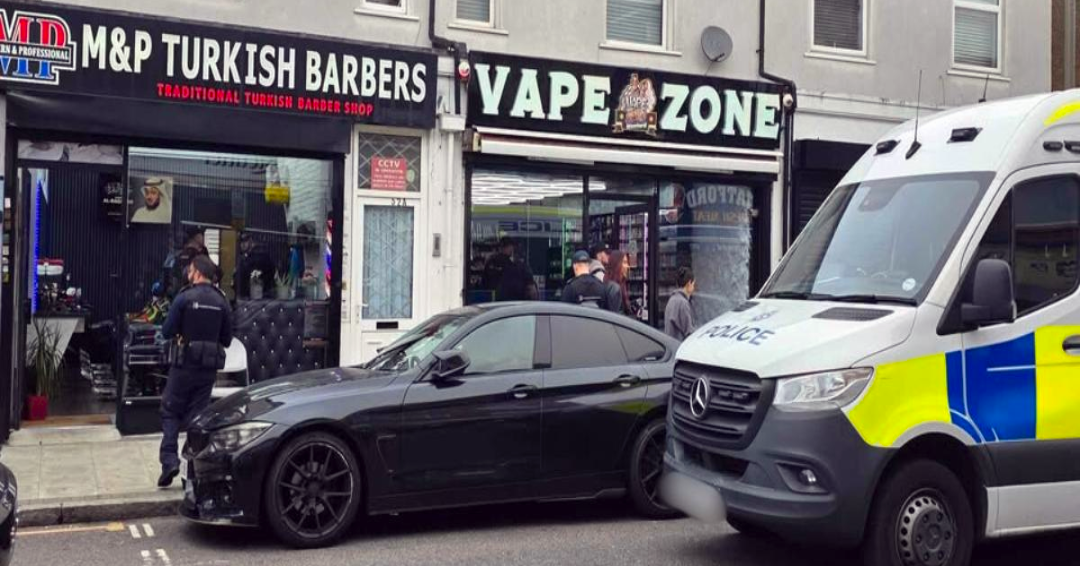
Walk down any British high street in 2026 and count the vape shops. Count the barbers. Count the miniature supermarkets with their sun-bleached awnings and improbable opening hours. According to the Chartered Trading Standards Institute, half of them are criminal enterprises.
The Hidden in Plain Sight report, published jointly by the CTSI and the Anti-Counterfeiting Group this week, is the most comprehensive attempt yet to quantify what every town planner, beat officer, and legitimate shopkeeper already suspected: serious organised crime has colonised the British retail premises. In some areas, up to half of convenience stores and vape shops, a third of American candy outlets, and a quarter of fast-food takeaways are believed to have links to organised criminal networks.
97% of trading standards officers are aware of suspected crime groups operating from retail units on their patch. 99% have observed a surge in cash-intensive businesses opening since 2020. Council staff are increasingly reporting serious threats of violence from these criminals.
These are extraordinary numbers. They describe not an aberration but a structural occupation. You can read the full report online for yourself.
Labour ministers and Guardian columnists, predictably, are determined to prove we are imagining it and think this is all just racism.
Corridors and Capitals
Two geographic corridors typically host concentrated criminal retail activity.
- The first runs along the southern coast, threading through Dorset, Hampshire, and Sussex: seaside towns long past their commercial prime, now peppered with shopfronts nobody local can explain.
- The second stretches across the industrial north, from Liverpool across Manchester, Huddersfield, Bradford, Leeds, and Sheffield to Hull and Grimsby.
Birmingham, Liverpool, and London sit atop the hotspot rankings.
These are not random locations. They are places where empty retail units are plentiful, rents are suppressed, local authority enforcement is threadbare, and footfall (though diminished) still exists. Criminal operators do not need thriving commerce. They need premises, anonymity, and cash flow. The post-pandemic high street delivered all three.
Manchester's Cheetham Hill deserves particular attention. Dubbed the "counterfeit capital of Europe," the area around Bury New Road and Strangeways had for decades hosted an open market in fake designer goods, drawing buyers from across the country as brazenly as any legitimate retail destination. Intelligence linked thirty-three organised crime groups to the trade there. When Greater Manchester Police launched Operation Vulcan in November 2022, officers found buildings riddled with rat droppings, homemade electrical wiring, hidden weapons, and shops without proper fire exits. In two years, the operation shut down all 206 identified counterfeit establishments, seized over a thousand tonnes of fake goods, made 238 arrests, and confiscated more than half a million pounds in cash. A single raid on 207 shipping containers yielded 580 tonnes; believed to be one of the largest inland counterfeiting seizures on the planet. Violent crime in the area fell by half. Public order offences dropped by nearly seventy per cent.
The Vulcan results are a case study in what concerted, multi-agency enforcement can achieve. They are also a damning indictment of every decade in which nobody bothered.
The Anatomy of a Front Store
The criminal exploitation of the high street is not a monolithic operation. It is a distributed architecture of interlocking rackets, each reinforcing the others.
At the base sits the shopfront itself: the convenience store, the vape outlet, the barber, the nail bar, the candy shop. These are what enforcement professionals call "cash-intensive businesses," chosen precisely because cash is difficult to audit, easy to inflate, and hard to trace.
- A barber can claim forty haircuts a day when only five walked through the door.
- A vape shop can report sales volumes its stock never supported.
The till receipts become the laundering mechanism. Dirty money enters as fabricated revenue ("placement"). Clean money exits through the banking system ("integration").
The product lines serve double duty.
Illegal tobacco and non-compliant vapes are profitable in their own right (the exchequer loses an estimated £1.8 billion annually to illicit tobacco and vape sales alone) while also providing cover for the cash throughput required to launder proceeds from drug trafficking, people smuggling, and fraud. Trading standards seized 2.2 million illegal vapes and 24.8 million illicit cigarettes in the 2024/25 reporting year. Many of the vapes contained nicotine concentrations far exceeding legal limits; laboratory analysis of devices confiscated from schoolchildren found lead levels 2.4 times the safe exposure threshold, nickel at 9.6 times, and chromium at 6.6 times.
Above the shopfront sits a logistics layer: shadow supply chains, off-site warehousing, and wholesale networks operating entirely outside regulatory oversight. The Hidden in Plain Sight report describes these as "vast" and "extensive." Criminal operators use sophisticated concealment methods, including hidden storage compartments within premises and dispersed stockpiles across multiple sites. The CTSI notes operators frequently give false details to landlords, lease premises under shell company structures, and vanish when enforcement arrives, only to reopen nearby under a different name.
The Oxford Street candy shop phenomenon illustrated this architecture at smaller scale. From around 2021, dozens of garishly decorated American sweet shops appeared along London's most famous retail strip, occupying units vacated by legitimate retailers crushed by the pandemic and sky-high business rates. Westminster City Council identified twenty-nine at the peak. The shops were almost always empty of customers, charged absurd prices, and stocked products including counterfeit Wonka bars, banned confectionery, and illegal vapes. Police raids recovered fake Rolexes, fraudulent Apple products, and suitcases stuffed with contraband. Investigations revealed many operators used shell companies with opaque ownership structures connected to offshore jurisdictions. The council pushed for changes to Companies House legislation through the Economic Crime Act to make such structures easier to trace. By 2024 the number had fallen to twenty-one, but the model had already metastasised beyond the capital.
The Barber Problem
The National Crime Agency's Operation Machinize, targeting barber shops across England, revealed the same structural pattern at national scale. The UK now has over 18,400 registered barber shops, with more than 750 opening in 2024 alone: a growth rate exceeding fifty per cent since 2018. Many are advertised as Turkish barbers. The NCA found they are often run by Kurdish or Albanian networks and linked to the proceeds of people smuggling.
The logic is identical to the candy shops. A barber charges ten or fifteen pounds per cut, in cash. The business can plausibly claim any volume of trade. The overheads are minimal. And a barbershop, unlike a vape outlet, rarely attracts regulatory attention from trading standards because its primary product is a haircut, not a controlled good.
Machinize raids across the country seized over £40,000 in cash, 200,000 cigarettes, 7,000 packs of tobacco, more than 8,000 illegal vapes, and two vehicles. Officers found two cannabis farms containing 150 plants. Ten premises were shut, with further closures expected. One convicted people smuggler, Amanj Hasan Zada, had run a barbershop in Preston while coordinating small boat crossings from a network later traced back to Iraq's Kurdish region. He received seventeen years.
The NCA estimates £12 billion of criminal cash is generated in the United Kingdom each year. Cash-intensive high street businesses are one of the primary mechanisms for integrating it into the legitimate financial system.
The Enforcement Desert
None of this would be possible, i.e. none of it could have reached this scale, without the near-total collapse of local enforcement capacity over the past fifteen years.
Trading standards is not a glamorous function. It is a local authority responsibility, funded through council budgets, staffed by officers whose daily work involves checking weighing scales, testing vape nicotine content, and prosecuting rogue traders. It is also, by some measures, the most cost-effective arm of consumer protection in the country. Operation CeCe, a joint National Trading Standards and HMRC initiative to tackle illicit tobacco, returned £8.75 in prevented public harm for every pound spent.
Since 2010, trading standards budgets have been cut by approximately fifty per cent, or double the reduction imposed on any other regulatory service within local government. The 2021 National Audit Office report documented a thirty-nine per cent cut. By 2023, a further NAO report showed regulatory services budgets had fallen by twenty-five per cent, but within those budgets trading standards had absorbed the worst of it. Staffing has been stripped to minimum levels. The CTSI has called for phased investment rising to £100 million after four years: a sum the government has so far declined to commit.
The cuts did not happen in isolation. Local authority funding across England was slashed throughout the austerity decade. The Institute for Fiscal Studies found spending on services like housing, culture, and highways fell by more than forty per cent between 2010 and 2024. Planning and development budgets were cut by nearly sixty per cent. Councils were forced to concentrate dwindling resources on statutory obligations (chiefly social care) the expense of everything else. Trading standards, discretionary and unglamorous, was an obvious casualty.
The result is an enforcement desert across much of the country. Seventy-two per cent of trading standards professionals now report experiencing intimidation or threats of violence in the course of their duties. One investigator, identified only as Mandy in a BBC report, received a phone call from a high street crime gang threatening to kill her and burn down her house: the beginning of a campaign of harassment so severe she and her husband were forced to move home. Officers operating without adequate backup, without legal support, and without the resources to pursue complex investigations are being asked to confront criminal organisations with international supply chains and access to serious violence.
How the Door Was Left Open
The architecture of criminal high street occupation rests on three pillars, none of which appeared overnight.
The pandemic vacancy crisis
Between 2020 and 2022, high street vacancy rates surged to record levels, peaking above fifteen per cent nationally and exceeding twenty per cent in some northern towns. Shopping centre voids reached 19.4 per cent by mid-2021. Even as rates stabilised through 2022 and 2023, the sheer volume of available units — cheap, often with desperate landlords willing to ask few questions — created a physical infrastructure ideally suited to criminal exploitation. The Hidden in Plain Sight report states directly: organised crime groups exploited vacant retail units left by the pandemic and wider structural changes on the high street.
The decade-long hollowing of enforcement
Criminal networks did not colonise the high street because they suddenly became more ambitious. They did so because nobody was watching. A fifty per cent cut to trading standards budgets, compounded by police resource constraints, meant whole swathes of the country had effectively no proactive commercial enforcement. Rogue operators could open, trade illegally, close, and reopen with near impunity. The cost of non-compliance was trivially low. In 2024, despite seizing nearly 1.2 million illegal vapes (the highest year on record), enforcement authorities issued only 122 fines.
The failure of the corporate transparency regime
The Oxford Street candy shops were not operated by lone chancers. Investigations found shell company structures connecting operators to offshore jurisdictions. The Economic Crime Act of 2023 attempted to address this by strengthening Companies House powers, but the reforms have been slow to bite. As long as it remains possible to register a limited company with fabricated directors and minimal verification, the corporate veil will continue to serve as the laundering mechanism's outermost layer.
What the Government Must Do
The Hidden in Plain Sight report's recommendations are sensible but insufficient. More funding for trading standards is necessary. So are expanded powers. But the problem is, yet again, for the millionth time, structural.
Structural problems require structural answers. As much as we could say about mass migration here, perhaps it's easier to address one disaster at a time.
- First, the government must treat criminal occupation of the high street as a serious organised crime priority, not a local authority nuisance. The National Crime Agency's involvement through Operation Machinize and the success of Operation Vulcan in Manchester demonstrate the difference multi-agency, properly resourced enforcement can make. Rolling these models into a standing national programme (rather than relying on ad hoc operations) would transform the enforcement landscape.
- Second, the corporate transparency reforms must be accelerated and enforced. Companies House should not merely be a filing cabinet; it must become an active gatekeeper. The ability to register companies with fictitious directors, no verified trading address, and no meaningful oversight is a standing invitation to criminal abuse. Mandatory identity verification, proactive data matching, and meaningful penalties for fraudulent filings would do more to disrupt criminal retail networks than a thousand individual raids.
- Third, local authorities need ring-fenced, sustained funding for trading standards. The fifty per cent cut was not merely a budgetary adjustment. It was the withdrawal of the state from commercial regulation across large parts of the country. The consequences are now visible on every high street. The CTSI's £100 million request is modest relative to the £1.8 billion the exchequer loses annually to illicit tobacco and vape sales alone. The return on investment is not speculative; it has been demonstrated repeatedly.
- Fourth, landlords must be brought into the enforcement architecture. Criminal operators depend on premises. Many landlords are complicit or wilfully blind. Operation Vulcan demonstrated the effectiveness of using Proceeds of Crime Act powers to target building owners, and pursued rogue landlords through tax evasion referrals and council enforcement action. This approach should be systematised nationally. A duty on commercial landlords to conduct due diligence on tenants (with meaningful sanctions for failure) would close one of the widest remaining gaps.
Physical Symptoms Of A Political Disease
There is a temptation, when confronted with figures like these, to treat them as a problem of policing alone. It is not. The criminal colonisation of the British high street is the product of a decade of deliberate policy choices: the gutting of local government, the degradation of regulatory capacity, the tolerance of a corporate transparency regime unfit for purpose, and the abandonment of commercial spaces to market forces unchecked by public authority.
The high street was once a civic institution; a shared space governed, however imperfectly, by rules everyone understood. Today it is something closer to an open market for criminal enterprise, operating behind the thinnest of façades. The customers buying counterfeit trainers or illegal vapes may not think of themselves as participants in organised crime. But the money they spend flows upward through supply chains connected to drug trafficking, people smuggling, modern slavery, and violence. The barber who launders the proceeds of a smuggling operation and the candy shop cleaning the takings of a fraud ring are not discrete problems. They are nodes in a single system.
The government has been warned. The evidence is comprehensive. The enforcement models exist and have been proven. What remains is only the question of whether the political will exists to act, or whether, as with so much else, the reckoning will be deferred yet again until the damage is irreversible.