The Free State Of Piddington
A village of 314 in Oxfordshire has voted to consider leaving the United Kingdom. It cannot. But the statute book will let it build a treasury, a border, a foreign ministry, and a navy. Whitehall will not be able to do anything. They should prepare for mass immigration by the English.

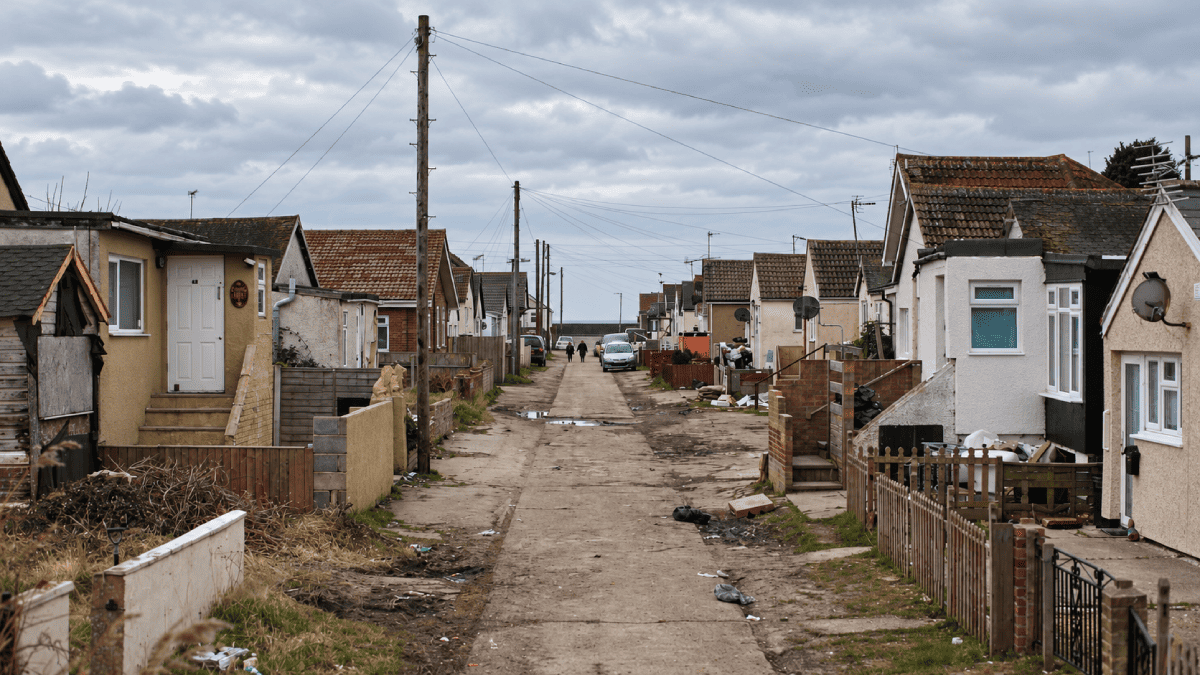
The small Oxfordshire village of Piddington appears in the Domesday Book. It has a church, a village hall, coffee mornings, short-mat bowls, and a pop-up pub which materialises once a month before dematerialising again. It has no shop, no school, and no permanent public house. Its parish council chairman counts 46 children and 268 adults.
Half a mile down the road, on Site A of the former Bicester Garrison, the Home Office proposes to accommodate 1,250 single adult military-age men holding unknown opinions of our country. Cherwell District Council learned of this grotesque announcement of June 25th a few hours before the press did, a point the local Labour MP disputes and the council continues to maintain. On the 24th July the department confirmed it would seek planning consent through the urgent Crown development route, which compresses the local planning authority's response window and dispenses with the ordinary requirements for public consultation.
On the fourth of July (a date selected with some care), roughly 180 adults voted and 175 backed holding a referendum on leaving the United Kingdom. On the 20th of July the chairman took a Declaration of Independence to the American Embassy in London.
Every joyless, tedious constitutional lawyer in England responded by explaining, patiently and at considerable length, why none of this can possibly work. They are correct. They have also answered the boring half of the question.
The interesting part concerns how much of it works perfectly well.
Yes, Piddington Can Hold Its Own Referendum
A parish is not a residents' association with delusions. It is a statutory tier of English local government, and the Local Government Act 1972 equips it with instruments most Englishmen have never heard of.
Every parish has a parish meeting, consisting of the local government electors of the parish, empowered to discuss parish affairs. Questions arising at a parish meeting may be decided by vote. Schedule 12 provides for a poll to be demanded on such a question, and the Parish and Community Meetings (Polls) Rules 1987 supply the machinery: ballot papers, a returning officer, polling hours, a count.
Which means the question:
Should the Parish of Piddington cease to form part of the United Kingdom?
can be put to the electorate of Piddington by a statutory process, on statutory ballot papers, counted by a statutory officer. The result binds nobody and changes nothing. But the returning officer would stand up in the village hall and announce a number, and the number would be real.
There is a meaningful difference between a man with a biscuit tin outside a church and the formal apparatus of English local democracy being turned, entirely lawfully, against the state which built it.
What A Parish May Declare
Section 1 of the Localism Act 2011 confers the general power of competence on eligible local authorities: broadly, the power to do anything individuals generally may do. Eligibility for a parish council depends on conditions prescribed by order, chiefly a properly qualified clerk and a sufficient proportion of elected members.
Piddington's capacity to declare nationhood therefore rests, in the last analysis, on whether its clerk holds a certificate in local council administration.
Nobody in the Home Office will find this funny, which is its own recommendation.
An individual may lawfully announce the Sovereign Republic of Number 14. It achieves nothing, and no offence is committed. A council with the general power may do likewise.
Piddington considers itself independent: unobjectionable.
- The enactments of Parliament shall cease to have effect within the parish: no.
- Council tax is abolished: emphatically no.
- Passports will be inspected at the village sign: entertaining, but no.
A council's capacity to speak and its capacity to alter the constitutional order are different capacities entirely.
Scotland Lost This Argument With Five Million People And A Whole Parliament
Scotland has its own Parliament, its own government, its own legal system, a distinct constitutional history, five and a half million inhabitants, and internationally recognised nation status. In Reference by the Lord Advocate of devolution issues [2022] UKSC 31, the Supreme Court held unanimously in November 2022 Holyrood could not legislate for an independence referendum without Westminster's authorisation, because such a Bill would relate to the reserved matters of the Union of the Kingdoms of Scotland and England, and the Parliament of the United Kingdom.
The Lord Advocate's best argument was an advisory referendum changes no law and therefore touches nothing reserved. The Court declined the invitation, holding the political consequences of such a vote meant its connection to the reserved matters was considerably more than loose or consequential.
The Court also disposed of the international escape hatch. Drawing on the Canadian Supreme Court's Quebec reference and the International Court of Justice's Kosovo opinion, it held the right of self-determination in its external form applies to peoples under colonial domination, foreign occupation, or comparable denial of meaningful self-government. Scotland qualified under none of these headings.
If a devolved legislature with a Lord Advocate and five and a half million constituents cannot manage it, the chairman of Piddington Parish Council should anticipate certain jurisdictional difficulties.
Westminster Could Grant Nationhood Tomorrow
There is nevertheless no mystical rule rendering the territory of England eternally indivisible. Britain has no entrenched constitutional text and no clause protecting its borders from its own legislature.
Parliament could pass the Piddington Independence Act 2026 and provide at midnight on 1st January 2027 the parish ceases to form part of England; UK legislation ceases to extend there save as specified; residents acquire whatever nationality arrangements Parliament prescribes; the parish boundary becomes an international frontier; and property, taxation, policing, citizenship, and the national debt are apportioned accordingly.
This is not speculative. Parliament has legislated British territory out of the British state within the lifetime of the buildings involved.
The Government of Ireland Act 1920, the Anglo-Irish Treaty, and the Irish Free State Constitution Act 1922 removed twenty-six counties from the United Kingdom by the ordinary operation of statute.
The villagers have chosen their branding better than they know. The last territory to leave the United Kingdom was also a Free State.
Piddington has no right to secede.
Parliament has the power to let it.
Those are wholly different propositions, and the second is the one Whitehall would prefer nobody dwelt upon.
Joining The US Is The Easy Half
Some of the campaign rhetoric has gone further than independence and proposed accession to the United States, which is why the Declaration went to Nine Elms rather than Downing Street.
The British side is trivially simple. Westminster may cede territory by statute, and has done so repeatedly.
The American side is harder but not incoherent. Sovereign states acquire territory from other sovereign states by treaty, and the United States has an extensive record of doing exactly such: Louisiana, Alaska, the Danish West Indies. Admission as a state requires Congress under Article IV of the American constitution, and 314 people are unlikely to secure it. Congress could instead designate the territory as unincorporated, in the manner of Guam or American Samoa.
The eventual result would be a two-square-mile unincorporated territory of the United States, surrounded on every side by Oxfordshire, garrisoned by Labradors, and reachable only by driving through a foreign country.
Border Force would be obliged to maintain an international frontier across a lane with passing places.
Nobody in Washington will permit this. It remains structurally lawful, which is a great deal more than can be said for the alternative approach.
Constructing a Microstate Within The Law
Assume the village instructs its solicitors accordingly: build everything, break nothing. The results are startling.
A Government With Two Sets of Letterhead
The body corporate remains Piddington Parish Council on every statutory account, every set of minutes, and every legal instrument. Everywhere else it styles itself the Provisional Government of the Free State of Piddington.
- The chairman becomes President.
- The clerk becomes Secretary to the Government.
- The planning committee becomes the Ministry of Territorial Integrity.
- The village hall becomes Government House.
Two parallel descriptions of the same lawful body, one for the statute book and one for the cameras, and no offence anywhere in the arrangement.
The chairman has already begun drafting a constitution, which suggests the point has occurred to him.
A Treasury Funded by British Tax Collectors
This is the finest joke available and nobody has noticed it.
Parish councils are precepting authorities. Piddington sets a precept, Cherwell District Council bills it, and the residents pay it as part of council tax under pain of enforcement. Parish precepts are not subject to the referendum principles which cap district and county increases.
Suppose the Free State resolves an additional fifty pounds on a Band D property and calls it the Sovereignty Fund.
The money is compulsorily levied on the citizenry of the Free State and collected on its behalf by the occupying power, which then hands it over. Expenditure remains bound by the council's statutory powers and by external audit, so the Sovereignty Fund buys planning consultants and counsel's opinions rather than artillery.
It is nonetheless a national budget raised by taxation, and the Treasury administers the collection without being asked.
Currency, Passports, and the Limits of Novelty Documents
Sterling cannot be displaced and nobody can be compelled to accept anything else. Community voucher schemes, however, are ordinary and lawful. The Piddington Dollar, redeemable at par at village events and participating businesses, printed with the President's face and the words NOT LEGAL TENDER in a font visible from orbit, produces the headline BREAKAWAY VILLAGE ISSUES OWN CURRENCY without troubling the Bank of England or the payment services regulations.
Passports require more care. The Identity Documents Act 2010 criminalises possession of false identity documents with improper intention, and a novelty passport designed to deceive an airline is a criminal offence with a custodial sentence attached.
A Free State Citizenship Book, oversized, stamped at village fêtes, and marked CEREMONIAL DOCUMENT, NOT VALID FOR TRAVEL, is a souvenir.
The Free State acquires citizens, a register, and a document, and comes nowhere near the criminal law.
Border Posts and Customs Declarations on Eggs
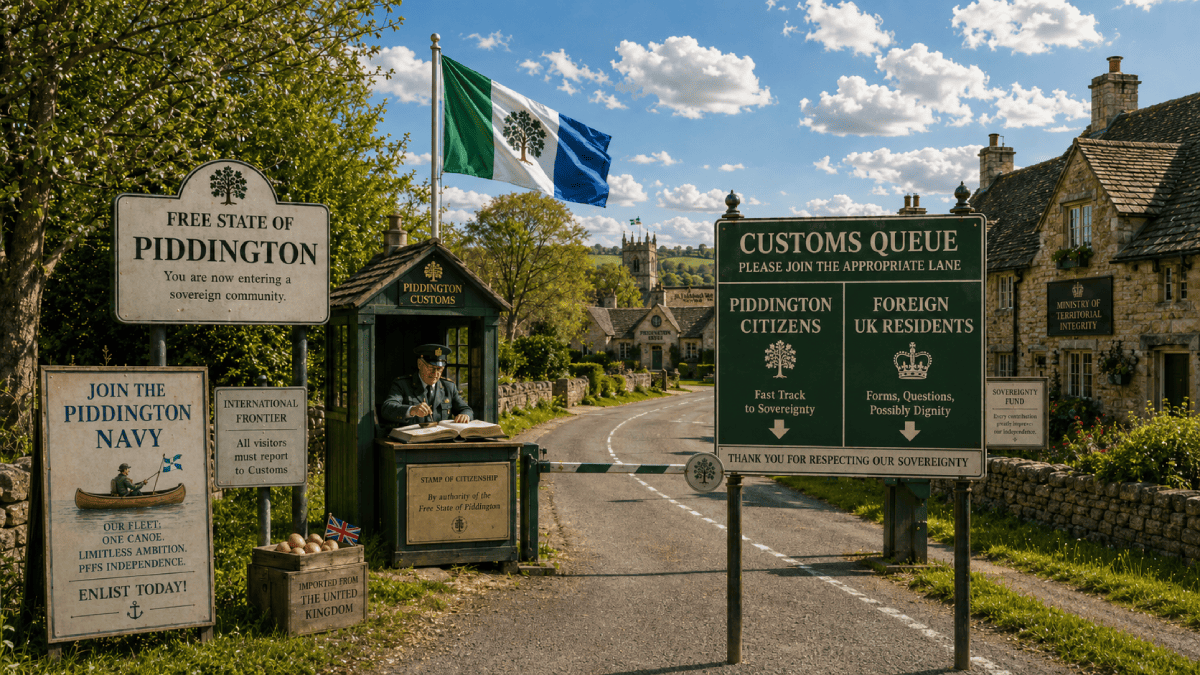
Section 137 of the Highways Act 1980 makes wilful obstruction of the free passage of the highway an offence, and no village volunteer may stop a car or demand papers. A sign reading WELCOME TO THE FREE STATE OF PIDDINGTON, INTERNATIONAL FRONTIER, with a wooden booth on adjoining private land and an invitation to stop voluntarily for a passport stamp, obstructs nothing at all.
Purpose of visit? Dog show. Entry granted. Television requires roughly eleven seconds of this footage.
Customs follows the same logic.
Village shops label British produce IMPORTED FROM THE UNITED KINGDOM. The monthly pop-up pub serves imported British ale, customs cleared. Eggs arriving from a neighbouring farm come with a certificate of origin. No enforcement, no duty, no offence, and a photograph in every newspaper in Europe.
A Foreign Ministry, a Treaty With Upper Arncott, and a Navy of One Canoe
Nothing prevents anyone writing to anyone. Diplomatic notes to the American, French, Danish, and Irish embassies, the Holy See, the Isle of Man, Jersey, Liechtenstein, San Marino, and Andorra, requesting recognition.
Recognition will not be forthcoming. That is no reason not to proceed.
Some junior press officer will nonetheless acknowledge receipt in writing, and DIPLOMATIC COMMUNICATION RECEIVED FROM UNITED STATES becomes technically defensible. Households in London and the Dordogne volunteer as the Embassy and the Honorary Consulate, taking care to claim no immunities and no official status.
Parish councils also enter agreements within their powers.
Upper Arncott sits on the other side of the proposed site and shares the grievance precisely. Two parish councils resolving mutual cooperation in cultural affairs, recreation, and the promotion of village events produces the published Arncott-Piddington Treaty of Friendship, which is inter-authority cooperation in law and a first international treaty in every other respect.
Defence requires restraint.
No militia, no weapons, no arrest powers, no impersonation of constables. A Territorial Guard performing flood response, litter clearance, welfare checks on the elderly, first aid, marshalling at the fête, and the recovery of lost dogs, issued with green polo shirts and a national patch. Twenty-four volunteers out of 268 adults is a mobilisation rate which would embarrass Switzerland.
A landlocked republic obviously requires a navy.
One canoe, named PFS Independence, operating on a pond with the owner's consent. Defence expenditure per capita becomes an excellent sidebar.
Laws the Free State Could Actually Enforce
Parish councils have no general legislative power. They do have byelaw-making powers under particular enactments for particular things: open spaces and pleasure grounds, recreation grounds, allotments, cycle parks, and similar. Such byelaws require confirmation by the Secretary of State and, once confirmed, are enforceable in the magistrates' court.
The Jubilee Reserve is a parish playing field, and its proximity to the proposed site is one of the village's stated objections.
Byelaws governing it, renamed Acts of the Piddington National Assembly with a discreet footnote citing the relevant English statutory power, would be genuinely binding law, enforceable against genuine offenders, in the courts of a foreign country which the Free State does not recognise, having been confirmed by a minister of the foreign country.
Certain laws of the Free State of Piddington would be real. Not because Piddington is sovereign, but because Westminster delegated the power and forgot to imagine what a village might do with it.
How Much Statehood Is Available Off The Shelf?
| Institution | Available to Piddington? | Legal force |
|---|---|---|
| Declaration of independence | Yes | None |
| Written constitution | Yes | Voluntary only |
| Independence referendum | Yes, by statutory parish poll | Advisory |
| Elected government | Already possesses one | Real |
| Compulsory taxation | Already possesses it | Real, collected by the UK |
| Treasury and budget | Yes | Real, within statutory powers |
| Flag, anthem, national day | Yes | Symbolic |
| Citizenship register | Yes | Honorary |
| Passport | Ceremonial document only | None |
| Currency | Voucher or token form | Private contract |
| Border post | Voluntary, off the highway | None |
| Armed forces | Unarmed civic corps only | None |
| Navy | One canoe | None |
| Legislature | Byelaws on parish land | Sometimes genuinely enforceable |
| Courts | Voluntary arbitration only | No coercive jurisdiction |
| Foreign ministry and embassies | Yes | Symbolic |
| International agreements | Ordinary contracts and inter-parish accords | Contractual |
| Disapplying Acts of Parliament | No | Not available |
| Excluding the police | No | Not available |
| Ceasing to pay UK taxes | No | Not available |
| Actual secession | Only by Act of Parliament | Real if enacted |
Three quarters of the visible apparatus of a sovereign state is available to an English village off the shelf, lawfully, this afternoon.
What remains unavailable is a short and exact list: exclusive legislative authority, courts of final jurisdiction, control of coercive force, control of the frontier, and freedom from superior law. Everything else turns out to be decoration.
Non-Cooperation Is the Only Real Weapon
Beneath the flags and the canoe sits a serious point, and it is the one Whitehall should be worried about.
A parish council must perform its statutory duties and comply with lawful requirements. Beyond that boundary it may simply decline.
- No voluntary use of parish land or parish buildings.
- No joint publicity.
- No letters of support.
- No community liaison arrangements.
- No memoranda of understanding.
- No participation in engagement exercises designed to generate photographs of engagement having occurred.
- No provision of the local legitimacy which every large government project requires and which no statute can compel.
"You cannot secede," and "we cannot make you leave," are separate propositions from we are not obliged to help you arrive.
The Home Office may build the site over every objection in Oxfordshire. It cannot conscript the parish council into pretending the outcome was collaborative.
A Village Which Objects Properly, Wins
The urgent Crown development route sits in sections 293B and 293C of the Town and Country Planning Act 1990, inserted by the Levelling-up and Regeneration Act 2023 and commenced in May 2025. The ministerial statement introducing it observed the predecessor provision had never once been used.
Its first significant outing removes Cherwell's ordinary control over a facility for 1,250 men. Piddington cannot veto anything and never could.
What a parish may do is become an exceptionally expensive consultee. This is what ChatGPT and Grok were made for.
Not "we do not want them."
Two hundred pages on highway capacity and pedestrian safety on unlit lanes without pavements, policing resource, foul drainage and sewage capacity, surface water, primary care and dental registration, ecology and protected species, lighting and noise, site access, safeguarding given the proximity of a children's playing field, fire and rescue response times, emergency planning, public rights of way, cumulative effects, and the evidential basis of every factual assertion in the application.
There is precedent worth putting in the first paragraph of the response.
In 2003 the previous Labour government proposed an accommodation centre on this same ground. The planning inspector rejected it, and the local MP has since reminded the Commons the scheme thrown out then was for roughly half the number now proposed. The stated objections were isolation, risk to social cohesion, and strain on local services.
Nothing about the geography has altered since. The Home Office will have to explain what changed besides the urgency.
Political opposition is easy for a department to override. A meticulously documented administrative record is not, and litigation is how a small locality compels central government to show its working.
Any claim would need a proper claimant with standing, most obviously the parish council, and any grounds would depend entirely on the eventual decision and the process followed. No claim is guaranteed to exist, still less to succeed.
But R (Piddington Parish Council) v Secretary of State is a considerably more alarming document to receive than a petition.
Withholding Council Tax Is A Mistake
One temptation must be resisted absolutely. Some residents have already floated non-payment if the site opens without local consent.
Council tax liability arises from statute, not from consent, contract, or approval of the government of the day. Declaring independence does not extinguish it. Non-payment permits the billing authority to obtain a liability order under the Council Tax (Administration and Enforcement) Regulations 1992 and then deploy the full statutory enforcement machinery, including attachment of earnings, deductions from benefits, enforcement agents, and in the last resort committal proceedings.
English councils spend a tedious portion of every year explaining this to Freeman on the Land litigants, who lose with monotonous regularity and expensively.
Far better to pay in full, on time, and enclose a note: Taxation remitted under protest by the occupied territory of Piddington.
Whitehall Requires Local Consent
The government's position on the referendum is sovereignty does not reside at village level and local consent is constitutionally beside the point. Perfectly correct.
The government's position on the Bicester site is a department may quadruple the effective population beside a settlement of 314 people, using an emergency planning route which strips out the consultation requirements, having given the district council a few hours' notice, and local consent is constitutionally beside the point.
Also perfectly correct.
Piddington may not choose who governs it; what is placed beside it; and to leave the government which tells it so. Every round goes to Westminster on the law, and every round is precisely why the joke has travelled from an Oxfordshire village hall to the American Embassy and onto the front pages of two continents.
Countries are made of people. Not things. Without the people, there is no country; merely a collection of large objects which become overgrown.
A state which permits its subjects a flag, an anthem, a constitution, a president, a currency, a border post, a foreign ministry, and a navy, while conceding nothing whatever about where the site goes, has told the public exactly which of those things it considers valuable.
The glorious Free State of Piddington may have everything except the five powers which matter.
Whitehall is welcome to explain, at its leisure, why 314 people are entitled to none of them, and why the entitlement of a government department to override them was never put to anybody at all.