The Fruit Of "Equality" Religion Is Sterility And Death
Nature does not produce equality. It produces variation, hierarchy, genius, mediocrity, beauty, and failure. A civilisation which declares war on distinction does not become just. It becomes sterile. Humans do not do equality. Britain's equality obsession is a religious faith in Fool's Gold.
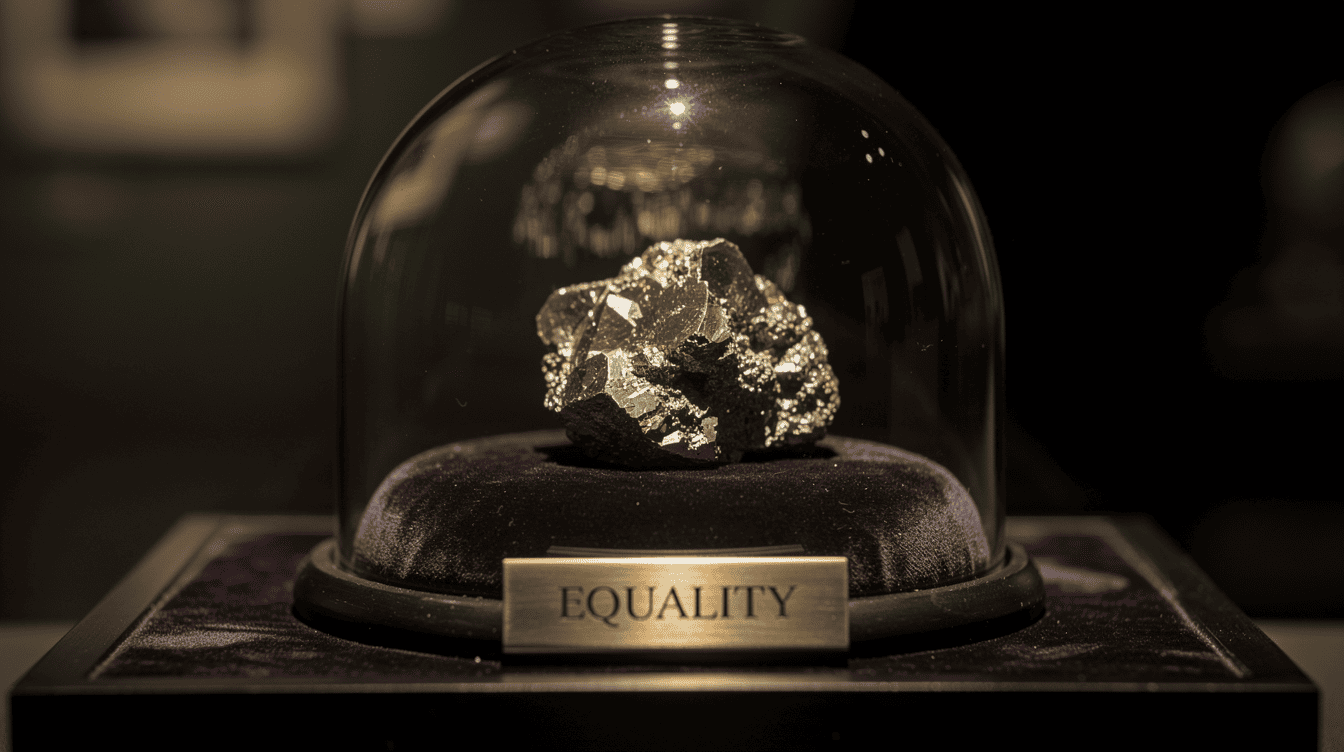
Equality is the most protected word in British public life. It sits behind glass in every manifesto, every mission statement, every institutional strategy document, every corporate away day, every schools inspectorate framework, every quango press release. Nobody elected it. Nobody defined it. Nobody is permitted to question it. It arrived sometime around 1945, kept growing, and now occupies roughly the same position in secular Britain as the Holy Trinity once occupied in Christian England: a mystery you are expected to reverence without fully understanding.
There is a truth nobody in polite society will say aloud: equality is not a universal good. It is not self-evidently desirable. It is not a synonym for justice. And the modern obsession with it has become something closer to a religious mania than a political programme.
Equality of moral worth before God and the law is precious. It is Christian in origin and civilisational in consequence. Nobody serious disputes it. "Equality" has metastasized into a total social philosophy, a secular salvation project, and an unfalsifiable faith system immune to evidence, logic, or reality itself.
The Word Has No Meaning
The first problem with equality is it means at least six entirely different things, and its defenders routinely slide between them without admitting the transition.
- Equality of moral worth.
- Equality before the law.
- Equality of opportunity.
- Equality of access.
- Equality of representation.
- Equality of outcome.
These are not the same idea. They are not even close. The first is a theological claim. The second is a legal principle. The third is a political aspiration. The fourth is an administrative question. The fifth is a statistical fetish. The sixth is an ideological programme requiring permanent coercion.
Modern Britain collapses all six into a single shining word and then deploys it as a moral trump card. If you question equality of outcome, you are accused of opposing equality of dignity. If you resist demographic quotas, you are smeared as hostile to basic fairness. The word functions as a semantic laundering operation: it borrows moral prestige from its strongest meaning and transfers it, quietly, into far more radical territory.
Nobody ever stops to ask which equality is under discussion. The ambiguity is the point.
Nature Does Not Do Equal
It is so obvious it should embarrass anyone who needs reminding: nature does not produce equality. It produces variation. Radical, persistent, ineradicable variation. In height, strength, intelligence, beauty, temperament, creativity, discipline, courage, fertility, charisma, pain tolerance, spatial reasoning, verbal fluency, risk appetite, emotional stability, and about four hundred other measurable characteristics, human beings differ enormously.
Not slightly. Wildly.
Two siblings raised in the same house, by the same parents, fed the same food, sent to the same school, given the same bedtime stories, still diverge. Sometimes dramatically. One becomes a surgeon. The other drifts. One is quick. The other is kind. One leads. The other follows. Same soil. Different trees entirely.
This is not a flaw in the system. This is the system. Biology does not optimise for sameness. It optimises for survivability across uncertain futures. A perfectly uniform population would be catastrophically fragile. One disease, one environmental shift, one unforeseen crisis, and every identical organism fails simultaneously. Variation is insurance against the unknown. It is how adaptive systems persist.
Agriculture learned this the hard way. Genetically uniform crops are magnificently efficient right up to the moment a blight arrives, and then entire harvests collapse in a single season. Monocultures are productive and brittle. Diverse ecosystems are messy and resilient.
Human civilisation works identically. A society composed entirely of median temperaments, median intelligence, median risk tolerance, and median ambition would be orderly, comfortable, and completely incapable of producing a Newton, a Brunel, a Shackleton, or a Shakespeare. Excellence is statistical rarity made visible. The tails of the distribution carry civilisation forward. The middle keeps it stable. Both are necessary. Neither is equal.
Delusion: Standardisation Produces Difference
Nowhere has the equality faith been tested more thoroughly than in British education, and nowhere has it failed more instructively. The comprehensive school movement rested on a seductive premise: if we equalise everyone's schooling, remove selective barriers, and standardise the experience, natural talent will emerge fairly from across the population. The playing field would be level. The cream would rise. Hierarchy would dissolve into meritocracy.
It did not happen.
Students still diverged. Intelligence still clustered unevenly. Motivation still varied. Conscientiousness still separated the excellent from the adequate. Setting reappeared. Streaming reappeared. Gifted programmes reappeared. Private schools continued to dominate the professions. The hierarchy regenerated itself, because human differentiation is not an institutional artefact. It is an emergent property of biological reality.
And here the system faced its defining contradiction. Every time natural differences became visible, the egalitarian impulse demanded they be suppressed. Grammar schools were abolished. Streaming was attacked. Gifted programmes became politically uncomfortable. Academic selection was treated as moral failure. Examinations were softened. Standards drifted downward so outcomes could drift together.
The comprehensive project claimed to liberate talent. Increasingly, it became uncomfortable the moment talent actually differentiated itself. The mountain was not climbed. It was bulldozed.
Equal inputs do not produce equal outputs, because human beings are not equal processors. A fair race does not end in a tie. It reveals who is faster. A fair examination does not produce identical marks. It reveals who prepared harder, thought more clearly, and understood more deeply. Unequal outcomes are precisely what we should expect from a genuinely fair system. The egalitarian refusal to accept this is not compassion. It is denial.
Hierarchy Is Not Oppression
Every civilisation in recorded history has been hierarchical. Every army, every hospital, every orchestra, every university, every ship, every business, every monastery, every parliament. This is not because human beings are cruel. It is because complex systems require differentiated roles, distributed competence, and chains of responsibility.
Surgeons are selected. Pilots are selected. Engineers are selected. Officers are selected. Judges are selected. Nobody boards an aeroplane hoping the cockpit was staffed by lottery in the interests of representational fairness. Nobody wants their appendix removed by a surgeon chosen for demographic balance rather than operative skill.
Civilisation already assumes unequal competence in every domain where failure is expensive. It simply pretends otherwise in every domain where failure is slow, diffuse, and difficult to measure, which is to say: in politics, in education policy, in public administration, and in culture.
Sport demolishes the egalitarian premise more efficiently than any philosopher. The entire point of sport is to reveal inequality under fair rules. One runner is faster. One boxer hits harder. One striker finishes more clinically. Equality of rules, not equality of result. Nobody watches the Olympics hoping everyone ties. Nobody follows a league hoping every team finishes level. The drama, the beauty, the meaning of competition depends entirely on the possibility of unequal outcomes.
Art is the same. A symphony is radically unequal. Beethoven is not interchangeable with a GCSE composition. The Sistine Chapel ceiling is not equivalent to a finger painting. Literary greatness is not evenly distributed. Artistic judgement depends upon discrimination: better and worse, profound and shallow, transcendent and mediocre. Egalitarian aesthetics eventually arrive at "everything is equally valid," which is another way of saying nothing has value at all.
The Secular Technocrat Vanity Religion
Modern egalitarianism in Britain does not function as a policy preference. It functions as a salvation doctrine (soteriology). It has all the structural features of a religion without any of the theological honesty.
- It has original sin: hierarchy, inherited advantage, and structural privilege.
- It has saints: campaigners, activists, whistleblowers against "systemic" injustice.
- It has heretics: anyone who questions whether disparities are always evidence of oppression.
- It has confession: institutional acknowledgements of privilege, "unconscious bias" training, public statements of complicity.
- It has eschatology: a promised future in which all disparities are abolished and justice is finally achieved.
- It has liturgy: the language of equity, inclusion, representation, and diversity recited in every public document with the solemnity of a creed.
- It has excommunication: the professional and social destruction of those who deviate.
And, critically, it has unfalsifiability. If outcomes remain unequal after an intervention, the diagnosis is always insufficient equality, never incorrect assumptions. The prescription is always more: more monitoring, more funding, more training, more targets, more compliance, more institutional self-examination. The possibility the premise itself might be flawed is never entertained, because the premise is not treated as a hypothesis. It is treated as a moral axiom.
This is the structure of religious faith, not empirical inquiry. And like all faiths, it is most dangerous when it refuses to recognise itself as one.
The Soviet Equality Experiment: Industrial Misery
The twentieth century conducted the largest forced equalisation experiment in human history. The Soviet Union attempted to abolish hierarchy, flatten class distinctions, collectivise property, standardise culture, and equalise outcomes across an entire civilisation.
The result was not justice. It was coercion, stagnation, and misery on an industrial scale.
Hierarchy regenerates itself spontaneously. Competence hierarchies, status hierarchies, intelligence hierarchies, organisational hierarchies: they emerge naturally wherever human beings cooperate, compete, or organise. You can suppress them temporarily. They return, because they are emergent properties of social reality.
Every "classless" society in history immediately produced party elites, managerial castes, black markets, prestige hierarchies, and hidden aristocracies. The hierarchy never disappeared. It merely became dishonest.
And this is perhaps the sharpest single observation available to the anti-egalitarian:
Egalitarian societies do not abolish hierarchy. They abolish honest hierarchy.
The nomenklatura lived in dachas while the proletariat queued for bread. The commissar rode while the peasant walked. The difference was not the existence of inequality. It was the added cruelty of pretending inequality had been abolished.
The Seductive Lure Of Moral Vanity
If equality is so philosophically fragile, why does it dominate? Why has it conquered every major British institution, both political parties, the civil service, the judiciary, the BBC, the universities, the Church of England, the armed forces, the NHS, and most of corporate Britain?
Because it is extraordinarily psychologically seductive.
Equality simplifies morality. A world of hierarchy, tradeoffs, tragedy, natural limitation, and irreducible unfairness is emotionally exhausting to inhabit. Egalitarianism offers a cleaner moral universe. Disparities become legible. Suffering acquires identifiable villains. Justice becomes measurable. Redemption becomes imaginable. The ambiguity of existence is transformed into a comprehensible moral drama with heroes and sinners.
Equality relieves status anxiety. Hierarchy produces envy, humiliation, shame, inadequacy. If hierarchy itself becomes morally questionable, failure hurts less, excellence becomes suspect, comparison weakens. Egalitarianism functions, at a deep psychological level, as a coping mechanism for the pain of living in a ranked world.
Equality costs nothing rhetorically. Supporting it sounds compassionate, humane, enlightened. Opposing it sounds immediately cruel. The word carries inherited moral prestige from Christianity, from abolitionism, from the civil rights movement, from every great campaign against genuine cruelty. Egalitarian language borrows this prestige and extends it, without justification, into projects the original movements would barely recognise.
And equality flatters. It tells people their failures are circumstantial, their limitations are structural, their outcomes should mirror their self-image. A harder worldview says talent varies, luck varies, discipline varies, and life contains irreducible unfairness. Few politicians have ever won an election delivering the second message.
The Destructive Civilisational Wipe
A civilisation catastrophically loses the very things it needs to survive when equality becomes its organising principle rather than its boundary condition.
- It loses aspiration. If hierarchy is morally suspect, there is nothing to climb, nothing to reach for, nothing above you worth admiring. The ladder becomes offensive. The summit becomes embarrassing.
- It loses honesty. If disparities are always evidence of injustice, the system cannot admit natural variation without committing heresy. So it lies. Standards are "updated." Examinations are "reformed." Language is softened. Reality is managed rather than acknowledged.
- It loses creativity. Every great civilisation tolerated dissent, eccentricity, competition, and uneven outcomes, because creativity itself is unequal. New ideas almost always begin as minority positions held by unusual people: obsessives, contrarians, heretics, difficult personalities. A civilisation hostile to deviation eventually becomes incapable of innovation.
- It loses resilience. Homogeneity creates brittleness. A society composed of identical beliefs, identical educational models, identical psychological profiles, and identical behavioural expectations cannot adapt to shocks. Variation is insurance against the unknown, biologically, economically, intellectually.
- It loses beauty. Art, music, literature, and architecture depend upon judgement, discrimination, and the willingness to say one thing is better than another. Flatten the standard and you flatten the culture. The result is not democratic art. It is cultural porridge.
- It loses courage. Mature politics acknowledges human life is tragic. People are not born with equal gifts, equal parents, equal health, equal beauty, equal luck, or equal time. Compassionate politics mitigates tragedy. Infantile politics promises to abolish it.
Atheists To The Equality Religion
Equality belongs at the threshold. Before the law. Before God. At the boundary of basic human dignity. It is a restraint on cruelty, not a blueprint for civilisation.
The moment it becomes total, the moment it escapes the courtroom and the parish and enters every classroom, every hiring panel, every arts council, every broadcasting standard, every planning committee, every institutional strategy, it ceases to protect human dignity and begins attacking human distinction.
A civilisation which cannot tolerate excellence eventually cannot produce it. A society which treats every disparity as a sin eventually treats every achievement as suspicious. A politics which promises to abolish inequality is promising to abolish reality itself.
Equality before God is a moral principle. Equality in all things is fool's gold. It glitters beautifully. It costs enormously. And when you bite down, it is worthless.