What Have African & Caribbean Nations Done To Stop Slavery?
African and Caribbean governments want trillions from Britain for a trade Britain outlawed and then chased off the oceans. Their own records against the slavery happening now, in Libya, Mauritania, Mali, and Haiti, are mostly blank columns. Receipts first, please.

On 3rd November 2026, King Charles III opened the Commonwealth summit in St John's, Antigua, by telling the assembled heads of government the transatlantic slave trade filled him with "horror" and "the most profound personal sorrow". Andy Burnham, in Downing Street since July, arrived having declared himself open to a formal apology, though not to paying.
Kemi Badenoch, a Nigerian, called the whole exercise a navel-gazing distraction and correctly warned an apology would become :
a lever to wedge open the door to ask for cash.
Hilary Beckles, chairman of the CARICOM Reparations Commission, hailed the visit by the King and the Prime Minister as "a very critical moment" for his movement.
A 2023 report by the Brattle Group, launched at the University of the West Indies by the Jamaican jurist Patrick Robinson, put Britain's share of the bill at between £15 trillion and £20 trillion.
Only 20 trillion?
The bottom of the Brattle range exceeds everything the country owns, net of everything it owes.
On 25th March 2026, Ghana's President John Dramani Mahama carried UN General Assembly resolution A/RES/80/250 by 123 votes to three, declaring the transatlantic trade "the gravest crime against humanity" and urging states to consider paying into a reparations fund.
The African Union stretched its 2025 theme of the year into a full decade of reparations, installed Mahama as its champion, and convened a committee of experts and a reference group of lawyers to work up the claim.
In June, Accra hosted a three-day follow-up conference for heads of state, ministers, and academics, with a "Juneteenth" ceremony at Christiansborg Castle, an old Danish slaving fort, to round things off.
Every hour of this effort is spent on people who died more than a century and a half ago.
Meanwhile, by the estimate of the anti-slavery foundation Walk Free, around seven million people were living in modern slavery in Africa on any given day in 2021.
A plainer question deserves an answer before a single British pound moves.
What have the governments sending the invoice done about the slavery taking place on their own soil, under their own laws, today?
What Britain Did After 1807
British ships carried roughly 3.1 million Africans across the Atlantic before Parliament abolished the British slave trade on 25th March 1807. Nobody disputes the figure. The reparations campaign rests its entire case on it, and then stops reading.
Parliament went on to pass the Slavery Abolition Act 1833, and Britain spent the following decades forcing the rest of the world to follow suit.
The Royal Navy's West Africa Squadron patrolled the coast from Cape Verde to Benguela, boarding slavers of every flag.
The political scientists Chaim Kaufmann and Robert Pape judged the campaign the most costly international moral action in modern history.
| Britain's campaign | Figure |
|---|---|
| Slave ships seized | about 1,600 |
| Africans freed from those ships | about 150,000 |
| British lives lost over the campaign | more than 5,000 |
| Annual cost, sustained for 60 years | nearly 2% of national income |
In June 1873, under threat of a naval blockade, Britain made Sultan Barghash of Zanzibar sign a treaty closing every public slave market in his dominions, shutting the open trade of the great Arab-run emporium of the East African coast.
Slavery itself survived on the islands for another quarter of a century, until its legal status was abolished in 1897 under a British protectorate.
Britain is still at it.
In May 2025, Oxford Crown Court jailed Lydia Mugambe, a Ugandan High Court judge who also sat on a United Nations criminal tribunal, for six years and four months. She had kept a young Ugandan woman as an unpaid maid and nanny in her Kidlington home, and the court ordered her to pay her victim £12,160.
In February 2026, British diplomats at the UN's human rights review in Geneva urged Mauritania to step up its efforts against hereditary and descent-based slavery.
The country receiving the bill is the one still asking an African government to free its slaves.
Eritrea, Mauritania, South Sudan, Hell
Walk Free's figure for 2021 breaks down into nearly four million people in forced labour and more than 3.1 million in forced marriage. The highest rates sit in three countries: Eritrea, Mauritania, and South Sudan.
| Country | Estimated slaves (2026) | Per 1,000 inhabitants |
|---|---|---|
| Eritrea | 320,000 | 90.3 |
| Mauritania | 149,000 | 32.0 |
| South Sudan | 115,000 | 10.3 |
In Eritrea the slaver is the state, through a compulsory national service with no fixed end. Walk Free scores Eritrea's government response at 5 per cent, the weakest in Africa, with Libya next at 10 per cent.
The African average, 36 per cent, is the lowest of any region on earth.
In Sudan, enslavement is a weapon of a war still being fought. In September 2025, the UN fact-finding mission for Sudan found the Rapid Support Forces had committed crimes against humanity during the siege of El Fasher, enslavement and sexual slavery among them, with women and girls from non-Arab communities, some as young as 12, singled out.
In February 2026, the same mission said the RSF's capture of the city bore the hallmarks of genocide.
The victims are alive, and nobody in Accra has drawn up a fund for them.
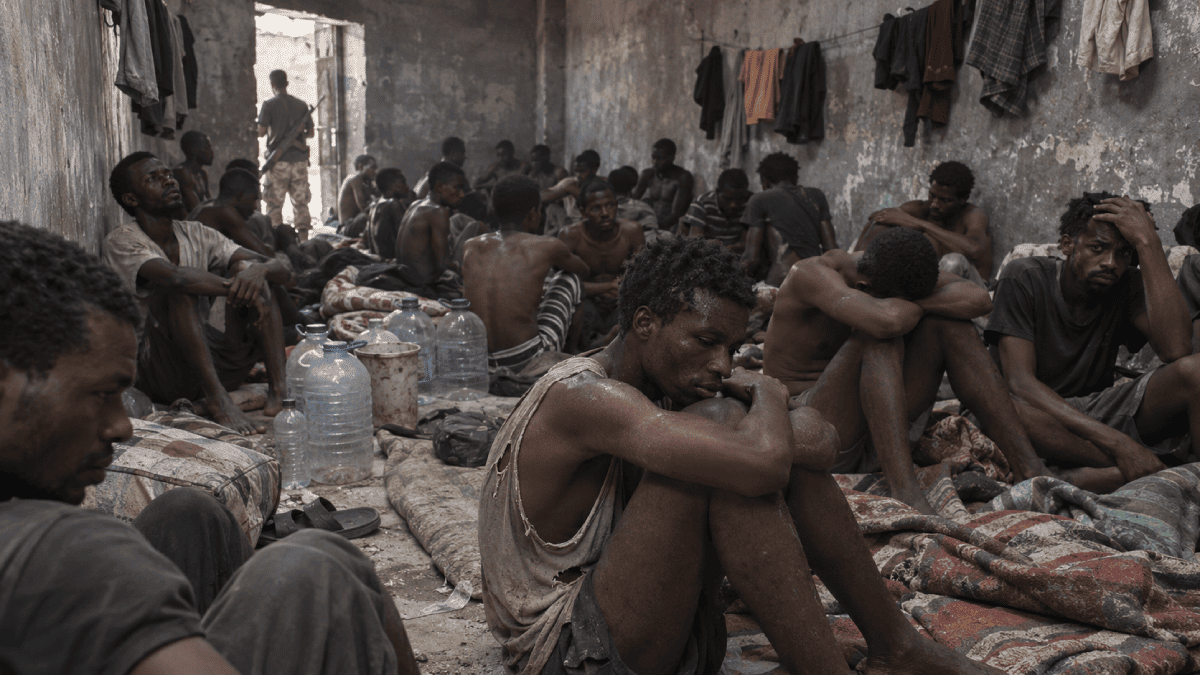
Libya Auctions Black Men
In November 2017, a CNN team filmed African migrants being auctioned outside Tripoli as farm labourers, some for as little as $400. The Libyan authorities announced a formal investigation.
Nine years later, the US State Department's 2026 assessment,
Libya's eleventh in a row as a "Special Case", records the result: the government has never reported prosecuting or convicting anyone for labour or sex trafficking.
The government again identified no victims at all, while an international organisation identified around 3,200 in 2025.
Government statements carried in the media claimed at least 179 victims freed in police operations, a figure the report could not verify.
The previous year's report recorded Coast Guard officers working with traffickers and detention centre staff selling female detainees to outsiders; the latest describes guards coercing detainees into sex in exchange for food and water.
For anti-trafficking training the government relied mostly on foreign donors, its own contribution including the loan of meeting rooms.
In February 2026, a joint report by the UN Support Mission in Libya and the UN human rights office described the abuse of migrants as "business as usual", a profit-driven trade run by networks often tied to Libyan authorities.
Libya has no anti-trafficking law and no asylum law.
The African Union and the European Union adopted their joint anti-trafficking blueprint, the Ouagadougou Action Plan, in Tripoli, of all places, in November 2006.
Eleven years later, men were going under the hammer on the city's outskirts.
Mauritania Only Abolished Slavery In 1981
Mauritania was the last country on earth to abolish slavery, in 1981. It made slavery a crime only in 2007, and in 2015 passed a tougher law declaring it a crime against humanity.
Walk Free estimates 149,000 people live in modern slavery there, 3.2 per cent of the population, and the core of the problem is hereditary servitude imposed on the Haratine, i.e. people born into ownership.
The State Department's 2025 assessment showed how the law performs in practice. The authorities identified 30 victims of hereditary slavery, the first for several years, and prosecuted none of their owners.
Some police and judicial officials reportedly refused to investigate hereditary slavery at all, and some prosecutors settled cases out of court, a practice the law forbids.
Senior officials publicly accused anti-slavery campaigners of fabricating cases.
The 2026 assessment brought better trafficking figures: 28 prosecutions and 22 convictions. Not one was for hereditary slavery. Three slavery cases sent to the country's new special tribunal were still sitting at the investigation stage.
The victims' fund was cut from $455,758 to $190,706, and the state paid out compensation of $15,556, shared between four people.
The special tribunal opened in February 2025, replacing three earlier anti-slavery courts which critics said had spent most of their time on slander cases.
Who was suing whom for slander is left to the imagination.
In 2015 a campaigner summed up the score: no slave-owners in prison, three anti-slavery activists convicted.
Mauritania sits in both the African Union and the Arab League.
Neither has imposed any penalty on it.
Mali & Chad Can't Convict If They Charge
Mali passed a law in October 2024 criminalising every form of slavery, descent-based slavery included. In the year to March 2025, prosecutors charged 300 alleged traffickers, 234 of them over hereditary slavery, and the courts convicted three, two of them for hereditary slavery.
Some slave-owners were charged under statutes on discrimination, crop destruction, or burglary, which carry far lighter penalties.
The following year the transition government prosecuted 253 people and reported six convictions, every one of them from cases dating back to between 2021 and 2023.
Once again it did not identify a single victim of hereditary slavery through its own efforts, and it issued restitution to no victim at all.
The previous report accused its officials, senior military officers among them, of covering up trafficking allegations and intimidating prosecutors.
Haiti Likes Its Child Servants
Haiti's grievance against France is specific and well documented. In 1825, Charles X forced the young republic to pay 150 million gold francs in exchange for recognition of its independence, a debt Haiti went on servicing into the twentieth century.
Emmanuel Macron conceded the injustice on its bicentenary in April 2025 and set up a joint commission of historians.
Haiti's national committee for restitution and reparations dismissed this as a "very small step".
Haitian households have for generations taken in children from poor rural families to work as unpaid domestic servants, a practice known as restavek ("working child"). Haiti's own Ministry of Social Affairs puts the number above 207,000 children, on figures dating from 2015.
The State Department describes them as often beaten, unpaid, and kept out of school, and cites an estimate putting two in three of them as girls, mostly victims of sex trafficking.
Its 2026 assessment records no investigations, no prosecutions, and no convictions for trafficking of any kind, for the second year running, with corruption still a significant concern.
The government published a ten-year action plan in December 2025 without attaching a single funding figure.
Gangs now run much of the capital, and UNICEF reports child recruitment tripled in 2025, with children making up between 30 and 50 per cent of armed groups.
The collapse of the state explains a great deal about the last few years. It explains nothing about the decades before.
In 2014, with an elected president in office, the State Department found the government had reported no trafficking prosecutions or convictions for four years running. In 2020 it reported the government did little to combat restavek.
Paris is being asked to repay a debt from 1825.
The children scrubbing floors in Port-au-Prince are owed something too, and no Haitian minister is drafting their claim.
Caribbean Countries Who Don't Even Bother
The island which staged this month's apology theatre has a record of its own. Antigua and Barbuda has never convicted a trafficker under its 2010 Trafficking in Persons (Prevention) Act, despite penalties of up to 25 years.
According to the 2026 assessment, it investigated 12 cases last year and prosecuted none, the sixth consecutive year without a single prosecution.
The same report counted 72 Cuban regime-affiliated medical workers on the island, vulnerable to wage confiscation and arbitrary punishment; the government now plans to phase the programme out.
Barbados, whose disgraceful Prime Minister Mia Mottley met Burnham at the summit to discuss slavery, has led the Caribbean campaign for years.
In 2025 Washington downgraded Barbados to its Tier 2 Watch List.
The 2026 report kept it there: six investigations, no prosecutions for a second year, and still no conviction under the anti-trafficking law passed in 2016, a law which allows a fine in place of prison for sex trafficking.
Barbados has had no national action plan since its last one expired in 2023.
The report's most notable conviction of a Barbadian trafficker was secured in the United States, by the Americans.
Trinidad and Tobago managed one conviction in 2025, a former police officer jailed for more than 16 years.
By the government's own submission to the UN, only two people were convicted of trafficking between 2013 and 2024, out of 85 brought before the courts. Spending on victim services fell by almost TT$300,000.
Ghana Proves The Job Can Be Done
Ghana deserves credit, and the credit sharpens the charge against everyone else. In October the State Department raised Ghana to Tier 1, making it the only African country among 35 governments judged to meet the minimum standards.
In 2025 Ghana prosecuted 212 alleged traffickers, convicted 28, identified 2,331 victims, and referred every one of them to services.
The restitution figure is less glamorous.
John Mahama's government issued restitution to six victims through criminal sentences, with no figure for what any of them actually received, in the same year it asked the world to pay into a reparations fund.
Its allocation for direct victim services was GHS 3.452 million, and a shelter for adult women stood out of action for the whole period.
In 2025 Ethiopia convicted 191 traffickers, Uganda convicted 171, and Nigeria convicted 97. Ethiopia and Uganda between them issued restitution to no victim at all.
African courts can sit, African police can investigate, and African prosecutors can win.
Where none of this happens, the State Department's reports point again and again to the same cause: officials who take bribes, look away, or take part.
| Government | Prosecutions | Convictions | Detail from the 2026 US assessment |
|---|---|---|---|
| Ethiopia | 417 | 191 | No restitution issued |
| Uganda | 1,033 | 171 | No restitution reported |
| Nigeria | 94 | 97 | Convictions include cases begun earlier |
| Ghana | 212 | 28 | Restitution for six victims |
| Mauritania | 28 | 22 | None for hereditary slavery |
| Mali | 253 | 6 | All from cases begun in 2021 to 2023 |
| Trinidad and Tobago | 13 | 1 | A former police officer |
| Chad | none reported | none reported | No victims identified |
| Antigua and Barbuda | 0 | 0 | Sixth year without a prosecution |
| Barbados | 0 | 0 | No conviction ever under its 2016 law |
| Haiti | none reported | none reported | Second year without an investigation |
| Libya | none reported | none reported | No trafficking conviction ever reported |
All figures come from the State Department's 2026 report, covering April 2025 to March 2026.
No 1200-Year Invoice For The Arabs
Africans were shipped across the Sahara, the Red Sea, and the Indian Ocean for centuries before the first Portuguese caravel reached West Africa, and for decades after the last British slaver left it.
The traders were Arab, Berber, Swahili, and African; the markets ran from Zanzibar to Cairo to the Gulf.
Mahama's resolution names one trade only, the transatlantic one.
No comparable campaign asks Riyadh, Muscat, Rabat, or Tripoli for a penny.
Saudi Arabia abolished slavery only in 1962, and Walk Free estimates 740,000 people were living in modern slavery there in 2021, many of them migrant workers bound to their employers under the kafala sponsorship system.
At least 274 Kenyan workers, most of them women, died in Saudi Arabia over five years, 55 of them in 2024 alone, with many autopsies attributing the deaths to natural causes.
Amnesty International published a report on Kenyan maids in the kingdom titled Locked In, Left Out; Kenyan authorities gave no response to its findings.
Nairobi then signed a new labour agreement with Riyadh in July 2026 covering more than 350,000 Kenyan workers, and kept the flights full.
Nobody has proposed a decade of anything for these women.
The Useless Disaster Of AU.COMMIT
African governments never needed Britain to tell them slavery was wrong. Article 5 of the African Charter on Human and Peoples' Rights, adopted on 27th June 1981 and in force since 21st October 1986, prohibits slavery and the slave trade.
Its signatories have had forty years to enforce it.
The African Union's own policy on the prevention of trafficking records what became of the Ouagadougou plan.
In 2009 the AU launched a campaign called AU.COMMIT to put the plan into effect; the policy concedes there has been "little or no information available" on its work since the launch.
Most member states, it admits, have rarely used the plan as the basis for reforming their laws or institutions. Regional schemes duplicated one another and ran without coordination.
In under two years, reparations acquired a committee of experts, a reference group of lawyers, a General Assembly resolution, an Accra summit, and a ten-year programme.
The AU.COMMIT campaign, launched seventeen years ago, left so faint a record the AU's own policy could say almost nothing about what it achieved.
The Answer Is Absolutely No
The principle proclaimed in Accra and St John's is a universal one: slavery is the gravest crime against humanity, and those who commit it owe redress to its victims.
Applied honestly, the principle points first at the living slave-owners of Nouakchott, the traffickers of Tripoli, the RSF commanders of Darfur, and the households of Port-au-Prince.
Before Britain hands over a penny, or an apology drafted as a down payment, every government demanding money should publish five figures.
- How much it spends each year fighting slavery inside its own borders.
- How many slaves it has freed.
- How many slave-owners and traffickers sit in its prisons.
- How much restitution living victims have actually received.
- And what it has demanded of Libya, Mauritania, and the Gulf states on behalf of Africans enslaved there.
Britain paid in ships, sailors, and money to end the slave trade once.
The governments now drafting its bill have yet to pay the far smaller price of convicting the slave-owners among their own citizens.
When Nouakchott jails a hereditary slave-owner, when Tripoli reports its first trafficking conviction, and when Bridgetown wins its first case under its own law, Britain can listen to the rest of the claim.
Until then, the envelope can stay sealed. The answer is categorically, NO.