Why Are Civil Servant War Pigs Pushing Us To Attack Russia?
On Armistice Day, the man who ran Britain's national security machinery urged Nato to put Moscow in jeopardy. His record runs from missing abuse files to chickenpox parties, and ended in a peerage. He now advises bankers on defence investment. Nobody voted for any of it.
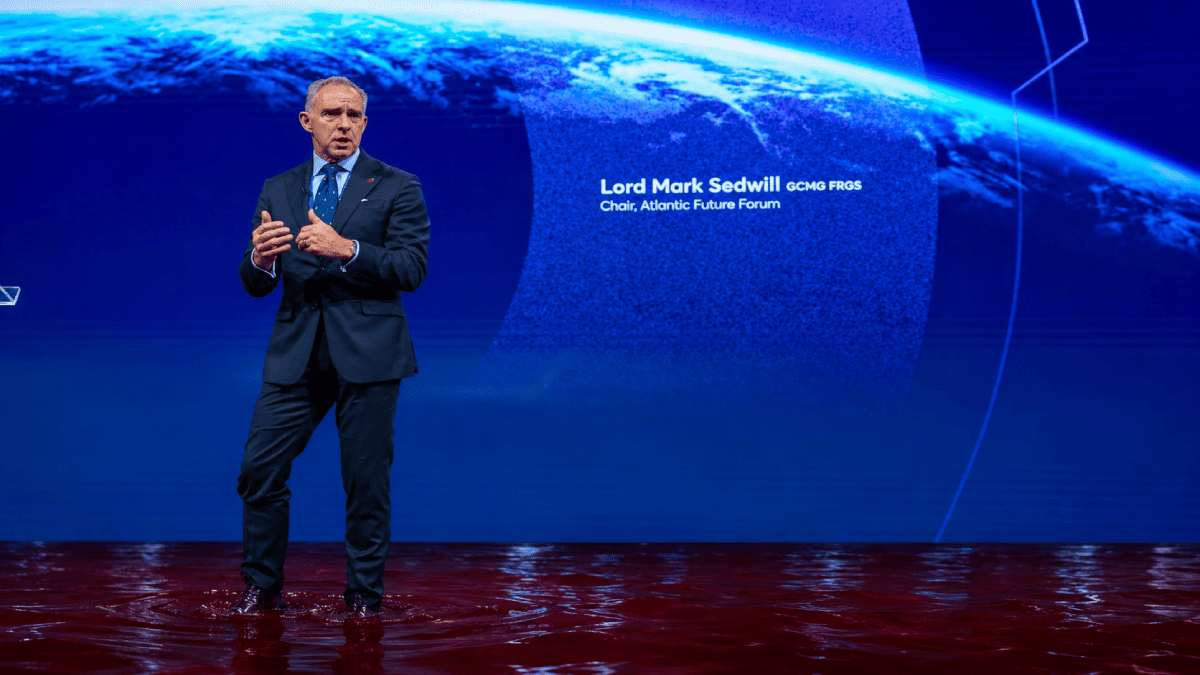
On a day set aside each year to remember what war costs, Mark Sedwill opened the Atlantic Future Forum on the flight deck of HMS Prince of Wales, berthed in Oslo. He chairs the forum. He is also a former Cabinet Secretary, a former National Security Adviser, a crossbench peer, and a man with a full diary of paid advisory work.
On this occasion he had a message for the assembled ministers, admirals, and officials: Britain and its allies should stop waiting for Russia to hit them and start frightening Russia instead.
"How do we make them feel they are under threat," he asked, and:
...not simply leave the initiative to them and defend against it? How can we put some pressure on the Russians?
Deterrence, he argued, required:
some jeopardy for our adversaries in continuing to probe us.
In remarks reported elsewhere he went further:
Sometimes the most effective form of defence is to cause a dilemma, it is to go on the offensive.
Britain, he told his audience, is on the front line, and
...in hybrid warfare we are engaged with our Russian and other enemies.
With what? Six frigates and a few drones?
Better question: why are we picking a fight with Russia at all?
The Liberal Democrat MP Mike Martin, who chairs the All-Party Parliamentary Group on Rearmament, rushed to agree, saying we:
...should consider going on the offensive to impose a real cost of aggression on our adversaries....in hybrid warfare we are engaged with our Russian and other enemies.
Take the initiative. Go on the offensive. 1000 days to war.
The proposal is plain enough: Britain should move first against a nuclear power, led a cunning psychotic fox who could outwit any of our officials in his sleep. For no benefit to us at all other than moral posturing at the ICJ and something something LGBT equality, probably.
In Abu Dhabi this month, Russian and Ukrainian negotiators sat down for their first direct talks in nine months, with American mediators in the room.
On the same carrier, a few hours after Sedwill spoke, the director of the Norwegian Intelligence School, Kristin Ven Bruusgaard, answered a question about imposing costs on Moscow without escalation. Her answer was blunt: "it might not be possible to avoid escalation", and allies need to be ready for Russia:
... actually crossing the nuclear threshold.
Great job, Sherlock. Yes, if you threaten a nuclear power, they might just deploy battlefield ordnance designed to make you back off.
The chairman's opening speech and the intelligence expert's warning were delivered from the same deck. Only one of them made the headlines.
Kaliningrad, Shadow Tankers, Every Trick
Oslo was no slip. Sedwill has been making this case for a year. In December 2025 he wrote an article for The Independent under the headline "Russia must be subdued by every trick in Britain's book." In it he called for "systematic pressure" on Kaliningrad, the Russian exclave wedged between Poland and Lithuania, which depends on land and sea access through Nato territory.
He proposed seizing Russian vessels in Nato waters and passing laws allowing allied navies to act against attacks on cables in international waters.
As for the risk, he waved it away: the danger was "not in provoking attacks", since Russia was already attacking.
Moscow has since answered him, in writing.
In September 2026 Russia sent Nato a diplomatic note warning of a possible nuclear response if the alliance tried to isolate Kaliningrad. Chatham House noted Nato had so far responded with restraint.
Restraint is precisely the quality Sedwill finds so disappointing. He is not alone in his impatience.
In December 2025 the chairman of Nato's Military Committee, Italian Admiral Giuseppe Cavo Dragone, told the Financial Times the alliance was weighing whether to be "proactive instead of reactive", up to and including what officials described as a possible "pre-emptive strike."
A fashion has taken hold among senior Western officials, serving and retired, for talking about striking first.
Its followers rarely mention who would do the fighting, or with what.
Threatened With What?
Any threat is only as good as the force behind it. Here is the force.
| Measure | Figure |
|---|---|
| UK regular armed forces, April 2010 | about 191,000 |
| UK regular armed forces, July 2026 | 137,480 |
| Regular Army target set in 2015, to be met by 2020 | 82,000 |
| Regular Army, July 2026 | 73,660 |
| Regular Royal Navy and Royal Marines, July 2026 | 32,430 |
Sources: MOD quarterly personnel statistics, July 2026; MOD personnel statistics, 2011; MOD location statistics, April 2020.
Britain has lost more than a quarter of its regular forces in sixteen years. Of the 73,660 regular soldiers, only 70,950 are trade trained. The whole Army would fit inside Wembley Stadium with room to spare.
The Navy is worse.
In October 2026 the Commons Defence Committee published Defence in the High North, which found "glaring gaps" in the availability of Britain's maritime forces, the very ships and submarines which would have to carry out any offensive in the North Atlantic. The committee recorded reports of all five Astute-class attack submarines then in service tied up in dockyards at the same time, with none deployed.
It found the Royal Navy had temporarily lost its ability to operate submarines beneath Arctic ice, the region where Russia bases two-thirds of its strategic nuclear missiles.
Three Type 23 frigates, HMS Iron Duke, HMS Richmond, and HMS Chiddingfold, left service this year, with replacements years away. Because these ships have a lifespan of 30-40 years which is known decades in advance.
In the committee's words, Britain (i.e. its politician fools) had let her under-ice capability
... lapse at a time when the High North has become strategically more important.
Astute-class boats have not been certified to operate under ice, meaning Britain could not fight Russia beneath the surface.
Sedwill wants Russia to feel jeopardy.
Russia's Northern Fleet can sail under the ice.
Britain's submarines currently cannot, when they sail at all.
What Sedwill Did With Power
None of this decline arrived by accident, and Sedwill did not watch it from the stands. He was National Security Adviser from April 2017 to September 2020, Cabinet Secretary from 2018, and Permanent Secretary at the Home Office from 2013 to 2017.
As National Security Adviser he ran the secretariat of the National Security Council, the body which exists to match Britain's commitments to its means.
Ben Wallace, dysgenic Defence Secretary from July 2019, later described the state of the Army in those years. In March 2021, announcing further cuts, he told the Commons:
The Army has not been at its established strength of 82,000 since the middle of last decade.
Through every year of Sedwill's tenure the Army was below the size the government itself said it needed.
The Integrated Review, formally launched on 26th February 2020 and run through the National Security Council while Sedwill was still its chief official, ended with the Army target cut to 72,500.
The review he helped begin is the review which shrank the force he now wants to brandish.
In March 2018, eleven months into his time as National Security Adviser, Russian military intelligence officers smeared Novichok on a door handle in Salisbury. Dawn Sturgess, a mother of three from Amesbury, died four months later.
In December 2025 the public inquiry into her death found the operation:
must have been authorised at the highest level, by President Putin.
You think? Great work, Sherlock.
A year later, in March 2019, Parliament's Intelligence and Security Committee completed its Russia report. It concluded the government had "badly underestimated" the Russian threat and had "actively avoided" investigating whether Moscow interfered in the 2016 referendum.
One committee member said nobody in government wanted to touch the subject "with a 10-foot pole". The report sat unpublished until July 2020.
Throughout those sixteen months, the national security machinery answered to Sedwill.
Today he warns the Oslo forum about Russian "dirty money in elections". The concern is welcome, if about seven years late.
In July 2017, weeks into the job, Sedwill told a Royal United Services Institute conference the first thing government must ask is "What is our core national interest?" Only once the answer was clear, he said, should anyone decide what Britain could and should do.
It was sound advice.
He has not applied it to himself.
Nowhere in his Oslo remarks did he say what outcome offensive pressure on Russia is meant to secure, how Britain would know it had succeeded, or where it would stop.
Lost Visas, Lost Paedo Files, And A Useless Dept
In Whitehall Sedwill was known as the ultimate "securocrat": grey, discreet, and forever promoted. The promotions are easy to list. The results are harder to find.
In November 2008 he was international director of the UK Border Agency when the independent visa monitor, Linda Costelloe-Baker, told MPs some 300,000 visas a year might be wrongly approved, because nobody checked the 80% of applications which were granted.
Our decisions are fair and objective.
From February 2013 he ran the Home Office as Permanent Secretary under Theresa May, and he stayed four years. Before the Public Accounts Committee he was confronted with figures showing 38% of asylum cases waiting more than three years.
He called it "part of the legacy".
The same department, in the same years, built the "hostile environment", and somehow aimed it at the wrong people.
Wendy Williams' Windrush Lessons Learned Review found the measures expanded from 2014 were applied with "a complete disregard for the Windrush generation", lawful British residents who had arrived to rebuild the country after the war. "Warning signs and messages about the hostile environment policy were not heeded," she wrote.
The Institute for Government concluded the Home Office's deep-seated flaws ran "from permanent secretary to caseworker". A department with a vast asylum backlog was busy chasing pensioners from Jamaica who had every right to be here.
In July 2014, asked by David Cameron to look into the dossier on alleged establishment child abuse handed to the Home Office in 1983, Sedwill disclosed an internal review had already found 114 files on historic child abuse allegations missing from his department.
The national inquiry which followed then lost two chairs in four months.
Baroness Butler-Sloss stood down after six days, once it emerged her brother had been Attorney General during the period under investigation.
Fiona Woolf went on 31st October 2014 over her links to Leon Brittan.
Neither problem required a detective to uncover.
Hauled before the Home Affairs Committee, Sedwill conceded his department had not grasped the threshold for public confidence "was in a different place".
Leak Hunts, Brexit Letters, Chickenpox Parties
In 2018 Theresa May made Sedwill Cabinet Secretary while he kept the national security job. He used both freely. In October 2018 he wrote to The Times, with Downing Street's authorisation, declaring Conservative MPs who criticised May's Brexit negotiator Olly Robbins "should be ashamed of themselves".
A head of the civil service publicly scolding elected members of the governing party was without precedent.
In April 2019 a 14-page letter of his to ministers reached the Daily Mail, forecasting food prices up 10% under no deal, along with direct rule in Northern Ireland and hobbled police and security services.
On 30th September 2019, with the Brexit deadline a month away, Sky News published another leaked Sedwill letter, this time to senior officials.
Brexit, he wrote, was "an unsettling period". He was "mindful of my own constitutional responsibilities" and would "resist attempts to draw the civil service into the argument."
The man who had written to The Times about Brexiteers was now promising to keep the civil service out of politics.
The same letter set out how he planned to spend the run-up to the deadline. He would be "on the road" for much of the month, touring the country to understand "the challenges and pressures at the sharp end".
With weeks to go before Britain was due to leave the European Union, and a government accusing parts of Whitehall of trying to frustrate it, the head of the civil service went on a listening tour. Sky reported the decision had surprised some officials. "Our attitude must be can-do," he wrote, before leaving town.
In May 2019, after details of a National Security Council discussion on Huawei appeared in The Telegraph, Sedwill ran the leak inquiry which led May to sack her Defence Secretary, Gavin Williamson.
Williamson has always denied leaking and called the process a "kangaroo court".
ITV reported Sedwill had been pointing the finger at Williamson before the investigation had even started, and the chair of Parliament's national security committee wrote asking him to explain his methods.
No police investigation followed.
In February 2020, as the Home Office tore itself apart over Priti Patel, he ordered every civil servant to keep advice to ministers "private". One source said the instruction went down "like a cup of cold sick".
Then the pandemic arrived.
On 12th March 2020, according to evidence given to the Covid Inquiry, the Cabinet Secretary suggested to Boris Johnson he go on television and tell the country this was like the old days, when "people are going to have chickenpox parties".
In a message of the same period Sedwill wrote:
Indeed presumably like chickenpox we want people to get it and develop herd immunity before the next wave.
Dominic Cummings recorded the moment with a WhatsApp to colleagues complaining of "Sedwill babbling about chickenpox".
In November 2023 Sedwill apologised to bereaved families for what was reported as his "heartless" suggestion, adding he had never meant the exchanges to become public.
In November 2025 the Inquiry's Module 2 report found a lockdown imposed on 16th March 2020 would have cut first-wave deaths by 48%, or some 23,000 lives.
Four days earlier, Britain's most senior official had been talking about parties.
On 28th June 2020 Johnson announced Sedwill's departure and nominated him for a life peerage:
...in recognition of his distinguished service to public life.
The Army was under strength, the Russia report was still locked in a drawer, and the man in charge of national security went to the House of Lords.
Business as usual.
Two months later, Patrick Vallance's diary recorded Sedwill complaining:
...this administration is brutal and useless.
If only.
He had accepted its peerage all the same.
Escalation Against A Nuclear Power
Sedwill speaks as though "jeopardy" can be dialled up and down like central heating. Russia does not see it in those terms, and has told Nato so.
| Warheads, early 2026 | Total inventory |
|---|---|
| Russia | 5,420 |
| United Kingdom | 225 |
Source: Federation of American Scientists, Status of World Nuclear Forces 2026.
Russian doctrine leans on nuclear weapons to make up for conventional weakness, which means a Russia losing a conventional exchange is the most dangerous Russia of all.
Bruusgaard said as much on the same deck where Sedwill spoke. Nato planners have told a European defence conference Europe could not currently sustain a long war of attrition against Russia at all.
There is no version of this contest which Britain wins in any meaningful sense.
A conventional war with Russia is one Britain cannot sustain. A nuclear war is one nobody survives intact.
"Winning" against a state with 5,420 warheads means not losing everything, and the surest way to achieve it is to avoid the fight.
On 30th September 2026 Nato's Secretary General, Mark Rutte, told Euronews there was no immediate threat to Nato territory.
On 14th October he repeated it: "no imminent threat against NATO territory."
Speaking at Sedwill's own forum on 11th November, Rutte said "Putin is failing on the battlefield," with Russian losses running above 40,000 killed or seriously wounded a month.
If Russia poses no imminent threat to Nato territory, and is losing men at a ruinous rate in Ukraine, the case for Britain taking the initiative evaporates.
What remains is a wish to punish, dressed up as strategy, and the bill would land on people who were never consulted.
Half Of Britons Will Not Fight
The British public has been remarkably patient with its governing class on defence. Its patience has limits.
| Public attitudes, autumn 2026 | Share of adults |
|---|---|
| Support higher defence spending | 51% |
| Would not take up arms for Britain under any circumstances | 48% |
| Would take up arms in some circumstances | 36% |
| Cost of living rose in the past month (August) | 55% |
| Of those, blamed the price of food shopping | 94% |
Sources: Ipsos, October 2026; House of Commons Library, citing ONS.
Britons want a properly armed country. They are willing to pay for one.
Nearly half of them will not fight in a war under any circumstances, and the majority are counting pennies at the supermarket till.
This is a country which wants to be defended, which is a different thing from a country which wants to pick a fight in the Barents Sea.
The people who bear the cost of escalation are easy to name. They are the soldiers in Catterick, Tidworth, and Colchester, many of them recruited from towns where a good job is hard to find.
They are the families whose energy bills would follow any Russian strike on North Sea pipelines and cables, the very infrastructure the Defence Committee says Britain cannot adequately protect.
They are not life peers.
Members of the House of Lords do not get called up, and none of them will be standing watch on a frigate in the Norwegian Sea.
Rothschild, Temasek, McKinsey, and Hakluyt
When a former official urges confrontation, the public is entitled to know where he earns his living. Sedwill's declared interests in the Lords list paid positions including a non-executive directorship at the business intelligence firm Hakluyt and membership of McKinsey's Geopolitical Advisory Council, as well as an adviser's honorarium from Rasmussen Global, the consultancy founded by a former Nato Secretary General.
Rothschild & Co describes him as chair of its Geopolitical Advisory business and of Rothschild & Co Saudi Arabia, as well as chair of the International Institute for Strategic Studies and of the Atlantic Future Forum. He also sits on Temasek's advisory group for Europe, the Middle East, and Africa.
Yeats of fruitful work, as Sir Humphrey would say.
When he took up the Temasek role, the Advisory Committee on Business Appointments noted the risk his "network and influence" might be perceived as helping the Singaporean state investor unfairly.
Rothschild's website, meanwhile, carries his own commentary on the opportunities for investment in the defence sector.
None of this is illegal, and all of it is declared.
A public figure who tells a military audience to go on the offensive, while chairing the geopolitical business of an investment bank which writes about defence investment, should expect the connection to be noticed.
The Second Cold War Must End
Sedwill is right about one thing. Russia is hostile. It poisoned a British city, killed a British woman, and has spent years probing British cables, airspace, and politics.
Its rulers have also been honest about why.
Russia's 2023 Foreign Policy Concept, signed by Putin, defines the country as a distinct "state-civilisation" with a unique mission.
It names the West as the source of "destructive neoliberal ideological attitudes" which Russia must resist.
Moscow treats a free press, independent courts, and government by consent as weapons aimed at it. Britain, whatever its present failings, holds them as the foundations of a decent country.
These two moral systems are not compatible. As Christianity and Islam are not compatible.
Thirty years of trade, summits, and London property deals did not make Russia more like Britain, and no amount of "jeopardy" will make Russia more like Britain either.
Pressure on a cornered Russia only hardens it.
When two irreconcilable systems sit side by side with nuclear arsenals, history offers one tested way to keep the peace: separate them, deliberately and by agreement. The Cold War stayed cold because both sides eventually accepted fixed lines and stopped trying to remake each other.
The Helsinki Final Act of 1st August 1975 wrote the inviolability of frontiers into a signed text.
Neither side abandoned its beliefs. Each simply gave up the fantasy of converting the other by force.
Europe needs a settlement of the same kind now: a negotiated end to the war in Ukraine, settled borders, verifiable limits on forces and missiles along the line of contact, a hard and unambiguous defence of every inch of Nato territory, and an end to the sub-threshold games on both sides.
The talks in Abu Dhabi, however halting, are the only process in sight which could deliver any of it.
Britain should be putting its weight behind them, and spending its money on the submarines, frigates, and soldiers it needs to defend its own waters.
Instead, on Armistice Day, a peer who presided over a hollowing army stood on a carrier and called for an offensive.
The dead of 1914 to 1918 were sent to a bloody and disastrous war by confident men who never doubted the plan. Britain should not repeat the experiment against a country with 5,420 nuclear warheads, on the advice of a man who will not be in the trenches and could not tell you what victory looks like.