£1.15 Billion To Save £4.3 Billion But Nobody Can Show How
Since 2004 the Cabinet Office has been trying to replace 286 back-office systems with five. It has burned through £1.15 billion, cannot state the bill, cannot name anybody in charge, and cannot persuade the Treasury to use the platform the Treasury is funding. Tesco managed this in the nineties.
The proposition is not complicated and nobody disputes it. Seventeen departments, some 470,000 civil servants, and at least 92 arm's-length bodies all need somebody to pay them, hire them, buy their laptops, and settle their invoices. Central government currently performs these miracles across 286 separate systems at a running cost of roughly £525 million a year.
Merging them into five is the kind of decision a competent finance director takes over a sandwich. Supermarkets did it. Insurers did it. Regional funeral directors did it, and with fewer consultants.
The Cabinet Office has been attempting it since 2004 and remains, on the evidence of a report published on July 15th 2026, some distance from success.
The Public Accounts Committee declared itself "astounded" the department could not explain the value-for-money case for its own efficiency programme. It found nobody in government with sufficient authority to deliver it. It suggested, with the strained politeness of a body which has seen this film four times, very serious consideration of scrapping the whole thing before more money vanishes into it.
Two decades. Four parliamentary inquiries. Three strategies. Five clusters. One unanswered question about the price.
Francis Maude Solved This in 2012, Apparently
The last-but-one attempt was unveiled two days after Christmas in 2012, when the Minister for the Cabinet Office announced Next Generation Shared Services would strip between £400 million and £600 million a year out of Whitehall administration by consolidating eight service centres into five. The press release assured readers robust governance had been established, including a Crown Oversight function to monitor performance.
Nobody has heard of the Crown Oversight function since. It went the way of all Whitehall oversight functions, which is to say it was announced, congratulated, and quietly composted.
Fourteen years later the unelected Cabinet Office is once again consolidating into five centres, once again promising enormous savings, and once again being told by a select committee its governance is inadequate and its leadership absent.
A further strategy landed in 2018, was refreshed in March 2021, and sorted departments into clusters given the names Matrix, Synergy, Unity, Defence, and Overseas, presumably by somebody who had recently taken mushrooms at a California therapy retreat.
In 2023 the Cabinet Office announced the clusters would magically produce around £1.8 billion of benefits for around £900 million of cost across fifteen years, measured against a world in which departments each bought their own kit at a price exceeding £1.7 billion.
Every one of those figures has since gone for a walk.
| Year | Claimed benefit | Claimed cost | Cost of doing nothing | What happened |
|---|---|---|---|---|
| 2012 | £400m–£600m a year | Not stated | Not stated | Superseded |
| 2018 | "Millions of pounds" | Not stated | Not stated | Refreshed after three years |
| 2023 | £1.8bn over 15 years | ~£900m | £1.7bn | PAC warns on the business case |
| 2026 | £4.3bn over 15 years | £846m or "around £1.6bn" | £4bn | PAC raises abandonment |
The claimed benefit has multiplied by two and a half in three years. The imaginary cost of carrying on as before has more than doubled in the same period, which is a marvellously helpful direction of travel for a number whose sole purpose is to flatter the programme it justifies.
Nobody has explained either movement. Nobody was asked to until this summer.
4.3 Billion in Benefits, Costs to Follow
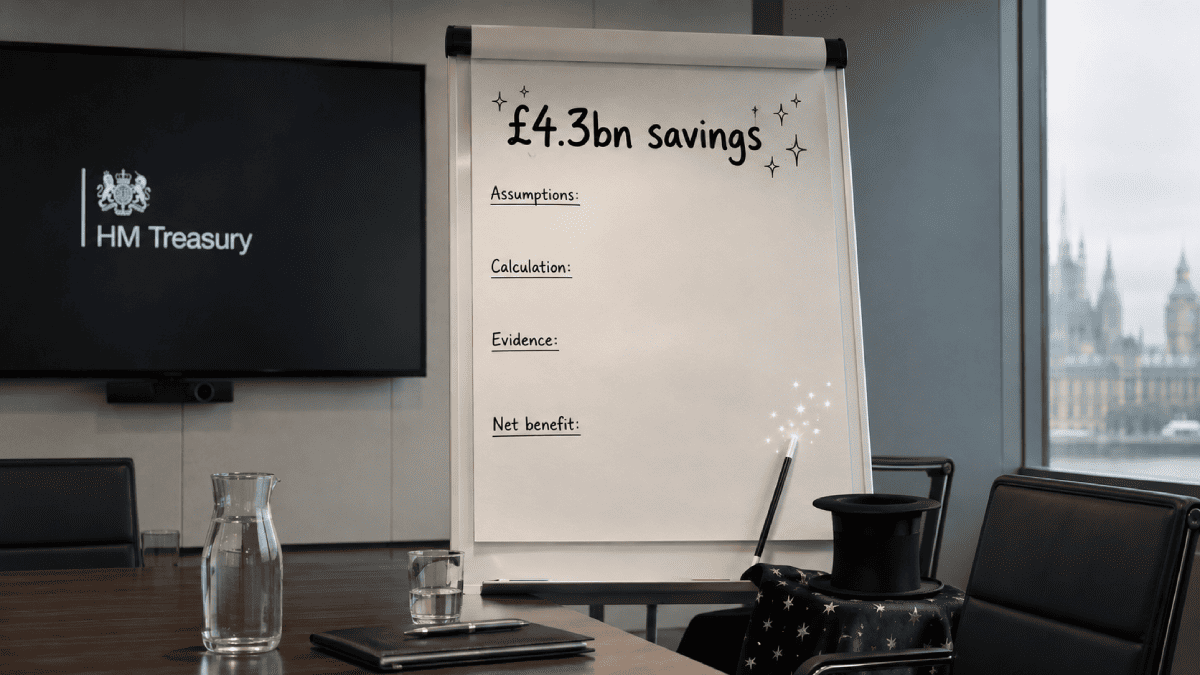
The Cabinet Office told the Committee its strategy will now deliver £4.3 billion of benefits over fifteen years. Under questioning it conceded the figure makes no allowance whatever for the cost of delivering it, and then conceded it could not say what the cost of delivering it is.
This is important, for a simple reason: if the cost of delivering it exceeds the savings it delivers, then it is not efficiency. It's reverse efficiency. If it costs twenty billion to save four billion, it's a rather pointless affair.
The gap between the two numbers is £3.3 billion and represents the entire distinction between accountancy and advertising.
Pressed for clarity afterwards, the department produced a letter dated 3rd of June 2026. In one section of the letter, change costs are £846 million. In another section of the same letter, they are around £1.6 billion.
No explanation is offered for the second figure, which simply appears, like weather.
The Cabinet Office cannot agree with itself across the width of a single sheet of correspondence, and this is the department charged with imposing standardised data on the rest of Whitehall.
The £846 million turns out to be the Treasury's Spending Review 2025 commitment to three of the five clusters. It excludes Defence. It excludes Overseas. It excludes departmental money covering the funding gaps the Treasury left behind. It excludes £300 million of reserve funding released between 2021 and 2025.
The benefits, meanwhile, cover all five clusters over fifteen years. Costs for three clusters over three years are therefore being weighed against benefits for five clusters over fifteen, and the resulting number is being read aloud in Parliament.
| Figure | Whose number | What it actually covers |
|---|---|---|
| £4.3bn benefits | Cabinet Office | Five clusters, 15 years, before any costs |
| £1bn net benefits | National Audit Office | Clusters' benefits after cost |
| £846m costs | Cabinet Office | Three clusters, SR25 period only |
| "Around £1.6bn" costs | Cabinet Office | Unexplained |
| £1.15bn committed | HM Treasury | Cash released since 2021 |
A House of Commons committee asked for a high-level cost-benefit summary of a programme in its fifth year and did not get one.
Any finance director in the country keeps that sheet of paper in a desk drawer.
The department leading government's efficiency drive could not find it, produce it, or reconstruct it in the three weeks between the hearing and the letter.
Nobody Can Ever Be Blamed
The Cabinet Office owns the strategy. It does not consider itself accountable for whether the strategy is delivered. Delivery belongs to five clusters, each with a senior responsible owner and a lead departmental accounting officer.
This being an arrangement the department described to MPs as a conscious and pragmatic choice, and also as ministerial preference; which are two ways of saying somebody wanted it and nobody wants to be the somebody.
Above the clusters sits a Service and Technical Design Authority.
Above that sits a Shared Services Board.
Beside both, outside the formal structure entirely, sits the Civil Service Transformation Board, where permanent secretaries actually commit their departments, and which the cluster senior responsible owners and the Cabinet Office's own Director of Shared Services do not regularly attend.
Elsewhere again sat the Applicant Tracking System board, which took decisions binding on shared services from a position of no formal relationship to it whatsoever, and which we shall come back to, because it cost between £26 million and £38 million.
The Cabinet Office proposed one, called it the Government Corporate Services Board, then dropped it in favour of the two-tier arrangement above.
It has since told the Committee the abandoned board might have been rather a good idea, and has commenced a review of the governance it reformed last year, which was itself the product of a review.
The Committee's verdict is one sentence long and should be engraved somewhere: no single person in government holds the authority necessary to deliver the strategy.
A programme conceived to abolish fragmented accountability has spread its own accountability across eleven bodies and appointed nobody at all.
Another Stupid, Pointless Dashboard
To keep track of the clusters, the Cabinet Office built a central dashboard (because, of course they did!!) collating data on costs, benefits, and milestones. The department proudly informed MPs 1,600 people consult it every day.
The dashboard depends on clusters submitting returns. The Cabinet Office has no power to make them.
One section of it was missing data for 21 of 64 returns.
Sixteen hundred officials, every working day, gazing at two thirds of a picture and drawing conclusions. Nobody appears to have asked what they do next.
The central instrument for overcoming departmental fragmentation cannot compel fragmented departments to fill it in, which is the whole problem rendered in a spreadsheet.
The Treasury Funds It But Will Not Touch It
The entire design assumes departments will behave as one civil service rather than seventeen sulking principalities. The Cabinet Office insists participation is compulsory and every department signed up unconditionally at the outset.
The Treasury takes a different view of its own case.
Having released £1.15 billion for the programme, it told the Committee its Permanent Secretary reserves the right to decide unilaterally whether the Treasury joins the Matrix cluster, pending further information on benefits and service levels.
The Department for Education is likewise waiting to hear more about feasibility and value for money. Both have already bought themselves modern cloud platforms and neither fancies giving them up.
This is the department which spends its life instructing other departments to accept collective discipline for the greater good. Presented with a bill for its own medicine, it has discovered a hitherto unsuspected constitutional right of refusal.
Better still, the Treasury cannot make its decision until Matrix supplies the information, and Matrix has been delayed, in part because the Cabinet Office's own migration has been delayed to December 2026.
The Treasury will therefore decide in December 2026 whether to join a system the people telling it to join have not joined either. The report also gives the pair's scheduled onboarding as November 2027 in the summary and August 2027 in the body, a small discrepancy, entirely in character.
Departments were meant to begin moving in July 2026. The date is now December 2026.
The Cabinet Office has offered no explanation for the five-month slip.
Not a bad one. None.
Capita Underbid By £272 Million And Won
Synergy, whatever the hell it means, is the largest cluster: the Department for Work and Pensions, the Home Office, the Ministry of Justice, Defra, 98 arm's-length bodies, and more than 250,000 civil servants, close to half the service.
In 2024 the DWP handed the underlying Oracle platform to IBM and Oracle for £711 million. In March 2026 it handed the business process services running on top to Capita (aka Crapita).
Court filings reported in June revealed the DWP's own should-cost model valued the ten-year contract at £642 million.
The should-cost model exists precisely and explicitly to protect government against bids which look too good to be true, and the Sourcing Playbook requires anything more than 10 per cent below it to be referred upwards to the Government Commercial Function.
This bid came in 42 per cent below. Asked whether the referral was made, the DWP declined to comment.
The incumbent supplier, Sopra Steria, whose subsidiary has run these services since 2013, is suing, alleging the winning bid was abnormally low and rested on staffing significantly below current levels.
he DWP's defence includes an accusation Sopra Steria breached an ethical wall agreement by relying on a document the DWP itself sent in error. A department incapable of addressing an email correctly is presently engaged in standardising the administrative processes of the entire British state.
Meanwhile the Unity cluster, led by HMRC, is building its service in-house. Two clusters, two opposite models, one programme, and a controlled experiment gifted to government free of charge.
The Committee asked whether anybody had worked out which approach delivers better value. Such assessments, the Cabinet Office explained, are made at cluster level rather than strategy level. Whatever that means.
Months of fruitful work, as Sir Humphrey would say.
It later supplied a list of factors considered, which is not an answer, and no comparison, which was the question. The case for outsourcing amounted to a decade of having outsourced already.
The Public and Commercial Services Union objected, citing Capita's administration of the Civil Service Pension Scheme, whose portal launched without full functionality and produced civil servants protesting outside the company's annual general meeting in May. The Committee has previously criticised the same supplier over army recruitment and NHS primary care support.
Whitehall's response has been to give it the payroll of half the civil service.
Unable To Agree What Hiring Involves
None of the five platforms works unless departments describe their processes identically. Since 2023 the Government Finance Function has led a standards programme called NOVA, mapping every step involved in paying a grant or recruiting a member of staff so the data can eventually be combined.
Finance has done it. Grants has done it. The Government People Function has not, cannot say when it will, and pleads in mitigation roughly 3
70 policy-sensitive areas of HR process against Finance's 95.
Whitehall, in other words, holds 370 distinct and jealously guarded opinions about how to hire a person.
The consequent delay has already pushed the Defence cluster's onboarding of military personnel back by a full year. A £5 million standardisation project has been commissioned to sort it out, with no completion date attached.
The Government Commercial Function declined to participate in NOVA from the very beginning, which in Whitehall counts as a lifestyle choice rather than insubordination.
The Government Commercial Function is also the body to which suspiciously low bids are supposed to be referred.
25 Platforms Lost In the Digital Spaghetti
At least 25 further government digital programmes must integrate with the cluster platforms. Responsibility for managing those dependencies rests with nobody in particular.
The Cabinet Office's Applicant Tracking System was abandoned in October 2025 at a cost of between £26 million and £38 million, its fatal decisions taken at a board sitting outside the shared services governance structure altogether. Thirty-eight million pounds evaporated at a meeting for which no one was formally accountable.
The Office for National Statistics closed its Integrated Data Service in March 2026 after spending a reported £240 million, which was a cross-government cloud transformation promising better data sharing and efficiency gains which delivered neither and was buried without ceremony.
Four months later the Committee found itself examining the next one and drew the comparison itself, in the tone of a coroner recognising a family name.
Month and months of fruitful work.
A Permanent Occupation Where Nothing Is Ever Finished And We Pay The Bill
The defect identified in 2004 was departments behaving as separate kingdoms, running duplicate systems, hoarding incompatible data, and answering to nobody in the centre.
Congratulations, Sherlock.
The cure has been a strategy, five clusters, five senior responsible owners, a design authority, a shared services board, a transformation board, a standards framework, a central dashboard, a functions convergence programme, an abandoned corporate services board, a governance reset, and a review of the governance reset.
Each of those is now an additional instrument requiring coordination.
Faced with an inability to coordinate seventeen departments, the Cabinet Office created eleven further bodies, and cannot coordinate those either.
The remedy has faithfully reproduced the disease at a cost of £1.15 billion, and the patient is describing the symptoms to Parliament as evidence of progress.
British government has reached the point where the apparatus of self-improvement absorbs more administrative effort than the inefficiency it exists to remove.
No enemy did this. No saboteur, no strike, no hostile Parliament, no cunning supplier.
The reform is being destroyed by precisely the qualities which made reform necessary, which confirms the diagnosis beyond argument and disqualifies the diagnostician from performing the operation.
Twenty-two years, £1.15 billion, four inquiries, and Whitehall still cannot buy one payroll system.
It should not be given a sixth strategy, a twelfth board, or another decade. It should be given considerably less to administer, then abolished.