Thatcher Ventriloquism: The Last Breaths Of A Dying Party Who Damned Themselves
A civil service grown by a third, 997 votes in Makerfield, and eleven former cabinet ministers lost to Reform. Kemi Badenoch now borrows Thatcher's script, toasts her own front bench, and blames the defectors she once sat beside in cabinet. The desperate cringe has apexed.

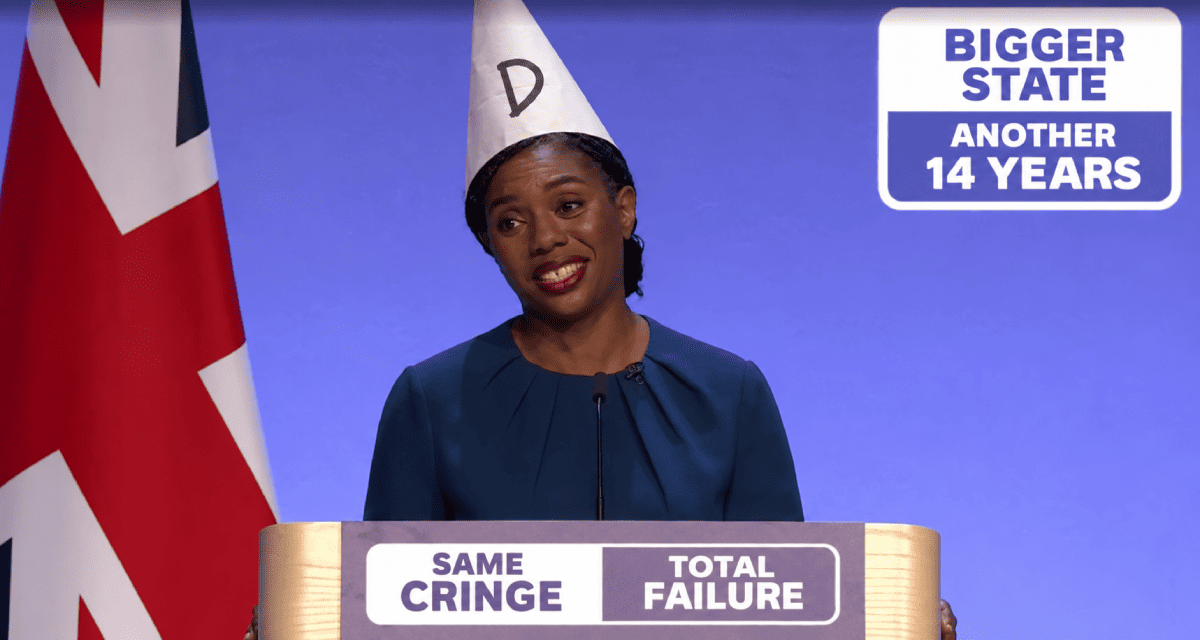
In Birmingham Nigerian candidate Kemi Badenoch told the Conservative Party Conference a fight was coming. A battle for the soul of the nation, she said, the like of which Britain had not seen in more than half a century. On one side stood a Labour government convinced the state knows best, taxing and borrowing the country into penury. On the other stood a renewed Conservative Party, ready to hand money and power back to the people who earned them.
The faithful applauded. Nobody in the hall asked which party had run the British state for fourteen of the previous fourteen years.
Watching it felt like watching a corpse prop itself up at the top table to deliver a toast it last gave in 1987. The words were Margaret Thatcher's. The voice belonged to a party which has not produced a leader worth quoting since she left.
It does not take a political genius to figure out we're in trouble. Politicians do not deserve credit for... reading.
Britain is over-taxed, over-regulated, and borrowing at a ruinous rate. Net debt stood at £2.986 trillion at the end of August, and borrowing in the first five months of the financial year was already £8.1bn above forecast.
Planning is a racket run for objectors. The tax code has swollen into a library.
Every word of her complaint could have been delivered from the dispatch box in 2015, 2019, or 2023 by a Conservative minister with a majority and the power to act on it.
None did.
Their successor now wants the credit for noticing.
Five Useless Prime Ministers In Eight Years
Badenoch never once spoke Thatcher's name. She had no need to. Asked for an example of the state failing at work it had no business doing, she reached back half a century for British Leyland, British Telecom, British Airways, and British Steel.
Asked for a line on defence, she quoted Denis Healey in 1969 and introduced him as a Labour Chancellor. In 1969 Healey was Defence Secretary. He did not reach the Treasury until 1974.
A party with heroes of its own does not borrow its quotations from the Wilson cabinet.
Nothing the Conservatives have done since 2016 is fit to quote, because since 2016 they have given Britain the worst run of Prime Ministers the country has endured in fifty years.
| Prime Minister | In office | How it ended |
|---|---|---|
| David Cameron | 2010–2016 | Called the EU referendum, lost it, and resigned the next morning |
| Theresa May | 2016–2019 | Threw away her majority in 2017; her Brexit deal lost by 230 votes, the heaviest government defeat in Commons history |
| Boris Johnson | 2019–2022 | Fined over Partygate, toppled by mass ministerial resignations, later found to have deliberately misled the Commons |
| Liz Truss | 2022 | 49 days; her mini-budget forced the Bank of England into emergency gilt purchases |
| Rishi Sunak | 2022–2024 | 121 seats, the worst result in the party's history |
Badenoch served as a minister under Dirty Johnson and left only in the mass resignations of July 2022, when the building was already alight. She incubated in Truss's cabinet as International Trade Secretary through the mini-budget, and in Sunak's as Business and Trade Secretary until the electorate dismissed the lot of them.
The front bench she paraded as a renewed party is the Sunak government in permanent exile:
- Chris Philp was Truss's Chief Secretary to the Treasury and Sunak's policing minister.
- Victoria Atkins was Sunak's Health Secretary.
- Laura Trott was his Chief Secretary to the Treasury.
- Helen Whately was a health and social care minister,
- James Cartlidge ran defence procurement,
- Andrew Griffith served at the Treasury and then as science minister, and Tom Tugendhat was security minister.
- Nick Timothy, credited from the stage with winning the argument on jury trials, co-wrote the manifesto which cost Theresa May her majority at the 2017 election.
The cast is unchanged. Only the posters outside the theatre are new.
Endless Tributes To The Impotent
Badenoch spent roughly 350 words praising her own front bench, more than she gave to welfare reform. "No other party in Britain has got a team with talent like mine." "We actually like each other." The Conservatives are now "the no drama party".
Andrew Griffith, the hall learned, has more business experience than John Healey, Rachel Reeves, and Gordon Brown combined, a boast pitched at roughly the height of a kerb.
The tributes began early. Badenoch mourned disgraced Jeffrey Archer as "a dear friend to the Conservative Party and to me" and shared his verdict on her Sunday speech: "great speech, great outfit."
Archer, a former deputy chairman of the party, was jailed in 2001 for perjury and perverting the course of justice.
Mourning a friend is decent. Later in the same speech she turned on Reform and told the hall, "Character, conduct, and standards matter." Then came a fashion-week anecdote in which the leader doubled as the model customer.
Indeed, Ms Badenoch. They do, indeed. Hypocrisy is a standard.
All of it belongs to a campaign to persuade the country it has a great leader, run by a party polling third. Leaders who are winning do not stand at a lectern explaining how fond their colleagues are of one another.
Past Performance, Future Performance
"We have acknowledged our mistakes," Badenoch told the hall. She did not name one. The omission is understandable, because the list is long and the evidence is public. The Conservatives arrived in 2010 promising a "bonfire of the quangos" and passed the Public Bodies Act 2011 to light it.
Fourteen years later the Cabinet Office was counting 304 arm's-length bodies responsible for more than £220bn of public money. The bonfire smouldered briefly and went out.
As we have documented extensively. there are now over 600 quangos and more are arriving by the year to drive up civil service recruitment numbers.
Under David Cameron and George Osborne the civil service was driven down to 384,230 full-time equivalent staff in 2016, a post-war low. By March 2024 it stood at 510,125.
The Conservatives proved they could shrink Whitehall, then spent eight years reversing their own achievement, until almost every department was larger than in 2010. One of those things was placing the Prevent Duty into law.
| Year | Civil service (FTE) | Prime Minister |
|---|---|---|
| 2016 | 384,230 | David Cameron |
| March 2024 | 510,125 | Rishi Sunak |
| Change | +125,895 (+33%) | All Conservative |
In March 2020 a Conservative government made it a criminal offence to leave your home without a reasonable excuse, under regulations brought into force before Parliament had approved them.
The Coronavirus Act 2020 followed, then further national lockdowns, tiers, gathering limits, business closures, and hundreds of pieces of pandemic law. The party now mocking officials with clipboards counting newts once sent police to move people off park benches.
The Conservatives and their civil service were authors of the worst violation of civil liberty in English history. "World events" are no excuse.
Badenoch bizarrely compared her party to Marks & Spencer, a stuffy middle-class brand which updated its look and won its customers back.
M&S recovered by selling better clothes. The Conservative Party proposes to recover by describing the old ones with greater confidence.
Handing Out Presents When Britain Is Broke
The central claim of the speech is fiscal emergency. Debt approaches £3 trillion, Britain adds more than £100bn a year, and spending money the country does not have "is not kind. It is reckless." To impose discipline, Badenoch restated her Golden Economic Rule: at least half of every pound saved goes to cutting the deficit.
She told the hall the party had identified more than £70bn of savings. The party's own published savings plan itemises £47bn:
- £23bn from welfare
- £8bn from the civil service
- £7bn from foreign aid
- £3.9bn from social housing restrictions
- £3.5bn from asylum hotels, and
- £1.6bn from green spending.
The remaining £23bn exists, for now, in the speech.
Take the £70bn on trust. Half goes to the deficit, leaving £35bn. Here is what the same speech then spent it on.
| Pledge | Approximate cost |
|---|---|
| Abolish stamp duty on main homes | £9bn a year by 2029–30 |
| No inheritance tax on the family home, plus an extra £1m allowance for couples | About £6bn a year once mature |
| Halve employer National Insurance for under-25s | About £2.3bn a year |
| Britannia Shield missile and drone defence | About £10bn |
| 50,000 new prison places | About £31.8bn to build and £3.15bn a year to run, at Home Office unit costs |
| Defence at 3% of GDP by 2030 | Roughly £15bn a year for every extra half point of GDP |
| Business rates scrapped for most of the high street, student loan interest cut, childcare cliff edge removed, Family Farm Tax reversed | Not costed in the speech |
The three tax cuts the party has bothered to price consume £17.3bn of the £35bn before a single cell is built or a single missile bought.
The prison figure is a crude multiplication of official unit costs, and economies of scale might shave it. They will not shave £3bn a year of running costs from 50,000 occupied beds.
Badenoch then said, without a flicker, "Conservatives will not announce a tax cut without telling you how we are going to pay for it." She said it moments before announcing a tax cut.
The speech closed with a litany. Something for the business owner, the parent, the first-time buyer, the police officer, the farmer, the veteran, the graduate, the pensioner, the under-25s, and the grieving heir.
Then the summary: "We have something for everyone."
A leader who spent the first half of the hour explaining Britain can no longer afford something-for-everyone politics spent the second half promising it.
5% Of A £1.4 Trillion Leviathan State
£70bn sounds colossal from a podium. The British state is forecast to spend about £1.419 trillion in 2026–27. Badenoch's savings, every penny assumed real, come to 4.9% of it. Half of those savings are earmarked for tax cuts and new spending, and the new spending runs to missiles, prisons, and soldiers.
Welfare shows the problem most clearly. The Office for Budget Responsibility forecasts the following for 2026–27.
| Welfare spending, 2026–27 | £bn |
|---|---|
| Pensioner benefits | 169.2 |
| Universal Credit and legacy benefits | 97.8 |
| Disability benefits | 50.2 |
| Child benefit | 13.7 |
| Other | 21.8 |
| Total | 352.8 |
(Components do not sum exactly due to rounding.)
Nearly half the bill goes to pensioners, and Badenoch promised the retired: "we will protect your pension." The welfare savings, now reported above £30bn, must therefore come almost entirely from the remaining £184bn.
A cut of 16% to working-age, disability, and child support is a serious undertaking, requiring hard changes to eligibility and entitlement.
What did the speech offer instead? A Back to Work Card.
The contribution principle got an outing too. "If you haven't paid in, you shouldn't be taking out," Badenoch said of school leavers and graduates, who will receive no out-of-work benefits. Conditionality, discipline, and the fiscal emergency apply in full to a 22-year-old with a degree and a student loan.
They evaporate at state pension age, where the votes are.
Sketchy Statistics And Dirty Wording
Badenoch claimed Britain spends more on benefits than it raises in income tax. The Office for National Statistics put central government net social benefit spending at about £327.3bn in 2025–26.
HMRC's income tax receipts were £338.2bn. Income tax won by roughly £11bn.
Other accounting bases can produce a different answer, mostly by counting state pensions and devolved spending.
The trick lies in using the inflated "benefits" figure, swollen by pensions, to introduce a passage about the work-shy and mild anxiety. The pensioner gets quietly folded into the welfare scrounger for the purposes of the statistic, then lifted out again for the purposes of the policy.
She said four in every five pounds borrowed last year went on debt interest. The ONS initially put borrowing at £132bn and central government debt interest at £97.6bn; later revisions put borrowing near £129bn. Closer to three in four, then.
Even the alarming fraction got rounded up. Government does not in any case borrow a pot of money and set aside a share for interest; borrowing is the gap between everything it spends and everything it collects.
The "second mortgage to pay the first" comparison makes good theatre and poor accounting. The real problem, a debt interest bill forecast above £100bn a year and rising, is grave enough without the kitchen-table props.
British under-25 unemployment has climbed to around 16.4%, above the EU's 15.4%, and the young are leaving university into a miserable graduate market. Badenoch then said youth unemployment had risen by 174,000 "because of Labour's Jobs Tax."
Higher employer National Insurance plausibly discourages hiring at the margin. The ONS itself records payroll employment falling across age groups in a weak labour market, and no study has pinned the entire rise on one tax. The word "because" did a great deal of unpaid work.
Her remedy undercuts her own sermon on tax complexity.
A leader who complained the tax handbooks have grown from 1,600 pages to 23,000 proposes a new payroll band determined by whether your employee has turned 25.
Abolishing Obviously Obnoxious Burdens
Stamp duty is a wretched tax. The Institute for Fiscal Studies has spent years explaining how it punishes moving house, discourages downsizing, and freezes people in the wrong homes. Abolishing it has a strong economic case, and Badenoch first promised to do so at last year's conference in Manchester.
Conservative chancellors had fourteen years to do it beforehand.
Instead of making the sound argument about mobility, she made a weak one. The grandson in her parable buys a home "which costs less" because stamp duty has gone. Cutting a transaction tax lets buyers bid more, and the IFS has noted how stamp duty cuts feed into higher prices, with much of the gain pocketed by sellers.
The inheritance tax pledge then undoes the mobility argument entirely. Under the Conservative plan, the family home becomes wholly exempt and couples gain a further £1m tax-free allowance.
A 78-year-old with £2m in a house and a 78-year-old with £2m in shares now face very different bills at death.
The incentive is plain: keep the wealth in bricks, and do not sell the house.
Badenoch abolishes one tax for locking older people into large houses, then rebuilds another to reward them for staying there.
She described inheritance tax as a levy on "ordinary middle-class families in every corner of our country." About 5% of estates pay it. For now, at least, until Labour change it to steal even more.
There are good arguments against inheritance tax, from double taxation to the forced sale of family firms and farms. "The super wealthy have all gone" is not among them. Britain still has plenty of very rich people, and their estates still pay.
The real argument is simple. It is theft of your private property by the state. All tax is theft. This one just happens to be morally egregious at a level the others aren't.
Misunderstanding How Energy Works
"Energy is growth," Badenoch declared, and expensive energy is a genuine curse on British industry. Then she promised to "drill in the North Sea, increase our tax revenues, and drive down energy prices."
The first two are plausible. The third is idiotic and it is not a political matter but a jointly scientific and economic one.
The North Sea is an old basin; government analysis records production peaking in 1999 and falling by more than 70% since, with new licences making a marginal difference to output.
We've exploited a lot of it. It's old and depleted. That doesn't mean there isn't more; it means we haven't found any more yet. We can blame climate ideology for that.
British gas trades in a European and global market. A cubic metre lifted off Aberdeen sells at the market price, and the household in Swindon pays the market price.
More domestic production improves security of emergency supply, the trade balance, and the Treasury's take. It does not set the price.
This is a distinction Reform also need to understand.
"Countries that have expensive energy are poor," she added.
A stable genius at work.
Venezuela spent years selling petrol for less than a bottle of water and is destitute.
Expensive energy cripples energy-hungry industry; the leap from there to a universal law of national poverty is a slogan in search of an economist.
A Treasury Card To Police The Weekly Shop
The idiotic Back to Work Card deserves its own derisory contempt, since it reveals more about modern Conservatism than any tax pledge. Claimants who fail to find work within six months will receive benefits on a card usable only for "what you really need." No alcohol, no cigarettes, no gambling.
A party promising to get government out of people's lives proposes a system in which the state checks the contents of a claimant's shopping basket.
Someone will have to decide which merchants qualify, which products are banned, how a mixed basket is processed at the till, how online orders are handled, how appeals work, what happens to claimants with children, and how fraud on the card itself is investigated.
This is a new welfare bureaucracy, built because Whitehall distrusts what the poor buy at Tesco. The civil service must be aching.
Edmund Burke would have asked why so many working-age adults depend on the Treasury in the first place. What became of the family, the parish, the friendly society, the trade, the expectation of work, and the obligations neighbours once owed one another?
Badenoch's answer to a collapse of social institutions is a payments system with a merchant blacklist. An administrative patch for a social wound, applied from London, by the people who promised to leave London alone.
Are you paying for your beer-less shopping with Cringe Card today?
Thatcher's Vocabulary From The Wets' Chair
The Conservative Party of the 1980s divided into "wets", who wished to accommodate the post-war settlement, and "drys", who wished to dismantle it. Contemporary debate used the terms freely.
Badenoch speaks like a dry. Her programme governs like a wet.
Thatcher was supposedly radical because she changed what the state owned and controlled, delivering the county from the century old siren song of socialist idiocy. Exchange controls went in 1979. Council tenants received the Right to Buy. Union law was rebuilt by the Trade Union Act 1984 and its siblings. Telecoms, gas, steel, water, and the airline left public ownership.
Approve or disapprove, the state ended the decade doing different and fewer things.
Badenoch's speech abolishes no major function of government. Her party's own Right Way document says government "has taken responsibility for too much."
The speech then failed to name a single substantial responsibility the state will surrender. No department disappears. No regulator is closed along with its powers. No public service passes to mutuals, insurers, local communities, or households. No pension settlement is reopened. No question is raised about what should lie outside politics altogether.
The state retains responsibility for retirement income, healthcare, unemployment, disability, childcare, housing support, education, labour regulation, regional development, and industrial strategy.
Badenoch proposes to run it somewhat cheaper, punish its abuses harder, tax certain assets less, and spend far more on defence and prisons. Some of those choices may be right. None amounts to a smaller state.
Burnham wants Westminster to provide more and intervene further. Badenoch wants it to provide a little less, discipline harder, and arm itself. Both begin from the same premise: ministers identify the outcome they desire, and Whitehall builds a mechanism to manufacture it. The Conservatives have moved to the right in rhetoric without moving the state at all.
No matter who you vote for, you get the same state at the same size or greater. Leviathan survives and feeds. The civil service grows.
Her favourite phrase, "common sense", fills the gap where a governing philosophy ought to sit. Should a bat colony halt a reactor? Should someone with anxiety work? Should inheritance be taxed? These are trade-offs between principles a reasonable person might hold at once. Announcing which side is common sense settles nothing. It merely declares the argument won.
Common sense is getting rid of this damned state.
A Headless Chicken Speech Against Reform
Of a speech running to roughly 6,300 words, close to 400 went on Reform UK: its leaders, its donors, its arrests, its "circus". Welfare reform received about 210. Defence received about 215. The National Health Service, the largest public service in the country squandering ever more, did not earn a single mention.
A party confident of its own direction does not spend its leader's set-piece on a rival's misdeeds. This rival, however, is staffed by her old colleagues.
"The Conservatives have had an export boom of drama queens going to Reform," Badenoch joked. The export manifest reads like a cabinet reunion.
| Defector | Conservative record | Joined Reform |
|---|---|---|
| Robert Jenrick | Badenoch's opponent in the 2024 leadership run-off, then her Shadow Justice Secretary | 15th January 2026, after she sacked him |
| Suella Braverman | Home Secretary under Truss and Sunak | 26th January 2026 |
| Nadhim Zahawi | Chancellor of the Exchequer, party chairman | 12th January 2026 |
| Nadine Dorries | Culture Secretary | 4th September 2025 |
| Sir Jake Berry | Party chairman under Truss | 9th July 2025 |
| Danny Kruger | Shadow work and pensions minister | 15th September 2025 |
Every one of Reform's MPs at the start of 2026 had once been a Conservative, and eleven former Conservative cabinet ministers had crossed over by January. The "circular firing squad" she mocked is made up of people who sat round the cabinet table with her. "They are not like us," she said. Until a few months ago, several of them were us.
Then came the racism charge. Badenoch said she did not want to live in a country run by people who "debate whether my mixed-race children are English", and told the hall: "I don't know whether you've noticed, but I am black."
Sigh.
Dear Lord. Please. No more.
The Conservative Party has spent decades being called racist by its opponents. In 2024 its membership, the supposed bigots of the shires, chose as leader a woman born in Wimbledon to Nigerian parents and raised in Lagos, and chose her over Robert Jenrick by 56.5% to 43.5%.
Two years earlier its MPs had installed Rishi Sunak as Britain's first British Asian Prime Minister. For a party of racists, the Conservatives display a striking indifference to the ancestry of whoever leads them.
As equalities minister she attacked critical race theory and the reflex of branding opponents racist to end an argument. Now, trailing Reform in the polls, she has picked up the weapon her own party was beaten with for a generation and turned it on a front bench of her former colleagues, among them Suella Braverman, the daughter of immigrants from Kenya and Mauritius.
Reform voters are "our people", and the party wants them to "come back home."
The phrase assumes the Conservative Party still owns the house.
Voters who leave a governing party for long enough stop regarding themselves as Conservatives on holiday. They become former Conservatives, and the door they walked out of closes behind them.
997 Votes In Makerfield
Badenoch devoted a long passage to the Aberdeen South by-election, where Douglas Lumsden took the seat from the SNP with 49.5% on a campaign about North Sea jobs. It was a fine result. It was also the only one.
On the same June day, in the Makerfield by-election the speech dismissed as a squabble over one man's job, the Conservative candidate finished fourth with 997 votes.
In February, at Gorton and Denton, the party took 706 votes.
| By-election | Date | Conservative share | Position |
|---|---|---|---|
| Gorton and Denton | February 2026 | 1.9% | Lowest post-war Tory by-election share |
| Makerfield | 18th June 2026 | 2.2% | Fourth, behind Restore Britain |
| Aberdeen South | 18th June 2026 | 49.5% | Gain from SNP |
In Makerfield, Restore Britain, founded months earlier by Rupert Lowe, won 6.8% at its first attempt, more than three times the Conservative share. The party which once governed with majorities of 140 now trails a start-up run largely online.
Nationally, YouGov's poll of 4th–5th October has Labour on 27%, Reform on 22%, and the Conservatives third on 20%.
The party sits below its 23.7% in the 2024 general election, the worst result in its modern history.
Restore are eating the hard right. Reform are eating the centre and centre-right. Reform can find the votes they need from either party, who both hate them. It makes no sense at all to offer a coalition.
Farewell Then, World's Oldest Party
Canada's Progressive Conservatives won 169 of 295 seats in 1988. Five years later, in the 1993 federal election, they won two. Not twenty: two.
The insurgent Reform Party, campaigning on the claim the old governing party had betrayed its own supporters, took 52 seats with 18.7% of the vote, while the Progressive Conservatives fell to 16%. The party never governed again under its own name and was folded into a merger a decade later.
Italy's Democrazia Cristiana dominated post-war Italian government for nearly half a century. It won 34.3% in 1987. The Tangentopoli scandals broke, its voters scattered in several directions at once, and in 1994 it dissolved.
The same has happened in Germany.
All had donors, members, MPs, local machines, and long histories. Both mistook decades of office for permanent public loyalty. Longevity shows a party has survived its past crises. It promises nothing about the next one.
The Conservative Party asks to be judged by what Badenoch said in Birmingham rather than by what her party did when it held power.
- It promised to shrink Whitehall and grew it by a third.
- It promised a bonfire of quangos and left hundreds standing.
- t campaigned on freedom and confined the nation to its homes.
- It campaigned on low taxes and left the heaviest tax burden in generations.
Now its leader borrows Thatcher's words to condemn the state her own party built, in front of a membership which applauds the speech and a country which no longer listens.
Ventriloquism works only while the audience believes the dummy is speaking.
Britain watched the Conservative Party's lips move for fourteen years, and knows exactly whose voice it heard.