£18.6 Billion, 12 Years, And 26,048 Breakdowns
Britain fills nearly two million potholes a year and the roads are still getting worse. The backlog has hit a record £18.62 billion. The state is not failing to fill holes. It is failing to maintain roads. And the cause is underground. It is all connected.
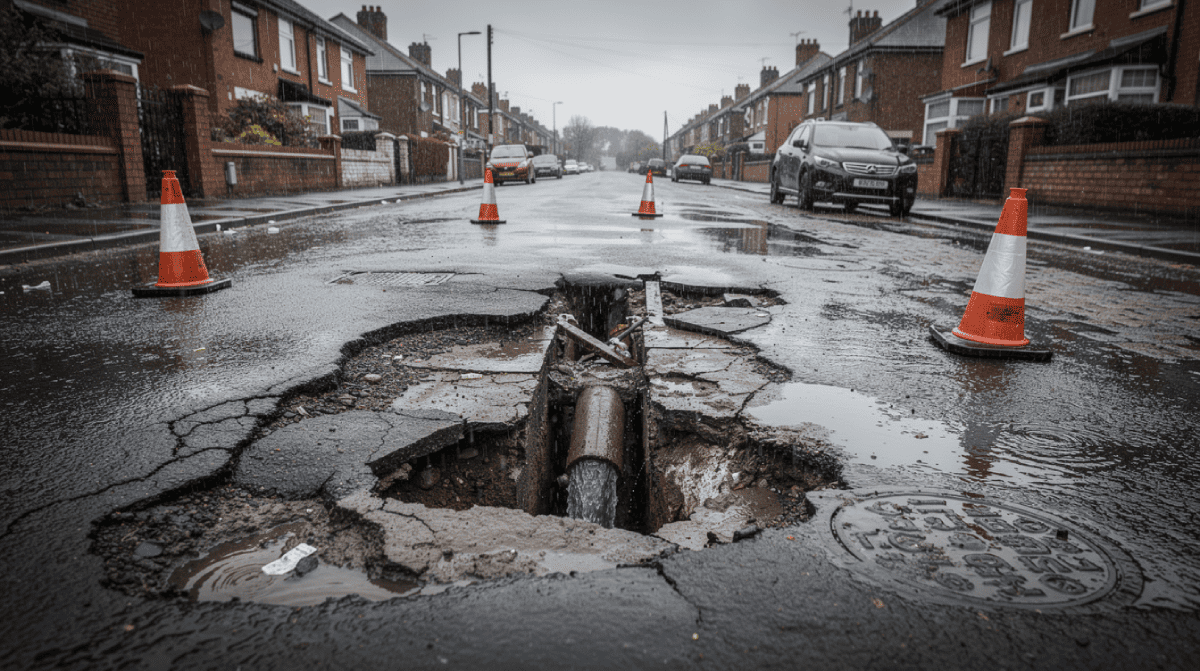
Britain’s roads, drains, water mains, sewers and utilities are not separate crises. They are layered on top of each other. The road fails because the water system fails. The water system fails because investment and maintenance were deferred. Repairs make more cuts in the road. Bad reinstatement weakens the surface. Councils then patch the visible damage while the underlying system keeps rotting. Let's start with the numbers, because they are grotesque.
The 2026 ALARM survey, published annually by the Asphalt Industry Alliance, puts the one-time catch-up cost for local roads in England and Wales at £18.62 billion. Up from £16.81 billion the year before. Up from £16.30 billion the year before. The average backlog is now approximately £91,100 per mile. Highway departments estimate it would take twelve years to clear the arrears, assuming adequate funding and resources, which they do not have and show no sign of acquiring.
The RAC estimates roughly six potholes per mile on council-controlled roads. Local authorities in England and Wales maintain approximately 183,000 miles of road, which is 98 per cent of the total network. Multiply the two and you arrive at something close to 1.1 million potholes at any given moment. In 2025, RAC patrols attended 26,048 breakdowns caused by damaged shock absorbers, broken suspension springs or distorted wheels. Up from 22,703 the year before. The roads are not improving. The roads are eating cars.
Councils in England and Wales filled around 1.9 million potholes in the previous year. The backlog still rose. Britain is patching at industrial scale and still losing ground.
The carriageway maintenance budget shortfall is £1.37 billion for 2025/26, up from £1.25 billion the previous year. The shortfall has roughly doubled since the late 2010s. Roads are now resurfaced on average once every 97 years.
Once every 97 years.
A road designed to last perhaps 20 to 25 years before it needs resurfacing is being asked to survive nearly a century on patches. The Romans managed better continuity of maintenance, and they had to do it while also running an empire.
The best data covers England and Wales, but the pattern is British: local roads are being patched faster than they are being renewed.
The Symptom Is Not The Disease
The public debate treats the pothole as the problem. It is not. The pothole is the corpse breaking the surface. The disease happened months or years earlier, underground, out of sight, and thoroughly ignored.
A road is not just tarmac. It is a sealed engineered structure: surface course, binder course, base, sub-base, drainage and foundation. The top layer exists to keep water out. Over time, bitumen oxidises and becomes brittle. Cracks form. Water enters. Traffic flexes the weakened layers. In winter, water freezes, expands, and breaks the road open from within. The visible pothole is the final stage of a failure chain the state chose not to interrupt.
The engineering sequence is simple: oxidised binder, cracking, water ingress, weakened base, traffic loading, surface collapse.
When councils send someone to fill the hole, they are repairing the symptom. The surrounding road may still be cracked, wet and structurally compromised. The patch fails. The crew returns. The money is spent again. The road continues to deteriorate. This is not maintenance. It is a very expensive way of watching an asset die.
The Local Government Association spells out the economics: surface treatments cost around £3.50 to £8 per square metre. Reactive pothole repairs can cost over £80 per repair. The state routinely chooses the cheaper annual option and the more expensive long-term outcome. This is the fiscal wisdom of a man who refuses to service his boiler because he can always call the emergency plumber.
For A Driver, A Repair Bill. For A Cyclist, A Collarbone.
For a motorist, a pothole is often a £500 repair bill and a ruined morning. For a cyclist or motorcyclist, it can be a broken collarbone, a head injury, or a fatal fall. A shallow depression invisible at speed, a puddle hiding a crater, a swerve into traffic to avoid a hole the council has known about for months.
This is why the pothole crisis is not cosmetic. It is a public safety failure being discussed as though it were a customer satisfaction issue.
The damage is not evenly distributed by vehicle count, either. A quiet lane used by heavy vans, buses, agricultural vehicles or construction traffic can be destroyed faster than a busy road carrying lighter cars. Axle load matters disproportionately. The school bus, the delivery van, the bin lorry and the construction truck all punch far above their weight.
Electric vehicles are heavier than their petrol equivalents, but the main killers of weak road surfaces remain freight, public transport and repeat commercial loading on structures already failing from within.
RAAC Concrete, But For Roads
The RAAC concrete scandal has a particular form. A construction material with known long-term weaknesses was installed widely, monitored badly, and left to decay until it became an emergency. The asset registers were poor. Maintenance was deferred. Ministers expressed surprise. The crisis had been entirely foreseeable, which is of course why nobody foresaw it.
The pothole crisis has the same characteristics, applied to a different surface.
Asphalt surfaces have known ageing, cracking and water-ingress risks. They were laid across a network of 183,000 miles over decades. The road structure fails beneath the surface before the pothole ever appears. Road-condition data is inconsistent and incomplete. Preventative resurfacing was deferred. The visible symptom, the pothole, is just the point where the hidden decay finally breaks through.
The difference is one of specificity. RAAC was a material scandal: one suspect product, identifiable in principle, whose failure mode was well understood. Potholes are an asset-management scandal with a technological core: not one defective material but a system of materials, water, traffic, cuts, weak inspection and chronic under-maintenance, all interacting.
The National Audit Office found in 2024 the Department for Transport did not have a sufficiently strong grasp of local-road condition or whether its funding was producing value for money. The department funds the system but cannot properly say what condition the asset is in, where the need is greatest, or whether its interventions work.
With RAAC, the state did not fully know where the risky material was, what condition it was in, or when it would fail. With roads, the state does not fully know the true condition of the local network, which interventions are working, where the worst hidden failures are, or whether funding is arresting decline.
The shared lesson is not bad concrete or bad asphalt. It is this: Britain has lost control of its asset register. Again.
Water Is The 3-Way Assassin
Roads can take enormous punishment when sealed and drained. They fail quickly when water enters the pavement layers. The political debate asks how many potholes the council filled. The engineering question is why water was allowed into the road in the first place.
Water attacks the road from above, from below, and from inside. The Restorationist reader will already connect these dots from this article:
 Daniel Cohen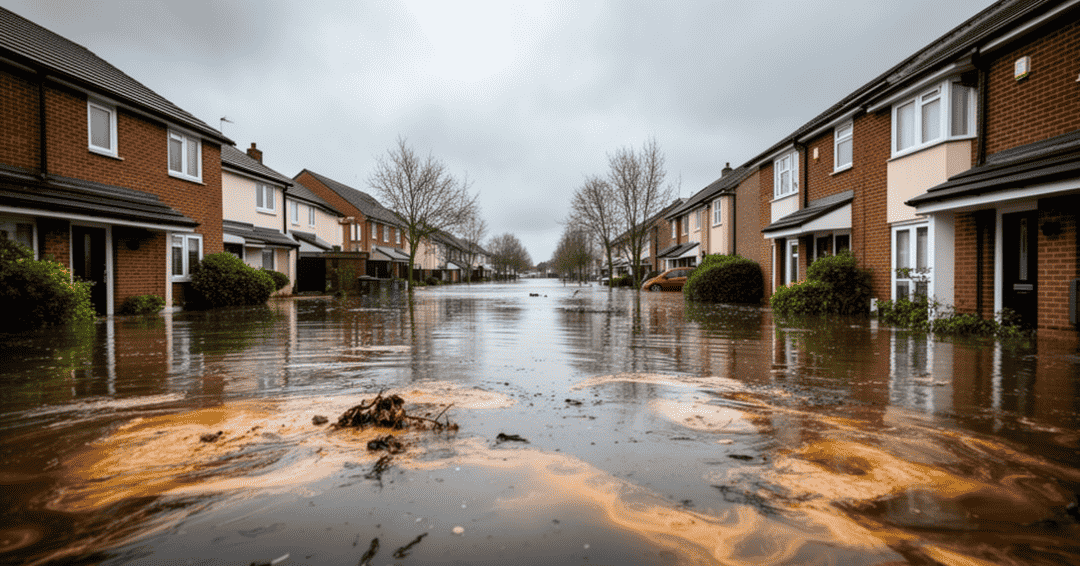
From above
Rain, flooding, blocked gullies, poor camber, failed kerbs, collapsed drains and overwhelmed surface-water systems all allow water to sit on the road instead of leaving it. Standing water finds cracks. Once inside, it weakens the structure. The Local Government Association is explicit: asphalt must be protected by removing water from the surface through highway drainage, and the surface must be sealed to prevent water entering the fabric of the road.
Ministers will blame rain. Ministers always blame rain. Rain is not a governance model.
Wetter winters and heavier downpours increase road failure, but bad weather does not create the maintenance backlog. It reveals it. A well-maintained road survives a wet winter. A neglected road does not. The variable is not the sky. It is the stewardship.
From below
Leaking water mains and sewers. UK Water Industry Research has noted leaks and bursts can damage highways. A technical paper on burst mains describes how even where a burst does not visibly damage the surface, it can cause subsurface cavitation, undermining the road several metres from the burst and later causing deformation. The visible road can look tolerable while the failure mechanism is already underneath it. This is precisely the RAAC pattern: the surface holds until it does not.
From inside:
Every utility trench, every fibre dig, every gas main repair is a cut through the waterproof surface. If reinstatement is poor, the seam opens, water enters, and freeze-thaw and traffic break the edge. The government recognised this in 2023 when it introduced a performance-based inspection regime for street works, specifically to make utility companies restore roads properly after works and prevent potholes forming.
The road is the battlefield on which every failed utility imposes its costs. And nobody sends the utility the bill for the road it helped destroy.
Privatisation Of Damage, Socialisation Of Repair
The water companies are already politically toxic over sewage spills, leakage, dividends, debt and underinvestment. But the road dimension adds another charge. Their networks are not only failing rivers and bills. In some places, their infrastructure is also helping destroy the roads above it.
A leaking main does not merely waste water. It can undermine streets, trigger works, require road cuts, damage surfaces, and add another scar to an already fragile highway. A fibre contractor digs a trench, reinstates it badly, and moves on. The road fails six months later. The public blames the council. The contractor is in the next county.
The system has many actors and no single steward.
- The road belongs to the council.
- The water main belongs to the water company.
- The telecoms trench belongs to the fibre contractor.
- The drain may involve the highway authority, the sewerage undertaker, the landowner or the developer.
- Funding comes partly from Whitehall.
- The public blames whoever filled the last hole badly.
Outsourcing did not create this crisis, but it makes the fog thicker. Once inspection, repair, resurfacing, street works, utility reinstatement and claims handling are spread across councils, contractors, subcontractors and utility companies, the road becomes nobody's single moral responsibility. Accountability is not divided. It has evaporated.
The same fragmentation appears on new housing estates: roads, drains, sewers, management companies, developers, water companies and councils can sit in a fog of contested ownership for years after the first residents move in. The public experiences one street. The system sees six asset owners, none of whom are entirely sure the problem is theirs.
The Legal Incentive To Be Defensible, Not Good
There is a telling detail buried in the Highways Act 1980. Section 58 provides councils with a statutory defence against pothole claims if they can demonstrate a reasonable inspection and maintenance system. The question before the court is not "was the road good?" It is "did the council have a defensible regime?"
In an action against a highway authority in respect of damage resulting from their failure to maintain a highway maintainable at the public expense it is a defence (without prejudice to any other defence or the application of the law relating to contributory negligence) to prove that the authority had taken such care as in all the circumstances was reasonably required to secure that the part of the highway to which the action relates was not dangerous for traffic.
This matters more than it sounds. A council can be bureaucratically protected while the road remains visibly appalling.
The incentive is to prove you inspected, not to prove you prevented. It is the difference between a hospital recording its waiting times and a hospital actually treating patients. One measures activity. The other measures care.
The entire pothole system runs on this distinction. Potholes filled. Inspections conducted. Funding announced. The road, meanwhile, continues to fall apart.
12 Funding Pots And No Plan
The Public Accounts Committee's 2025 report is devastating. The Department for Transport has shown too little interest in what its funding actually achieves. It has not set clear outcomes. It has not properly evaluated whether more than £1 billion a year in local road maintenance funding has improved road conditions.
How did the technocrats respond? In their lingua franca: the government now collects "maintenance ratings." It counts, but does not do.
Funding has been fragmented across twelve different pots, with different eligibility rules. Most is annual. Much is allocated on road length, bridges and lighting columns rather than actual road condition, traffic volume, flooding risk or wear and tear.
This creates exactly the wrong incentives. A council cannot sensibly plan long-term resurfacing if the money arrives in annual scraps, top-ups, pothole funds, competitive bids and ringfenced announcements. It can fill holes. It cannot restore the asset.
Britain has protected the roads with national branding and neglected the roads people actually live on. The strategic network gets longer-term, multi-year funding and more coherent management. The PAC explicitly notes this contrast. Local roads, where 98 per cent of all journeys begin and end, get short-termism and ministerial photo calls.
The government announced nearly £1.6 billion for local highways maintenance in 2025/26, including an extra £500 million. Set against an £18.62 billion backlog, this is a man with a bucket bailing a sinking ship and calling it a naval strategy.
In April 2026, ministers announced tougher rules: councils failing to show effective maintenance could lose around a third of next year's funding. Politically understandable. Practically absurd. Whitehall is threatening councils for symptoms produced by a funding and accountability model Whitehall itself created. The arsonist is now inspecting the ashes.
The Technology Exists, No-One Uses It
Surface preservation treatments exist. Drainage management is well understood. Machine-vision inspection using cameras, laser scanning and deep-learning models has been demonstrated for over two decades. Research systems can detect road-surface degradation before it becomes a pothole. Fleet-based mapping using vehicle-mounted sensors and phone data is already in trial.
A UK pothole-mapping app reportedly uses around 10,000 drivers and AI detection with claimed accuracy around 80 per cent. A perfect example of how British inventiveness emerging from the public is superior to anything Whitehall can produce.
Self-healing asphalt is under development. Leftist researchers at Swansea University and King's College London have developed a concept using plant spores filled with recycled oils: when cracks form and traffic compresses the road, the oils soften the bitumen and help microcracks heal before they open. Lab reports suggest cracks could heal within an hour and potentially extend road lifespan by up to 30 per cent. Net Zero may prove useful somehow after all.
None of this solves the existing backlog. But it demonstrates the gap between what is technically possible and what the British state actually does. The knowledge exists to see failure coming. The materials science exists to slow it down. The engineering exists to prevent it.
What Britain lacks is not asphalt. It lacks adults.
The Wrong Metric, The Wrong Target, The Wrong Incentive
The government and councils love counting potholes filled. This may be the single most misleading metric in British public administration, and the competition is stiff.
"Number of potholes filled" tells you:
- Nothing about whether the repairs lasted.
- Nothing about whether the same road was patched three times in eighteen months.
- Nothing about whether the surrounding surface is about to fail.
- Nothing about whether the drainage is working.
- Nothing about whether utility reinstatements are holding.
- Nothing about whether the road was resurfaced before the structure collapsed.
The right metrics would be:
- Percentage of roads with sealed surfaces;
- Average resurfacing cycle;
- Number of repeat defects at the same location;
- Repair survival rate after six, twelve and twenty-four months;
- Utility reinstatement failure rate;
- Drainage defect rate;
- Road-edge failure rate;
- Whole-life cost per road segment;
- Condition deterioration curve by authority.
The current system rewards visible activity: crews dispatched, holes filled, money announced. A serious system would reward avoided failure. Britain does not have a serious system. Britain has a press release.
This is the simple reason you do not allow civil servants to cosplay as civil engineers.
DfT's own 2025 road-condition statistics classify B and C roads as red, amber or green. They post on Facebook about it, because this is how Boomers receive news.
These are also mapped in ArcGIS.
But green roads have fallen from 66 per cent in 2022 to 61 per cent in 2025, while amber and red have increased. Even the official data shows deterioration. People do not drive on averages. They drive over the same failed junction every morning.
What A Serious Government Would Do
It is not mysterious. The engineering is understood. The economics are understood. The institutional design is understood. The only thing lacking is a government willing to be boring on purpose.
A serious roads policy would require:
- Multi-year local road funding, not annual pothole funds designed for headlines.
- Condition-based allocation, not crude formulas pegged to road length and lighting columns.
- Whole-life asset metrics, measuring repair survival and resurfacing cycles rather than holes filled.
- Mandatory repair warranties and repeat-defect tracking, so councils and contractors cannot count the same failing patch as three separate successes.
- Utility reinstatement bonds or penalties, so the companies cutting the road carry the future failure cost instead of leaving it on the public balance sheet, and
- National drainage and road-surface mapping tied to predictive maintenance, so the state knows what condition its assets are in before the assets tell it by collapsing.
Are you reading, Nigel?
The PAC already supports the funding critique. The NAO already supports the data critique. The engineering profession already supports the prevention critique. This is not a shortage of evidence. It is a shortage of political seriousness in the face of evidence the political class finds terminally dull.
The Deeper Cause Is Institutional
Five structural failures produce the crisis. As they do with every problem in different ways. This "mysterious" disaster is simply something our civil servants and politicians are unable to understand connects to every other system in the broader, collapsing system-of-systems.
Prevention lost to crisis repair
Roads need resurfacing, drainage, sealing and structural maintenance. Instead, Britain waits until the road fails, then sends someone with a bag of cold-lay and a prayer.
Austerity destroyed local government capacity
Councils must protect statutory services: adult social care, children's services, homelessness. Road maintenance is visible but politically squeezable until the surface collapses. Then it becomes an emergency, and emergencies always cost more.
The funding model is too short-term
Physical assets cannot be managed on annual scraps and ministerial photo opportunities. A road does not care about the electoral cycle.
Accountability is split
Councils own the roads. Whitehall controls the funding. Voters blame councils. Ministers blame councils. Utilities blame councils. Councils blame funding. Nobody owns the national outcome. Everybody owns a press statement.
Roads are carrying more punishment
Heavier vehicles, heavier electric cars, vans, buses, flooding, freeze-thaw, bad drainage and repeated utility works all accelerate deterioration. The roads were not built for this load. They were barely maintained for the last one.
£18.62 Billion Worth Of Memory Loss
Britain has approximately one million potholes at any given moment. It fills nearly two million a year. The backlog still rises. The resurfacing cycle has stretched to 97 years. The budget shortfall has doubled in under a decade. Councils are losing a war of attrition against their own roads, armed with cold-lay asphalt and annual funding scraped together from twelve competing pots, while the water grid leaks beneath the surface, the utility contractors cut and run, the drains back up, and Whitehall counts holes filled as though the number meant something.
The council patches the visible damage. The underlying rot continues. And the minister announces another pothole fund, as if the problem were a shortage of men with shovels rather than a state which has spent thirty years strip-mining its own infrastructure for short-term savings.
RAAC was the same disease in a different organ. A known material weakness, badly recorded, badly monitored, deferred until the ceiling began to fall. Potholes are the road version: known engineering vulnerabilities, primitive data, fragmented funding, no single owner, no serious metrics, and an entire political culture which would rather announce a repair programme than maintain the thing properly in the first place.
Britain did not get potholes because it forgot how to fill holes. It got potholes because it forgot how to look after roads, how to manage drains, how to hold utilities to account, how to fund prevention, how to measure what matters, and how to do the unglamorous, continuous, boring work of keeping a country from falling apart.
The pothole is not the scandal. The pothole is the receipt.