Why Every New Government Fails In A Fortnight
An election victory does not deliver the power to govern. Within a fortnight every new Prime Minister learns the spending is locked and the officials answer to nobody. A serious first week means four bills drafted in opposition, the permanent administration retired by statute, and a calm market.

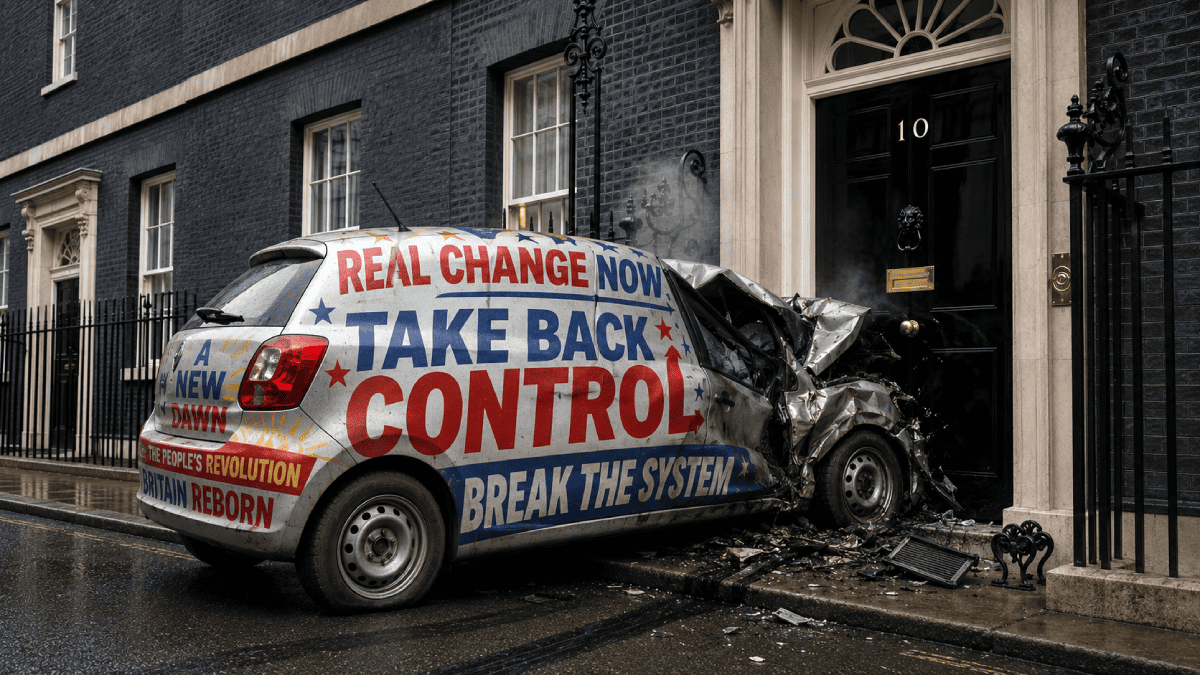
Every incoming Prime Minister walks into Downing Street believing it's time for "hope" and "change" under their new messianic soft-dictatorship. The belief survives roughly one to two weeks. After that comes the education, which never varies. This is repeated into the hypotheticals laid out in the Cardswell Plan. Two facts arrive within days of taking office after the four letters of last resort, and both are engineered to break the will of anyone who imagined a mandate meant anything.
The first fact concerns money.
A vast share of public expenditure is no longer meaningfully discretionary in the hands of an incoming government. Statutory entitlements, service duties, contracts, accrued rights, standing grants, and operational dependencies place prior claims upon the annual supply Parliament votes. The Chancellor can move at the edges. The great mass of it arrives already spoken for.
The second fact concerns people.
Those who run the departments are not the ministers. They are permanent, numerous, hold the institutional knowledge, and they will still be at their desks long after the minister has been reshuffled into obscurity.
A new leader therefore discovers there is almost no headroom.
The spending is locked, the machine is staffed by people who did not vote for the programme and feel no obligation to deliver it, and any attempt at rapid change triggers a mixture of judicial review, union resistance, with a chorus of officials explaining why the lawful thing is somehow unlawful.
The leader learns to make announcements instead. Announcements are free. Announcements change nothing, which is exactly why the system tolerates them.
What follows is what a serious first week would actually look like. Not a manifesto. Not a five-year plan. The narrow set of legal and administrative moves required before any other promise becomes deliverable. A government which fails to make them in week one will spend its entire term discovering it cannot do anything else.
The premise is unforgiving, and it is correct: the opening days are not about implementing policies. They are about making Britain governable, which is a different and prior task, and the one every recent government has walked straight past.
Before one can switch off immigration, repeal Net Zero, rip up the Marxism Act, or disapply domestic interpretation of the EHCR, one must take first control of the money and the people. These other sensible measures come in week two.
There are at least four serious problems which need to be dealt with before attempting anything else, even emergency work: duties written into law; obstruction by unrotated civil servants; judicial review at the supreme court; and inherited programs.
4 Constraints Which Cripple New Governments
An incoming administration inherits four distinct forms of administrative internal restraint, and understanding them separately is the beginning of wisdom.
- Statutory duties compel expenditure or particular outcomes.
- Administrative institutions are capable of obstructing, diluting, or indefinitely delaying ministers.
- Courts and international obligations can convert a policy disagreement into a legal injunction.
- And contracts, grants, payroll, and benefit entitlements continue spending automatically even after the policy has supposedly changed.
Immigration, prisons, and defence are immediate emergencies, but the deeper first-week work is duller and more important: ensuring ministers actually possess the legal, financial, and administrative power to deal with any of it.
"Statutory spending" is not a single legal category.
Some statutes create individual entitlements. Some impose duties on public bodies. Some prescribe processes. Others merely authorise expenditure. A duty does not always determine how much must be spent.
Take the raw numbers facing a Chancellor on the morning of day one. Debt interest alone was forecast at roughly £111 billion for 2025-26. Health and disability benefits ran close to £99 billion. Around £688.5 billion of the debt portfolio, a quarter of it, was index-linked, giving inflation a direct and rapid route into public expenditure.
Layered on top are thousands of duties requiring public bodies to provide, secure, promote, or fund some service, each enforceable, each indifferent to whether the money exists.
Then there is the procedural state.
Britain is governed by thousands of obligations to "have regard to" something: equality assessments, environmental assessments, consultation, impact assessments, safeguarding processes, the balancing of endlessly competing objectives. Individually each looks modest.
These all need to be removed, repealed, transformed, and frankly, burned with fire.
Collectively they make decisive government almost impossible, because every decision can be challenged for failing to have sufficiently regarded one of them. The result is a state which cannot easily stop spending and cannot move quickly, run by a minister elected to do both.
Emergency Powers Are the Wrong Instinct
The obvious response is to grab the wheel. Grant ministers sweeping emergency authority, suspend the rules, rule by decree until the crisis passes. This is wrong, because it is the reason nearly every reforming impulse in British government has failed.
Taking emergency powers recreates the very disease it claims to cure. The Defence of the Realm Act made everything subject to state direction. A modern equivalent would simply transfer the machinery of compulsion from the permanent officials to the new ministers, leaving the machinery fully intact and waiting for the next occupant to inherit.
The governing principle therefore runs the opposite way to instinct.
- Stop the state compelling expenditure.
- Stop administrative bodies exercising power independently of ministers.
- Stop courts reconstructing repealed policies through interpretation.
- Stop government making promises which bind its successors.
The test applied to every single measure is one question: does this remove a compulsory claim upon money, conduct, or government attention?
If a measure merely shifts control from one public body to another, it has failed and should be discarded.
A release of state power, rather than a seizure of it, is the entire argument. A government which grasps it produces a constitutional correction. A government which does not produces the same administrative state under new management, which is to say it produces nothing at all.
A 4-Bill Opening Package For Day One
Everything depends on the legislation being complete before the government takes office. A hostile civil service can stall a bill for months simply by claiming it cannot be drafted in time, and it will.
The answer is to arrive on day one with the drafts finished, the explanatory notes written, and an external team of parliamentary counsel already retained and working alongside the Office of Parliamentary Counsel.
The opening package should consist of four narrow bills, each directed at a separate structural constraint. This matters both constitutionally and practically. A single State Reconstruction Bill would invite months of amendment, allow the defeat of one controversial provision to obstruct the whole programme, and make it harder for Parliament and the markets to distinguish fiscal protection from administrative reform.
Four bills make the sequence legible: secure the state’s credit and immediate operations, recover control over expenditure, replace the permanent administrative command, and then dismantle the wider public-body apparatus.
Bill One: Sovereign Debt and Emergency Supply
The first bill guarantees every existing gilt strictly according to its terms, gives principal and interest first call on the Consolidated Fund, and provides the temporary supply necessary to keep essential government operations running. It expressly prohibits compulsory exchanges, retrospective alteration of indexation, selective taxation of existing bondholders, capital controls, and any direction requiring pension funds or banks to purchase government debt.
The bill also authorises a short emergency supply period covering debt service, existing pensions and benefits, defence, prisons, borders, tax collection, urgent healthcare and other named continuity functions. It freezes new discretionary commitments and requires verified savings to reduce the net financing requirement before they finance tax reductions or new programmes. Its purpose is to tell creditors and the public the government will challenge inherited political promises while honouring its actual financial and contractual obligations without qualification.
Bill Two: Statutory Duties and Public Expenditure
The second bill restores annual parliamentary control over public expenditure. It converts inherited statutory duties to provide, secure, promote, facilitate or fund services into discretionary powers, except for a narrow schedule of obligations Parliament expressly preserves. The exercise of those powers becomes subject to the money appropriated for the relevant financial year.
The bill prevents previous expenditure, policy guidance, established practice or legitimate expectation from creating an entitlement to future funding. It prohibits courts from prescribing a minimum level of expenditure and provides that a public authority has discharged a cash-limited duty once the appropriated funds have been lawfully spent.
Debt service, accrued pensions, final court judgments, existing contractual rights and essential continuity functions remain protected.
Everything else must return to Parliament each year and justify its claim upon public money.
Bill Three: Senior Offices Abolition and Continuity
The third bill removes the permanent administrative command structure without interrupting the state’s essential transactions. It abolishes the offices of Permanent Secretary, Director General, Director and Deputy Director by operation of law, together with designated Grade 6 policy, strategy and corporate-management offices. Because Parliament abolishes the offices themselves, termination is not a collection of individual disciplinary or redundancy decisions.
The bill preserves accrued pay and pension rights, defines compensation as the exclusive remedy, extinguishes existing delegations and prevents abolished offices from being recreated under different names. At the instant of commencement, fixed-term departmental executives receive new statutory commissions and operational custodians acquire narrowly defined authority to maintain payments, records, safety and essential services. No employee, function, contract or budget transfers automatically. Only functions expressly listed in a continuity schedule survive.
Bill Four: Public Bodies and Legal Finality
The fourth bill dismantles the wider administrative state. It abolishes the worst scheduled arm’s-length bodies, executive agencies and regulatory structures, extinguishing their functions unless Parliament or the bill expressly assigns a necessary function to a named destination. Each abolition is accompanied by schedules identifying functions terminated, functions preserved, assets and liabilities transferred, and staff temporarily retained. This prevents a quango from disappearing in name while reappearing intact as a departmental directorate or successor authority.
The bill also protects Parliament’s repeals from administrative and judicial reconstruction. Guidance issued by an abolished body loses legal effect; previous practice creates no legitimate expectation of continuation; another enactment cannot be interpreted to revive substantially the same function; and courts cannot compel unappropriated expenditure or restore an abolished programme through interim relief.
Judicial protection remains available against unlawful detention, seizure, punishment and interference with private rights.
What ends is the ability to transform a procedural defect or general policy disagreement into an order requiring the state to continue spending, regulating or administering.
Together, the four bills follow a deliberate order.
- The first secures credit and continuity.
- The second recovers control of money.
- The third transfers executive authority.
- The fourth extinguishes the institutions and functions which should not survive.
None grants a general emergency power, and none leaves the government dependent upon the machinery it intends to abolish.
The Financial Beating Heart
Bill Two is the financial constitution of the new government, and its central provision is deliberately brutal in its simplicity:
No enactment shall be construed as requiring the expenditure of public money unless the expenditure has been expressly appropriated by Parliament for that purpose for the relevant financial year.
Then the reversal:
A duty imposed upon a public authority to provide, secure, promote, facilitate or fund any service shall be construed as a power, except where that duty is expressly preserved in Schedule 1.
This inverts the presumption which has governed Britain for a century.
Rather than identifying and repealing several thousand duties one at a time, an impossible task, Parliament lists the limited set it intends to preserve, and everything unlisted becomes discretionary.
The preserved schedule would begin narrow:
- Principal and interest on public debt,
- Accrued pension rights,
- Compliance with final court judgments concerning existing private rights,
- Police protection against immediate threats,
- Core criminal justice,
- Defence of the realm,
- Essential public-health containment, and
- Obligations under contracts already lawfully executed.
Reinforcement clauses do the genuine work, because without them the courts would rebuild every abolished duty through interpretation within a year:
No judicial reconstruction
No duty converted into a power may be revived or inferred by reference to legitimate expectation, previous practice, published policy, statutory purpose, international law, or retained guidance. This blocks a judge deciding although Parliament removed the express duty, the same duty somehow survives implicitly.
No minimum expenditure inferred
No court or tribunal may determine the amount, minimum level, or distribution of expenditure necessary to exercise a discretionary power.
Appropriation creates no entitlement
Previous expenditure of public money does not create any entitlement to its future appropriation.
No compensation for withdrawal
Discontinuing a discretionary programme, grant, or service does not of itself give rise to compensation or damages.
Functions lapse rather than migrate
Where a body or programme is abolished, its functions cease unless another enactment expressly assigns each one to a named recipient. This kills the standard Whitehall manoeuvre: abolish the body, transfer all staff and functions into a new directorate, and announce a saving which never materialises.
Cash limitation
A public authority's duty is satisfied once the funds appropriated for the purpose have been lawfully spent. This is structurally decisive for local government, because a council can no longer be ordered by a court to provide an unlimited service from money it does not have.
Making Repeal Final
Bill Four exists because Bill Two will be attacked in court within hours. A distinction must be understood clearly. The UK Supreme Court generally cannot strike down a Westminster Act as unconstitutional.
The real danger is subtler and more effective:
- courts interpret legislation against its intended effect,
- invalidate the ministerial actions taken under it,
- issue interim orders freezing implementation,
- find consultation requirements went unmet, or
- allow well-funded organisations to bring repeated test cases designed to exhaust the government rather than win any single one.
The answer is not to hand ministers unlimited power. It is to make Parliament's repeals legally final.
Each major repeal carries a direct-effect clause stating it has effect notwithstanding any rule of domestic or international law, convention right, common-law principle, or rule of interpretation to the contrary.
A general interpretive rule provides where Parliament expressly abolishes or converts a public function, no court shall interpret another enactment so as to preserve substantially the same function.
Standing is restricted to a natural or legal person whose existing liberty, property, contractual right, or personal legal status is directly and materially affected. This excludes the campaigning organisations which dislike a policy but have suffered no injury whatever.
Disagreement with the purpose, merits, proportionality, or evidential basis of an Act is declared not to constitute grounds for review.
A decision cannot be quashed for a failure to consult or have regard to some matter unless the claimant proves deliberate bad faith and direct material injury, which neutralises most of the machinery built around impact assessments and "due regard" duties.
For designated structural legislation the remedies are stripped back: no interim injunction, no suspension order, no mandatory order compelling expenditure, declarations only where genuine ambiguity exists, an expedited appeal directly to the Supreme Court, and a strict time limit of perhaps fourteen days to bring any challenge.
The dividing line is liberal and deliberate. Courts retain full power to protect a person against unlawful coercion, detention, seizure, or punishment. They lose the power to compel the state to keep spending, regulating, or administering. Judicial protection against state action stays strong.
Judicial compulsion of state action becomes extremely narrow.
The Day One Stop-Right-Now List
Legislation converts the duties into choices. The next move is to actually exercise the choice, and the exercise is not "review", "reform", or "improve efficiency". It is a flat refusal from the first morning: no new applications, contracts, awards, phases, grants, or commitments from today. Existing claimants, contracts, and construction sites unwind lawfully over time. The liability simply stops growing from this moment.
Three columns of saving must be kept rigorously separate, because conflating them is precisely how governments deceive themselves and the markets. Immediate cash saved this year is one thing. Recurring annual saving once commitments unwind is another. Avoided future expenditure is a third.
HS2's remaining tens of billions are avoided future capital, not a cut to this year's deficit, and any Chancellor who counts them as the latter has told the gilt market a lie it will punish.
The major refusals, each defensible on its own terms.
No new health and disability awards under the existing tests
Two related but distinct systems are in play, and blurring them is a common error. Personal Independence Payment concerns the extra costs of disability, is not means-tested, and can be paid to people in work; its expenditure alone is forecast to exceed £41 billion by 2030-31.
The Universal Credit health element and its limited-capability-for-work category concern work capability and conditionality; at September 2025, 2.5 million people (77 per cent of caseload) were classified as not normally required to prepare for work at all.
The day-one rule applies a functional test to each, differently:
- no award made merely because a person holds a diagnosis,
- a severe functional-impairment threshold for new claimants, and
- short-interval reassessment for the young.
ADHD, autism, anxiety, and depression can be genuinely disabling. A diagnosis is not proof someone requires a potentially long-running, non-means-tested cash entitlement.
No further HS2 construction commitments
The line is now projected to open somewhere between 2040 and 2043. No new contract, variation, or land acquisition without personal Treasury authorisation, a seven-day inventory of termination clauses, and the separation of the route into sections capable of sale, conventional use, or abandonment. Sunk cost is irrelevant. Finishing at any price because construction has started is exactly as irrational as ignoring the marginal completion cost. It ends immediately.
No new net-zero subsidies
The Warm Homes Plan committed £13.2 billion across the spending period; carbon capture was allocated £9.4 billion. Repealing the statutory target does not stop the spending. Each grant, loan, and price guarantee must be closed individually: no new heat-pump subsidy applications, no new carbon-capture clusters, no further capitalisation of Great British Energy, honouring only work already irreversibly contracted.
No asylum hotels at full-price contract
Roughly 30,657 people sat in around 200 hotels last December at an average Home Office cost of £53,000 per person per year. The saving comes from reducing the supported population through rapid decisions and removals, not from finding a marginally cheaper hotel.
No new consultants
...beyond named technical exceptions in engineering, medicine, litigation, audit, and cybersecurity. Strategy, transformation, communications, culture, behavioural science, and inclusion engagements terminate. The government's own figures put halving consultancy spend at over £700 million a year, but the greater value is stopping consultants manufacturing further programmes to spend on.
No grants to campaigning, lobbying, or behavioural organisations
.... ending the circular process by which government funds organisations to demand government spend more.
Assembled honestly, before overlap and implementation costs, the picture looks like so:
| Area | Steady-state annual saving | Avoided future commitment |
|---|---|---|
| Health and disability benefit reform | £10-20bn | Very large long-term |
| Civil service and public bodies | £7-12bn | Pension and property liabilities |
| Overseas aid beyond humanitarian core | £5-8bn | none |
| Industrial, housing and discretionary grants | £5-10bn | £10bn+ guarantees |
| Net-zero subsidies | £4-7bn | £20-30bn |
| Rail and major-project cancellations | £4-9bn | £30-50bn (HS2 net) |
| NHS administration | £3-6bn | none |
| Asylum support | £3-4bn | Additional future liabilities |
| IT, consultancy and transformation | £3-5bn | £5-15bn |
| Entitlement expansions | £2-5bn | Growing recurring cost |
| Gross range before overlap | £46-86bn | £90bn+ potential |
Honesty about the total is what makes the rest of the argument survivable. The measures identified here produce a gross range of roughly £46 to £86 billion a year before overlap, implementation costs, and behavioural effects.
The overlaps are real and must be admitted:
- Civil-service reductions overlap NHS administration,
- IT and consultancy overlap departmental running costs,
- Homes England overlaps housing grants,
- Net-zero bodies overlap net-zero programmes,
- HS2's savings are temporary capital rather than permanent recurring cuts, and
- Defence administrative savings may be reinvested in capability rather than returned to the Treasury.
Netted down, the credible recurring figure is lower than the gross headline, and any politician who quotes the top of the range as though it were bankable is repeating the 2022 mistake in slow motion.
Reaching a genuine £100 billion net therefore requires a second tier of reform which the opening week only makes possible: pensions and the triple lock, NHS financing and eligibility, adult social care, local-government service duties, public-sector pay and headcount, and the remaining structure of working-age welfare.
The visible absurdities produce the opening savings and establish seriousness. The enormous automatic machines produce the rest, and they cannot be touched until the statutory-discretion Act has made them discretionary.
The stop list buys the credibility. The financial constitution buys the capacity. They are two separate achievements and should never be presented as one.
What Must Not Be Allowed to Fail
An obvious objection arrives the moment duties become discretionary and institutions begin to close. What happens to the people depending on the systems while they are being replaced? A government which cannot answer that has not designed a reform; it has designed a collapse.
The doctrine is straightforward.
Remove the compulsory claim, but preserve the function whose interruption would cause immediate harm, under a temporary measure with a defined expiry.
Several systems would fail physically rather than merely deteriorate if their statutory machinery were removed without a holding measure. Each needs continuity legislation which preserves the narrow essential function, imposes a hard cash ceiling, and expires automatically when a measurable failure condition ends.
| System | Immediate danger | Temporary continuity measure |
|---|---|---|
| Prisons and courts | No cells; collapsed trials; offenders released | Modular custody on public land; emergency and weekend court sittings; sentencing triage toward violent and sexual crime |
| Small boats and asylum | Continuing arrivals create irreversible claims | Basic processing accommodation; rapid single-stage determination; interception only under a lawful return arrangement |
| Local government | Section 114 insolvency while duties continue | Statutory cash limits; an orderly municipal insolvency procedure; creditors bear losses |
| NHS acute care | Emergency and urgent capacity consumed by queues | Ring-fence emergency, maternity, cancer and intensive care; buy existing capacity at a published tariff |
| Hospital discharge | Beds blocked by patients who cannot leave | Temporary convalescent facilities; direct payments to families who take relatives home |
| Energy | Blackouts if dispatchable capacity closes early | Preservation order on functioning generation; secured fuel and transformer stocks |
| Defence | Depleted munitions; weak homeland defence | Immediate replenishment orders on existing designs; counter-drone and air defence around critical sites |
| Critical digital and water | Single-supplier failure disables essential services | Tested offline procedures; manual payment and continuity plans; operational, not corporate, continuity |
The prison and court chain deserves particular emphasis, because a shortage at any point pushes pressure backwards through the whole system: no cells means altered sentencing and early release, court delays lengthen remand, and prosecutorial delay wastes police time.
Modular custody on existing prison and military land (austere but safe and subject to ordinary judicial authority) buys the time to simplify sentencing. Prison is reserved immediately for violence, sexual offences, serious theft, weapons, and persistent offending; non-violent offences move to immediate fines, seizure, curfews, and compulsory work, because a punishment delivered next week is more credible than a severe sentence imposed in two years and then cut because there is nowhere to put the offender.
The formula throughout is the same.
- Preserve the function, not the institution.
- Protect the person, not the provider.
- Maintain continuity, not the existing model.
That is what allows prisons to keep dangerous people confined without preserving the justice bureaucracy, and urgent patients to be treated without treating the entire NHS structure as untouchable.
Quangos: Sensible Total Abolition
The nearly £400 billion which flows through arm's-length bodies is routinely misdescribed as £400 billion of quango administration. It is nothing of the sort. Most is programme throughput.
NHS England's accounts show roughly £189 billion of cash operating expenditure, but the overwhelming majority was money passed straight through to hospitals and primary care. Abolishing NHS England does not abolish medical treatment.
The useful decomposition is four-way: administration, programme distribution, operational services, and grants. Each demands different treatment:
- Administration is eliminated.
- Distribution is replaced with direct formula payments.
- Operations are transferred, mutualised, or contracted.
- Grants raise the separate question of whether the underlying activity should continue at all.
The government's own analysis notes the largest ten arm's-length bodies account for around 90 per cent of the funding.
Obviously all of these organisations need to go. But not in the first week.
The fiscal target is therefore not three hundred obscure boards. It is a handful of enormous funding and infrastructure bodies. Every abolition clause carries four schedules, and anything not named in one of them ceases: functions extinguished, functions transferred, assets and liabilities transferred, and staff expressly retained.
This reverses the traditional Public Bodies Act model under which a minister closes an organisation and quietly transfers substantially everything to a successor.
| Body | Treatment | Replacement mechanism |
|---|---|---|
| NHS England | Abolish | Automated payment clearinghouse; small specialist purchasing office; minimal mandatory dataset |
| Integrated Care Boards | Abolish | Provider allocations continue mechanically, then move to direct activity and capitation payment |
| Care Quality Commission | Abolish present form | Narrow safety inspectorate; accredited private inspectors liable for negligent certification |
| NICE | Reduce to formulary | Small commission deciding only what the public schedule pays for |
| Defence Equipment & Support | Abolish | Navy, Army, Air and Strategic acquisition commands owning requirement and budget |
| Submarine Delivery Agency | Fold into Royal Navy | Naval Nuclear and Submarine Command under the First Sea Lord |
| Homes England | Abolish | Public land auctioned with development rights; loan book run off and sold |
| Office for Students | Abolish | Published outcome data; competing accreditors; student-transfer insolvency procedure |
| Ofsted | Abolish present form | Accredited inspectors; published attainment and safeguarding facts; no single-word judgment |
| Natural England | Abolish | Protected boundaries fixed in statute; compensation for genuine takings; no standing planning veto |
Abolishing a body on Friday must not imply its entire payment system changes on Monday. The move from Integrated Care Boards to direct provider payment runs in three stages, not one. Existing allocations continue mechanically for perhaps ninety days. Direct activity and capitation payments follow as the intermediate settlement.
The permanent model, whatever mixture of insurance and mutual provision is eventually chosen, comes later and separately.
The same staging governs private CQC inspection and competing school accreditors, none of which can appear spontaneously; each needs accreditation, liability, and data rules legislated before it can operate. The destination may be right. The transition still has to be built.
Defence illustrates a classification trap worth naming.
The formally classified Ministry of Defence arm's-length bodies accounted for only around £239 million of resource spending. The real bureaucracies (Defence Equipment and Support, the Submarine Delivery Agency, the Defence Infrastructure Organisation), are executive agencies rather than conventional quangos. Fold them back into the services.
The Atomic Weapons Establishment is a genuine industrial operation and cannot be "abolished" in any ordinary sense; its corporate governance disappears while its nuclear engineering plainly does not.
Some bodies must survive in the interim because their operational core is expensive to recreate and irreplaceable:
- The UK Health Security Agency's reference laboratories and disease surveillance,
- NHS Blood and Transplant's physical logistics,
- The NHS Business Services Authority as the temporary payment utility onto which the abolished planning bodies can be landed.
Independent adjudication is not the same as independent policymaking. A tribunal deciding a dispute may need insulation from ministers. A regulator setting national social or economic policy does not.
Clinical Negligence and the Maternity Provision
One neglected cost deserves its own attention. NHS Resolution reported clinical-negligence payments of £3.24 billion for 2025-26, with future claims provisions of roughly £60.26 billion. £34.7 billion, some 58 per cent, related to maternity alone. Abolishing NHS Resolution extinguishes none of this, because injured claimants hold legal rights and many settlements run for a lifetime.
The correct move is a split:
- A Legacy Liabilities Office running off existing claims to extinction, and
- A prospective Future Medical Injury Scheme replacing open-ended litigation with:
- Rapid no-fault provision for catastrophic birth injury,
- Lifetime care rather than a cash award calculated to buy private care,
- Scheduled compensation, and
- Fixed legal costs.
Because maternity dominates the provision, the largest fiscal effect comes not from sacking administrators but from safer obstetric staffing. A £100 million improvement in maternity safety is economically rational if it prevents several billion in future liability.
Non-Medical NHS Hiring
A blanket attack on "non-clinical staff" is inaccurate and self-defeating, because the category includes the receptionists, ward clerks, porters, cleaners, and IT staff without whom no clinician can work.
The honest test is whether a role directly enables a patient episode, operates a physical facility, processes payment, maintains a clinical record, or protects immediate safety.
Recruitment freezes on day one across strategy, transformation, communications, equality and inclusion, organisational development, behavioural science, and stakeholder engagement, with those vacancies abolished automatically.
Booking clerks, coders, pharmacy support, and estates engineers are retained. A defensible programme removes most NHS England and Integrated Care Board policy staff and a meaningful share of trust managerial cost, not the fantasy figure obtained by pretending every porter is disposable.
Firing The Senior Civil Service
Assume the permanent administration resists with everything it has. Assume coordinated legal challenge, union action, selective leaks, warnings essential systems are about to collapse, and a great deal of briefing to sympathetic journalists.
Gradual reform is self-defeating against this, because the incumbents would control recruitment, define which functions are "essential", write the implementation plans, select their own replacement structures, and wait for the minister to lose interest and be reshuffled.
The senior chain must go together.
The dismissal cannot take the form of thousands of individual ministerial decisions, because each one is then challengeable through employment tribunals, judicial review, injunctions, and consultation requirements.
It must be the direct legal consequence of an Act. Parliament abolishes the offices.
Ministers do not dismiss the incumbents.
This greatly narrows what a court can review and, critically, prevents litigation from suspending the transition. It does not eliminate legal contest: challenges will still test whether:
- A person falls within the scheduled class;
- Commencement was correct;
- Compensation was properly calculated;
- Replacement appointments are valid;
- Any particular ouster clause covers the claim advanced.
Courts construe such clauses narrowly, and Strasbourg proceedings may continue in parallel even where they cannot suspend the domestic abolition. What parliamentary abolition buys is not immunity from litigation. It is the ability to keep governing while the litigation runs.
Abolishing Grades 1-5 Overnight
The formal Senior Civil Service (SCS) runs to more than 5,000 people across four grades: Permanent Secretary down to Deputy Director, with Grade 6 immediately beneath.
The SCS grade includes 4 grades (SCS1 – SCS4), these correspond to the roles of deputy director, director, director general and permanent secretary.
Sweeping every Grade 6 and Grade 7 indiscriminately into the cut would take out tens of thousands of engineers, doctors, scientists, intelligence specialists, and tax experts along with the policy caste.
The correct formulation abolishes the entire Senior Civil Service, then terminates the fifth managerial tier only where ministers designate it as policy, strategy, corporate management, or programme administration.
Technical specialists are preserved provisionally. The people who keep the machine physically running stay. The command structure does not survive the morning.
Abolition by Operation of Law
Termination happens by operation of law: every appointment to a scheduled office terminates at commencement. The Act then states expressly this is not a decision, determination, disciplinary act, or exercise of discretion by any minister, which removes the usual subject matter for judicial review.
It abolishes entire offices rather than merely ending employment contracts, so no incumbent can argue his job title changed while his underlying employment continued.
Compensation is the exclusive remedy, set out in a schedule: salary during gardening leave, accrued pension preserved, defined statutory compensation, and no damages for loss of office, expectation, or reputation.
An override clause gives the Act effect notwithstanding any enactment, employment term, collective agreement, Civil Service rule, legitimate expectation, convention right, or rule of interpretation to the contrary. It names the specific provisions it disapplies rather than relying on a generic formula, because courts give firmer effect to a statute which has plainly addressed the conflicts.
An anti-revival provision prevents any abolished office or function being continued, renamed, or exercised through another office unless expressly recreated by primary legislation.
A non-transfer clause ensures no employee, function, contract, or budget moves by reason of abolition; only what the minister expressly names survives.
Removal from post means genuine removal: access ended, distribution lists cleared, authority to instruct contractors or speak for government withdrawn, devices surrendered, records preserved. Nobody lingers as a "transition adviser", interpreting every early problem as proof the reform must be reversed.
Accrued pay and pension are honoured in full, because withholding them converts a constitutional correction into a confiscation and hands the other side a grievance genuinely worth litigating. Inflated exit packages are legislated away, along with any settlement carrying a confidentiality clause and any rapid rehiring through a consultancy or quango.
Re-entry to senior government is barred for five years: long enough to stop the dismissed network reconsolidating and choosing the next generation; short enough to preserve genuinely useful technical knowledge.
A Ministerial Executive Service
The replacement cadre is recruited before the election, because the one thing the old service cannot be permitted to do is select its successors. The former Civil Service Commission, Cabinet Office, departmental HR, and permanent secretaries have no role in it.
Around 300 to 500 senior executives suffice, not 5,000, because most of the former structure is never recreated. The pool is drawn from industry but also from the military, hospital and clinical management, engineering, restructuring, insolvency practice, prosecution, and audit, and kept firmly away from the major government consultancies and the contractors angling for the department's own business.
In their place stands a Ministerial Executive Service on fundamentally different terms:
- Fixed appointments of no more than three years
- Removable by the responsible minister
- No permanent tenure
- No cross-departmental career hierarchy
- No independent constitutional role, and
- Personal responsibility for material representations made to ministers.
Solving The Upper Chamber Problem
The Lords problem is the hardest political obstacle in the entire programme, and it cannot be waved away with the assumption that a narrow bill will simply pass. The Parliament Acts provide no first-week solution. The Salisbury convention is political, not enforceable. Continuous Commons sittings cannot compel an unwilling second chamber.
A government serious about this must therefore arrive with:
- The full bill published before the election
- An explicit manifesto mandate for the exact measure
- A Commons majority committed to it
- Advance political pressure on the Lords, and
- A stated willingness to create sufficient peers if the upper house attempts to veto the central manifesto commitment.
Timing then decides everything.
There is a vulnerable interval between the appointment of a Prime Minister and Royal Assent, and it must be closed by design.
Before Royal Assent the Prime Minister uses existing management powers to place senior officials on paid leave and withdraw discretionary delegations; measures which need only survive until the Act commences.
The revocation instructions, replacement commissions, and contractor notices are all prepared in advance but execute automatically and simultaneously at the moment of commencement.
The bill becomes law at midnight; credentials, delegations, and offices expire at midnight; the replacements' authority begins at midnight. Not one before the other. No interregnum, and no window in which the old hierarchy can either claim an interim mandate or reach a keyboard after its authority has ended.
Essential functions never stop.
Tax and customs collection, debt service, benefit payments, borders, prisons, national security, and emergency medicine sit on a statutory continuity schedule with minimum operating levels and named operational custodians whose authority is deliberately narrow: maintain existing operations, pay authorised salaries, preserve assets and records, prevent safety failures, and create no new policy or commitment. This is how a void is avoided without allowing the remaining hierarchy to claim it is indispensable.
The government does not attempt to compel every civil servant to work. It ensures refusal cannot stop essential functions.
- For designated continuity roles, secondary and political strikes receive no statutory protection, refusal to perform the function is grounds for dismissal, no payment is made for strike days, and agencies may recruit temporary staff or recall former staff directly.
- For non-essential functions, a strike may actively accelerate the abolition case: if a communications or stakeholder unit stops working and nothing whatever happens, it has demonstrated its own dispensability better than any minister could.
Operational and junior staff are offered a direct amnesty.
- Continue performing the essential transactions and your employment is protected through the transition, versus:
- Join an attempt to prevent lawful government operating and that protection ends.
Treating all 550,000 civil servants as one hostile bloc would unite them. Splitting the operational workforce from the political leadership divides the resistance at exactly the seam where it is weakest.
The contest over information is fought on specific ground.
The Act creates offences for:
- The intentional destruction or concealment of official records;
- Unauthorised instruction of government contractors;
- Knowingly misrepresenting legal authority;
- Retaining credentials after termination, and;
- Disabling an essential system.
Ordinary whistleblowing about crime, fraud, or safety remains fully protected; political disagreement is not whistleblowing.
Every critical contractor receives a statutory notice at commencement: your contract remains valid; you take instruction only from the named new authority; instructions from former officials have no legal effect; and change-of-control clauses cannot be triggered by the reorganisation.
Without this, hostile officials would use outsourced systems to retain control after formal dismissal.
The first broadcast comes only after the fact is complete, never while the incumbents still hold access. The Prime Minister threatens nobody and announces a finished reality:
At midnight, Parliament abolished the existing Senior Civil Service and terminated the authorities attached to it. This is not a disciplinary proceeding, and no allegation is made against individuals as a class. Accrued pay and pension rights will be honoured. Essential public services continue under named operational custodians. No court proceeding or industrial action can restore offices which no longer exist. The permanent administration no longer determines the policy of the United Kingdom.
The point is not noise or punishment. It is making every legally decisive change at the same instant, so resistance discovers the old levers no longer connect to anything.
Keeping The Bond Markets Calm
None of this survives contact with a panicking gilt market. A government reforming spending, the civil service, and the machinery of state at once could easily be read as a risk event rather than a correction. The word "restructuring" is never used in any announcement, because in bond markets it means default, coercive maturity extension, or a haircut.
The programme is a National Debt Management and Refinancing Plan, and its message is the exact reverse of the 2022 error.
Debt service is one of the very few things which stays mandatory in statute, and the contrast carries the entire argument. Ordinary programmes become discretionary; principal and interest remain absolutely protected and retain first call on the Consolidated Fund.
Bill One honours every existing gilt to the letter: no compulsory exchange, no retrospective alteration of indexation, no forcing pension funds or banks to hold government paper, no capital controls, none of the tricks markets correctly read as default under another name.
The four weeks have a careful market-calming rhythm.
- Week one establishes inviolability and publishes an emergency fiscal statement with deliberately conservative savings assumptions.
- Week two audits the real maturity wall, not merely the gilt-redemption schedule, and uses the Debt Management Office's established switch and buyback techniques to smooth concentrations where the market permits.
- Week three reduces exposure gradually: new index-linked issuance is cut back from its quarter-of-portfolio concentration without any retrospective change to the existing £688.5 billion, and Treasury and Bank coordinate transparently on issuance against the roughly £522 billion of gilts still held in the Asset Purchase Facility, without any direction which would compromise monetary independence.
- Week four establishes a firewall: the state does not automatically guarantee speculative council, university, or water-company debt, and an orderly insolvency mechanism lets creditors bear losses while essential services continue.
Verified savings are not banked before they exist. They reduce the net financing requirement and are reflected in a revised Debt Management Office remit at the earliest orderly fiscal update, rather than being announced as an immediate pound-for-pound cancellation of gilt sales, because expenditure falls later than forecast, redemptions still require refinancing, and termination and redundancy costs often arrive first.
A statutory sequencing rule underpins the discipline: no reduction in taxation may be certified as permanent until an independent auditor has verified an equal or larger recurring reduction in cash expenditure.
If a department claims £100 billion, the fiscal statement recognises far less until the cash is visible in the accounts.
| Period | Plausible net cash reduction |
|---|---|
| Year 1 | £25-40bn |
| Year 2 | £50-65bn |
| Year 3 | £70-80bn |
| Years 4-5 | £80-100bn |
The credibility comes from what the government strengthens rather than abolishes. The Debt Management Office, the Comptroller and Auditor General, the National Audit Office, independent statistics, and Bank of England monetary independence all remain untouched.
A government trying to reform spending, suppress fiscal scrutiny, direct interest rates, and hide the accounts all at once would terrify every investor alive.
A government removing administrative power while reinforcing financial verification presents something coherent. Markets judge cash, not rhetoric.
Where a Serious First Week Leaves You
By the end of the month the country has not been rebuilt. It has been made governable, which is the necessary precondition for everything else.
- Parliament controls expenditure again, because a statutory service power is no longer an unlimited claim on public money.
- Departments cannot claim spending is legally unavoidable.
- Courts cannot prescribe a minimum.
- Previous funding creates no entitlement, and
- Guidance cannot resurrect a repealed duty.
- The permanent administrative veto is broken:
- Ministers determine policy.
- Fixed-term executives implement it.
- A neutral operational service delivers the transactions, and
- Departmental controllers guard the appropriations without any of them setting the direction of the state.
- The bloated quango machine is placed into managed extinction, essential operations preserved and named, with programme expenditure no longer trailing automatically behind an abolished body into its renamed successor.
- And the systems whose failure would cause immediate harm keep running under temporary continuity measures which expire the moment they are no longer needed.
The governing settlement is finally legible:
        Parliament authorises law and cash
                     │
                     ▼
          Ministers choose policy
                     │
                     ▼
      Temporary executives implement
                     │
                     ▼
     Operational services deliver ◄──── Courts protect liberty,
                     │                   property and contract
                     ▼
        Auditors report results
                     │
                     └────────► (back to Parliament)
Four things have been won.
- Legal discretion, so the state is no longer compelled to fund most inherited programmes.
- Administrative command, so elected ministers control implementation.
- Fiscal capacity, so a substantial and honestly scored share of spending becomes removable across the Parliament, with the deeper reforms to pensions, health, and welfare now possible rather than forbidden.
- And financial credibility, because the savings are directed first at lower borrowing rather than at a premature tax cut.
None of this yet delivers better healthcare, pensions, housing, or defence. Those require the positive replacement programme, and that is a different month's work.
What changes is the foundational question every minister asks.
Before the reset, each one walks in and asks what the inherited state will permit them to change, then discovers within a fortnight the answer is almost nothing.
After it, the question belongs to Parliament, and it is the right one: which limited functions are necessary enough to justify public money and coercive authority. Every recent occupant of Downing Street has governed without ever being in a position to ask it.