£2,500 A Year For Owning Your Own House
From April 2028, owners of England's priciest homes must pay the state every year simply for keeping them. The machinery behind the charge traces back to 1947, when Attlee's ministers confiscated the right to build and left the country rationing houses ever since.
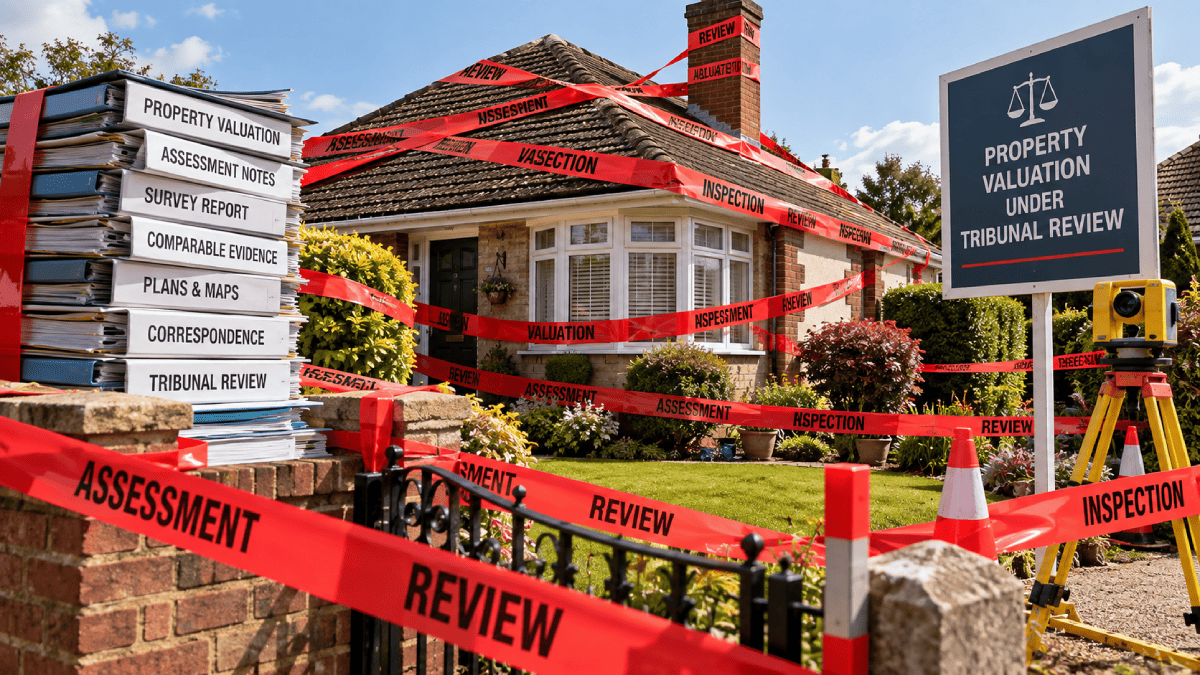
The nice people at HMRC are coming to England's larger houses with tape measures to ensure socialism is enforced. Officers will visit private homes to decide whether their owners owe the Treasury a new annual charge for continuing to own them. Ministers confirmed in written answers to Conservative MPs where the inspections come in: whenever a home's features can only be confirmed internally, or the building needs measuring again.
Officers will record floor area, architectural style, and the number of storeys, rooms, bedrooms, and bathrooms. Obstructing them is a criminal offence.
The Shadow Chancellor, Mel Stride, called the plan a "sinister assault on civil liberties". His colleague Mike Wood warned of "council tax police" entering family homes. The Telegraph correctly argues the tax turns the state into everyone's landlord and families into tenants in their own homes.
The government's defence was essentially a shrug.
The powers are old, visits will be arranged in advance, and a code of practice applies.
All true.
And not good enough.
The reassurance amounts to telling homeowners the inspectorate has existed for years and they were simply lucky enough never to meet it.
Let Them In Or You Commit A Crime
The power of entry sits in section 25A of the Local Government Finance Act 1992, inserted in October 2015 by SI 2015/982. It lets a listing officer, or anyone the officer authorises in writing, enter, survey, and value a dwelling. The secondary legislation imposes the tribunal quango into the original 1992 bill.
The MPs responsible were Eric Pickles, Kris Hopkins, Lord Ahmad, Baroness Williams, and civil servant Catherine Marsh of the Department for Communities and Local Government. Pickles's 2015 measure was sold as an anti-snooping reform. Lord Ahmad told Parliament that VOA officers should “no longer have an automatic power of entry” and would first have to persuade the First-tier Tribunal quango where consent had been denied.
These people are not heroes. They did not abolish the power. They simply entrenched this stupid quango in front of it to benefit the civil service.
The original 1991–92 Council Tax Bill was introduced by Michael Heseltine, John Major's Secretary of State for the Environment. The Commons Journal records the formal sponsors as Michael Heseltine, supported by Prime Minister John Major, Chancellor Norman Lamont, Tony Newton, David Hunt, Ian Lang, Michael Portillo, and Robert Key. They defended the powers of entry specifically and the Lords debated it strongly.
The valuation officer now needs the approval of the First-tier Tribunal and must give at least three clear days' written notice. A separate provision, section 27, lets the same officer demand information about a property by formal notice.
| Conduct | Provision | Penalty |
|---|---|---|
| Intentionally delaying or obstructing an officer exercising the power of entry | s.25A | £200 fine |
| Failing to answer an information notice within 21 days | s.27 | £500 fine |
| Knowingly or recklessly supplying false information | s.27 | £1,000 fine and up to three months' imprisonment |
Source: Local Government Finance Act 1992, as amended.
A £200 fine will not frighten anyone with a £3 million house. The size of the penalty misses the point. Parliament has already decided a private dwelling is something the state may enter, measure, and assess for tax, and refusing admission is a crime.
The mansion tax merely gives the power a reason to be used on a scale never seen before.
The Valuation Office Agency ceased to exist as a separate body in March 2026, and its staff moved into HMRC the next day. Whoever knocks will now work directly for the taxman.
Jonathan Russell, head of the VOA, told MPs in January his professionals would probably look at houses with an indicative price of £1.5 million to make sure none slipped through. Homes a quarter below the threshold are therefore in scope for scrutiny, if not yet for payment.
HMRC holds a second set of powers too. Under its information and inspection regime, an officer may enter a dwelling to value or measure it where the figure matters for inheritance tax, capital gains tax, or stamp duty.
The state can walk through your house to price it while you live there, and again after you die.
£2,500 A Year At Gunpoint
Rachel Reeves announced the High Value Council Tax Surcharge in her Budget in November 2025. She has since lost her job. Andy Burnham became Prime Minister in July 2026 and replaced her with John Healey, but the surcharge survived the cull.
| 2026 valuation | Annual surcharge |
|---|---|
| £2m to £2.5m | £2,500 |
| £2.5m to £3.5m | £3,500 |
| £3.5m to £5m | £5,000 |
| Over £5m | £7,500 |
Source: House of Commons Library.
- The charge falls on the owner, not the occupier, so it attaches to title rather than to use of local services.
- The amounts rise every year with CPI.
- Homes are revalued every five years, starting in 2033.
- And owners who cannot pay may defer the debt, which then accumulates against the property and is recovered when the house changes hands.
Ministers justify all this as "fairness."
The Treasury's written statement of 19th May 2026 complained a Band D home in parts of the North can pay more council tax than a London property worth many millions. A government spokesman later put the gap between a Blackpool Band D home and a £10 million Mayfair house at nearly £300 a year.
The anomaly is real.
Its cause is a council tax system still resting on prices from 1st April 1991, a date when Blur had yet to release an album.
Faced with valuations older than most first-time buyers, the government has chosen to revalue the top 1% of homes and leave the other 99% in the era of the Poll Tax riots.
The Treasury And Its Waste
A Freedom of Information request, reported in May 2026, forced the Treasury to disclose its own costings. They make grim reading for anyone who believes the surcharge is about money.
| Item | Amount | Period |
|---|---|---|
| Stamp duty lost as buyers retreat below £2m | £215m | November 2025 to April 2028 |
| Inheritance tax lost through lower prices | £65m | To 2030-31 |
| Identifying and valuing homes in scope | £150m | One-off, before launch |
| Gross surcharge receipts | £1.4bn | First three years |
| Net receipts after costs | About £930m | By 2031 |
Source: Estate Agent Today, Calculate My Stamp Duty, citing Treasury figures.
The Treasury admitted it had carried out no analysis of lost VAT or corporation tax.
Industry figures warned some 200,000 homes worth between £1.5 million and £2 million now face a strong reason to abandon extensions and renovations, since adding a bathroom could add a bill for life.
A tax sold as a way to raise money for local services will cost hundreds of millions in lost receipts and administration, discourage building work, and hand HMRC a filing cabinet of England's most expensive interiors.
Attlee Confiscated A Man's Right To Build
For centuries, owning land in England meant being free to build on it, within the law of nuisance and local by-laws. The Town and Country Planning Act 1947 ended this. From the appointed day, 1st July 1948, the right to develop land passed to the state. Owners needed permission from the local authority to build anything, and permission became a gift of government.
This was a disgrace then, and it's a disgrace now.
Attlee's ministers were candid about the purpose.
Lewis Silkin told the Commons during the second reading on 29th January 1947 the development value of land would be taken out of private ownership.
Any rise in a plot's price caused by planning permission was taxed at 100% through a development charge paid to a new Central Land Board. Councils could buy land compulsorily at its existing-use price, stripping out anything a buyer might have paid for its potential.
The development charge collapsed quickly.
Owners saw no reason to sell land when the state took every penny of the gain, and the Conservatives scrapped the charge within a few years.
The nationalisation of development rights, however, was never reversed.
Seventy-eight years later the Town and Country Planning Association, the planners' own lobby, told a Commons committee the disgusting position plainly: landowners do not own the right to develop their land.
The freehold survived 1947 as a legal title. The freedom to use it did not.
How Scarcity Became A Tax Base
Once a government controls whether houses may be built, it controls how many exist. Once it controls that, it controls their price. Seventy years of rationing produced exactly the result any economics student could predict.
| Indicator | Figure |
|---|---|
| Median house price to median earnings, England, 2025 | 7.6 times |
| Same ratio, London | 10.6 times |
| Same ratio, Kensington and Chelsea | 25.2 times |
| Major applications decided within the 13-week statutory period, January to March 2026 | 19% |
| Major residential decisions made, January to March 2026 | 1,033, the lowest on record |
| Net additional homes, England, 2024-25 | 208,600 |
| Progress towards 1.5 million homes, 9th July 2024 to 14th June 2026 | 392,400, or 26% |
Sources: ONS, MHCLG planning statistics, Mortgage Strategy, Full Fact.
The ONS reports a modest improvement in affordability since 2021, as wages outpaced prices. Its measure ignores mortgage costs, and Deloitte's economists point out higher interest rates have made buying dearer for most people regardless.
The planning figures tell their own story.
Councils decide fewer than one major application in five on time, and meet their deadlines on paper only by persuading developers to agree extensions.
Decisions on major housing schemes have fallen 44% in a decade.
- The state restricts the supply of homes, and scarcity pushes up their price.
- Higher prices make existing owners look rich on paper, and the Treasury then taxes the paper wealth its own rationing created.
- The revenue funds a state which employs more officials to administer the rationing and more valuers to measure the result.
A Kensington townhouse is not worth 25 times local earnings because its owner did anything clever. Its price reflects a planning system which has allowed almost nothing new to be built nearby for generations.
Poorer Owners Do Not Make Cheaper Homes
The government has confused making existing owners poorer with making housing cheaper for everyone else. A £2.5 million house charged £3,500 a year remains one house. The surcharge lays no bricks, grants no permissions, and releases no land. At best, a handful of owners may sell, which moves a house from one wealthy household to another.
The consultation document talks about funding local government and reducing inequalities in council tax. It contains nothing to help a 29-year-old nurse in Reading buy her first flat, because it was never designed to.
The only nod towards supply is a possible extra premium on non-resident owners, which the government hopes might ease pressure on housing availability. Even this assumes the problem lies with who owns existing homes, rather than with the scarcity of homes to own.
Young people have not been priced out by widows in Hampstead paying too little council tax.
They have been priced out because too few homes exist where the jobs are.
A government serious about their prospects would give back some of the right to build, which Attlee took in 1947.
Instead it has chosen the option costing it nothing politically: charging people who already own houses and hoping the young mistake resentment for a housing policy.
Five Bills for One Front Door
The surcharge is one charge among many. A valuable family home now meets the state at every stage of its life.
| Stage | Charge |
|---|---|
| Buying | Stamp duty at up to 12% on the portion above £1.5 million, plus a 5% surcharge on additional homes |
| Owning | Council tax on 1991 prices, plus the High Value Council Tax Surcharge from April 2028 |
| Altering | Planning permission, fees, and in many areas the Community Infrastructure Levy |
| Selling a second home | Capital gains tax at 18% or 24% |
| Dying | Inheritance tax at 40% above £325,000 |
The house is bought with income already taxed. It is maintained with income already taxed. After the owner dies, the estate is taxed again on the same bricks.
The inheritance tax rules contain a telling detail.
The residence nil-rate band, worth up to £175,000 when a home passes to children or grandchildren, shrinks by £1 for every £2 by which an estate exceeds £2 million. It vanishes entirely at £2.35 million. The surcharge begins at exactly £2 million.
Two separate taxes have settled on the same figure as the point where a family home stops being treated as a home and starts being treated as a fiscal resource.
Freehold Ownership On Licence From the State
English property law still speaks of freehold as the fullest form of ownership. The word describes something close to independence: land held from nobody, free of rent and free of any superior's claim.
The owner pays the state every year for keeping a freehold of a £2 million house. The state decides what it is worth and revisits the figure every five years. Its officers may, with a tribunal's blessing, enter and measure it, and obstructing them is a crime.
Unpaid council tax can lead to liability orders, bailiffs, and charging orders against the property. An owner who cannot pay the surcharge may defer it, with the debt secured against the house until it is sold or inherited.
A landlord collects periodic payments, inspects the premises, and recovers arrears from the property. The Treasury does not appear on the title deeds, and in law no Englishman rents his freehold from HMRC. In practice the arrangement is what the Telegraph notes it is. It bears every mark of a tenancy except the name.
European human rights law offers little comfort either.
Article 1 of Protocol No. 1 to the European Convention on Human Rights protects the peaceful enjoyment of possessions, then expressly preserves the power of states to secure the payment of taxes. Strasbourg gives governments a wide margin in tax matters.
The right to property, as currently understood, protects owners from confiscation in one stroke while permitting it by instalments.
An older tradition of English thought held the opposite. John Locke argued government exists to protect property, and a state which takes property without consent defeats its own purpose.
From this starting point, the size of the threshold is irrelevant. Nobody needs to decide whether a £2 million house makes its owner rich.
The objection is to the principle itself: once ownership becomes a standing reason for the state to send a bill, private property has become a licence renewed each year on payment of a fee.
These People Have No Right To Enter Property
Owners below £2 million may assume none of this concerns them. Good luck with that. They should look at the inheritance tax nil-rate band, fixed at £325,000 since April 2009 and frozen until at least April 2031.
A tax designed for the very rich now reaches ordinary homeowners in the South East, because house prices rose while the threshold stood still for 22 years.
The surcharge will follow the same path because this is how Leviathan constricts and suffocates its prey.
Its charges rise with inflation, and its revaluations every five years will catch any home whose price has climbed.
Whether the £2 million line ever moves depends on future chancellors, and they have a long record of finding frozen thresholds convenient. The inspection powers, the valuation machinery, and the enforcement regime will all be in place, paid for, and staffed.
Only the line needs to move.
Britain's housing shortage began when the state took the right to build. The remedy lies in handing it back. Measuring the bathrooms of people who already own houses will not build a single one.