The National Suicide Service Is Given Assisted Political Death
Sixteen votes spared Britain from turning its health service into a supplier of death. Canada shows how fast the rules move, the NHS inquiry reports show who would run the scheme, and no talk of dignity or choice gives the state a power it was never meant to have.

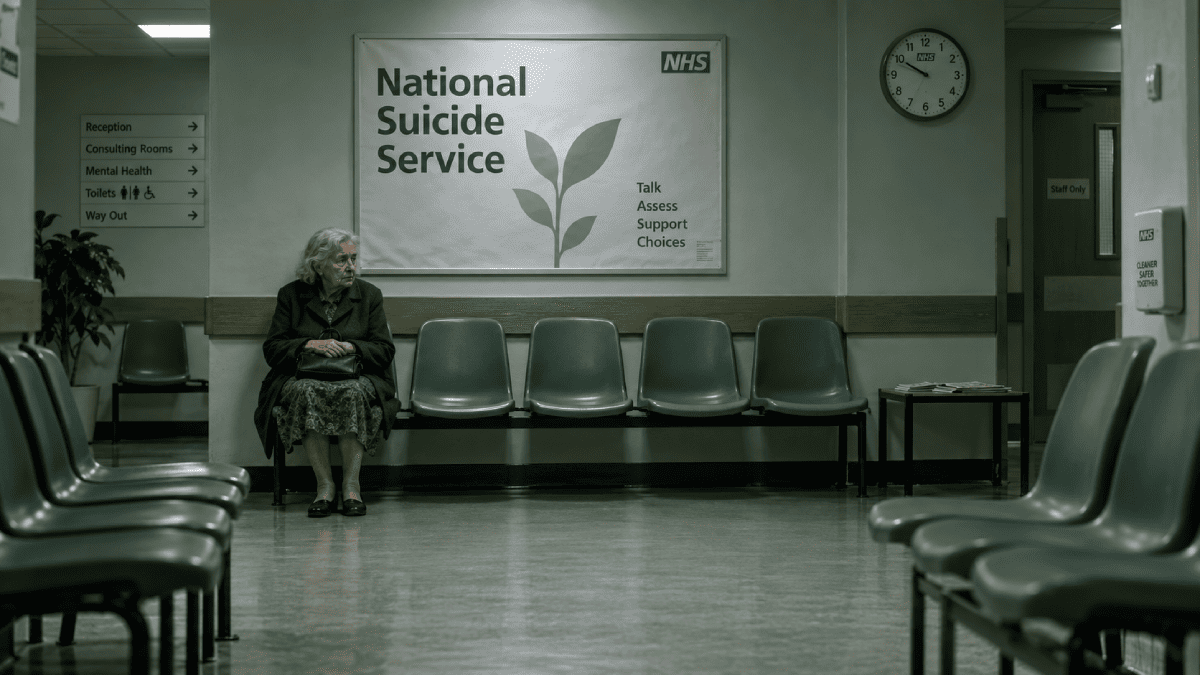
Last week the House of Commons rejected the reintroduced assisted dying bill at second reading by 286 votes to 270. Fifteen months earlier, the previous version had cleared the Commons by 314 votes to 291 at third reading before time ran out in the Lords. Another thoroughly bad idea has thankfully been seen off for a while and our country can breathe knowing we're not killing more people.
Opponents barely grew in number; their tally actually fell by five. Supporters lost 44. Labour's Janet Daby, a previous supporter, told the Commons her conscience would no longer let her back it, and she spoke for a good many colleagues who had waved the principle through in 2025 on the promise of safeguards. She spent a year looking at the safeguards and at the institution which would run them, and discovered pressing business elsewhere.
The campaign will return.
Its liberal Boomer backers treat every defeat of their ideological madness as a drafting error, and the next bill will arrive with a longer reflection period, a second panel, and perhaps a panel to supervise the panel.
None of it will touch the real objection, because the real objection has nothing to do with paperwork.
A correspondent to the Telegraph's letters page recently put the case against in simple terms:
SIR – Much is written on assisted dying, but I need just six words to explain why I oppose a change in the law: sanctity of life; slippery slope; coercion. I am yet to read any effective rebuttals that shake my view.
On the evidence of the division lobby, neither had 286 Members of Parliament.
None of them seem to have considered the actual argument: Parliament does not have authority to allow the government to provision death.
Aren't we all a little sick of Boomers and want they think they have a "right" to? Haven't they done enough now with what they claim they are "entitled" to?
New Names For Mercy Killing
The vocabulary has been through more rebrands than a failing building society. Euthanasia became mercy killing; mercy killing became physician-assisted suicide; suicide, with its awkward associations, was dropped for assisted dying, and assisted dying has since been softened again into "choice at the end of life".
Canada, never knowingly out-euphemised, settled on Medical Assistance in Dying, abbreviated to MAID, as though a lethal injection were a light dusting and a change of bed linen.
The House of Commons Library acknowledges there is no agreed terminology for killing the vulnerable and elderly.
- Supporters object to "suicide" because they regard a dying person's decision as a different category of act.
- Opponents object to "assisted dying" because it describes the patient's experience and omits the doctor's: the deliberate administration or supply of a substance intended to stop a heart.
Each term smuggles in a verdict, and the direction of travel has always been towards words which make the verdict harder to see.
Canada has taken the trick to its logical end.
Health Canada's latest annual report tells readers MAID is not a cause of death at all, since a cancer patient's certificate records the cancer, and warns against comparing MAID numbers with cause-of-death statistics.
A procedure designed to end a life is officially not the reason the life ended. Orwell would have asked for royalties.
Dignity Belongs To The Patient, Not To Dying
The most effective word in the campaign is "dignity" (i.e. dignity in dying, dying with dignity etc.). It is a myth. Death is not dignified.
Dying is frequently wretched. Bodies fail in humiliating ways. People become incontinent, confused, frightened, dependent, and disfigured. There is nothing picturesque about a man who can no longer wash himself or a woman who no longer recognises her daughter.
Yet this is precisely why dignity cannot mean composure.
If a person's dignity departs along with his continence, his memory, or his capacity to work, then dignity was never inherent in him. It was a performance bonus, payable while stocks last. Once dignity depends on capability, dependence itself becomes an indignity, and death arrives as the remedy.
The phrase "death with dignity" performs a quiet transfer. It moves dignity from the person to the manner of his exit, and in doing so implies the frail, the bedbound, and the demented have already lost something a syringe can restore.
The honest reply to a patient who fears dying without dignity is simple: your dignity is not something cancer can take from you. Good medicine protects the dignity of the dying person. It has no business promising a tasteful death as the alternative to an untidy life.
Canada has written the transfer into its official forms.
Practitioners record the "nature of suffering" behind each request, and loss of dignity appears in 63.5% of Track 1 cases and 73.9% of Track 2 cases.
The Canadian state now countersigns, thousands of times a year, the proposition a civilised medicine exists to deny.
Freedom to Refuse Creates No Duty For Poison
Campaigners speak of a "right to die" as though the phrase settled something. It settles nothing, because the word "right" is doing four jobs at once. A freedom and an entitlement are different creatures, as the Boomers have so categorically demonstrated since the swingin' sixties.
To say a competent adult is free to refuse chemotherapy means nobody may force treatment on him. To say he has a right to be helped to die means somebody else owes him a service.
A freedom restrains other people.
An entitlement recruits them.
The obvious question follows: who owes it? The GP? The pharmacist? The hospital trust? The taxpayer in Wolverhampton?
- Section 1 of the Suicide Act 1961 abolished the crime of suicide.
- Section 2 kept the crime of assisting it.
- When Diane Pretty argued the decriminalisation amounted to a right, the House of Lords in Pretty v DPP [2001] UKHL 61 rejected the idea:
Parliament had removed a punishment and created no entitlement.
Suicide moved from forbidden to unpunished. It never moved to something others must facilitate.
Strasbourg agrees.
In Pretty v United Kingdom, the European Court of Human Rights refused to read a right to die into Article 2, whose entire purpose is to protect life. In Haas v Switzerland, it declined to impose a duty on the Swiss to hand a man lethal barbiturates without a prescription.
In 2024, in Karsai v Hungary, it found no Convention right to physician-assisted death and drew a clear line between refusing treatment, which flows from consent, and being helped to die, which does not.
Anybody claiming human rights law requires Britain to legalise mercy killing is misinformed or hoping you are.
Doctors already give doses of morphine which may shorten life, the argument runs, so where is the difference?
The difference lies in the object of the act. Palliative medicine accepts a risk of earlier death in the course of relieving pain. Mercy killing makes death the goal and the measure of success.
One says: we will not prolong your life against your will. The other says: we will end it for you. The first leaves nature to take its course. The second overrides nature by design.
A Spoilt Boomer Generation Wants More
Not every pensioner demands mercy killing, and many of the most eloquent opponents are elderly themselves. But the campaign speaks in an accent the post-war generation will recognise, because it is their own.
It runs roughly as follows.
- I chose where to live.
- I chose my career, my marriage, my divorce, and my retirement.
- I was promised a pension protected by the triple lock, a house which tripled in value while I slept, and a health service free at the point of use.
- Therefore I shall choose the date and manner of my death, and the public services shall provide it.
This is autonomy as a consumer product: the final item in a lifetime of bespoke arrangements, delivered by the state, at the taxpayer's expense, on schedule.
The generation which once told the state to keep out of the bedroom now wants it in the hospice, holding the syringe.
Nobody proposes forcing treatment on the dying. You may refuse chemotherapy. You may write an advance decision. You may decline resuscitation. You may receive enough analgesia to make your last hours bearable, die at home, and have your family beside you.
What you may not do is convert a private wish into a public duty.
The existence of a welfare state does not turn every sincerely held desire into an NHS entitlement.
The cruelty of the consumer model lies in who pays for it. The confident, well-housed retiree who demands the option on his own terms is rarely the person it endangers. That would be the widow in a council flat with an overstretched carer and a son who visits less than he should who absorbs the new option as a question aimed at her.
Death Is Not A Treatment For Illness
Parliament is sovereign. It can legislate for almost anything, including a state mercy killing service which ends lives. The bill proposed exactly this. Clause 41 would have obliged the Secretary of State to establish voluntary assisted dying services in England, free at the point of access, and the Government's own ECHR memorandum contemplated delivery through the NHS.
In other words, Clause 41 would have established the National Mercy Killing Service.
Legal power was never the obstacle. Legitimate purpose is.
Section 1 of the National Health Service Act 2006 defines the health service around improving physical and mental health and the prevention, diagnosis, and treatment of illness. The NHS Constitution promises to keep patients as well as possible to the end of their lives.
There is a coherent line running through all of it: cure, then treatment, then relief, then comfort, then company at the bedside.
Mercy killing breaks the line.
Death joins the list of outcomes the system is authorised to produce, and a doctor may look at one patient with a single permissible aim, to help her live, and at the next with another, to help her stop.
Imagine every relative loving, every doctor conscientious, every signature genuine. Before legalisation, an elderly dependent patient who asks why everyone is still going to such trouble receives an implicit answer: because you are alive, and caring for the living is what we do.
After legalisation, a second answer exists: because you have not yet chosen the alternative. Nobody need say it aloud. The burden of justification drifts from a society which ought to explain its inadequate care to a patient who begins to wonder why she is still imposing on everybody.
The Government saw this coming and wrote it down.
Its own impact assessment conceded disabled people may face pressure from feeling a burden and from structural conditions such as neglect, poverty, and poor services, and noted poorer patients already wait longer and receive worse care.
A wealthy patient with a good hospice and a poor patient with an exhausted daughter can both pass a capacity test. Their choices are not remotely the same, and no criminal offence for coercion can reach a pressure exerted by circumstance rather than by a relative.
How Canada Became A Killing House
Canada is the case study supporters would rather avoid. The Supreme Court's Carter ruling in 2015 led to a 2016 law restricted to people whose natural death was "reasonably foreseeable."
In 2019 a Quebec court (predictably as the worst leftist haven within Christendom) in Truchon struck down the foreseeability requirement;
Ottawa declined to appeal.
Bill C-7 in 2021 duly created "Track 2" for people who might have years or decades to live. Eligibility for those whose sole condition is mental illness has been legislated, postponed twice, and is now due in March 2027.
Quebec has "progressed" on to advance requests.
Each widening was presented as a matter of fairness to those left out by the last one, which is exactly how a slope works.
| Year | Total MAID deaths | Track 2 (death not foreseeable) | Annual growth |
|---|---|---|---|
| 2019 | 5,461 | n/a | n/a |
| 2020 | 7,469 | 18 | 36.8% |
| 2021 | 10,066 | 224 | 34.8% |
| 2022 | 13,199 | 469 | 31.1% |
| 2023 | 15,427 | 625 | 16.9% |
| 2024 | 16,499 | 732 | 6.9% |
Source: Health Canada, Sixth Annual Report on Medical Assistance in Dying
MAID accounted for 5.1% of all Canadian deaths in 2024, and 76,475 people have died by it since legalisation.
Defenders point out, fairly, 95.6% of 2024 cases involved people whose death was reasonably foreseeable, and growth has slowed sharply. They also note loneliness was not recorded as the sole source of suffering in any 2024 case.
It describes a country in which one death in twenty is arranged by the health system, and where the debate has long since moved from whether doctors should end lives to which categories of sufferer qualify next.
Track 2 is where the reassurance runs out.
| Reported in 2024 | Track 1 | Track 2 |
|---|---|---|
| Loss of dignity cited as suffering | 63.5% | 73.9% |
| Perceived burden on family or carers | 48.4% | 50.3% |
| Isolation or loneliness | 21.9% | 44.7% |
| Self-identified as disabled | 31.6% | 61.5% |
| Had received palliative care | 76.4% | 23.2% |
Source: Health Canada, Sixth Annual Report on Medical Assistance in Dying
Among people who were not dying; nearly half cited isolation or loneliness; half cited being a burden; and six in ten "self-identified" as disabled.
These are no longer stories of agony in the final fortnight. They are stories of long illness, dependence, and solitude, resolved by the state at the patient's request.
In 2025 the UN Committee on the Rights of Persons with Disabilities urged Canada to repeal Track 2 and abandon the 2027 extension to mental illness. It condemned the scheme as resting on prejudiced assumptions about the worth of disabled lives, treating suffering as intrinsic to disability instead of a product of inequality.
It described MAID as relief offered by the state to people whom the state had already failed on healthcare and housing.
Ontario's own review team has found Track 2 cases draw practitioner feedback roughly four times as often as Track 1 cases.
Oversight gets harder precisely where the stakes get higher.
Britain's rejected bill was narrower than Canada's current law, and its supporters said so repeatedly.
Canada's 2016 law was narrower than Canada's current law too.
The first decision changes the grammar of every later one. Once intentional death counts as healthcare (cough, abortion), each subsequent argument becomes an eligibility dispute, and eligibility disputes are won by whoever tells the most sympathetic story.
The NHS Is Already A Disaster
The bill's protections depended on two doctors establishing capacity, voluntariness, a settled wish to die, and the absence of coercion, followed by a multidisciplinary panel. Every one of those judgements relies on an institution which listens to patients, recognises subtle warning signs, lets junior staff challenge seniors, and learns from its mistakes.
Recent evidence on the NHS in exactly those functions is not encouraging.
Four days after the Commons vote, the Thirlwall Inquiry reported serious failures at the Countess of Chester Hospital in handling and escalating concerns about Lucy Letby. Lady Justice Thirlwall found some deaths and further harm could have been prevented had concerns been acted on sooner; Letby was removed from clinical duties in July 2016, yet the police were not contacted until May 2017.
Ten months, to pick up a telephone.
- The Ockenden review of Shrewsbury and Telford examined nearly 1,500 families and found repeated failures to investigate, learn, and listen.
- The East Kent report identified avoidable harm and an institution deaf to challenge.
- The Care Quality Commission rated nearly half the maternity services it inspected as requiring improvement or inadequate.
NHS Resolution paid £1.3 billion in maternity negligence claims in 2024/25 alone and carried a provision for future liabilities of £60.3 billion. Maternity has accounted for only about 12% of claims by number but 62% by value, a pattern the National Audit Office has spent years warning about.
Many of these claims concern injury rather than death, and a claim is not a verdict. But the recurring faults behind them are not exotic surgical errors. They are failures to hear the patient, failures to escalate, hierarchies which silence dissent, and managers who protect the institution first.
Those are the precise faculties on which a mercy killing scheme would depend. The Royal College of Physicians, neutral on the principle, warned six-month prognoses are highly uncertain and poor end-of-life care could push patients towards death for fear their needs would go unmet.
A missed tumour can sometimes be caught at the next scan. A wrongly approved death has no next scan, no second opinion, and no apology the patient will ever hear.
Sanctity Of Life, Slippery Slope, Coercion
The perpetual trouble with left-wing thought isn't merely intellectual childishness. It is these people, who tout this endless "progress" towards the cliff edge fail to see what they are advocating for is entirely immoral.
Killing is worse than allowing someone to die uncomfortably in a hospice. Neither are good, but killing is worse. It is morally wrong to kill an innocent child in the womb. It is morally wrong to kill the innocent at any age, full stop.
The nature of progressives is utterly deranged. Test any of the same arguments for mercy killing against their opposition to the death penalty, and they resolve the opposite, automatically. Their moral decisionmaking is entirely incoherent unless it involves killing children, where it matches up. It is only killing of the guilty they take issue with. One wonders why that might be.
Sanctity of life is the principle: the state does not deliberately end innocent lives and call the killing a benefit to the person killed. Slippery slope is what Canada demonstrates once the principle is surrendered. Coercion is what happens when the new principle meets real families, real poverty, and a real health service with a real record.
Suppose the safeguards worked perfectly. The objection would stand untouched. A liberal state can tolerate an enormous range of private choices while refusing to become their instrument. It can respect a man's refusal of treatment, relieve his pain to the limit of medicine, and sit with him to the end.
What it cannot do, without becoming a different kind of state, is supply his death as a public service and enter the transaction in its accounts under healthcare.
The campaign's next bill will ask, as every previous one has, who ought to qualify.
Parliament should refuse to engage on those terms.
The prior matter was settled centuries before the NHS existed, and 286 MPs remembered it last week: death is not something a government owes its citizens, and a health service which forgets this has stopped being one.
Perhaps instead of killing the unborn and the elderly, we should try something else.
Like being a moral people again.